• A native of New York, Nick Krieger realized at the age of twenty-one that he’d been born on the wrong coast, a malady he corrected by transitioning to San Francisco. His writing has earned several travel-writing awards and has been published in multiple travel guides. He is the author of Nina Here Nor There: My Journey Beyond Gender. 

    Enter to win a copy of Nina Here Nor There or one of Beacon's other LGBT titles in our Pride Month Giveaway. For more information, visit beacon.org/queervoices.
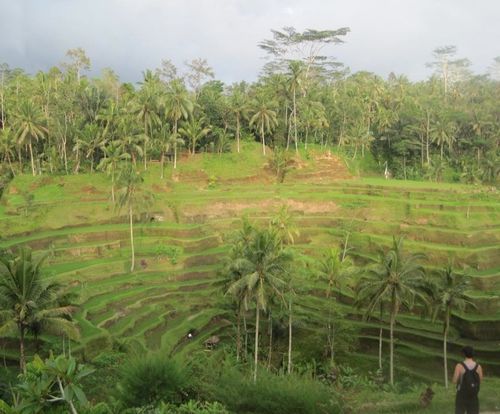
    Rice Fields in Bali, photo by Nick Krieger
    About five months ago, I quit my day job as a web writer, put my possessions in storage, and took off for Asia. I’d just finished promoting my memoir, Nina Here Nor There, exploring the land between man and woman. During the four years it took to complete the book, I also changed physically, growing comfortable in my body, now commonly perceived to be male.

    My great intention for this trip was to put my memoir down and leave my transition behind me, to clear some space for the next phase of my life. 

    I eased into Bali in luxury, at a closed yoga retreat with my teacher and a few friends from San Francisco. In heteronormative settings with swimming pools, I’m used to fielding questions about my chest scars. Sometimes I’ll tell people they’re shark bites. At first, at least. Then I’ll disclose the truth. “I’m transgender,” I always say, occasionally adding something explicit despite my discomfort, like “had breasts,” “born female,” just to be clear.

    I wrote a memoir, so perhaps it’s not surprising that I find outing myself powerful. The ensuing conversation is my opportunity to educate, dismantle stereotypes, and make my queer, gender-hybrid identity visible. As a speaker on trans issues, I’ve trained myself to handle unintentional insensitivity and ignorance, but even after a record-breaking number of questions, one particularly tactless person in Baliset me off.

    Internally fuming, I went to the edge of the jungle and hurled rocks into the black night. All the old words — disfigured, abnormal, glaring, different – came alive again. I threw wildly, venting my frustration and anger, until I accidentally pegged a nearby tree. The rock bounced back and almost nailed me. I started to laugh. Which made me laugh even harder, joggling something loose deeper inside.

    I wondered what it would be like to really leave it all behind, not just the story I’d crafted between two covers, nor the hormones, surgery, name change, family and workplace challenges, but the pain I still held on to and all that I’d built around it — the drama that defined who and what I was.

    Photo of Nepal by Nick KriegerAfter the retreat, I embarked on my own solo journey through Bali and then Nepal. I learned to say, “I had surgery, I’m totally fine, but I’d prefer not to talk about it.” Even with my shirt on, I faced challenging questions about my writing. I told people my memoir was about “alternative genders.” Of course, this was confusing. If pressed, I’d cop to my evasiveness, write down the title, and suggest they look it up later, like when we were in different countries. (I received a couple of kind emails later.)

    Without presenting myself as a queer person and writer, the most amazing thing happened. I made friends, lots of them, of all ages and nationalities. Underneath the tags I’d adhered to myself, and beyond the stories that had solidified like foundation, I rediscovered a sense of myself that existed outside of identities and narratives, expressed in my smile, my laughter, and the way I carried myself.

    The longer I spent on the road, the fewer and fewer people I told about being trans. I shrugged off comments about my “women’s fit” backpack, and my atypical traits for a man– my small size, youthful face, and robust hairline – all prior triggers for me to mention my past.

    During my last month, I outed myself to only one person, my new best friend, a Dutch woman I’d met during my stay at a Tibetan Buddhist monastery. After our course, we trekked for two weeks in the Himalayas, talking about everything in the way that you do when you eat, sleep, and walk side by side.

    “Could you ever live here?” she asked as we crossed a suspension bridge over a glacial river.

    “No,” I said without hesitation. Throughout my twenties, I’d traveled to dozens of countries, spent many months backpacking alone, always wondering if and when I’d arrive somewhere that could become home. Eventually, I started to believe that I’d never find in Nepal, in Bali, in Laos — in the places that I loved the most — something I’d always need, the freedom to be queer.

    “The things I care about,” I said, “The subjects I write about, the lifestyle I lead, sex and love, I can’t find that here.” I’m pretty sure my friend had no idea what I was talking about, but I continued, rambling about GLBTQ progress and trans/queer struggles, spurred on by the resurgence of a passion that had lain dormant for the past few months, “I cannot be my full self here.”

    Reminded of the split I used to feel between my traveler identity and my queer identity, I thought of a long train ride I once took from Amsterdam to Slovenia. Re-reading Michelle Tea’s “Valencia” cover to cover, I got lost in the sexually-charged dyke world of San Francisco. Toward the very end, I looked up to find myself surrounded by the mountains of Austria, an apple-strudel setting straight out of the “The Sound of Music.”

    I felt unmoored, disconnected from both my home culture in the States and the new landscape I was exploring in Europe. Both were flashing before my eyes, in the pages and out the window. Unable to situate myself, the whole notion of identity started to seem relative, something created in connection to my surroundings. On a train, my background in constant motion, for a brief moment, my sense of a solid self crumbled.

    I think that’s when I fell in love with traveling. Since that journey, I’ve disappeared from San Francisco for a few months every now and then, changing the backdrop and watching my own self-definitions fade just a little.

    ****

    By the time I returned from this trip, my queer/trans badge had fallen to the very bottom of my backpack. Culture shock, or reverse culture shock (always more my issue) refers to the disorientation that results from jumping across continents, and even after a month back, I’m experiencing it big time. Some days, I think it’s getting worse.

    Pride weekend just ended. It was my 13th Pride here, and over the past few years, it’s become an effort for me to engage in the festivities – the crowds, the boozing, the out-of-towners, the chaotic energy – I find it slightly painful.

    Instead of going to the Trans March, I attended my regular yoga class wearing my tacky rainbow wristband. In my heart, I was with my people in Dolores Park, united in pride – for surviving, for being, for fighting for rights and equality.

    I knew I was in the right place, there on my mat, even as the waves of guilt, and sadness, and fear passed through me. What if I blended in with the straight guy next to me who had no idea it was Pride weekend? What if I could no longer summon that hurt, angry boy chucking rocks into the night? What if my activism, my writing, and my passions change?

    From afar, I couldn’t see that in creating the space that I now have, the first thing to show itself would be uncertainty, and that to dwell here would require patience and faith. As I readjust ever so slowly, I try to keep the traveler in me alive – not in terms of revisiting trip highlights, but in the ways my sphere of caring expanded, my sensitivity to all sorts of people increased, and the world outside my own trans narrative got a little bigger.

    Photos courtesy of the author.  

  • TweetLandSCOTUS broke its recent mold,
    Handing down a nice uphold!
    Meanwhile back in Romney camp,
    Handkerchiefs & brows are damp.

    –Elinor Lipman @ElinorLipman

    Some commentary and insights about today's Supreme Court decision in NATIONAL FEDERATION OF INDEPENDENT BUSINESS v. SEBELIUS:

    Why The Obamacare Decision Is Very Good News For Women (Forbes)

    The Health Care Mandate is Clearly a Tax (Jack Balkin in the Atlantic this past May that explains the Court's finding)

    The Justice-by-Justice Obama Scorecard (New Yorker)

    Obama Wins the Battle, Roberts Wins the War (Tom Scocca in Slate on why he thinks Roberts used the opinion to gut the Commerce Clause)

    The Progressive President Speaks. About Damn Time. (Charlie Pierce in Esquire)

    U.S. Wakes Up in Alternate Reality Where Obamacare is Not Killed (From the fine folks at Indecision Forever)

  • This is the fourth episode in a series of interviews with Michael Bronski about the A Queer History of the United States, this year’s Lambda Literary Award winner for LGBT Nonfiction. The interviews were conducted by Richard Voos. 

    Enter to win a copy of A Queer History of the United States or one of Beacon’s other LGBT titles in our Pride Month Giveaway. For more information, visit beacon.org/queervoices.

    Listen to Queer History Episode 4-Bromances: “Sentiment” Then, “No Homo” Today

    “I don’t see how I can live any longer without having a friend near me, I mean a male friend. Yes, James, I must come; we will yoke together again; your little bed is just wide enough; we will practice at the same bar, and be as friendly a pair of single fellows as ever cracked a nut. We perhaps shall never be rich; no matter, we can supply our own personal necessities. By the time we are thirty, we shall put on the dress of old bachelors, a mourning suit, and having sown all our wild oats, with a round hat and a hickory staff, we will march on till the end of life, whistling as merry as robins, and I hope as innocent.” —Daniel Webster, letter to James Bingham, April 3, 1804

    My dear general—From those happy ties of friendship by which you were pleased to unite yourself with me, from the promises you so tenderly made me when we parted at Fishkill, gave me such expectations of hearing often from you, that complaints ought to be permitted to my affectionate heart. Not a line from you, my dear general, has yet arrived into my hands, and though several ships from America, several despatches from congress or the French minister, are safely brought to France, my ardent hopes of getting at length a letter from General Washington have ever been unhappily disappointed: I cannot in any way account for that bad luck, and when I remember that in those little separations where I was but some days from you, the most friendly letters, the most minute account of your circumstances, were kindly written to me, I am convinced you have not neglected and almost forgotten me for so long a time. I have, therefore, to complain of fortune, of some mistake or neglect in acquainting you that there was an opportunity, of anything; indeed, but what could injure the sense I have of your affection for me. Let me beseech you, my dear general, by that mutual, tender, and experienced friendship in which, I have put an immense portion of my happiness, to be very exact in inquiring for occasions, and never to miss those which may convey to me letters that I shall be so much pleased to receive.— Marquis de Lafayette to George Washington, 1799

    A man of deep and noble nature had seized me in this seclusion. . . . The soft ravishments of the man spun me round about in a web of dreams. . . . But already I feel that this Hawthorne has dropped germinous seeds into my soul. He expands and deepens down, the more I contemplate him; and further and further shoots his strong New England roots into the hot soil of my Southern soul. — Herman Melville, review of Nathaniel Hawthorne’s Mosses and the Old Manse, August 1850

    462px-Gilbert_du_Motier_Marquis_de_Lafayette
    If the Marquis de Lafayette were around today, he might have signed his letters to George Washington, “Love you bro. No Homo.”

    How do we understand this language, from one military hero to another, which sounds to the modern ear more like a lover’s whining than one general having missed contact with a fellow military leader? And the letter from Daniel Webster to James Bigham reminds me of the controversy about Abraham Lincoln that he shared bed with his law partner. Neither Lafayette, Washington, Webster, nor Lincoln was gay or homosexual. Those words didn’t exist in their lifetimes. Men slept in the same bed as other men–it was the practice. Yet the feeling in Lafayette’s letter and the strength of Webster’s attachment to Bingham are undeniable. Are these the “bromances” and “man dates” of the 19th century?

    I think that’s an excellent question. When we read these letters now– and I’ve actually taught these letters and these journal entries in my classes and students are quite perplexed and often try to come up with reasons why they are not love letters– I think it’s difficult to put these in context using anything in our contemporary society, because they have nothing to do with that. What I do think stands out with each of these, thinking particularly of the second Lafayette letter, is that they contain enormous amounts of sentiment. Sentiment as it was known in the late eighteenth century and into the nineteenth century is not as we might think of it today, as sloppy sentimentalism, but as a deep, sincere, honest, and, above all, ethical feeling for one’s fellow man, the emphasis on “man,” although it could be applied to human beings in general. And I’d like to make a distinction about the Washington/Lafayette correspondence as opposed to the Daniel Webster note–what we’re seeing here is men who are valuing one another not only as men– in all the complexity it might entail for the time– but actually as patriots. When we look at Washington and Lafayette and we know the history, these are two men who just fought the American Revolution. Lafayette’s gone back to France to fight the French Revolution. They are actually putting the Enlightenment ideals of equality, fraternity, and democracy above all else. So that’s the context we have to view these in. I’m not arguing that they may not have had a sexual affair– we have no evidence that they did, nor do we have any evidence that they did not. Certainly the intensity here of emotion and of sheer emotional investment in one another is very, very clear.

    It’s interesting, Michael, that the expression of that kind of sentiment and emotion today between two men–pick two generals, General Schwarzkopf and Colin Powell–would be completely unheard of and impossible to imagine. What happened in the intervening almost two hundred years?

    I think what’s happened is that we’ve lost the notion of sentiment between men, of honest, real, deep emotional feeling that can be expressed. Certainly, men today can feel deeply for one another, can work together. We hear wonderful stories in horrible situations of soldiers and their intense relationships in war time in Iraq or in Afghanistan. But the expression of these is completely different now. Certainly if General Schwarzkopf wrote a letter like this to General Powell–probably on email or texting him because he would not have time to write the entire letter out by hand–he’d have to add what the younger people these days say at the end of the letter: “No Homo.” Clearly, he would not write this letter to begin with. I think what we’ve lost here is the ability of men to actually express their feelings, and maybe their feelings for women as well, but certainly for one another as men.

    When we read the Herman Melville quote–and there are certainly others that would be very similar–it’s impossible to come to the “No Homo” conclusion. The reading from Melville is really a different matter altogether from the Lafayette and Webster letters. He clearly formed a strong sexual attraction to his neighbor, Hawthorne. And in A Queer History of the United States, you put this in context with a number of homoerotic sentiments expressed in literature and letters by Ralph Waldo Emerson, by Thoreau, by Emily Dickinson, by Margaret Fuller. Some of those sentiments, and certainly Melville’s, expressed far more than romantic friendship. And in Melville’s work, the homoerotic is a clear theme, and the relationships, like Ishmael and Queequeg in Moby Dick, almost always cross racial lines. Talk to us about the interaction and intersection of the racial and the homoerotic, starting with Melville, but as a theme in A Queer History.

    I think one thing to keep in mind here is that when we’re looking at this notion of sentiment, it really is in the context of the Enlightenment and in the concept of equality between men and ostensibly among women as well, although that doesn’t play out as well until later on when we come into the suffrage movement. But I think that when we’re looking at some of the writings by Herman Melville, say, in Moby Dick, or Charles Warren Stoddard in his South Sea Idyls, we’re looking at two things. First, we’re looking at this early bromance, this early version of the buddy movie between a white man and, as Leslie Fiedler puts it, a “colored” man. But we’re looking at this, because it is the Enlightenment and we’re looking at equality among men, as a form of racial justice. Keep in mind that at this time the races are completely separated, we have slavery, we have essentially a system of white supremacy across the world. And yet these men, in this case Herman Melville and Charles Warren Stoddard, are able to imagine relationships– possibly sexual, certainly love relationships, and certainly intimate relationships– between white men and men of different races. So when we’re looking at these, I think it’s important to focus on the sexual aspects, of course, but also on the aspect that this is the roots of what I would think of as being a movement, or an imagining, of coexistence between the races, which would bring us to a new level of equality that we had never even imagined before. 

    In a future podcast, we’re definitely going to talk about the contrast between social purity, persecuting society and social control movements and of movements for racial liberation and sexual liberation. I think that you describe in some detail and very clearly the relationship between the racial and the sexual in that contrast of movements.

    What I find fascinating is that when we look at the history of race struggles, the struggle for racial equality within American culture, one of the earliest places that we can find it is in these homoerotic writings of Melville and of Stoddard. So in some ways, there’s a very deep connection between sexual liberation, sexual equality, sexual desire, and the desire for equality among men.

  • Jeremy Adam Smith is Web Editor of the Greater Good Science Center and author or coeditor of four books: Are We Born Racist?, The Daddy Shift, Rad Dad, and The Compassionate Instinct. This post originally appeared at Greater Good.

    1157Last week, Stephen Marche published a thought-provoking piece in the New York Times entitled, "How to Read Racist Books to Your Kids."

    I empathized with the issues he faced—I’ve also felt ambushed by racist imagery when reading classic children’s boReadoks to my multiracial child—and I was sympathetic to his viewpoint.

    But ultimately, Marche just seems flummoxed by the problem. “How am I supposed to explain to a child the superimposition of cultural generalizations onto toy cars and monsters and space aliens?” he writes. “I can barely explain it myself.”

    Neither can I, really. But I think Marche is much too quick to dodge tough questions about kids and race. His bottom-line answer seems to the question in the title is, “Don’t—don’t read racist books to your kids”—and if you do, to excise racist language and imagery. I saw this response echoed by followers on Twitter when I shared his piece.

    The trouble with this answer is that it assumes books are either racist or they are not—and if they are, the solution is to simply ignore them. But as a parent and as a journalist who covers scientific research into the roots of prejudice, I don’t believe that’s the best plan, in reading or in life.

    Some books, like The Story of Little Black Sambo, are obviously too explicitly racist to bother reading, but since those are often out of print and off library shelves, they are the red herrings of this debate. Because the truth is that there are many very good children’s books which are, like people, often a mix of the bad and the good.

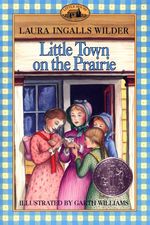
    Book.littlehouselittletownTake the Little House series, for example—wonderful stories that my wife and I have read aloud to our son since he was five. A woman born in the 19th century and raised on the American frontier, Laura Ingalls Wilder, wrote these books. They are the product of a time and a place, and we are reading them across a span of time that makes the stories strange to us.

    Thus there are portrayals of African and Native Americans that seem stereotypical; many of the characters in the books are casually, bluntly white supremacist in their attitudes. In one passage in Little Town on the Prairie, for example, Laura’s father—a good man—participates in a minstrel show with grotesque racial caricatures, and Laura refers to the performers as “darkies.”

    At the same time, however, there are elements in these stories that confound our own stereotypes of the time—characters like the African-American doctor, based on the real-life George Tann, who saves Laura, her family, and her neighbors from malaria in 1870. A black doctor treating whites in 1870? Who is, indeed, the only doctor—and likely the most educated man—in the region? In the narrative, Laura notes his race but doesn’t dwell on it. Tann is less strange or unexpected to her than he might be to us. This is part of the value of reading old, classic stories—discovering how people of past times lived and saw the world, and taking the good with the bad.

    But even granting that reality, the question remains: How do we help our children navigate obsolete racial attitudes and stereotypes that will, if internalized, hurt their ability to navigate multiracial 21st-century America—and even hurt them, if they are kids of color? Here are three tips, largely distilled from the Greater Good anthology I co-edited called Are We Born Racist? New Insights from Neuroscience and Positive Psychology. Each one arises from scientific research, but I’ve put them to the test in my parenting, messy and imperfect as that is.

    1. Openly discuss the existence of race and racism.

    Colorblindness doesn’t work. We know this because many, many neuroscientific studies show that race is one of the first things we perceive about a person, and that encountering people of different races can produce a spike of anxiety. Children don’t pretend to not see differences in skin color, eye shape, and hair texture. When adults do that, we only confuse them.

    Fortunately, psychological studies also find that perceiving difference does not necessarily lead to racism. Done right, it can actually lead to many good outcomes, including increased emotional, cognitive, and social sophistication.

    Prolonged exposure to people of different races helps reduce anxiety—this is the famed “contact hypothesis,” and the reason why it’s very good to raise children in multiracial environments. But it might be even more important to openly identify and discuss feelings about people who are different from us, to make ourselves conscious of kneejerk responses so that our conscious brains can take over and regulate unconscious bias. Children can be trained to do this from a very early age—teaching impulse control is, in fact, fundamental to childrearing. This is just one more example of that.

    How is that insight operationalized in my parenting?

    PBlgLong before our son was exposed to ambiguous racial imagery in books like the Little House series, we read him children’s books about black, Asian, Native American, and Latino history, especially ones that show how non-White peoples were treated at different times in American history. These include Ruthanne Lum McCunn’s trilingual Pie-Biter [Editor's Note: McCunn is also the author of A Thousand Pieces of Gold, which was published by Beacon Press], Diana Cohn’s ¡Si, Se Puede! / Yes, We Can!, Richard Michelson’s Across the Alley, and Mary Pope Osborne’s Magic Tree House series, which does a pretty good job of dealing with race and racism in historical context. Each of these books reveals, to some degree, the realities of racism, while also giving children heroes—people throughout history who have struggled against prejudice.

    This, I hope, is the framework my mixed-race son brings to encounters with yellow menace imagery in the old comic books that I love reading to him. And when we encounter a “slant-eyed, Oriental mastermind” (to quote one old comic of mine), I stop, close the book, and tell him that image is a product of prejudice, and that I think prejudice is wrong. I try to answer any questions he has. Then I re-open the book… and keep reading.

    2. Emphasize our capacity to grow and change.

    Speaking of comic books: Ever hear of the superhero team Thunderbolts? They’re a group of Marvel supervillains who are trying to reform themselves and put their powers to use in saving the world. I love the Thunderbolts—as well as other morally complex comic characters like Wolverine, Catwoman, Silver Sable, and more—because they reveal an essential human truth: few of us are pure good or pure evil. “Good” people can do bad things, and “bad” people can do good things—and perhaps become a force for good in the world, no matter what bad they did in the past.

    That message is completely consistent with neuroscience. This is a message readers hear again and again in our anthology Are We Born Racist?: “Research consistently shows that we can override our automatic associations through our behavior, and can even unlearn our automatic associations with enough practice,” writes co-editor Rodolfo Mendoza-Denton. “Thus we’re not simply either egalitarian or prejudiced; egalitarianism is a learned skill.”

    This is a message kids need to hear—not just when it comes to countering prejudice, but in all areas of life. Psychology calls it the “growth mindset,” and its message is simple: You will grow and you will get better with practice—and so will other people. When we encounter Oriental masterminds in the comics of yesteryear, I emphasize to my son that what was OK then is not OK now. I often connect this process of change to the political activism we’ve read about in other books, like Freedom on the Menu: The Greensboro Sit-Ins.

    These moments are also excellent opportunities to develop empathic skills, which both scientific studies and common sense say can help reduce bias. We can, for example, ask how it might make black people feel, to be told they couldn’t eat or drink in certain places, just because they were black—or to see the minstrel shows like the one in Little Town on the Prairie.

    3. Foster the egalitarian impulse.

    In his essay, “Political Primates,” the anthropologist Christopher Boehm argues that the human drive for equality has deep evolutionary roots and is, in fact, the norm for most of primate history. This is a finding echoed in neuroscience, which finds egalitarian impulses co-existing with fear and prejudice.

    “To understand prejudice and the brain,” writes psychologist David Amodio, “one must take the brain (and the mind) for what it really is: a survival machine.” It’s designed to search for threats, which could come from people outside the tribe. But it also evolved to negotiate complex social interactions and to override automatic impulses. “The brain cannot be anti-racist, per se, because it never stops spotting differences and sorting people into categories,” writes Amodio. “But it is pro-goal—and if the goal is to make judgments without regard to race, the brain can do that, though it may take a bit of effort and practice.”

    The point is that we should encourage children to adopt fairness as a goal, and to not reject people just because they look different—and reading a children’s book with racist imagery and ideas provides an excellent opportunity to reiterate the importance of that goal. And in this, we are again helped by evolution. As we report every week here at Greater Good, many, many studies have suggested that human beings are wired for altruism, compassion, and empathy. Group identification can limit those qualities and prevent us from extending them to people outside the tribe, but that’s no reason to throw up our hands in defeat. The challenge—and the opportunity—is to provide our kids with the messages and the social environments that elicit their natural impulses for fairness.

    Even if human nature is not quite the ally I hope it is, the basic point stands: We have to ask our children to adopt fairness to all people as a goal, and to call out unfairness when we encounter it in one of their books, movies… or inside ourselves. Research says the more explicit we are with children about that struggle, the better. We’ll overcome racism by talking about it, not ignoring it.

  • Today's post comes from educator David Chura, author of I Don’t Wish Nobody to Have a Life Like Mine: Tales of Kids in Adult Lockup. He has worked with at-risk teenagers for the past 40 years. For 26 of those years, he taught English and creative writing in community based alternative schools and in a county penitentiary. His writings have appeared in the New York Times as well as other scholarly and literary journals. He blogs at kidsinthesystem.wordpress.com/. 

    ChuraI didn’t expect my talk to a class of criminal justice majors at a local community college to be any different from the other workshops, presentations and classes I’d done. The students had read my book for class. I figured I’d talk about the book, about my 10 years teaching high school kids locked up in an adult county jail, and about juvenile justice issues in general. The usual topics. But when I asked the students to go around and say what area of criminal justice they wanted to pursue, I knew this would be a different kind of talk.

    Most wanted to be police or correctional officers; a few mentioned probation. I wasn’t surprised then, when several students commented and questioned me on what they felt was my negative portrayal of the prison system and the people who work in it.

    Anyone who has been in corrections probably wouldn’t deny the things that I wrote about: how “the system” is toxic both physically—the overcrowding, the noise, the smell, the potential for violence, and morally—the lack of respect, the constant suspicion, the need to be “tough.” Most correctional people would agree that these conditions have a harmful impact on their professional performance and their personal lives. Over my years in lockup, more than one CO ruefully commented to me, “Sometimes I feel like I’m the one doing time.” What they didn’t like was that I said these things publicity:  I was the worst kind of jail scum—a rat.

    However, there was a subtext to what I wrote that I suspected the students (and other correctional professionals) might have missed. As I explained in my book, and to the students that day, jail is defined by a hierarchy of power. Who’s got it, who wants it, and what they’ll do to get it. It is a culture based on “us” and “them.” I wrote about how, when I first came to teach at the jail, I had my own version of this hierarchy: the “bad guys” were the correctional staff, the ones with the keys, and the “good guys” were the inmates, the ones who were oppressed, locked up. A pivotal element in my personal prison journey was to recognize how I had been taken in like everyone else by this hierarchy.  Realizing that, I worked to shake off my stereotypes, meeting each person—inmate and staff alike—as an individual no matter where they fit into the pecking order.

    I hit pay dirt. Stereotyping was a concept the students had studied in class, and given their future careers, it was an essential one to understand. As I talked about my evolution their own concerns slowly came out about how quickly their stereotypes of inmates kicked in, seeing them all as thugs, predators, as “bad,” getting what they deserved.

    And then their worries started to come out. If you go beyond the media stereotypes of criminals then what are you left with? How do you keep your humanity, your openness, yet not get taken advantage of by inmates, eaten up by “the system.”

    “What I want to know is how you didn’t get discouraged by the whole thing and just quit?” Jake was sitting in the front row, baggy shorts, sneakers, and backwards ball cap. With his book opened, eager and interested, he’d been asking tough questions. I should’ve known that he’d get to the heart of the matter. “I mean, what with inmate recidivism and the conditions in the prison, what about hope?” 

    I’m not sure the students bought the “long view” I presented. I wouldn’t have at their age. It sounded too simplistic, downright hokey. But I gave it anyway. Although I saw young kids return to jail time after time, and watched officers and inmates bowed by prison’s oppressive conditions, I never gave up hope because I had a bone-deep belief that no effort to be fair, to be respectful, to be decent in the face of all “the system’s” negativity would be wasted. Early in my jail time I made the decision not to tally my efforts with the results. I’d let others keep score. I just held fast to the belief that small change would happen sometime, somewhere, and that that’s all it takes to turn things around.

    At the end of class I’m pretty sure I left the students with more questions than answers. It’s not something I like to do. Maybe it’s a teacher thing. I know Jake wasn’t satisfied. He told me so, quite respectfully, when he came up to have me sign his book.

    But looking back at that morning I feel now that Jake’s “What about hope?” was a good question for the class to carry into their challenging futures as correctional professionals—and as people. Too many of us forget, in our professional and personal lives, that there will always be more questions than answers in whatever we do. Maybe the only way to keep hope alive in our jobs and our lives is to keep asking those tough questions and hope we don’t come up with answers.

  • It's Pride Month and World Humanist Day, so what better time to run this post? Chris Stedman is the Interfaith and Community Service Fellow for the Humanist Chaplaincy at Harvard University and the Managing Director of State of Formation, a new initiative at the Journal of Inter-Religious Dialogue. He is the founder and author of the blog NonProphet Status, and his book, Faitheist: How an Atheist Found Common Ground With the Religious, will be published by Beacon Press in Fall 2012. 

    A version of this essay (which was originally published at Huffington Post) will appear in Atheist Voices of Minnesota, out this August from Freethought House. 

    For more information about our LGBT Titles, visit Beacon.org/queervoices.

    Faitheist-borderRecently, while talking to my mom, I used the word "queer" to describe myself. Though it wasn't the first time she had heard me use it, she paused.

    "I don't really like that word," she said. "'Queer.' When I was younger, it was a slur."

    "Well, when I was younger, 'gay' was an insult," I replied. "So I've had to reclaim that — why not 'queer,' too?"

    She nodded, unconvinced, and I reminded her that other aspects of who I am and what I do are commonly used in a derogatory way. "'Atheist' isn't exactly free of negative connotations," I said. "And ask some of the Muslims I work with about some of the flack they get."

    "I get it," she said, "I do. But I just can't shake the negative associations I have with that word."

    My mom is perhaps a bit more protective of me than she'd like to admit — especially when it comes to my sexual orientation and how others treat me because of it. She was the reason I came out: when I was a freshman in high school, she found a journal I kept detailing my struggles over being gay and a "born-again" Christian. Unable to accept myself as gay, I was contemplating suicide, but my mother pointed me in the direction of resources that helped me embrace my sexual orientation. She's always encouraged me to chart my own course and be self-reliant, but she's also been a tireless advocate every step of the way.

    My mom has always modeled tolerance and acceptance. In 1986 — the year before I was born — she didn't think anything of it when she went to her mother's for dinner and was greeted by three HIV-positive gay men. At that time, HIV/AIDS was incredibly taboo — especially in Minnesota — but my mother was raised in a home that welcomed those whom mainstream society rejected. This attitude of openness was instilled in her at a young age, and my siblings and I were raised to wear gender-neutral clothing, to play with non-gendered toys, and to think of ourselves as unrestrained by societal norms. My mother gave dolls to all three of her boys so that we might learn to be nurturing and caring; my younger brother Colton, who would go on to play football and head up his college's rugby fraternity, loved his doll more than any of us did, making blankets for it and taking it with him everywhere.

    During my teen years as a "born-again" Christian, these values were eclipsed as I embraced my church's message that LGBTQ (lesbian, gay, bisexual, transgender and queer) people were inferior — that their lives were not a part of God's plan. But after my mom helped me come to accept myself, I was introduced to a different community of Christians, which welcomed, included and celebrated LGBTQ people.

    Now, 10 years after my mom first helped me come to accept myself, I work as an atheist and interfaith activist. (If that seems like a bit of a jump, it is — unfortunately, I can't fit my entire journey into this piece, which is why I'm working on a memoir.) I am frequently asked how my atheism and my interfaith activism align, just as often as I am asked why I call myself queer and gay instead of just gay.

    While I can understand such questions, I believe that there is a value in identifying as queer in the same way that I believe in the importance of interfaith engagement. I call myself queer for the same reason that I split my work at the Humanist Chaplaincy at Harvard between building up and supporting a community for the nonreligious and promoting interfaith engagement — because I believe in constructing solidarity among diverse people around shared experiences and shared values.

    One of the reasons I most love doing interfaith work is that it encourages me to be in conversation with religious people about some of the challenges that atheists and queer people face. For example, I have had deeply transformative experiences being in dialogue with the Muslim community (for more on this, check out a piece I wrote on LGBTQ-Muslim dialogue). Just as I've been able to share my experiences as a queer atheist with people from many different faith communities and encourage them to challenge their beliefs about atheists and queer people, I've been fortunate in return to learn a lot about the lives of people who believe radically different things about the world than I do. By coming together as large, diverse groups of people to engage in dialogue and common work, we are able to educate one another and, in turn, advocate for one another.

    The importance of positive relationships in effecting social change cannot be overemphasized. In 2010, a Gallup poll demonstrated that people are significantly more inclined to oppose same-sex marriage if they do not know anyone who is gay. Around that same time, a Time Magazine cover story revealed that only 37 percent of Americans even know a Muslim American, and a Pew survey reported that 55 percent of Americans know "not very much" or "nothing at all" about Islam. As Robert Wright wrote in The New York Times, the LGBTQ community has learned that engaged relationships change people's hearts and minds, and this is a model that the interfaith movement utilizes in its aim to counter the negative and often combative relationships that exist between people of different (or no) religions. Engaged diversity humanizes those we see as vastly different from ourselves; through positive and productive relationships across lines of identity, we learn that another has value, worth and the right to dignity.

    I engage in interfaith work because I see my dignity and my identity as an atheist and a queer person — my happiness, my well-being and my freedom — as bound up in the identities of others, and their abilities to be happy and live freely. Similarly, I identify as queer because I believe that those of us who are not heterosexual, those of us who do not fit into traditional conceptions of gender expression — and even those who do — share common concerns, common joys and common challenges, and that we can better address those concerns, joys and challenges when we are engaged with one another.

    I credit the accepting upbringing my mom provided, and the struggles I experienced around being queer, with setting the course for the work I do now. Being a member of a marginalized community helps me empathize with experiences and worldviews that are different from my own, and I believe that this has made me more compassionate. At one point in my life, being gay might have contributed to the bitterness I had toward religion and the religious, but now it informs my desire to be deeply and personally invested in active religious pluralism, or the idea that we all — religious or not, LGBTQ or straight — need to work to understand one another better.

    The only way we'll be able to break down the walls that keep us apart — the stereotypes and assumptions that exist about atheists, LGBTQ people and various religious communities — is by finding avenues to discover common ground. I believe that interfaith and queer work are two of the best ways to do so.

  • This is the third in an eight-part series of interviews with Michael Bronski about the A Queer History of the United States, this year's Lambda Literary Award winner for LGBT Nonfiction. The interviews were conducted by Richard Voos. 

    Enter to win a copy of A Queer History of the United States or one of Beacon's other LGBT titles in our Pride Month Giveaway. For more information, visit beacon.org/queervoices.

    Listen to Queer History Episode 3-The American Man: From Ichabod Crane to Jackie Chan

    In this by-place of nature there abode, in a remote period of American history, that is to say, some thirty years since, a worthy wight of the name of Ichabod Crane, who sojourned, or, as he expressed it, “tarried,” in Sleepy Hollow, for the purpose of instructing the children of the vicinity… He was tall, but exceedingly lank, with narrow shoulders, long arms and legs, hands that dangled a mile out of his sleeves, feet that might have served for shovels, and his whole frame most loosely hung together. 

    […]

    The schoolmaster is generally a man of some importance in the female circle of a rural neighborhood; being considered a kind of idle, gentlemanlike personage, of vastly superior taste and accomplishments to the rough country swains, and, indeed, inferior in learning only to the parson… Our man of letters, therefore, was peculiarly happy in the smiles of all the country damsels. How he would figure among them in the churchyard, between services on Sundays; gathering grapes for them from the wild vines that overran the surrounding trees; reciting for their amusement all the epitaphs on the tombstones; or sauntering, with a whole bevy of them, along the banks of the adjacent millpond; while the more bashful country bumpkins hung sheepishly back, envying his superior elegance and address. 

    From his half-itinerant life, also, he was a kind of traveling gazette, carrying the whole budget of local gossip from house to house, so that his appearance was always greeted with satisfaction.

    […]

    Among these [country swains], the most formidable was a burly, roaring, roystering blade, of the name of Abraham, or, according to the Dutch abbreviation, Brom Van Brunt, the hero of the country round which rang with his feats of strength and hardihood. He was broad-shouldered and double-jointed, with short curly black hair, and a bluff but not unpleasant countenance, having a mingled air of fun and arrogance. From his Herculean frame and great powers of limb he had received the nickname of BROM BONES, by which he was universally known. He was famed for great knowledge and skill in horsemanship, being as dexterous on horseback as a Tartar… He was always ready for either a fight or a frolic; but had more mischief than ill-will in his composition; and with all his overbearing roughness, there was a strong dash of waggish good humor at bottom. He had three or four boon companions, who regarded him as their model, and at the head of whom he scoured the country, attending every scene of feud or merriment for miles round… Sometimes his crew would be heard dashing along past the farmhouses at midnight, with whoop and halloo, like a troop of Don Cossacks; and the old dames, startled out of their sleep, would listen for a moment till the hurry-scurry had clattered by, and then exclaim, "Ay, there goes Brom Bones and his gang!" The neighbors looked upon him with a mixture of awe, admiration, and good-will; and, when any madcap prank or rustic brawl occurred in the vicinity, always shook their heads, and warranted Brom Bones was at the bottom of it.

    The Legend of Sleepy Hollow, Washington Irving, 1820.

    Illustration from Legend of Sleepy Hollow
    America's definition of itself has been tightly connected to our definition of manliness and masculinity. There's a contrast between the British fop and the self-reliant Colonial; the educated and rather girly Ichabod Crane, as we've just heard read, and the manly Brom Bones; the Eastern intellectual and the cowboy; finally, from the invert and homosexual to a new heterosexual man at the start of the 21st century. Would you take these in turn, starting with the earliest definition of the American Man? How and where does that definition come into being?

    The American Man has a very odd history, the remnants of which are still with us today, maybe even magnified in some ways. Certainly, we see the first American Man as a reaction to the English fop, as we see in the Washington Irving story. But even before the Washington Irving story, which was written in the 1820s, we see the American Colonialist really fighting against the notion of the effeminate Englishman, an odd notion since in fact George Washington, Thomas Jefferson, and those other people all wore powdered wigs, had large libraries, and were actually rather dandified. One of the first American plays ever written is called The Contrast by Royall Tyler. It features two main characters: the effeminized English sympathizer– also an American– named Billy Dimple; and his opponent in love– they're both after the same girl– whose name is Colonel Manly. So from the very beginning, we see this dichotomy, and we see it play out again and again. 

    I think the Brom Bones/Ichabod Crane story is simply one early aspect of this, but one which is really formative for American culture, even now, since most school children have to read this story which is at heart a story about a queer bashing. 

    Say some more–remind us of how this story ends.

    In the story, which I'm sure most people know, Ichabod Crane is the effeminized school teacher who comes into this small town, who teaches children but hangs out with the women, who does knitting with them, who is part of the women's sewing circle. His opponent is Brom Bones, who is a bully. At the height of the story, relying on the legend of Sleepy Hollow, which is that the headless horseman rides at night, Ichabod Crane is very fearfully riding home one night with this legend in mind. Suddenly, from across the bridge and chasing him is, indeed the headless horseman, who we know is actually– probably— Brom Bones with a lighted pumpkin on his shoulder. Ichabod Crane runs off– is bullied– out of town, essentially, and never is seen again. Presumably, he's moved, although there's always the possibility that he's actually dead. What I think is most interesting, and most people don't realize this about the story now, although certainly it would have been true back in Washington Irving's time, is that the first line in the story says that the action takes place next to "Major Andre's tree." This is a reference to the tree upon which Major Andre, the man who worked with Benedict Arnold against the American forces, was hanged for treason. Now, people would have realized this in 1820, not now, but Major Andre was generally thought to be a homosexual or certainly a man who was in love with other men. So, even Washington Irving back in 1820 was quite aware of the homosexual subtext for the story.

    So there's a link right in 1820 between the girly-man and betrayal, betrayal of your country.

    Completely. And I think what's interesting is that we see this played out again and again and again, in increasingly more complicated ways, when we come to World War II, but certainly as far back as 1820 and even before that we see this dichotomy between men who are learned, men who teach, men who like women versus who want to have sex with women, men who work with children, and the more "manly" American man.

    And that's reflected in the legends around Daniel Boone and Davy Crockett and in James Fenimore Cooper's Leatherstocking Tales as well.

    Shortly after the Revolutionary War, we do begin to have these other American legends coming up. Ultimately, by the early to mid-19th century, the legends of Davy Crockett and of Daniel Boone, which are quite distinct legends, but both really show American men in this new light as frontiersman, as men going out to the West, as men who can conquer nature. A man who can– in the case of Davy Crockett– kill huge amounts of animals to prove his manhood. The Daniel Boone story is slightly different. He's somebody who actually seems to be taming nature versus killing it.

    6a00e54ed2b7aa88330154325e385f970c-150wiSo the distinction that you write about in James Fenimore Cooper–the additional complexity in his work–involves that these are settlers and Native Americans in his stories.

    Yes. I think if you look at Washington Irving, the paradigm here is the American Man is praised for being the bully against the effeminized Ichabod Crane. Shortly after this, we have James Fenimore Cooper, who is spinning out a different legend, which is that the white American man who is conquering the continent becomes friends with the Native American. In fact, they become very intimate friends. So in the five Leatherstocking novels by Cooper, we have Natty Bumppo becoming best of friends with Chingachgook. And the writing is quite erotic, the relationship is quite erotic. They have female love interests, but the center of the novels is this evolving male companionship and friendship, where they leave civilization, they leave the city, they leave the fort, and they go into the forest to bond together. I don't think Cooper intended for us to see them as being physical lovers, but the paradigm of the white man and the nonwhite man, or what Leslie Fiedler in his essay "Come Back to the Raft Ag'in, Huck Honey" would call "the colored man," is st up as an American paradigm. It begins back in the 1840s and we see it play out again and again. We see it with Cooper, and we see it in a slightly different way in Moby Dick, where we have the intense relationship between Ishmael and Queequeg. Melville is quite clear that they are a couple, since there is a chapter called, "The Wedding Night." We see it again even in Mark Twain, and this is what the reference is to the Fiedler essay– we see it in the relationship of Huck to Jim, who's a runaway slave. I think that we can trace this from the 1820s throughout the 19th century.

    And we see it today in movies such as Lethal Weapon with Mel Gibson and Danny Glover. And there are a spate of these movies in the 1980s with black and white cop teams. So one way of looking at these books– be it James Fenimore Cooper or Mark Twain or Herman Melville– is these are really the early template for what we now understand to be the buddy movie. The buddy movie as it exists now could either be Butch Cassidy and the Sundance Kid with two white guys, but more recently– in the '80s and we see this today in a more advanced, complicated way– all those cop buddy movies. The newest spate of these is with an African-American actor and Jackie Chan, so we do have the biracial tension and the biracial loving relationship, only now it's an Asian man who has replaced the white man.

  • Bigstock-Summer-Picnic-Basket-With-Stra-4855395

    In honor of the summer solstice, some poetic inspiration from Mary Oliver, who asks, "Tell me, what is it you plan to do/with your one wild and precious life?" 

    "The Summer Day" first appeared in House of Light (Beacon Press, 1990), and has been reprinted in New and Selected Poems, Volume 1 (Beacon Press, 1992) and The Truro Bear and Other Adventures (Beacon Press, 2008). 

    This poem, which many refer to as "The Grasshopper," is one of the best-known and often quoted of Mary Oliver's work. This recording of the poet reading her own work is from At Blackwater Pond, an audio CD of Mary Oliver reading forty of her poems. 

    Over the course of her long and illustrious career, Mary Oliver has received numerous awards. Her fourth book, American Primitive, won the Pulitzer Prize for Poetry in 1984. She has also received the Shelley Memorial Award; a Guggenheim Fellowship; an American Academy and Institute of Arts and Letters Achievement Award; the Christopher Award and the L.L. Winship/PEN New England Award for House of Light; the National Book Award for New and Selected Poems; a Lannan Foundation Literary Award; and the New England Booksellers Association Award for Literary Excellence.

    Mary Oliver reads "The Summer Day" (aka "The Grasshopper")

    More Mary Oliver on Beacon Broadside: 

    A Bear in Provincetown

    Maria Shriver Interviews Mary Oliver

    Mary Oliver on the Power of Voice

    Like Mary Oliver on Facebook.

    The Summer Day

     Who made the world?
    Who made the swan, and the black bear?
    Who made the grasshopper?
    This grasshopper, I mean—
    the one who has flung herself out of the grass,
    the one who is eating sugar out of my hand,
    who is moving her jaws back and forth instead of up and down—
    who is gazing around with her enormous and complicated eyes.
    Now she lifts her pale forearms and thoroughly washes her face.
    Now she snaps her wings open, and floats away.
    I don’t know exactly what a prayer is.
    I do know how to pay attention, how to fall down
    into the grass, how to kneel down in the grass,
    how to be idle and blessed, how to stroll through the fields,
    which is what I have been doing all day.
    Tell me, what else should I have done?
    Doesn’t everything die at last, and too soon?
    Tell me, what is it you plan to do
    with your one wild and precious life?

    Copyright @ 1990 by Mary Oliver. First published in House of Light, Beacon Press. Reprinted in The Truro Bear and Other Adventures: Poems and Essays, Beacon Press.

    Summer picnic basket photo from Bigstock.

  • 0094Consumers are told that when they put on an American Apparel t-shirt, leggings, jeans, gold bra, or other item, they look hot. Not only do they look good, but they can also feel good because they are helping US workers earn a decent wage (never mind that some of those female workers have accused their boss of sexual harassment). And when shoppers put on a pair of Timberlands, they feel fashionable and as green as the pine forest they might trek through-that is, until they’re reminded that this green company is in the business of killing cows. But surely even the pickiest, most organic, most politically correct buyers can feel virtuous about purchasing a tube of Tom’s toothpaste, right? After all, with its natural ingredients that have never been tested on animals, this company has a forty-year history of being run by a nice couple from Maine . . . well, ahem, until it was recently bought out by Colgate.

    It’s difficult to define what makes a company hip and also ethical, but some companies seem to have hit that magic bull’s-eye. In this age of consumer activism, pinpoint marketing, and immediate information, consumers demand everything from the coffee, computer, or toothpaste they buy. They want an affordable, reliable product manufactured by a company that doesn’t pollute, saves energy, treats its workers well, and doesn’t hurt animals-oh, and that makes them feel cool when they use it. Companies would love to have that kind of reputation, and a handful seem to have achieved it. But do they deserve their haloes? Can a company make a profit doing so? And how can consumers avoid being tricked by phony marketing?

    In Ethical Chic, award-winning author Fran Hawthorne uses her business-investigative skills to analyze six favorites: Apple, Starbucks, Trader Joe’s, American Apparel, Timberland, and Tom’s of Maine. She attends a Macworld conference and walks on the factory floors of American Apparel. She visits the wooded headquarters of Timberland, speaks to consumers who drive thirty miles to get their pretzels and plantains from Trader Joe’s, and confronts the founders of Tom’s of Maine. More than a how-to guide for daily dilemmas and ethical business practices, Ethical Chic is a blinders-off and nuanced look at the mixed bag of values on sale at companies that project a seemingly progressive image.

    Read Fran Hawthorne’s posts at Beacon Broadside.

    Hawthorne, credit to Leonard YakirAward-winning journalist Fran Hawthorne (@hawthornewriter) has been a writer or editor at Fortune, BusinessWeek, Institutional Investor, and other publications. She is the author of The Overloaded Liberal: Shopping, Investing, Parenting,and Other Daily Dilemmas in an Age of Political Activism and three books on health care and investing, including Inside the FDA and Pension Dumping. She lives with her family in New York City.

    Read the introduction to Ethical Chic at Scribd.

    How to Tell if Your Favorite Companies Are Truly Progressive or Secretly Selling Out–interview at Alternet.

    Listen to an interview with Fran Hawthorne on KUOW.

  • Michael Lanza is the author of Before They're Gone: A Family's Year-Long Quest to Explore America's Most Endangered National Parks. He is a veteran freelance outdoors writer and photographer. He is the northwest editor of Backpacker magazine, where his articles about the impacts of climate change on Montana's Glacier National Park and other wild lands helped Backpacker win a National Magazine Award. He runs the website TheBigOutside. Lanza is celebrating Father's Day by rock climbing all weekend with his 11-year-old son at Idaho's City of Rocks National Reserve. 

    We stand on the rim of an unnamed slot canyon in the backcountry of Utah’s Capitol Reef National Park, in a spot that just a handful of people have seen before us. We’ve arrived here after hiking about two hours uphill on the Navajo Knobs Trail, and then heading off-trail, navigating a circuitous route up steep slickrock and below a sheer-walled fin of white Navajo Sandstone hundreds of feet tall, stabbing into the blue sky. Now I peer down at the narrow, deep, and shadowy crack that we have come to rappel into, and feel a little flush of anxiety.

    By making the 100-foot drop into this slot canyon, to be followed by three more rappels, we will commit ourselves to going all the way through it—there will be no option to climb back out the way we’re going in. We know the walls will close in to about two feet or less apart. We also know that one long horizontal traverse through that claustrophobic chasm will require employing the rock climbing technique known as “chimneying,” where you press your feet, hands, and back against opposing rock walls, and meticulously reposition feet and hands one at a time to inch slowly sideways as you would climb up or down a chimney. 

    My wife, Penny, looks at me and asks gravely, “Are you sure about this?”

    Neither of us is worried about ourselves. We are thinking about the two little people in our party who have never done anything quite like this before: our 11-year-old son, Nate, and daughter Alex, who turned nine a week ago.

    We do have an ace in the hole, though: our other companion today, my buddy Steve Howe. Steve has been Backpacker Magazine’s Rocky Mountain Editor for years—which is how we became friends—and runs Redrock Adventure Guides. Having lived in nearby Torrey for more than two decades, he knows Capitol Reef’s backcountry quite possibly better than anyone. He and a friend of his made what was probably the first descent of this slot canyon only months ago, and Steve went down it most recently two days ago. 

    Although this slot has no known name, for purposes of organizing this park’s largely anonymous wilderness in his own mind, Steve has dubbed it Stegosaur Canyon, and the unnamed but distinctive white fin soaring above us The Stegosaur. He calls the narrows section that we’re looking down on a “butt-crack slot”—a highly visual descriptor meant to inspire a mental image of a slice in the rock that continues narrowing as it drops deeper, eventually pinching down to just inches wide. Someone losing their grip on the walls in the chimney section could fall and become wedged in.

    It is definitely serious stuff. But Steve and I had also discussed the difficulty of the slot canyon in painstaking detail at his house last night, and he showed me his pictures of it. I thought about the challenging situations Nate and Alex have handled well before—particularly rock climbing, which most closely parallels this endeavor, and where they had to follow instructions and remain calm. I became convinced that they could manage this.

    When I tell Penny again that I think the kids will be fine—and Alex and Nate both insist they want to do it—she gives in to the implacable momentum of will to move forward. But she tells me, not entirely in a joking tone, “I’m holding you responsible.”

    Yes, well then. It’s good to know where you stand.

    Watch video from the hike at YouTube

    A Little-Visited Park

     We’ve come to Capitol Reef in the last week of March, on our kids’ weeklong spring break from school, to spend a couple of days on off-trail dayhikes with Steve and then backpack for three days into Spring Canyon.

    Dominated by the Waterpocket Fold, a spine of sandstone ridges, cliffs, canyons, and spires that extends nearly 100 miles from Thousand Lake Mountain to Lake Powell in southern Utah, Capitol Reef is one of the largely overlooked gems of the National Park System. Situated between more-famous Zion and Bryce national parks to the southwest and Arches to the east, with minimal infrastructure and roads to attract the masses of tourists who never stray far from their vehicle, Capitol Reef (like Canyonlands, another easterly neighbor) sees a small fraction of the visitors that flood those other parks. So few people venture into the backcountry that you can show up at the visitor center’s backcountry desk here on the day you want to start a multi-day trip and grab a permit for wherever you want to hike, no reservation needed. Try that at Yosemite or Grand Canyon.

    On previous visits, I had discovered that Capitol Reef has scenery comparable to its neighboring parks—but it feels wilder, less overrun. I’ve squeezed through other slot canyons here, hiked trails through a landscape of rock formations that look sculpted by a giant child with an unlimited supply of mud and crayons, and camped below night skies lit up like Times Square with stars. 

    During conversations at home before the trip, the kids had eagerly suggested we go backpacking and descending a slot canyon during their spring break. So we came here fired up for an adventure.


    Nate and the rest of the party scramble up a rising, flared crack on an off-trail hike in Capitol Reef. Click on the photo to see the complete photo gallery.

    Dayhiking Off-Trail

     Yesterday, our first day in the park, we dayhiked with Steve from the end of the park’s Scenic Drive into Capitol Gorge, a wide, sandy-bottomed canyon of sheer walls. Steve pointed out petroglyphs of bighorn sheep, deer, and sun figures that are 900 to 2,000 years old, carved by Fremont Indians who once inhabited these canyons. After walking 30 minutes down Capitol Gorge, we turned onto The Tanks Trail, ascending steeply a quarter-mile to rock basins the size of small swimming pools, filled with water—features found throughout the Waterpocket Fold, explaining its name.

    Then we left the trail behind, following Steve up and up onto the almost barren, wildly contorted, otherworldly rock-scape of the reef formation. Domes of rippled white, red, and golden sandstone, petrified sand dunes from the age of dinosaurs, rose above us on all sides. Alex noticed something moving in the distance, and we all turned to watch a bighorn sheep grazing on one of the rare patches of vegetation growing up there. We scrambled, often on all fours, up a steep slope of loose, shifting talus blocks, traversed a sidewalk-like ledge across a cliff, and wriggled our way up a flaring groove in stone.

    Explore Capitol Reef off-trail and you quickly understand why it remains so unknown: It would take years of patient, hit-or-miss forays over its convoluted, labyrinthine topography—and countless episodes of getting turned back by impassable cliffs and canyons—to piece together a twisting, seemingly improbable route that actually got you from point A to point B. In other words, it would take the kind of time that Steve has put into getting to know this park.

    At a high pass, we sat down in warm sunshine and gusts of cool, early spring wind for a break. Below us unfolded a valley lined by white and golden cliffs and spires, a spot also unlabeled on maps but Steve says is known to a few locals as Sand Blow Canyon. We hiked to its upper end, to the base of a feature that actually is named on maps and visible from many points in the park, a massive dome called the Golden Throne.

    Whenever we walked across beach sand yesterday, I looked for other footprints, but saw none. In 22 years of exploring Capitol Reef, Steve told us, “I have never, ever encountered another person while hiking off-trail in the park.”

    As if to punctuate that point, near the end of our rugged, six-mile, mostly off-trail dayhike, as we descended a gully of loose rock, Steve noted, “Probably no one has walked through here since I came here 10 years ago.”

    That gully narrowed into a slot that abruptly turned vertical. We pulled out two ropes and we adults rappelled about 12 feet over blocks of stone jammed in between the slot’s walls; we lowered Alex and Nate over. Then we descended one at a time, helping the kids as needed, through a vertical chimney that was sort of like a twisting sandstone laundry chute. That dropped us into a short, narrow hallway that terminated at a cliff, where we made a 25-foot rappel—lowering the kids again—to the ground. As the late-afternoon March sunshine started throwing long shadows across the cliffs and domes in the distance, we picked up the Golden Throne Trail and hiked the two miles back to our car.

    After seeing how Nate and Alex did on that rugged day, Steve told me, “Your kids can handle Stegosaur Canyon.” 

    Now we are about to find out.

    On the rim of Stegosaur Canyon, we put on climbing harnesses. Steve makes the 100-foot rappel first, followed by Nate, who rappels on his own, though I back him up with a belay on a second rope. I lower Alex, then Penny and I follow—and we are in the hole.

    I see none of the usual signs of human traffic, like a beaten path or the branches of the occasional bush broken off. We scramble over rocks deposited by periodic flash floods, push through brush, and use a rope to lower over two vertical drops of about 15 feet. The walls steadily close in and rise maybe a couple hundred feet above us, keeping us in cool shade. Then the canyon makes a 90-degree left turn, and we stop at the mouth of the narrows.

    The walls close in to two feet or less apart—too tight to squeeze through wearing our daypacks, which we take off to carry in one hand while edging sideways over sand and rocks. At the chimney section, Steve and I cross first with Nate between us, talking him through placing his feet, hands, and back side against small features in the walls to inch gradually across the traverse. Maybe 20 feet below us, the canyon constricts to a crack less than a foot wide with several inches of standing water.

    Leaving Nate at the other end of the 100-foot traverse, Steve and I chimney back and repeat the procedure with Alex. Both kids traverse it slowly and calmly—just the way they should—and beam with pride at the other end. Beyond the chimney section, we hike through more sandy-bottom narrows, the walls still not much more than shoulder-width apart, to emerge from the canyon’s mouth, where it ends in a 100-foot pour-off that we rappel and lower off.

    Later, back at Steve’s house, he and I measure Stegosaur Canyon’s length on his mapping program: it’s 0.6 mile long. It took us three hours to descend the slot canyon itself, sandwiched between an approach hike of about three hours and an exit hike of another hour or more—a pretty full day, and one of my kids’ most exciting adventures to date.

    Backpacking Spring Canyon

     At the park visitor center on our third morning in Capitol Reef, the ranger at the backcountry desk tells me that we’re the only party that has obtained a permit to backpack into Spring Canyon today, our third day in the park. We’ll see a few dayhikers in Chimney Rock Canyon, the tributary of Spring Canyon where we’ll begin and end our three-day hike. Beyond that, we’ll have the entire canyon to ourselves.

    It’s at least nine miles from the Chimney Rock Trailhead to the bottom end of Spring Canyon, where it meets the Fremont River. While some hikers knock it off in a day, backpackers often do it as an overnight trip, to spend a night below Spring’s soaring red walls. But at the canyon’s mouth, you have to ford the river to reach UT 24. When we eyeballed the river yesterday, we decided it was moving too fast and deep to ford it with the kids. So we’ll hike in six or seven miles and camp two nights, giving us a day to explore farther down canyon before hiking back out the way we came in.

    The temperature sits around 60 degrees and the sun filters through a slight haze; we wear T-shirts and shorts without breaking much of a sweat starting up the Chimney Rock Trail. To our left, burnt red and orange walls rise some 300 feet tall above steep slopes of broken rock and fine sand; to our right stand darker burgundy cliffs of Moenkopi Shale with horizontal striations in hues of red, including the severe pinnacle called Chimney Rock. A 30-minute climb through switchbacks on a good trail brings us to a pass, where we start the gentle descent into broad, sun-baked Chimney Rock Canyon.

    Towering red cliffs with patches of white and orange and black water-stain streaks rise up on both sides; enormous boulders pile up below the cliffs. In the canyon bottom, the trail ends and we follow the dry, sandy channel to the junction with Spring Canyon, about three miles from the trailhead. The route continues down the canyon bottom of sand, cobblestones, and slickrock, beneath walls several hundred feet high.

    At a pour-off, we walk a wide slickrock ledge above a narrow gorge maybe 12 feet deep, with walls sculpted in dramatic, smooth curves. At another pour-off, we detour up onto a goat path across a steep, crumbling slope. Some six to seven miles in, after more than four hours of hiking, we pitch the tent on a grassy bench beneath cliffs topped by domes and spires—our home for the next two nights.

    Accessible and not very difficult, Spring Canyon is one of the more popular backpacking destinations in Capitol Reef. But “popular” has a different meaning in this park. While we’re not exploring virgin terrain, as we were Stegosaur Canyon, not seeing anyone else in here allows my kids to feel like explorers. 

    On our middle day we hike a couple of miles farther down the canyon and back. We scramble over boulders and I boost Nate and Alex up into cave-like “windows” in the rock that they crawl inside. Even though daytime temperatures have reached around 60 degrees every day since we arrived in the park, in a narrows that rarely sees direct sunlight we find thick plates of ice in the inch-deep trickle of water flowing from a spring—a reminder that winter only made its exit a week ago. 

    The kids spend at least an hour of our walk telling me about wild dreams they’ve had. Their stories sound to me like a perfect soundtrack to a dreamlike landscape—one that we have to entirely ourselves for a few days of hiking and exploring.