• Today's post is from Aaron Bobrow-Strain, is associate professor of politics at Whitman College in Washington and the author of White Bread: A Social History of the Store-Bought Loaf. He writes and teaches on the politics of the global food system.

    4467In a 1974 New York Times column, the great Craig Claiborne offered the following instructions for filling home ovens with the steam necessary to produce crisp-crusted European artisan bread:

    Take two iron ingots, about 6-10 pounds in total, and heat them on a stove burner until “fiery hot.” Then, “using extreme caution and wearing padded asbestos gloves” transfer the glowing ingots to a baking pan at the bottom of your oven. Next, place your loaves in the oven and pour boiling water over the ingots. This will immediately produce billows of scalding steam so “shut the oven as hurriedly as possible.”

    I was hooked after “fiery hot” and “asbestos gloves”—what a great project
    to try with kids! A perfect Fathers’ Day activity!

    “Or maybe not,” my wife commented from the other room, reading my mind.

    I’m a dad and a slightly obsessive amateur bread baker, but those two sides of me don’t always mix that well. My kids don’t really like to bake bread. They like to eat it, and they like to putter around the edges while I bake. But they don’t yet have the patience to see a European artisan loaf through its 8-15 hours journey from mushy white paste to glorious golden richness. 

    Or maybe it’s me who lacks patience… Either way, instead of fighting against short attention spans, I weave my kids into the baking process with quick, fun activities. Since I’m a food historian, they usually derive from an oddity of the past.

    Here are two favorites that provide a dash of instant gratification during baking day and a way for fathers (0r mothers) to connect with their kids in the kitchen. Even better, there’s only a small risk of explosion.

    Instant Bread

    In 1939, scientists at the Wallace and Tiernan Laboratories in Newark hooked a ball of dough to two electrodes, cooking it perfectly evenly with no crust formation. This demonstrated something that most bakers already knew: bread’s rich, nutty flavor comes primarily from browning reactions in the crust. No crust, no flavor.

    When I asked another dad, who is an experimental physicist and beer brewer, how to reproduce this test, he offered a surprisingly simple option: microwave the dough.

    It was an immediate hit, and a great source of pleasure at precisely the stage in baking when my kids start to lose interest. 

    Here’s how it works: have your kids shape a small lump of rising dough into a ball (about the size of a golf ball). Then microwave it on low for about a minute, or until the dough has doubled in size (and just before it bursts into flames). The result—as predicted by science—is a doughy, flavorless gumball. But my kids love it more than anything. Hands down it’s their favorite thing to do on baking day.

    Finish with a Pizza

    European artisan breads need to cool for at least an hour, if not more, after baking. Tearing into a loaf too soon interrupts key chemical processes of flavor and texture development—but try telling that to your kids.

    Instead, I distract them with an old Italian bakery tradition: set aside a hunk of raw dough (it can sit on the counter under a damp towel while you proof and bake your loaves). Then, as soon as you take your bread out to cool, take advantage of the hot oven and baking stone by making a pizza out of the set aside dough.

    There’s a lot of talk these days about how to make “the perfect” pizza crust–all kinds of complicated formulas and mystical thinking circulate on this topic. But, really, any well-fermented Italian or French bread dough will make a delicious pie.

    Let your kids stretch out the crust. It will get dropped on the floor and torn full of holes, but they’ll love it (and it’ll distract them from the cooling loaves). Top the crust with whatever you have around. A simple pizza bianca (topped with olive oil, salt, and rosemary) is easy.

  • Stefan Bechtel is the author of ten books, including Mr. Hornaday's War: How a Peculiar Victorian Zookeeper Waged a Lonely Crusade for Wildlife That Changed the World. A founding editor of Men’s Health magazine, his work has appeared in Esquire and the Washington Post, among other publications. 

    Bigstock-sunset-in-the-woods-15081113For every childhood summer as long as I can remember, my family went to visit my grandparents in a bucolic mountain town in upstate New York. To my brother and I, this was roughly equivalent to a yearly prequel to heaven. Almost every morning, we two boys would tag along behind our grandfather, like a couple of rollicking puppies, as he walked down the hill from his house, across the railroad tracks, and down into the deep woods along the river.

    My gramps was a fierce-looking man with a thick shock of white hair, who wore workingman’s clothes and long johns even in hot weather. His pocketknives, and all his tools, were stropped to a lethal sharpness at all times. His temper could be equally sharp. My brother and I feared him as much as we adored him, as if he were one of those alarming Old Testament prophets glaring out of some ancient family Bible.

    Once we got down to the river, the air would be loud with birdsong, you could smell the dank rush of wild water, and the old man would periodically kneel before some odd disturbance in the mud and the grass, trying to puzzle out the mystery of what had taken place there the night before. Though he never really talked it very much, it was my beloved “grampie,” Earl S. Krom, who taught me to love the woods.

    BECHTEL-MrHornadaysWarWhen I first encountered William Temple Hornaday, while doing the research which would eventually lead to Mr. Hornaday’s War, I was struck by how much he reminded me of my grandfather. In fact, my memories of grampie became a kind of magic door into the personality of Hornaday, bringing him alive,  as if he were rising up like Lazarus out of those dusty archives of his letters and papers at the Library of Congress. By the end of the nearly two years I spent working on this book, Hornaday had become so vivid that I could practically smell the sweatstained collar of his hunting shirt, after a couple of days afield. I could almost hear his voice, both the bombastic shouting voice he used in public,  and the sweet, confiding whisper he used in his private letters to his wife Josephine, who remained the love of his life for sixty years.

    Hornaday was very much a 19th century man, born on a farm in the Midwest in 1854. My gramps was also a 19th century man, born on a farm – everybody was born on a farm in those days – in 1889. Neither one of these men were the least bit cuddly, modernized or “metrosexual” (at least, not in public). In fact, they were both cranky and cantankerous in the same sort of way; difficult, ornery, intimidating. Both men were fundamentally at odds with this world in many ways – though my granddad mostly just grumbled, and Hornaday actually left the world profoundly changed from the way he found it. 

    Most of all, both men seemed to come alive when they were outdoors, in some remote hunting camp, close to the sound and smell of mud, bark, moss, leaves, boot leather and wild nature. Hornaday, who spent much of his very public life wearing a suit, once wrote Josephine that “if you should actually see me when I come from hunting when out in the jungles, I fear you would refuse to even look upon me again… It shows a depraved taste, I know, but it does my heart good to wipe everything on my pants.”

    But, like all of us, both Hornaday and my grandfather had their shortcomings and blindnesses. I particularly remember one day when my grandfather brought along a .22 rifle on our walk down to the river. Usually he carried nothing more than a walking stick or a berry pail, but on this particular day he was armed. And when he spotted a big owl in a shade tree down by the river, he laid the gun on a fencepost, aimed, and – to my absolute amazement — squeezed off a shot. Luckily, he missed, and the owl went silently winging off, like a gigantic moth. But for years afterwards, my brother and I were both astounded by this. If you saw something beautiful, why would you shoot it?

    Because, if you grew up on a farm in the 19th century, that’s what you did. That was the 19th century view of the nattural world. Though my grandfather loved the woods, he also believed that certain “varmints” — hawks, owls, crows, woodchucks, snapping turtles and any number of other living things — deserved to be destroyed. And, of course, nature was considered to be a limitless resource: If you shot an owl, a thousand more would appear to take its place. (These attitudes are hardly confined to ancient history.  As recently as the 1950s, if you shot a bald eagle in Alaska, you would not only not be fined or imprisoned, you’d get a bounty from the state government. That’s because people thought eagles were destroying the salmon fishery, and killing lambs. According to one Alaska historian,120,000 bald eagles were killed in Alaska’s bounty program before it ended in 1953.)

    These were the kinds of attitudes Hornaday also grew up with, but which he spent fifty years of his life fighting to change. (Yet even Hornaday himself, the great conservationist, was not free of such notions.  Based on studies of the contents of their stomachs, he believed both the sharp-shinned hawk and the Cooper’s hawk deserved to be destroyed, because of their special appetite for domestic poultry.)

    One key difference between my grandfather and William Temple Hornaday was that Hornaday not only changed the world, he also changed himself. As a young man he was a specimen collector, rifleman and taxidermist, who brought down more than his fair share of birds and game. But as he ranged further and further into the world’s remotest places – Borneo, the Malay penninsula, the Orionoco – he began to realize that even in these far-flung places, wherever wild nature made contact with human habitation, birds and animals were in full-scale retreat. And if the natural was in peril in Borneo, the entire natural order, everywhere, was at risk.  Hornaday saw this long before most other people did, and as a result his attempts to educate the public were often bitterly contentious. People – especially hunters – just didn’t believe him when he said that birds and game were in grave danger.

    My granddad, much as I loved him, never really changed. He never really saw that his predatory relationship to that owl in the tree would have to change if the complex web of nonhuman life on the planet was to be kept safe. Still, he did bequeath to me a love of the wild things and wild places that has carried through to this day. And for that – as well as his injunction that I always keep my pocketnife sharp — I will always be thankful.

  •  Jeremy Adam Smith is the author of The Daddy Shift: How Stay-at-Home Dads, Breadwinning Moms, and Shared Parenting Are Transforming the American Family. He is web editor at Greater Good, and co-editor of the books Are We Born Racist? and Rad Dad: Dispatches from the Frontiers of Fatherhood.

    In anticipation of Father’s Day, the International Museum of Women put together a gallery on “the changing role of the modern dad,” which includes a global facts and figures, a three-minute video on how mothers around the world view fatherhood, a documentary about stay-at-home dads in Hungary, and profiles of fathers in South America and Africa. They also invited me to contribute an essay on why and how fatherhood has evolved in North America. This was originally shared on the Berkeley Blog, and reposted on Beacon Broadside in honor of Father's Day.

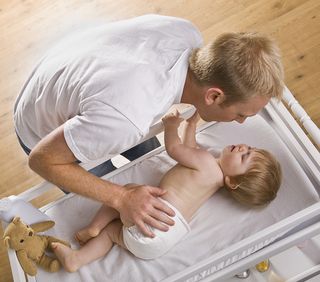
    Bigstock-A-young-father-is-changing-his-27200900In 1946, when my grandfather mustered out of the army and married my grandmother, he set up what looked like the ideal family at the time. His wife quit her job and he started work driving a crane in a quarry—a job he would do for the next forty years, working up to six days a week, sometimes 12 hours a day. When I asked him if he faced any challenges raising his three children, he replied, “I never did. My wife took care of all that. She brought the kids up.” This arrangement came with a rigid hierarchy: “She worked for me,” said my grandfather of his wife. “I always said, ‘You work for me.’”

    By the time my mother and father met in 1963, the same year that Betty Friedan published The Feminine Mystique, more and more people were starting to question this division of labor between men and women. The following year, the United States Congress formally abolished sex discrimination at work. I was born in 1970. “I wanted to be closer to you than my father was to me,” my dad told me when I interviewed him for my book, The Daddy Shift. “I wanted to participate more in my kids’ lives.” Even so, my parents never questioned for a moment that he would make most of the money and she would change most of the diapers.

    By 1988—the year I graduated from high school—only 29 percent of children lived in two-parent families with a full-time homemaking mother. And like many Baby Boomer couples, my parents split in 1991—the same year I met the woman who is today my wife. By the time we became parents in 2004, my wife and I were stepping into a family landscape that was totally different from the one my grandparents faced in 1946.

    For one thing, we never assumed that one of us was the natural breadwinner and the other a natural caregiver—instead, we saw those as roles that we would share and negotiate over time. For a year, I took care of my son while my wife went to work, and as we visited playgrounds, I met many other dads who took care of their kids while their female partners were at work.

    2121This personal reality reflects one that has been empirically measured. For almost every decade for the past 100 years, more and more women in the United States have gone to college and work. For most of the past three years, men have been much more likely to lose their jobs than women, who are concentrated in fast-growing, high-skill industries like health care and education. Between 2009 and 2010, men with college degrees saw their median weekly earnings drop three percent while the income of women with degrees grew by 4.3 percent. Today, young women’s pay exceeds that of their male peers in most metropolitan areas.

    Not coincidentally, fathers now spend more time with their children and on housework than at any time since researchers started collecting comparable data. I call it “the daddy shift” — the gradual movement away from a definition of fatherhood as pure breadwinning to one that encompasses a capacity of caregiving.

    The right-wing “family values” movement has painted these trends as a crisis, but no one I know experiences them that way. Instead, we seem to share a positive (if often unarticulated) vision of the family as diverse, egalitarian, voluntary, interdependent, flexible, and improvisational. Many people hold these ideals without necessarily being conscious of their political and economic implications—and they’re not making politically motivated choices. In researching The Daddy Shift, for example, I didn’t interview any breadwinning moms and caregiving dads who adopted their reverse-traditional arrangement for feminist reasons. They almost always framed their work and care decisions as a practical matter, a response to brutally competitive labor and childcare markets.

    Indeed, I don’t believe that a political force like feminism has driven men and women to share roles more equally; it seems more accurate to say that feminism has tried to teach people to personally adapt to broad, deep economic and technological changes that made equality more possible and desirable—and the movement has fought for public policies that would support our new roles at home and at work.

    Rising inequality and economic instability has meant that many families can’t afford specialists anymore, with one focused on career and the other exclusively on taking care of the family. And so couples are moving from a family model that prioritizes efficiency to one that tries to build resilience in the face of economic shocks. In the ideal resilient family, both women and men are capable of working for pay and working at home.

    But families often fall short of this ideal, partially because of lingering structural and interpersonal sexism, and partially because men lack support for their new caregiving roles at both home and work. Studies consistently show that 80 percent to 90 percent of mothers still expect fathers to serve as primary breadwinners (and very few will consider supporting a stay-at-home dad). At work, only seven percent of American men have access to paid parental leave, among other structural limitations.

    How can the daddy shift continue? The to-do list is long. It includes an education campaign to help men of all social classes understand what workplace and public policies can help them be the fathers they want to be — and legal campaigns that will defend their jobs against backward attitudes at work. Men whose mindsets are still shaped by the sole-breadwinner ideal need explicit permission and encouragement from both their female partners and their bosses to take advantage of leave policies and participate in family life.

    We also need to shift the language we use to discuss work-family issues in a more inclusive direction, so that it includes fathers as well as mothers. That language should stress resilience and meaning to men instead of the language of equality that has mobilized women. In the end, it’s up to guys to tell the stories of our lives and speak up for what we want. No one will do it for us.

    Photo of dad and baby from Bigstock.

  • This is the second in an eight-part series of interviews with Michael Bronski about the A Queer History of the United States, this year's Lambda Literary Award winner for LGBT Nonfiction. The interviews were conducted by Richard Voos. Listen or read below to learn about how Europeans applied their language and beliefs to the "Two-Spirt" Native Americans they encountered.

    Enter to win a copy of A Queer History of the United States or one of Beacon's other LGBT titles in our Pride Month Giveaway. For more information, visit beacon.org/queervoices.

    Listen to Queer History Podcast Episode 2: Berdache and Sodomite


    "Among Mamitarees if a boy shows any symptoms of effeminacy or girlish inclinations he is put among the girls, dressed in their way, brought up with them, and sometimes married to men." Nicholas Biddle, original journals of the Lewis and Clark expeditions

    "Their garments consist only of skins; the women are always clad very modestly and very becomingly, while the men do not take the trouble to Cover themselves. I know not through what superstition some Ilinois, as well as some Nadouessi, while still young, assume the garb of women, and retain it throughout their lives. There is some mystery in this. For they never marry and glory in demeaning themselves to do everything that the women do. They go to war, however, but can use only clubs, and not bows and arrows, which are the weapons proper to men. They are present at all the juggleries, and at the solemn dances in honor of the Calumet; at these they sing, but must not dance. They are summoned to the Councils, and nothing can be decided without their advice. Finally, through their profession of leading an Extraordinary life, they pass for Manitous, — That is to say, for Spirits, — or persons of Consequence." From the journals of Jacques Marquette, 1673-1677

    "Among the women I saw some men dressed like women, with whom they go about regularly, never joining the men. . . . From this I inferred they must be hermaphrodites, but from what I learned later I understood that they were sodomites, dedicated to nefarious practices. From all the foregoing I conclude that in this matter of incontinence there will be much to do when the Holy Faith and the Christian religion are established among them." Franciscan Pedro Font's diary


    The use of the word "gay" really arose in the 1920s or '30s, but there was all sorts of different language in the previous four hundred years. Take us back to some of the earliest descriptions and usages of terms to describe queer people in the Americas.

    Language can be very tricky, so when we're looking at language and how it's describing people, we have to realize that sometimes other people do the describing. So, before the Europeans even came here, we had many Native tribes and groups of people who exhibited behavior such as cross-dressing, same-sex relationships for both women and for men. Each of the tribes had their own language for this. When the Europeans came here, they used the French word berdache–which was a pejorative word essentially meaning a pedophile–for these people, completely inaccurately. Yet it's a word that continues to be used by anthropologists even today.

    Catlin_-_Dance_to_the_berdache
    George Catlin (1796-1872), Dance to the Berdache. Drawn while on the Great Plains, among the Sac and Fox Indians, the sketch depicts a ceremonial dance to celebrate the two-spirit person.

    There's a mix in the behaviors and attitudes that you're talking about among the Native Americans, around both same-sex sexual behavior but also around breaking gender boundaries.

    Certainly breaking gender boundaries for the Europeans, who were quite shocked when they came here. So the language that we have, which is used to some degree now, is the European terminology. Which I think we find repeatedly throughout the history of America. America was here before the Europeans came, they brought over the language, another word that they brought with them was "sodomite." Which is a theological term, meaning a person who has committed a sin of sodomy. Used rather broadly about anybody who transgressed accepted gender or sexual behaviors. And yet, a word that's used today, even in the general sense of the sodomy laws which are defined in various different ways. So from the earliest Colonial times, we did not have "homosexuals," we did not have "gay people," we had people who were accused of committing the sin of "sodomy" and were "sodomites."

    And so both of those terms–"berdache" and "sodomite"–were really pejorative.

    Completely pejorative. The first, by social implication, although considered a sin. The second explicitly, theologically, a sin. So it's important to realize that most of our laws emanate to a large degree from canon law in Europe, and were translated from the church into the state.

  • Nancy D. Polikoff is the author of Beyond (Straight and Gay) Marriage: Valuing All Families under the Law. She is professor of law at American University. This post originally appeared on her blog: beyondstraightandgaymarriage.blogspot.com.

    Bigstock-Child-on-the-road-18703625Cambridge University Professor Michael E. Lamb has impeccable credentials as one of the world's leading experts on child development. Among other things, he was Chief of the Section on Social and Emotional Development of the National Institute of Child Health and Human Development for 17 years. His list of publications is about 50 pages long (that is not a typo!  check it out here). He is credited with, among other things, determining that fathers, as well as mothers, matter to child development. It is no doubt that early finding of his that endeared him to the "father's rights" movement and the fatherhood movement that sought to pathologize women raising children without father involvement.

    Perhaps because of the mischaracterization of his research, Dr. Lamb was drawn into the public conversation about the relationship of family structure to child outcome. Turns out that his research supported the findings that when fathers are there, they matter; in other words that there is more to child adjustment than the mother-child bond.  What his research did not support was the assertion that optimal child adjustment demands that every child have a father in the home.

    In 2004, the ACLU, in a case litigated brilliantly by LGBT Rights Project attorney Leslie Cooper, called Dr. Lamb as a witness in a lawsuit in Arkansas state court successfully challenging the social services agency regulation against placing children with lesbian and gay foster parents. The trial judge referred to Dr. Lamb as the "most outstanding" expert witness in the case (coming close to saying he was the most outstanding expert witness he had ever heard), who answered questions fully with no "animus or bias" to any parties.  He testified about what did (quality of relationships, available resources), and did not (gender or sexual orientation of parents), matter to the well-being of children. Since then, Michael Lamb has participated in other litigation, most notably the Perry case challenging the constitutionality of Prop 8.

    Last month, Dr. Lamb published in the journal Applied Development Science a summary of many hundreds of studies over the last four decades elucidating the factors that contribute to child adjustment. The article, Mothers, Fathers, Families, and Circumstances: Factors Affecting Children's Adjustment is available online here. This means that Dr. Lamb's professional opinion is now widely available for anyone who needs support for the following propositions:

    *Social scientists have reached consensus that the following factors matter most to healthy child development: the quality of relationships with parents; the quality of relationships between the parents and other significant adults; and the availability of adequate economic, social, and physical resources.

    *Family structure explains a "small (or even insignificant) portion" of differences in child outcomes

    *Children in one-parent families have greater adjustment problems than children in two-parent families, but the primary causes of this increased maladjustment are disturbed relationships with one or both parents, reduced resources when there is only one wage-earner and care-giver, and unstable living arrangments and conflict around parental separation.  "The mere fact that the majority of children raised in single-parent or divorced families are well-adjusted," writes Dr. Lamb, "undercuts the argument that children 'need' to be raised in traditional families."

    *Mothers and fathers are important to their children "as parents";  "father absence" is not itself important to adjustment.  (emphases in original)

    *There is no support for the notion that both male and female role models in the home enhance child adjustment.

    *The same factors affect child adjustment whatever the sexual orientation of parents; children with same-sex parents suffer no developmental disadvantages when compared with children of different-sex parents.

    *Arguments from "some politicians and advocacy groups, especially those who oppose divorce and same-sex parenthood" that children need to be raised by "biological" parents have no empirical support.

    4433Dr. Lamb concludes that discrimination against individuals and families on the basis of sexual orientation, gender, and marital status — which he refers to as "outmoded beliefs in the superiority of traditional families" — are harmful to individuals, families, and children.

    To me, this is what is most important about this article. It places single-mother and same-sex couple families together and debunks the myths about both. Too often, advocates for LGBT families (especially for same-sex marriage) distance themselves from single-mother families. Those families, they say, are pathological, but not ours. I despise such arguments. The Lamb article makes clear that circumstances often associated with single motherhood, such as exposure of the child to parental conflict and lack of resources, can lead to child maladjustment. But it is not the structure of a family with children raised by a single mother that's the problem.

    Time for Michael Lamb to get an "allies" award from some gay rights group….

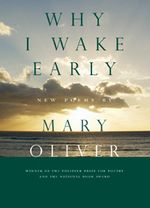
  • BearApparently a bear is attempting to find summer lodging in Provincetown (poor thing must not realize that he should have had his rental all lined up by April). Wildlife officials are out attempting to relocate him to a less-touristy locale. Of course, hearing "Cape Cod" and "Bear" instantly made us think of Mary Oliver. So here's a poem from Why I Wake Early to listen to and read as we follow the ursine updates from the Cape. (You may also want to delve into The Truro Bear and Other Adventures for more thoughts on these wild beasts.)

    UPDATE: The bear has been captured and relocated. But will he come back for Bear Week? 

    Listen to "Bear" by Mary Oliver from At Blackwater Pond

    Bear

    It’s not my track,
    I say, seeing
    the ball of the foot and the wide heel
    and the naily, untrimmed
    toes. And I say again,
    for emphasis,

    to no one but myself, since no one is
    with me. This is
    not my track, and this is an extremely
    large foot, I wonder
    how large a body must be to make
    such a track, I am beginning to make

    bad jokes. I have read probably
    a hundred narratives where someone saw
    just what I am seeing. Various things
    happened next. A fairly long list, I won’t

    go into it. But not one of them told
    what happened next—I mean, before whatever happens—

    how the distances light up, how the clouds
    are the most lovely shapes you have ever seen, how

    the wild flowers at your feet begin distilling a fragrance
    different, and sweeter than any you ever stood upon before—how

    every leaf on the whole mountain is aflutter. 

    Copyright @ 2004 by Mary Oliver. First published in Why I Wake Early, Beacon Press. Audio from At Blackwater Pond, Beacon Press. 

    At Blackwater Pond The Truro BearWhy I Wake Early by Mary Oliver

    Bear photo by lazymonkey on Flickr. Used under Creative Commons.

  • A Queer and Pleasant Danger is one of the books you can win if you enter our Pride Month Book Giveaway. For more info, visit: www.beacon.org/queervoices.

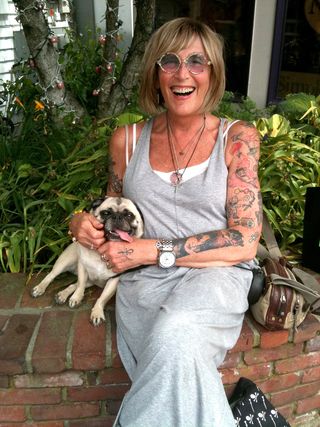
    Kate_Bornstein-by_Barbara_Carrellas-FINAL"If Kate Bornstein didn't exist, we would have to invent her. But luckily for queers, straights, gender outlaws, and general readers, Bornstein is out and out there." — Dan Savage

    And now, A Queer and Pleasant Danger is out and out there as well! It's been about a month since the release of Kate Bornstein's memoir, and the media, blogs, and Twitter have been lit up all over with love for this book. Here's a quick roundup of her recent blog tour and other mentions.

    The Village Voice cover story by Tony Ortega, "Kate Bornstein's Amazing Voyage," complete with a comics adaptation of key moments from the memoir that graced the magazine cover. 

    Bornstein's tale of disaffection from Scientology has a sense of intrigue—it involves Swiss bank accounts, a rogue group of executives leading a series of purges, and hours of intimidating interrogations—but really, it's the same story we see repeated again and again. After years of superhuman dedication, financial sacrifice, and hermetically sealing themselves from outside influences, one by one, longtime Scientologists tend to reach the same precipice. Forced out through interrogations, disconnected from family members, and simply exhausted by the constant fundraising, many veteran church members go into free fall as they are declared suppressive or simply break away. Some then become the targets of retaliation known as "fair game," which is a well-documented history of using church-hired private eyes and legal harassment.

    But Al had other concerns after being suddenly kicked to the curb. He returned home to New Jersey and, three years later, was ready to become Kate. In this revealing book, we learn some particulars about her surgery. And then, there's this rather remarkable little detail: On January 24, 1986, Kate legally changed her name—and remained unaware until much later that on that same day, L. Ron Hubbard died.

    Officially, it was a transition for both of them. The church has maintained to this day that Hubbard chose to leave his corporeal body in order to pursue even higher levels of spiritual training somewhere in the galaxy. And Kate—well, she had her own new frontiers to explore.

    In the Boston Phoenix, Thomas Page McBee tells Kate he gave a copy of My Gender Workbook to his mom, and they discuss how writing the memoir was different than writing her previous books. 

    "Most people don't think about, 'Well, if I remember back to a certain time in my life would I be able to embody that person who I was?" And, frankly, when I sat down to write the memoir I didn't think I was going to be able to. But then I started writing myself in the first-person boy — man — that I was, and it was easy. I just told the truth of it without judging myself. And yeah, it has helped me resolve a lot. Writing that book has helped me come to — a lot closer to not man, not woman, and both. And that's the kind of state of grace that I aspire to."

    In an interview with Nicole Pasulka in Mother Jones, Kate talks about Judaism, Scientology, and being transgender:

    "Growing up we were secular Jews, but what I got out of Judaism at that time in my life was questions. Everything was a question. "Dad, is there a heaven? Is there a hell?" You never could get an answer. That informed a lot of my reasons for getting into Scientology, because they had all the answers. They said I was not my body, not my mind. I don't have a soul; I am an immortal soul. I've lived many lives and I'll live endlessly into the future, and as an immortal soul I have no gender.

    Now this is a big deal, because I never wanted to be a boy, and I didn't want to grow up to be a man."

    BORNSTEIN-Queer&PleasantDangerReviews:

    Pop Matters (10 of 10):
    "But what Bornstein ultimately teaches us is that non-normal, or beyond normal, can be fun, challenging, but most of all rewarding. We need to accept expressive fluidity and understand that life is not a solo performance, but the actors certainly will change." 

    Lambda Literary:
    "Ultimately Bornstein has written us a profoundly brave book that cracked me open, leaving me quivering and grateful for the stories I hadn’t known I’d needed to hear. A Queer and Pleasant Danger is truly a singular achievement and gift to the generations of queers who consider her our Auntie, and all those who will follow."

    Religion Dispatches:
    "QAPD is at least three books in one, each of which is a page-turner. The first part is a powerful, at times painful, autobiography of a transgender woman growing up before the category even existed. In some ways, LGBT-youth-memoir is a conventional narrative, but Bornstein has never been conventional and—Goddess help us—never will be. If QAPD ended at page 54, it would be a must-read for anyone interested in transgender, queer theory, or LGBT lives more generally.

    But then there’s part two, on Bornstein’s twelve years in Scientology, and part three, on her eventual liberation, transition, and embrace of her kinky, post-gender, post-fame self. (Bornstein’s new book gives her status as a “cult hero” a whole new meaning.) These are also two complete books, and also indispensable."

    BORNSTEIN-blogtourBlog Tour:

    en|Gender
    "We were lucky enough to have Kate read us a chapter – the one on her expulsion from Scientology – a few years ago on a drive from Appleton, WI – where I’d convinced her to come speak at Lawrence University – to the big queer midwest college conference in Madison, WI, where she was the keynote speaker. Sometimes it’s striking what kinds of things you remember, things that maybe no one else would, but anyone – anyone and their favorite aunt – would definitely remember eating Taco Bell with Kate Bornstein in a car on a Wisconsin interstate while she reads to you from her as-yet-unpublished memoir." 

    io9: "How I Helped L. Ron Hubbard Take Over the Planet"
    "On the subject of taking over the planet, Scientology staff worldwide were at an emotional tone of 3.75, between Strong Interest and Enthusiasm. On the subject of doing their own jobs, however, the international tone level dropped to 0.95, smack-dab in the middle of Numbness and Terror. "Gotcha!" exclaimed the Old Man, pounding his desk for emphasis. He outlined his plan to bring worldwide Scientology staff upscale to where their feelings about their jobs matched their feelings about taking over planet Earth. Because staff were so low-toned emotionally, we had to pitch the first campaign at a level of Anger (1.5). We watched the statistics as they came in at the next week-ending. Damned stats went up, pretty near one for one. There was much celebration aboard the Flagship that night. LRH's breakthrough in public relations had worked like a charm, which, in a way, it was."

    Queer Fat Femme:
    "I’ve read a lot of Kate’s theory and seen her perform and keynote events but never got the full scoop of what she’s gone through. I mean, the process of getting to be a charming babe like Kate Bornstein is no less than spectacular."

    Book Notes at Largehearted Boy:
    Kate's music playlist includes Audrey Heburn, the Dresden Dolls, and Mx Justin ViVian Bond. 

    Caitlin Song:
    "Her compassion, honesty, service, and humour are rare and beautiful traits in a society supersaturated with anemic pop culture." 

    Biographile
    "We can’t all push so many boundaries — and all at once — but we can be moved and inspired by someone who does."

    Watch Kate: 

    Watch Kate on the Melissa Harris-Perry Show at MSNBC

    See Kate reading an excerpt of A Queer and Pleasant Danger at the Beyond Visibility Conference.

    Check out the Book Trailer for A Queer and Pleasant Danger

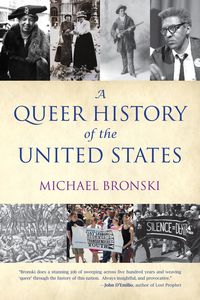
  • Beacon Press is proud to announce that A Queer History of the United States by Michael Bronski is this year's Lambda Literary Award winner for LGBT Nonfiction. The news came at last night's Lammy Awards, as we were preparing to post the first in an eight-part series of interviews with Michael Bronski about the book. The interviews were conducted by Richard Voos. Listen or read below to find out why American History is Queer History.  

    Listen to A Queer History of the United States, Episode One

    BRONSKI_QueerHistory

    What's the difference between a "Queer History" and a "regular" history?

     As I was writing the book and as the book was being edited, we decided that actually that was a little bit too literal, and that what we wanted to do was a Queer History, which would be rather a history of a sensibility rather than a history of what certain people did or didn't do. I think that a Queer sensibility would be a sensibility that would be from the outside. So whereas LGBT people may have lived to a large degree on the outside–although not always since many of these people were in fact not openly gay at the time–what the book does is that it looks at American History from the point of view of an outsider. So in this sense, it's not that different than, say, a black sensibility or a Latino sensibility. 

    One of the things that always comes up is the terminology, and you discuss this in the Introduction and the first chapter. The language used even in the last one hundred and twenty years–gay, homosexual, invert, Sapphist–none of that existed of course when the Mayflower landed or in the first hundred or two hundred years of US History. So, how do you write a "Queer" history of the United States given that the terms and the identity and the social meanings have changed really radically over five hundred years?

    I think one of the reasons we were attracted to the word "Queer" is its non-specificity. So, by "Queer," it's being used generally, meaning a point of view an outsider or a "deviant"– non-normative experience. But you are completely right. Certainly words such as "gay" and "lesbian," "homosexual" were not used two hundred years ago in many cases. I think that none of these words were used for the first four hundred years of American history–my book begins in 1492. It is a tricky feat to actually use contemporary words to describe the activities, the emotions, the feelings, the sensibilities of people who lived five hundred years ago, or three hundred years ago. I tried for the most part not to use those words, and simply to let the people speak in their own words, and to evaluate what they were saying and what they were doing without putting our modern sensibilities onto them. 

    The core argument in your book is that American History is Queer History. Lay out the argument for us if you would.

    Since the 1960s, there have been movements to include those people who have been "left out" of American history. So we see Women's History, African-American history, Latino history, Native American history. And certainly when we think about Gay and Lesbian or GLBT history, that's the same impulse–to bring Gay and Lesbian people back into American history. When I began writing the book, it struck me that the more research I did, that while this project was well-intentioned, it was rather unnecessary. That in fact gay, lesbian, bisexual, transgender people, African-American people, Latino people, women have always been in American history. So the very process of separating people out in order to put them back in seemed to me to be shortsighted. So the purpose of the book as I began writing it became clearer and clearer–it was simply to identify and find the LGBT people that are in American history already. The more I did this, what I discovered was that there were so many people, so many events, people's lives, people's personalities were so intertwined with what we think of as American history that there was no separation at all. 

    Can you give us one or two examples that would connect what we all learned in elementary and high school about American History to the idea that the queers were here all along?

    HoweCharles_Sumner_1855_BPL-crop

    There are a multitude of examples. Two that come to mind immediately are, in the 19th Century, the 1850s, we have an intense relationship between Charles Sumner, a senator from Massachusetts who was one of the leading abolitionists, who had an intimate, passionate relationship with Samuel Gridley Howe, one of the major reformers of American culture back then. This is the man who started Perkins School for the Blind and completely reformed our notion of dealing with different physical disabilities. The letters between the two men are quite striking, and even though both of them were married–Samuel Howe actually was married to Julia Ward Howe, who wrote the Battle Hymn of the Republic–their relationship was sustaining to both of them. When Howe was on his honeymoon with Julia Ward Howe, he received word that Charles Sumner was very upset and wrote him a passionate note saying that he wished that he was there with them. Interestingly, Sumner himself married later. They have complicated relationships. Julia Ward Howe, although this was only discovered about ten years ago, wrote a novel about a hermaphrodite–a man/woman who loves both men and women–that most critics now think was her own meditation on her husband's bisexuality.

    I recall hearing about Charles Sumner in high school. There was a famous fistfight in the Senate that he was involved in. Obviously, we all know the Battle Hymn of the Republic. And your purpose is to connect their queer lives into American History in a way that has not been done before. 

    Right. And I think there are two ways of looking at it. One way of looking at it is to say, "This is sort of interesting. This is some extra stuff we didn't know before." And we can actually prove it. We have letters, we have diaries, we have unpublished novels. But I think that's a simplistic way of looking at it. I think a more complicated way is to ask, "What did this have to do with their relationships? What did Sumner's queerness have to do with his abolition stand? What did Howe's queerness have to do with his drivenness to reform society? What did Julia Ward Howe's realtionship to her husband have to do with her impulses to the early suffrage movement and for liberation of women?" So, I think that when we look at the larger picture, the queerness, the sexuality, the really complicated sexual relationships, are integral to these people's desire to change the world and make it better. 

    And you said you have an example from the twentieth century as well.

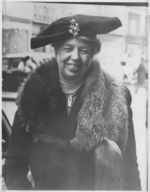
    Eleanor_Roosevelt_in_New_York_City_-_NARA_-_195376I think we see a very similar situation, and similar also in the sense that these are people involved in a heterosexual marriage, when we look at the career and life of Eleanor Roosevelt. We know now, thanks to historian Blanche Weisen Cook, that Eleanor had a very complicated, intimate, most-probably sexual relationship with Lorena Hickok, who was a journalist. At one point, Eleanor moved her into the White House with her. And that Hickok's reporting upon Eleanor Roosevelt was integral to Eleanor Roosevelt's promotion of herself as a social reformer. Along with this, we do know that Eleanor Roosevelt had a wide, wide circle of female friends, many of whom were lesbians, many of whom were involved with social work. These women as an aggregate were called "Roosevelt's Brain Trust." And, in fact, Eleanor brought them to Washington and they were instrumental in forming the New Deal. Francis Perkins, one of Eleanor's intimate friends, was the first woman to head the Labor Department. So I think when we're looking at Eleanor Roosevelt's life, it's not just interesting that she had this affair with a woman– she also apparently had an affair with her chauffer, named Earl Miller, as well, so Eleanor's life was complicated– but what is really amazing that there is this circle of friends–which, again, Blanche Weisen Cook calls "female support networks"–that literally changed our very notions of how social work functions in American society and how reform functions. All again based upon lesbian–or women being intimate with women–relationships.  

  • Joey L. Mogul is a partner at the People’s Law Office in Chicago, Illinois, and Director of the Civil Rights Clinic at DePaul University College of Law.  Mogul’s practice focuses on representing individuals who have suffered from police and other governmental misconduct in civil rights cases, and defending individuals in criminal and capital cases. Mogul is co-author, with Andrea Ritchie and Kay Whitlock, of Queer (In)Justice: The Criminalization of LGBT People in the United States. 
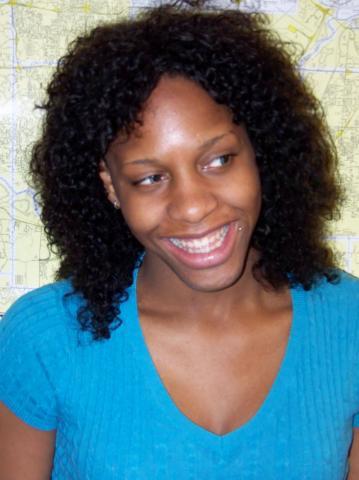
    Cece4-lo_2On June 5, 2011, Chrishaun “CeCe” McDonald, an African American transgender woman, was assaulted by Dean Schmitz, a white heterosexual man, and his friends in a violent, racist, and transphobic attack. In the face of extreme violence causing her serious physical injury, CeCe defended herself. The Hennepin County Attorneys’ Office in Minneapolis refused to recognize her right to self-defense, and instead prosecuted her for two counts of second degree murder for the death of Mr. Schmitz.

    On May 3, 2012, after a jury was selected and opening arguments were set to begin at trial, CeCe pled guilty to a reduced charge of second degree manslaughter in exchange for a recommended sentence of forty-one months imprisonment, as opposed to proceeding to trial where she faced a possible forty year term of imprisonment if convicted of second degree murder as originally charged.

    The following text is adapted from a speech I gave at an event on April 22, 2012 organized by CeCe’s Support Committee at the University of Minnesota in Minneapolis, Minnesota.

    CeCe’s sentencing hearing is scheduled for June 4, 2012.

    Gay Pride Month and the Stonewall Rebellion 

    In June of 2011, Gay Pride Month, CeCe McDonald, a Black transgender woman, was the victim of a vicious, racist, transphobic attack. It is sadly ironic that she is the one criminalized for exercising her right to self-defense.

    Gay Pride month is more than just a month to party (although I have nothing against partying), and it is certainly more than a parade full of politicians and corporate sponsors who want you to vote for them or buy their products.

    The Gay Pride Parade and Pride Month derive from a cherished moment in queer history – the Stonewall Rebellion.

    The Rebellion occurred in June of 1969 when officers from the New York Police Department (NYPD) raided the Stonewall Inn, a private drinking establishment in the West Village of New York City. The purported justification for the raid was the enforcement of liquor law violations.

    The raid was nothing new. Law enforcement officers frequently used pre-textual justifications, like liquor law enforcement, to raid gay bars nationwide in order to arrest, humiliate, and in many cases abuse, all those present. This time, however, people were fed up with these unjustified attacks, and in response to the homophobic onslaught and physical brutality, people resisted and defended themselves. Led by drag queens and butches, bar patrons yelled “Gay Power” and they threw shoes, coins, and bricks at the officers and clashed with the NYPD over the next three days.

    We celebrate Gay Pride in June each year to mark the moment when queers fought back, defended themselves, and said no to the violence. Thus, it is tragically ironic that, at the beginning of Pride Month, CeCe McDonald is awaiting punishment for fighting back, defending herself, and protecting her life during Pride Month one year ago.

    The Facts Regarding CeCe McDonald’s Prosecution for Murder

    On June 5, 2011, around 12:30 a.m., CeCe and four of her friends, who were also young queers of color, were in South Minneapolis walking to Cub Foods when they passed the Schooner Tavern. According to witnesses, Dean Schmitz began yelling at CeCe and her friends, calling them rapists who were wearing women’s clothes, as well as a slew of racist, homophobic epithets, including “niggers,” “fags,” and “faggot lover.” Schmitz further verbally assaulted CeCe, denying her gender identity, yelling out that she was not a girl, and claiming she was tucking in her dick.

    When CeCe and her friends verbally responded to Schmitz and his female companions – all of whom were white – the crowd began calling them “niggers” and “faggots” and “chicks with dicks.” A physical altercation ensued, when one of the white women with Schmitz smashed a liquor glass in CeCe’s face with such force that it shattered on impact, cutting CeCe’s cheek and requiring 11 stitches.

    Witnesses at the scene reported that CeCe had turned away and was leaving the altercation, when Schmitz followed her in an aggressive, hostile fashion. Eventually, Schmitz was stabbed during the altercation with a pair of scissors in the chest and he bled to death at the scene. CeCe claims she acted in self-defense.

    This was not the first time Dean Schmitz had expressed racist sentiments. Schmitz was a proud racist who had a swastika tattooed on his chest. Schmitz also had a history of violence, and had three prior convictions for assaulting his ex-girlfriend’s 14-year-old daughter, assaulting his ex-girlfriend, and getting into a physical fight with his ex-girlfriend’s father.

    The Racist, Transphobic Hate Violence Endured by Transgender Women of Color in the United States

    Schmitz’s assault on CeCe was not an isolated incident. Transgender women of color endure egregious violence every single day across the U.S. The National Coalition of Anti-Violence Programs (NCAVP) reported in 2010 that people who identified as either as transgender or people of color were twice as likely to experience assault or discrimination as non-transgender white individuals. NCAVP also reported that transgender women made up 44% of the 27 hate murders committed in 2010 despite being only 8% percent of the queer population (see http://www.avp.org/publications/reports/reports.htm).

    Just this past month, 3 transgender women of color have been murdered. On Monday, April 16, Paige Clay, an African American transgender woman, was found dead in an alley on Chicago’s Westside with a bullet through her forehead. On April 3, CoCo Williams, an African American transgender woman, was murdered in Palmer Park in Detroit, Michigan. Her throat was slashed and her body was riddled with gunshot wounds. In March, Rosita, a presumably Latina trans woman, was found dead in her apartment in Miami, Florida, the victim of multiple stab wounds.

    It was more than reasonable for CeCe to fear for her life, not only because of Schmitz’s own aggressive and violent behavior, but also because of the endemic and often deadly violence transgender women of color experience in this country on a daily basis. In light of nationwide trends, it is fair to ask what would have happened if CeCe did not defend herself. Would her name simply have been added to the too long list of names we recite at annual Transgender Day of Remembrance?

    Is CeCe’s real crime that she lived?
    5116The Criminalization of LGBTQ Targets of Hate Violence

    CeCe is not the only queer of color to be physically attacked and forced to defend herself, only to be blamed for the violence and prosecuted in the criminal legal system. As my co-authors Andrea Ritchie, Kay Whitlock and I discuss in Queer (In)Justice: The Criminalization of LGBT People in the United States, LGBTQ people, particularly those of color, report that police often focus on them rather than their assailants when they are the victims of violence, questioning their accounts of the incident and/or blaming them for bringing the violence upon themselves.

    This was the case with the New Jersey 7, which involved a group of seven Black lesbian friends who were confronted by Dwayne Buckle, a Black heterosexual man in the West Village of NYC. Buckle made a sexual advance towards one of the women, and when she responded she was not interested, he shouted “I’ll fuck you straight, sweetheart!” He then spit on this woman, and later grew physically abusive, pulling on one of the women’s hair and choking another woman. A physical struggle ensued, and two unknown men ran over to help the women. Buckle was stabbed during the altercation and he cried he was the victim of a “heterosexual hate crime.”

    As my co-authors and I discussed in Queer (In)Justice, the police responded to the incident and they refused to see the women as victims. Instead, the police arrested and charged them with attempted murder, framing them as the perpetrators of “gang violence.” Ultimately, three of the seven women felt compelled to plead to get a reduced sentence, and four of the women were found guilty and sentenced to three and half to eleven years in prison.  (For more information: See INCITE! Women of Color Against Violence: Critical Lessons from the New Jersey 7.)

    The same dynamic occurred in Monica James’s case, a Black transgender woman in Chicago in 2007. Monica was pursued by an unknown white, gay man who was yelling and screaming racists, transphobic epithets at her. A physical altercation ensued, and during the struggle she bit in him in self-defense and he knocked her unconscious. Both claimed to have acted in self-defense, but she was the one charged with a host of serious felonies. In Monica’s case, the white man who pursued her was an off duty Chicago police officer. She was charged with attempted murder, discharge of the officers’ weapon and aggravated battery on a peace officer.

    Her claims of self-defense were also ignored and rejected. The State also rejected her claims that she was the victim of a racist and transphobic attack, arguing to the jury this could not be the case because the officer was gay.

    While Monica prevailed and was found not guilty of the more serious charges, thanks in great part to the organizing efforts of the Transformative Justice Law Project, she was still found guilty of aggravated battery.

    Why Is CeCe the Only Person Facing Charges from this Incident

    Against this backdrop, it is fair to question the fairness and legitimacy of CeCe’s criminal prosecution, and there are several other unanswered questions regarding this prosecution. For instance, why is CeCe the only person charged with a crime as result of this incident?

    It appears several people committed crimes that fateful night. The white, presumably heterosexual woman who hit CeCe with a beer mug committed battery (possibly aggravated battery), when she hit CeCe, causing her a severe injury requiring medical treatment. Why wasn’t she charged? Is it because the State is going to call her as a witness and rely her testimony to convict CeCe? Are the police and prosecutors crediting her testimony over that of CeCe’s based on her race and gender conformity?

    This woman and another, along with Schmitz, were yelling out racist and homophobic slurs and accusing CeCe and her friends of setting out to commit heinous crimes of rape (both projecting on to CeCe and tapping into archetypes that have framed Black people as perpetrators of rape and sexual deviance since slavery and Jim Crow, archetypes that have been used to justify lynching). Is it fair to infer that Schmitz’s friends may be guilty of inciting a riot, stirring people to engage in violence against CeCe and her friends?

    If CeCe was white and gender conforming would she be facing murder charges today? Or, would her case be dropped by the Hennepin County Attorney’s Office like that of three other white women who claimed they acted in self-defense?

    Drop Prosecution of CeCe

    Paige Clay, the African American transgender woman killed in Chicago was known for saying, “If you are quiet as a mouse, no one will hear you.” Well, CeCe was not quiet as a mouse, but instead she spoke up and defended herself. And we cannot be quiet like mice either. We cannot stand silent in the face of the racist, transphobic violence plaguing the nation that is silencing, harming and killing transgender women of color. And we cannot stand silent in the face of this unfair and unjust prosecution. I believe CeCe has the right to defend herself and I applaud the valiant efforts of the CeCe Support Committee in organizing on CeCe’s behalf and calling on the Hennepin County Attorney Mike Hennepin to drop the charges. Free CeCe.

  • Carlos A. Ball is professor of law at the Rutgers University School of Law (Newark). He has written extensively on LGBT rights issues, is the author of From the Closet to the Courtroom: Five LGBT Rights Lawsuits That Have Changed Our Nation and the recently published The Right to be Parents: LGBT Families and the Transformation of Parenthood (NYU Press, May 2012). Ball has received a Dukeminier Award from UCLA's Williams Institute for excellence in sexual orientation and the law scholarship. He lives with his family in Brooklyn, New York.

    Carlos_ballNow that the U.S. Court of Appeals for the First Circuit in Boston has struck down the Defense of Marriage Act (DOMA), the Supreme Court should quickly agree to hear the case. In its DOMA ruling, the lower appellate court practically begged the high court for guidance on how judges should assess the constitutionality of laws that treat individuals differently because of their sexual orientation.

    In some ways, the Supreme Court has had it both ways in matters related to the constitutionality of laws that withhold benefits or impose burdens based on the sexual orientation of individuals. In 1996 (in Romer v. Evans), the Court struck down a Colorado constitutional provision that denied LGBT individuals (and no others) legal protection from discrimination. Seven years later (in Lawrence v. Texas), the Court found unconstitutional a Texas statute that criminalized consensual same-sex sexual intimacy. But the Court in neither case clearly explained how other laws that treat LGBT individuals differently because of their sexual orientation should be assessed under the Constitution. It is now time for the Court to speak on that issue.

    Many of us have been arguing for a long time that lesbians and gay men satisfy the Court's own criteria for determining when to apply heightened (or rigorous) judicial review to laws that treat individuals differently because of who they are. The long history of discrimination that lesbians and gay men have suffered, for example, justifies judicial protection. In addition, it is widely accepted that sexual orientation does not affect the ability of individuals to contribute to society. We all know that there are lesbians and gay men who are doctors, lawyers, scientists, engineers, and even members of Congress. This means that courts should be particularly skeptical of laws that target individuals because of their sexual orientation.

    In its ruling striking down DOMA, the First Circuit did not find it necessary to address the question of whether lesbians and gay men are entitled to heightened judicial protection. Nonetheless, after pointing to the Supreme Court's own gay rights cases, it concluded that laws which treat individuals differently because of their sexual orientation must, at the very least, be subject to a meaningful form of judicial review that denies those laws a strong presumption of constitutionality.

    One of the factors that the Supreme Court is supposed to take into account in deciding whether to hear a case is the extent to which there is a need to provide guidance to lower courts on a particular question of federal law. Although defenders and supporters of DOMA agree on little, both sides should agree that we need to clear up the confusion regarding how courts should assess constitutional challenges to laws that treat individuals differently because of their sexual orientation.

    The lesbian and gay plaintiffs in the First Circuit DOMA lawsuit are either currently married or were married before the deaths of their same-sex spouses. The legal issue in the case, therefore, is not whether the plaintiffs have a constitutional right to marry. Instead, the issue is whether the federal government can deprive the tens of thousands of married same-sex couples the hundreds of rights and benefits that it makes available to heterosexual married couples. The nation desperately needs guidance from the Supreme Court on the question of whether this kind of brazen differential treatment is consistent with our constitutional values of equality and fairness.

    Gill v. Office of Personnel Management

    GLAD DOMA Section 3 Challenge