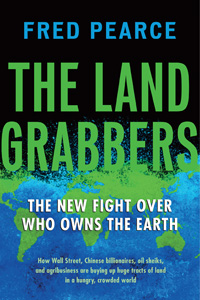
• 0324An unprecedented land grab is taking place around the world. Fearing future food shortages or eager to profit from them, the world's wealthiest and most acquisitive countries, corporations, and individuals have been buying and leasing vast tracts of land around the world. The scale is astounding: parcels the size of small countries are being gobbled up across the plains of Africa, the paddy fields of Southeast Asia, the jungles of South America, and the prairies of Eastern Europe. Veteran science writer Fred Pearce spent a year circling the globe to find out who was doing the buying, whose land was being taken over, and what the effect of these massive land deals seems to be.

    The Land Grabbers is a first-of-its-kind exposé that reveals the scale and the human costs of the land grab, one of the most profound ethical, environmental, and economic issues facing the globalized world in the twenty-first century. The corporations, speculators, and governments scooping up land cheap in the developing world claim that industrial-scale farming will help local economies. But Pearce's research reveals a far more troubling reality. While some mega-farms are ethically run, all too often poor farmers and cattle herders are evicted from ancestral lands or cut off from water sources. The good jobs promised by foreign capitalists and home governments alike fail to materialize. Hungry nations are being forced to export their food to the wealthy, and corporate potentates run fiefdoms oblivious to the country beyond their fences.

    Pearce's story is populated with larger-than-life characters, from financier George Soros and industry tycoon Richard Branson, to Gulf state sheikhs, Russian oligarchs, British barons, and Burmese generals. We discover why Goldman Sachs is buying up the Chinese poultry industry, what Lord Rothschild and a legendary 1970s asset-stripper are doing in the backwoods of Brazil, and what plans a Saudi oil billionaire has for Ethiopia. Along the way, Pearce introduces us to the people who actually live on, and live off of, the supposedly "empty" land that is being grabbed, from Cambodian peasants, victimized first by the Khmer Rouge and now by crony capitalism, to African pastoralists confined to ever-smaller tracts.

    Over the next few decades, land grabbing may matter more, to more of the planet's people, than even climate change. It will affect who eats and who does not, who gets richer and who gets poorer, and whether agrarian societies can exist outside corporate control. It is the new battle over who owns the planet. 

    Fred pearceFred Pearce is an award-winning author and journalist based in London. He has reported on environment, science, and development issues from sixty-seven countries over the past twenty years. Environment consultant at New Scientist since 1992, he also writes regularly for the Guardian newspaper and Yale University’s prestigious e360 website. Pearce was voted UK Environment Journalist of the Year in 2001 and CGIAR agricultural research journalist of the year in 2002, and won a lifetime achievement award from the Association of British Science Writers in 2011. His many books include With Speed and Violence, Confessions of an Eco-Sinner, The Coming Population Crash, and When the Rivers Run Dry.

    "Wherever I went, people were being moved off with little or no regard for their historic or cultural rights. The grabbers want big spaces – 50,000 hectares – and you can only get that if you take commonly owned ancestral lands. They come in and put in an airstrip and a compound and roads and canals and the villagers are told to go to the nearest town and they lose absolutely everything." Read an interview with Fred Pearce at the Guardian.

    Read an excerpt from The Land Grabbers at Scribd.

  • Carl Elliott is the author of White Coat, Black Hat: Adventures on the Dark Side of Medicine. Elliott is a professor at the Center for Bioethics at the University of Minnesota. His work has appeared in The New Yorker, Atlantic Monthly, the Believer, Slate, the London Review of Books, and theAmerican Prospect. His six previous books include Better Than Well, Prozac As a Way of Life, Rules of Insanity, and A Philosophical Disease.

    This post originally appeared in two parts at the Chronicle of Higher Education's Brainstorm blog.

    Bigstock-Pills-137062In June, I will be returning to Washington for the annual Pharmed Out conference, a project located at Georgetown University Medical Center. It is one of my favorite events of the year, in part because of the wide array of academics, journalists, and activists who attend, but mainly because of its extraordinarily committed, outspoken director, Dr. Adriane Fugh-Berman, and her merry band of student volunteers. Adriane agreed to an interview by email.

    Would it be fair to say that your project was funded by a felony?

    Yes, we were funded by the Attorney General Consumer and Prescriber Grant program, a novel and never-to-be-repeated program that resulted from a settlement between Pfizer and all 50 states and the District of Columbia. We promised so much that before we got the grant, the grant administrators asked us to cut down what we promised to do. We refused — and in the end, we exceeded what we promised.

    Just by chance, we had begun our project by shooting an interview of Shahram Ahari — a former drug rep for Eli Lilly who is now a medical student — talking about how he had sold Zyprexa. That was just days before the story broke in The New York Times about how Lilly hid data about adverse effects. Jim Ridgeway, the investigative reporter and filmmaker we worked with, realized that what we had was newsworthy and insisted that we release a quickly edited video clip. We didn’t even have a phone line yet, let alone a Web site. So we released the video on YouTube, crediting the not-yet-existing PharmedOut, with Georgetown’s media office as the contact number. It received a lot of media attention. The video “Zyprexa Drug Rep” has been viewed more than 150,000 times.

    Since then, we’ve done novel research on, for example, promotional tone in medical journal articles, and how marketing messages are inserted into CME. We created the first educational module that has convinced physicians that they are personally affected by promotion. And we’ve had groundbreaking conferences, the third of which will be held at Georgetown on June 14-15. It’s called “Missing the Target: When Practitioners Harm More Than Heal,” and will cover the potential adverse effects of marketing drugs and medical devices.

    How did you get started as an activist?

    I came out of women’s health advocacy work, and we were fighting medicalization of childbirth, menopause, and menstruation, so I feel I always had that bent. Being a reformer suits my crabby nature.

    I come from a family of utterly fearless women. I’m the most cautious, but apparently still less afraid than most. My parents were both anti-Vietnam war activists. My mother was very active with Women’s Strike for Peace, and met with Vietnamese women in Djakarta. My brother was president of SDS [Students for a Democratic Society] at Rutgers. I think I learned to walk at demonstrations.

    I got involved in feminism, women’s health, worked at Planned Parenthood as a teen, then a reproductive health clinic as a counselor and medical assistant. I would sometimes ask docs to treat women who couldn’t afford care. I decided it would be easier to become a doc then beg docs to help people. Anyone who hasn’t been through medical training romanticizes medicine; med school and internship were so tough in unexpected ways.

    I know exactly what you mean, but maybe you should explain. 

    Med school was anti-intellectual and inhumane. First there was the vast quantity of mind-numbing rote memorization of largely irrelevant material in the basic-science years, followed by the clinical years, in which we learned tradition, myth, and ritual. The overwhelming amount of material in the preclinical years makes students pine for shortcuts. No wonder they’re ripe for the simplistic, definitive messaging of drug reps later. Third year was one long hazing ritual; then in fourth year we were accepted into the fold. And in gratitude, we would accept and perpetuate the whole dehumanizing training system.

    Questions were punished. Empathy for patients was discouraged. I was horrified that there seemed to be no connection between medicine and public health, and only a tenuous connection between medicine and science. (Whenever docs are caught out doing something nonscientific, they say, medicine is an art, not a science.) And only lip service was paid to the concept of patient autonomy, or making medical decisions in the context of a patient’s own life and values.

    So when they removed your soul in medical school, did it hurt? I was under the impression that soul extraction was a pretty simple procedure, but to be honest, I found it excruciatingly painful. 

    Yeah, they need to work on the informed consent for that procedure.

    I think all of us found ourselves doing things or thinking things we would not have imagined being capable of. Being deprived of sleep, food, and the company of loved ones is terrible for the soul. I remember reading an account of a hungry, exhausted intern who wolfed down the dinner of a patient who had just died. No physician would be proud of that, but we would all understand it. We need to change the training system. Physicians-in-training who are treated compassionately will treat their patients with compassion. Medical training is changing, but not fast enough.

    Can you think of any particularly bad moments that seem emblematic to you? 

    The interns discussing how we envied patients because they were lying in bed and eating and watching TV. It’s terrible looking back on how distorted our thinking was. One of my internship mates ended up in a mental institution; another intern attempted suicide. Standing in a supply cabinet looking for a kit to cath someone who hadn’t peed in 18 hours and realizing, “Hey, I haven’t peed in 18 hours either.” On a psych rotation, handing out an account of a patient permanently damaged by electroconvulsive treatment to fellow students and having them hand it back, saying, “I don’t want to hear the other side if it involves more reading.” Being criticized for putting my arm around a pregnant teen on the way to the exam room. Realizing that preference in IV fluids or antibiotics varied by medical specialty as opposed to patient or disease characteristics. The utter exhaustion — falling asleep on a bus to my clinic for four hours, as the bus crisscrossed the Bronx. The guy I lived with didn’t make it home one night because he fell asleep on a dumpster at a subway station.

    What about your writing? When did that start, and how?

    I always wrote. I come from a family of writers and activists. Words were important. My father was a professor working on his fourth book on American government when he died at age 39. My mother wrote as well — a column for a small newspaper, letters to the editor. She would have written more had she not been left widowed and penniless with a nine-year-old and a 19-year-old. She never finished a cookbook she started, but my brother, a chef, later wrote one. I was made to write letters as a child, and my family wrote letters to each other. I remember coming home once to an eight page screed from my mother unfurling from a kitchen cabinet.

    Anyway, my mother went into the restaurant business, which she ran like a social-service agency. She hired a busboy too damaged to speak, poor single mothers, a prostitute from Chinatown. She brought in chefs from China. Our restaurant launched many others in DC. She was so generous to everyone. We never had money, but we had lots of fun and ate like kings. Food, in my family, was the most important thing. My grandmother believed you should be able to recreate any dish you taste. Not that she deigned to make much non-Chinese food. She did make a great apple pie, from sour, quarter-size apples from a tree in her backyard. I didn’t realize that she had learned to make apple pie in some YWCA American acculturation course she took after coming to the U.S.. As a child I thought apple pie was a Chinese dish. The day my grandmother made a bad dish was the day we knew she was dying.

    How have you managed to keep Pharmed Out going?

    Those of us who started the project came out of nonprofit groups so we knew how to work crazy hours, convince volunteers to work harder for free than they ever worked for pay, and stretch a penny until it screams. We have an incredibly smart, savvy, responsive, creative team.

    Our strength has always been the industry insiders who have provided us invaluable information on marketing practice, and the utter dedication of the doctors, scientists, students, artists and all the individual donors — who have kept the project going despite our having no external funding support since 2008. Every single person whom I paid off the initial grant continued to volunteer for the project after the money ran out. Our Web master supported the site for years; every academic stayed on. Even our work-study student continued to work for free after our funds ran out. Our fabulous anonymous team is what makes this project great. Because so many team members — not just industry — must remain anonymous, we made a decision not to name those team members who could be named. Our staff has been phenomenal. Alicia Bell, now a med student at the Medical College of Virginia, was the founding staff-person who became an amazing colleague over our first four years; without her we would not have achieved the impact we did. Beth Johnson and Nicole Dubowitz have also been great. But every one of our projects is a team effort. As director, I get way too much credit. I have a brilliant, efficient team that reminds me often of one of my mother’s favorite quotes: “The difficult with ease, the impossible with time.”

    Pill photo from BigStock.
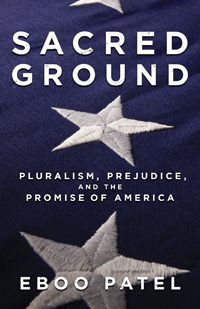
  • Eboo Patel is the author of Acts of Faith: The Story of an American Muslim, the Struggle for the Soul of a Generation and the forthcoming book Sacred Ground: Pluralism, Prejudice, and the Promise of America. He is founder and Executive Director of the Interfaith Youth Core, an international nonprofit building the interfaith youth movement. He was appointed by President Obama to the Advisory Council of the White House Office of Faith Based and Neighborhood Partnerships and serves on the Religious Advisory Committee of the Council on Foreign Relations. This post originally appeared at Huffington Post.

    Delivered at the Colgate University Baccalaureate.

    7748In the early days of Islam, when the Muslim community was small and fledgling, and being harassed and hunted by the powerful tribes of Mecca, the Prophet Muhammad — may the Peace and Blessings of God be upon Him — sent a delegation of his companions to a land called Abyssinia.

    When they arrived, the Kingdom's ruler, a man known as the Negus, summoned them to his court and demanded they explain their purpose. Ja'far, speaking for the Muslims, said they were followers of the Prophet Muhammad, believers in the One God, reciters of the Quran — a divine scripture which, among other things, had deep reverence for Jesus and his mother Mary.

    Ja'far then quoted a verse:

    …'I am but a messenger
    Come from thy Lord, to give thee
    A boy most pure.'
    She said, 'How shall I have a son
    whom no mortal has touched, neither
    have I been unchaste?'
    He said: 'Even so my Lord has said;
    "Easy is that for Me; and that We
    May appoint him a sign unto men
    And a mercy from Us"…

    The sources say that the Negus and his assembled advisors wept so hard at this recitation that their beards were wet and their scrolls were soaked through. The Abyssinians were Christians, and the knowledge that an emerging religious community would hold as holy what they held as holy moved them deeply.

    When I first read that story, it occurred to me that there were many ways that those Muslims could have explained their faith to the Negus. They could have shaken their fists and marked their disagreement with the Christian belief that Jesus is the Son of God. They could have wagged their fingers, and lectured the Negus and his court on the distinct notion of revelation in the Quran. Instead, they chose to extend their hand, to speak of the shared reverence for Jesus and Mary, the mutual belief in the virgin birth, the joint view that Jesus was sent by God as a messenger and as a mercy. In other words, the Muslims chose to highlight common ground.

    Honestly, I hate the term "common ground." It just sounds boring. Every time it escapes my lips or gets tapped onto my keyboard, I imagine the audience preparing for a snooze. Passion, everyone seems to agree, lies with the partisans — those who stand at either pole and volley verbal assaults. The only way to generate audience electricity, the most direct route to expressing personal authenticity, is to mark the territory of difference and erect a barrier.

    God, I know the satisfaction in that. I've shaken and wagged so many times that I'm surprised I've got fists or fingers left. And precisely because I've exercised those muscles so frequently, I know intimately the many prices to be paid for singing the song of division, especially when it's put to the soundtrack of self-righteousness. 

    One price is fewer converts to my cause. All of my shaking and wagging has only ever succeeded in ending conversations, and sending people running in the opposite direction. In the history of the world, I don't know if anyone has ever been truly convinced of anything when staring into a shaking fist or a wagging finger. 

    The price I've been more attuned to recently is of the relationship lost — the cost of what we might have learned from each other, what we could have accomplished together — if I had just led with my hand. Wherever you stand on whatever divisive issue the headlines are screaming about — however much we might disagree on that particular matter — I want to reject the instinct to dig in there. I want to nurture the discipline to look elsewhere, to find common ground. The Quran says that God made us different nations and tribes so that we may come to know one another, that where there are differences, we should engage them in the best and most beautiful of ways. The term common ground might lack a little electricity — and I'd be happy to entertain synonyms from this well-educated crowd — but the idea is holy, and finding it is a spiritual practice. Let me give you an example. 

    People ask me all the time why, as a Muslim who is concerned about the intersection between religion and politics in the world, I don't talk more about the elephant in the room when it comes to interfaith relations: the Palestinian-Israeli conflict. It's not that I don't follow it, or that I don't have a point of view. I don't lead with that because, when it comes to the relationship between Muslims and Jews, there are — stick with me on this metaphor — other animals in the zoo. I'd much rather talk about those: the similarities between Jewish law and Muslim law, Jewish practices of charity and Muslim practices of charity, Jewish patterns of integration in America and Muslim patterns. To limit the conversation about a 1,400-year-old relationship between two great faiths that has spanned nations and civilizations and been largely mutually enriching to the experience of a few decades on a single patch of land seems to me narrow. When we concentrate only on the elephant, we not only we ignore the other animals, we also distort them. The more we talk and talk and talk about the elephant, the more every animal starts to look like an elephant.

    Similarities between the Muslim view of interfaith cooperation and the Jewish view brought me to Ruth Messinger, President of American Jewish World Service, one of the most inspiring NGOs I know. Ruth has been a mentor of mine for the past 15 years, helping nurture me and Interfaith Youth Core along our journey. She came by our offices a few weeks ago and talked about the holiness of common ground. Someone on my staff asked where she got that conviction, and Ruth told this story.

    Her first professional experience was in Western Oklahoma in the early 1960s. She was a Jewish woman from New York City with a graduate degree working for the government — lots there for the locals to be suspicious about. The best place to do her job happened to be at churches. So she went. A lot. She went to formal brick churches on Sunday mornings, she went to Bible studies on porches on Wednesday evenings, she went to backyard praise gatherings on Thursdays.

    I imagine Ruth did not agree with everything she heard, was probably offended by some of it. I imagine a few of the people looked at her crosseyed. But Ruth had something a lot more powerful than political and theological disagreement. Ruth had hundreds of children — abused, neglected, orphaned children. And she needed to find foster families for them. The evangelical ministers in Western Oklahoma considered this God's work. After the sermons and the songs and the altar calls and the amen choruses, they would stand at the pulpits and point at Ruth and say, "This woman has informed me that there are four of God's children in our community who are hurting and need families to take care of them. I need four families to come forth and volunteer to do God's work with her and me and take them in."

    "We always got our families, and it never took long," Ruth told my staff.

    How many subjects did Ruth Messinger and those Western Oklahoma evangelicals disagree on? Those arguments could have lasted long into the night. But Ruth Messinger chose to extend a hand instead of wag a finger or shake a fist. Hundreds of children in Western Oklahoma grew up in families instead of orphanages because Ruth Messinger stood on common ground.

    When I graduated from college, I had this belief that the whole world was going to take notice of my every move. If I was nice to a homeless person, everyone would be nice to homeless people. I would give the signal, and we would end homelessness. There's a Bob Dylan song about that: "Someday, everything is gonna be diff'rent, when I paint my masterpiece." Took me a while to figure out that it was satire.

    Will the headlines about Afghanistan or Iraq or the election be different next month if you extend your hand a bit more? Probably not. Will cable news anchors hang it up when you commit to finding common ground? I'd be lying if I said yes. But sometimes you do things because they are important to do, because they are holy.

    As William Carlos Williams writes in "Love Song":

    Who shall hear of us
    in the time to come?
    Let him say there was
    a burst of fragrance
    from black branches.

  • Sarah Garland is a staff writer at The Hechinger Report. She has written about education, crime and immigration for the New York Times, Newsweek, the Atlantic, and the American Prospect, among others. Her first book, Gangs in Garden City, was a runner up for an Investigative Reporters and Editor award. Her second book, Divided We Fail, will be published by Beacon Press in 2013. This post originally appeared at the Hechinger Report blog.

    Bigstock-New-bus-wide-276017In a New York Times editorial over the weekend, University of California, Berkeley professor David Kirp asks why we’ve turned away from school integration, an education reform that has quite extensive evidence showing it worked:

    “Economists’ studies consistently conclude that African-American students who attended integrated schools fared better academically than those left behind in segregated schools. They were more likely to graduate from high school and attend and graduate from college; and, the longer they spent attending integrated schools, the better they did.” 

    Indeed, during the 1970s and 1980s—the time when desegregation was in full force—the achievement gap closed faster than it ever has before or since. Why did we abandon such a successful intervention? Kirp writes that “desegregation was too often implemented in ham-handed fashion, undermining its effectiveness,” but doesn’t go into detail.

    In fact, the “ham-handed” way that busing was done in many cities is part of the reason for its downfall. Black students may have benefited, but there were many sacrifices that came along with busing—and not just long bus rides for black kids. Kirp doesn’t mention how black families viewed desegregation, and the flaws many saw in the way it was framed and then implemented. In reporting I’m doing for a book due out next January, Divided We Fail, I have spent the past few years talking to a group of black families about their views of busing, and why they led a charge against desegregation in their city of Louisville, KY.

    The other piece of the puzzle of why desegregation disappeared is the rise of the school choice movement. Others have argued before that the two don’t mix well, and school choice won out.

    None of this is to say that desegregation should be considered irrelevant. Quite the opposite. Both its successes and failures have a lot to teach those seeking to reform the public education system today.

    Bus photo from Bigstock.

  • Mt. Hornaday in Yellowstone National Park

    Alexis Rizzuto is an Editor at Beacon Press. 

    BECHTEL-MrHornadaysWarAs an editor, I feel very fortunate to have worked with Stefan Bechtel on his book about the early and fierce conservationist William Temple Hornaday. As an eco-activist myself, I was captivated by Hornaday’s story, that he went up against circumstances just as dire as we face today—so many species just about to blink out of existence due to the actions of some humans and the apathy of others—and said, “No, I will not allow this to happen.” And then fought by every means he could for the rest of his life.

    His crusade for the bison is especially inspiring. Like the flocks of the now-extinct passenger pigeon, which would darken the sky for miles, the bison herds historically thundered by the millions over the Great Plains. But, as Hornaday said, there is “no volume of wild life so great that civilized man could not quickly exterminate it.” The massive bison slaughter was an intentional act of genocide, against the Plains Indians with the bison as proxy: from millions to a few hundred. His description of the carcass-covered plains, where once bison families stood peacefully eating prairie grass, is heart-rending. But thanks in good part to Hornaday, descendants of those last few still survive, and I was lucky enough to be able to visit Yellowstone last fall to see them for myself.

    The first bison I saw was a solitary male, out in a field grazing. Not too close but within good binocular distance. To me, this was an almost mythic bison: I looked at him through the spiritual debt my species owed his. He was a magnificent representative of his almost-extinguished race, and I had the urge to bow in respect. At that moment I recalled that the “Indian name” I had as a child (my mother’s best friends were Oneida) was Little Buffalo.

    It was also at that moment I banned my husband from eating buffalo burgers.

    During our week in Yellowstone my view of bison went from mythical to personal as I got to know them better. In Lamar Valley we sat for hours, observing small herds dotting the plateau near and far. Mothers with frisky calves, trotting and frolicking. A couple of young males butting heads, one alpha leading his herd across the river (which reached only to their knees).  Small family groups, sitting or sprawled out in the grass under an afternoon sun. When grazing, they had an undeniably bovine placidity, chewing, kicking up insects for the cowbirds that hopped near their feet and sat on their backs.  At other times they were completely undignified, especially when taking their dust baths: it was funny to see these majestic animals belly-up in the dirt with legs flailing like grass-happy dogs.

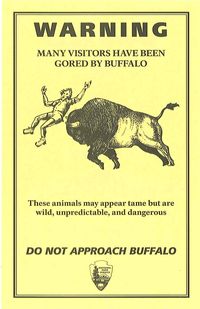
    Buffalo warning in Yellowstone National ParkTheir cattle-like appearance lulls people into forgetting that these are wild animals, and the parks department includes warnings in their literature to keep your distance. The males weigh up to 2,000 pounds and can run over 30 mph. Both genders have horns. More people die from bison goring than bear attacks, because people think these quietly ambling animals are harmless. I heard a story of someone putting their child on a bison’s back for a photo.

    The only hint at aggression we saw was a male defending his chosen mate. He never left her side, quietly chuffing sweet nothings into her ear, sniffing her, nibbling her side. But if another male came too close, he lowered his head and grumphed at them. I was glad the others gave way. Michael Lanza (in Before They’re Gone) has compared a charging bison to a grand piano sprouting horns and moving at the speed of a race-horse. I did not want to see two grand pianos collide.

    We got more up-close and personal when we ran into a bison jam; cars were stopped in the middle of the road not because people were stopping to watch wildlife, but because a herd was crossing the road, with some of the animals simply standing in the midst of traffic. A few got within ten feet of us, close enough that we could see the patchiness of their fall coats and hear their munching as they pulled up grass by the roadside.  

    Our most intimate experience of bison was tactile. In a couple of visitor centers, we could bury our fingers in the thick, wiry fur of preserved hides, feel the heft of their horns, and examine their vertebrae. We learned that the hump on their shoulders is actually specialized musculature designed to keep bison moving in deep snow: they swing their heads back and forth like a plow, and the vertebrae in this area are elongated to support these massive muscles.

    Though the animals’ continued existence is history’s best tribute to Hornaday, Franklin Delano Roosevelt had a mountain in Yellowstone named for him. I could not leave without seeing it. Before departing the lodge on the morning of our quest, we asked a ranger for help locating the mountain. We had a map that showed the general spot, but I wondered if they could be any more specific. The ranger had not heard of Mt. Hornaday, but she wanted to be helpful, so she looked it up in a reference book and sure enough there it was with a short bio of the man. I filled her in on the rest of the story and why I wanted to see this mountain so badly. Because I had told her something she didn’t know about the park, she awarded me a “Junior Park Ranger” sticker, which is one of my favorite souvenirs.

    Junior Park Ranger Badge, Yellowstone National ParkMy husband used his GPS to locate the mountain but it wasn’t really visible from the road, so we took an unplanned hike up Pebble Creek Trail to reach a high enough elevation to see the 10,000-foot peak named for my new hero. The trail was more than I had bargained for, and we were low on water. I wanted to give up, but Alex urged me on and only a couple of miles later we reached a clearing that gave us the perfect of view of the adjacent summit we were after!

    Since then, I have kept up with bison news and goings-on in the West. One of the most exciting recent stories has been the reintroduction of Yellowstone bison to the Fort Peck Indian Reservation. The Yellowstone bison are among the last genetically pure, wild bison (others have been interbred with cattle on ranches). They are the direct descendants of the last few survivors of the genocide, and about 60 of them have now been returned to the prairies of Montana, under the care of their original Plains cohabitants. Since the move, five new calves have been born to the herd, their little hooves aerating the tall-grass prairies that have not felt their tread in over a century.

  • Today's post is from Carole Joffe, author of Dispatches from the Abortion Wars: The Costs of Fanaticism to Doctors, Patients, and the Rest of Us. Joffe is a professor in the Bixby Center for Global Reproductive Health at the University of California, San Francisco (however, the views and opinions expressed here do not necessarily state or reflect those of the Regents of the University of California, UCSF, or the UCSF Medical Center). This post originally appeared at RHRealityCheck.

    “…there is now an unprecedented and sweeping legal assault on women’s reproductive rights. New legislation is being introduced, and sometimes passed, in state after state that would roll back access to abortion and contraception, mainly by intruding on the relationship between doctor and patient…..But where are the doctors? They have been strangely silent about this legal assault, even though it directly interferes with medical practice.”

    Bigstock-Ultrasound-scan-of-a-woman-s-p-26193497The above statement is important not just because of the insightful words being said, but because of who is writing these words, and where these words are published. The writers are Marcia Angell and Michael Greene, and the piece they wrote on current abortion restrictions appears in USA Today, the newspaper with the largest circulation in the United States. Dr. Angell, a senior lecturer at Harvard Medical School, is the former editor-in-chief of the New England Journal of Medicine; Dr. Greene is professor of obstetrics, gynecology and reproductive biology at Harvard Medical School and chief of obstetrics at Massachusetts General Hospital.

    Why do the credentials of the writers, and the place of publication, matter? The significance of these issues becomes clear if one takes into account the longstanding marginalization of abortion — and abortion providers — in the United States. As I learned in researching a book on the first generation of doctors who provided abortion after Roe v Wade, these pioneers acutely felt their isolation from mainstream medicine. Most hospitals did not establish abortion services, most professional organizations did not set guidelines for abortion care, very little training of residents in abortion procedures was taking place, and many individual providers told me of sanctions they experienced because of their involvement with the abortion issue. I heard numerous stories of academic advancement denied, difficulty in getting research published, but perhaps most poignant of all, the lack of colleague-ship they felt with their fellow physicians. As I speculated, the memories of the “back alley abortionists” were still so strong in the period immediately after Roe that even ethical and competent doctors, such as those I interviewed, were tainted with that legacy. In short, a majority of physicians then (as now) have supported legal abortion — but there was less support for the abortion provider.

    To be sure, much has changed for the better since 1973 in U.S. medicine with respect to abortion. The number of training sites has considerably improved; such technological developments as medication abortion (formerly known as RU-486) and an improved device for Manual Vacuum Aspiration have brought many primary care doctors and, where legally permitted, nurse practitioners, midwives and physician assistants to offer early abortion care; perhaps most importantly, organizations such as Medical Students for Choice and PRCH (Physicians for Reproductive Choice in Health) have facilitated collegial contact between numerous clinicians who go on to become abortion providers, or who are already doing so, and clinicians in other fields who, while not performing abortions themselves, firmly support those who do.

    However, while the stigma surrounding abortion within medicine may have lessened, in the larger society it has only worsened — as we see from the unprecedented number, and character, of the restrictions proposed in the last year and a half. In fact numerous states even mandate that abortion patients be told misleading or downright untrue facts, such as the links between abortion and breast cancer or infertility — while a number of states have passed, or are proposing, laws that shield doctors from lawsuits if they withhold accurate information, such as the results of prenatal diagnosis that might lead a pregnant woman to seek an abortion.

    JoffeBack to the forceful statement by Drs. Angell and Greene. They are not the only voices within medicine to object to these egregious measures. The Pennsylvania Medical Society and the Wisconsin Medical Society, for example, are on record as opposing restrictive laws in those states because they interfere with the doctor-patient relationship. Dr. Pippa Abston, a pediatrician in Alabama, has become an outspoken critic of Alabama's mandated ultrasound law, speaking at rallies and making a video of her opposition, and others have voiced objection as well.  But given the cultural stigma that now surrounds abortion, the fact of two high profile physicians at one of the country’s leading medical institutions, speaking out in such a widely read newspaper, is a particularly welcome blow against the legislative persecution of abortion providers. To me, it is especially encouraging, given the past marginalization of this field that I have described, that the two physician-writers have not themselves built careers around abortion.

    Angell and Greene mince no words in denouncing the assault on medical ethics that such laws represent, and make clear their understanding that the stakes in these battles go well beyond abortion care. “Physicians…have ethical commitments to patients that they cannot and should not be required by state law to set aside. Prominent among them is the responsibility to place the welfare of their patients above all other considerations.”  But their statement does not only call for the proper treatment for patients. They end their piece with a call for the relevant medical professional organizations — too timid till now, in their view — to support their members who are caught in this war on those who serve women.

  • STREITMATTER-OutlawMarriages

    For more than a century before gay marriage became a hot-button political issue, same-sex unions flourished in America. Pairs of men and pairs of women joined together in committed unions, standing by each other “for richer for poorer, in sickness and in health” for periods of thirty or forty—sometimes as many as fifty—years. In short, they loved and supported each other every bit as much as any husband and wife.

    In Outlaw Marriages, cultural historian Rodger Streitmatter reveals how some of these unions didn’t merely improve the quality of life for the two people involved but also enriched the American culture.

    Among the high-profile couples whose lives and loves are illuminated in the following pages are Nobel Peace Prize winner Jane Addams and Mary Rozet Smith, literary icon Gertrude Stein and Alice B. Toklas, author James Baldwin and Lucien Happersberger, and artists Jasper Johns and Robert Rauschenberg.

    Read the prologue at Scribd. 

    Read a review of Outlaw Marriages at Edge. 

    Couples featured in Outlaw Marriages:

    Walt Whitman & Peter Doyle
    America's most influential poet found his muse for in a young conductor on a horse-drawn streetcar.  

    Martha Carey Thomas & Mamie Gwinn
    Thomas created the first graduate program for women in the United States at Bryn Mawr College, but counted on her partner for assistance with many of her academic duties. 

    John Marshall & Ned Warren
    The Museum of Fine Arts in Boston and the Metropolitan Museum of Art in New York City both owe a great debt to these intrepid collectors of antiquities.  

    Jane Addams & Mary Rozet Smith
    The first American woman to win the Nobel Peace Prize, Addams shared her life and work with her partner of more than four decades, a woman from a wealthy family who helped keep Hull House afloat. 

    Bessie Marbury & Elsie de Wolfe
    Elsie de Wolfe is widely recognized as the founder of the field of interior design. Bessie Marbury was a highly successful theatrical agent, as well as the woman who made a series of suggestions to de Wolfe that led to the interior designer becoming a pioneer in her field. 

    J. C. Leyendecker & Charles Beach
    America's most popular and successful illustrator in the early decades of the twentieth century, Leyendecker drew on his partner of fifty years for inspiration and guidance in his work.  

    Gertrude Stein & Alice B. Toklas
    Gertrude Stein was an avant-garde author as well as a literary mentor for such legendary writers as F. Scott Fitzgerald and Ernest Hemingway. Alice B. Toklas took it upon herself to see that Stein’s works got into print, becoming not only her partner’s editor but also her literary agent and publicist. 

    Janet Flanner & Solita Solano
    For fifty years, Janet Flanner served as the Paris correspondent for the New Yorker. But it was Solita Solano who encouraged her to move to Europe to jump-start her career in journalism.

    Greta Garbo & Mercedes de Acosta
    Screen legend Greta Garbo was the daughter of poor Swedish laborers, but her partner taught the actress how to dress and speak like Hollywood royalty. 

    Aaron Copland & Victor Kraft
    One of America's most celebrated composers, Aaron Copland was honored with a Pulitzer Prize, an Academy Award, and a Presidential Medal of Freedom. His relationship with a free-spirited and troubled violinist took his work in bold directions.  

    Tennessee Williams & Frank Merlo
    Frank Merlo weaned Tennessee Williams off a diet of drugs and casual sex so the playwright was able to create his Pulitzer Prize-winning drama Cat on a Hot Tin Roof.

    James Baldwin & Lucien Happersberger
    An unconventional but long-lasting relationship helped Baldwin find the stability he needed to become one of the most important writers of his generation. 

    Jasper Johns & Robert Rauschenberg
    Robert Rauschenberg urged Jasper Johns not to ignore a bizarre dream he had but instead to act on it and paint the American flag-as he had done in the dream. 

    James Ivory & Ismail Merchant
    Ismail Merchant and James Ivory were widely recognized, during the final decades of the twentieth century, as setting the gold standard when it came to adapting iconic novels into high-quality motion pictures. Among their best-known works are A Room with a View and Howards End—both films won multiple Academy Awards. 

    Audre Lorde & Frances Clayton 
    Frances Clayton gave up tenure at an Ivy League university to help her partner, Audre Lorde, reinvent herself as a pioneering poet who gave voice to women of color around the globe. 

    About the Author: Rodger Streitmatter, a former newspaper reporter, is a member of the School of Communication faculty at American University. He lives in Washington, D.C., with his husband, Tom Grooms.

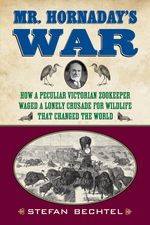
  • BECHTEL-MrHornadaysWarMr. Hornaday's War is a long-overdue bigoraphy of William Temple Hornaday, first director of the Bronx Zoo, who helped launch the American conservation movement. 

    He was complex, quirky, pugnacious, and difficult. He seemed to create enemies wherever he went, even among his friends. A fireplug of a man who stood only five feet eight inches in his stocking feet, he began as a taxidermist and an adventurer who tracked tigers in Borneo with friendly headhunters, lead crocodile-hunting expeditions in the Orinoco, and scouted the last remaining bison in the Montana territories.

    William Temple Hornaday (1854-1937) was also a man ahead of his time. He was the most influential conservationist of the nineteenth century, second only to his great friend and ally Theodore Roosevelt. When this one-time big-game collector witnessed the wanton destruction of wildlife prevalent in the Victorian era, he experienced an awakening and devoted the rest of his life to protecting our planet's endangered species. Hornaday founded the National Zoo in Washington, D.C., served for thirty years as director of the renowned Bronx Zoo, and became a fierce defender of wild animals and wild places. He devoted fifty years to fighting gun manufacturers, poachers, scandalously lax game-protection laws, and the vast apathy of the American public. He waged the "Plume Wars" against the feathered-hat industry and is credited with having saved both the Alaskan fur seal and the American bison from outright extinction.

    Mr. Hornaday's War restores this major figure to his rightful place as one of the giants of the modern conservation movement. But Stefan Bechtel also explores the grinding contradictions of Hornaday's life. Though he crusaded against the wholesale slaughter of wildlife, he was at one time a trophy hunter, and what happened in 1906 at the Bronx Zoo, when Hornaday displayed an African man in an "ethnographic exhibit," shows a side of him that is as baffling as it is repellant. This gripping book takes an honest look at a fascinating, enigmatic man who both represented and transcended his era's paradoxical approach to wildlife, and who profoundly changed the course of the conservation movement for generations to come.

    STEFAN_BECHTEL-IMG_0954c-Peggy_HarrisonAbout the author: Stefan Bechtel is the author of ten previous books. A founding editor of Men’s Health magazine, his work has appeared in Esquire and the Washington Post, among other publications. 

    “Stefan Bechtel’s Mr. Hornaday’s War is essential for anyone interested in U.S. conservation history and the wildlife protection movement. Not only did William T. Hornaday save the bison from extinction, but he is also the spiritual progenitor of today’s Endangered Species Act. Every zoo in America should erect a statue of the larger-than-life Hornaday. Bechtel has [my] unstinting admiration for writing such a smart, thoroughly researched, landmark biography. A gaping deficit in our understanding of progressive era ecological warriors has been filled.” — Douglas Brinkley is Professor of History at Rice University and author of The Wilderness Warrior: Theodore Roosevelt’s Crusade for America

    Read "The Last Buffalo Hunt," Chapter 5 from Mr. Hornaday's War

    Watch an interview with author Stefan Bechtel.

  • Amy Seidl is an ecologist and teaches at the University of Vermont. She is the author of Finding Higher Ground: Adaptation in the Age of Warming and Early Spring: An Ecologist and Her Children Wake to a Warming World. 

    Bigstock-Fern-4985007Last Mother’s Day, I woke to a rainy, chilly day, one that nonetheless began nicely with breakfast in bed­—poached eggs and toast, tea, and a cupful of my own coconut yogurt. “What next Mom?” four year-old Helen asks. “I’d like to walk in the woods.” I say. “Let’s check in on the spring flowers, the migratory songbirds, and newly unfurling ferns. Maybe collect some wild leeks for dinner.” “It’s raining,” they complain. “But it’s Mother’s Day,” Dad replies firmly.

    We dress and prepare to leave the house for a local trail. Helen chooses her own wardrobe for the rainy outing—Crocs, a pair of tights under a summer dress, and her favorite hat with a butterfly stitched in the front. An hour later, we are all damp to the skin and heading for home to light a fire and make tea. But we have managed to hear and see the rose-breasted grosbeak, to identify four species of fern, to marvel at the rare white trillium, and to collect a handful of wild leeks. Not a bad catch for a raw, 40-degree day.

    Then the idea of a matinee comes up. We check Netflix: Earth and Monsters vs. Aliens emerge as options. The four of us crowd around the laptop to watch the previews. Mother/infant pairs of humpback whales swim in an immense ocean, elephant herds famous for their bonding are tracked across Africa, and baby polar bears—the icons of climate change—nurse from their mother’s teats before exiting icy dens and encountering an all-too bright and warm world. James Earl Jones’ voice draws me like a preacher, but the children grumble, “We’ve seen all this on Planet Earth.”

    Next we preview Monsters vs. Aliens. Ginormica, the 10-story tall monster with Disney eyes to die for, is skating across the San Francisco Bridge while a genetically-engineered blue tomato swallows highway medians and extraterrestrial aliens land in Modesto, bent on capturing the speck of a planet the locals there call Earth. The trailer is hilarious, funny, silly, and captivatingly colorful.

    Can we make a film that addresses a future affected by climate change as captivating as sci-fi monsters saving humanity from aliens? As good a question is, should we?

    I raise my children in a TV-free household. Much of our media comes through the radio, and Celia knows to turn the NPR station off when the news of a car bombing or other inappropriate material is aired. My children receive National Geographic and National Geographic Kids Magazine, along with an occasional catalog. We take weekly trips to the library for story hour and kids book group. But by and large my husband and I deftly censor the entrance to media, opening doors to information we deem suitable and in keeping with our values and closing doors to information that is contrary to our beliefs –violence, a culture of consumption, and the overly sexualized characterization of girls and women being chief among them. (Does the Title 9 catalog fall into this category? I’m still deciding…surely the Athleta one does.)

    Still, it isn’t difficult to see where the marketers are making inroads. Scholastic Book Sales at the school introduce Hannah Montana, books featuring TV characters, and cheap gadgets and toys. The library at my daughter’s small school (6 grades and 130 children) now carries American Girl Magazine, a newly created zine full of tween marketing strategy, with articles on room redecorating and birthday party themes. Even though my children are not seeing the 100 commercials a day viewed by TV-watching children, the $15 billion spent each year on advertising and marketing to children manages to pervade even the most “gated” households. My point is that I’m finding it increasingly hard to instill positive values—ones that resonate with the message of why, for instance, we need to stop climate change—in the context of a consumer culture that explicitly targets children.

    8499While we may want to educate our young about climate change—explaining why there is no pond hockey at Christmas, or why the hollyhocks that used to bloom around my daughter’s birthday are now blooming well before, or why we are walking 8 miles down Vermont’s Route 7 with a thousand other people carrying signs that read “Save our Syrup”—we need to do it in the context of a culture that is just waking up to the certainty that climate change is happening. Happening now.

    Children are wise. But they also have short attention spans. From my own experience I know that when I go down the path of overtly educating my children about global warming, often triggered by an extreme weather event like March’s heat wave, I am likely to hear one of the following: “Can I have a play date?” (Helen) or “I’m going to go ride my bike” (Celia). This is not to say that they aren’t taking the information in, aren’t mulling it over while they shift into low gear to get up the hill. But what I realize is that children orient themselves toward fun; a little bit of sober information goes a long, long way.

    Enter the marketers who understand that fun for children is what it’s all about; colorful fun—crazy blues, electric greens, hilarious yellow—silly and giddy and popping-out fun. Like the eyes on Ginormica, the spandex-clad star of Monsters vs. Aliens. Every bit animated and every bit sultry, Ginormica hits, neurologically speaking, the bull’s eye for every child’s attention.

    As adults concerned about global warming, what we want is for our message to be factually accurate, long-lived, one that serves to evolve a new set of values, or to strengthen values already in place. But I believe the message has to on some level be enjoyable too, something people want to be a part of, something kids want to do. 

    8584I don’t have an answer here except to say that marketing and our own literacy in it has to be part of the equation. The messages we give to our children land in a greater context than the one we create in our households; parents of children older than mine can attest to the superpower strength of these other contexts. They are powerful, and highly strategic, as Juliet Schor concludes in her book Born to Buy on how advertising and marketing sells to children. But our messages are powerful too. And they can be more powerful with better strategies.

    Talking with children about climate change is in essence talking to ourselves about our own stewardship of the planet. The response to the facts, in our minds as well as theirs, quickly becomes, “Why do we keep emitting greenhouse gases knowing what we do?” or “What are we doing to stop global warming?” The fact is we are collectively complicit and therefore collectively responsible to come up with solutions, ones that will define our future.

    I would have much preferred to watch the nature documentary on Mother’s Day, so I wasn’t in a great mood after watching my daughter’s choice of film. I won’t give away the ending of the movie, but suffice to say the monsters go up against an even larger crisis than climate change, an unwinnable one. But when I put Helen to bed that night, tucked her in against the raw chill that had continued into the evening, she recited the four species of fern we’d learned on our walk: oak, marsh, sensitive, and lady. 

    Fern photo from Bigstock.

  • By Kate Whouley

    WhouleyWe are so many people in our lifetimes.

    We are babies, toddlers, children, teenagers. We are young people, flirting with option and opportunity. We explore, winnow, commit, arrive. We settle on an acceptable version of ourselves. For ten, or fifteen, or even twenty years, we believe: I am this person; this person is me. Then one day, we turn up middle-aged. This surprises us. We begin to make adjustments, attempt to match our inner and our outer images. We realize that we’re growing—damnit—old. Soon enough, we are really old, and—if we are lucky—ancient. And yet we don’t feel ancient inside—because all those people we have been—well, they won’t go quietly.

    As a writer, I am obsessed with the rag-tag parade that lasts a person’s lifetime. I want to know and memorize all those past, present and future variations—in myself, but especially in others. I love the process of sharing stories, for in stories, we meet the selves we cannot see—lined up single-file, in the lives of new friends. Sharing stories, we remind old friends that we once were young—or at least, younger. Sharing stories, we keep the memories—and all our human variations—alive. If we are doubly blessed, there may be people in the world who can tell us stories of our childhoods, and children in our lives who will one day ask us to tell them about the day they were born.

    Still, over-linking our identities to our stories has its downside. What happens when you can’t remember the stories? With the loss of memory, are those versions of ourselves disappeared? 

    My mother—who was diagnosed with a combination of vascular dementia and Alzheimer’s disease—taught me that it is possible to forget who we once were—and even to forget who we are now. But while an organic brain disease may prevent the remembering, it doesn’t halt the parade of selves. Even as her disease progressed, my mother emerged anew. For a time, her humor carried an edge. Her moods were volatile, and she was prone to angry outbursts—directed mostly at me. But she could not sustain the anger when she began to forget what—or who—was making her mad. In time, my mother emerged from a chrysalis of fear, confusion and anger to become a chatty, smiling social butterfly. She grew lighter; losing track of her old selves, she was free of bad memories and troubled times. She laughed more often–that same, full-throated, honest laugh she laughed when I was a kid. The laugh I can still hear.

    My mother, at that point, could be prompted to recall her early variations, and taking a cue from her forgetting, I told her stories of good times, reminded her of former glories. She would smile, nod, express admiration for her younger self and her achievements, which were not inconsiderable. Remembering is what I did for my mother—not just the big life-event sort of remembering, but the putting-on-a-coat-because-it’s cold outside remembering, too. It’s the second kind of remembering—because of the second kind of forgetting, that is actually harder on everybody.

    Early in my mother’s journey into Alzheimer’s, I fought for her memory, concerned with all those past, now-lost versions of the woman I knew. In time, I gained some altitude—a new perspective and a kind of grace. I learned to live life her way: moment to present-moment.

    “It’s a blessing,” unthinking, well-meaning people told me, when my mother passed away, “that she died while she still knew you.”  

    Really?

    I would give up recognition for a living, pain-free, forgetful mother any day. I’d be willing, every day, to spin the yarn of her own life for the woman who always loved a good story.

    Like many mother-daughter relationships, ours was complicated. I did not love all the versions of my mother equally; yet I hope to honor all her selves when I remember them. But there’s something else my mother taught me—late in her life: forgetting them is okay too. I need not watch the parade. It feels great to sit with your eyes on the person in front of you. And sitting with my mother, knowing she had lost so many pieces of her life, so many memories of her former selves, I came to believe there is something permanent—or at least something transferable—that we carry with us. Something beyond the memory of our variations, beyond the sum of our experiences, beyond what we can express. Maybe, if we live with care—for ourselves and for others—we might manage to hold onto the metaphor we call our soul. May my mother’s rest in peace.

    About the Author

    Kate Whouley lives and writes on Cape Cod, where she also works as an independent consultant in the book industry. She is the author of Remembering the Music, Forgetting the Words: Travels With Mom in the Land of Dementia, and Cottage for Sale, Must Be Moved.