• Roe v. Wade was decided on January 22, 1973, making it thirty-nine years old this weekend. In today's post, Carole Joffe looks at how the abortion debate remains one of the hot-button political issues in America today. Joffe is a professor emerita of sociology at the University of California, Davis, and a professor at the Bixby Center for Global Reproductive Health at the University of California, San Francisco. She is the author of Dispatches from the Abortion Wars: The Costs of Fanaticism to Doctors, Patients, and the Rest of Us, Doctors of Conscience: The Struggle to Provide Abortion before and after Roe v Wade, and numerous other writings on abortion provision. 

    This post originally appeared in On the Issues magazine.

    Bigstock_MESA_AZ_-_FEBRUARY___Presid_19852100

    What about abortion gives it staying power as the central issue in domestic politics, even in the period of the worst economic situation since the Great Depression of the 1930s? This is a question well worth pursuing.

    I sounded a much more hopeful note in my recent book, Dispatches from the Abortion Wars. The book was started in the administration of George W. Bush, a particularly harsh time for the reproductive justice community. I finished the book in the first months of the presidency of Barack Obama, ending on a note of "cautious optimism" about a turnabout for the fortunes of reproductive health services and particularly for the provision of abortion. Candidate Obama, after all, had forcefully voiced his support for legal abortion, and nothing — at the time — seemed to be worse than the endless attacks on reproductive health services (not just abortion, but family planning , sex education, condom distribution for HIV patients and more) that were a key feature of the Bush presidency.

    Quoting from the distinguished historian Carroll Smith-Rosenberg's work on an earlier period of abortion conflict in 19th century America, I even speculated that we might be entering a period in which abortion and related issues would no longer be "the central drama of (our) culture." Given the devastating recession that had already become very evident around the time of the 2008 election, I, like many others, reasonably thought that the economy would in fact become the "central drama."

    JoffeBut very soon after the 2008 election, it became very clear that social conservatives were not going away. On the contrary, they seemed more energized than ever. It also became clear that Obama the president was not going to be the forceful defender of reproductive rights that many of his supporters, including myself, had fantasized. Indeed, as early as January 2009, in his first weeks in office, reproductive politics emerged as a factor in the stimulus debates, and the new president blinked. The President's proposal had included a modest provision that allowed states to spend more Medicaid funds on family planning. The Republican House of Representatives leader, John Boehner, publically mocked this provision, asking incredulously what "spending millions for contraceptives" had to do with "fixing the economy." The provision was quickly dropped.

    And, of course, many reproductive rights supporters are still smarting over Obama's key concessions to anti-abortion forces, particularly the Catholic Church, in order to win support for his health reform legislation. By late 2011, it was still unclear whether Obama would again cave to the Church's demands for very broad exemptions to the requirement that health insurance plans, under Obama's health legislation, provide contraception without co-pays. But while that was pending, the reproductive health community was stunned when, in a clear bow to politics, the Obama Administration took the unprecedented step of overruling the head of the U.S. Food and Drug Administration and rejecting the agency's recommendation that Emergency Contraception be made available without a prescription to women under the age of 17.

    How the Wedge Works

    My purpose in this essay, however, is not to simply catalogue all the disappointments that reproductive health advocates have suffered in the Obama administration, an indictment that has been done very well by others. (For the record, an unequivocally positive step that has occurred in the Obama presidency is the Department of Justice's vigorous enforcement of the FACE legislation that protects providers and patients from anti-abortion terrorism, an effort that far outstrips such activity by the Justice Department in the Bush years.)

    Despite my hopeful predictions, abortion has maintained its dominance as a wedge issue. This is reflected in the various bills put forward by the new Republican majority in Congress after the November 2010 mid-term election, for example the Orwellian-named "Protect Life" Act, which stipulated that hospitals did not have to offer abortions to women, even in life-threatening situations.

    Similarly, in state houses across the country after that pivotal election an unprecedented number of abortion restrictions were introduced by Republican legislators, including bans on abortion after 20 weeks, which clearly violate the Roe v. Wade decision and were intended, in the eyes of many observers, to lure pro-choice lawyers into a test case that could possibly overthrow that landmark ruling. Finally, as politicians compete to be the Republican nominee in the 2012 presidential race, the ante has been raised: in this election cycle, to be acceptable to the anti-abortion base, and to compete with each other, candidates must make clear their opposition to rape and incest exceptions and declare their agreement that "life begins at fertilization."

    It is actually not surprising that Republican politicians at all levels insist on keeping abortion front and center, the economic crisis notwithstanding. Abortion is not only the best arrow in these politicians' quivers, in terms of pleasing a crucial segment of the Republican base — it is arguably the only arrow they have. The reality, as has become evident since Obama's election, is that the Republican party is tied to economic policies — opposition to infrastructure spending, fanatical devotion to tax cuts for the most wealthy – that will not create jobs, but, in fact, will destroy them. So abortion has, once again, as I termed it in my book, become a "brilliant distraction" from pressing social problems.

    For me, the more complicated — and fascinating — question is: Why do voters put up with this endless assault on abortion and contraception (and the corresponding neglect of the economy)? Why, for example, is there seemingly no price to be paid by a politician who is on record as saying its okay for a woman with an ectopic pregnancy to die?

    The first, most conventional, answer is that the U.S. is a deeply apolitical country, with a notoriously low voting turnout, compared to other countries. Politicians therefore can take actions that speak to the minority of voters who are deeply engaged, and be confident that the rest of the country is not paying attention. A variant on this general political apathy is that the abortion issue, in particular, has been so divisive and raucous, for so long, that voters simply tune out abortion-related political news, assuming a "pox on both their houses" stance.

    In contrast, a third intriguing possibility is that the public's backlash against Right-wing overreach may, just may, finally be at hand. The recent defeat, by a substantial margin, of the "fertilized-egg-as-person" amendment in Mississippi, a highly conservative state where the measure was widely predicted to pass, is suggestive of this. Furthermore, the "defund Planned Parenthood" campaigns, avidly pursued by Republicans both in Congress and in a number of states, have polled very badly with the public. Certainly, in April 2011, when Obama refused to bend to John Boehner's demand that cutting Planned Parenthood and other family planning programs be part of budget negotiations, the president gained — not lost — political capital.

    It is, to be sure, demoralizing from a reproductive justice viewpoint, that it takes such surreal proposals as making fertilized eggs the moral and legal equivalent of living women, and the all-out demonization of birth control, nearly 50 years after the Supreme Court decision legalizing its use, to make the American people wake up to the threats posed by the fanatics of the Right, and the cynical politicians who do their bidding. And it may well be that these extremist proposals — rather than causing a backlash — will make more "normal" restrictions on abortion and contraception look reasonable.

    So Bad That It's Good?

    But the favor that the zealots now in ascendancy in social conservative circles — that is, those who oppose all sexual activity except procreative sex within heterosexual marriage — may have given us is the broad sweep of their proposals. In a society that is marked by deep economic inequality, it is hardly surprising that those women most affected by the assaults on both abortion and contraception are disproportionately poor women of color — that is, those who have the least political, as well as economic power, and who are most vulnerable to cuts in public services. The unfortunate reality is that, while many of those in the reproductive justice movement work tirelessly on behalf of these women, most in this society — including other women who also use reproductive health services — worry little about these marginalized women. Nonpoor women have long been able to assume that contraception and abortion will always be available, as long as one has the means to purchase them.

    In that sense, the Mississippi egg-as-person amendment, and similar efforts planned elsewhere, may truly be serving as wake-up calls for the electorate. For it was not just abortions (including lifesaving ones) that were on the line — but most forms of contraception and IVF treatments (a service that, almost by definition, implies a well-to-do clientele).

    Just as the Occupy Wall Street movement has brilliantly framed the economic inequality in the U.S. as existing between the one percent of the super-wealthy and the remaining 99 percent of the population, the current battles in reproductive politics reminds us of another 99 percent — those American women who have ever used birth control in the context of heterosexual sex. The reproductive legacy of the Obama years may well be this huge group's recognition of itself as a political community. Again, I am cautiously optimistic.

    Photo of President Obama from Bigstock.

  • Today's post is from Jay Michaelson, author of God vs. Gay? The Religious Case for Equality. Michaelson is a writer, scholar, and activist whose work addresses the intersections of religion, sexuality, spirituality, and law. 

    This post originally appeared at Huffington Post. 

    Bigstock_Rainbow_1215454
    Our national conversation about equality for LGBT people can often be, well, nasty. Opponents of "gay rights" routinely compare us to perverts, accuse us of horrible things, and deny our very existence. Meanwhile, to many religious people, gay folks really do threaten their understanding of the proper relationship of religion and society, morality and social order. It can be painful on both sides.

    Yet I want to suggest that this debate is good for us as a society, and good for religion, specifically. As more religious communities, especially conservative ones, recognize the existence and humanity of LGBT people, they are forced to engage in the sort of critical thought and introspection that makes religion worthwhile in the first place. This is a good thing.

    We grow as religious people through an unlikely combination of courage and humility. It takes courage to question one's opinions, and humility to recognize that we may not be as right as we thought. As St. Paul says in I Corinthians 13:11, "When I was a child, I talked like a child, I thought like a child, I reasoned like a child. When I became a man, I put childish ways behind me." We're not meant, religiously speaking, to remain as ethical babies. We're called to something more than that.

    All of us who make religion or spirituality part of our lives are accustomed to the process of introspection. Whether we attend confession, or review our lives as part of the annual cycle of Rosh Hashanah and Yom Kippur, or have heart-to-heart conversations with Christ, or enter periods of contemplation and discernment when we try to understand what course of action is the right one, or engage in any number of other procedures of self-examination and review, those of us involved in religious communities or spiritual practice are invited, time and again, to look inward.

    We are even asked to reflect on our reflection. After all, introspection is not entirely interior in nature. Our hearts and minds are informed, saturated, even, by the values we learn from our sacred traditions and the world around us. We all know this to be true, which is one reason so many believers choose to separate themselves from the world at large. But do we acknowledge the depth to which it is true? Even on a gut, instinctual level, our very hearts and minds are shaped by assumptions and judgments that may be so familiar that they pass unnoticed. And these assumptions are culturally determined: show a picture of a dog to someone born into a Western society, and they may think "pet," and possibly feel affection. Show the same picture to someone born into some traditional Asian societies, and they think "food," and feel hungry.

    6a00e54ed2b7aa883301539298f5f4970bNotwithstanding all the common-sense advice to "trust your gut," really, our guts are not trustworthy at all and must instead be tempered by love and reason. All animals have gut reactions, after all. But only humans (and perhaps a few others, in more limited ways) are able to reason beyond them. The "gut" may contain intuition and wisdom, but it's not the sum total of humanity. We are blessed with the ability to rise beyond our gut reactions — as some religious traditions put it, we have sparks of God within us. (Or, as some neuroscientists put it, we have pre-frontal cortexes that can mediate the impulses of the amygdala.) And we all know from experience that we can feel something in our gut and still be wrong. The process of educating the moral conscience, of growing up religiously and ethically, is, in large part, the process of applying love and reason to what we think we already knew. Love teaches us how to think justly.

    This is how moral progress takes place, I think. We learn to stop trusting the gut reactions based on falsehoods we've been taught. And it is one of the gifts that our national wrestling with the question of equality for LGBT people gives to each of us. It is an invitation to be uncomfortable, because discomfort is a sign of growth; it's a sign that you've reached your learning edge, where assumptions may be challenged and difficult lessons may be learned.

    Let me share a bit of my personal story for a moment. I was raised to believe that being gay was about the worst thing in the world. Before I even knew what a "faggot" was, I knew I didn't want to be one, because it was what you called kids you wanted to degrade — "Gay Jay" was the one name that I'd try to beat someone up over. Eventually, I learned what these words meant, and, years later, that they did in fact apply to me. My first response? Horror, terror, hatred, denial. I postponed coming out, for fear that it would end my religious life and alienate everyone I knew. I tried desperately to evade the truth myself. And why? Because I felt in my deepest guts that this way of intimate relation was wrong, disgusting, depraved.

    Thanks to years of love, activism, therapy, and, above all, meeting hundreds of people who have shown the stereotypes I learned as a child to be wrong, I no longer feel this way. And yet I meet people in my work who are right back at square one, still repulsed by their own sexuality. And I meet devoutly religious people who, indeed, feel that revulsion deep inside… in their kishkes, their guts. It's easy to condemn right-wing loons as ignorant bigots — but really, how different is what they feel from what I myself felt? I understand their hatred, because I once felt it myself.

    And the journey has a way of continuing. One may be comfortable with some gay men, but not with "effeminate" gay men. With lesbians, but not "butch" lesbians. Or not with transgender people. Or not with people who reject the gender binary and locate themselves somewhere in the middle of a gender continuum. And so on. Rather than see this as an unending litany of PC requirements, I want to invite an attitude of joy that there are always assumptions in need of being defeated. Yom Kippur may come but once a year, and confession once a week — but every encounter with an "other" is an occasion for growth and renewal.

    In other words, feeling uncomfortable is a sign that you're where you need to be: working through your "stuff."

    Imagine if you didn't do that. In past decades, our country kept racist laws on the books because privileged white people like me felt the rightness of them in our guts. But guts should never be the end of a moral conversation. If religion has taught us anything, it is that there is a moral value in transcending our baser instincts — and that includes the snap judgments all of us make all the time. At first, and maybe for a while, these corrections along the course of moral conscience may not "feel right." But they are the defining marks of our humanity. Discomfort can be a good sign not just for the individual, but also for entire communities and societies.

    I have seen this process unfold hundreds of times regarding LGBT issues. The organization PFLAG, for example — Parents and Friends of Lesbians And Gays — is largely made up of folks who have traveled this journey, from rejection to acceptance to embrace. These are ordinary people, not gay activists and not gay themselves, who once had strongly anti-gay views, for whatever reason, but who were forced to reexamine those views when people they loved came out as gay or lesbian.

    This journey is a painful one, but it is also crucial. It is the unfolding of the moral conscience, and it is, in my opinion, humanity at its very best. We should be grateful for it.

    Rainbow photo from Bigstock. 
  • 0743

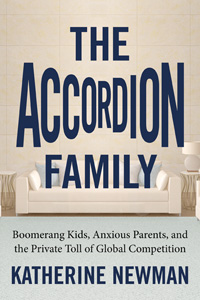
    Why are adults in their twenties and thirties boomeranging back to or never leaving their parents' homes in the world's wealthiest countries? 

    Why are adults in their twenties and thirties boomeranging back to or never leaving their parents' homes in the world's wealthiest countries? Acclaimed sociologist Katherine Newman addresses this phenomenon in this timely and original book that uncovers fascinating links between globalization and the failure-to-launch trend. With over 300 interviews conducted in six countries, Newman concludes that nations with weak welfare states have the highest frequency of accordion families. She thoughtfully considers the positive and negative implications of these new relationships and suggests that as globalization reshapes the economic landscape it also continues to redefine our private lives. 

    "Combining personal interviews with careful analysis of economic trends, and paying close attention to differences in cultural values and political structures, Newman sheds new light on the complex trade-offs that recent changes in intergenerational relationships and residence patterns involve for young adults, their parents, and society as a whole." –Stephanie Coontz, author of The Way We Never Were: American Families and the Nostalgia Trap 

    "In this wide-ranging book, Katherine Newman shows that the ages at which young adults leave their parents' homes are rising in developed countries around the world. She brilliantly demonstrates that the global forces behind this change are everywhere the same but that each nation interprets it in its own cultural way. Newman's insightful presentation of the stories of accordion families challenges us to re-think what it means to be an adult today." –Andrew Cherlin, author of The Marriage-Go-Round: The State of Marriage and the Family in America Today 

    "With the unerring eye and keen insight that has become her hallmark, Katherine Newman identifies a previously unexamined casualty of the new global economy–the prolonged dependence of adult children on their families. The resulting 'accordion family,' as she calls it, is emerging all over the developed world due to declining job prospects for young people, increasingly expensive higher education, and the increasing costs of living on one's own. The responses to this trend–social, political, and economic–will shape generations to come. Brilliant and important." –Robert B. Reich, Chancellor's Professor of Public Policy at the University of California-Berkeley and author of Aftershock: The Next Economy and America's Future

    KnewmanKatherine Newman is professor of sociology and James Knapp Dean of the Krieger School of Arts and Sciences at Johns Hopkins University, and has taught at the University of California-Berkeley, Columbia, Harvard, and Princeton. Newman is the author of ten books on middle-class economic instability, urban poverty, and the sociology of inequality, including The Missing Class: Portraits of the Near-Poor in America.

    Read Katherine Newman on the New York Times Room for Debate blog: The Whole Family Under One Roof?


    Read the Introduction to The Accordion Family on Scribd

  • This poem written in honor of Dr. Martin Luther King, Jr. is from poet, activist, and scholar Sonia Sanchez—one of the most important writers of the Black Arts Movement. She is the author of numerous books, including Shake Loose My Skin: New and Selected Poems, where this poem appears.

    Frontispiece for Where-cropMorning Song and Evening Walk

                        1.

    Tonite in need of you
    and God
    I move imperfect
    through this ancient city.

    Quiet. No one hears
    No one feels the tears
    of multitudes.

    The silence thickens
    I have lost the shore
    of your kind seasons
    who will hear my voice
    nasal against distinguished
    actors.

    O I am tired
    of voices without sound
    I will rest on this ground
    full of mass hymns.

                            2.

    You have been here since I can remember Martin
    from Selma to Montgomery from Watts to Chicago
    from Nobel Peace Prize to Memphis, Tennessee.
    Unmoved along the angles and corners
    of aristocratic confusion.

    It was a time to be born
    forced forward a time
    to wander inside drums
    the good times with eyes like stars
    and soldiers without medals or weapons
    but honor, yes.

    And you told us: the storm is rising against the
    privileged minority of the earth, from which there is no
    shelter in isolation or armament
    and you told us: 
    the storm will
    not abate until a just distribution of the fruits of
    the earth enables men (and women) everywhere to live
    in dignity and human decency.

                            3.

    All summerlong it has rained
    and the water rises in our throats
    and all that we sing is rumored
    forgotten.
    Whom shall we call when this song comes of age?

    And they came into the city carrying their fastings
    in their eyes and the young 9-year-old Sudanese
    boy said, "I want something to eat at nite a
    place to sleep."
    And they came into the city hands salivating guns,
    and the young 9-year-old words snapped red
    with vowels:
    Mama mama Auntie auntie I dead I dead I deaddddd.

                            4.

    In our city of lost alphabets
    where only our eyes strengthen the children
    you spoke like Peter like John
    you fisherman of tongues
    untangling our wings
    you inaugurated iron for our masks
    exiled no one with your touch
    and we felt the thunder in your hands.

    We are soldiers in the army
    we have to fight, although we have to cry.
    We have to hold up the freedom banners
    we have to hold it up until we die.

    And you said we must keep going and we became
    small miracles, pushed the wind down, entered
    the slow bloodstream of America
    surrounded streets and "reconcentradas," tuned
    our legs against Olympic politicians elaborate cadavers
    growing fat underneath western hats.
    And we scraped the rust from old laws
    went floor by floor window by window
    and clean faces rose from the dust
    became new brides and bridegrooms among change
    men and women coming for their inheritance.
    And you challenged us to catch up with our
    own breaths to breathe in Latinos Asians Native Americans
    Whites Blacks Gays Lesbians Muslims and Jews, to gather
    up our rainbow-colored skins in peace and racial justice
    as we try to answer your long-ago question: Is there
    a nonviolent peacemaking army that can shut down
    the Pentagon?

    And you challenged us to breathe in Bernard Haring's words:
    the materialistic growth–mania for
    more and more production and more
    and more markets for selling unnecessary
    and even damaging products is a 
    sin against the generation to come
    what shall we leave to them:
    rubbish, atomic weapons numerous
    enough to make the earth
    uninhabitable, a poisoned
    atmosphere, polluted water?


                            5.

    "Love in practice is a harsh and dreadful
    thing compared to love in dreams," said a Russian writer.
    Now I know at great cost Martin that as we burn
    something moves out of the flames
    (call it spirit or apparition)
    till no fire or body or ash remain
    we breathe out and smell the world again
    Aye-Aye-Aye Ayo-Ayo-Ayo Ayeee-Ayeee-Ayeee
    Amen men men men Awoman woman woman woman
    Men men men Woman woman woman
    Men men Woman woman
    Men Woman
    Womanmen.

    On December 29, 2011, Philadelphia selected Sonia Sanchez as the city’s first Poet Laureate. A proud resident of Philadelphia since 1976, Mayor Michael Nutter called her the “conscience of the city.” As Philadelphia’s Poet Laureate, she is responsible for selecting and mentoring a Youth Poet Laureate, participating in spoken word and poetry events at City Hall and the Free Library of Philadelphia.

    Her most recent book of poetry, Morning Haiku, is available from Beacon Press. For a complete list of works by Sonia Sanchez, visit her website. Read more about her selection as Philadelphia’s Poet Laureate here, or visit Poetry Foundation.

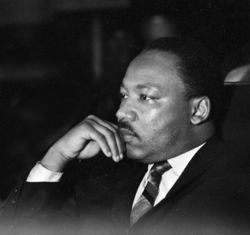
    Photo Credit: April 4, 1968:  Rev. Martin Luther King, Jr., just before making his final public appearance to address striking Memphis sanitation workers. King was assassinated later that day outside his motel room. (AP/Wide World Photos)

  • “Free at Last! Free at Last!”

    God grant that right here in America and all over this world, we will choose the high way; a way in which men will live together as brothers. A way in which the nations of the world will beat their swords into plowshares, and their spears into pruning hooks. A way in which every man will respect the dignity and worth of all human personality. A way in which every nation will allow justice to run down like waters, and righteousness like a mighty stream. A way in which men will do justly, love mercy, and walk humbly with God. A way in which men will be able to stand up, and in the midst of oppression, in the midst of darkness and agony, they will be able to stand there and love their enemies, bless those persons that curse them, pray for those individuals that despite- fully use them. And this is the way that will bring us once more into that society which we think of as the brotherhood of man. This will be that day when white people, colored people, whether they are brown or whether they are yellow or whether they are black, will join together and stretch out with their arms and be able to cry out: “Free at last! Free at last! Great God Almighty, we are free at last!”

    Martin Luther King, Jr. From "Thou, Dear God": Prayers That Open Hearts and Spirits.

    Date-header-bg

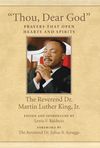
    Lewis Baldwin, credit to Daniel DuboisLewis V. Baldwin is professor of religious studies at Vanderbilt University and an ordained Baptist minister. An expert on black-church traditions, he is author of The Voice of Conscience: The Church in the Mind of Martin Luther King, Jr.; There Is a Balm in Gilead: The Cultural Roots of Martin Luther King, Jr.; and Never to Leave Us Alone: The Prayer Life of Martin Luther King, Jr. He is the editor of "Thou, Dear God": Prayers That Open Hearts and Spirits, the first and only collection of prayers by Martin Luther King, Jr. 

    8603The question of the Reverend Dr. Martin Luther King, Jr.'s spirituality and spiritual life has occupied my thinking for more than two decades.   It was clear to me when I began my research back in the late 1980s that King, from his earliest years growing up in Atlanta, Georgia in the 1930s and 40s, struggled with issues about a supernatural reality or divine being, about the world around him, and about how his own life figured into the larger scheme of things in the universe.  Such a spiritual quest was only natural for one who was the descendant of generations of Baptist male preachers and pious, God-fearing women. Spirituality for King became that path toward a greater sense of being in communion with God and with the whole of creation.  The ways in which this spiritual path unfolded over time are richly revealed in the Reverend Dr. King's sixty-eight prayers, which are brought together in an exciting and provocative book entitled, "Thou, Dear God": Prayers that Open Hearts and Spirits. Through a careful reading of this book, one is able to join King in what is unmistakably an interesting and enriching spiritual journey.

    Photo of Lewis V. Baldwin by Daniel Dubois.

    Date-header-bg


    Watch the book trailer on YouTube. 

  • One idea promoted at last month's UN Climate Summit in Durban was “climate-smart agriculture," which could make crops less vulnerable to heat and drought and turn depleted soils into carbon sinks. The World Bank and African leaders are backing this new approach, but some critics are skeptical that it will benefit small-scale African farmers. Here, in a post that originally appeared on Yale Environment 360, Fred Pearce looks at what this kind of agriculture could mean for some of the world's poorest farmers. 

    Pearce examines this and other issues in his forthcoming book The Land Grabbers: The New Fight over Who Owns the Earth. He is an award-winning former news editor at New Scientist, and is the author of With Speed and Violence, When the Rivers Run Dry, Confessions of an Eco-Sinner and The Coming Population Crash and Our Planet's Surprising Future

    Bigstock_Tea_plantation_in_Uganda_6980732
    The glacial pace of international efforts to curb climate change continued at the UN climate talks in Durban, South Africa last month. Governments concluded that by 2015 they should agree on legally binding targets for greenhouse gas emissions that involve all major nations — including China, India and the United States. But they also agreed that those targets would probably not come into force until 2020.

    The climate isn’t waiting for the diplomats. Most experts agree that by 2020 it will likely be too late to halt dangerous warming above two degrees Celsius. So the race is now on to find new, unconventional initiatives to fill the gap. One possibility that came to the fore in Durban is fixing some of that carbon dioxide in the soils of Africa. And that is why the continent’s political leaders met in Durban to launch an initiative known, somewhat cryptically, as “climate-smart” agriculture.
     
    0324The new buzz phrase went down well. Host president Jacob Zuma extolled it. Kofi Annan, the Ghanaian former UN secretary-general, praised it as a panacea to Africa’s problems. “Till now agriculture has been sidelined from climate change discussions,” he said. “But Africa has a huge potential to mitigate climate change.” Beside him sat the Ethiopian Prime Minister Meles Zenawi, the chair of the African Union Commission. They were all on hand as the World Bank announced plans to turn climate-smart agriculture into the next big thing for the world market in carbon offsets.

    So what exactly is climate-smart agriculture? It sounds as if it might involve making agriculture resilient to climate change, by making soils and crops less vulnerable to droughts and heat waves. And that is part of the plan. But only part. The real prize — the one that can lure private finance — is the potential for carbon offsetting. If farm soils can be used to soak up carbon dioxide from the atmosphere, then they can generate carbon credits that can be sold to industrial polluters who want to offset their emissions.

    The offer from the world of carbon finance to poor farmers in Africa and elsewhere is this: Let us use your soils to capture carbon from the atmosphere, and we will, in return, make those soils more productive and less vulnerable to the climate.

    This is a big deal. Nurturing the organic matter in soils on the world’s farms has as much potential to absorb carbon dioxide emissions from industrialized countries as the much better-known plans to fund forest conservation, such as REDD. Rattan Lal of the Ohio Agricultural Research and Development Center at Ohio State University suggests soils worldwide could capture as much as a billion tons of carbon a year — more than a tenth of man-made emissions.

    Climate-smart agriculture neatly combines the twin goals of today’s climate negotiators, helping to prevent climate change while at the same time adapting farms to inevitable change.

    Africa is the big prize. Its farmers are more vulnerable than any others to climate change. Some estimates suggest a hotter, more dire world could cut African farm yields by as much as 20 percent by mid-century. Without an African green revolution, that would spell disaster for a continent with a population that is expected to double to two billion people.

    But the continent’s huge land area — greater than the U.S., China, India, Mexico and Japan combined — also holds huge potential as a planetary carbon sink that, many believe, could create the necessary green revolution. 

    Currently, African soils are leaking carbon as they erode and lose organic matter due to bad farming practices. An estimated 43 percent of Africa’s greenhouse gas emissions come from land clearance, including farming. But the same soils could be turned from a carbon source to a carbon sink, absorbing many tens of millions of tons of carbon a year, according to the UN Food and Agriculture Organization (FAO).

    If an agricultural carbon offset program were in place, carbon dollars from Western companies could pay for composting, mulching, recycling crop waste, planting farm trees, and much else on the world’s poorest farms. Those improved soils, richer in organic matter, would grow more crops, help soils withstand droughts and floods, and — vital to earning those carbon dollars — capture carbon from the atmosphere.

    The World Bank is keen to mastermind a global effort to fix carbon in African soils. It brought agriculture ministers from across the continent to Johannesburg in September to promote the idea and continued to push it in Durban.

    For the past year, the bank’s BioCarbon Fund, which sets up demonstration carbon-capturing projects in both forests and farms, has been running the first pilot African soil project among smallholder farmers near Kisumu in western Kenya. The bank’s climate envoy Andrew Steer said in Durban that the maize and bean farmers “are getting higher yields, improving the resilience of the soils to drought and getting stronger soils that sequester more carbon.”

    If all goes according to plan, the Kenya Agricultural Carbon Project, which covers 40,000 hectares of farmland in a densely population region of the country, should capture 60,000 tons of carbon dioxide a year. It could also increase annual farm incomes by $200 to $400 per hectare.

    That’s the plan. Will it work? The Stockholm Environment Institute, a think tank that looks at both climate and development issues, is supportive. The institute’s Olivia Taghioff, who has studied the Kenyan scheme, says, “Carbon finance even in modest amounts can make a big difference for smallholders.”

    But there are concerns. In Durban, Annan warned: “These efforts must have at their heart smallholder farmers. Without their participation we will fail.” And many critics fear that climate-smart agriculture is in reality a Trojan horse for marginalizing smallholder farmers. They believe the arrival of carbon markets, brokers and traders in the fields of Africa can do nothing but harm.

    “Soil carbon offsets will promote a spate of African land grabs and put farmers under the control of fickle carbon markets,” said Teresa Anderson of the UK-based Gaia Foundation, an NGO that promotes indigenous farming, speaking in Durban. “The [World] Bank’s agenda is more money for the bank and for carbon project developers, not development,” said Doreen Stabinsky of the Minneapolis-based Institute for Agriculture and Trade Policy.

    The high costs of employing scientists, consultants, and field surveyors to assess and monitor the carbon uptake of farm soils will make it impossible for smallholder farmers to pocket any income from the sale of the carbon absorbed by their soils, these critics maintain. Only large landowners will be able to reduce these transactions costs sufficiently to profit from the carbon markets, they say, and the result will be a new phase of land grabbing. “Soil grabbing,” some are calling it.

    Across Africa, governments are already leasing wide areas of land traditionally used by smallholder farmers to foreign companies for industrial agriculture or for planting trees as carbon sinks in order to gain carbon credits. The fear is that the process will accelerate if the soil itself becomes a carbon commodity.

    There is another reason why peasant farmers may lose out. Early evidence gathered by the World Bank in Kenya suggests that the cultivation of commercial crops of the kind that large agribusinesses specialize in have a much greater potential to soak up carbon than smallholder subsistence crops.

    Data presented last year at the FAO in Rome by Rama Reddy of the World Bank’s carbon finance unit show that the carbon-capture potential for a hectare of smallholder maize in Kenya is around half a ton of carbon dioxide per year, whereas the potential for commercial biofuels is between 2.5 and 5 tons, and for a sugar cane plantation up to 8 tons per hectare.

    The dream of enthusiasts for climate-smart agriculture is that investors will one day invest billions of dollars in the fields of Africa in order to purchase the resulting credits from capturing carbon, while at the same time improving the continent’s soils. In truth, any credible solution to climate change will probably involve finding ways to get the landscape to absorb more carbon, whether in trees or soils, probably financed from carbon markets. Can it be done in a way that helps smallholder farmers? Or will it drive them off their land? That remains far from clear. 

    "Tea Plantation in Uganda" photo from Bigstock.

  • Chris Mercogliano has been a teacher at the Albany Free School since 1973 and codirector since 1985. His writing has appeared in numerous publications, and he is the author of In Defense of Childhood: Protecting Kids' Inner Wildness and Teaching the Restless: One School's Remarkable No-Ritalin Approach to Helping Children Learn and Succeed. 

    Bigstock_Bottle_of_school_glue_with_cop_14086733

    “Education is the Glue of Democracy,” reads a billboard towering over I 90 just outside the birthplace of the American Revolution.

    “It is a sticky business these days, isn’t it?” I mused to myself as I zoomed by. Then a more serious thought: “Shouldn’t it be the other way around? Shouldn’t the right of every student to determine his or her own learning be the glue that holds education together?”

    I, for one, think it should. Every day of my thirty years as a teacher confirms that children learn faster and better when they have a voice in the educational process, when they get to choose which interests to pursue, and when and with whom. They also act more responsibly, and with greater maturity and consideration when they are actively involved in making the plans and the rules, and in resolving the conflicts that inevitably crop up when individuals come together to form a community.

    3286This is hardly a new idea. The Greeks long ago demonstrated that a society in which the people—dêmos—share the power—krátos—is more likely to flourish on every level. It’s common sense, really. Hell, you might even argue that nature herself is democratic, considering the way she distributes power in the form of genetic variation and refinement so evenly across the spectrum of humanity, thus endowing all children with the potential and the means to develop their inborn talents on their own terms.

    But let’s back up for a moment and take that billboard at face value. It goes without saying that democratic societies count on education to prepare the younger generation to become engaged citizens with the skills to do the society’s work and the wisdom to keep it on track. Or as Thomas Jefferson did once say, “An informed citizenry is the only true repository of the public will.” Indeed, if we are going to enjoy “government by the people,” which is Webster’s modern definition of democracy, then don’t we need our children to grow up learning how to govern? Isn’t it important for them to be able to think for themselves and not be intimidated by power-hungry individuals, or swayed by the latest opinion poll?

    Here is where my bile always begins to rise, because what do we see when we peek in a typical schoolroom door? Isn’t it rows of seated children simply doing as they’re told? When they raise their hands, it’s seldom in order to enter into the discussion of issues of real import or to exercise their democratic right to participate in the governance of the classroom, or God forbid the school as a whole. Rather it is in order to call out rote answers to preordained questions.

    Where in this picture do we see students becoming the informed citizens upon whom Jefferson declared any true democracy depends? If anything, as Ivan Illich pointed out in Deschooling Society, education today has a net effect that is profoundly undemocratic. Compulsory schooling’s latent function—what Illich termed the “hidden curriculum”—is to turn us into dependent people who rely on outside experts to do our thinking for us. Furthermore, schools literally school our minds into believing that learning itself depends on the structure and official sanctions provided by specially designated institutions.

    Then there is perhaps education’s most undemocratic aspect: the system that was supposed to create equal opportunities for all uses a set of institutional rankings to deem a small subset of individuals more worthy of advancement than others, thereby compounding the privilege of a select few while degrading everyone else. As an interesting aside, in the democracy developed by the Greek city-state of Athens, 90% of the officeholders carrying out the city’s administration were people who lacked particular expertise initially and were chosen by lot rather than popular ballot. Also, each office could be held by the same person only once.

    There were three underlying reasons for this approach to government: trusting individuals to learn the necessary skills on the job raised society’s overall level of competence; elections tended to favor the rich; and it was more important to the Athenians to guard against using office holding as a way of accumulating power than against incompetence.

    Meanwhile, the sad irony is that the self-appointed guardian of democracy around the world is grooming its future citizens in an educational system that is entirely autocratic. It’s a totally top-down affair run by a handful of highly credentialed so-called “experts,” with millions of students sitting at the bottom of the pyramid with virtually no power at all—who even need permission to use the bathroom.

    Equally ironic is the education revolution that began in certain Soviet Bloc nations soon after the collapse of the Berlin Wall. All of a sudden, groups of parents and teachers emerged who were determined to create a new educational model based on democratic principles, so that they could raise a generation of young people who understand the meaning and practice of democracy and who would then form the core of a truly democratic society. These groups created schools like the Stork School in the Ukraine and Moscow’s School for Self-Determination, in which students have substantial freedom of choice and a real say in the terms and conditions of their learning.

    These schools have joined a loosely united coalition of other “democratic schools” around the world that likewise empower children to codirect their educations and participate in the direction of their schools. No two “member” schools are alike; but they all hold in common a belief in the critical importance of enabling young people to learn real citizenship skills now and not have to wait until they are voting age adults.

    Initially I had a problem with labeling schools like the one I have always taught in “democratic” because of a concern that the term’s strong political connotations may mislead outsiders into thinking the primary aim is to train children in the mechanics of parliamentary government. But then one day I somewhat stumbled upon some fascinating research done in the late-1930s and early ‘40s by psychologist Kurt Lewin. Lewin, the first to apply quantum principles to depth psychology and also a pioneer in the field of group dynamics, was one of a group of scientists and intellectuals—including Hannah Arrendt, Wilhelm Reich, and Erich Fromm, among others—that was trying to uncover the root causes of the alarming spread of fascism.

    Lewin wanted to understand how adult leadership styles affect children’s individual and group behavior, and so he and his associates conducted a number of unusual field experiments in summer camps and after-school programs. He identified three basic leadership styles, and not surprisingly he referred to them in political terms: autocratic, democratic, and laissez-faire.

    The autocratic group leaders were strict and highly controlling. They unilaterally determined what kind of projects the kids would do, and tended to closely supervise them to make sure they all followed the same uniform steps. These leaders also tightly structured who worked with whom, and remained aloof from group participation except to issue individual praise or criticism of each child’s performance.

    On the opposite end of the spectrum, the laissez-faire counselors gave the kids permission to do whatever they wanted and generally didn’t participate in any group process, other than to make it known that they would supply information and materials when asked. Otherwise they limited their role to making infrequent comments on the activities of the members.

    In the democratic groups, the members decided the activities collectively, with the counselors encouraging everyone to express their opinions. The counselors began with an overview of the various possible techniques and media, and then they allowed the kids to choose their own approaches, leaving it to them to work with whomever they pleased and to structure the tasks as they saw fit. The counselors let the kids do the actual work and only gave instruction or assistance as needed. They also tended only to give criticism and praise to the group as a whole.

     The difference between the behavior and the performance of each group was striking.

    The children in the autocratic groups expressed as much as 40 times more hostility. They also tended to be careless and leave their work unfinished, and to dissolve into chaos whenever the counselor left the room. The morale of the autocratic leaders was much lower as well.

    Interestingly, the children in the laissez-faire groups exhibited similar, though less extreme tendencies, while the democratic groups showed a much higher level of enthusiasm and persistence, and a significantly higher degree of self-discipline. The quantity and quality of the children’s work was dramatically higher too, and they often chose on their own to tackle challenging long-range projects. The morale of the counselors, who reported that their jobs felt challenging and meaningful, was also higher. They particularly reported feeling more relaxed because the responsibility for the group’s behavior didn’t fall solely on them.

    There’s a great deal more depth and detail to Lewin’s studies; however, the real reason for sharing them here is to point out that his use of “democratic” includes both the idea of power sharing and a leadership style that leaves initiative and responsibility in the hands of the children, with the adults fully present as models and advisors but not as top-of-the-pyramid controllers. The distinction is crucial, I think, because in the context of children and education, “democratic” is much more than a political concept that can be taught in a semester-long civics class.

    In a democratic school, democracy means more than just the sharing of governmental power. It is a multi-dimensional practice that runs deeper than the outward manifestations of electing leaders, following Roberts’ Rules of Order, and voting on motions. It involves the sense of mutuality and connection, of being part of a community centered on shared interests and concerns. It means being responsible to more than just oneself, and being an active, caring, contributing member of a group. And it takes practice, which is why the structure of democratic schools includes regular forums in which children as young as five or six can express their opinions on community issues and propose their own solutions to community problems. This kind of structure offers myriad opportunities for leadership and engagement, and by the time those five- and six-year-olds reach graduation age, they will have a profound and enduring understanding of what it means to be a good citizen.

    But there’s more: by encouraging both community responsibility and self-direction, democratic schools encourage students to take ownership of their learning. Because they learn by choice, motivated by learning’s intrinsic pleasure, meaning, and value rather than competition and external rewards, their education is more likely to be purposeful and connect forward into their adult lives.

    In democratic schools, in other words, democracy is indeed the Elmer’s of education.

    "Bottle of Glue" photo from Bigstock. 

  • Philip Warburg is the author of Harvest the Wind: America's Journey to Jobs, Energy Independence, and Climate Stability, forthcoming in April from Beacon Press. 

    Bigstock_Windmill_on_the_sunset_19278608
    In December, yet another global climate change conference – this one in Durban, South Africa – failed to bind the world’s greatest polluters to specific, quantifiable curbs in their greenhouse gas emissions. Sadly, America was among the leading forces fighting the adoption of greenhouse gas reduction targets, just as we fought these targets in Bali the previous year, and in Copenhagen the year before that.

    Even as America shirks its responsibility before the international community, there is a lot we can do here at home to reduce our nation’s massive carbon footprint. Boosting renewable energy’s share of our electricity supply should be at the top of that agenda.

    The Congressional uproar over the failed federal loan guarantee to solar manufacturer Solyndra shouldn’t be allowed to cast a shadow over our government’s broader efforts to stimulate renewable energy growth. Nowhere have federal energy incentives been more effective than in launching American wind power. Part of that success hinges on a production tax credit that gives wind manufacturers and wind farm developers enough confidence to break into a field still dominated by underpriced fossil fuels and heavily subsidized nuclear power.

    Today wind supplies a relatively modest three percent of our electricity, but it’s growing fast. The Department of Energy projects that wind, with the right incentives, could supply a fifth or more of our power by 2030. Others see as much as half of our electricity coming from wind by mid-century. Wind farms already account for 17 percent of Iowa’s electric output and nearly 7 percent of power generated in Texas, America’s biggest electricity user.

    0107Unlike the battering that U.S. solar equipment producers have suffered at the hands of Chinese and other Asian competitors, America is well on its way to building a robust domestic manufacturing platform for wind. General Electric makes over half of the turbines sold in America, and a smaller U.S. firm, UTC-owned Clipper Windpower, contributes further to U.S. sales. Several non-U.S. turbine companies have also built factories here. Given what it costs to ship bulky equipment like giant blades and multi-ton steel towers across the seas, wind manufacturers realize big savings by producing this hardware on U.S. soil.

    Looking at the American wind industry’s overall supply chain, the story gets even better. Hundreds of companies employing thousands of skilled and semi-skilled workers are now involved in manufacturing components and subcomponents for turbines. American labor today creates about 60 percent of the value of a typical turbine sold in the United States. Rust Belt stalwarts like Ohio-based Timken, maker of the “million-mile bearing” for the automotive sector, have made a major strategic shift toward wind. The rugged weather endured by turbines is a perfect match for Timken’s super-high standards.

    Add to manufacturing jobs the thousands of people who build our wind farms. Truckers, crane operators, electricians, concrete suppliers, and civil engineers are all finding new jobs in wind farm construction. And once these farms are in operation, thousands more are employed keeping turbines running reliably.

    Roughly 75,000 Americans now have jobs in the wind industry. The Department of Energy predicts that over a quarter-of-a-million people will be gainfully employed by this sector as we approach the 2030 date for supplying a fifth of our power from wind. As important as the number of jobs is where many of those jobs are located – in rural communities where it’s been hard to find work even in good economic times.

    In an ideal world, power suppliers would compete in a marketplace that reflected the true costs of each technology. The European Union is moving in this direction, with a carbon emission-trading regime that has begun to monetize the global-warming impacts of coal and other fossil fuels used by electric utilities and other major industries. In America, fossil fuel producers and users do not pay for the environmental devastation they cause. To the contrary, they benefit from billions of dollars in subsidies each year, nurtured for decades by an army of well-paid lobbyists.

    Faced with these imbalances, renewable energy producers are fighting an uphill battle. Federal incentives, like the 2.2 cent-per-kilowatt-hour production tax credit for wind that is due to expire at the end of this year, are essential to leveling the playing field. Thanks to this tax credit, wind farms can compete with proposed new coal plants, and even with electricity from new natural gas facilities in some locations. If the tax credit expires, many wind developers will hold off on siting new wind farms, and wind turbine manufacturers will have to scale back production. Aside from the lost environmental opportunity, tens of thousands of people now employed by the wind industry risk losing their jobs.

    In a rare bipartisan move, 23 governors – Republicans and Democrats – have appealed to Congress to renew the renewable energy production tax credit. Their motivation may have little to do with taming the global-warming juggernaut, but these savvy politicians are fully aware of the economic benefits that a vibrant wind industry can bring to their constituencies.

    Many years may pass before Congress summons the resolve to cap America’s greenhouse gas emissions. Meanwhile, extending the renewable energy production tax credit – a measure that has already proven its worth to our economy and the environment – is a worthy step.

    "Windmill on the Sunset" photo from Bigstock.

  • Bigstock_Bank_Owned_Real_Estate_Sign_an_11936546

    Anita Hill (Reimagining Equality) calls on the goverment to restore communities blighted by the subprime mortgage crisis:

    Ultimately, after the financial market collapsed, the government bailed out the banking industry, including Bank of America, which now owns Countrywide. The industry rebounded because the government concluded that a secure banking system was in the public’s interest. Yet, the playing field won’t be level as long as American communities pay for the corrupt decisions made by lenders. A federal effort targeted at restoring blighted neighborhoods is needed to clean up the mess left behind by such egregious predatory practices as those alleged in the Department’s reports and pleadings. The establishment of a pool of money, drawn from fines for violation of the laws and modeled after the Environmental Protection Agency’s Superfund, to be distributed by the DOJ in collaboration with state and local governments, is also in the public’s interest. The process for prioritizing communities set for restoration and structuring relief could be coordinated with other agencies under the DOJ’s direction.

    Nancy Gertner (In Defense of Women) wants Massachusetts to move forward, not backward, in criminal justice reform. 

    Massachusetts is the only New England state with life without parole for juveniles. The Supreme Court has recognized that the adolescent brain is sufficiently different from that of an adult that the death penalty is inappropriate — even for murder, as is life without parole in non-murder cases. And it is inconsistently applied. The story is a familiar one: The law is enacted because of one juvenile’s horrific crime, but is then applied in very different cases – to impulsive crimes, nowhere near as brutal as the offense that motivated the law, committed by teenagers with little or no prior record.

    Edge interviews Jay Michaelson about God Vs. Gay: The Religious Case for Equality:

    We should respond with compassion, and by showing up as human beings. I once had a heckler ask me, "What about bestiality?" What I did was, I showed him my engagement ring, and asked him to look me in the eye and tell me that my love for my partner was no different from the lust a person might feel for a sheep or a goat. Of course, he couldn’t do that.

    By showing up without anger but with our human dignity, we give the lie to the claim that someone can "know all about gays" without actually meeting one as a human being.

    Talking about the ADHD drug shortage on the NYTimes Well blog, Danielle Ofri (Medicine in Translation) looks at the impact on patients:

    Most physicians think little about prescriptions after they hand them off to their patients. Usually, the only time I hear about it is when a patient calls from the pharmacy because the insurance plan has changed which statin it covers or a medication is not covered by insurance and the price is simply astronomical — what could I substitute?

    But Amy’s experience is quite different. Pharmacies just seem to be out of Ritalin, and no one seems to know when more will arrive. And without medications to treat their attention deficit hyperactivity disorder, life can fall apart. Amy’s ability to do her job and run a household can become overwhelming. More painfully, her son’s schooling suffers.

    “For each new prescription,” Amy says, “I must muster up energy to begin the hunt. Maybe I’ll get lucky and my order can be filled on the first try. But most often, it’s the start of a very difficult search that can take weeks, and burns precious resources.”

    In light of mapping being done by the NYPD's new "Demographics Unit," the NYTimes City Room blog asks Chris Finan (From the Palmer Raids to the Patriot Act) about the history of racial and ethnic profiling by the department:

    Mr. Finan, who is the president of the American Booksellers Foundation for Free Expression, said the maps were used by the legislative committee “to justify a series of laws violating First Amendment rights” — loyalty tests and other provisions — which Mr. Smith vetoed in 1920 as striking at “the very foundation of one of the most cardinal institutions of our nation: the fundamental right of the people to enjoy full liberty in the domain of idea and speech.”

    Mr. Finan said of the latest effort by the Police Department, “This mapping exercise is as silly — and dangerous — today as it was in 1919.” 

    Stacy Mitchell (Big-Box Swindle) continues her series at Grist, looking at how Wal-Mart has taken over our food system:

    Walmart's rise as a grocer triggered two massive waves of industry consolidation in the late 1990s and early 2000s. One occurred among supermarkets, as regional titans like Kroger and Fred Meyer combined to form national chains that stood a better chance of surviving Walmart's push into groceries. Today, the top five food retailers capture half of all grocery sales, double the share they held in 1997.

    The second wave of consolidation came as meatpackers, dairy companies, and other food processors merged in an effort to be large enough to supply Walmart without getting crushed in the process. The takeover of IBP, the nation's largest beef processor, by Tyson Fresh Meats is a prime example. "When Tyson bought IBP in 2001, they said they had to do that in order to supply Walmart. We saw horizontal integration in the meat business because of worries about access to the retail market," explained Mary Hendrickson, a food systems expert at the University of Missouri. Four firms now slaughter more than 80 percent of cattle. A similar dynamic has played out in nearly every segment of food manufacturing.

    "Bank Owned" photo from BigStock.

  • We are so excited about our forthcoming titles for 2012, we were actually happy to come back from vacation! So, without any further ado, here's what's on deck this at Beacon Press. 

    JANUARY

    Accordion_family_newmanThe Accordion Family: Boomerang Kids, Anxious Parents, and the Private Toll of Global Competition by Katherine Newman

    Order now at Beacon.org |Amazon |Barnes & Noble | Powells |Independent Bookstore

    Why are adults in their twenties and thirties boomeranging back to or never leaving their parents' homes in the world's wealthiest countries? Acclaimed sociologist Katherine Newman addresses this phenomenon in this timely and original book that uncovers fascinating links between globalization and the failure-to-launch trend. With over 300 interviews conducted in six countries, Newman concludes that nations with weak welfare states have the highest frequency of accordion families. She thoughtfully considers the positive and negative implications of these new relationships and suggests that as globalization reshapes the economic landscape it also continues to redefine our private lives. Read the Introduction to Accordion Family on Scribd.

    The economic consequences of these demographic trends are quite serious. When young people stay with their parents for a long period, family formation is delayed, fertility falls, populations age and productivity declines. Boomers may find it harder to retire if their savings are absorbed in the support of their adult kids. Katherine Newman on Room for Debate at the New York Times.


    4443Straight: The Surprisingly Short History of Heterosexuality by Hanne Blank

    Order now at Beacon.org |Amazon |Barnes & Noble | Powells |Independent Bookstore

    Heterosexuality is not a fact of nature, it’s a nineteenth-century invention, only about as old as the traffic light. In this surprising chronicle, historian Hanne Blank digs deep into the past of sexual orientation while simultaneously exploring its contemporary psyche. Illuminating the hidden patterns in centuries of events and trends, Blank shows how culture creates and manipulates the ways we think about and experience desire, love, and relationships between men and women. Ranging from Henry VIII to testicle transplants, Disneyland to sodomy laws, and Moby Dick to artificial insemination, the history of heterosexuality turns out to be anything but straight or narrow. With an eclectic scope and fascinating detail, Straight tells the eye-opening story of a complex and often contradictory man-made creation that is all too often assumed to be an irreducible fact of biology. Read the Introduction to Straight on Scribd.

    Follow Hanne Blank on Twitter.

    FEBRUARY

    0321Cheating Justice: How Bush and Cheney Attacked the Rule of Law, Plotted to Avoid Prosecution, and What We Can Do about It by Elizabeth Holtzman and Cynthia Cooper

    Order now at Beacon.org |Amazon |Barnes & Noble | Powells |Independent Bookstore

    President George W. Bush and Vice President Cheney deceived Congress and the people to drive us into a war in Iraq; they claimed the right to wiretap illegally and to eavesdrop on citizens; and they authorized torture, unilaterally upending laws and violating international treaty obligations. Yet, both Bush and Cheney are audaciously unapologetic about their crimes. In his recent memoir, President Bush makes no apologies for his decision to start a war in Iraq, though no weapons of mass destruction, the ostensible reason for the war, were found there. Regarding his approval of the waterboarding form of torture, he proudly said, "Damn right." 

    Time and again throughout his term, President Bush proclaimed sternly "we do not torture." However, the 2009 release of secret torture documents revealed otherwise. The documents paint a bleak picture of the involvement of President Bush, Vice President Cheney, and top administration officials in unleashing, sanctioning, and conspiring in the infliction of torture. Holtzman and Cooper cite unlawful torture as only one of the many ways that the Bush-Cheney administration transgressed the law, trampled the Constitution, and harmed the image of the United States around the world. Bush and Cheney, the authors argue, authorized and condoned behavior and practices that starkly violate human-rights principles and the rights of American citizens. Congress chose not to pursue impeachment, despite multitudes of citizens advocating for it, Holtzman and Cooper among them. New revelations, however, about the extent and depth of their crimes make the need for accountability imperative.

    Holtzman posits that the failure to indict, prosecute, or hold accountable officials at the highest level makes a mockery of U.S. law and sets frightening precedents. With Holtzman's legal expertise and Cooper's bold journalism, Cheating Justice explains why the nation needs to address the Bush-Cheney administration's abuse of power and manipulation of the law.

    As a member of Congress and part of the committee that investigated and held hearings on the conduct of President Richard Nixon in the Watergate scandal, Elizabeth Holtzman balks at Bush's echo of Nixon's claim that he was acting in the interest of national security. Using Watergate-era reforms as a model, Holtzman details the steps necessary to undo the damage that the Bush-Cheney administration inflicted and explains how we can establish new protections that will block future presidents from similarly abusing the law.Cheating Justice is a call to empower the American people, and a firm insistence that the nation's leaders are not above the law.

    1160Fragile Beginnings: Discoveries and Triumphs in the Newborn ICU by Adam Wolfberg

    Order now at Beacon.org |Amazon |Barnes & Noble | Powells |Independent Bookstore

    This is a gripping medical narrative that brings readers into the complex world of newborn intensive care, where brilliant but imperfect doctors do all they can to coax life into their tiny, injured patients. Dr. Adam Wolfberg–journalist, physician specializing in high-risk pregnancies, and father to a child born weighing under two pounds–describes his daughter Larissa's precipitous birth at six months, which left her tenuously hanging on to life in an incubator. Ultrasound had diagnosed a devastating hemorrhage in her brain that doctors reasoned would give her only a 50 percent chance of having a normal IQ.

    Through Larissa's early hospital course and the struggle to decide what is best for her, Wolfberg examines the limitations of newborn intensive-care medicine, neuroplasticity, and decision making at the beginning of life. Featuring high-profile scientific topics and explanatory medical reporting, this is the first book to explore the profound emotional and ethical issues raised by advancing technology that allows us to save the lives of increasingly undeveloped preemies.

    Follow Adam Wolfberg on Twitter. 

    MARCH

    4456Jumped In: What Gangs Taught Me about Violence, Drugs, Love, and Redemption by Jorja Leap

    Order now at Beacon.org |Amazon |Barnes & Noble | Powells |Independent Bookstore

    Jumped In tells the story of the gangs of Los Angeles in the words of the gang members themselves as well as the people who interact with them on a daily basis–trying to arrest them, control them, and help them. There are priests and police officers, murderers and drug dealers, victims and grieving mothers, and other assorted characters, often partnering in unlikely ways. Jorja Leap's work draws upon intimate material, from interviews to eyewitness accounts, telling the deeply personal stories of current and former gang members who span three generations, as well as the dilemmas Leap herself faces as she struggles to adjust to marriage and motherhood–with a husband in the LAPD and a daughter in adolescence. Jumped In is a chronicle of the unexpected lessons gang members taught her when she was busily studying them. Ultimately, it is a book about attachments and commitments, loyalties and betrayals, drugs and guns, sex and devotion.


    4467White Bread: A Social History of the Store-Bought Loaf by Aaron Bobrow-Strain

    Order now at Beacon.org |Amazon |Barnes & Noble | Powells |Independent Bookstore

    What can the history of America's one-hundred-year love-hate relationship with sliced white bread tell us about contemporary efforts to change the way we eat? Fluffy industrial loaves are about as far from slow, local, and organic as you can get, but the story of social reformers, food experts, and diet gurus who believed that getting people to eat certain food could restore the nation's decaying physical, moral, and social fabric will sound very familiar. White Bread teaches us that when Americans debate what one should eat, they are also wrestling with larger questions of race, class, immigration, and gender. As Bobrow-Strain traces the story of bread, from the first factory loaf to the latest gourmet pain au levain, he shows how efforts to champion "good food" reflect dreams of a better society–even as they reinforce stark social hierarchies.

    In the early twentieth century, the factory-baked loaf heralded a new future, a world away from the hot, dusty, "dirty" bakeries run by immigrants. This bread, the original "superfood," was fortified with vitamins and marketed as patriotic. However, sixties counterculture made white bread an icon of all that was wrong with America. Today, the alternative food movement favors foods deemed ethical and environmentally correct to eat. In a time when open disdain for "unhealthy" eaters and discrimination on the basis of eating habits grow increasingly acceptable, White Bread is a timely and important examination of what we talk about when we talk about food.


    0136

    The Most Expensive Game in Town: The Rising Cost of Youth Sports and the Toll on Today's Families by Mark Hyman

    Order now at Beacon.org |Amazon |Barnes & Noble | Powells |Independent Bookstore

    Building on the eye-opening investigation into the damaging effects of the ultra-competitive culture of youth sports in his previous book, Until It Hurts, Mark Hyman's new book looks at the business of youth sports, how it has changed, and how it is affecting young Americans. Examining the youth sports economy from many sides–the major corporations, small entrepreneurs, coaches, parents, and, of course, kids–Hyman probes the reasons for rapid changes in what gets bought and sold in this lucrative marketplace. Just participating in youth sports can be expensive. Among the costs are league fees, equipment, and perhaps private lessons with a professional coach. With nearly 50 million kids playing organized sports each year, it is easy to see how profitable this market can be. Hyman takes us to tournaments sponsored by Nike, Gatorade, and other big businesses, and he talks to parents who sacrifice their vacations and savings to get their (sometimes reluctant) junior stars to these far-off, expensive venues for a chance to shine. He introduces us to videos purporting to teach six-month-old babies to kick a ball, to professional athletes who will "coach" an eight-year-old for a hefty fee, to a town that has literally staked its future on preteen sports. With its extensive interviews and original reporting, The Most Expensive Game in Town explains the causes and effects of the commercialization of youth sports, changes that the author argues are distorting and diminishing family life. He closes with strong examples of individuals and communities bucking this destructive trend.

    Follow Mark Hyman on Twitter.


    0339Billionaires' Ball: Gluttony and Hubris in an Age of Epic Inequality by  Linda McQuaig and Neil Brooks

    The concentration of wealth today in such a small number of hands inevitably created a dynamic that led to freewheeling financial speculation—a dynamic that produced similarly disastrous results in the last great age of inequality, in the 1920s. Such concentrated economic power reverberates throughout society, threatening the quality of life and the very functioning of democracy. As McQuaig and Brooks illustrate, it's no accident that the United States claims the most billionaires but suffers from among the highest rates of infant mortality and crime, the shortest life expectancy, and the lowest rates of social mobility and electoral political participation in the developed world.

    In Billionaires' Ball, McQuaig and Brooks take us back in history to the political decisions that helped birth our billionaires, then move us forward to the cutting-edge research into the dangers that concentrated wealth poses. Via vivid profiles of billionaires—ranging from philanthropic capitalists such as Bill Gates to hedge fund king John Paulson and the infamous band of Koch brothers—Billionaires' Ball illustrates why we hold dearly to the belief that they "earned" and "deserve" their grand fortunes, when such wealth is really a by-product of a legal and economic infrastructure that's become deeply flawed.

    AND BEYOND…

    Before They're Gone: A Family's Year-Long Quest to Explore America's Most Endangered National Parks by Michael Lanza

    "Before They're Gone is a beautifully written, moving meditation on the meaning of parenthood, our parks, and the first generation of children to grow up in the age of global warming." —Richard Louv, author of The Nature Principle and Last Child in the Woods

    Follow Michael Lanza on Twitter.


    Dosed: The Medication Generation Grows Up by Kaitlin Bell Barnett

    “A skillful and knowledgeable storyteller, Kaitlin Bell Barnett uses young adult’s sagas of their childhood struggles with psychiatric diagnoses and drugs, her own included, to explore a fundamental question: What does it mean to grow up as ‘the medicated kid’? Dosed is thoughtful, potent and overdue.”—Paula Span, Contributor, the New York Times’ Science Times

    Follow Kaitlin Bell Barnett on Twitter.


    Harvest the Wind: America's Journey to Jobs, Energy Independence, and Climate Stability by Philip Warburg

    “Phil Warburg is to renewable energy what Daniel Yergin is to the oil industry. He has written the definitive book on wind power, tracing its history from wooden prairie windmills to modern turbines with blades as long as football fields. He writes with equal lucidity and insight about the life of Kansas wind farmers and the byzantine complexities of federal energy policy. This is a must read for anyone who wants to understand the promise and challenge of building the clean energy economy of the future.” —Rep. Henry Waxman


    2205

    The Cure for Everything: Untangling Twisted Messages about Health, Fitness, and Happiness by Timothy Caulfield

    In The Cure for Everything, health policy expert and fitness enthusiast Timothy Caulfield wades through the tides of health crazes, misleading data, and well-meaning gurus in a quest to sort out real, reliable health advice. He takes us along as he navigates the maze of facts, findings, and fears associated with emerging health technologies, drugs, and disease-prevention strategies and presents an impressively researched, accessible take on the production and spread of information in the health sciences.