• O God, our gracious Heavenly Father, we thank Thee for the fact that you have inspired men and women in all nations and in all cultures. We call you different names: some call Thee Allah; some call you Elohim; some call you Jehovah; some call you Brahma; and some call you the Unmoved Mover; some call you the Archetectonic [sic] Good. But we know that these are all names for one and the same God, and we know you are one.

    And grant, O God, that we will follow Thee and become so committed to Thy way and Thy kingdom that we will be able to establish in our lives and in this world a broth- erhood. We will be able to establish here a kingdom of un- derstanding, where men will live together as brothers and respect the dignity and worth of all human personality. In the name and spirit of Jesus we pray. Amen. 

    Martin Luther King, Jr. From "Thou, Dear God": Prayers That Open Hearts and Spirits.

    Date-header-bg

    Lewis Baldwin, credit to Daniel DuboisLewis V. Baldwin is professor of religious studies at Vanderbilt University and an ordained Baptist minister. An expert on black-church traditions, he is author of The Voice of Conscience: The Church in the Mind of Martin Luther King, Jr.; There Is a Balm in Gilead: The Cultural Roots of Martin Luther King, Jr.; and Never to Leave Us Alone: The Prayer Life of Martin Luther King, Jr. He is the editor of "Thou, Dear God": Prayers That Open Hearts and Spirits, the first and only collection of prayers by Martin Luther King, Jr. 

    Spirituality as an Integral Aspect of World Religions: A Global Reading of the Prayers of Martin Luther King, Jr.

    8603

    The prayers in "Thou, Dear God": Prayers that Open Hearts and Spirits reveal that Martin Luther King, Jr. never associated "the spiritual" with a particular religion or religious tradition. He associated a sense of "the spiritual" not only with Christianity, but with Judaism, Islam, Hinduism, Buddhism, and other great world religions. It is at this point that his prayers are so spiritually enlightening. They are the passionate pleas, longings, and hopes of a man who were deeply wedded to his own faith tradition while, at the same time, recognizing the truths and the vitality of other traditions. In short, the prayers in "Thou, Dear God" are the prayers of all peoples of faith. They emerged out of King's unwavering belief that the Kingdom of God ultimately intersects with people of different faith claims. Thus, there is something for everyone in "Thou, Dear God." Indeed, there are lessons and challenges here even for persons who make no profession of faith.


    Photo of Lewis V. Baldwin by Daniel Dubois.

    Date-header-bg

    Read "Prayers for Social Justice" from "Thou, Dear God" on Scribd.

    Purchase in hardcover or ebook at Beacon | Independent Bookstore | Amazon | Barnes and Noble | Powells 

    Watch the book trailer on YouTube. 

  • A Facebook giveaway to inspire and guide activists: twelve chapters of Playbook for Progressives by Eric Mann, free. 

    MANN-PlaybookForProgressivesIn Playbook for Progressives, Eric Mann distills the lessons learned from his forty-five years as an organizer, as well as from other organizers within the civil rights, labor, LGBT, economic justice, and environmental movements.

    This is the first book since Saul Alinsky’s Rules for Radicals written for the swelling wave of dedicated activists—those fighting for affordable housing, ending the mass incarceration of Black and Brown youth, expanding LGBTQ rights, protesting economic inequality, and dozens of other issues—which is why we’ll be releasing twelve chapters from Playbook for Progressives exclusively to our fans on Facebook.

    Starting February 6, we’ll post one chapter every Monday, Wednesday, and Friday on the different roles of the successful organizer—twelve chapters in all. (Preview those roles on Scribd to learn more.) If you want to get involved, want to accelerate your level of involvement, or are already on the front lines of the battle and want to push yourself to a higher level of effectiveness, be sure to become a fan of Beacon Press on Facebook and read the twelve roles of the successful organizer! 

    Schedule

    February 6: The Foot Soldier

    February 8: The Evangelist

    February 10: The Recruiter

    February 13: The Group Builder

    February 15: The Strategist

    February  17: The Tactician

    February 20: The Communicator

    February 22: The Political Educator

    February 24: The Agitator

    February 27: The Fund-Raiser

    February 29: The Comrade and Confidante

    March 2: The Cadre

    March 5: Roles 1–12


  • “From its thorough but brisk explorations of sexual orientation’s intersections with sex, gender, and romance, this illuminating study examines our presuppositions and makes a powerful, provocative argument that heterosexuality—mazy, unscientific, and new—may be merely 'a particular configuration of sex and power in a particular historical moment.'" Publisher's Weekly

    4443Buy from Beacon | Independent Bookstore | Amazon | Barnes and Noble | Powells

    Like the typewriter and the light bulb, the heterosexual was invented in the 1860s and swiftly and permanently transformed Western culture. The idea of “the heterosexual” was unprecedented. After all, men and women had been having sex, marrying, building families, and sometimes even falling in love for millennia without having any special name for their emotions or acts. Yet, within half a century, “heterosexual” had become a byword for “normal,” enshrined in law, medicine, psychiatry, and the media as a new gold standard for human experience.

    In this surprising chronicle, historian Hanne Blank digs deep into the past of sexual orientation, while simultaneously exploring its contemporary psyche. Illuminating the hidden patterns in centuries of events and trends, Blank shows how culture creates and manipulates the ways we think about and experience desire, love, and relationships between men and women. Ranging from Henry VIII to testicle transplants, from Disneyland to sodomy laws, and from Moby Dick to artificial insemination, the history of heterosexuality turns out to be anything but straight or narrow.

    With an eclectic scope and fascinating detail, Straight tells the eye-opening story of a complex and often contradictory man-made creation that is all too often assumed to be an irreducible fact of biology.

    Read a review at the New York Times.

    Read an interview with Hanne Blank on Salon.com.

    Listen to Hanne Blank's Spotify mix courtesy of Largehearted Boy.

    Follow Hanne Blank on Twitter.

    Watch Hanne Blank discuss the invention of heterosexuality on YouTube.


  • David Chura is the author of I Don’t Wish Nobody to Have a Life Like Mine: Tales of Kids in Adult Lockup. He has worked with at-risk teenagers for the past 40 years. For 26 of those years, he taught English and creative writing in community based alternative schools and in a county penitentiary. His writings have appeared in the New York Times as well as other scholarly and literary journals. He blogs at http://kidsinthesystem.wordpress.com/. 

    This post originally appeared at the Juvenile Justice Information Exchange.

    Screen Shot 2012-02-02 at 11.25.02 AM
    Arizona’s Legislature recently passed a law charging prison visitors a onetime $25 fee as a way to help close the state’s $1.6 billion budget deficit. Middle Ground Prison Reform, a prison advocacy group, challenged the law in court as a discriminatory tax, but a county judge upheld its constitutionality.

    Fees like that, slapped on prisoners and their families, couldn’t be more counterintuitive. But then again, so many of our criminal justice policies are just that. Since it is mostly the poor, the desperately poor who fill U.S. prisons, the $25 fee is one more economic hardship offenders’ families have to struggle with. It becomes another bill they have to scramble to pay — that is if they can.

    These kinds of charges (and Arizona isn’t the only jurisdiction trying to shift the cost of incarceration to the poor) have even graver consequences. When a family can’t pay the fee, their contact with their loved one is limited, essentially cutting an offender off from the only supports he or she has in the outside world.

    Psychologists have long known how central it is for an individual to have nurturing people in his or her life in order to develop emotionally, psychologically and socially. This need for a supportive network is even more essential when we talk about the young people who are locked away from family and loved ones in our nation’s prisons and detention centers.

    As anyone who has worked with kids in the penal system knows on a gut level, it is crucial to have families and other supportive community members involved in young offenders’ lives as they serve their time. Now, that commonsense intuition has been given empirical strength by studies done by such juvenile justice groups as the Vera Institute of Justice which have demonstrated that maintaining young people’s connection to families is a major factor in helping kids stay out of jail once they are released.

    But it’s easy to question whether these families are really such a positive influence. After all, if they were doing such a great job what are their kids doing in jail?

    ChuraIt’s an easy assumption to make until you see some of those family members in the prison visiting room with their sons and daughters. I got to do that at least twice a year when the jailhouse high school where I taught for 10 years in a county adult facility had its open house for families and caregivers.

    The place was packed with mothers, fathers, grandmothers, grandfathers, aunts, uncles, brothers and sisters, or the people who stepped into those roles when circumstances — AIDS, death, addiction, incarceration, abandonment, all the things that ravage the lives of the poor and disenfranchised — demanded it. It wasn’t easy for many of them to get there. Meals had to be missed. Second jobs skipped. Long cross-county bus rides with tickets to pay for, transfers to be negotiated, at night, often in bad weather.

    The grandmother of one of my students, Leon, a skinny 15-year-old who was finally making progress in class, had to travel over an hour on three buses to get there. It was a trip I knew she faithfully made twice a week to see her grandson. “I wouldn’t miss a visit with my boy for anything,” she told me, reaching over and giving Leon’s hair a playful tug. “But now you tell, Mr. Chura, how’s he doin in class?” That set Leon squirming.

    It was a conversation I had over and over during those family visits. Miguel’s uncle who gave me his phone number and urged me to call him if Miguel wasn’t in school. Luis’ mother, frail and  in a wheelchair, holding her son’s hand, telling me how when Luis got out of jail she was moving her whole family out of state to get away from the gangs that ran wild in the streets. “I just want my boys to be safe,” she said, her English halting but her fear and determination palpable.

    It was hard to hear in the visiting room sometimes with people chattering in several different languages, children running around, little brothers squealing when their big brother in his funny orange jump suit picked them up, mothers crying, locked-up sons trying to explain, promise, console. It was hard to hear but it was easy to know what was going on: Families — fragile, fragmented, strained, mending — were desperately trying to stay a family.

    Many of those visitors would be willing to admit that they hadn’t done such a good job at maintaining the family bond, but that they did the best they could given the problems they had to face. Like Luis’ mother the determination was there but the resources weren’t.

    If we as a nation are serious about reducing crime (and not just by increased incarceration) it is important that we not put more obstacles in the way of young inmates’ families but rather that we give them the opportunities and resources to develop and sustain those crucial connections. It’s an investment that’s worth losing 25 bucks over.

  • At our offices here in Boston, many of us are thinking about the Super Bowl… well… obsessively. So we thought it would be a nice kickoff to Black History Month to highlight a few Beacon's books that discuss the history of African-Americans in sports.

    Book cover for Showdown by Thomas G. SmithShowdown: JFK and the Integration of the Washington Redskins by Thomas G. Smith Buy from Beacon Press | Independent Bookstore | Amazon | Barnes & Noble | Powell's 

    In 1961-as America crackled with racial tension-the Washington Redskins stood alone as the only professional football team without a black player on its roster. In fact, during the entire twenty-five-year history of the franchise, no African American had ever played for George Preston Marshall, the Redskins' cantankerous principal owner. With slicked-down white hair and angular facial features, the nattily attired, sixty-four-year-old NFL team owner already had a well-deserved reputation for flamboyance, showmanship, and erratic behavior. And like other Southern-born segregationists, Marshall stood firm against race-mixing. "We'll start signing Negroes," he once boasted, "when the Harlem Globetrotters start signing whites." But that was about to change.

    Opposing Marshall was Interior Secretary Stewart Udall, whose determination that the Redskins-or "Paleskins," as he called them-reflect John F. Kennedy's New Frontier ideals led to one of the most high-profile contests to spill beyond the sports pages. Realizing that racial justice and gridiron success had the potential either to dovetail or take an ugly turn, civil rights advocates and sports fans alike anxiously turned their eyes toward the nation's capital. There was always the possibility that Marshall-one of the NFL's most influential and dominating founding fathers-might defy demands from the Kennedy administration to desegregate his lily-white team. When further pressured to desegregate by the press, Marshall remained defiant, declaring that no one, including the White House, could tell him how to run his business.

    In Showdown, sports historian Thomas G. Smith captures this striking moment, one that held sweeping implications not only for one team's racist policy but also for a sharply segregated city and for the nation as a whole. Part sports history, part civil rights story, this compelling and untold narrative serves as a powerful lens onto racism in sport, illustrating how, in microcosm, the fight to desegregate the Redskins was part of a wider struggle against racial injustice in America.

    “Smith has written a thoughtful and engaging book that details the racial integration of one of professional football’s most storied franchises. With great insight and passion, he explains how African American athletes finally cracked the color barrier to play for the Washington Redskins amid the turmoil of the civil rights movement and the nation’s quest for equality on and off the playing field.”—David K. Wiggins, author of Glory Bound: Black Athletes in a White America

    Listen to an interview with the author of Showdown on Weekend All Things Considered.

    Read Chapter 5: The Washington Whiteskins on Scribd.  


    Book cover for Raceball by Rob RuckRaceball: How the Major Leagues Colonized the Black and Latin Game by Rob Ruck Preorder the Paperback (release date 2/21/12) or buy the hardcover

    After peaking at 27 percent of all major leaguers in 1975, African Americans now make up less than one-tenth–a decline unimaginable in other men's pro sports. The number of Latin Americans, by contrast, has exploded to over one-quarter of all major leaguers and roughly half of those playing in the minors. Award-winning historian Rob Ruck not only explains the catalyst for this sea change; he also breaks down the consequences that cut across society. Integration cost black and Caribbean societies control over their own sporting lives, changing the meaning of the sport, but not always for the better. While it channeled black and Latino athletes into major league baseball, integration did little for the communities they left behind.

    By looking at this history from the vantage point of black America and the Caribbean, a more complex story comes into focus, one largely missing from traditional narratives of baseball's history. Raceball unveils a fresh and stunning truth: baseball has never been stronger as a business, never weaker as a game.

    “One of our greatest historians of sport has given us a gift for the ages: a history of baseball that captures its multicultural dynamics in original and profoundly illuminating ways. Synthesizing a lifetime of pathbreaking research, Raceball presents a brilliant new account—in black, white, and brown—of what can no longer be regarded as merely the national game.”—Marcus Rediker, author of The Slave Ship

    Read Chapter 2: Blackball's Heyday on Scribd.

    Listen to an interview with the author of Raceball on NPR's Only a Game.

    Watch Rob Ruck talking about Raceball on YouTube.


    0979Shut Out: A Story of Race and Baseball in Boston by Howard Bryant

    WINNER OF SPITBALL MAGAZINE'S 2002 CASEY AWARD FOR BEST BASEBALL BOOK OF THE YEAR "An essential read." -John Henry, principal owner of the Boston Red Sox
    With a new introduction by celebrated baseball writer Roger Kahn and a new afterword by the author, updating John Henry's first year of ownership after nearly six decades of the Yawkey dynasty, the legacy of the late Will McDonough, and the author's return to his native Boston after a seventeen-year absence, Shut Out has reopened the discussion of baseball, race, and Boston with a new candor.

    "One of the best baseball books I have ever read, and in fact one of the best non-fiction books I have read in years. To simply call it a baseball book is to do it a disservice, in that people interested in American history, race relations in America, and simply human nature might not read it, which would be their loss." 
    —Lisa Winston, USA Today's Sports Weekly

    Watch Howard Bryant talk about Shutout on YouTube.

  • O God, our gracious Heavenly Father, help us to rise out of our attitude of self-centeredness, out of our egotism. Help us to rise to the point of having faith in Thee and realizing that we are dependent on Thee. And when we realize this, O God, we will live life with a new meaning and with a new understanding and with a new integration. We ask Thee to grant all of these blessings in the name and spirit of Jesus. Amen. 

    Martin Luther King, Jr. From "Thou, Dear God": Prayers That Open Hearts and Spirits.

    Date-header-bg

    Lewis Baldwin, credit to Daniel DuboisLewis V. Baldwin is professor of religious studies at Vanderbilt University and an ordained Baptist minister. An expert on black-church traditions, he is author of The Voice of Conscience: The Church in the Mind of Martin Luther King, Jr.; There Is a Balm in Gilead: The Cultural Roots of Martin Luther King, Jr.; and Never to Leave Us Alone: The Prayer Life of Martin Luther King, Jr. He is the editor of "Thou, Dear God": Prayers That Open Hearts and Spirits, the first and only collection of prayers by Martin Luther King, Jr. 

    Discovering the Essence of the Self in Relation to Others:
    Martin Luther King, Jr.'s Prayers as a Source of His Philosophy and Ethics

    8603

    Martin Luther King, Jr. was a Christian minister with a Ph.D. in Philosophical Theology, and philosophical and ethical concerns were always at the center of his consciousness when he thought of self in relation to other selves. The prayers afforded in "Thou, Dear God": Prayers that Open Hearts and Spirits give the reader a sense of that inner search which enabled King to not only discover the essence of his own being, but also the true meaning of community. King's prayers really amount to an expression of emotions, thoughts, and words that are consistent with the conviction that everyone and everything in the universe are interconnected, interrelated, and interdependent. King called this "the interrelated structure of reality." Evidently, the content and language of his prayers transcend the dimensions of the materialistic world to affirm people, personhood, and the oneness of creation. In other words, the prayers acknowledge a meaning to existence that transcends the self and its immediate circumstances. Thus, they confront the reader with a more perceptive and inclusive definition of spirituality.

    Photo of Lewis V. Baldwin by Daniel Dubois.

    Date-header-bg

    Read "Prayers for Social Justice" from "Thou, Dear God" on Scribd.

    Purchase in hardcover or ebook at Beacon | Independent Bookstore | Amazon | Barnes and Noble | Powells 

    Watch the book trailer on YouTube. 

  • Today's post is from S. Craig Watkins, author of The Young and the Digital: What the Migration to Social Network Sites, Games, and Anytime, Anywhere Media Means for Our Future. Watkins is a researcher with the MacArthur Foundation’s initiative on Youth, Digital Media and Learning where his work explores the intersection of youth culture, social media, and learning. He blogs at theyoungandthedigital.com, where this post originally appeared.

    Bigstock_Social_Media_Keyboard_25020713
    The debates about schools and social media are a subject of great public and policy interests. In reality, the debate has been shaped by one key fact: the almost universal decision by school administrators to block social media. Because social media is such a big part of many students social lives, cultural identities, and informal learning networks schools actually find themselves grappling with social media everyday but often from a defensive posture—reacting to student disputes that play out over social media or policing rather than engaging student’s social media behaviors.

    Education administrators block social media because they believe it threatens the personal and emotional safety of their students. Or they believe that social media is a distraction that diminishes student engagement and the quality of the learning experience.

    Schools also block social media to prevent students from accessing inappropriate content. I have often wondered what are schools really blocking when they block social media. Working in a high school this year has given me added perspective.

    WatkinsIn one class my graduate assistant and I are working with a teacher in a Technology Applications class. Our goal is to reinvent the classroom and, more important, the learning that takes place. We structured the learning to be autonomous, self-directed, creative, collaborative, and networked. We decided to let the student teams pick which digital media project they wanted to pursue. Some students elected to team together to produce a series of Public Service Announcements (PSAs) that target teens. These students liked the idea of using digital media to tell compelling stories about the challenges of teen life.  Other students wanted to produce short narratives. They were excited about creating worlds, characters, and narrative dilemmas that allowed their artistic identities to flourish.

    In one of our first activities we selected a sample of teen produced PSAs and narrative shorts for the students to study. We asked them to view and critique the different styles, aesthetics, narrative strategies, and technical approaches to digital media storytelling. The teacher posted the links to the videos online and provided the instructions. Suddenly one student raised her hand. She could not access some of the videos. Another student raised her hand. She was having the same problem. At least two of the videos that we asked them to critique were posted to YouTube. The teacher and I had overlooked the fact that YouTube was blocked. A few students used proxy servers to access the videos, a typical workaround in this school. As we struggled to figure out a way to proceed with the learning activity it was clear that we needed to recalibrate the design of the class.

    We faced a similar challenge in a game design class that we are working with. Some of the students were intrigued by the prospects of using a Facebook poll to conduct research to build ‘user personas’ of their peers. We thought that the poll would be useful in teaching them some of the principles of human-centered design and also expand their social media repertoire. But because Facebook is blocked the poll could only be conducted outside of school. This prevented us from working with them in the classroom. It also posed a problem for some of the students who either lacked access to the internet at home or have to share computers with parents and siblings.

    We are learning a lot about how young people from this community, which has been hit especially hard by the recession and the growing wealth gap in the United States, are managing their participation in the digital world. The old theories about the digital divide—the access narrative—only explain a small part of what is happening in edge communities.

    The real issue, of course, is not social media but learning. Specifically, the fact that our schools are disconnected from young learners and how their learning practices are evolving. The decision to block social media is inconsistent with how students use social media as a powerful node in their learning network. Can social media be a distraction in the classroom? Absolutely. Will some students access questionable content if given the opportunity? Yes. But many students use social media to enhance their learning, expand the reach of the classroom, find the things that they ‘need to know,’ and fashion their own personal learning networks. We have met students who have used YouTube to learn how to play a musical instrument—a not so insignificant fact for students whose families can not afford private music lessons. We have seen students use YouTube to help them pursue an interest in building their own gaming computer or share a multi-media project that they developed. Last summer I wrote about students from this same school and how they created a dynamic learning community to support their interest in creating games. Many of them shared YouTube videos with each other in order to learn how to use the game authoring software, GameSalad. (Because it was a summer program, the students and their teacher successfully lobbied to have YouTube unblocked).

    A key part of the work that we are doing with students reaches beyond the typical new media competencies such as computer, information, and digital literacy. The teacher believes that network literacy is also crucial. That is, teaching students what Henry Jenkins explains is, “the ability to effectively tap social networks to disperse ones’ own ideas and media products.” Cathy Davidson’s students at Duke made a case for network literacy, that is, “using online sources to network, knowledge-outreach, publicize content, collaborate and innovate.” A number of these students are creators and makers. They design blogs, websites, games, and graphic art. By blocking social media schools are also blocking the opportunity:

    1) to teach students about the inventive and powerful ways that communities around the world are using social media

    2) for students and teachers to experience the educational potential of social media together

    3) for students to distribute their work with the larger world

    4) for students to reimagine their creative and civic identities in the age of networked media

    In the not so distant future the notion that schools should block social media will become difficult to defend. Before that happens schools will have to reimagine their mission in the lives of young learners, the communities that they serve, and the extraordinary possibilities of networked media and networked literacy.

    Keyboard photo from Bigstock. 

  • Today's post is from David Bacon, a former union organizer and a fellow at the Oakland Institute. Bacon is the author of Illegal People and the forthcoming The Right to Not Migrate. This post originally appeared at New American Media.

    OAXACA, MEXICO — Just before Christmas, the women and children who'd spent 17 months living on the sidewalk outside the governor's palace in Oaxaca announced they were going home. In the spring of 2010, these refugees abandoned their homes in San Juan Copala, the ceremonial center of the Triqui people. Many houses were burned after they left.

    Stringing tarps and ropes across the palacio's outdoor colonnade, they set up their planton, an impromptu community of sleeping and cooking areas across the sidewalk from the zocalo, the plaza at Oaxaca's heart. It looked hauntingly similar to the settlements of the Occupy protesters that spread across the United States last fall, but rather than fighting to remain in their tents, the Triqui families in the planton were fighting for the right not to live there, for the right to go home.

    Finally, this December, they announced an agreement with representatives of Gabino Cue, elected governor last July, who promised to protect the families if they returned to San Juan Copala. Still, many question whether they can really go back safely. Even more importantly, they ask what can bring an end to the violence that has claimed the lives of at least 500 people over the last two decades.

    This question is not just debated on the sidewalk by the zocalo, or only in Oaxaca. It is asked, albeit in whispers, by migrant farm workers in Baja California and Sinaloa, in northern Mexico, and in Hollister and Greenfield, in California's Salinas Valley. 
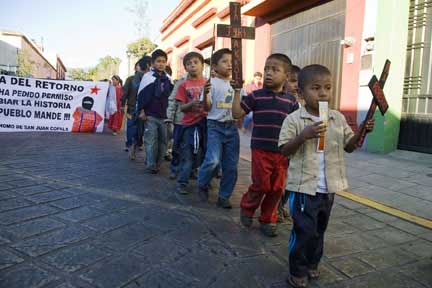
    Indigenous Triqui children march through the streets of Oaxaca on December 19, 2011, to protest a wave of killihngs in their home community of San Juan Copala.Indigenous Triqui children march through the streets of Oaxaca on December 19, 2011, to protest a wave of killihngs in their home community of San Juan Copala.

    Mixtecos have been leaving Oaxaca for decades, driven mostly by the endemic poverty of the Mexican countryside, says Gaspar Rivera Salgado, a Mixteco professor at UCLA and past coordinator of the Binational Front of Indigenous Organizations. Yet for many years the Triquis, who were equally poor and live in the same region, stayed put. Their migration only began when the violence in their communities made life unbearable.

    Once displaced, they began to migrate within the Mixteca region, then within Oaxaca, and then within Mexico. They traveled north, following other Oaxacans to San Quintin in the 1980s, and then in the 1990s, to California. 

    Triqui migrants might have escaped the violence, but not the political presence of the groups they were fleeing. Wherever they went, the Movement for the Unification of the Triqui Struggle (MULT) and the Social Welfare Group of the Triqui Region (UBISORT) sent agents, requiring people to pay monetary quotas and participate in mobilizations.

    In the 1980s, Triqui activists organized MULT. "It was a grassroots organization to fight the caciques (rural political bosses) over control of land, forests and other natural resources," says Rivera Salgado. "The caciques were so violent that MULT members had to arm themselves. Eventually, those armed men became a paramilitary group. The caciques were overcome, but what began as a grassroots organization became something different. There was no transition to a civil society form of organization."
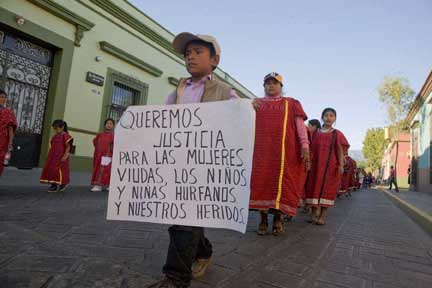
    A Triqui boy carries a sign that says, We want justice for the widows, the orphans and our injured.
    A Triqui boy carries a sign that says, "We want justice for the widows, the orphans and our injured.

    Eventually MULT itself fractured into factions. One faction became UBISORT, which began fighting MULT for political control of Triqui communities. Oaxaca's repressive state government used the conflict to enhance its own control. 

    UBISORT was organized with the support of then-governor Jose Murat, and became a political support base for Oaxaca's old governing party, the PRI (Party of the Institutionalized Revolution). MULT organized its own political party, the Popular Unity Party. But behind the parties were the guns.

    "A civil war went on between them," Rivera Salgado says. In 2006, Raul Marcial Perez, a leader of UBISORT, was assassinated. Then in October, 2010, Heriberto Pazos, the founder of MULT, was gunned down in the streets of Oaxaca city. 

    In the only municipio that remained in Triqui hand, San Martin Itunyoso, Antonio Jacinto López Martínez, a MULT leader, was elected president in 2004, but then couldn't take office because of threats, and fled to the nearby city of Tlaxiaco. Last October, as he was crossing the street there with two members of his family, a gunman shot him in the head. Many others were killed in years of violence and retribution.
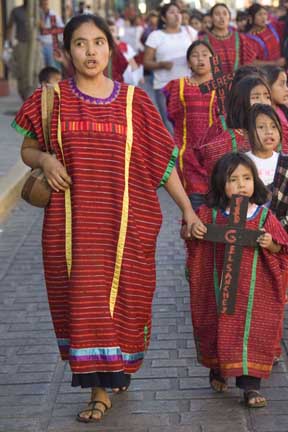
    The Triquis attempted to create an autonomous town in San Juan Copala, and were expelled by paramilitary gangs.  They carried crosses with the names of people who were killed.
    The Triquis attempted to create an autonomous town in San Juan Copala, and were expelled by paramilitary gangs.  They carried crosses with the names of people who were killed.

    The High Cost of Migration

    For Triquies, migration has had a high cost – they've had to fight for survival wherever they went.  "They faced tremendous racism and prejudice," Rivera Salgado charges. "They're always the outsiders, treated like savages."

    Over the course of some 25 years, so many have fled the political murders plaguing their homeland that they've formed towns like Nueva Colonia Triqui, or New Triqui Town, in Baja's San Quintin Valley. In that colonia, or in California's Triqui neighborhoods, people ask whether peace is possible, and if it were, would they go home too?

    "People left looking for a better future, but they worry about the safety of their families at home," says activist Elvira Santos (whose name has been changed), pointing to the fear that many Triquis share of reprisals for speaking publicly not only against themselves, but also against their families in Oaxaca.  "They'll think twice before going back because the conflicts and the same armed groups are still there."

    In north Mexico, migrants found farm labor camps with dirt floors and no electricity. When they wanted homes for children and families, Triquis and other indigenous migrants had to mount land invasions, building houses on Federal land, and then awaiting the police sent to evict them. 
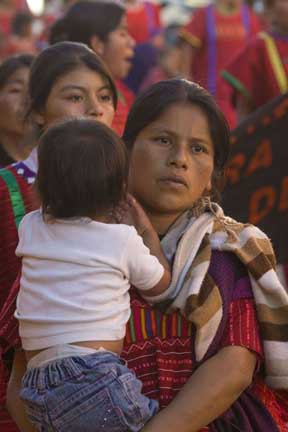
    The march called on the governor, Gabino Cue, to guarantee their safety when they try to return to the town and to arrest those responsible for the killings.
    The march called on the governor, Gabino Cue, to guarantee their safety when they try to return to the town and to arrest those responsible for the killings.

    In one of the most celebrated cases, Julio Sandoval, a Triqui leader from Yosoyuxi, was imprisoned for two years in the penitentiary in Ensenada for helping families settle in Cañon Buenavista.

    When Triqui migrant farm workers arrived in Greenfield, the local police and legal system condemned them for cultural practices like home births or early marriages, or for drinking in public, a normal activity at home. Eventually they reached agreement with the local police chief, who even set up a desk in the police station for a Triqui leader to provide translation. 

    Then town residents, who saw the migrants as unwelcome invaders, tried to fire the chief. The Triqui community by then numbered at least 3,000 people. Helped by the United Farm Workers, migrants marched through town to assert their right to live there.

    Roots of the Violence

    Adelfo Regino Montes, a Mixe indigenous leader and writer for Mexico's leftwing daily, La Jornada, traces the violence in the Triqui region to "political submission, territorial disintegration, economic exploitation, racial discrimination and exclusion in every aspect of daily life." 
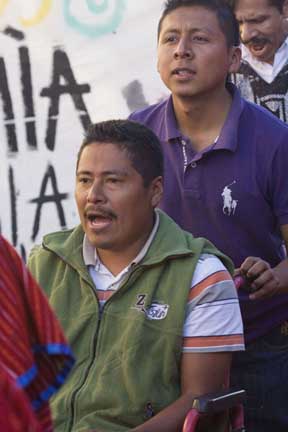
    Triqui men joined the women and children in the march.
    Triqui men joined the women and children in the march.

    After Mexico won its independence, Triquis controlled three municipios, or counties, where they were the majority. That gave them some degree of political power. After the Mexican Revolution, however, two of the municipios were dissolved, and much of the community's autonomy was lost.

    "San Juan Copala itself was no longer a municipio," Santos explains. "Many mestizos [people of mixed indigenous and Spanish ancestry] didn't want Triquis to have power. They introduced alcohol and arms in order to gain control of the land and resources." Those caciques  ruled Triqui towns using repression and violence.

    "[Triqui municipios] were dispersed into districts where non-indigenous people are the majority," Regino Montes said in a 2010 Jornada column. "The big majority of Triqui communities have been excluded from any decisions that affect their lives and destinies, undermining their autonomy and freedom to make their own choices. Those decision remained in the hands of the caciques, the state and federal governments, and the party leaders of the PRI."

    In the only municipio that remained in Triqui hands, San Martin Itunyoso, Antonio Jacinto López Martínez, a MULT leader, was elected president in 2004, but then couldn't take office because of threats, and fled to the nearby city of Tlaxiaco. Last October, as he was crossing the street there with two members of his family, a gunman shot him in the head.

    The women carry a banner that says, Neither forgive nor forget, punishment to the assassins.   Autonomous town of San Juan Copala.
    The women carry a banner that says, "Neither forgive nor forget, punishment to the assassins.   Autonomous town of San Juan Copala."

    "The violence is created by a lack of the assertion of the rule of law. But the government has excused its failure to stop it with such racist ideas as 'Triquis are savages and uncivilized,'" Rivera Salgado charges.

    Indigenous self-government

    Looking for a way out themselves, in 2007 Triqui activists created the autonomous municipio of San Juan Copala, inspired by the experiences of the Zapatistas in nearby Chiapas. "They recreated the system of indigenous self-government," Regino Montes wrote, "the only real possibility for peace in the region."

    "They were looking for a political alternative," adds Rivera Salgado, "and they used the political process.  They weren't armed. And they won in a clean election."

    Those activists had roots in another splinter from MULT, called MULT Independiente, or MULT-I. UBISORT and MULT united against them, and eventually laid siege to the town, which went on for months. A number of residents were killed. 
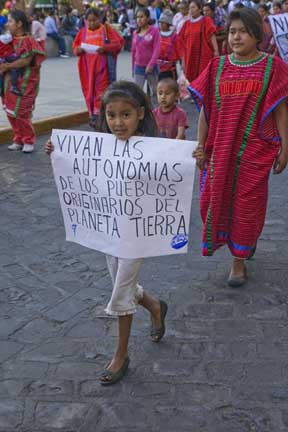
    Image007
    A Triqui girl carries a sign that says, "Long live the autonomy of the native people of the planet earth."

    On April 27, 2010, a caravan of Mexican and European human rights activists set out for San Juan Copala.  They were stopped at a roadblock, and gunmen began shooting. Beatriz Alberta Cariño Trujillo, a Mexican human rights activist, and a Finnish supporter Tyri Antero Jaakkola, were murdered. The others fled into the hills.

    Human rights lawyer Gabriela Jimenez Rodriguez said she was captured by hooded men who told her they were from UBISORT and MULT. "They told us than no one could pass here, that it was their territory."  Finally she and others were released. Police recovered the two bodies, but never tried to enter the town.

    On August 22, three more people were killed and two wounded, as they drove to nearby Santa Cruz Tilapia, where residents were also trying to establish an autonomous municipio. One was the town leader, Antonio Ramirez Lopez, 78 years old. 

    Then in September, 500 paramilitaries surrounded San Juan Copala and told supporters of the autonomous municipio they had 24 hours to leave. "That wasn't just a threat," Reyna Martinez, one of the town's leaders, told La Jornada. "They did the same thing in San Miguel Copala, where they killed twelve of our colleagues in the city hall. Neither state nor Federal authorities dare even to come into San Juan Copala.

    Image008
    Women and children walked past the street vendors selling toys in the city's main plaza, with the star and masked figure on their banner showing their connection to the Zapatista movement.

    No need for protective measures?

    Oaxaca's governor at the time, Ulisses Ruiz, notorious for his violent suppression of the teachers' strike of 2006, said there were no gunmen, deaths or disappearances in the Triqui region, and no need for protective measures for residents. By that time, families who'd fled were already living in the planton outside his office, and some had gone to Mexico City to set up a similar planton there. "They got us to leave," said another leader, Marcos Albino Ortiz, "but that doesn't mean we've given up."

    Last July, however, Gabino Cue, who Ruiz defeated in the election of 2004, beat the PRI candidate for governor. UBISORT campaigned for the PRI. MULT's PUP ran its own candidate, viewed largely as an attempt to draw votes from Cue. After the election, Cue put Region Montes in charge of the state Secretariat of Indigenous Affairs. Rufino Dominguez, former coordinator for the Frente Indigena de Organizaciones Binacionales, was appointed director of the Oaxacan Institute for Attention to Migrants.

    The women in the planton didn't stop demonstrating against the government, however, and the violence continued. In August three MULTI members were killed in Agua Fria. Their bodies were brought to the planton for a public funeral. In October, Reyna Martinez was arrested with two dozen others for occupying a piece of land near the airport, in an act of civil disobedience. They demanded that the new state government provide protection to allow their return to San Juan Copala, pay for the destruction of peoples' homes there, and arrest those responsible for the killings. And in December women and children in bright red huipils marched through Oaxaca city, demanding the government accept the conditions.

    In response to the pressure, Rufino Juarez, a UBISORT leader, was arrested in May for killing MULTI activist Celestino Hernandez Cruz a year earlier. Cue's administration then issued arrest orders for a number of others, but so far none have been detained, with one exception. Authorities did arrest a MULTI founder and retired teacher, Miguel Angel Velasco, accusing him of arranging the disappearance of two young women from MULT in 2007.
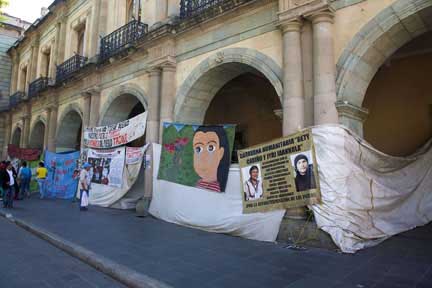
    Image009
    The planton in front of the governor's palace on the main square in Oaxaca.

    Nevertheless, Marcos Albino Ortiz, says that the state government "has fulfilled about half of what it agreed to. We're going back to San Juan Copala, and we're talking with the communities there to ensure they support our decision. Our objective is to pacify the region." He predicts that the state and federal police will provide an escort, along with representatives of the Interamerican Commission for Human Rights, which has issued orders of protection for many of the activists. Some 135 families have received some restitution for their burned homes, he says.

    Can Triquis go home?

    To ensure peace in San Juan Copala, however, some police presence there is unavoidable, at least in the short run, Rivera Salgado believes. "The litmus test is whether the government will create the conditions in which people can go home," he says. "You can't change overnight a situation that's existed for 30 years. In the short term they have to disarm the armed people. This can create political space. But military occupation is not a long-term solution. People need to become a force for change themselves."

    Following the ambush of the caravan, Regino Montes asserted, "The solution must be the recognition and respect, in law and in action, for the process of Triqui autonomy." Now he is a responsible official in a government that has the power to implement that recommendation.

    Peace in Oaxaca may encourage Triqui migrants to return, but going home won't be easy. No one can afford to go back to Oaxaca, just to take a look. 
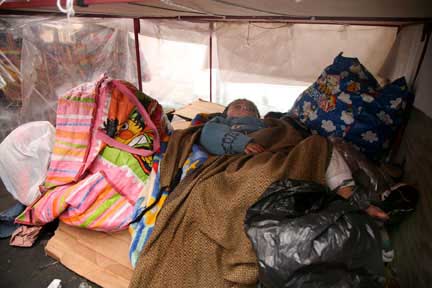
    Image010
    A child sleeps in a planton set up by the Triquis in Mexico City's zocalo, or main square.

    Triqui migration hit the U.S. after the amnesty of the 1986 Immigration Reform and Control Act, so most people have no legal immigration status.  They can cross the border into Mexico, but coming back to the U.S. is a much bigger problem. It's expensive — $2500 for a coyote for the crossing is two months wages for a farm worker. Plus, it's more dangerous every year, as people get pushed by increased enforcement into the most remote sections of the border to cross. 

    Going back home is a permanent decision, not a temporary visit. Nor has the fear of violence there diminished. In the last few years, five Triqui families even won political asylum, helped by San Francisco's Lawyers Committee for Civil Rights. Nevertheless, "most migrants get much harsher treatment now," according to Rivera Salgado. "The current enforcement policy is based on excluding them, through violence and jail at the border, and isolation and fear in their community. The idea is to make life so hard for them in the U.S. they'll have to leave.  But where are they supposed to go?"

    "I think a lot of people would go home if they could," Santos believes. "Our land is very productive, and as farm workers here we've seen new crops that we could grow in Oaxaca. But we need jobs and schools there, and especially security. Right now, we don't know if we can even hope for that. Some of us have lost hope. Our governments have made these promises before. It would be good if it were true this time, but we have to see if their actions match their words.""

    "And where is home?" asks Rivera Salgado. "Lots of Triquis have grown up in San Quintin or Greenfield by now. Yet the first generation still yearns for connection to San Juan Copala. It is part of their identity and sense of belonging.  Everybody needs that."


  • 4443
    What do you know about the surprisingly short history of heterosexuality? Hanne Blank talks with Salon about her soon-to-be-published book, Straight.

    Just because something is constructed as a social category, doesn’t mean that it’s not enormously meaningful.  It doesn’t mean that we haven’t built a whole damn civilization on it. Doesn’t mean that we don’t live our daily lives on it, doesn’t mean that we don’t use it all the time every time we’re walking down the street.  This is real.  It’s stuff that has physical manifestations in the real world. But that does not mean that it is organic. 

    The Provincetown Banner reviews the memoir Remembering the Music, Forgetting the Words: Travels with Mom in the Land of Dementia by Kate Whouley.

    Kate, with delicate skill, tells the story of her mother’s progression through Alzheimer’s and mixes it with insight, humor and equal measures of acceptance and hope. In the course of the book she goes from the daughter who loves her mother but has a complicated and sometimes stressful relationship with her to the sole caregiver who must put all the old patterns away. There are no siblings, no husband to help. This is something Kate must do on her own though she finds support from close friends and a group of caring professionals.

    In the New York Post, Sam Skolnik explains why governors and legislators shouldn't look to gambling as the quick fix for budget woes, a topic he explores in his book High Stakes.

    What we gain in state revenues we lose in increased bankruptcy filings, divorces and gambling-related crimes such as robberies, domestic violence and, in the worst cases, suicides.

    In a study, Earl Grinols, an economist at Baylor University, said that when a casino is introduced into a region that didn’t before have one, the long-term cost-benefit ratio is more than three to one because of things like rising crime, unemployment, addiction treatment costs.

    States also lose economically, Grinols says, because gamblers aren’t using as much of their money to help local economies by buying normal amounts of consumer goods such as food, cars, clothing and the like.

    Anita Hill offers advice to women lawyers.  

    Cynthia Barnett explains why the green movement should include blue.

    Kaitlin Bell Barnett wonders what the term "serious mental illness" means.

    Sign up to be a giver in World Book Night. Sign up ends February 1st! Read more here. 

  • “Forgive Us for What We Could Have Been but Failed to Be”

    O thou Eternal God, out of whose absolute power and in- finite intelligence the whole universe has come into being. We humbly confess that we have not loved thee with our hearts, souls and minds, and we have not loved our neigh- bors as Christ loved us. We have all too often lived by our own selfish impulses rather than by the life of sacrificial love as revealed by Christ. We often give in order to receive, we love our friends and hate our enemies, we go the first mile but dare not travel the second, we forgive but dare not forget. And so as we look within ourselves we are confronted with the appalling fact that the history of our lives is the history of an eternal revolt against thee. But thou, O God, have mercy upon us. Forgive us for what we could have been but failed to be. Give us the intelligence to know thy will. Give us the courage to do thy will. Give us the devotion to love thy will. In the name and spirit of Jesus we pray. Amen. 

    Martin Luther King, Jr. From "Thou, Dear God": Prayers That Open Hearts and Spirits.

    Date-header-bg

    Lewis Baldwin, credit to Daniel DuboisLewis V. Baldwin is professor of religious studies at Vanderbilt University and an ordained Baptist minister. An expert on black-church traditions, he is author of The Voice of Conscience: The Church in the Mind of Martin Luther King, Jr.; There Is a Balm in Gilead: The Cultural Roots of Martin Luther King, Jr.; and Never to Leave Us Alone: The Prayer Life of Martin Luther King, Jr. He is the editor of "Thou, Dear God": Prayers That Open Hearts and Spirits, the first and only collection of prayers by Martin Luther King, Jr. 

    Spirituality as a Relationship with a Higher Power: Exploring the God Concept in the Prayers of Martin Luther King, Jr.

    8603

    Prayer as a spiritual practice connected the Reverend Dr. Martin Luther King, Jr. with that profoundly powerful and pervasive spiritual force that created and sustains the universe. This is evident from even a casual reading of King's prayers for all seasons, which are provided in a rich and handsome volume called, "Thou, Dear God": Prayers that Open Hearts and Spirits. King often spoke of God as his "divine companion," and of walking and talking with this God in the midst of his daily routines and struggles. The prayers in this volume are directed toward that Supreme Being to whom King commonly bowed, especially in times when he felt helpless, vulnerable, and in need of courage and guidance. The prayers show that King had an inner sense of something greater than himself, and he was clearly not hesitant about expressing his dependence and/or reliance upon the God of the universe. Generally speaking, the prayers in "Thou, Dear God" take the reader beyond questions about King's own relationship to God to the larger issue of what the divine-human relationship might entail. Thus, they challenge us to come to terms with our own consciousness about that larger and more powerful reality that ultimately brings what King termed "the disjointed elements of all reality into a harmonious whole."

    Photo of Lewis V. Baldwin by Daniel Dubois.

    Date-header-bg

    Watch the book trailer on YouTube.