• Nancy D. Polikoff is Professor of Law at American University Washington College of Law, where she teaches in the areas of family law, civil procedure, and sexuality and the law. She is the author of Beyond (Straight and Gay) Marriage: Valuing All Families under the Law. Get 10% off on this and all other Beacon Press titles at our Holiday Sale, running through December 31st. This post originally appeared on Polikoff's blog.

    Polikoff If supporters of Prop 8 have standing to appeal Judge Walker's order in Perry v. Schwarzenegger (even though the state did not appeal it), the Ninth Circuit Court of Appeals will decide whether Prop 8 violates the federal constitution. If you listened to the oral argument yesterday, you heard the term "rational basis" used a lot. That term means something in constitutional law. Every time the state puts people in categories — classifies them — it must have at least a "rational basis" for doing so. Charles Cooper, arguing for the Prop 8 supporters, therefore had to say what the rational basis is for allowing different-sex couples to marry but denying that right to same-sex couples.

    Here's what he said. The key purpose of marriage is to manage the one relationship that naturally produces children, often unintentionally. Society's interests are threatened by unwanted pregnancy because a child raised by "its" (his word) mother alone violates society's vital interests. Society will have to step in and assist that single parent. ("That is what usually happens," he said). He argued as an "undeniable fact" that children raised in that circumstance have poor outcomes. In the middle of this last sentence, Judge Reinhardt said that sounded like a good argument for prohibiting divorce, but how does it relate to same-sex couples raising children?

    His question caused chuckles in the courtroom, but here is its constitutional significance: The rational basis test requires that the state's classification be rationally related to achieving a legitimate state interest. So, first, what is the legitimate state interest? In general, providing for the welfare of children is of course legitimate, but, in this context, Cooper, on behalf of opponents of same-sex marriage, is essentially saying that the state has a legitimate interest in preventing births to single mothers. I strenuously object to this, on its own terms. And I wish supporters of same-sex marriage would object to it as well.

    Instead, the emphasis among gay rights advocates is the approach reflected in Judge Reinhardt's question. It assumes that the state does have a legitimate interest in preventing births to unmarried mothers but suggests that keeping same-sex couples from marrying does nothing to achieve that objective. Judge Reinhardt's comment about divorce doesn't directly tackle bearing a child outside of marriage but does explicitly address a corrolary principle that opponents of same-sex marriage adhere to, which is that children do best raised by their married mother and father. Banning divorce would result in more couples staying married, so it does bear a rational relationship to having children raised by their married parents. Of course there is no political support for banning divorce, so no state is going to do that.

    As a matter of constitutional argument, it is completely proper to focus on the relationship between the classification and the state interest. If the classification is not rationally related to the state interest then it should fail as a matter of Equal Protection law. So if banning same-sex marriage won't result in fewer heterosexual pregnancies outside of marriage, then it is irrational. (Or if allowing same-sex marriage won't result in more heterosexual pregnancies outside of marriage, then it is irrational.)

    But I want to directly address the alleged state interest in reducing births outside of marriage. I wish that gay rights advocates would say directly that the state has no business prefering heterosexual motherhood within marriage over heterosexual motherhood outside of marriage. I do not believe that should be considered a "legitimate state interest." The arguments from social science about the well-being of children, which Charles Cooper referred to as "undeniable fact," are overstated, mischaracterized, covertly political, and flat out wrong. I've written about this in many posts about spending federal dollars on "marriage promotion." Consistently, the right wing argues that poverty is the result of unmarried births and that marriage is the way to end poverty. When that reasoning prevails, poverty looks like the moral failing of individuals who do not marry, rather than the result of systemic policies that reinforce income inequality that could be addressed through laws and programs designed to reduce that inequality. We know how to end poverty but we lack the political will to do it.

    Charles Cooper's argument about the rational basis for opposing same-sex marriage is that if you redefine the word "marriage" to include same-sex couples you change the institution of marriage and make it something other than the place society provides for the well-being of children born, often accidentally, from the sexual relationship of the two participants. Unfortunately, it's an argument that has been successful in some state courts. I believe it fails the rational basis test in the way that Prop 8 opponents argued, but I also wants the gay rights movement to recognize its common cause with single mothers. Family structure does not determine child outcome. All children need government policies that optimally serve their physical, emotional, and educational needs. That's the gay rights position I champion.

    Beacon Press Holiday Sale: 10% off all titles.

  • David Chura is the author of I Don’t Wish Nobody to Have a Life Like Mine: Tales of Kids in Adult Lockup. He has worked with at-risk teenagers for the past 40 years. For 26 of those years, he taught English and creative writing in community based alternative schools and in a county penitentiary. His writings have appeared in the New York Times as well as other scholarly and literary journals. Get 10% off on this and all other Beacon Press titles at our Holiday Sale, running through December 31st.

    ChuraThe statistics are grim, but the reality behind those numbers is even grimmer for the many young people locked up in US adult prisons. Since publishing I Don't Wish Nobody to Have a Life Like Mine: Tales of Kids in Adult Lockup, about my years teaching in a New York county jail, I spend a lot of time writing, talking and hearing from families, professionals, and the young people themselves about the failures of our child welfare and criminal justice systems.

    Depressing, discouraging stuff. That's why I need to tell you about Andrew. Andrew is a young African American in his late 20s. He's got a home, an education, and a profession. Andrew is a success.

    But it wasn't always that way. As a very young child his schizophrenic mother was placed in long term care and Andrew was shuffled around to various family members until eventually he ended up in the foster care system. There he was moved from home to home to home. Then at 16 he was placed in an overcrowded and understaffed foster care facility where kids like him were warehoused. But he supposed it was better than being homeless. At least he had food and shelter. He even learned some things, mostly how to get into trouble, serious trouble.

    Andrew would be the first to admit that he did stupid stuff. You might say that the first time he got arrested, the time he hopped a cab with a buddy who then pulled a knife and robbed the cabby, really wasn't his fault. But he wouldn't agree. Wrong place, wrong time, still makes a crime. And there was no way to excuse the other felonies he committed after that, felonies that landed him in state prison.

    Andrew was just another young, black male fulfilling the destiny society defined for him: broken-down family, raised in the 'hood, poor, uneducated, unemployed and unemployable. America has a place for kids like him—jail or the grave.

    But somewhere along the way he realized he didn't want either fate. During one of his county bids he enrolled in school and got himself into counseling with our school social worker. He studied for his GED and achieved it. With that first taste of success Andrew peeked over the top of the box society had put him in and glimpsed a different way to live. He began to recognize in himself the young man the social worker kept hinting at to him: someone who had survived a mentally ill mom, a neglectful family, a broken foster care system, and a punishing criminal justice system; someone who was ripe to make changes. Through his own efforts and the social worker's encouragement both while he was in jail and after he was released, Andrew began to do what he had to do to change.

    And change he did. He enrolled in community college and excelled even while working 2 or 3 part-time jobs at a time to support himself. For awhile he slept in the back of the pizzeria where he worked or in a rented room he shared with a couple of other homeless young guys. After finishing his associate's degree he earned a scholarship to a Bronx college where he received his BA in social work, again while holding down multiple jobs.

    Andrew didn't stop there. He got another scholarship, this time to Fordham University's Graduate School of Social Work. In 2008 he earned his MSW as well as the recognition of the New York State Social Work Educators Association as the "Social Work Student of the Year." He now works at a county Youth Bureau helping at-risk kids navigate the minefield of the streets.

    Andrew is a success by anybody's standards. By the standards of our penal system he's a damn miracle. But we're an unforgiving and shortsighted nation, and so our tenacious stereotypes of ex-offenders, reinforced by CORI laws which give employers the right to deny felons jobs, has limited Andrew's possibilities in state social service agencies and academia. While interviewers acknowledge his personal, academic and professional accomplishments, that's as far as it goes. In America, once a felon always a felon.

    Andrew got where he is because of his resolve and hard work and because someone had faith in him and acted on that faith. Unfortunately our criminal justice system doesn't provide that kind of support even though it is in the best interest of the society it is committed to protect.

    But just because the prison system doesn't—or won't do it—that doesn't let the rest of us off the hook. Teachers, social workers, youth advocates, clergy and their congregations, community activists, family members, neighbors, employers, concerned citizens, we all need to push to have these exclusionary laws changed; to challenge our own and society's attitudes about ex-offenders; and to take a chance in whatever way we can on some kid once locked-up now locked-out of the world. One kid by one kid: It's a slow, chancy process. Maybe it's even futile. But then again, there's always Andrew.

    Beacon Press Holiday Sale: 10% off all titles.

  • Check out our Holiday Sale at Beacon.org: order any book by December 31st and receive 10%, free shipping, and a warm fuzzy feeling from knowing that your purchase will help support Harlem Children's Zone, Interfaith Youth Core, and Food Democracy Now! Beacon Press will donate 20% of the proceeds of this sale to these three organizations.*

    The Holiday Sale Page has great suggestions for books to buy for your favorite locavore, history buff, activist, and more, but the sale applies to any Beacon title, so be sure to browse the site for your own ideas. 

    *You must use discount code HOLIDAY10 to receive 10% off your order. Orders using promo code HOLIDAY10 will receive a standard shipping upgrade to priority mail. However, due to the increased volume of mail shipping during the holiday season, we cannot guarantee orders submitted after December 13 will arrive by December 24. If you would like to ensure your package arrives by that date, we offer paid shipping options via UPS. A 20% donation from each sale using promo code HOLIDAY10 will be divided between the three organizations: Harlem Children's Zone, Interfaith Youth Core, and Food Democracy Now.

  • Looking for some Hanukkah tunes?

    Danielle Ofri wonders whether patients need chaperons.

    Carl Elliott thinks that doctors need more than sunshine to banish the influence of big pharma.

    Noam Chomsky talks about Wikileaks and the Pentagon Papers on Democracy Now.

    Arranged marriage: a proactive, community-based approach to love?

    We might be more racist than we think we are.

    Cleaning with garbage? Vacuum cleaners made with trash from the ocean.


    Related articles

    A Hannukah Surprise for Interfaith Mom
  • Mark Hyman is a Baltimore-based journalist and author who writes often about the business of sports, sports and law and about the role of adults in youth sports. He is the author of Until it Hurts: America's Obsession with Youth Sports and How It Harms Our Kids, and blogs at Youth Sports Parents.

    HymanWednesday's New York Times ran my article on DVDs and group classes that introduce babies and toddlers to sports. A lot of reaction – pro and con – on the Times Web site. Last time I looked, 105 comments.

    Each company cited in the article – and the entrepreneurs behind them – seems to be coming from a slightly different perspective. Doreen Bolhuis, who created the Gymtrix exercise videos, believes that babies truly can improve coordination by working out. She's quoted in the article on this point and during my interview with her spoke about it at length, telling me, “We sell babies short because they can’t speak yet. But they’re all about learning how their bodies work and about movement patterns. When we guide them they learn so much more quickly than if we leave it to chance and hope they’ll figure it out."

    Other company executives quoted in the story cited different reasons for getting really, really young ones started in sports – fighting childhood obesity, getting them in the habit of being active and teaching the basics of games they may pick up later.

    How many parents are buying videos and signing up for classes hoping to turn their babies and toddlers into superstars later on is impossible to say. Clearly some companies are appealing to that instinct, subtly or otherwise.

    I had a small role in putting together this video which ran with the article on the Times site. It's worth a look.

  • As we all get ready to sit down to Thanksgiving dinner, Mark Winne provides food for thought on the Washington Post‘s Political Bookworm blog and on NPR’s Tell Me More.

    And while we’re thinking about food, hunger, and how to challenge our industrial food systems, Winne talks about how we can all be Food Rebels. Happy Thanksgiving!

  • WINNE_FoodRebelsIn Food Rebels, Guerrilla Gardeners, and Smart-Cookin’ Mamas: Fighting Back in an Age of Industrial Agriculture, Mark Winne introduces us to innovative "local doers" leading the charge to bring nutritious, sustainable, and affordable food to all, and we wanted to give a shout-out to organizations that we consider "Food Rebels" here on the blog.

    Last week, we saluted Connecticut's Working Lands Alliance and the National Farm to School Network on Thursday, and the Sustainable Food Center, headquartered in Austin, Texas, and the W. K. Kellogg Foundation's Food and Community Program on Friday. Today, Mark Winne talks about a Food Rebel in Cleveland: Maurice Small of City Fresh.


    Mark Winne on Food Rebels and urban farming in Cleveland

  • Geoffrey Canada, author of Fist Stick Knife Gun, spoke with Tavis Smiley about the graphic adaptation of his acclaimed memoir. 

    In USA Today, Eboo Patel calls for a more pluralistic view of Islam in the world.

    Ted Dracos discussed PCBs and his new book, Biocidal, on Portland's KPOJ.

    Steve Wilson talked about The Boys from Little Mexico on KUOW.

  •  

    WINNE_FoodRebelsYesterday, we looked at two of the organizations featured in Food Rebels, Guerrilla Gardeners, and Smart-Cookin’ Mamas: Fighting Back in an Age of Industrial Agriculture by Mark Winne. In the book, Winne introduces us to innovative "local doers" leading the charge to bring nutritious, sustainable, and affordable food to all, and we wanted to give a shout-out to organizations that we consider "Food Rebels" here on the blog.

    In our first post, we featured Connecticut's Working Lands Alliance and the National Farm to School Network. Today we profile the Sustainable Food Center, headquartered in Austin, Texas, and the W. K. Kellogg Foundation's Food and Community Program.


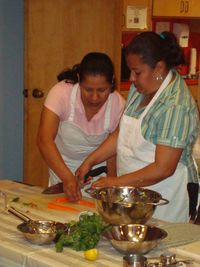
    DSC00111The Sustainable Food Center's mission is to cultivate a healthy community in Austin, Texas, by strengthening the local food system and improving access to nutritious, affordable food. SFC envisions a food secure community where all children and adults grow, share and prepare healthy, local food. Through organic food gardening, relationships with area farmers, interactive cooking classes and nutrition education, children and adults have increased access to locally grown food and are empowered to improve the long-term health of Central Texans and our environment. 

    The SFC's major projects include the Grow Local program, which provides education to increase proficiency in food gardening, and aid in the establishment and long-term sustainability of community and school gardens; the Happy Kitchen, a cooking and nutrition education program; and Farm Direct, which runs the Austin Farmers Market and connects local growers with institutional consumers. 

    In December, the Happy Kitchen will hold a facilitator appreciation banquet at a local library. And SFC will benefit from a CharityBash fundraiser for young professionals on December 8th. 

    The W. K. Kellogg Foundation's Food and Community Program is focused on creating healthy places where all children thrive. The program includes efforts to improve school food, aid community-led initiatives to increase access to good food and opportunities for physical activity, and works to build movements to promote healthy eating and active living.

    Among the many programs supported by the foundation is Double Up Food Bucks, a Detroit-based group which helps families receiving food assistance benefits purchase more fresh fruits and vegetables at farmers’ markets. This brings benefit to both the families and to the local farmers selling the fresh fruits and vegetables. Watch a video here or at YouTube to find out more about the program.

  • WINNE_FoodRebels In his book Food Rebels, Guerrilla Gardeners, and Smart-Cookin’ Mamas: Fighting Back in an Age of Industrial Agriculture, Mark Winne introduces us to innovative "local doers" leading the charge to bring nutritious, sustainable, and affordable food to all. Heeding Emerson's call to embrace that great American virtue of self-reliance, these leaders in communities all across the country are defying the authority of the food conglomerates and taking matters into their own hands.

    Today we profile two groups of "Food Rebels": the Working Lands Alliance and the National Farm to School Network.


    Workinglandsalliance
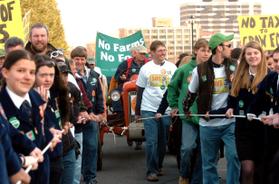
    Working Lands Alliance at their "No Farms, No Food" rally at the Connecticut State Capitol in spring 2009.

    The Working Lands Alliance was formed in 1999 with the sole purpose of preserving Connecticut’s most precious natural resource – its farmland.  WLA is a coalition whose supporters include more than 600 individuals and 200 businesses and organizations that include farmers, conservationists, anti-hunger groups, planners and local food enthusiasts.  This coalition has joined together in an effort to halt the loss of Connecticut’s remaining farmland.

    This week, the Working Lands Alliance and the CT Trustees of the Eastern States Exposition announced the winners of the 2010 Farmland Preservation Pathfinder Awards. The town of Pomfret, a community of 4,100 residents, won the Pathfinder Group Award for their preservation efforts, including a bonding resolution of $4 million for land preservation and a one-time preservation of 17 parcels totaling over 700 acres in 2009 (unprecedented in the State of Connecticut). WNPR radio host Faith Middleton is the winner of the Pathfinder Individual Award for outstanding achievement in advancing farmland preservation in the State of Connecticut. And for their determination and success in restoring an agricultural asset to their community and founding a community farm that features educational programs about farming, raises vegetables for a CSA, and makes weekly donations of product to local families in need, the Woodbridge Conservation Commission & the Board of Directors of Massaro Community Farm is the winner of the Pathfinder Education Leader Award for significant contributions in the area of educating the public about the importance of farmland preservation.

    NFSN_PrimaryLogoThe National Farm to School Network increases access to local food and nutrition education to improve children's health, strengthen family farms, and cultivate vibrant communities. Founded in 2007, the National Farm to School Network provides training and technical assistance, information services, networking, support for policy advocacy, and media and marketing activities in all 50 states with national staff and eight Regional Lead Agencies. The National Farm to School Network envisions a nation in which Farm to School programs are an essential component of strong and just local and regional food systems, ensuring the health of all school children, farms, environment, economy and communities. 

    20090323_tierra_miguel_0201
    Photo by Emily Hart Roth

    In May 2010, the White House Childhood Obesity Taskforce Report recommended both Farm to School and school gardens as a community based solution to childhood obesity. Specifically, recommendation 3.6 of this report states: "USDA should work to connect school meal programs to local growers and use farm to school programs, where possible, to incorporate fresher, appealing food in school meals." Michelle Obama’s Let's Move campaign website also specifically promotes community gardens, school gardens and Farm to School programs.

    Farm to School is involved with Root 4 Kids, a campaign from Annie’s that calls on parents and teachers nationwide to help one million kids dig and plant new veggies harvest 2010 through harvest 2011. Annie’s will award the school with the most people who join Root 4 Kids by December 31, 2010, with their choice of a garden, a new Farm to School program or gardening supplies for one year. In addition, for every 1,000 people who join, Annie’s will contribute funds toward a garden or Farm to School program in an underprivileged school.

    Read about Farm to School's social media campaign to put Child Nutrition Reauthorization back on Congress’s radar and build momentum to pass the child nutrition bill. Join the Twitter campaign to pass the Healthy, Hunger Free Kids Act, or share the following video on Facebook, Twitter, or through email.