• David Chura is the author of I Don’t Wish Nobody to Have a Life Like Mine: Tales of Kids in Adult Lockup. He has worked with at-risk teenagers for the past 40 years. For 26 of those years, he taught English and creative writing in community based alternative schools and in a county penitentiary. His writings have appeared in the New York Times as well as other scholarly and literary journals.

    4369192900_b77e6479e4 At the beginning of my ten years teaching teenagers in a county lockup I was always surprised, and yes, disappointed, when one of my students got rearrested.

    Jail’s a sobering place no matter how tough you want to think you are. The deprivation, brutality, and oppression gets your attention especially if you’re 15 years old. So once locked up, many of the kids I taught saw my jailhouse classroom as an opportunity to do something productive. Along with education, some got counseling to deal with their addiction and anger problems; others reconnected with family and church. When they were released, they talked about changing their lives for the better. They were sincere and determined, and I was hopeful that they would do just that.

    Over time, though, my attitude changed. More and more I was surprised when a student didn’t return. Despite society’s puzzlement as to why jail is a revolving door for so many teens, the reasons became obvious to me: The kids I taught might have made significant changes while locked up, but the world they were sent back into—poor, violent, defined by racism—had not. I’ve seen teens walk out the prison gates alone, carrying nothing but a plastic bag with their clothes, a token for the bus, and the county’s other freebie—the wise words, “Don’t come back.” That’s all. No planning, or guidance, or support to make the mega-changes needed to turn their lives around, changes that when you’re a kid with no resources feel insurmountable.

    One major stumbling block for any former inmate is jobs. Ex-offenders don’t get hired. Teenage ex-offenders get hired even less. When I asked guys, “What are you doing back here?”,  they would talk about not being able to get jobs they knew they were qualified for because they had a record. It’s hard to “do the right thing” when the streets and their hustles—drugs, auto theft, guns, robbery—are the only employers eager to hire you back.

    (more…)

  • Some quick links to good reading and viewing to help you with your Friday afternoon procrastinations.

    Recent reviews:

    News and Letters on Carole Joffe's Dispatches from the Abortion Wars.

    CommonWealth Magazine on Neil Miller's Banned in Boston.

    Author Interviews:

    Civil Eats talks to Mark Winne about Food Rebels, Guerilla Gardeners, and Smart-Cookin' Mamas.

    The worst fear to me is that we may voluntarily forfeit control of our food because it’s easier and we may not feel we have an alternative because circumstances have become so dire. And the first casualty in all of that will be democracy. I am trying to make it clear to people who are in the alternative food system that while a lot of good things are happening, they are still pretty small measures. We shouldn’t be so sanguine, we are still barely at the margins.

    Carl Elliott explains the dark side of medicine to Time's Healthland.

    White Coat, Black Hat can best be described as simultaneously fascinating and depressing — which is exactly what I told Elliott when I emailed him for an interview. In response, he said, "If you're depressed, then I'm doing my job," and added jokingly that he'd provide "free Zoloft with every purchase."

    Forbes talks with Courtney E. Martin about the role money plays in activism.

    The most important thing I’ve learned came from my friend Chris, who actually helped me produce the short videos of each activist that you can find on our website. He’s an ad executive, a very successful guy who came from a low-income background. He told me, “Courtney, money is just a tool. No more. No less.” I think that’s the most liberating and empowering way to look at it. It’s not your worth. It’s not your ticket to happiness. It’s simply a very powerful tool. 

    Things to watch:

    20/20 on Islam in America, featuring Eboo Patel.

    Frederick Lane talks about privacy, teens, and "sexting."

    http://www.wcax.com/global/video/videoplayer.js?rnd=969098;hostDomain=www.wcax.com;playerWidth=400;playerHeight=340;isShowIcon=true;clipId=5208297;flvUri=;partnerclipid=;adTag=News;advertisingZone=undefined;enableAds=false;landingPage=http%253A%252F%252Fwww.wcax.com%252Fglobal%252Fvideo.asp;islandingPageoverride=false;playerType=POPUP_EMBEDDEDscript

  • Jay Wexler is the author of Holy Hullabaloos: A Road Trip to the Battlegrounds of the Church/State Wars. He is a professor of law at Boston University Law School.

    Odonnell_hullaballo
    Christine O’Donnell: This could be you.

    So, the blogosphere and tweetosphere and facebookosphere are all abuzz about how it appears that Christine O’Donnell doesn’t really know what the first amendment’s religion clauses say.  I’ve watched the footage, and I think that probably she was trying inartfully to make the old point that the First Amendment does not actually include the phrase “separation of church and state.”  This is true, but irrelevant.  The First Amendment says that “Congress shall make no law respecting an establishment of religion, or prohibiting the free exercise thereof.”   The Supreme Court has long interpreted these two clauses (the Free Exercise Clause and the Establishment Clause) to require a certain amount of separation between church and state, with the details of what exactly that means with respect to various specific controversies worked out over time through lots of cases examining particular facts.  The First Amendment is very complicated when it comes to religion, it’s true, but luckily for Ms. O’Donnell, I have written a book about exactly what the religion clauses mean, in a way that I think even she could understand.  After all, Publishers Weekly wrote in its starred review that my “lucid explications of difficult constitutional concepts and the vagaries of Supreme Court rulings are superb, providing readers a deeper understanding of the First Amendment and Supreme Court jurisprudence.” So, here’s my offer to you, Ms. O’Donnell. If you would like a copy of my book Holy Hullabaloos: A Road Trip to the Battleground of the Church/State Wars, to help you prepare for your next political debate, I would be absolutely delighted to send it to you free of charge, and I’ll even pay for postage. Let me know. I’ll be checking my email at jaywex@bu.edu for your message.

  • Michael Lanza is a freelance photographer and writer. The creator of TheBigOutside.com, Lanza dedicates his site to sharing personal hiking adventures and offering guidance to fellow wilderness enthusiasts. He is the Northwest Editor of Backpacker magazine, the voice behind the Trip Doctor blog on backpacker.com, and a former editor for AMC Outdoors magazine. Author of previously published hiking guides, Lanza's newest book, Before They're Gone (Beacon Press, spring 2012), examines climate change in national parks through the lens of family hiking excursions. The following post is an example of one such adventure.

    Crossing Spray Park below Mt. Rainier Crossing Spray Park below Mt. RainierWe hiked slowly but steadily uphill through switchbacks in the cool shade of Pacific silver fir and Alaska yellow cedar draped in Spanish moss. With melting snow swelling every river, stream, and rivulet in the 470 miles of waterways within the boundaries of Mt. Rainier National Park, the Cascade Range erupted in a riot of greenery all around us, the forest a happy drunk on an H2O bender.

    The temperature was a just-about-perfect 60° F. or so, and a breeze wandered through the big trees—weather copied and pasted directly from my backpacking dreams. I barely broke a sweat despite carrying a pack weighing as much as my nine-year-old son, jammed with much of the gear, clothes, and food for our three-day, 24-mile family backpacking trip across Rainier’s northern flanks, from Mowich Lake to Sunrise. I tried not to think about the forecast of rain for the next two days, or that my itinerary assumed our nine- and seven-year-old kids would happily hike nine miles and 2,000 feet uphill on our last day.

    We emerged from the dense forest and crossed a log bridge over a small stream, passing through a threshold of conifers into a spacious meadow—and a vision of impossibility suddenly loomed on the horizon before us.

    (more…)

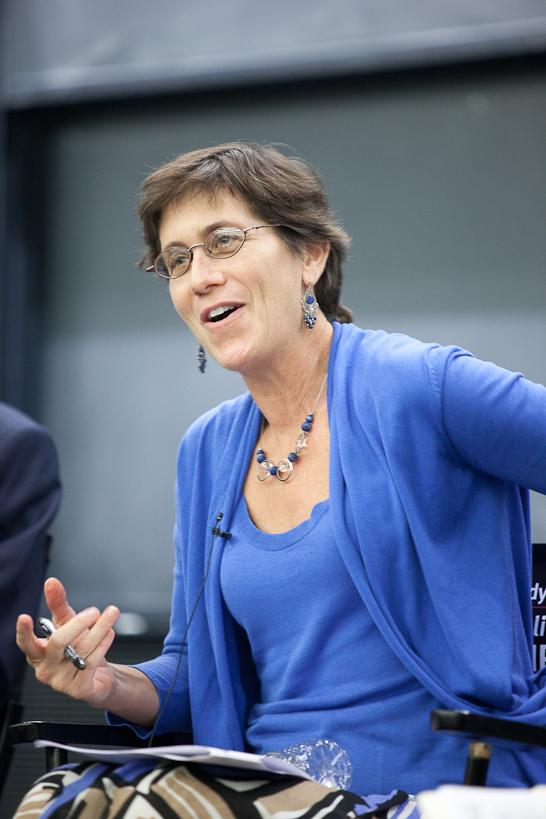
  • Award-winning educator Linda F. Nathan founded the Boston Arts Academy in 1998. She consults and speaks on educational issues nationally and internationally, and teaches a graduate course at Harvard on building democratic schools. She is the author of The Hardest Questions Aren't on the Test: Lessons from an Innovative Urban School.

    Recently, I had the chance to participate on a panel discussion at the Center for Public Leadership (Harvard Kennedy School) following a screening of the newly-released documentary Waiting for Superman. I was joined on the panel by Jim Berk (CEO of Participant Media, the film’s production company) and Thackston Lundy, a student at Kennedy school and former Director of Operations at one of the schools profiled in the film. David Ager, Director of Undergraduate Studies and Professor of Sociology at Harvard, moderated the discussion.

    Panel

    Panelists Thackston Lundy, Jim Berk, and myself with Moderator David Ager

    You’ve probably heard about this moving but controversial film directed by Davis Guggenheim (An Inconvenient Truth). In Waiting for Superman, Guggenheim documents the aspirations of five families seeking charter school admission as a way out of under-performing district public schools. By focusing primarily on charter schools while omitting well-performing district schools entirely, the film (intentionally or not) promotes charter schools as the logical alternative to public school systems. Although charters have been one source of innovation and best practices, the overall record for these schools has been a mixed bag at best. As a person with first-had knowledge of many high-functioning district public schools, you can be sure that I had a few things to say!

    In our discussion Jim Berk stated his hope for a sea change as a result of this film; a vision of people rising up to get involved in their communities to demand better schools and better results for kids. I do hope that this will happen and that the film doesn’t continue to polarize the debate about charter and public schools. 96% of our young people go to public schools in public school systems, so we have to get public education right.

    Maybe charters can help show the way to some “best practices.” While the autonomies of charter schools (and of pilot schools–Boston Arts Academy is a pilot school within Boston Public Schools) certainly provide some of the tools necessary for improved schools. These autonomies in and of themselves are not a magic bullet. They are part of the solution. The autonomies in both charters and pilots are:

    1. Autonomy of curriculum and assessment, within the constraints of state tests
    2. Autonomy of schedule and school year calendar
    3. Autonomy of budget
    4. Autonomy of governance
    5. Autonomy of hiring and staffing

    Lindanathan A major difference with pilots and charters is that pilots are still within the district and teachers part of the union.

    Waiting for Superman truly excoriates the union–in incredibly vicious ways. While there are many areas in which I’d like to see unions become more progressive, I don’t want us to forget that it was the union that brought us pilot schools and it is always the union that fights for better conditions in classrooms (often when districts or even the public is looking the other way). And if the union was so much the problem, why wouldn’t non-unionized states like Texas, South Carolina or Virginia have fabulous schools?

    To end on an optimistic note–let’s hope that this film does elevate the dialogue in all communities about how to improve schools and help all of us focus on what’s important in education: students who are truly engaged in learning communities; teachers who are inspired and inspiring, creative and knowledgeable about content area, and dedicated to kids; and clear standards and assessments that allow all students to stretch to high standards of achievement.

    We need fewer constraints and less bloated bureaucracy to get there, that is for sure. And the film does point this out. Let’s make sure that everyone feels motivated and welcomed in their local schools and that there are great schools for all kids.

  • Shelina Zahra Janmohamed is the author of Love in a Headscarf. She is a leading commentator on British Islam and is author of the award-winning blog, Spirit21. Named one of the UK's hundred most influential Muslim women by the Times of London, Janmohamed lives in London. This post is from her weekly column at The National UAE.

    Coffee.jpg

    Let's stop talking about politics and extremism. We need to go shopping.

    Trade was arguably one of the things that once made the Muslim world great (and rich), and created fluid and mutually binding relationships with other great world powers.

    Star products included spices from as far afield as India and Indonesia, Oman’s sweet fragrances of frankincense. And coffee, ah, dear wonderful coffee with its warm hug of caffeine first thing in the morning, also came from the Muslim world.

    So, at a time when global relations are showing the odd sign of strain (anyone mentioned the mis-labelled "Ground Zero" mosque recently?), what antidote could be more fitting than the resurgence of Islamic branding and marketing as a 21st century phenomenon?

    You all think I’ve lost the plot, don’t you? Some Muslims are going to be up in arms that I’m advocating a supposedly consumerist-capitalist-slave-making-spirituality-stifling paradigm. And Islamophobes are going to say that I’m trying to hide an Islamist take-over inside my recyclable plastic shopping bags.

    Chillax, people.

    JanmohamedOgilvy & Mather, one of the world’s largest marketing and advertising agencies, has commissioned research to better understand the world’s 1.6 billion Muslim consumers. The segmentation of consumers was not just for shopping’s sake, but to get under the skin of what makes "real" Muslims tick, those 1.599999 (recurring) billion Muslims, not the handful of crazy ones who think the way to get your fifteen minutes of fame is to blow things up.

    Maybe it’s the juxtaposition of the seeming frivolity of shopping versus the scary headlines of bombings that gives rise to this kind of angst. Or maybe it’s that people who stand to benefit most from upholding the “Clash of Civilizations” thesis don’t want us to see the things we have in common as human beings. These shared aspirations include trying to become better human beings, world peace, eradication of poverty, equality and justice for all, and an end to exploitation, violence and suffering. Oh yes, and we all need stuff, starting from the basics like food, clothing and construction materials.

    So, given our shared human need for things which we need to buy, perhaps we can use trade and commerce, built on ethical, sustainable and non-exploitative principles, to understand a bit more about each other and to build relationships. Please note that I am not advocating a materialist, exploitative, disposable culture. I’m simply pointing out that all human beings need things to survive, and trade is a basic of human civilisation.

    So what did Ogilvy & Mather’s research tell us about Muslim consumers? Importantly, instead of judging them on a single dimension of how "devout" they are, it looked at what role religion plays in their lives. Their findings identified two broad categories which they labelled "Traditionalist" and "Futurist" and in each one were a further three segments. "Traditionalists" have a desire for harmony and belonging, they are quietly proud of their faith and align with values of tolerance and compassion. "Futurists" see themselves as steadfast followers of Islam in a modern world. They are individualists who "choose" Islam. Their pride is intense, regardless of the extent to which they would be categorized as "devout."

    The research insights are meaningful because the trick to successful commerce is the same as that needed for international relations and diplomacy: it is to understand the drivers and motivations of people and to give them due recognition.

    So, when we talk about trade with Muslims, we might find ourselves positively addressing wider issues of international relations. In the world of shopping, I believe they call that a "two for the price of one" offer.

  • Sherrilyn Ifill is Professor of Law at the University of Maryland. She is the author of On the Courthouse Lawn: Confronting the Legacy of Lynching in the Twenty-first Century.

    Ifill There's a story to be told from the intense media focus on last week's Snyder v. Phelps case in the Supreme Court. To be sure, the case – involving a challenge by the father of a slain serviceman to protests conducted by a fringe religious organization at his son's funeral – is an important one in which the Court may provide importance guidance on the reach of the First Amendment. The protests at the military funerals, in which followers of the Westboro Baptist "church," hold up signs that celebrate the death of U.S. soldiers in Iraq and Afghanistan, which Westboro members regard as a punishment for what they believe is U.S. tolerance of gays in the military – are repulsive by almost any sane standard. Given the lurid facts of the case, and the tension between our sympathy for Alfred Snyder and our traditional robust protection of even repulsive speech under the First Amendment, it's perhaps not surprising that almost every major news outlet and Supreme Court blog reported on last Thursday's oral argument.

    But it's telling that on the same day Snyder was argued, the Court also heard oral argument in Connick v. Thompson – a case with considerably more concrete implications for the lives of thousands of criminal defendants. In Connick, the Court will decide whether a man who was convicted of capital murder and held in solitary confinement on death row for 14 years can hold a prosecutor's office civilly liable for violating his constitutional rights by withholding exculpatory evidence from defense counsel and failing to train prosecutors in their obligation to furnish this information to defense counsel. The obligation of prosecutors to turn over such evidence to defense counsel was first established by the Supreme Court in 1963. But the New Orleans district attorney's office argues in Connick that it cannot be held liable for a single incident of violating Brady. Instead, the prosecutor argues that they can only be held liable if it is demonstrated that they engaged in a pattern of withholding such evidence. In other words, only if we repeatedly violated the Constitution can we be compelled to pay for allowing an innocent man to be imprisoned and almost executed.

    (more…)

  • Reshma Melwani is Publicity and Rights Associate at Beacon Press.

    JanmohamedToday, U.K. author Shelina Zahra Janmohamed’s memoir Love in a Headscarf will be released in the U.S. As Shelina’s publicist at Beacon Press, I’ve been spending the last few months working on ways to publicize her irreverent and witty book about her journey to find a husband through the arranged marriage process.

    While chatting with a girlfriend, I mentioned I was going to blog about this book but couldn’t quite figure out what to write. “I suppose I can write about my mom’s arranged marriage,” I told her “or my aunt’s on-going, slightly manic search to find my cousin a suitable husband.” But then my friend suggested I write about how I was a “liberated” Indian woman, not condemned to an arranged marriage like the other women in my family.

    That’s when it hit me—arranged marriage, or the idea of what an arranged marriage is, unfortunately continues to get a bad rap in our society, which is more or less unfamiliar with this still common South Asian and Middle Eastern custom. And this is precisely why a book like Love in a Headscarf is so invaluable. Many Westerners likely hear the term arranged marriage and assume it is a coercive, anti-feminist practice straight out of the dark ages. But for Shelina, my friends and family members, and countless other bright and independent women who opt for an arranged marriage, the process is only filled with love and the best of intentions. An arranged marriage, as Shelina explains in her memoir, is “something very different from a forced marriage.”

    When the good news of my engagement spread throughout our community, the first question many friends curiously asked my parents was not when the big day was, but rather, if my match was “arranged or love.”  A “love marriage,” as it’s referred to, may have been taboo during my grandmother’s generation and possibly even my mother’s, but today there is really no right or wrong answer to the question. As for me, I had a “love marriage,” not because I was ever opposed to the idea of an arranged marriage, but it just so happened that my husband found me before my family had the opportunity to find him.

    My mom, who recently celebrated her 30th wedding anniversary this September, still gets a kick out of sharing her two-day courtship story with friends. My parent’s first “date” was a family dinner and their only solo meeting was drinks at a coffee shop followed by an awkwardly silent rickshaw ride. The next time they met, September 12, 1980, was their wedding day. And while my mom’s quick courtship was the custom at her time, she was in no way forced into the marriage. She always had the choice to pass on my dad, but I am glad she didn’t.

    With humor and heart, Shelina perfectly recounts what it’s like to find a husband with your parents, siblings, “buxom aunties,” extended family and friends along for the ride. When your loved ones are your matchmakers, only the best and the brightest men make the cut. And with so many potential suitors to choose from, there is no chance of wasting months or years in a dead-end relationship. In her memoir, readers go on countless, sometime disastrous, dates with Shelina. She was not coaxed to say yes to the first man presented to her—she took her time, almost ten years, until she met what she calls her “Muslim Man Travolta.” Her experience personifies the modern arranged marriage process—a process my single and searching cousin compares to being on a dating game show where her anxious mom and lovingly meddling aunts set her up on blind dates with various “contestants.” And one day, one lucky winner of her choosing will get her hand in marriage.

    These days, it seems like it has become even harder to meet “the one.” With so many of us relying on online dating and social sites, where’s the harm in welcoming some friendly matchmaking from those who know us best and love us the most?

    Read an excerpt from Love in a Headscarf on Scribd. http://d1.scribdassets.com/ScribdViewer.swf?document_id=37172755&access_key=key-iozra8xa3yruatxtkac&page=1&viewMode=list

  • Fiststickgraphic The critically-acclaimed documentary Waiting for Superman opens nationwide today, and one of the key educators featured in the film is Geoffrey Canada. Canada is President and CEO of Harlem Children’s Zone, an organization described by President Barack Obama as “an all-encompassing, all-hands-on-deck anti-poverty effort that is literally saving a generation of children in a neighborhood where they were never supposed to have a chance.”

    Beacon Press was proud to publish Canada’s two books, Fist Stick Knife Gun: A Personal History of Violence (now available in a new edition) and Reaching Up for Manhood: Transforming the Lives of Boys in America, as well as a new graphic book adaptation of Fist Stick Knife Gun. The graphic version, which was adapted by comic artist Jamar Nicholas, was recently praised by Publisher’s Weekly as “exactly the sort of broadly appealing and gripping nonfiction graphic novel that librarians need to be adding to their shelves.”

    We are equally proud to see Canada given prominent voice in the debate about how to improve educational opportunities for all children in America. Click on the links below to find out more about Geoffrey Canada, the Harlem Children’s Zone, and Waiting for Superman.

    Geoffrey Canada Members Project video, where he speaks about Mike, his childhood protector and a major figure in Fist Stick Knife Gun.


    Time Magazine feature article on Waiting for Superman

    New York Times review of Waiting for Superman

    Oprah Winfrey’s Waiting for Superman resource page

    Geoffrey Canada on The Today Show

    As Waiting for Superman highlights the challenges faced by our educational system, Beacon offers several titles that provide perspectives on how to address them.

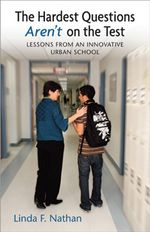
    Lindanathan The Hardest Questions Aren’t on the Test: Lessons from an Innovative Urban School
    by Linda Nathan

    The Boston Arts Academy comprises an ethnically and socioeconomically diverse student body, yet 94 percent of its graduates are accepted to college. This remarkable success rate, writes Principal Linda Nathan, is in large part due to asking the right questions and being open to seeking solutions collaboratively with faculty, parents, and the students themselves.


    Qecr

    Quality Education as a Constitutional Right: Creating a Grassroots Movement to Transform Public Schools

    Editors: Theresa Perry, Robert P. Moses, Ernesto Cortés Jr., Lisa Delpit, Joan T. Wynne

    Legendary civil rights leader and education activist Robert Moses invited one hundred prominent African American and Latino intellectuals and activists to meet to discuss a proposal for a campaign to guarantee a quality education for all children as a constitutional right-a movement that would “transform current approaches to educational inequity, all of which have failed miserably to yield results for our children.” The response was overwhelming, and people literally started organizing on the spot.


    Meier In Schools We Trust: Creating Communities of Learning in an Era of Testing and Standardization
    by Deborah Meier

    We are in an era of radical distrust of public education. Increasingly, we turn to standardized tests and standardized curricula-now adopted by all fifty states-as our national surrogates for trust.

    Legendary school founder and reformer Deborah Meier believes fiercely that schools have to win our faith by showing they can do their job. But she argues just as fiercely that standardized testing is precisely the wrong way to that end. The tests themselves, she argues, cannot give the results they claim. And in the meantime, they undermine the kind of education we actually want.

    In this multilayered exploration of trust and schools, Meier critiques the ideology of testing and puts forward a different vision, forged in the success stories of small public schools she and her colleagues have created in Boston and New York. These nationally acclaimed schools are built, famously, around trusting teachers-and students and parents-to use their own judgment.

    Meier traces the enormous educational value of trust; the crucial and complicated trust between parents and teachers; how teachers need to become better judges of each others’ work; how race and class complicate trust at all levels; and how we can begin to ‘scale up’ from the kinds of successes she has created.


    These and many more titles can be found on the Beacon Press website.