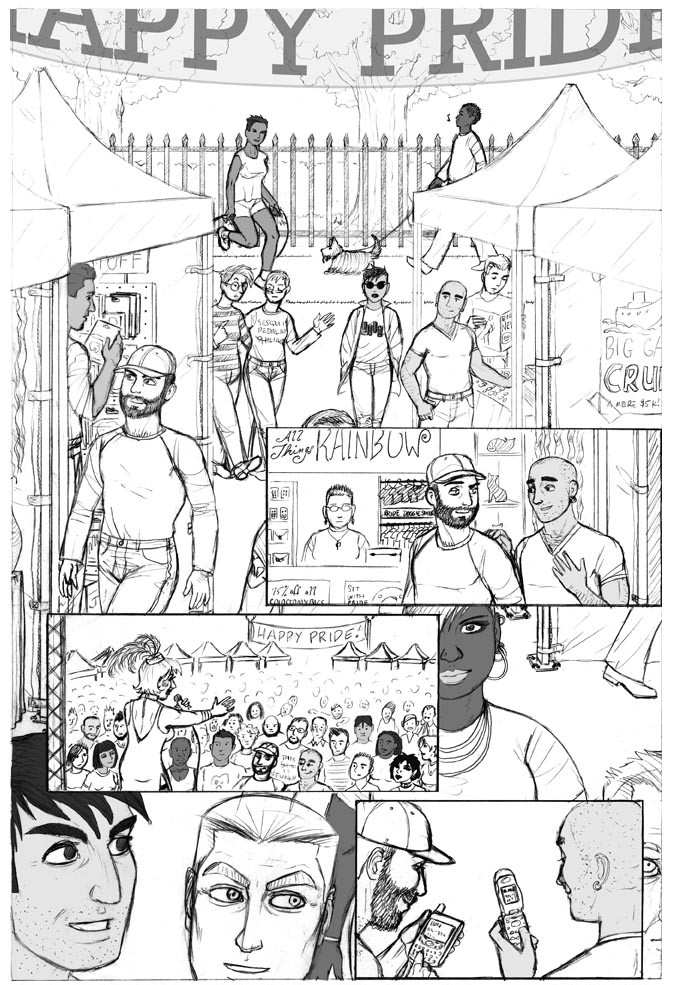
• Today's pride panel is by Dylan Edwards, an artist and writer currently working on Transposes, a graphic nonfiction book about queer transsexual men, which Beacon Press will publish. His comics work includes his ongoing series, Politically InQueerect.

    Happy Pride comic panel
     

  • Carlos A. Ball is Professor of Law at the Rutgers University School of Law (Newark). He has written extensively on gay rights issues and is the author of From the Closet to the Courtroom, which chronicles five ground-breaking LGBT lawsuits that ultimately defined history.

    For supporters of LGBT rights, the election of President Obama represented an apparent historical turning point for sexual minorities in our country. As a presidential candidate, Obama had said all of the right things: he criticized the military's Don't Ask, Don't Tell policy (DADT); he called for the enactment of the Employment Non-Discrimination Act (ENDA), which would protect employees against sexual orientation and gender identity discrimination; and called for the repeal of the Defense of Marriage Act (DOMA).

    But now that almost a third of Obama's first term has gone by, there is growing despair among many of his LGBT supporters over how little the administration has accomplished on gay rights. We have been here before. Eighteen years ago many gay rights advocates celebrated the election of President Clinton, the first presidential candidate to reach out to the LGBT community, only to be disappointed by how clumsy and conflicted the new administration was in handling the gays in the military controversy.

    (more…)

  • Today’s excerpt is from the first chapter of Steve Wilson‘s book The Boys from Little Mexico. Wilson’s book captures the powerful role that soccer plays in the lives of an all-Hispanic boys’ team in Oregon. With the World Cup in full swing, you can catch Wilson’s interview with The New Republic‘s blog, Goal Post, discussing Latino immigration and the U.S. soccer team.

    The Boys from Little Mexico – Chapter 1 http://d1.scribdassets.com/ScribdViewer.swf?document_id=32837840&access_key=key-2jct6c1qlantin1im1td&page=1&viewMode=list

  • It's a big week for us here at Beacon Press. While Cambridge celebrated their "Go Green" awards, Boston has been displaying its LGBT pride all week. Across the globe, nations are being unified by a common love for soccer with the World Cup. Our authors are also getting involved and getting their universal messages out there to the public. Here are a few of their latest updates and achievements:

    Carlos Ball's new book, From the Closet to the Courtroom, chronicles five ground-breaking LGBT lawsuits that ultimately defined history. In this month's newsletter from the Lesbian and Gay Law Association of Greater New York, Ball's book received the following praise: "This should become a basic text for college LGBT studies courses and can be read with profit by all students of LGBT law, but it is also aimed at a more general audience and is recommendable to non-specialists as well."

    In a fascinating "gender-bending" look into the role of a non-biological lesbian mother, Amie Klempnauer Miller's memoir, She Looks Just Like You, was recently described in Seattle Woman as a "funny, provocative and satisfying memoir.

    The World Cup has officially begun. Symbolizing the drive, determination, and love for soccer, The Boys from Little Mexico, by Steve Wilson, delves deep into the lives of an all-Hispanic boys' soccer team who, despite cultural differences, language barriers, and academic struggles, won the Oregon state championship. In an interview with Dropping Timber, a soccer blog for the Portland Timbers, Wilson stated, "My hope with the book… is that it humanizes people." OregonLive.com also featured an article on Wilson, focusing on the care he took for the privacy of the students featured in his book.

    The more negative side of youth sports represented by the strive for academic scholarships, the pressures of overbearing parents, and the injuries inflicted on overworked children, is the subject of Mark Hyman's book Until It Hurts. In a recently published article in Sports Illustrated, Hyman documents the efforts of Dr. James R. Andrews and his celebrity-athlete endorsed prevention program STOP (Sports Trauma and Overuse Prevention).

    David Chura has observed and interacted closely with the juveniles who reside in our prison systems. His book, I Don't Wish Nobody to Have a Life Like Mine, examines these young inmates as individuals failed by the responsibilities of our society. In a recent blog for Solitary Watch, Chura brings to light the truth behind solitary confinement.

    A thorough examination of the overpopulation myth, Fred Pearce's book, The Coming Population Crash, discusses lower average birthrates across the globe, the growing epidemic of world hunger, and the first upcoming population decrease that this world has seen since the Black Death. Pearce's book was recently discussed on amnews.com.

    From overpopulation to income inequality, Chuck Collins, coauthor of Wealth and our Commonwealth, describes personal wealth as being not only achieved through personal decisions and hard work, but also through the opportunities for success inherent in our society. Collins was quoted in an article for The New York Times on estate taxes and the legacies of the opulent.

    There are a million questions that run through the minds of liberal consumers. How will our purchasing powers affect the economy or the environment? Who frantically toiled in a foreign country to make this coat and what were their wages? Fran Hawthorne, author of The Overloaded Liberal, tackles investing your money into the perpetuation of liberal ideals. In a recent article for The Jew and the Carrot, Hawthorne describes kosher living through the humane methods of animal slaughter and the inhuman wages paid to workers behind the scenes.

    In the vein of liberal-minded consumers, we here at Beacon Press would like to congratulate the Harvard Book Store for winning the Cambridge "Go Green Award" for transportation. The store's Green Delivery Service boasts a quick and inexpensive method of using emissions-free vehicles to deliver book orders to readers across the Boston area. Harvard Book Store's actions not only promote eco-friendly methods of delivery, but also support local businesses.
  • Today's post is from Amie Klempnauer Miller, a frequent speaker about gay and lesbian families and author of the book She Looks Just Like You: A Memoir of (Nonbiological Lesbian) Motherhood. Miller works as a development consultant to the public media industry and lives with her partner and daughter in St. Paul, Minnesota.

    The recently released results of a 25-year study of the children of lesbians (specifically, the children of "planned lesbian families" – conceived through alternative insemination by women who identified as lesbian) shows that the kids turn out to have fewer behavioral problems and greater self-confidence than their peers with straight parents. As the nonbiological lesbian mom (my partner of 26 years is the birth mom) of a seven-year-old daughter, this should make me feel great. Right?

    On one level, it does. While our family lives in a neighborhood, and our daughter attends a school, where we are affirmed for the most part, I am nonetheless aware that many people in the world actively disapprove of gay and lesbian parents. Sometimes I am reminded of this in small ways – little comments, odd questions – and other times it is with all the subtlety of a punch to the gut. So when studies like this one come along, I find myself wanting to wave it in front of the opponents of gay and lesbian parenting and shout HA!

    (more…)

  • Today's blog post is from Sara Hatch. Sara is the sales assistant and resident soccer enthusiast here at Beacon Press. She has been watching the World Cup since 2002 and will be supporting the U.S., England, the Netherlands, and Côte d'Ivoire.

    Tomorrow the world will explode. Don't worry; it's not the onset of nuclear war. It's the World Cup, the glorious tourney that occurs every four years and pits nation against nation, creating stories that will last for decades in each nation's history. Games will be won and games will be lost. We will see both spectacular dives and goals that make your heart sing.

    Here at Beacon, we have taken a personal interest in the sport, with Steve Wilson's book, The Boys from Little Mexico. Published this month, Wilson tells the story of an all-Hispanic boys' high school soccer team in Woodburn, Oregon, documenting their lives on and off the field. It is an inspiring story of a small-town team transcending racial boundaries and proving the transformative power of sports. For further evidence of the unifying power of sports, one needs to look no further than Côte d'Ivoire, the small West African country and former colony of France.

    (more…)

  • Today's post is by Paul Ortiz. Ortiz is an associate professor of history at the University of Florida. He is writing a book titled Our Separate Struggles Are Really One: African American and Latino Histories, which will be published by Beacon Press.

    "In the debate surrounding Arizona's laws targeting immigrants and ethnic studies, we've heard very little mention of capitalism and its place in American politics. Senate Bill 1070 is an insurance policy for capitalism, a way to ensure that the cheap labor that serves the foundation of the new economy remains cheap forever. House Bill 2281 is part of a package deal. The erasure of ethnic studies courses that show how poor people have changed history – when they have organized – will allow the invention of a historical narrative as one sided as the old myths of the European Conquest. These bills are a gift from a steadily shrinking, white, ruling class to its own posterity and to any white workers and ethnic minorities willing to accept second-class citizenship in order to avoid something far worse. Unless we mobilize to defeat these measures, worse things are on the horizon. Our history proves it."

    To continue reading, visit truthout.org.

  • Today's post is from Frederick S. Lane, an author, attorney, expert witness, and lecturer who has appeared on "The Daily Show with Jon Stewart," CNN, NBC, ABC, CBS, the BBC, and MSNBC. His fifth book is American Privacy: The Four-Hundred-Year History of Our Most Contested Right.

    Almost thirty years ago, a young Justice Department attorney was assigned to assist Sandra Day O'Connor in preparing for her upcoming Supreme Court confirmation hearings.

    "The approach," John Roberts said in a memo written in the summer of 1981, "was to avoid giving specific responses to any direct questions on legal issues likely to come before the Court." In effect, Roberts was advising O'Connor that she had the right to remain silent, because anything she said could and would be used against her. It is an approach that has been followed religiously by Supreme Court nominees ever since, including Roberts himself during his 2005 confirmation hearings to succeed the deceased Chief Justice William Rehnquist.

    For conservatives, it is clear that silence has been golden.

    (more…)

  • From our justice system to immigration, our authors have been working within and on behalf of progressive communities agitating for change in our world. Here's a sampling of their many conversations this past week:

    David Chura's book I Don't Wish Nobody To Have a Life Like Mine brings attention to the lives of kids in adult lockup through a thoughtful piece from Sam Roberts in the New York Times.

    In response to a recent New York Times article on the inherent racial biases in police killings, Jason Marsh, co-editor of Are We Born Racist?, remains optimistic in an article he wrote for Greater Good. "New York State's recognition of the problem," he says, "is certainly an important step forward."

    Bruce Rich's interview with Religion Dispatches ran on the website for the Canadian Centre for Progressive Christianity. Rich, the author of To Uphold the World, discusses "the overarching challenge of our age" when he states that "a global world system and a global economy require a global ethic."

    John Buehrens, coauthor of A House for Hope, writes openly and warmly about a "liberal religious renaissance" in a guest blog post for Washington Post's "Political Bookworm." In the blog, Buehrens states, "Conservatives in religion too often operate out of lesser rules, and out of cultural stereo-types of what constitutes a loving family. Too often they seem to pander to the fear of change. And for the past 30 years they have had the loudest religious voice in America."

    Carole Joffe, author of Dispatches from the Abortion Wars, appeared on KPFA's "Against the Grain" to examine the role women's sexuality plays in American society.

    In a fascinating article in The Washington Post on the aging baby boomer generation, Fred Pearce covers the idea of the retirement age, an older workforce, and the inspiration of a lively 108-year-old Japanese woman named Ushi Okushima. A quote from his book, The Coming Population Crash, can be seen over on Grist. The Guardian reported on Pearce's appearance at the 2010 Hay festival.

    The Willamette Week welcomed a look into the lives of the Hispanic teenagers at the heart of Steve Wilson's debut book, The Boys from Little Mexico: "what this book offers is an actual human face on immigration and the people affected by it." Oregon Magazine applauded Steve's "riveting sports writing coupled with a compassion for his subjects' lives." 

    While tensions continue to rise on the Arizona-Mexico border, the Tucson Weekly advises readers to add The Death of Josseline to their summer reading lists, calling Margaret Regan's work "heartbreaking and infuriating and uplifting, all at the same time." Be sure to also catch Regan's discussion of immigration on New American Media.


  • Today's post is from Aviva Chomsky, professor of history and coordinator of Latin American Studies at Salem State College. The author of several books—including her latest, "They Take Our Jobs!" And 20 Other Myths About Immigration—Chomsky has been active in Latin American solidarity and immigrants' rights issues for over twenty-five years.

    During a week in Nogales in March, working with the No More Deaths documentation project, I must have met several hundred deportees. They were arrested for a crime that no U.S. citizen can commit: entering the United States without official permission. Only people who are not U.S. citizens need special permission to enter U.S. territory.

    When you get your U.S. passport in the mail, it comes with a flyer that says "With your U.S. passport, the World is Yours!" Holders of the U.S. passport are accustomed to simply arriving at the border of another country, showing their passport, and easily crossing in. Rarely, they have to apply beforehand for a visa. If they pay the fee and fill out the application correctly, the visa is routinely granted. Holders of a U.S. passport tend to believe that freedom to travel is their birthright, a view reinforced by the literature that comes with their passport. For the cost of a plane ticket, they can leave the country they were born in any time they want.

    For most of the world's population, though, freedom to travel is a distant dream. They can't leave the country of their birth because instead of that magical ownership of the world that comes with a U.S. passport, they are citizens of countries in Africa, Latin America, or most of Asia. Many of them are also poor, and people of color. They can't leave their countries because no other country will let them in. Least of all the United States. We live in a kind of global apartheid, where whole countries—almost all of them in the First World—shut themselves off to travelers, while assuming that their own citizens have the right to travel anywhere they choose. Meanwhile the citizens of other countries—mostly in the Third World—can't travel at all because no country will let them in.

    (more…)