• Today's post is from Caitlin Meyer, a publicist here at Beacon Press, who was recently quoted in Publisher's Weekly.

    Book Expo America On Friday I returned from New York where I had been attending 2010's BEA (BookExpo America) conference. After taking the long weekend to recuperate from all the activity, I wanted to share the experience with our Beacon Broadside readers. Last week, I, along with our Director, Helene Atwan, our Publicity Director, Pam MacColl, and our Executive Editors, Amy Caldwell and Gayatri Patnaik, came together with friends and colleagues from the book world to celebrate the past, present, and future of publishing. Here are some highlights from our four days in New York:

    This year the event was held at the Jacob Javits Center in Manhattan. Beacon Press was one of 1,500 exhibitors in attendance, with an estimated 22,000 people in attendance.

    The conference kicked off on Tuesday with a plenary meeting for the exhibitors titled, "The Value of a Book." Everyone gathered to watch a heated discussion about the current state of publishing and how upcoming changes to the industry will affect agents, authors, and publishers alike. Book Expo America  

    When it was over we headed straight upstairs to the exhibit hall to set up our booth. 

    Book Expo AmericaWe were promoting some of our most anticipated titles for the fall, including Swan, the twentieth poetry collection from Mary Oliver, and our very first graphic novel, an adaptation with Jamar Nicholas of Geoffrey Canada's memoir, Fist Stick Knife Gun. Our booth was well positioned near our new distributor, Random House.

    Later that morning Pam and I attended the panel discussion, "Building Online Reader Communities with an Eye on ROI." The entire conference, including this panel, was being live tweeted all week. The benefit of social networking has been an ongoing conversation in the publishing world for quite some time now. This panel included a discussion about how authors, bookstores, and publishers can use these new technologies to their advantage.
    Book Expo America  

    Things were in full swing by Wednesday. Everyone was busy taking meetings with agents, authors, editors, producers, and booksellers.

    Book Expo America Across the aisle from us, new author, Vordak, was trying to lure people in with his plans to take over the world. Helene took a moment to pose for a photo with him. I couldn't hear what they were talking about, but I assume they were comparing notes on world domination tactics.

    Later in the afternoon, C-SPAN BookTV stopped by to talk to Pam about our

    Book Expo America new fall list. She did an amazing job discussing our upcoming books. The producers even stopped back the next day to compliment her, (we'll be sure to share a link when the video airs).

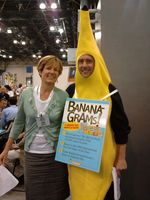
    In fact, she did such a great job that Mr. Bananagrams himself agreed to have his photo taken with her.
    Book Expo America
    On Thursday we started the day out at the "Adult Book & Author Breakfast," hosted by Jon Stewart. 
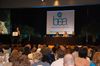
    Book Expo AmericaStewart was a part of an author panel, along with John Grisham, Condoleezza Rice, and Mary Roach. Each of the authors gave a tease for their upcoming book and took part in a Q&A with the audience. Stewart made it clear that he was less than pleased with the direction of the audience's somewhat self-serving questions, but we didn't mind his blunt approach. After all, "The Daily Show" has been a friend to Beacon this year.

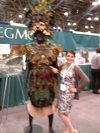
    The rest of the day was spent much like Wednesday had been: taking meetings, connecting with the media and booksellers, and continuing to spread the word about Beacon Press. The view from our booth did change that day though. Vordak was gone and replaced by this guy… 
    Book Expo America

    …who I believe comes from Middleworld. He was the strong and silent type, but was nice enough to pose with me. The picture is blurry because everyone was rushing around the exhibit hall to make sure they took it all in before the end of the day. I think my photographer might have gotten jostled by a passing book enthusiast.

    As the day wound down I really began to appreciate everything I'd seen and done during the week. This was my first BEA and I felt very grateful for and inspired by my wonderful and knowledgeable colleagues. 

    I was also honored to be a part of the thriving community of publishing professionals and book lovers. Each year we hear more and more about the fast approaching "death of print." Yet, each year Beacon Press and other publishers around the globe bring in new and exciting writers who help us to keep books alive in the marketplace. Yes, there was much discussion about ebooks and Twitter accounts. Yes, the print industry, from books to newspapers, is facing new challenges. And yes, publishing will need to continue to evolve in order to keep up with changing technologies. But one of the most valuable lessons I took away from BEA was that there are still few things that excite people as much as the prospect of writing, publishing, or reading a good book. If the community and enthusiasm of this year's attendees is any indication of our publishing future, I think we'll be ok.

    American Museum of Natural History Oh…and while I was in NYC, I also went to the Museum of Natural History. It can't be all work all the time!

  • Sophia Raday lives in Berkeley, California, with her soldier/police officer husband, their two children, a bipartisan dog, and assorted firearms. She is the author of Love in Condition Yellow: A Memoir of an Unlikely Marriage, which chronicles her peacenik/warrior love story and provides insight on age-old political divisions in the United States. This post originally appeared on military.com.

    In a very un-scientific survey, I asked kids around the country what Memorial Day meant to them:

    "Memorial day is about playing games, resting, and celebrating the Lincoln memorial too." Boy, 8, MT

    "Picnics" Girl, 4, CA

    "I think Memorial Day is about honoring our troops. I think it's about loving and caring for our troops and we should honor it and respect it." Boy (whose dad is in Iraq), 11, TN

    "Watermelon" Boy, 3, CA (with Momma's help)

    "We celebrate the soldiers that died. But it just came to mind that we celebrate this day because our flag was still there in fort." Girl, 8, MT

    "My daddy has people tell him thank you all day for his hard work for the USA and Chico." Girl, 6, CA

    "I don't know what Memorial Day is. I do not even know what the word means." Boy, 8, MT

    "It is a day to acknowledge the men and women who have died serving our country." Boy, 11, NJ

    "Where are you going with this? I don't want to answer." My son, 9, (who is tired of being the subject of his mother's writings and knows his Miranda rights.)

    Among military families, I'd wager most everyone knows what Memorial Day means. But the rest of the country?

    (more…)

  • Today's post is from Carole Joffe, author of Dispatches from the Abortion Wars: The Costs of Fanaticism to Doctors, Patients, and the Rest of Us. Joffe is a professor in the Bixby Center for Global Reproductive Health at the University of California, San Francisco. See her much-read original response to Dr. George Tiller's killing, here. Take action here.

    In the year since the murder of Dr. Tiller, the polarization around abortion in the United States shows no signs of abating. State legislatures have passed a host of measures restricting abortion provision in various ways, measures which are noteworthy for the mean-spiritedness directed toward women. In Oklahoma, for example, among the new laws are a mandate that women must view an ultrasound of their fetus and hear a doctor describe various parts of the fetal body (with no exception for victims of rape or incest), and another law that requires that women fill out a 36-page questionnaire, giving extensive demographic information as well as the reason for their abortion. Yet another law passed in that state exempts doctors from lawsuits if they decide to withhold information about fetal anomalies from pregnant women, as a strategy to prevent these women from aborting.

    In the period since Dr. Tiller's death, many clinics have reported an upsurge in threatening and aggressive behavior by protestors. Tiller himself continues to be vilified by his enemies, most recently at the annual meeting of ACOG (American College of Obstetricians and Gynecologists), where protestors stood outside the conference hotel carrying signs that read "George Tiller is burning in hell."

    Far more encouraging, however, are the actions that have been taken by Tiller's former colleagues in the abortion providing community. Aware that Tiller's death left a huge gap for those women needing later (post 24-week) abortions (as discussed in the piece linked here), physicians, researchers and advocates have formed a network which is strategizing how to increase the availability of such services, and which disseminates accurate information about this subject to both clinicians and prospective patients.

    Most notably, Dr. Curtis Boyd, a longtime abortion provider in New Mexico, and a close friend for decades with George Tiller, has recently expanded his practice to include post-24 week abortions "on a case-by-case basis." Two of the physicians who worked with Dr. Tiller in Kansas now work with Dr. Boyd. When I asked Dr. Boyd about this change in his practice, he told me, "We felt we had to do it…both for the women who need this service and to honor George's memory."

  • This week, our authors' words have been quoted, posted, and commented on throughout the online community on a wide range of urgent topics. They're going viral and we invite you to continue the conversation. Here are a few highlights:

    Mark Hyman's book, Until It Hurts, is a central topic for Jane Brody's recent article in the New York Times. Documenting the history and facts of overworked young athletes, Brody's piece delves into the Phelps family and other fascinating examples of the
    abuses of our obsession with youth sports.

    Author David Chura sits down with Midweek Politics to discuss the inspiration for his book I Don't Wish Nobody to Have a Life Like Mine, kids trapped in a cycle of crime and punishment. Catch his two-part filmed radio interview here and here.

    From its highly lucrative revenue to its inherent racial biases, the adult film industry continues to thrive and affect many. Marie Claire addresses five shocking facts from Gail Dines's book, Pornland, set to release this July.

    For his in-depth analysis of the Indian emperor, Ashoka, Bruce Rich's book To Uphold the World is mentioned in American Buddhist Perspective, a popular blog on "Buddhism, philosophy, ecology, life, teaching & politics."

    In an interview with WBUR, U.S. District Court Judge Nancy Gertner is described as "push[ing] for better science, better evidence and convictions that she can have more faith in." Gertner's new book, In Defense of Women: Memoirs of an Unrepentant Advocate, is due spring 2011.

    Andrew Sullivan, blogger for The Atlantic's The Daily Dish, quoted Salon.com's interview with Amie Klempnauer Miller, author of She Looks Just Like You. Daring to ask the question "so what's my role here?" as a nonbiological lesbian mother, Miller expresses her opinion on maternity leave and her connection with stay-at-home dads.

    In an article on Grist correlating falling birthrates to sexism, Fred Pearce author of The Coming Population Crash, is quoted for his research on the conservative ideals of Italy and the Vatican versus the flexibility of Swedish gender roles.

    Finally, we close honoring a writer whose teachings still inspire conversation today. In a 1972 lecture titled "Why to Believe in Others" (recently posted on Ted.com), Viktor Frankl, author of Man's Search for Meaning, expresses the psychiatry behind reaching human potential through his use of insight and humor. Frankl states with zeal: "If we take man as he is, we make him worse; but if we take man as he should be, we make him capable of becoming what he can be!"

  • Today's post is by Adele Barker, author of Not Quite Paradise: An American Sojourn in Sri Lanka. She has taught at the universities of Arizona and Washington. Most recently, she received a Fulbright Senior Scholar grant to teach and write in Sri Lanka.

    On the wall in my study is an index card with a quote on it from Michael Ondaatje's The English Patient. "We are communal histories, communal books," it says. I carry those sentiments into the classroom with me five times a week at the university where I teach, as I try to communicate to my students why stories matter, why books matter, and why, by God, we should all read. Sometimes I am so busy proselytizing the virtues of literature that I forget to look inside and ask myself "Why does my own writing matter?" I write because I love writing and because I think it changes lives—sometimes in ways that we can't possibly anticipate. I suppose our books are, in this sense, like our children. We send them into the world, and they do things that we never intended them to do, things that are sometimes confounding, often improbable and even heart stopping. They make their way in the world totally independent of us. Maybe that is ultimately what a book launch is all about.

    Having said this, I've also had moments of real doubt over the past four years about whether writing has the power to change anything. I have spent the past eight years of my life writing about Sri Lanka, a country that has been at war with itself for thirty plus years. I lived there with my son in 2001-2002 and then returned after the 2004 tsunami. In the fall of 2005, a cease-fire hung in the balance, and it became possible finally to get up to the Tamil north. I felt that I really needed the Tamil perspective on this war for the book I was writing. In Jaffna I stayed in a makeshift guest house where I was the lone guest on a street where every house had either been destroyed or abandoned. I spent my days talking to students, to people who were part of demining operations, to people whose children had been forcibly recruited by the Tamil Tigers, and to people who had suffered war loss compounded by tsunami loss. And at night I came back to the guest house and wrote about them. I struggled with what I was doing up there as a writer. The people in Jaffna didn't need me sitting at my computer; they needed aid and they needed for this war to be over, the very things I could not give them. Was I using these people, I wondered, as nothing more than material for my book?

    (more…)

  • Today's post is from David Chura, author of I Don't Wish Nobody to Have a Life Like Mine: Tales of Kids in Adult Lockup. Chura has worked with at-risk teenagers for forty years and is a frequent lecturer and advisor.

    I never expected to learn much about hope during the ten years I taught kids locked up in an adult county prison. After all, jail's a pretty dead-end place. Turns out I was wrong.

    I learned a lot about optimism and resilience from some unlikely teachers—my jailhouse students. There was Ray who told me, "I've only lived in the world, free, not locked up somewhere, for a total of 6 years and 4 months," but who firmly believed that God would put a light at the end of his own dark tunnel; or Dario who despite living in shelters, on the streets, or in jails completed his high school diploma; or Wade who was looking at state prison, yet planning how he'd help his little brother when he got out.

    Still, I'm a slow learner. In spite of the Obama optimism, I don't easily see much hope in our nation. It's hard to look past the bully culture fostered by Tea Party narcissism and conservative righteousness; by laws that require police to suspect, stop and question anyone whose skin is darker than theirs or whose name hints of Latino origins; by churches that kick children out of their schools because of their parents' sexual orientation.

    That's why I was pleased, relieved, and frankly startled when the Supreme Court, an institution which in my opinion hasn't been this country's greatest source of hope lately, ruled recently that it was unconstitutional to sentence juveniles who have not committed homicide to life behind bars without the possibility of parole.

    (more…)

  • Beacon authors have been collecting laurels lately for their powerful writing and progressive ideas. Here's a sampling from this past week:

    The May edition of the Internet Review of Books finds Tucson journalist Margaret Regan's The Death of Josseline to offer "A Desperately Needed Message."

    Dr. Danielle Ofri, author of Medicine In Translation, has a stunning "Cases" piece in the Science section of the New York Times.

    Finally, a wave of praise for Amie Klempnauer Miller's She Looks Just Like You on the The StrollerDerby blog, which quotes Salon.com's "delightful" interview with the author, plus over on Mombian. Also, ForeWord Reviews in their May/June issue, says: "She Looks Just Like You tells a story that parents from all sorts of 'categories' need to hear." And the June issue of Curve Magazine notes, "Motherhood can be scary for anyone, but when it comes to lesbian, Nonbiological moms-to-be, there was no real guidebook—until now. Miller talks about the excitements and difficulties that come from being the lesbian partner who doesn't give birth."

  • Today's post is from David Chura, author of I Don't Wish Nobody to Have a Life Like Mine: Tales of Kids in Adult Lockup. Chura has worked with at-risk teenagers for forty years and is a frequent lecturer and advisor.

    Book signings are great for stories, as every author knows. Everybody has one they want to tell you.

    I've had my share as I've done readings for I Don't Wish Nobody to Have a Life Like Mine. There was the teenaged woman who lived on the streets, but finally got a job and a room for "me and my baby." The grandmother who lost a son and daughter to crime. The Viet Nam vet who did lots of drugs until Jesus found him.

    At one recent reading, I couldn't help noticing the woman, last in line, staring down, clutching my book. When she got to me I wasn't sure she'd give it up to be signed.

    "I'm almost afraid to read your book," she winced. "I have two boys locked up. I hear bad things happen in prison."

    That's all she said. Then she asked me to sign her book, took it back and left.

    (more…)

  • Today's post is by Steve Wilson, whose debut book—The Boys from Little Mexico: A Season Chasing the American Dream, called "unvarnished and moving" by Sonia Nazario—will be published in June 2010.

    On May 5, the Phoenix Suns wore jerseys with a Spanish word on them and everybody got excited because the team was making a political statement, as seen here, and here, and here, and even here.

    But wait, didn't those jerseys exist because of an NBA marketing scheme called Noche Latina? Didn't the Suns wear them on March 21 and 26? Yes and yes.

    Noche Latina, which this year lasted a couple of semanas, is an outreach program to Hispanic fans, and features Spanglish uniforms (more on that later) and other Latino-themed entertainment, as well as basketball analysts breaking out their high school Spanish phrasebooks. It was a token gesture to the 15% of NBA fans who have Hispanic heritage, and nobody took it seriously.

    Which is why the Suns' decision to use the uniforms a second time, in protest of Arizona's new immigration enforcement law, is even more interesting than most columnists have given it credit for. The uniforms were a marketing gimmick—in fact, the NBA didn't even fully translate the team names. Los Suns? That's about as Hispanic as Taco Bell.

    (more…)

  • Our authors have been busy tackling important social issues out in the world this past week. A handful of highlights:

    Mother Jones is hosting a lively conversation on population control. Fred Pearce weighs in, as does Courtney E. Martin. You can also join the conversation on Twitter by tracking #popforum.

    Lambda Literary finds Terry Galloway's memoir, Mean Little deaf Queer, "well worth the read."

    David Bacon, author of Illegal People, has a stunning photo essay on hunger with Betsy Edwards over at East Bay Express.

    New America Media examines "Life and Death on the Arizona Border" with Tucson journalist Margaret Regan, author of The Death of Josseline.

    Everyone's talking about SCOTUS these days. Chris Finan parses the Citizens United decision and "Free Speech for Corporations" over at Bookselling this Week.

    Catch Jonathan Metzl's discussion of The Protest Psychosis with ABC Radio International.

    Finally, Religion Dispatches asks Bruce Rich the question "What Can Ancient India Tell Us About Our World?" Rich, the author of To Uphold the World, will be speaking May 14th at 7 p.m. in New York's Tibet House.