• Beacon Broadside ran a post by William Ayers on April 7 about being "disinvited" from lecturing at the University of Wyoming—read the original post here. Earlier this week, Denver Westword's Michael Roberts, who followed the incident closely as it became a lawsuit, reported that United States District Court Judge William Downes "ordered that Ayers be allowed to speak at the university," after dismissing the university's security concerns as a "heckler's veto." According to Roberts, the federal judge cited earlier free speech cases—including the famous Williams v. Wallace involving Dr. Martin Luther King, Jr.—and "stressed that 'fear is not enough to override the First Amendment.'" Ayers spoke yesterday to a crowd of more than 1,000; the Billings Gazette offers a write-up of the event, which drew "about 10 protesters."

    For those interested in reading more about important First Amendment battles, we suggest two great books: Anthony Lewis's Freedom for the Thought That We Hate: A Biography of the First Amendment and Christopher M. Finan's From the Palmer Raids to the Patriot Act: A History of the Fight for Free Speech in America.
  • Fran Hawthorne is the author of The Overloaded Liberal: Shopping, Investing, Parenting, and Other Daily Dilemmas in an Age of Political Activism. Hawthorne has been a writer or editor at Fortune, BusinessWeek, Institutional Investor, and other publications. She is the author of three books on health care and investing, including Inside the FDA and the award-winning Pension Dumping.

    Let's say you try to eat food grown without chemical fertilizers, and you want to follow that principle in your investing as well. Consider Group Danone, the manufacturer of Dannon Yogurt. "Group Danone is the largest purveyor of organic dairy products in the world," according to Amy Domini, chief executive of Domini Social Investments, which runs the benchmark Domini 400 Social Index. So Group Danone is a buy?

    Not so fast. Amy Domini also points out that "twenty percent of its business is bottled water, and about half of that is to people with potable water" – that is, Danone is wasting millions of barrels of petroleum to make plastic water bottles for Americans who could safely drink their own tap water. Furthermore, in 2007 the company bought a manufacturer of infant formula named Royal Numico, and remember the consumer uproar when Nestle tried to push its powdered infant formula in developing countries in the 1970s and 1980s?

    Now should you put your money in Group Danone?

    (more…)

  • In the weeks leading up to the fall of Saigon on April 30th, 1975, nearly three thousand babies and children were airlifted out of South Vietnam, often under chaotic and dangerous circumstances. Dubbed "Operation Babylift," the mission was a highly publicized U.S. backed plan to evacuate Vietnamese orphans and bring them to America for adoption.

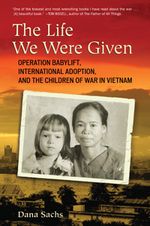
    The Life We Were Given book cover In The Life We Were Given: Operation Babylift, International Adoption, and the Children of War in Vietnam, Dana Sachs, who has written about Vietnam for 20 years, draws on extensive research and countless interviews in both the U.S. and Vietnam to offer a fresh look at this complex and often controversial mission. She traces the stories of adoptees, including a woman whose Vietnamese mother managed to find her twenty years later, and looks at why there was so little oversight and such sparse documentation attached to the movement of these children, many of whom, it was discovered, weren't orphans at all and were desperate to go home.

    This week, in the lead up to the 35th anniversary of the fall of Saigon on Friday, Sachs was interviewed about Operation Babylift and how its lesson can be applied to the current debate about international adoption:

    Joy Cardin Show/Wisconsin Public Radio (scroll down to Monday, April 26, at 8:00 a.m.)

    The Leonard Lopate Show/WNYC Radio

  • June Carolyn Erlick is the editor-in-chief of ReVista, the Harvard Review of Latin America and the author of Disappeared: A Journalist Silenced. Her new book is A Gringa in Bogotá: Living Colombia's Invisible War.

    As elections in Colombia rapidly approach, I think about horses in Bogotá.

    This is not a non sequitur.

    When I arrived in Bogotá as a young journalist in 1975, I was struck by the contrast between its cultural richness and lingering rural quality. Horses, cows and roosters inhabited the same space along with opera, world-class bookstores and dynamic discotheques.

    (more…)

  • Today's post is from David Chura, author of I Don't Wish Nobody to Have a Life Like Mine: Tales of Kids in Adult Lockup. Chura has worked with at-risk teenagers for forty years. His writing has appeared in the New York Times and multiple literary journals and anthologies. He is a frequent lecturer and advisor on incarcerated youth.

    It costs a lot to lock people up (by some estimates $32 billion annually). You have to house them, feed them, give them basic medical care.

    It costs a lot, even if you cut corners. Overpack a dorm or double-bunk (as dangerous as that practice is). Serve cheap food—unrecognizable, processed meats; overripe, almost rotted fruit; white bread that wads up to the touch. Save on health care by not giving any. In the county jail where I taught high school for ten years I'd seen young guys with cheeks ballooned out from abscessed molars told to wait two weeks for the next dentist visit; or students go without their essential medications because they supposedly filled out the wrong forms which would eventually get "lost" anyway in the great paper-shredder of jailhouse bureaucracy. One male warden on the women's unit even decided to save money by rationing toilet paper and tampons.

    Today, some states such as Virginia, Utah, Missouri, Arizona, New York, New Jersey and Iowa have a new, more direct approach: charge locked up men and women fees for room and board.

    (more…)

  • We've been listening to vital voices recently here at Beacon and hope you'll spend some time with them as well. We invite you to then lift your own in our comments section.

    Author Fred Pearce joins Jon Stewart on "The Daily Show" to discuss The Coming Population Crash. Pearce also gives a lively interview over on Salon.com in which he asserts that feminism and pop culture are preventing Earth from becoming too overcrowded.

    Listen to Bruce Rich discuss To Uphold the World on Wisconsin Public Radio's "Here on Earth."

    Allison Martin reviews Dana Sachs's "gripping" new book about the aftermath of Operation Babylift, the story of how, in 1975, the U.S. government airlifted nearly 3,000 displaced children out of wartime Vietnam. Martin's website is devoted to helping families who are adopting children from Vietnam.

    Check out David Chura's article on the Huffington Post, "Jail's Racism Gets Worse: But Who Really Cares?" where he confronts the baffling American belief that justice is colorblind.

    On a more somber note, Beacon Press mourns the passing of Civil Rights leader and renowned activist for racial justice and gender equality, Dr. Dorothy Irene Height, who died early the morning of April 20th at the age of 98. Among her lifetime of distinguished and selfless service, Dr. Height served as chair and national president of the National Council of Negro Women and worked on the original Historical Cookbook of the American Negro. You can listen to snippets of her speaking courtesy of NPR's "Morning Edition."

  • Bruce Rich is an attorney who has served as senior counsel for major environmental organizations such as the Environmental Defense Fund and the Natural Resources Defense Council. He is the author of Mortgaging the Earth. This piece is adapted from his new book, To Uphold the World, with a foreword by Nobel Economics Laureate Amartya Sen and an afterword by His Holiness the Dalai Lama. You can watch a video of Bruce Rich discussing universal health care in Ancient India here.

    This April marks the 40th Anniversary of Earth Day, and indeed we like to think that environmental protection is a relatively recent invention, and that in particular the United States has been a pioneer in this area. We often think that the U.S. established the first national forests and parks well over a century ago and promulgated the world's first endangered species protection act in 1973, three years after the first Earth Day.

    (more…)

  • Fran Hawthorne is the author of The Overloaded Liberal: Shopping, Investing, Parenting, and Other Daily Dilemmas in an Age of Political Activism. Hawthorne has been a writer or editor at Fortune, BusinessWeek, Institutional Investor, and other publications. She is the author of three books on health care and investing, including Inside the FDA and the award-winning Pension Dumping.

    For me, it happened when my four-year-old daughter returned from a weekend visitation with her father and announced, "At Daddy's house I get chocolate cereal."

    For Louise Heit-Radwell, a vegetarian mom in New York City, it happened gradually after her daughter, Molly, entered first grade. Molly would say things like, "Oh, at school, those chicken fingers smelled so good…."

    For all parents, it's only a matter of time. We try to feed our children healthful, nutritious foods without antibiotics, pesticides, and unpronounceable chemicals. (Some of us, in fact, begin buying organic only after we have kids, because it seems more important to protect their newly-forming bodies than our already-wrecked ones.) We include foods in our religious rituals. We plant gardens with our preschoolers. We take them apple-picking. All the while, we explain why we're doing this, why we don't want to poison the earth or eat animals.

    And then, they drift out of our 24-7 orbit.

    (more…)

  • Fred Pearce is the author of The Coming Population Crash: and Our Planet's Surprising Future. He is environment consultant at New Scientist and a weekly columnist and investigative journalist for the Guardian. He has also written for Audubon, Popular Science, Time, the Boston Globe, and Natural History. His other books include Confessions of an Eco-Sinner, With Speed and Violence, When the Rivers Run Dry, Keepers of the Spring, Turning Up the Heat, and Deep Jungle.

    Watch Fred Pearce tonight at 11 p.m. EST on "The Daily Show."

    I bring good news from Machakos, a rural district of Kenya, a couple of hours drive from Nairobi. Seventy years ago, British colonial scientists dismissed the treeless eroding hillsides of Machakos as "an appalling example" of environmental degradation that they blamed on the "multiplication" of the "natives." The Akamba had exceeded the carrying capacity of their land and were "rapidly drifting to a state of hopeless and miserable poverty and their land to a parched desert of rocks, stones and sand."

    (more…)

  • Nancy Rubin Stuart is the author of The Muse of the Revolution: The Secret Pen of Mercy Otis Warren and the Founding of a Nation, and is an award-winning author, journalist and writer-producer who specializes in women and social history. Her articles have appeared in the New York Times, the Los Angeles Times and many national magazines.

    A bumper sticker is first-cousin to the slogan, a statement steering the driver behind the message-laden car to a new thought, witticism or warning.

    Veterans of highway driving know that bumper stickers vary depending upon region, economics and political climate. Ironically, they also reveal more about the driver than the style, make and year of his stickered car. Among the most popular have been messages like "I break for animals," "Save Paper," "If you can read this, you're tailgating," "He who dies with the most toys wins," or "Is it 2012 yet?" As slick as the paper they are printed upon, bumper stickers are literally and figuratively the rear guard of popular thought.

    One such bumper sticker recently appeared quoting Founding Mother Mercy Otis Warren (1728-1814), the first female historian of the American Revolution and an architect of the Bill of Rights. It reads, "The rights of the individual should be the primary object of all governments."

    (more…)