• Today’s post is from Maggie Kast, whose story “Joyful Noise,” appears in the anthology Love You to Pieces: Creative Writers on Raising a Child with Special Needs, edited by Suzanne Kamata. Kast is also the author of and The Crack between the Worlds: a Dancer’s Memoir of Loss, Faith and Family (Wipf and Stock, 2009). Her essay, “No Pity,” appears in the anthology Gravity Pulls You In: Perspectives on Parenting Children on the Autism Spectrum, edited by Kyra Anderson and Vicki Forman (Woodbine House, 2010).

    Book Cover for Love You to Pieces
    Browse this book
    http://books.google.com/books/previewlib.js
    GBS_insertPreviewButtonPopup(‘ISBN:9780807000304’);
    GBS_setViewerOptions({‘showLinkChrome’:
    false });

    Qty:

    Rahm Emanuel’s recent use of the “r” word to castigate conservative Democrats has created a flurry of comment about the word, both as slang for incompetent and as derogatory term for people with developmental disabilities. Sarah Palin demanded he be fired, and Rush Limbaugh called Rahm’s meeting with advocates for the mentally handicapped a “retard summit at the White House.” Questioned about Rush’s rant, Palin called his use of the word, “crude and demeaning,” although she later excused it as “satire.”

    This current publicity merely highlights a longstanding problem and efforts to solve it. In March, 2009, the Special Olympics held a youth summit, and this group of young people conceived and launched a campaign to “Spread the Word to End the Word,” designed to eliminate “retard” both as epithet and descriptor. Several governors have endorsed this campaign and forty-eight states have replaced “mental retardation” with “developmental disability” or a related term in their laws and departmental designations. A bill known as “Rosa’s law,” currently before Congress, would change the term “mentally retarded” to “intellectual disability” in several federal statutes.

    As the parent of a child who failed to sit up, walk or talk when expected, I faced the question of what to call his condition. Never fond of euphemisms, I still dreaded the harsh sound and still harsher meaning of the “r” word and yearned to call my son anything else. At the same time, I wanted to say the word before it was said to me. More than anything, I hoped my son would never hear it, would never know this cruel fact about himself. One night in the ’70s, as I listened to reports of Nixon’s wrongdoing on the radio, my son propped on his hands on the kitchen floor, and repeated to myself: “retarded, retarded,” coming down lightly on the “r’s” and the “e” and clipping the “t” and the “d’s,” trying to improve the sound of the word and get myself used to it. Accepting the term was part of my facing difficult facts, and my regret was matched by

    (more…)

  • Today’s post is from Tom Hallock, Associate Publisher of Beacon Press.

    Last week, Beacon announced a change in its distribution from Houghton Mifflin Harcourt to Random House Publisher Services which will be effective July 1, 2010.

    It’s a big change and one we’re excited about. The new partnership encompasses all formats and channels. Random House will be selling Beacon books, audios, eBooks and audio downloads to US, Canada (as of 1/1/11), and other English language markets. We will also have the support of Random House in the academic, library, school and special sales areas. We think this new partnership will serve our authors and their books– and enable us to reach a wide audience through a variety of channels in a variety of formats. We also think this will enable us to focus on building our lists and exploring the new publishing and marketing opportunities of the digital age.

    Although we won’t start shipping books until July 1, our work with RHPS started in December and it’s been exciting to see things take shape. We launched our fall 2010 list, including our first graphic book (an adaptation of Geoff Canada’s Fist Stick Knife Gun), at sales conference last week. We’ve already started working with our new distributor on Book Expo, ALA, and the London Book fair and are especially excited about their support in bringing Eboo Patel (Acts of Faith) to the Freshman Year Experience conference in January 11.

    The change also means we’re saying goodbye to two distributors who have served us well over the past decade. Houghton Mifflin Harcourt has been with us– and looked out for our interests– through some tough times, including the recent economic downturn. They helped us launch Michael Patrick MacDonald’s All Souls, Meredith Hall’s Without a Map and many new titles by Mary Oliver including her first audios. We’ll miss having a distributor across the Boston Common, with whom we could talk through the issues of the day over lunch at the Beacon Hill Bistro. We’ll also miss working with Beth Ineson and the all the great reps at HMH. We leave with a sense of gratitude to them and to Gary Gentel, Laurie Brown and the HMH management team for all they’ve done for the press in the past ten years.

    We’ll also be saying goodbye six months later to our wonderfully independent Canadian distributor, Fitzhenry and Whiteside. Among the things I have loved about working with them is that I can always get their President, Sharon Fitzhenry, on the phone and that I was greeted at the door by their resident cats. (It reminds me of my days at FSG when a monstrously ill-tempered cat named Maizy inhabited the sales and marketing floor. The Fitz cats always treated me well, however.) And I want to give special thanks to Fitz’s Michael Davis who educated me about many things Canadian and did yeoman’s work on our list.

    We enter this period of change with a sense of excitement and optimism about the future. We think technology is giving us ways to reach new readers and fulfill our mission in new ways. And we feel like we’ve found the right partner for these times in Random House Publisher Services.

  • Today's post is from David Chura, author of I Don't Wish Nobody to Have a Life Like Mine: Tales of Kids in Adult Lockup. Chura has worked with at-risk teenagers for forty years. His writing has appeared in the New York Times and multiple literary journals and anthologies, and he is a frequent lecturer and advisor on incarcerated youth. This post originally appeared at his Kids in the System blog.

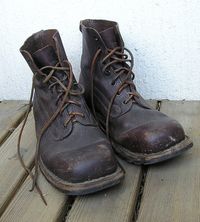
    Boots By now I thought the shocked reactions to the Department of Justice's report on sexual abuse of juveniles in detention centers would've disappeared. But articles and editorials from across the country continue to appear as states grapple with shocking numbers that won't go away. Will all this worry and lament translate into change? Who knows?

    The one thing I'm pretty sure won't change is America's fear of these new barbarians marauding our streets in hordes (except today we call them "gangs.") Because that fear seems ingrained in our culture, kids will continue to be shut away in the very horrible places we condemn.

    But if you're going to continue putting kids in some kind of detention I have a solution: boot camp.

    For several years during my ten year tenure teaching high school kids at a New York county jail I had the privilege (strange as that sounds) of teaching in a boot camp for teenagers serving county time.

    When I was first approached about the assignment I turned it down.

    They had the wrong guy. After all, I'd been a conscientious objector during Vietnam, and to this day am a staunch pacifist. The military approach to anything is not one I can, or will ever be able to endorse. Young guys? Put in a boot camp? To be screeched at? Humiliated? All in the name of "helping" them?

    I wanted nothing to do with it.

    Until I finally gave in and visited the boot camp on which county corrections would model theirs.

    What I saw knocked the protest sign out of this old pacifist's fist.

    (more…)

  • Analyzing the colorful language of two of the right's loudest voices is Jonathan M. Metzl, author of The Protest Psychosis: How Schizophrenia Became a Black Disease. Metzl is associate professor of psychiatry and women's studies and director of the Culture, Health, and Medicine Program at the University of Michigan.

    Glenn Beck at CPAC, photo by Gage Skidmore on FlickrHas addiction become the new rhetoric of the right?

    Glenn Beck suggested as much in his in his recent keynote address to the Conservative Political Action Conference when he parlayed his own history of substance abuse into a critique of so-called big government. "I'm a recovering alcoholic," Beck explained. "I screwed up my life six ways to Sunday." Beck argued that his experiences as an alcoholic privileged him to critique the seemingly different "addictions" to government perpetuated by progressives and liberals. "It is still morning in America," he decried. "It just happens to be kind of a head-pounding-hung-over-vomiting-for-four-hours kind of morning in America."

    For much of the following week, Rush Limbaugh used his own, well-publicized addiction to prescription painkillers—"Have you ever had a genuine addiction to something? Well I have and let me tell you about it"—as a jumping off point into full-throated damnation of President Obama and his "liberal" followers. "Liberals," Limbaugh told his radio listeners, "their lives are basically meaningless, their addiction to power and dominance and control is what drives them."

    Such language is, of course, a savvy political construction. Beck and Limbaugh paint the fight against addiction, and by extension against liberalism, as a redemption narrative in which the fallen overindulge earthly sin and then disavow it in what Beck calls "come to Jesus" moments. Beck literally dropped to his knees during his CPAC speech to demonstrate how "I was completely out of control," then rose to show how "I'm going to stand up on my own two feet, figure it out, and because of that failure I can stand here today." Addiction testimonials do the dual work of appealing to a presumed base of religious conservatives and placing the ex-addict, like the convert, on higher moral ground. Former President George W. Bush, who to his credit would never dream of using his own substance issues to critique others, employed such salvation to enhance his evangelical credentials. Riding Bush's coattails, Beck and Limbaugh craft the angry, white, male addict in remission as the embodiment of a new American conservative ideal.

    (more…)

  • On International Women’s Day, we offer this post from Carole Joffe, author of Dispatches from the Abortion Wars: The Costs of Fanaticism to Doctors, Patients, and the Rest of Us. Joffe is professor of sociology at the University of California-Davis and a Professor at the Bixby Center for Global Reproductive Health at the University of California-San Francisco, and she contributes to the blog at RHrealitycheck.org.

    Planned Parenthood Keeps Families Healthy sign from photo by clockworknate on Flickr The abortion wars rage relentlessly on, in the United States and elsewhere.

    Consider the various abortion-related items in the headlines these first days of March. After months of wrangling and immense concessions from abortion rights supporters, abortion still has the capacity to derail Congressional passage of a health reform bill, as some House antiabortion legislators remain dissatisfied with the actually quite onerous funding restrictions of the procedure in the Senate measure. A woman in Nicaragua, the mother of a ten year old girl, is denied an abortion even though she is a suffering from cancer, and is not allowed to start chemotherapy as long as she is pregnant.

    And antiabortion fanatics in state legislatures continue to pass laws that are truly hard to parody. The latest of these is a Utah measure which would permitted life imprisonment for a woman “whose intentional or reckless behavior” caused the death of her fetus—if implemented, this bill which would have the effect of making suspect every miscarriage occurring in that state. (Though the bill passed in the Utah legislature, its sponsor withdrew it for revision in the face of massive national criticism.

    Indeed, one of the few genuine abortion parodies around– the Onion’s hilarious account of a law requiring women seeking abortions to first name the baby and paint the nursery— is actually not that far removed from a real-life incident I recount in my book, Dispatches from the Abortion Wars. In this case, a pregnant woman with the life threatening condition of DVT (deep vein thrombosis, a blood clot in the leg), was scheduled for an in-hospital abortion. While hospitalized for a flare-up of her condition several days before her abortion, she was forced by an anti-abortion doctor to tour the newborn nursery!

    (more…)

  • Today’s post is from Robert Kunzman, author of Write These Laws on Your Children: Inside the World of Conservative Christian Homeschooling. Kunzman spent ten years as a high school teacher, coach, and administrator and is currently an associate professor in the Indiana University School of Education. He is also the author of Grappling with the Good: Talking about Religion and Morality in Public Schools.

    Homeschool Homeschooling’s phenomenal growth in the United States has attracted the attention of policymakers and politicians in recent years. Now homeschooling threatens to cause an international scene—or at least some uncomfortable moments—between the U.S. and Germany. The news that a Tennessee immigration court granted political asylum to a homeschool family from Germany had been making the rounds in homeschool circles for several weeks, but immigration officials’ decision to appeal the ruling earned it notice in this week’s New York Times.

    German parents Uwe and Hannelore Romeike, concerned about the public school environment and wanting to provide religiously-based instruction (the two most common reasons for American homeschoolers as well), decided to homeschool their five children—despite the fact that such a practice is illegal in their native land. What followed were over $11,000 in fines and threats that the Romeikes would lose custody of their children.

    The Virginia-based Home School Legal Defense Association (HSLDA), the largest and most influential homeschool advocacy organization in the world, saw the opportunity to push back against the German system by helping the Romeikes apply for political asylum. The family moved to rural Tennessee in 2008, and this January they were granted asylum because of persecution for their homeschooling beliefs—an apparent first in U.S. immigration history. According to HSLDA, immigration judge Lawrence O. Burman offered a blistering critique, asserting that Germany violated “basic human rights that no country has a right to violate” and describing German policy as “repellent to everything we believe as Americans.”

    The Romeike case—and Judge Berman’s critical comments—highlight a fundamental difference between how the United States and Germany view the relationship between families and the state, and the role the government should play in educating citizens. From its founding, America has sought to limit the reach of government, and suspicion of government intrusion is obviously alive and well today. While Germans (and other Europeans) certainly argue about the ways in which the state should regulate and serve the public, there exists a far greater acceptance of the idea as a whole.

    (more…)

  • A fantastic interview with Ruthanne Lum McCunn over at Bookslut (and also posted at the Smithsonian Bookdragon blog) made us think that you all should read a sample of her completely amazing novel, Thousand Pieces of Gold. The book is a biographical novel about the life of Lalu Nathoy, aka Polly Bemis, a Chinese woman who was auctioned as a slave in San Francisco and later bought her freedom and became a pioneer legend. Here is an excerpt of the novel we're sharing on Scribd. You can find a reader's guide to the book on the Beacon website.

    An Excerpt from Thousand Pieces of Gold by Ruthanne Lum McCunn http://d1.scribdassets.com/ScribdViewer.swf?document_id=27847156&access_key=key-25r4pymp1qms1l8whwi3&page=1&viewMode=list

  • The following is an excerpt from Stride Toward Freedom: The Montgomery Story by Martin Luther King, Jr.. Beacon Press is giving away copies of this book as part of our Black History Month giveaway on Facebook.

    RosaparksOn December 1, 1955, an attractive Negro seamstress, Mrs. Rosa Parks, boarded the Cleveland Avenue bus in downtown Montgomery. She was returning home after her regular day's work in the Montgomery Fair, a leading department store. Tired from long hours on her feet, Mrs. Parks sat down in the first seat behind the section reserved for whites. Not long after she took her seat, the bus operator ordered her, along with three other Negro passengers, to move back in order to accommodate boarding white passengers. By this time every seat in the bus was taken. This meant that if Mrs. Parks followed the driver's command she would have to stand while a white male passenger, who had just boarded the bus, would sit. The other three Negro passengers immediately complied with the driver's request. But Mrs. Parks quietly refused. The result was her arrest.

    There was to be much speculation about why Mrs. Parks did not obey the driver. Many people in the white community argued that she had been "planted" by the NAACP in order to lay the groundwork for a test case, and at first glance that explanation seemed plausible, since she was a former secretary of the local branch of the NAACP. So persistent and persuasive was this argument that it convinced many reporters from all over the country. Later on, when I was having press conferences three times a week– in order to accommodate the reporters and journalists who came to Montgomery from all over the world– the invariable first question was: "Did the NAACP start the bus boycott?"

    (more…)

  • We're giving away free copies of The Death of Josseline on our Twitter feed. Follow us for more info!

    Carole Joffe puts the closing of an abortion clinic in Philadelphia into perspective.

    Stacy Mitchell (who posted here about Big-Box Greenwashing) is quoted in the NYTimes today in response to Wal-Mart's plans to green their supply chain.

    Dana Sachs looks at Haiti, the possible airlift of at least a dozen "orphans" who actually have family back home, and how similar mistakes in Vietnam should make us wary of hasty action.

    Andrew Sullivan nods to our graying world, a phenomenon outlined in Fred Pearce's Peoplequake, which Beacon will release in April as The Coming Population Crash. Meanwhile, the Schott's Vocab blog looks at "perforated cities."

    Don't forget our Black History Month book giveaway at Facebook. Enter by Monday, March 1st to be eligible. 

    And aspiring orators and admirers of Howard Zinn… contribute your own video to our crowd-sourced Howard Zinn tribute. 

  • Today's post is from Margaret Regan, author of The Death of Josseline: Immigration Stories from the Arizona-Mexico Borderlands. Regan appeared on Talk of the Nation yesterday, and you can read an excerpt from her book at Tucson Weekly.

    Picture of Josseline's shrine from No More Deaths Two weeks ago five young Americans were hiking the trails in the Tumacacori Wilderness in southern Arizona, a few miles north of the Mexican border.

    The terrain here is rugged, with rocky pathways snaking through up-and-down canyons in the mountains, and desert cacti ready to pierce a walker’s skin. But the volunteers had a reason to be out trekking this forbidding turf on a winter’s day. They were members of the Tucson activist group No More Deaths, and they were leaving food and water out for the migrants who throng these trails when they slip over the border into the U.S.

    Not all of the migrants make it through.

    On February 9, the young volunteers, members of the Tucson activist group No More Deaths, were about two miles east of Ruby, a remote ghost town long since abandoned by the miners who once dug their claims here. Loaded down with gallons of water — each one weighing more than eight pounds — and boxes of food, they decided to walk down a narrow canyon they had never passed through before.

    Suddenly, in the path ahead of them, they saw a shallow grave.

    (more…)