Margaret Regan talks about the deaths of immigrants crossing the border into Arizona with Arizona Public Media.
-
Be a part of a People's Tribute to Howard Zinn! Submit a video of yourself reading a chosen selection from his autobiography, You Can't Be Neutral on a Moving Train, and part of your reading may be included in a video tribute.
If we use a portion of your video, we'll send you a copy of You Can't Be Neutral on a Moving Train or the new compilation of his plays, Three Plays: The Political Theater of Howard Zinn—Emma, Marx in Soho, Daughter of Venus.
Rules
- Download the selection from You Can't Be Neutral on a Moving Train from Scribd http://www.scribd.com/doc/27076445.
- Make a video of yourself reading the posted selection out loud. You can read the entire selection, from the top of page 206 to the end of the document, or choose a part of the selection.
- Remember to speak clearly and make sure you're not speaking too fast.
- Send the video to us. You can do it a number of ways:
- Upload the video to YouTube and tag the video as "People's Tribute to Howard Zinn" or send a link to the video to marketing@beacon.org.
- Upload the video to YouTube and link to it in the comments section of this post.
- Send the video to marketing@beacon.org through a service such as Pando or YouSendIt.com.
An Excerpt from Howard Zinn's You Can't Be Neutral on a Moving Train http://d1.scribdassets.com/ScribdViewer.swf?document_id=27076445&access_key=key-2ee944ojawdjjh2xfxqp&page=1&viewMode=list
-
Jonathan Metzl discusses schizophrenia, the DSM (The Diagnostic and Statistical Manual of Mental Disorders), and how the disease moved from being thought of as a ailment of housewives to a diagnosis of violent behavior among African-American men.
http://video.bigthink.com/player.js?height=288&autoplay=0&width=512&embedCode=12bW83MTpwODcOe_JgTibprmHkVoJ7ve
If the video doesn't embed in your reader, check it out here: http://bigthink.com/ideas/18711 -
Today’s post is from Dana Sachs, author of The Life We Were Given: Operation Babylift, International Adoption, and the Children of War in Vietnam. Sachs has written about Vietnam for twenty years. The author of two books, Sachs teaches at the University of North Carolina-Wilmington and lives in North Carolina.
 The drama in Haiti took a new turn when 10 Americans (8 of whom were released this week— ed.) were arrested as they tried to carry a group of Haitian children across the border into the Dominican Republic. While the American group claimed to be rescuing orphans, the Haitian government accused the group of child trafficking. These conflicting accounts reflect the opposing views in a debate that has been raging ever since the devastating earthquake occurred last month, leaving in question the fate of thousands of displaced and homeless children.
On one side of this debate, for example, a bipartisan group of U.S. senators is promoting legislation to speed up the adoption process. “The littlest and most vulnerable victims of the tragedy in Haiti are orphan children,” Senator Christopher Bond argued, “and they cannot wait for help.” On the other side, several international aid organizations have been calling for a complete suspension of adoptions in order to adequately investigate the orphan status of each displaced child. “Haiti’s infrastructure has been severely damaged by the disaster, and with it the systems to ensure that children are correctly identified as orphans,” said a statement issued by Save the Children. “The possibility of a child being mistakenly labeled as an orphan during this time is incredibly high.”
These arguments seem eerily familiar, and speak to the fact that the United States has yet to develop a well-reasoned policy regarding displaced children in time of crisis. Thirty-five years ago, in April 1975 in Vietnam, another evacuation of children took place. The scene was Saigon, on the brink of collapse as the Communist forces approached the city. The foreign volunteers who ran international adoption programs begged for help getting their wards out of the country. In response, President Gerald Ford authorized funds to evacuate thousands of children, who were flown out of the country and placed with new adoptive families overseas.
By all appearances, Operation Babylift, as the evacuation came to be called, looked like a bold response to a heart-wrenching humanitarian crisis. In Vietnam, hundreds of thousands of people had lost their homes; hungry children wandered alone through the streets; foreign aid agencies could not meet the most basic needs of the population. The idea of evacuating displaced children and placing them in loving homes overseas seemed not only wise but also deeply moral.
-
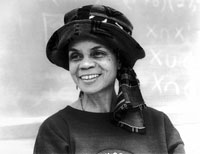
9 haiku
(for Freedom's Sisters)from Morning Haiku
1.
(Kathleen Cleaver)
quicksilver
panther woman speaking
in thunder2.
(Charlayne Hunter-Gault)
summer silk woman
brushing the cobwebs
off Southern legs3.
(Shirley Chisholm)
We saw your
woman sound footprinting
congressional hallways4.
(Betty Shabazz)
your quiet face
arrived at a road
unafraid of ashes . . .5.
(Fannie Lou Hamer)
feet deep
in cotton you shifted
the country's eyes6.
(Barbara Jordan)
Texas star
carrying delicate words
around your waist7.
(Rosa Parks)
baptizer of
morning light walking us away
from reserved spaces8.
(Myrlie Evers-Williams)
you rescued women and men
from southern subscriptions
of death9.
(Dr. Dorothy Irene Height)
I
your words
helped us reconnoiter
the wonder of womenII
woman sequestered
in the hurricane
of herstory . . .Sanchez, Sonia. "9 haiku (for Freedom's Sisters)." Morning Haiku. Boston: Beacon Press, 2010. Please do not distribute this work without permission. You may submit requests to reprint the work of Sonia Sanchez from titles published by Beacon Press through its website.
Read more about the women featured in this poem:
Kathleen Cleaver
Charlayne Hunter-Gault
Shirley Chisholm
Betty Shabazz
Fannie Lou Hamer
Barbara Jordan
Rosa Parks
Myrlie Evers-Williams
Dr. Dorothy Irene Height -
In an 1997 episode of This American Life called "Guns," Geoffrey Canada discussed his childhood in the Bronx, the violence he faced there, and the changes brought about when guns became more commonplace among young people in the city. You can listen to the episode online. On the show, Canada read a piece from his memoir, Fist Stick Knife Gun, which you can read below.
– – – – – – –
 In 1971, well before the explosion of handguns on the streets of New York City, I bought a handgun. I bought the gun legally in Maine, where I was in college. The clerk only wanted to see some proof of residency, and my Bowdoin College I.D. card was sufficient. For a hundred and twenty-five dollars I was the proud owner of a .25-caliber automatic with a seven-shot clip. The gun was exactly what I needed. It was so small I could slip it into my coat pocket or pants pocket.
I needed the gun because we had moved from Union Avenue to 183rd Street in the Bronx, but I still traveled back to Union Avenue during holidays when I was home from school. The trip involved walking through some increasingly dangerous territory. New York City was going through one of its gang phases and several new ones had sprung up in the Bronx. One of the gangs liked to hang out right down the block from where we now lived on 183rd Street and Park Avenue. When I first went away to school I paid no mind to the large group of kids that I used to pass on my way to the store or the bus stop back in the Bronx. The kids were young, fourteen or fifteen years old. At nineteen I was hardly worried about a bunch of street kids who thought they were tough. But over the course of the next year the kids got bolder and more vicious. On several occasions I watched with alarm as swarms of teenagers pummeled adults who had crossed them in one way or another. Everyone knew they were a force to be reckoned with, and many a man and woman crossed the street or walked around the block to keep from having to walk past them.
And I crossed the street also. And there were times that I went out of my way to go to another store rather than walk past the rowdy group of boys who seemed to own the block. On more than one occasion I rounded a corner only to come face to face with the gang. I could feel their eyes on me as I looked straight ahead, hoping none of them would pick a tight. That September in 1971, when I got back to the serenity of Bowdoin College I was more tense than usual. I realized that those kids had me scared. After having survived growing up in the Bronx, here I was scared to go home and walk down my own block. The solution was simple, and as I held the small gun in my hand I knew I had found the answer to my fears.
-
 All this month, you can enter to be one of six winners in our Black History Month giveaway. To enter, become a fan of Beacon Press on Facebook, and RSVP to our giveaway event as "Attending."
 Winners can choose one of the following books:
Stride Toward Freedom: The Montgomery Story by Martin Luther King Jr.
Martin Luther King, Jr.'s account of the first successful large-scale application of nonviolence resistance in America is comprehensive, revelatory, and intimate. King described his book as "the chronicle of fifty thousand Negroes who took to heart the principles of nonviolence, who learned to fight for their rights with the weapon of love, and who, in the process, acquired a new estimate of their own human worth.'' It traces the phenomenal journey of a community, and shows how the twenty-eight-year-old Dr. King, with his conviction for equality and nonviolence, helped transformed the nation-and the world.Where Do We Go from Here: Chaos or Community? by Martin Luther King Jr.
In 1967, Dr. Martin Luther King, Jr., isolated himself from the demands of the civil rights movement, rented a house in Jamaica with no telephone, and labored over his final manuscript. In this prophetic work, which has been unavailable for more than ten years, he lays out his thoughts, plans, and dreams for America's future, including the need for better jobs, higher wages, decent housing, and quality education. With a universal message of hope that continues to resonate, King demanded an end to global suffering, asserting that humankind-for the first time-has the resources and technology to eradicate poverty.Morning Haiku by Sonia Sanchez
This new volume by the much-loved poet Sonia Sanchez, her first in over a decade, is music to the ears: a collection of haiku that celebrates the gifts of life and mourns the deaths of revered African American figures in the worlds of music, literature, art, and activism. In her verses, we hear the sounds of Max Roach "exploding in the universe," the "blue hallelujahs" of the Philadelphia Murals, and the voice of Odetta "thundering out of the earth." Sanchez sings the praises of contemporaries whose poetic alchemy turns "words into gems": Maya Angelou, Richard Long, and Toni Morrison. And she pays homage to peace workers and civil rights activists from Rosa Parks and Congresswoman Shirley Chisholm to Brother Damu, founder of the National Black Environmental Justice Network. Often arranged in strings of twelve or more, the haiku flow one into the other in a steady song of commemoration. Sometimes deceptively simple, her lyrics hold a very powerful load of emotion and meaning. -
Today’s post is from Adele Barker, who was awarded a Ucross Fellowship for her work on her latest book, Not Quite Paradise: An American Sojourn in Sri Lanka. Barker has taught at the universities of Arizona and Washington, and is the author and editor of five books on Russian literature and cultural life. In 2001-2002 she received a Fulbright Senior Scholar grant to teach and write in Sri Lanka. After the tsunami she returned to the island where she traveled to the areas most devastated by the waves and by the thirty year old civil war between the Tamil Tigers and the central Sinhalese government.
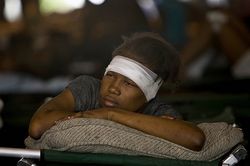 I was on my way home from Sri Lanka, sitting in the transit lounge of Heathrow Airport when the earthquake struck Haiti. Several hours later the first film footage began to come in. We sat with our Starbucks and along with everyone else just stared.
Two weeks earlier my son and I had spent December 26th driving up the southwest coast of Sri Lanka. It was the fifth anniversary of the tsunami. We stopped at a couple of beaches and swam along with other Sri Lankans. On the surface it looked like just another day. But it wasn’t. How could it be? We have friends over there who will never ever go to the shore again, much less swim in the waters. Others marked the day in their own way. Officially nothing was done by the government. But privately people remembered.
Like most of us, I’ve spent a lot of time over the past few weeks in front of the television set looking at images of Haiti. We used to live in Sri Lanka. I had written about the tsunami, and so people have asked me if what happened in South Asia in 2004 can teach us anything about how to respond in Haiti. People want answers; I want answers, but the answers aren’t easy to come by. We want people not to die in these disasters; we want aid to reach its mark in something approximating a timely manner; and we want to see life returning to normal as soon as possible. Do we have a shot at any of these or am I simply dreaming? I am neither a seismologist nor an aid worker. Like all of us though I am devastated by the disaster, puzzled and irritated by the problems getting aid where it is supposed to go, and wishing things were different. And so I offer here a few thoughts.
-
Today’s post is from David W. Moore and George F. Bishop. Moore is a Senior Fellow with the Carsey Institute at the University of New Hampshire. He is a former Vice President of the Gallup Organization and was a senior editor with the Gallup Poll for thirteen years. He is author of The Opinion Makers: An Insider Exposes the Truth Behind the Polls. Bishop is Professor of Political Science and Director of the Graduate Certificate Program in Public Opinion & Survey Research at the University of Cincinnati. His most recent book is The Illusion of Public Opinion: Fact and Artifact in American Public Opinion Polls.
 Every year, poll watchers are confronted with poll results and commentary that defy either logic or science, often raising questions about the very utility of polls. Typically, the problems are not with the method of conducting polls, but with the pollsters themselves — as they focus on what they believe is entertaining and appealing to the audience rather than an accurate reflection of public opinion. In the process, pollsters can manipulate public opinion or write commentary that makes a mockery of what the public is really thinking.
With this article, veteran pollsters, authors and political scientists George F. Bishop and David W. Moore issue their Second Annual Top Ten “Dubious Polling” Awards. These awards are intended to mark for posterity some of the most risible and outrageous pronouncements by polling organizations during the previous year.
Each award is ranked, from a low of one set of crossed fingers to a high of five sets. Pollsters generally know in their hearts when all is not right with their polls, but they (figuratively) cross their fingers and hope that no one notices anything amiss. The five crossed-fingers icon is the ultimate in wishful thinking, perhaps the equivalent of football’s “Hail Mary pass” for the truly untrustworthy poll.
-
Today’s post is from David Chura, author of I Don’t Wish Nobody to Have a Life Like Mine: Tales of Kids in Adult Lockup. Chura has worked with at-risk teenagers for forty years. His writing has appeared in the New York Times and multiple literary journals and anthologies, and he is a frequent lecturer and advisor on incarcerated youth. This post originally appeared at his Kids in the System blog.

Jail photo by http://www.flickr.com/photos/abardwell/ / CC BY-SA 2.0We Americans don’t know much about how our criminal justice system works. We have the basics down. “Commit the crime, do the time!” as the pop cliché has it.
If only it were that simple.
Most Americans know that if you get arrested and post bail you’re released from custody while your case grinds through an overburdened court system.
That is, if you’re lucky enough to be able to post bail– which means you’re white enough; rich enough; well connected enough. But if you can’t get bail– which means you’re poor; probably a minority; you’ve burned bridges, are alone– you go to jail. Even though you’ve not been judged guilty. Even though the state has yet to prove that you did the crime you’re accused of. Even though you’re innocent until proven otherwise. Still you stay locked up in jail, not some special holding place, until your trial. You live with convicted criminals in the same conditions that society has set up to punish (because that’s what jails do) these wrongdoers.
That’s the way it is for two-thirds of the people in U.S. jails according to a recent series on NPR; more than a half million inmates locked up because they can’t get the money to post bail.

