• Thomas N. DeWolf is the author of Inheriting the Trade: A Northern Family Confronts Its Legacy as the Largest Slave-Trading Dynasty in U.S. History. Tom speaks regularly at schools, conferences, and other events around the country. For further information go to: www.inheritingthetrade.com, where you can also find his Inheriting the Trade blog, where this post originally appeared.

    Book Cover of Inheriting the Trade, links to Beacon Press page for bookMy first thought when I heard the voice shout out “You lie!” during President Obama’s speech before Congress last week was that whichever kook had been so inappropriate was surely being escorted out from the spectator’s gallery by security officials posthaste.

    Like everyone else, I learned the next morning that it was a U.S. Congressman from South Carolina who had been so rude. Then several days later Jimmy Carter said on NBC that “an overwhelming portion of the intensely demonstrated animosity toward President Barack Obama is based on the fact that he is a black man.”

    Is racism really at play here?

    (more…)

  • Today’s post is from Jennifer Culkin, author of A Final Arc of Sky: A Memoir of Critical Care. Culkin, winner of a 2008 Rona Jaffe Foundation Award, is a writer and longtime neonatal, pediatric, and adult critical care nurse. Her work has appeared in many literary magazines, including the Georgia Review and Utne Reader, and in the anthologies Stories with Grace and The Jack Straw Writers Anthology 2006.

    Book Cover for A Final Arc of SkyI’m so confused. To judge by two current television series about nurses, TNT’s HawthoRNe and Showtime’s Nurse Jackie, are we nurses angels or ‘hos? Self-righteous, micromanaging do-gooders in lab coats, or adulterous, vigilante prescription-drug addicts in scrubs? Granted, Jackie comes off as intelligent and realistic. Her black humor feels right. But how does she find time for lunch at a restaurant, let alone the sort of restaurant that has wine glasses on the table? And how, during the course of her shift, does she manage a roll in the hay with a hospital pharmacist? There are days I don’t have time for a drink of water. I want to work where she works!

    Except I’m not into narcotics, and certainly wouldn’t use (Snort! Now there’s a nice touch… and it’s so lovingly filmed) them at work. Thirty years ago, when I was young and clueless, I sometimes had a glass of wine with lunch at noon before a shift that began at 3 PM. Now I’d never do that, and neither would the vast majority of nurses I know. My patients, like other consumers, have a right to expect that I’ll save the wine for my time off. That I’ll care for them unimpaired.

    And then there is Christina HawthoRNe. I suppose it’s a good thing that the public sees there IS such a thing as a chief nursing officer, that nursing is an independent profession with its own management hierarchy and that the CNO is a high-level administrator with her share of clout in the organization. But despite 30 years as a critical-care nurse, I have yet to see one charging around so ostentatiously, setting everyone straight: other hospital administrators, the Emergency Department nurses, her own daughter, a patient and his MD father. The disappointing bottom line is, Christina isn’t any more realistic than… a TV doctor.

    (more…)

  • Today’s post is from Robert Kunzman, author of Write These Laws on Your Children: Inside the World of Conservative Christian Homeschooling. Kunzman spent ten years as a high school teacher, coach, and administrator and is currently an associate professor in the Indiana University School of Education. He is also the
    author of Grappling with the Good: Talking about Religion and Morality in Public Schools.

    Book Cover for Write These Laws on Your ChildrenHow firmly should a ten-year-old child hold her religious beliefs? How much exposure to alternative viewpoints should she have? These questions are at the heart of a recent controversy out of New Hampshire, where a family court has decreed that ten-year-old Amanda Kurowski– who has been homeschooled by her mother since first grade– should enroll in public school this month. Conservative Christian news organizations and blogs are vehemently protesting this decision, pointing to the court’s own acknowledgment that Amanda is “generally likeable and well liked,” “social and interactive with her peers,” and “intellectually at or superior to grade level.”

    Let’s be clear at the outset that this is a custody case, which is the only reason the state is involved. The parents, who share joint decision-making responsibility for Amanda, disagree about whether homeschooling is the best educational choice for her, and have asked the family court to decide. Under homeschooling regulations in New Hampshire (and everywhere else in the U.S.), the state would have no cause to step in if this weren’t a custody issue.

    But apart from those legal complications, the controversy nonetheless highlights some central concerns by outsiders about religiously-inspired homeschooling. “The counselor found Amanda to lack some youthful characteristics,” wrote the court. “She appeared to reflect her mother’s rigidity on questions of faith.” While it’s not clear what forms this rigidity took (other than Amanda’s apparent attempt to proselytize the counselor), it’s this observation that most infuriates critics of the court’s decision. Should we really be so concerned about religious dogmatism in a ten-year-old? How many ten-year-olds hold a nuanced view of their religious commitments anyways? And what if her rigid beliefs were about environmentalism or politics—would outsiders still be so concerned?

    (more…)

  • This post originally appeared on the Washington Post's blog "The Faith Divide.

    PatelBrian McLaren, the great Christian writer and activist, called me up a few weeks ago with a remarkable request: Would I be his fasting partner during Ramadan? He explained to me that there was a long-held Christian tradition of fasting, although it is not practiced much in contemporary Christian communities. Brian's goal was to live more fully into that Christian tradition during Ramadan, while also feeling solidarity with Muslim communities.

    There are a number of Christians Brian knows who are doing this. As he writes in his blog: "We, as Christians, humbly seek to join Muslims in this observance of Ramadan as a God-honoring expression of peace, fellowship, and neighborliness. Each of us will have at least one Muslim friend who will serve as our partner in the fast. These friends welcome us in the same spirit of peace, fellowship, and neighborliness."

    I shared the story with Shaykh Hamza Yusuf at the beginning of Ramadan, and he told me that he was reading a book about the Judeo-Christian tradition of fasting, and learning a great deal from it.

    Then I heard that many of the non-Muslim FaithsAct Fellows (a joint program of the Interfaith Youth Core and the Tony Blair Faith Foundation), are fasting together. That is truly remarkable. These young people are currently on an interfaith fellowship in Africa, working with Christians and Muslims in health clinics that prevent and treat malaria.

    In his beautiful video message on Ramadan, President Obama spoke of the particular Muslim practice of Ramadan (the additional nightly prayers, the belief that this is the month when the Qur'an was revealed), but also of the common tradition of fasting across religions – how it is meant to bring us closer to God, and to remind us of those who cannot take their next meal for granted.

    Shaykh Hamza told me during our conversation, "Eboo, the walls are falling, the barriers are breaking." I hope so. I hope this interfaith solidarity during Ramadan is a sign of the times. I pray that we are moving towards a world in which people are rooted in their own traditions but find dimensions to admire and learn from in others, that Ramadan is a time during which people from a variety of backgrounds come together in the common purpose of growing closer to God and one another. That is the heart of Islam, of all of our faiths and traditions.

    Also read Eboo Patel's NPR piece on Ramadan, and watch him on CNN discussing how to create alternatives to Islamic extremism.

    About the Author

    Eboo Patel is the founder and president of Interfaith Youth Core and the author of Acts of Faith, Sacred Ground, and Interfaith Leadership. He was a member of President Obama's inaugural faith council, is a regular contributor to the Washington Post, Huffington Post, CNN, and public radio, and speaks frequently about interfaith cooperation on college campuses. He lives in Chicago with his wife and two boys.

  • Meredith Hall's Without a Map continues to resonate with readers.

    A Q&A with homeschooling expert Robert Kunzman addresses some of the criticism his book has received from conservative bloggers.

    Kathryn Joyce uncovers the dark side of Christian adoption agencies.

    The Ethicurean looks at Nancy Gift's A Weed by Any Other Name (Gifted posted here today).

    Marcus Rediker has a stimulating discussion about pirates with the inmates of Auburn Prison.

    Mark Winne looks at the link between obesity and poverty.

  • Today’s blog post is from Nancy Gift, author of
    A Weed by Any Other Name: The Virtues of a Messy Lawn, or Learning to Love the Plants We Don’t Plant. Gift is an assistant professor of environmental studies and acting director of the Rachel Carson Institute at Chatham University in Pittsburgh, Pennsylvania, where she lives with her husband, two daughters, and a lawn full of weeds. This post originally appeared at Gift’s Weeds and Kids blog.

    Book Cover for A Weed by Any Other NameWhatever sense of crazy excitement or optimism August brings, I usually associate this time very strongly with new beginnings, having had an academic-year schedule for at least 32 of my 38 years. So when we were down in Kentucky last week, perhaps we were drawn to the boldness of the idea of another new beginning, this one by choice. Or perhaps we just couldn’t resist. But we are, once again, raising chickens.

    Giftphoto1At left, you see Emily cuddling with one of the most cuddly chickens I have ever met, one belonging to Louisville garden writer and commentator, Jeneen Wiche. This chicken was practically purring while the girls held her, having been hand-raised by Jeneen’s niece. That was Wednesday. Thursday found us at the Kentucky State Fair, looking at chickens of all sorts, plus a few odd pens of chicks, at $3 apiece. I was thinking how I wished we could try again, when Emily came up to tell me “Daddy said we could get a couple of chicks!” Given that it was Brian who witnessed the fox’s massacre last time, if he was ready, I could be ready.

    Giftphoto2Each girl picked out two, Hazel two black ones – Japanese cochins, the farmer told us; Emily two yellow, with brownish marks, which she hopes are Ameraucana, like her favorite chicken from our last group. I took it as a sign of both remembrance and healing that these choices reflected their favorites from our last batch.

    (more…)

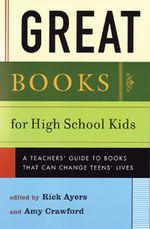
  • Today’s post is from Rick Ayers, co-author (with Amy Crawford) of Great Books for High School Kids: A Teachers’ Guide to Books That Can Change Teens’ Lives. Ayers is an Adjunct Professor in Education at University of San Francisco and teaches at UC Berkeley and New College. He is in the Language, Literacy, and Culture PhD program of the UC Berkeley Graduate School of Education. He blogs at the Huffington Post, where this post originally appeared.

    GreatbooksforhskidsI teach a course on adolescence at a nearby university, exploring the various challenges and rewards that new teachers will encounter in the middle and high school classrooms. In addition to the university’s computerized evaluations, I always hand out my own feedback and evaluation form near the end of the semester. Amidst the many positive comments and suggestions, one negative evaluation stood out. Of course I wondered who wrote this and I imagined it was the class grump. One tries to be professional, to reflect on what was learned from the overall feedback. But, of course, it is easy to obsess, to keep coming back to the negative one.

    What the student had to say was interesting. “I was looking back at my expenses this semester and I calculated that I pay $150 for each class session I have. Sometimes I wonder… was it worth $150 for me to attend a movie (The Class) with you and chat about it afterwards? Did I get my $150 worth when we did that artifact share activity?”

    (more…)

  • Today’s post is from Robert Kunzman, author of Write These Laws on Your Children: Inside the World of Conservative Christian Homeschooling. Kunzman spent ten years as a high school teacher, coach, and administrator and is currently an associate professor in the Indiana University School of Education. He is also the
    author of Grappling with the Good: Talking about Religion and Morality in Public Schools.

    Book Cover for Write These Laws on Your ChildrenQuick—who are the only two nations who haven’t ratified the 1989 UN Convention on the Rights of the Child?

    Somalia is one of them—no bonus points for that guess. Who else stands against the 193 nations who’ve ratified the treaty? None other than the United States of America. This may change under the Obama administration; U.N. ambassador Susan Rice recently proclaimed the situation a disgrace and indicated that U.S. ratification of the treaty was under active discussion.

    But not if the Home School Legal Defense Association (HSLDA) has their way. Calling the UNCRC “anti-family” and “anti-American,” they have urged their 80,000 members—as well as those who’ve joined ParentalRights.org, a “grassroots” organization founded by HSLDA—to voice their opposition. To further their cause, they have been a driving force in promoting a Parental Rights Amendment, which now has more than 110 co-sponsors in the House of Representatives.

    Why does the most powerful and prominent homeschool advocacy organization in the world see the UNCRC as such a threat? Ultimately, it’s an argument about who should have a say in the raising and educating of children.

    (more…)

  • Today’s post is from Dana Sachs, the author of The Life We Were Given: Operation Babylift, International Adoption, and the Children of War in Vietnam, which will be published by Beacon Press in April.

    This week, many people have recollected their interactions with Senator Edward Kennedy. I also met him– in the pages of a 34-year-old transcript I discovered while researching a book about the war in Vietnam.

    My research involved Operation Babylift, the U.S.-sponsored evacuation, and subsequent overseas adoption, of several thousand children from Saigon at the end of the war. The transcript came from an April 8, 1975, Senate Judiciary Subcommittee hearing titled, “Indochina Evacuation and Refugee Problems, Part I: Operation Babylift and Humanitarian Needs.” The chair of the subcommittee was Ted Kennedy, 43 years old and 13 years into his Senate career.

    By early April 1975, the war in Vietnam was nearly over but the misery was intensifying every day. The North Vietnamese-backed final offensive had displaced hundreds of thousands of people, many of whom were dying of starvation and disease. “Tragedy is piled on tragedy,” Senator Kennedy said in his opening remarks. He recognized a “deep and despairing sense of helplessness among the American people” over what was happening in Vietnam. At the hearing, he hoped to find answers to a simple question: Why, after so many millions of dollars in aid had been promised to Vietnam, were we still witnessing so much suffering?

    (more…)

  • Today’s post is from David W. Moore, author of The Opinion Makers: An Insider Exposes the Truth Behind the Polls (out in hardcover now, paperback with a new afterword available this fall). Moore is a senior fellow of the Carsey Institute at the University of New Hampshire. A former senior editor of the Gallup Poll, where he worked for thirteen years, Moore also served as professor of political science at UNH and is the founder and former director of the UNH Survey Center.

    Book cover for The Opinion Makers by David W. MooreIn my earlier post (Part I) on this subject, I suggested it would be a political miracle if Democrats did not lose U.S. House seats in the 2010 election. A major reason is that in mid-term elections, the voters most likely to turn out are those who are disgruntled with the policies of the incumbent president, rather than his supporters. In fact, since Democrats and Republicans first began vying against each other for Congress in the mid-19th Century, the president’s party has lost seats in mid-term elections, relative to the “out” party, all but three times– 1934, 1998 and 2002.

    The two most recent times seem to be special situations that are likely to have little relevance for 2010. The 2002 mid-term election saw the president’s party pick up a few seats, probably because the country was still rallying around the flag in reaction to the terrorist attacks the previous year. President Bush’s approval rating was still high (Gallup showed it at 68 percent in a poll conducted Nov. 8-10, 2002).

    And the 1998 mid-term election found voters quite dissatisfied with the Republicans’ vote to impeach President Clinton, apparently a major reason why the president’s party was able to pick up a few House seats. In both years, the Republicans enjoyed slim majorities, and the changes did not affect their majority control.

    If neither of the two exceptions just noted appear to have much relevance to what might happen in 2010, the third exception (the first chronologically) is a different story. Taking place just two years after President Roosevelt came into office during the Great Depression, the 1934 mid-term election campaign focused largely on the New Deal measures adopted by Congress. The result was a net increase of 9 seats for the president’s party– from 313 to 322. Democrats today no doubt hope that a similar debate about the economic stimulus bills and health care reform will be a positive inducement for voters next year.

    (more…)