• Today’s post is from Steven I. Apfelbaum, author of Nature’s Second Chance: Restoring the Ecology of Stone Prairie Farm. Apfelbaum is founder, president, and senior ecologist of the firm Applied Ecological Services, known for its international science-based ecological design and restoration work. He lives in Juda, Wisconsin, on Stone Prairie Farm.

    Book Cover for Nature's Second Chance, links to Beacon Press page for bookI noticed the difference in the first rays of the rising sun that 5th February: a definite brighter yellow morning glow, the appearance of warmth even though it was only seven degrees Fahrenheit, and something else that spoke of a turning point. I wasn’t the only creature at Stone Prairie Farm cognitive to this event. The chickadees, at the bird feeder for the first time since late fall, were calling. They spurted parts of their normal songs, seeming like first-time vocalists practicing a few lines over and over.

    The sunlight soaked the land, once released by the horizon to our side of the earth. Then I knew, before listening to any weather reporting on the radio, today was going to be different. Today the snow drifts would shudder and slump, water would ooze from beneath their slumping forms like the melting of butter, and the land’s whiteness of several months would flow from the land to the streams, to the ground to replenish water supplies, and evaporate back to the atmosphere. The passing thought–expect foggy mornings–was interrupted by a proclamation for the fish in Spring creek: expect a surge of cold clear water. Incoming!

    Then I became preoccupied with the morning rush to chores, off to my office and work. During the perfunctory morning dog walk, Willow ran between the shadows and the glowing light as he crisscrossed behind prairie grass clumps and shrubs, looking for the perfect spots and sniffing the scents of the nightly wildlife movements. The rabbits in particular. For a gray haired muzzled dog, there was a little more spring in his step. He too appeared to notice or feel something in the cold morning air.
    (more…)

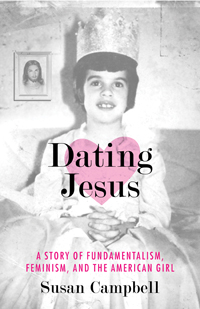
  • Today’s post is from Susan Campbell, author of Dating Jesus: A Story of Fundamentalism, Feminism, and the American Girl. Campbell’s writing has been recognized by the American Association of Sunday and Features Editors; National Women’s Political Caucus; the Sunday Magazine Editors Association, and the Connecticut chapter of Society of Professional Journalists. She was also a member of the Hartford Courant‘s 1999 Pulitzer Prize-winning team for breaking news. Campbell blogs at the Hartford Courant and at her Dating Jesus blog.

    Dating Jesus: link to Beacon Press page for the bookAs exciting a prospect as it may be, I don’t think we are quite ready for the big balloon-drop to celebrate gender equality.

    For what else could we be celebrating when we hear that we’re in a post-feminist era?

    I hate to be the skunk at the picnic, but maybe you’ve heard the rumblings, too. Earlier this year, commentators called Michelle Obama a post-feminist (look, she’s married and she has a job!), and no less an entity than the New York Times referred to the era in which we live as a “post-feminist” one in a promo asking that age-old and impossible-to-answer question, “What Do Women Want?”

    We all know what “post” means, right? After-the-fact–as if feminism had served its purpose, and it’s time to move on to a new era, a more egalitarian one. We can take all that energy that we were putting into correcting gender inequality in the boardroom, the military, and the pulpit and–I don’t know–end the war or something.

    Except, well, we’re not done yet.

    (more…)

  • Today’s post is from Thomas N. DeWolf, the author of Inheriting the Trade: A Northern Family Confronts Its Legacy as the Largest Slave-Trading Dynasty in U.S. History, published by Beacon Press. Tom speaks regularly at schools, conferences, and other events around the country. For further information go to: www.inheritingthetrade.com, where you can also read his Inheriting the Trade blog.

    Book Cover of Inheriting the Trade, links to Beacon Press page for bookIt stung in that hotel room in Cape Coast, Ghana when Juanita said (which you can see in the film of our journey, Traces of the Trade) “white people have been cowards.”

    It stung to hear the words. It stung because they were true; certainly in my case. I just didn’t know how to talk about issues of race. I certainly didn’t know how to talk about it with people of color.

    This week Attorney General Eric Holder, in comments before the Justice Department in regards to Black History Month, said we’ve been “a nation of cowards,” which pretty much includes everyone, when it comes to talking about race relations.

    (more…)

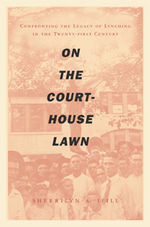
  • Today’s post is from Sherrilyn A. Ifill, a civil rights lawyer and law professor at the University of Maryland School of Law in Baltimore, Maryland. Ifill is the author of On the Courthouse Lawn: Confronting the Legacy of Lynching in the Twenty-first Century.

    Book Cover for On the Courthouse Lawn links to Beacon Press page for bookConservative commentator Bill Bennett famously (and arrogantly) summed up the significance of Barack Obama’s win last November as the end of “excuses” for blacks. Although Bennett, as a white right-wing talking head prone to inflammatory racial commentary may have been an inappropriate and certainly ill-timed messenger of this bromide, his statement was not far off from what many black people have been saying among our family members, and in our community centers and churches since November. Days after the election a black analyst in the Washington Post seemed to unconsciously parrot Bennett when she declared that, “African-Americans just entered the ‘no-excuses’ zone.” Black comics joked that blacks could no longer claim that we are being held back by “the man,” when with a black man in the White House we technically are “the man.” The widely accepted understanding of this sentiment is that traditional black civil rights thinking–which focuses on dismantling systematic racial inequity as the principal means of improving the economic, educational and social condition of African Americans–has been rendered obsolete by Obama’s presidency.

    But in the months since Obama’s election, little attention has been directed at the possibility that Obama’s ascension has thrown another traditional black school of thought into potential obsolescence: black conservatism. I’ve been fascinated by the dearth of statements by black conservatives (and the directionless rambling of the few that have offered some reflections) on the meaning of the Obama presidency. I speak of course of Ward Connerly, Justice Clarence Thomas and Shelby Steele, among others–those who, as Chris Rock bitingly put it years ago, have “devoted their lives to making sure the white man gets a break.” I began thinking of Obama’s presidency as a blow to black conservatives when I was on the Mall on Inauguration Day. I was surprised that when Justice Thomas appeared on the screen of the jumbotron, taking his place along with other Supreme Court justices on the dais, he elicited nary a boo, a hiss or even a sarcastic comment from the normally vocal liberal crowd around me. It was as though Obama’s inauguration was, in and of itself, answer to all of Thomas’ tirades against affirmative action.

    Because whatever you think of the merits going forward of affirmative action, and other traditional civil rights strategies, there can be no doubt that Obama’s presidency would not have been possible without the successes and groundwork laid by those earlier efforts.

    (more…)

  • Today’s blog post is our first from Rev. Forrest Church, author of Love & Death: My Journey Through the Valley of the Shadow. Rev. Church served almost three decades as senior minister and is now Minister of Public Theology of All Souls Unitarian Universalist Church in New York City. He was educated at Stanford University, Harvard Divinity School, and Harvard University, where he received his Ph.D. in early church history. He has written or edited numerous books, including Life Lines: Holding on and Letting Go; Lifecraft: The Art of Meaning in the Everyday; So Help Me God; and Freedom from Fear.

    Book cover for Love and Death links to Beacon Press page for bookI’m agnostic about life after death, but believe deeply in love after death. Not only do I believe in it, I experience it. We can arrange the pictures on the walls of our mind in any way we choose. As I slowly die of terminal cancer, blessed with the opportunity to rearrange those pictures more thoughtfully I fill my memory wall with images of love. The pictures that adorn my mind illuminate my life. Past and future disappear. Eternity, for me, is not a length of time extending on forever, but depth in time. In the time’s eternal depth, through love’s portals we enter heaven on earth. One with God, self and neighbor, we are saved.

    This lesson lies at the heart of my final book, Love & Death. As I reflect upon it further, it grows in both clarity and power. I know how deeply love can hurt and how sensible it seems sometimes to rip its recurring promise from the tapestries of our lives. I also know how tempting it can be to armor our hearts from the pain of being broken, not only the pain of betrayal but also the abiding pain of loss.

    Grief, you see, is love’s measure. The courage to die is nothing when compared to the courage of those who live on after us, their hearts broken by their loss. Yet it is precisely at these moments when we are invited to stand before love’s tribunal to be judged. Are you guilty of love or not guilty? That is life’s ultimate question. Again and again over the course of a lifetime we are brought before the Tribunal of Love, where the innocent are damned and the guilty are saved.

    (more…)

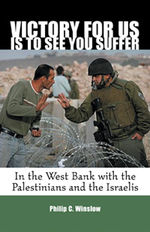
  • Today’s post is from Philip C. Winslow, author of Victory For Us Is to See You Suffer: In the West Bank with the Palestinians and the Israelis. Winslow has been a journalist and foreign correspondent for more than twenty years; he has worked for the Christian Science Monitor, the Toronto Star, Maclean’s magazine, ABC radio news, CTV News, and CBC radio. He also served in two United Nations peacekeeping missions and spent nearly three years living in the West Bank.

    Book Cover for Victory For Us is to See You Suffer links to Beacon Press page for book
    Israel’s use of white phosphorus munitions in the Gaza Strip in January was one of the most intensely debated issues of the hyper-violent 22-day war, in which 13 Israelis and 1,300 Palestinians died. Dramatic photographs showed Israeli shells bursting over a United Nations school in northern Gaza as Palestinians ran for cover and others frantically tried to extinguish burning lumps amidst the smoke.

    Israel’s phosphorus shells–and Hamas’s rockets aimed at Israeli civilians–are only part of a disturbing picture of modern warfare. The use of phosphorus deserves a closer look, because of its particular danger to civilians and because of its relevance to what is legal in warfare.

    (more…)

  • Today’s post is from Claire Hope Cummings, an environmental lawyer, journalist, and author of Uncertain Peril: Genetic Engineering and the Future of Seeds.

    Book Cover for Uncertain Peril, links to Beacon Press page for bookCharles Robert Darwin was born 200 years ago today. Thomas Jefferson was in the White House and life was slower and much quieter. The sounds of the natural world could still be heard in daily life.

    Now we live with the constant hum of engines and the ringing and beeping of electronics. We may have advanced technologically, but have we progressed in our ideas about the role of science in society? What would Darwin think if he knew the same old arguments over science and religion were still raging?

    Over the last few decades, in the United States especially, religious conservatives have successfully denied the fact of evolution and forced science classes in public schools to teach it as a theory and offer creationism as the alternative.

    A study by Jon Miller of Michigan State University surveyed 32 European countries and found that “the U.S. is the only country in which [the teaching of evolution] has been politicized.” Miller began examining American ideas on evolution in 1985. At that time, only 45 percent of Americans accepted the basic idea of evolution. By 2005, that number had declined to 40 percent. (You can read about the study in this New Scientist article. The original article is available by subscription only here.)

    Miller says that religious fundamentalism, poor science education in our schools, and partisan politics have resulted in more Americans denying evolution than ever. Just last month, the Texas Board of Education, the largest and most influential textbook purchaser in the nation, finally dropped its 20 year mandate that science teachers include a critique of evolution in their curriculum. Still, 7 of the 15 seats on the board are held by conservatives who vow to keep pushing their agenda.

    Darwin, of course, would recognize this old argument. But he would probably see it as it is, a false dichotomy. His writing gave due respect to both nature and his religious beliefs. He might be surprised that so many of us now, especially those of us who think we have accomplished so much in taming the natural world, still think we need to choose.

    (more…)

  • Today’s post is from Jacqueline Olds, MD, co-author with Richard S. Schwartz, MD, of The Lonely American: Drifting Apart in the Twenty-first Century. Drs. Olds and Schwartz are both psychoanalysts and Associate Clinical Professors of Psychiatry at Harvard Medical School. They have written two other books, Overcoming Loneliness in Everyday Life and Marriage in Motion. Drs. Olds and Schwartz will discuss The Lonely American at the Cambridge Forum, Wednesday, February 11th at 7:30pm. Details here.

    Cover of the Lonely American links to Beacon Press page for bookHere it is Valentine’s Day again… and many of us are thinking, “Oh dear, I’m alone again. How I hate this celebration of couples!” There are in fact a lot of us who live alone (approximately 25% of households are single-person households according to the latest census), and the General Social Survey from 2004 revealed that many of us have no really close confidants. So how are we to cope with such a “holiday” when there seems to be so little to celebrate?

    Well, much of the research done on health and social connection does not specify that to achieve longevity, you have to have a Valentine, but it does imply that you have to be socially connected to some small groups in such a way that you schmooze regularly with them. And, even though we don’t know for sure whether it lengthens lives, many psychologists stress the benefits of having a couple of people with whom you “can truly be yourself” without worrying about the impression you’re making. So one of the worst things you can do if you don’t happen to have a Valentine is huddle at home feeling too ashamed to go out and let everyone know that there’s no special someone in your life.

    (more…)

  • Today’s post is from Reshma Melwani, Beacon’s Foreign Rights Assistant. Since joining Beacon a little over a year ago, Reshma has overseen countless translation deals; this post explores some of her more inspiring deals and their significance in today’s world. When she’s not selling foreign rights for Beacon, Reshma works as a freelance writer in Boston.

    During his inauguration, President Barack Obama spoke of the strength of our “patchwork heritage,” describing America as “a nation of Christians and Muslims, Jews and Hindus, and nonbelievers… shaped by every language and culture, drawn from every end of this Earth.” Weeks later, these words still reverberate within me.

    Perhaps, because, like my country, I too am a product of a “patchwork heritage”– purposefully shaped by many cultures, molded by many languages.

    I spent monsoon summers in Bombay, watching my aunts bargain for glass bangles and silk saris at bustling bazaars. I enjoyed warm winters with my maternal grandparents in Indonesia. Rather than a bowl of cereal, I woke up to a steaming bowl of spicy fried rice topped with an over-easy egg. I cherish my memories of lazy afternoons in Spain, taking a siesta on the cool tile floor alongside my paternal grandparents.

    I’ve worshipped in Catholic churches, Islamic mosques, and temples both Hindu and Buddhist. I’ve grown up with an agnostic mother, a meditating father, and everything else in between. I am who I am precisely because of my “patchwork heritage.”

    But even in my day-to-day life in Boston, as a foreign rights liaison at Beacon Press, I see President Obama’s words materialize. I bear witness to the steps the international publishing community is taking to embrace other cultures and promote tolerance.

    (more…)

  • I remember a phrase uttered often on the playground, usually in response to a dropped piece of candy: “God made dirt and dirt don’t hurt.” Apparently, there’s some truth there.

    It’s only just started, but is it really the end of Black History Month?

    David Moore hands out the first annual Top 10 Dubious Polling Awards.

    At Mark Hyman’s blog, he addresses swimmer Michael Phelps and his recent embarrassing photo. Hyman talked about Michael and his mom Debbie Phelps on Beacon Broadside last August.

    Kate Clinton fights bad weather and the flu to get to the Task Force’s 21st Annual National Conference on LGBT Equality in Denver.

    On Thirteen.org, “Broadcasting While Black,” a look at several important Black public affairs television shows. If you have a chance, check out the Say Brother archive for short clips of the show.

    Glenn Branch, in an opinion piece at US News, makes the case against Intelligent Design.

    At the Harvard University Press Publicity Blog, a new look at Booker T. Washington.

    Beacon Broadside got some praise at Galleycat. Check out the post and see all the other exciting publisher’s blogs featured there.

    Via 26th Story, a history of the Atlantic Monthly in magazine covers. Beacon Press currently occupies the Atlantic’s former home, so our address is there on the cover from 1919.