• Today's post is from Jeremy Adam Smith, senior editor of Greater Good magazine and author of The Daddy Shift, forthcoming from Beacon Press in spring 2009. He blogs about the politics of parenting at Daddy Dialectic, where this post, in a slightly different form, originally appeared.

    Book Cover for The Daddy Shift, links to Beacon Press page for bookThree weeks ago I went to pick up my son, Liko, from preschool and found his class gathered outside the school, waiting for the mommies and daddies.

    Something struck me: The white girls huddled in one group and the white boys in another.

    Where was Liko? He and his three other part-white/part-Asian classmates, boys and girls, were off to one side, hanging out with each other. (A note on demographics: Since this is a Jewish Community Center preschool, a majority of the kids, including the half-Asian ones, have at least one Jewish parent; there are no black or Latino kids in his class. I should also note here that the white/Asian mix is very, very, very common in San Francisco, as it is in Hawaii, where my wife grew up.)

    Now, my perception has to be taken with a grain of salt. When it comes to sources of social tension like race, adults see what they're prone to see, and I'm no exception.

    (more…)

  • Eboo Patel responds to the recent violence in Mumbai and finds a connection to Judaism during the Eid.

  • Today's post is from Rita Nakashima Brock and Rebecca Ann Parker, co-authors of Saving Paradise: How Christianity Traded Love of This World for Crucifixion and Empire. Rita Nakashima Brock is a research associate at Starr King School for the Ministry at the Graduate Theological Union in Berkeley, California. Rebecca Ann Parker, an ordained United Methodist minister in dual fellowship with the Unitarian Universalist Association, is president and professor of theology at Starr King School for the Ministry at the Graduate Theological Union.You can read more about Saving Paradise and see color plates of the art discussed in the book at SavingParadise.net. 

    Savingparadise

    On Sunday, Nov. 30, Daily Kos conducted a poll about whether or not Barack Hussein Obama should use his middle name when he is sworn in on January 20th. Chris Matthews of NBC had done a morning feature on how Ronald (Wilson) Reagan and Jimmy (Earl) Carter didn't like their middle names and omitted them. Obama could follow suit.

    During the election, the right wing emphasized his middle name to suggest that he was not a Christian—as if there is something wrong with being a Muslim, as Colin Powell noted. Nathan Thornburg at Time criticized Candidate Obama for choosing not to defend his middle name, which Thornburg felt reinforced the right-wing use of it to stir up Islamophobia.

    We hope President-Elect Obama will use his middle name. We'd look forward to an inauguration that had a few multi-religious overtones. Not just because Islam is one of the great world religions, but because the idea that Christians cannot respect the truths of other religious traditions is a betrayal of its founder Jesus Christ.

    (more…)

  • Bill Ayers spoke for himself on the op-ed pages of the New York Times this past weekend.

    Kai Wright's Drifting Toward Love was selected as an Outstanding Book by the Gustavus Myers Center for the Study of Bigotry and Human Rights. A profile of Wright ran his past weekend in Edge Boston.

    John Hanson Mitchell's The Paradise of All These Parts was selected as one of 2008's most memorable books by the Boston Globe.

    TreeHugger Radio ran the first of a two-part interview with Fred Pearce about his new book, Confessions of an Eco-Sinner. Last week in the Guardian, Pearce examined what Coca-Cola's claims of becoming "water-neutral" really mean.

  • “Before we put this awful, sadomasochistic election campaign behind us, we need to deal with one of the most shameful parts of it — the treatment of Bill Ayers by both political parties.” Brent Harold in the Cape Cod Times.

    In the comments field of our recent memorial post, Senator Mike Gravel shared his own remembrance of Gobin Stair.

    Looking to have an economic impact with your holiday shopping dollars? Shop locally-owned businesses.

    A thoughtful meditation by Stephen Prothero on the work of Mary Oliver.

    The North American Congress on Latin America ran an excerpt from Garry Leech’s Beyond Bogota: Diary of a Drug War Journalist in Colombia.

    At Alternet, Nan Mooney on how the economic crisis is affecting higher ed.

    In The Nation, David Bacon charts an immigration course for the new administration.

    Happiness is contagious. Really—they’ve scientifically proven it. Keep that it mind as you read Michael Moore discussing the crisis in the auto industry, or Robert Reich telling you that, “We are falling off a cliff… the November losses alone are the worst in 34 years.”

    We don’t like to get too commercial on Beacon Broadside, but as a thank you to our readers we wanted to let you know that Beacon Press is offering 10% off all items and free shipping if you order from beacon.org before December 15. Just add the items you want to your cart, enter “HOLIDAY08” into the discount field of your cart, and proceed through the checkout.

    Recently on Beacon Broadside:

    Caring for the Soul of the World by David Paul

    Health Care: The Change We Need by Patricia Harman

    World AIDS Day Link Roundup

    In Memoriam: Gobin Stair

    Happy Thanksgiving

    To View, To Eat, Perchance to Not by Mark Winne

  • Today's post is from David Paul, co-author (with Craig Rennebohm) of Souls in the Hands of a Tender God.  Paul is a Seattle-based writer and editorial consultant. He is a former political scientist who taught at Princeton and the University of Washington, and he has authored or co-authored six books and many articles ranging from politics and history to film criticism, the Internet, and poetry translations.

    Book Cover for Souls in the Hands of a Tender God links to Beacon Press page for book
    A Canadian reader named Barbara wrote about our book, Souls in the Hands of a Tender God, that her favorite sentence in it is, "We begin caring for the soul of the world by caring for the souls of our neighbors, for each life that touches ours."

    Caring for the Soul of the World. It's actually the title of our tenth chapter, and now that I think about it, it may strike some as pretentious—who are we to take care of the soul of the world? Or it may seem impossible, overwhelming; how can you and I bear the weight of everybody? A counter at the Web site ibiblio.org tells us that the earth's population is approaching 7 billion people. What an enormous responsibility, to care for all those souls!

    The context of the sentence is an experience Chaplain Craig Rennebohm had eight years ago when he was invited to Bosnia-Hercegovina, a small country then trying to recover from the devastating war of 1992–1995. Craig's mission was to participate in discussions among local officials and healthcare workers whose task it was to rebuild the country's system of community mental health centers. Craig met with representatives of ethnic groups that had fought each other bitterly—Serbs, Bosnian Muslims, and Croats—and were now struggling to pick up the broken pieces of their community. What had been a functioning mental healthcare system was in shambles.

    (more…)

  • Today's post is from Patricia Harman, author of The Blue Cotton Gown: A Midwife's Memoir. Harman got her start as a lay-midwife on the rural communes where she lived in the '60s and '70s, going on to become a nurse-midwife on the faculty of Ohio State University, Case Western Reserve University, and West Virginia University. She lives and works near Morgantown, West Virginia, and has three sons. In the interest of privacy, the names and some identifying details of the women she discusses in this post have been changed.

    Book Cover for The Blue Cotton Gown by Patricia Harman, links to Beacon Press page for book
    Willa Burr, a forty-eight-year-old West Virginian, was a housekeeper and a darn fine one. She made good money too; a little over $14.00 an hour on Mondays, Thursdays, and Fridays for two doctors' families and a single middle-aged teacher. The rest of the week, she stayed home with her three-year-old granddaughter.

    Darrell, her husband, had retired early, when the shirt factory at the edge of town closed. He worked on an addition to their house on Taylor Mountain, a little at a time, when they could afford lumber. He had diabetes and took the medication he got at the free clinic. When the snow was too bad, he drove Willa down the steep mountain, in his four-wheel-drive truck, into the suburbs for her cleaning jobs.

    Life was pretty good on their two acres, what with Willa's pay and Darrell's Social Security, until Willa's knees gave out. First Mrs. Haddock let her go. That's the urologist's wife. She said Willa was missing too much work, but there was only that once when Willa and Dave had to go to South Carolina for two weeks to help their son, and the other time when Willa had the flu.

    The real reason Mrs. Haddock fired Willa was she couldn't get down on knees on the tile floors anymore, and the dusting was deteriorating too. Then Dr. Kepler said he didn't need her either. That left Miss Robinson, the second grade teacher, and when Willa noticed her hands were shaking and walking was difficult, she gave up cleaning altogether and just stayed home. Maybe she'd been working too hard, was what Darrell said.

    After that things went downhill. Willa's daughter, Tina, a secretary in an accountant's office, took her mom down to the low-income clinic, staffed by students, residents, and faculty from a nearby medical school, but they couldn't find anything wrong. Then, even though the Burr's couldn't afford it, Willa and Darrell made an appointment at the Patterson Family Health Center to see a young Doc who wore a gold cross around his neck and a cashmere sweater. He wasn't much help.

    The medical bill, from the clinic was $565, counting lab work. The doctor with the gold cross said he was pretty sure Willa had Parkinson's disease and wanted to order more tests, maybe a CAT scan of her brain, but Willa refused. She didn't have the money. And she couldn't pay for a trial of medication either.

    (more…)
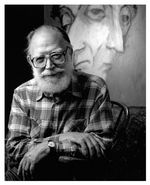
  • Portrait of Gobin Stair by Edward Nute Gobin Stair, former Director of Beacon Press, died last Wednesday, November 26, at the age of 96. Stair joined Beacon initially as Production Manager before taking over as Director in 1962, a position he held until his retirement in 1975. The books published during Stair's tenure speak to his courage and convictions as a staunch advocate of free speech and essential inquiry.

    While Beacon published many important books during Stair's years at the helm—including works by Victor Frankl, Mary Daly, Herbert Marcuse, and Paul Robeson—it is perhaps the publication of the Senator Gravel edition of the Pentagon Papers: The Defense Department History of United States Decisionmaking on Vietnam that brought him the most scrutiny and acclaim. The 7,000 page Pentagon Papers "documented the lies and cover-ups used by the U.S. government to maintain the war in Vietnam and public support of that war," and were read by Senator Mike Gravel into his Senate subcommittee records before being turned over to the Washington Post and New York Times and excerpted in both papers ("A Brief History of Beacon Press," by Susan Wilson, available in full here). Publication of the complete Pentagon Papers was logistically and legally daunting—the papers ultimately constituted a four-volume set and were published in spite of governmental efforts at suppression. Richard Nixon even called Stair at home to discourage against it, but the call from the President had the opposite of its desired effect, as Stair later recounted that being "told by Nixon… not to do it, convinced me before I had [completely] decided, that it was a book to do." (Quoted in "Beacon Press and the Pentagon Papers" by Allison Trzop, available in full here.)

    Stair and former UUA President Robert West spoke at the Arlington Street Church in Boston in 2002 about the publication of the Pentagon Papers. West, Gravel, and whistleblower Daniel Ellsberg appeared on Democracy Now! in 2007 to talk about the process of publication as well.

    Stair was also an artist and graphic designer, and examples of his murals can be found in the Public Library and the First Congregational Parish Unitarian Universalist Church in Kingston, MA. He was a prolific book illustrator, and his paintings were shown in many galleries in Massachusetts.

    Beacon Press was enriched by Gobin Stair's term as Director, and his leadership during the Vietnam War era made Beacon a vital voice for freedom of the press and the movement to end to the war. All of us at Beacon Press are grateful for his legacy and mourn his passing.

    Portrait by Edward Nute, used with permission of the photographer.

  • Our relations to each other, our prayers whispered across generations to our relatives, are what bind our cultures together.—Winona LaDuke, American Indian activist

    All of this ugliness and emptiness can be washed away by connecting. We can heal each other through nurturing and sitting in that circle with our relatives and just to hear the word "relative" and know it means you.—Sandra White Hawk, American Indian activist

    To share one's food is to demonstrate one's humanity. —Leslie Marmon Silko, American Indian writer

    These quotes are included in "Language Is a Place of Struggle": Great Quotes by People of Color, edited by Tram Nguyen.