• Today’s post is from Rabbi Danya Ruttenberg, author of Surprised by God: How I Learned to Stop Worrying and Love Religion. Ruttenberg has been published in a wide variety of books and periodicals, including the San Francisco Chronicle, Salon, and Bitchfest, and she is on the editorial board of (and blogs at) Jewschool.com. Ruttenberg received her rabbinic ordination from the Zeigler School of Rabbinic Studies in Los Angeles. Her personal website is danyaruttenberg.net.

    On Rosh Hashana it is written and on Yom Kippur it is sealed:
    How many shall pass on, how many shall come to be
    Who shall live and who shall die
    Who shall attain the measure of his and who shall not
    Who shall perish by fire and who by water
    Who by sword and who by beast
    Who by hunger and who by thirst
    Who by earthquake and who by plague
    Who by strangling and who by stoning
    Who shall be secure and who shall be driven
    Who shall be tranquil and who shall be troubled
    Who shall be poor and who shall be rich
    Who shall be humbled and who exalted

    But teshuvah, tefillah and tzedekah cause to pass over the evil of the decree.

    Ruttenberg The theology of the Unetane Tokef–which appears in both the Rosh Hashanah and Yom Kippur liturgy–has always troubled me–how can we accept that tefillah (prayer) and teshuvah (repentance) and tzedekah (acts of righteousness, usually translated as "charity") are going to save us from earthquakes, car accidents, persecution? We know that lots of very good people suffer every day, and that many people who do horrible things prosper. One could write off the prayer as reflective of an era in which people found solace in trying to control their fate, but I think that’s unfair and dismissive of the liturgy.

    I wonder if, instead, we should regard it as a collective imperative. The prayer is written more or less in the third person, with some second-person address to God. And when it’s written in the first person, it’s in the plural, as is much Jewish liturgy. Not I. We.

    (more…)

  • In the New York Times Magazine last weekend, David Gessner, author of Soaring With Fidel, weighed the pros and cons of teaching and writing, and teaching writing.

    Salon talks with Carmine Sarracino about our porn-saturated culture. Sarracino is co-author of The Porning of America.

    David Moore (The Opinion Makers) was on Greater Boston this Monday (Sept. 22nd) talking about why pre-election polling is suspect. 

    On BlackProf, Sherrilyn Ifill analyzes the loss of prestige suffered by an isolationist, ideological Supreme Court.

    This Sunday, a handful of politically conservative pastors intend to flout their churches’ non-profit status by openly endorsing John McCain from the pulpit. The Interfaith Alliance has countered their action, urging pastors of all political stripes to pledge to refrain from direct political endorsement.

    Beacon Broadside is One Year Old

    That first year goes so fast! To commemorate our first anniversary, here are the most popular posts of the past year based on page hits. They represent a good cross-section of the topics and voices we’ve featured here on the blog. If you’ve enjoyed the blog during this past year, join our Facebook Blog Network or Fan Page. Thanks for reading! 

    The Summer Games: Raising an Olympian by Mark Hyman

    The Email That Ended a Career: Intelligent Design and Texas Education by Glenn Branch

    Sarah Palin: No Friend to Children and Adults with Disabilities by Jane Bernstein

    Redefining the Pill: Bush Administration Calls Contraception "Abortion" by Carole Joffe

    Obama’s Mixed Heritage: A Mother’s Perspective by Barbara Katz Rothman

    The Porning of Miley Cyrus by Kevin Scott

    Wal-Mart Takes Greenwashing to a New Level by Stacy Mitchell

    Read This! Instilling a Love of Reading in Kids by Chris Mercogliano

    Edna St. Vincent Millay by Mary Oliver

    On the Road with Mary Oliver by Helene Atwan

  • Helene Atwan began her career in publishing at Random House in 1976; she worked at A.A.Knopf, Viking Press, Farrar, Straus and Giroux, and Simon and Schuster, before being named director of Beacon Press in 1995. She served for eight years on the board of PEN-New England and is the Administrator of the Hemingway Foundation/PEN Award.

    Selectric I'm proud to note that Beacon Broadside is celebrating its first birthday this week—what a milestone. All our metrics are strong—measures I didn't even know existed a year ago but which I now follow avidly. Thanks to a dedicated and very talented blog editor, Jessie Bennett, and especially to a tremendously creative and generous list of house authors and friends, we have a very deep archive of posts on almost any subject of interest to Americans who are drawing breath in the 21st century. This fall also happens to mark my 32nd year in book publishing, and my 13th as director of Beacon. I think I value the blog so much because it is so radically different from anything I could imagine back when I was banging out letters to authors on a Selectric, with white-out smudges betraying my all-too-frequent typos.

    When I first started in publishing, dinosaurs roamed the industry. Actually, they were giants. Among them, in my second job, was Alfred A. Knopf, who greeted one of my banal pleasantries about the weather one fine morning by styling it "a stinker," but who was otherwise quite civil, especially to his heir apparent, Bob Gottlieb, a giant-in-training. Random House already owned Knopf, and was owned itself at the time by RCA, but RH was still very much run by "gentleman publishers" with Bob Bernstein at the helm. I also had the opportunity to work at The Viking Press when Tom Guinzburg was still president. As good as they were, all were warm up acts for the men I was about to encounter when I went to work at Farrar, Straus and Giroux in 1983.
    Helene_blogphoto
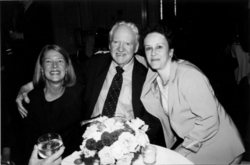
    Pat Strachan, currently of Little, Brown, and one of Bob Giroux's most illustrious mentees, Bob, and Helene Atwan, 2004

    A great deal has been written about Roger Straus by some very fine writers. He was far more outrageous and colorful than they let on. (His wonderful wife, Dorothea Straus, has never received the press she deserves, and her death last month passed without enough comment. No one who knew them will ever forget them.) But of all the giant figures in the industry, the most impressive to me was Bob Giroux, whose death this month leaves a gaping hole in the industry. His obituaries (in the New York Times, Washington Post, Huffington Post, and elsewhere) deserve to be studied, but they don't tell the whole story. I don't think I know anyone who worked with Mr. Giroux who didn't love him as much as they admired him. In addition to his considerable achievements as an editor, he was also a great mentor, an avid amateur Shakespeare scholar, and wonderful company. In my first weeks at Farrar, Straus and Giroux (and once I knew him I would never again abbreviate the firm's name by omitting his!), he invited me to lunch at his beloved Player's Club, where he took obvious relish in showing me around. The Booth room—the assassin's brother, of course—preserved lovingly, was a point of particular pride and pleasure. He enjoyed ordering our lunch—invariably awful in those days, watery soups and limp vegetables; pale, beaten down slabs of meat swimming in gray gravy—which he cheerfully consumed. He had a way of laughing—and he laughed a lot in good company—which made his distinguished face suddenly round and positively babyish. He took delight in things, and loved springing a surprise. One afternoon, he came striding down the hall out of his small, darkish office at the extreme end of the back hall to announce that he'd just received a new ms. from Walker Percy so we'd better add it to the next list. The catalogue, if memory serves, had to be called back from the printer. He loved good collections of letters—Flannery O'Connor's were often to him—and biographies. I hope to high heaven that someone will collect his letters and write a very long, detailed and juicy biography of Bob. Until then, we are very lucky to have the books he brought into the world, so many of them classics already, and for those lucky enough to have shared an overcooked meal or two with him, our fond memories.

  • Today’s blog post is from Eddee Daniel, author of Urban Wilderness: Exploring a Metropolitan Watershed, a new book just released by the Center for American Places at Columbia College Chicago and distributed by the University of Chicago Press. Eddee Daniel is an urban eco-explorer who has taught art and photography in the Milwaukee area since 1980. For more information about the project and additional excerpts go to www.eddeedaniel.com and click on Urban Wilderness. This post was adapted from the introduction to the book.

    19_tranquility_industrial_valley_mi
    What is "urban wilderness?" It is a paradox: the experience of the wild in the city. I recently completed a six-year voyage of discovery, not of untraveled locations—for at the turn of the millennium there are none left—but of my own vicinity. What I discovered was a rich and worthwhile experience of nature in the midst of urban and suburban development.

    I explored natural areas—and also other areas that lie along a continuum from wilderness to concrete—within my local watershed. This quest became The Urban Wilderness Project and was eventually adopted by a partnership of seven local Wisconsin environmental and community organizations.

    I wanted to raise awareness about fragile environmental systems within an urban setting and inspire people to protect and enjoy natural areas. I envisioned a new way of seeing the city, one that encourages people to leave pavement behind, to discover secret footpaths and dwell in the presence of wildlife. I found a wealth of natural resources in the metropolitan region and learned that urban living leads to a wide variety of contrasting realities. The Urban Wilderness Project promotes an understanding of watersheds and biodiversity. It also promotes the creation of a network of interconnected natural corridors along rivers and streams based on watersheds rather than political boundaries.

    (more…)

  • The literary world lost two vital voices last week: author David Foster Wallace and poet/poetry blogger Reginald Shepherd. Kottke has assembled a comprehensive links list for DFW memorials, although you could spend the day trolling through the thousands of blog posts reacting to his death. You can read Reginald Shepherd’s final poem, “God-With-Us,” on his blog, and remembrances on The Valve, Samizdat and elsewhere. Emily Warn at the Poetry Foundation (where he wrote for the Harriet blog this past year) shared his poem “You, Therefore,” which begins, “You are like me, you will die too, but not today.”

    Good Reading Elsewhere:

    Earlier this week, Danya Ruttenberg, author of Surprised by God, liveblogged a rabbinic conference call with Barack Obama. Read more about the call at the Jewish Journal.

    At YouthSportsParents, Mark Hyman posted some disturbing findings on the ethics of high school sports.

    Baggy pants are no longer illegal in Florida.

    A Kentucky court dealt a blow to gay families last week in ruling that second-parent adoptions are not permitted under state statutes. Read Nancy Polikoff’s reaction on her Beyond (Straight and Gay) Marriage blog.

    Recent Beacon Broadside Posts:

    Contraception Foes With Friends in High Places

    Sister Pact: A Bostonian Living in Europe Goes to Padua

    A Dad’s View of the Mommy Wars and Sarah Palin

    Professor’s Perspective: the Red Sox and the History of Racial Inequality

    Sarah Palin: No Friend to Children and Adults with Disabilities


  • Today's post is from Kathryn Joyce, author of Quiverfull: Inside the Christian Patriarchy Movement. Joyce received her B.A. from Hampshire College and her M.A. in cultural reporting and criticism from New York University. Her freelance writing has appeared in The Nation, Mother Jones, Newsweek, The Massachusetts Review, and other publications, and she is former managing editor of The Revealer, a daily review of religion and the media.

    QuiverfullNext Thursday, September 25th, is the cut-off date for public comments on the Department of Health and Human Services' proposed regulations concerning the expansion of the so-called "conscience clause" of the 2004 Weldon Amendment, which would ban federal funds from medical establishments that "discriminate" against health care providers or institutions by requiring them to participate in or provide referrals for abortion services – very broadly defined.  In an early draft of the regulations leaked in July, the HHS proposed that abortion, under its definition, included any procedure, action or drug "that results in the termination of the life of a human being in utero between conception and natural birth, whether before or after implantation." This follows an extremist antiabortion belief that some forms of contraception function as abortion by hypothetically preventing the implantation of a fertilized egg. By defining abortion to include any contraceptive that could prevent pregnancy by preventing implantation rather than fertilization – though it's virtually unknowable whether a particular contraceptive is functioning this way – the HHS broke with the American Medical Association's longstanding definition of pregnancy. Instead, the administration chose to side with a growing anticontraception religious movement, which only numbers in the tens of thousands but has an outsized influence in spreading its ideology through the growing support of churches and religious bodies.

    (more…)

  • Today's post is from Jay Wexler, whose first book, Holy Hullabaloos: A Road Trip to the Battlegrounds of the Church-State Wars, will be published by Beacon Press in Spring 2009. Wexler is Professor of Law at Boston University, where he teaches first amendment and environmental law. His website is www.jaywex.com.

    We had been living in Krakow for three months when I started feeling homesick for Boston. It's not that I don't like Krakow. As everyone knows, Krakow is the new Prague. It is blessed with magnificent architecture, a vibrant student population, and more beets than you can shake a stick at. But it just isn't Boston. Nobody honks a horn just to hear how loud it is. You can't find a bowl of clam chowder anywhere. And while plenty of drunk guys roam the streets, they generally aren't chanting "Yankees Suck."

    Citgosign_2 We didn't have time to cross the ocean, though, so we decided to seek out one of Boston's "sister cities" instead. The "sister city" concept was the brainchild of President Dwight Eisenhower, who wanted to encourage more Americans to travel abroad and cooperate with overseas friends. "The Sister Cities Program," according to the City of Boston website's sort-of incomprehensible description, "promotes world peace in an individual level and encourages citizens to better understand community." Cities can find "sisters" in all sorts of ways, including through a matchmaking service provided by an organization called Sister Cities International. Single, land-locked, authoritarian Central Asian capital seeks strategically located steel producing sister city for economic cooperation, militaristic conquest, and long walks on the beach.

    Boston has eight official sister cities, including Kyoto, Melbourne, and Sekondi-Takoradi, which is the capital of the Western Region of Ghana. The two closest sisters to us, though, were Padua, Italy ("Padova" to Italians) and Strasbourg, France, so we decided to pick one of these. I'm sure Strasbourg is plenty nice, but how could a French city be anything like Boston? Padua, on the other hand, now that had potential. Sometimes, like when Italy won the World Cup in 2006, it seems like half of Boston is Italian-American. And what Bostonian could ever forget the commercial from the early seventies where Anthony Martignetti runs home through the streets of the North End for Prince Spaghetti night? Want to guess who the Patron Saint of Padua is? That's right: St. Anthony. I booked our tickets and looked up how to say "wicked pissah" in Italian.

    (more…)

  • Kathryn Joyce (whose book Quiverfull: Inside the Christian Patriarchy Movement will be released by Beacon this winter) compares the candidacy of Sarah Palin to the biblical story of Esther.

    The student loan credit crunch may just be a “convenient” distraction for lenders who would like to keep attention away from predatory lending practices, says Alan Collinge, author of The Student Loan Scam.

    On Democracy Now!, David Bacon, author of Illegal People: How Globalization Creates Migration and Criminalizes Immigrants, discusses how aggressive tactics by Immigration and Customs Enforcement makes some undocumented immigrants too afraid to evacuate in the face of dangerous hurricanes.

    The state of Pennsylvania brings fresh, healthy food to underserved populations with a grant-funding program for locally-owned grocery stores in low-income communities.

    A special diet can help reduce cow methane emissions (which is to say “bovine flatulence”) and thus reduce the impact of cattle farming on global warming.

  • Today’s post is from Jeremy Adam Smith, senior editor of Greater Good magazine and author of The Daddy Shift , forthcoming from Beacon Press in Spring 2009. He blogs about the politics of parenting at Daddy Dialectic.

    When the Republican Party nominated Sarah Palin for Vice-President of the United States, they (inadvertently?) reignited the mommy wars, that alleged antagonism between working mothers and stay-at-home moms. But this round of the war is Vietnam, not World War II, for there is no front line and no one can tell friend from foe.

    Indeed, Palin is catching flak from both sides of the mommy wars.

    “She is the mother of five children, one of them a four-month-old with Down Syndrome,” writes Washington Post columnist Sally Quinn, a feminist and working mother. “Her first priority has to be her children. When the phone rings at three in the morning and one of her children is really sick what choice will she make?” Stay-at-home mommy bloggers agree: It’s “hard to believe that this country needs Sarah Palin more than her own children,” says the blog Suburban Turmoil.

    The not-so-covert assumption in these criticisms is that Todd Palin, who is now a stay-at-home dad, could not possibly serve as primary caregiver to his five children. It has to be the mom.

    But whenever I read criticisms of Palin for abandoning her family, I think of the Hoffman family (not their real names), whom I profile in my forthcoming Beacon Press book about reverse-traditional families.

    (more…)

  • Although Beacon Press is not strictly speaking an "academic publisher," Beacon’s books are frequently used in college and high school classrooms around the country. Today we share the perspective of one professor about why she chose Shut Out: A Story of Race and Baseball in Boston as a text for her students. Amy Bass, Ph.D., is an Associate Professor of History at the College of New Rochelle and is the author of
    Not the Triumph but the Struggle: the 1968 Olympic Games and the Making of the Black Athlete
    (University of Minnesota Press, 2002) and In the Game: Race, Identity, and Sports in the 20th Century (MacMillan, 2005).

    Cover of Shut Out by Howard Bryant So here’s my problem teaching cultural history: I am a devout and devoted, dedicated and dutiful, fan of the Boston Red Sox.

    There are many, many, many well known burdens in being a fan of Boston. Until recently, there was the whole "curse" thing. The year 1918, which could be mentioned for many historically important reasons (the flu epidemic, Exterminator’s unlikely win at the Kentucky Derby, the creation of Wilson’s Fourteen Points, etc.), haunted Boston fans until 2004. I was one of them. I endured.

    But perhaps the greatest burden is when I come to the story of Jackie Robinson on my syllabus. It’s a topic I address not just when I’m teaching my upper-division seminar entitled "Race, Sport, and Society." I also talk about Robinson at length in my U.S. history survey, "Reconstruction to Present," using his minor and major league debuts, and Branch Rickey’s push to make the Dodgers the team that would transform baseball’s color line, to describe what was going on in early postwar America to spur on the major civil rights movements that emerge in the 1950s and 1960s. It’s not sports history, I tell students; it’s history.

    But then comes that question. That terrible, terrible question. That question that is part of my burden: which team was the last to integrate?

    And here’s where Howard Bryant and his wonderful Shut Out: A Story of Race and Baseball in Boston come in.

    I used to answer that while the Red Sox were technically the last team to integrate, they had tried to integrate first by getting Robinson board, along with Marvin Williams and Sam Jethroe, as early as 1945. But then I read Bryant’s tremendously readable book, and I realized that the word tried was really the wrong one. Bryant’s startling telling of the tryout shut down my defense of Boston, and only heightened my understanding of why it wasn’t until 1959 that the Red Sox became the last – yes the absolute last – team to integrate, bringing up Elijah "Pumpsie" Green in 1959. By the time Green came on board, Robinson was retired, a fact that makes the "Curse of the Bambino" seem like a story used, as so many are in American history, to overshadow the very real and devastating effects of racism.

    Howard Bryant’s book isn’t just about baseball. And it isn’t just about sports. It’s about history – American history – and should be read by anyone interested in it.

    If you are a professor and are interested in learning more about Beacon Press titles, visit the "For Educators" links on the Beacon Press website. If you have used a Beacon title in your course, Beacon Broadside would like to hear your story, either in the comments stream below or in an email to the editor.