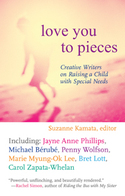
• Today’s post is from Jane Bernstein, the author of five books, most recently Rachel in the World, a memoir of raising her developmentally disabled daughter. Her essay "Rachel at Work: Enclosed, a Mother’s Report" was included in I Love You to Pieces: Creative Writers on Raising a Child With Special Needs, edited by Suzanne Kamata. Bernstein is a professor of English and creative writing at Carnegie Mellon University and lives in Pittsburgh, PA.
    Kamata As the mother of a young adult with mental retardation, nothing should make me happier than a candidate for vice president vowing that my daughter would at last have a "friend and advocate in the White House." Instead, I find myself more concerned than ever about the fate of children and adults with disabilities.

    As most of us know by now, Sarah Palin’s fifth child has Down Syndrome. When Palin learned through genetic testing that her unborn baby would likely "face special challenges," she confessed that she "initially felt sad" but now that he was four months old felt "truly blessed."

    Of course she loves her infant son. He’s an adorable little boy. It’s hard to find parents who don’t love their newborns –- even when we learn that our babies have disabilities. While for most of us, the grief we feel after hearing that our babies are less than perfect doesn’t abate as quickly as it did for Palin, it hardly matters, because when our tears dry, as eventually they do, what’s left is love and commitment.

    (more…)

  • Today’s post is from Rita Nakashima Brock, co-author, with Rebecca Ann Parker, of Saving Paradise: How Christianity Traded Love of This World for Crucifixion and Empire. Rev. Brock is Founding Co-Director of Faith Voices for the Common Good, an organization dedicated to educating the public about the values and concerns of religious leaders and organizations. You can read more about Saving Paradise and see color plates of the art discussed in the book at SavingParadise.net. 

    Savingparadise For many, Barack Obama’s birthplace, Hawaii, is the closest thing to paradise on earth. In fact, however, a perverted search for paradise led Western Europeans to conquer and colonize both North America and Hawaii. Unlike the colonizers of the last five hundred years, early Christians believed that the whole earth, including where they already lived, was the earthly paradise. They understood that empires and other powers sought to destroy it and that paradise was a place of struggle against those powers. They saw their responsibility as working to create just and loving communities wherever they lived.

    Hawaii has a long history of injustices and poverty, especially among native Hawaiians, but because it was remote from the mainland, it developed a different society that is more racially mixed. This history of Hawaiian interracial politics, though not perfect, has been far ahead of the U.S. mainline in equality of diverse races. It is a harbinger of how the rest of the United States will become in the second half of this new century, when there will be no racial majority and a lot of mixity.

    In Hawaii’s mixed brown majority, Barack Obama’s white mother was the minority person. He did not have the black minority experience of the mainland until he had already been immersed in a Hawaiian identity. He struggled to find an identity throughout his young adult life, of course. He does not, however, carry the burdens of suspicion of whites that affects so many of us raised on the mainland. His African father was from Kenya, and his ancestors were not subjected to slavery and segregation.

    (more…)

  • Today's post is from Frederick S. Lane, author of The Court and the Cross: The Religious Right's Crusade to Reshape the Supreme Court. Lane is an expert witness, lecturer, and author who has appeared on The Daily Show with Jon Stewart, CNN, NBC, ABC, CBS, the BBC, and MSNBC. His next book will be People in Glass Houses: American Law, Technology, and the Right to Privacy (Beacon 2009). For additional information, please visit www.FrederickLane.com.

    LaneFour and a half years ago, during the halftime show for the 2004 Super Bowl, Justin Timberlake and Janet Jackson set off a heated national debate about televised decency when Timberlake pulled off part of Jackson's bustier and revealed her right breast.

    The global exposure of Jackson's breast was remarkably brief — roughly half a second — but more than long enough to send the nation's moral watchdogs into orbit. The following morning, Federal Communications Chairman Michael Powell (the son of former Secretary of State Colin Powell) made the rounds of the morning television talk shows and promised a swift and thorough governmental investigation. The Timberlake/Jackson "flash dance" proved to be a political boon for many in Washington: the controversy enabled Chairman Powell to divert attention from his failed and much-criticized efforts to promote media consolidation, and the FCC's new-found willingness to punish indecency was a boost for President Bush's re-election campaign. Much more detail on the political fall-out of the half-time show is available in the opening chapter of my 2006 book, The Decency Wars: The Campaign to Cleanse American Culture (Prometheus Books 2006).

    (more…)

  • Amy Goodman and two producers of Democracy Now! (Sharif Abdel Kouddous and Nicole Salazar) were arrested yesterday in St. Paul while covering the Republican National Convention for the show. All three have been released, but the video of Goodman’s arrest and reports of the rough treatment of Kouddous and Salazar are disturbing. Goodman served as moderator of Beacon’s panel on the Pentagon Papers, and she contributed to Global Values 101: A Short Course and the foreword to Jennifer Harbury’s Truth, Torture and the American Way. The SF Gate spoke with Goodman after her release.

    Carole Joffe (who has posted at Beacon Broadside about reproductive rights issues) joins Gloria Feldt in asking John McCain for some answers on the role of women in the workplace, health care for children, and his change in position on abortion rights.

    Obsessed with the polls? David Moore, author of
    The Opinion Makers: An Insider Exposes the Truth Behind the Polls
    , reveals a truth that many pollsters downplay: most voters still haven’t made up their minds and won’t until much closer to the election.

    Acts of Faith: The Story of an American Muslim, the Struggle for the Soul of a Generation by Eboo Patel is a finalist for the 2008 Dayton Literary Peace Prize. Other finalists include The Brief and Wondrous Life of Oscar Wao by Junot Díaz (Penguin), The Ocean in the Closet by Yuko Taniguchi (Coffee House Press), and Song for Night by Chris Abani (Akashic Press). Previous award winners include Elie Weisel, Studs Terkel, and Francine Prose.

    Via Librarian.net, as mayor of Wasilla, Alaska, Sarah Palin apparently approached her town’s library to find out how she could go about banning books.

    Linda Lenz, founder and publisher of Catalyst Chicago, an educational magazine, defends Barack Obama’s association with Bill Ayers by defending Ayers’ record as an education reformer.

    Student Loan Scam: The Most Oppressive Debt in U.S. History—and How We Can Fight Back by Alan Michael Collinge will be released by Beacon this February. The New York Times
    recently talked with Collinge, the self-described “complaint box” for the student loan industry.

    A man was ejected from Yankee Stadium for not showing adequate respect to Kate Smith and Irving Berlin.

    A new website for Saving Paradise: How Christianity Traded Love of This World for Crucifixion and Empire is up and running, and includes beautiful color plates of images discussed in the book.

  • Today’s post is from Sherrilyn Ifill, author of On the Courthouse Lawn: Confronting the Legacy of Lynching in the Twenty-first Century. Ifill is a professor at the University of Maryland School of Law. She is also a civil rights lawyer and a regular speaker on race, public policy, and law. She blogs regularly at BlackProf.com, where a version of this post originally appeared. 

    Ifill
    Sometimes, you just can’t be cynical. Sometimes – even though you know that we still have a long way to go, that the work of achieving a racially just society is far from over, even though you don’t subscribe to the messianic fervor that sometimes surrounds talk of about this presidential campaign – sometimes you just have to stop for a moment, and acknowledge the extraordinariness of this moment in American history.

    Sometimes, as the old spiritual goes, "my soul looks back and wonders, how I got over." And so I’m taking a moment to reflect on an event that I wished my father had lived to see. I’ve watched conventions since 1968. I consider myself politically savvy, intellectually gifted, skeptical and pragmatic. But when Michelle Obama and her daughters were standing up on that stage with fresh perms, looking like my sister and her daughters, and when Barack Obama was nominated to be the presidential candidate for the Democratic Party by acclamation Wednesday night, I got a little emotional.

    Unlike so many others, I’m not thinking so much about 1963 and King’s "I Have a Dream" speech today. Instead, today I’m thinking about 1964. Forty-four years ago, the Democratic Party refused to seat that great voting rights activist, leader and former sharecropper Fannie Lou Hamer on the floor of the convention.

    (more…)

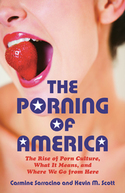
  • Today’s post, which we hope makes it through your spam filter, is from Carmine Sarracino, co-author of The Porning of America: The Rise of Porn Culture, What It Means, and Where We Go from Here.  Sarracino is a professor of English and the author of three books of poetry. He has also published widely on Walt Whitman and was twice a Fulbright Scholar.

    Prningofamerica I spent the better part of academic year 1989-90 in Kathmandu, Nepal, on a Fulbright research grant. My project was to explore connections between the poetry of Walt Whitman and ancient Vedic literature, especially on the topic of consciousness. I also agreed to supervise the doctoral dissertations of several students at Tribhuvan University, one of which was entitled, "Walt Whitman as a Tantrika Yogi."

    Fascinating.

    I knew little about tantra, which was then just beginning its faddish popularity in the United States, but I felt okay about supervising the dissertation. After all, Whitman’s sexuality—his own personal sexuality as well as his views of human sexuality—was so enormous and complexly layered a subject as to invite a myriad of approaches— the more unconventional the better. And I was in the perfect spot to learn about tantra, since many scholars regard Nepal as its historical home. So, working on the dissertation should be interesting.

    Indeed, I came to see Whitman in a revealing new light. But beyond that, what I learned about tantra was often on my mind fifteen years later when my co-author, Kevin Scott, and I began work on The Porning of America. As we studied definitions of pornography, distinctions between porn and erotica, and so on, it became clear that porn in America has its roots in Puritanism. And that tantra provided an example of a completely different—and much healthier—orientation toward sexuality. The porn websites we surfed could have been written by characters right out of Hawthorne. Sex is "filthy," "nasty," "dirty." The women are "sluts," and "whores." Puritanism and porn share the same view of the human body and sexuality. The only difference is that porn transgressively revels in what the Puritans righteously ran away from.

    (more…)

  • Nancy Mairs is a poet and essayist whose work includes A Dynamic God: Living an Unconventional Catholic Faith, Waist-High in the World: A Life Among the Nondisabled, and Ordinary Time: Cycles in Marriage, Faith, and Renewal. She recently received the 2008 Arizona Literary Treasure Award, which prompted this essay. She lives in Tucson with her husband, George.

    Dynamicgod "It is my pleasure to tell you," the letter began, "that the Arizona Humanities Council will be awarding you the 2008 Arizona Literary Treasure Award this year." After a second reading, I decided that this was not a form letter (for all I knew there could be a whole chest of treasures out there) or a hoax. Although the name might sound a little silly ("Gee, it sounds like you should be dead," a friend remarked), I was delighted to have my work singled out for such recognition. I took years to call myself a writer—it sounded so pretentious—and then more years to stop thinking of myself as a Boston poet and start identifying myself as a southwestern writer, and now the Southwest has embraced me. This is not a trajectory I could ever have conceived 35 years ago when I arrived, husband and two little children in tow, to spend a couple of years earning an MFA in creative writing at the University of Arizona. I can no longer recall the visions and ambitions of that young woman. One of the features of getting old, I find, is that I look back time after time and ask myself how the heck I got here.

    I am most commonly asked, when I speak with writing students, "How do I get published?" and the only answer I can come up with is, "Beats me." I’m not being facetious with this less than helpful response. But when I look back, I see my writing life as a series of (mostly happy) accidents. I was 40 when my first full-length book was published, and that was by happenstance. The Western States Book Award had just been founded, and Jim Hepworth, the director of what became Confluence Press, asked if he could enter a collection of my essays. I wasn’t yet thinking in terms of a book, but I’d written ten essays by this time, which I happily gave to Jim and, since there wasn’t any entry fee, I asked whether he would submit a manuscript of my poetry as well. Politely, though unenthusiastically, he agreed.

    (more…)

  • Today’s post is from Chris Mercogliano, author of In Defense of Childhood: Protecting Kids’ Inner Wildness. He has been a teacher at the Albany Free School since 1973 and co-director since 1985. His writing has appeared in numerous publications, and he is also the author of Making It Up As We Go Along, and Teaching the Restless: One School’s Remarkable No-Ritalin Approach to Helping Children Learn and Succeed.

    Restless Michael Phelps didn’t need drugs to ‘fly into Olympic history. And at the tender age of 11 he decided he didn’t need them to negotiate his way through school.

    Growing up in what by several accounts was an authoritarian household—his father was a state trooper and in an interview in the New York Times
    his mother describes herself as "stern"—Michael was diagnosed ADHD at age 9. His parents’ on- again, off-again relationship had finally ended in divorce two years earlier, and his teachers had been complaining since kindergarten that he was restless, talkative, and easily distracted in class. These, of course, are all classic "symptoms" of a supposedly genetic neurochemical imbalance in the brain, and so a pediatrician suggested to Michael’s mom that she put him on Ritalin.

    According to Mrs. Phelps, Ritalin marginally improved her son’s school performance and dulled him into peacefully doing the minimum on his nightly homework assignments. But he felt stigmatized by having to go to the nurse’s office at lunchtime to swallow a pill every day, and after two years Michael pleaded to be taken off the drug. "I don’t want to do this anymore, Mom. My buddies don’t do it. I can do this on my own." Fortunately for Michael, his mother believed in him deeply and so she listened.

    (more…)

  • “To understand military sexual assault, let alone know how to stop it, we must focus on the perpetrators.” Helen Benedict on why soldiers rape.

    “To us sofa slouchers, these teen Olympians are heroes. But they have the nation’s pediatricians on edge.” A Baltimore Sun op-ed by Mark Hyman about young athletes. Also check out Hyman answering questions about how to be a good sports parent.

    “I awoke still weeping, my first real tears for him – and for me, his jailor, his judge, his son.” Kelley Bulkeley, author of American Dreamers, analyzes the dreams of Barack Obama.

    “[T]he artist’s weapons are cleaning materials and … the enemy is the elements: wind, rain, pollution and decay.” The Environmental Graffiti blog, in a convergence of title and topic.

    “They’re being asked now to tighten their belts, and there simply aren’t any notches left, so that I think what we’re going to see is people going into a huge amount of debt.” Nan Mooney, author of Not Keeping Up With Our Parents, on NewsHour (available in transcript, audio or video).

    “At the nation’s extreme western edge, sitting over 2500 miles from the U.S. mainland, Kauians are as vulnerable to high food and energy costs as a people can be.” At the Slow Food Nation blog, Mark Winne highlights the special challenges faced by a Hawaiian food bank.

    “There’s historical truth, which I don’t discount at all, and there is, co-existing with it, a deeper truth about what it is to be a person and what it is to live your life in alignment with the sacred.” Danya Ruttenberg, author of Surprised by God, at the Cultural Criticism and Beauty Tips blog.

    Related Beacon Broadside posts:

    Helen Benedict on female veterans.

    Mark Hyman talking about Debbie Phelps, mother of Michael Phelps, the greatest Olympian in history.

    Kelly Bulkeley telling Americans to get more sleep, and dissecting dreams of the presidential candidates (posts one and two).

    Nan Mooney discussing how economic equality is hurting the middle class.

    Mark Winne about high food prices and the food gap between the rich and the impoverished.

  • Today’s post is from Matt Kailey, the author of Just Add Hormones: An Insider’s Guide the Transsexual Experience (Beacon Press, 2005), the editor of Focus on the Fabulous: Colorado GLBT Voices (Johnson Books, 2007), and the managing editor of Out Front Colorado, Colorado’s oldest and largest GLBT publication.

    Artkrieger_2
    The online teaser was intriguing: ‘"Human monsters" a reality.’ Having lived through the first few years of the 21st century, I wholeheartedly agreed. But when I clicked on the link, I discovered that it led not to a story about current political figures, but to a CNN article about an ’80s Olympic athlete who was unknowingly given steroids by her coaches in order to enhance her performance.

    East German shot putter Heidi Krieger thought she was taking vitamins, but later discovered, as her body began to masculinize, that she was being given the anabolic steroid Oral-Turinabol, a drug that, according to the article, "changed a woman into a man." As Krieger continued on the steroids, she noted changes not only in her physical appearance, but also in her feelings.

    "I felt much more attracted to women and just felt like a man. But I knew I was not (a) lesbian," Krieger told CNN.

    Good thinking, because lesbians don’t feel like men. But I digress.

    In 1997, Krieger had a "sex-change operation" and became Andreas Krieger. Details of this particular "operation" were not made public, and I would like to know more, because I find it fascinating that there is one magical "sex-change operation" that will do the trick. But I digress. Krieger is now married and runs an army surplus store. He says he does not want to be seen as a victim, but he presents himself as quite unhappy with his situation and with the circumstances surrounding his "sex-change operation."

    (more…)