• Today’s post is from Stephen Burt, author of The Forms of Youth: Twentieth-Century Poetry and Adolescence (Columbia University Press). His essays and articles on modern and contemporary poetry have appeared
    in many journals in America, Britain, and elsewhere, among them American Literary History, Boston Review, London Review of Books, the New York Times Book Review, the Times Literary Supplement, and the Yale Review. Burt is an Associate Professor of English at Harvard University. 
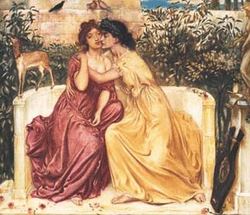
    Sapphoerinna_3
    There have been gay poets—or, at least (if you prefer historical accuracy) poets who presented same-sex erotic passion—for as long as poetry has been written down; maybe longer. Think of Sappho, whose name has referred for centuries both to the idea of eros between women and to the ancient idea of lyric itself: think of what may be her single most famous poem, "He seems to me equal to a god, that man/ Who sits beside you," its first sentence a feint towards opposite-sex desire, its substance an homage to the young woman Sappho loves. Shakespeare’s sonnets, most of them addressed to a comely young man, have inspired centuries of arguments about his erotic investment in, "the master-mistress of my passion." Walt Whitman insisted that he wrote for, and about, both women and men, but what records there are tell us that he loved men; he put his poems about same-sex love ("adhesiveness," as he called it) in a discrete segment of his lifework, Leaves of Grass, entitled "Calamus" (after the phallic plant of the same name): Whitman inspired what later became gay movements as his poetry circulated internationally—in England, Edward Carpenter and J. A. Symonds thought they had found in his work a model for gay Utopia. Federico Garcia Lorca’s "Ode to Walt Whitman" called together, under Whitman’s name, the stigmatized homosexual men of the Old and New World, trying to wring new lives from their frequent self-hate.

    (more…)

  • Today’s post is from Eboo Patel, author of Acts of Faith: The Story of an American Muslim, the Struggle for the Soul of a Generation. Patel is the founder and executive director of the Interfaith Youth Core, an international nonprofit building the interfaith youth movement. This post originally appeared at On Faith, the Washington/Post Newsweek forum on religion.

    Patel I chuckled to myself wondering what William F. Buckley, the author of the landmark conservative tract God and Man at Yale, might have thought of this year’s Baccalaureate Service at Dartmouth College. In addition to Christian hymns and Bible readings, there was a Native American prayer offered in the Yuchi language, and recitations from the Hindu and Buddhist traditions.

    The main speaker – yours truly – was a Muslim.

    One theme of Buckley’s classic work is that God should be at the center of people’s intellectual journeys, and therefore should play a far more significant role on campus. And when Buckley spoke of God at Yale, he meant the Christian idea of God. (According to a recent New Yorker piece by George Packer, Buckley refused to promote David Brooks – now at The New York Times – past a certain stage at his National Review because he was not a "believing Christian".)

    Buckley would be happy to know that religion is once again being taken seriously on college campuses, but one of the reasons is because of the diversity of traditions present. Jews, Catholics and Protestants have had an institutional presence on campuses for many years, and colleges (including Wellesley, Duke, Princeton, Brown and Georgetown) are increasingly hiring Muslim chaplains to minister to the growing numbers of Muslim students on campus. Dartmouth has all of the above, plus the first ZaZen Chaplain I’ve ever met on a college campus.

    (more…)

  • Today’s post is from Matt Kailey, the author of Just Add Hormones: An Insider’s Guide the Transsexual Experience (Beacon Press, 2005), the editor of Focus on the Fabulous: Colorado GLBT Voices (Johnson Books, 2007), and the managing editor of Out Front Colorado, Colorado’s oldest and largest GLBT publication.

    Kailey
    Trans people aren’t broken. We aren’t looking to be "fixed," and we have no need of a repairman. We have spent decades trying to convince the Western world of this, and forgive us if some in our ranks were starting to feel a little optimistic about our progress – until, maybe, now.

    Just when we thought that an end to the tinkering around with our brains might be in sight – at least for those who are very far sighted – along comes a repairman in the form of Dr. Kenneth Zucker, a non-transman who, like so many before him, thinks he knows what’s better for us than we do. Dr. Zucker thinks he can "fix" us – whether we want him to or not.

    Now Dr. Zucker might be merely an annoying interruption in our otherwise peaceful day – some scam artist who knocks on our door and tells us that our roof or our driveway or our air conditioning is in disrepair and that he can fix it for cheap – and we could easily tell him that we have our own service, thank you very much, and close the door in his face. Unfortunately, in this case, there’s one small catch – Dr. Kenneth Zucker has been appointed by the American Psychiatric Association to serve as the chair for the Sexual and Gender Identities Disorder task force that reviews the new version of the DSM – the Diagnostic and Statistical Manual that is used by psychiatrists, psychologists, and therapists to diagnose mental illness. And, in this regard, Dr. Zucker is no mere annoyance knocking on our door. He is a very dangerous man – and not just to trans people.

    (more…)

  • On June 19, 1865 Union soldiers arrived in Galveston, Texas and let people know that the Civil War had ended and the enslaved were free. This news—and the Union soldiers necessary to enforce the law—made it to Galveston two and a half years after Lincoln’s Emancipation Proclamation took effect. "Juneteenth" became celebrated within black communities in Texas and across the United States as the African American day of independence. Juneteenth became an official Texas state holiday in 1980.

    While there won’t likely be significant coverage by mainstream media outlets about Juneteenth, there will be at least one exception. The Early Show on CBS will take note of Juneteenth and include an interview with Thomas N. DeWolf, author of Inheriting the Trade: A Northern Family Confronts Its Legacy as the Largest Slave-Trading Dynasty in U.S. History  (published by Beacon Press), and his cousin Katrina Browne, producer/director of  the film of their family’s journey, Traces of the Trade: A Story from the Deep North  which will be broadcast on PBS’s acclaimed documentary series P.O.V. on June 24 (check your local listings). DeWolf has posted on Beacon Broadside about the historic significance of the 2008 Presidential campaign, attending the Sundance Film Festival with Browne and other family members in support of Traces of the Trade, and  200th anniversary of  the abolition of the slave trade. You can also find him at http://inheritingthetrade.com/blog/.

    The New York Times Magazine this past weekend ran a cover story about shared parenting: When Mom and Dad Share it All. As the title implies, the article focuses on families with two opposite-sex parents, but refers to the different challenges same-sex parents face in dividing care, and quotes Harlyn Aizley’s book Confessions of the Other Mother: Nonbiological Lesbian Moms Tell All. Aizley is a regular contributor at Beacon Broadside: read her latest post, "Pride Shalom."

    Jeremy Adam Smith links to the Times article and many other great posts in his definitive Father’s Day Media Roundup. (I know, a link roundup linking to a link roundup? This is the rabbit hole that is Web 2.0.)

    Fred Pearce asks, "If biofuels are so bad, why aren’t we campaigning against cotton?"

    Nan at the blog Letters From a Hill Farm is so enamored of Suzanne Strempek Shea’s Sundays in America, she’s savoring it and reading a chapter a week, then posting her impressions here. If you want a sample of Shea’s journeys, be sure to check out her blog posts on Barack Obama’s former church and Christmas Eve in Bethlehem.

    And lastly, have you had your nap today? The Boston Globe has a handy guide on How to Nap.

    (more…)

  • Today’s post is from Nancy Polikoff, author of Beyond (Straight and Gay) Marriage, and a Professor of Law at
    American University Washington College of Law. Polikoff teaches
    Sexuality and the Law and has taught Family Law for more than 20 years. She posts regularly about LGBT family issues at the Bilerico Project and at her blog.

    PolikoffQuestion: When will a right-wing, anti-gay legal group help out a lesbian mother? Answer to follow.

    Lesbian couples raising children in the suburbs of my city, Washington, DC, got a one-two punch in the last three weeks. First the Maryland Court of Appeals ruled that when only one member of the couple had adopted the child they were both parenting, and then the couple split up, that the child had only one mother….and that mother can decide whether to maintain or stop contact between the child and the other mother. Since 2000, Maryland courts had been awarding visitation rights in this situation. Not anymore:the highest court in the state said there’s no such thing as a “de facto” parent with rights to continue a relationship with a child she has raised.

    Last week, while the Virginia State Supreme Court handed down a ruling that on the surface seemed to support gay parents, an appeals court in that state ruled in a way similar to the Maryland court Lots of people heard about the Miller-Jenkins case, which was a cover story in the Washington Post Magazine. In that case, the biological mom (Lisa) moved from Vermont to Virginia with the child, renounced her lesbianism, obtained representation from the right-wing, anti-gay Liberty Counsel, and argued that the state’s version of the Defense of Marriage Act meant the courts should not enforce a Vermont order giving the non-bio mom (Janet) visitation rights. Earlier this month, the Virginia Supreme Court ruled in Janet’s favor, prompting glee among gay parents everywhere – including in the blogosphere.

    But that case was decided on a technical issue; the Virginia court agreed that the Vermont court had jurisdiction to rule in the case and therefore under both state and federal law Virginia had to respect Vermont’s order.

    (more…)

  • Yale Environment 360, a new online magazine from the Yale School of Forestry and Environmental studies, launched last week. Among the stellar commentary from leading voices in the environmental movement is Beacon’s own Fred Pearce, whose piece “Water Scarcity: The Real Food Crisis” ties the growing food crisis to water overconsumption (the article was also picked up by Alternet). While you’re at E360, be sure to read Elizabeth Kolbert’s environmental plan for the next President and Bill McKibben’s sobering article about levels of carbon dioxide in the atmosphere.

    Big Think asked Howard Zinn ten questions about American history, democracy, race, and philosophy. Links to his answers are collected at HowardZinn.org.

    Frederick Lane, whose most recent post on this blog concerned John McCain’s attention to the Religious Right, has been hitting the airwaves in support of his new book, The Court and the Cross: The Religious Right’s Crusade to Reshape the Supreme Court. Listen to his appearance on Equal Time for Freethought or tune in next Monday (or subscribe to the podcast) to Culture Shocks with Barry Lynn, and you can also read an excerpt of The Court and the Cross at Talk2Action.

    Also for your listening pleasure, To the Best of Our Knowledge recently featured David Gessner in an episode of Nature Stories, discussing his Green Manifesto we recently excerpted here. He’s about thirty minutes in, but you might also enjoy the story about David Rothenberg’s clarinet duets with whales.

    Making summer travel plans? Here are the top tourist spots American’s can’t visit (via kottke.org).

    Nancy Polikoff, author of Beyond (Straight and Gay) Marriage, blogged last week at the Bilerico Project about protecting children of LGBT families. At the Oxford University Press blog, Edward Zelinsky discusses the desirability of abolishing civil marriage altogether.

    With all the press about our America’s first black Presidential nominee, you might think that the days of Jim Crow are far behind us at last. Well, this Mississippi High School just held its first integrated prom.

  • June is Pride Month, and Beacon Press will feature posts throughout the month about Pride in the LGBT community. Today’s post is by Harlyn Aizley. Aizley edited Confessions of the Other Mother: Nonbiological Lesbian Moms Tell All!  and is the author of Buying Dad: One Woman’s Search for the Perfect Sperm Donor.

    Aizley The season of GLBT Pride is like the Shabbat of gayness except for the "day of rest" part, which might mean it’s more like Christmas – lord knows there’ll be at least a few kings walking around.  But everything is always compared with Christmas and hardly ever is anything compared to Shabbat.  So yes, Happy Pride, Shabbat Shalom! 

    Pride month is a chance to pay respect to our brothers and sisters who have worked all year to secure the rights of GLBT folk everywhere: by campaigning, organizing, marrying, or joining the PTA as same-sex parents.  It’s an opportunity to reflect upon the past year and all that was accomplished in the name of GLBT equality and all that needs still to be done.  Most of all it’s a chance to celebrate with beads, bikinis, and martinis. 

    In the spirit of Pride I thought I’d share the top ten things this lesbian mom is proud of in 2008:

    (more…)

  • Today’s post is from Thomas N. DeWolf, author of Inheriting the Trade: A Northern Family Confronts Its Legacy as the Largest Slave-Trading Dynasty in U.S. History published by Beacon Press. The film of his family’s journey, Traces of the Trade: A Story from the Deep North will be broadcast on PBS’s acclaimed documentary series P.O.V.  on June 24 (check local listings). Tom and his cousin, filmmaker Katrina Browne, will be interviewed on CBS’s The Early Show on Juneteenth (June 19).

    Dewolf Oregon—where I live—held its primary election on May 20. For the first time since I moved here for college in 1972, the primary actually meant something to the presidential contest. Always in the past our primary is so late in the game that the presidential candidates for both parties have already been crowned. This exceedingly white state handed a man of color an 18-point margin of victory over a woman. That same day, far across the country in Kentucky, voters there handed that same woman a 35-point victory over the man of color.

    Also that day I received an article in the mail from my father about Jackie Robinson who, while serving in the army, stationed in Texas, was court-martialed for refusing to move to the back of a bus in 1944. At UCLA a few years earlier Robinson was the first athlete to earn varsity letters in four sports (football, basketball, baseball, and track). When he enlisted in the army it was with great fanfare. Many historians believe that Robinson’s trial and acquittal had a strong impact on President Harry Truman and led to his integrating the military in 1948.

    Robinson first donned a Dodger uniform and trotted onto the field on April 15, 1947. Two reasons my father and I share a strong interest in Jackie Robinson are, first, we’re life-long Dodger fans, and second, I was born seven years to the day after Jackie’s first Dodger game.

    (more…)

  • Today’s post is from Mark Winne, the author of Closing the Food Gap: Resetting the Table in the Land of Plenty. For 25 years Winne was the Executive Director of the Hartford Food System, a private non-profit agency that works on food and hunger issues in the Hartford, Connecticut area. Some of his essays and opinion pieces have appeared in the Washington Post, The Nation, Hartford Courant, Boston Globe, and In These Times. His website is www.markwinne.com.

    Winne
    The current spate of alarming farm and food stories – drought, rising food prices and shortages – has riveted our attention on the precarious state of our food system. As a nation that has become accustomed, at least for the past generation or two, to an abundant supply of affordable food, the daily accounts of everything from food riots to soaring egg prices have brought us up short.

    For some, these events may mean that those weekly strolls down the tastefully lit aisles of Whole Foods now become monthly. For those who have naturally spurned such discount pariahs as Wal-Mart, second thoughts may be in order.

    But for another class of American shoppers, rising food prices, whether organic or conventional, are just another bump in the road on an already trying journey. I’m speaking of low-income families, and increasingly low-to-middle income families who now find themselves treading closer to the lower end of the income spectrum.

    (more…)

  • Today’s post is from Suzanne Kamata, editor of
    Love You to Pieces: Creative Writers on Raising a Child with Special Needs. Kamata is fiction editor at the online magazine Literary Mama, and her work has appeared in Utne Reader; Brain, Child; Literary Mama; and It’s a Girl: Women Writers on Raising Daughters. Her novel Losing Kei was published earlier this year by Leapfrog Press.

    Kamata I’m the kind of person who looks to literature to make sense of life, so when I learned that my daughter was deaf and had cerebral palsy, I sobbed for a while and then I logged onto Amazon.com. I was looking for deep and sustaining stories to guide me on the long path ahead, and while I found many cheery volumes offering hope and inspiration, that wasn’t exactly what I wanted. I needed to know that others had felt the same kind of pain, fear, and anger that I was feeling, and I wanted a better idea of how my daughter’s disability would affect my marriage, my son, my work, and other aspects of our lives. The best novels, short stories, and memoirs can pull us into the lives of their characters and provide a deeper understanding of others, while poetry can distill and illuminate moments that longer essays gloss over.

    I didn’t find as many books as I’d hoped, and I wondered why. According to the March of Dimes Global Report on Birth Defects, every year 8 million babies worldwide are born with genetic birth defects. Hundreds of thousands more are born with serious birth defects of post-conception origin. So where were all the novels about parenting a child with cerebral palsy? Or a deaf child? Or one with muscular dystrophy or Down syndrome? Could it be that those in the trenches were too busy to write? After all, parenting a child with disabilities takes a lot of time – a lifetime. Some of us have to help our children move from room to room, from wheelchair to toilet, from house to hospital or therapy center. Some of our children cannot be left alone, or cannot live unsupervised even as adults.

    (more…)