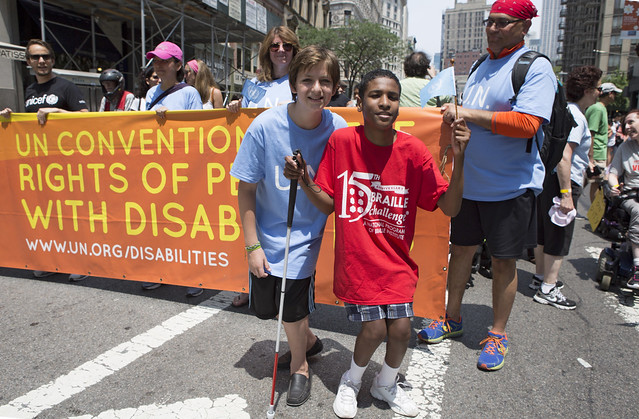
• Third Annual NYC Disability Pride Parade. Photo credit: New York City Department of Transportation

    Third Annual NYC Disability Pride Parade, 2017. Photo credit: New York City Department of Transportation

    A little over half a century ago, zero federal laws made it illegal to discriminate against disabled people. Today’s accessibility accommodations in buildings and services were nonexistent. We have disability rights activist and supreme badass Judy Heumann to thank for sparking a national movement for the protection of disabled peoples’ rights that led to the creation of the Americans with Disabilities Act. And it benefits everyone. Take it from Heumann on her Daily Show interview: nondisabled people enjoy many accommodations originally made for disabled people without realizing those luxuries are there.

    It would be complacent to assume that everyone has access to what they need. Because the pandemic swooped in and reminded us with a quickness that quality of life for all disabled Americans is not a given. Just last month, a quadriplegic father in Houston, TX, was left to die of illnesses related to coronavirus because the hospital decided he would not benefit from further treatment. The 2020 elections are coming up, and many voters with disabilities still face barriers with accessibility to the voting system. Reading the below selected titles on disability stories and disability resistance from our catalog, you will see that the fight for disability rights is far from over.


    Being Heumann

    Being Heumann: An Unrepentant Memoir of a Disability Rights Activist
    Judith Heumann with Kristen Joiner

    “Judy’s story has shaken me to the core. For the first time, I see myself in someone else. Her fierce advocacy and work changing the laws around disability rights have undeniably paved the way for me to achieve what I have today. . . . A must-read.”
    —Ali Stroker, Tony Award–winning actress


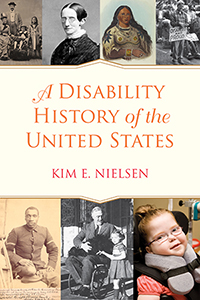
    A Disability History of the United States

    A Disability History of the United States
    Kim E. Nielsen

    “A wonderful, beautifully written, remarkable achievement that will certainly become a classic within the field and should become standard reading.”
    —Michael A. Rembis, Director, Center for Disability Studies, University at Buffalo


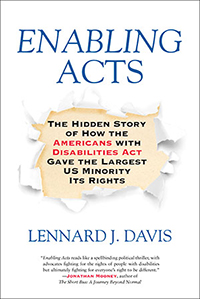
    Enabling Acts

    Enabling Acts: The Hidden Story of How the Americans with Disabilities Act Gave the Largest US Minority Its Rights
    Lennard J. Davis

    “Davis’ page-turning account puts the reader on the ground along chanting disability rights advocates and behind closed doors within the walls of Washington. An important and outstanding contribution.”
    —I. King Jordan, first deaf president of Gallaudet University


    Entwined

    Entwined: Sisters and Secrets in the Silent World of Artist Judith Scott
    Joyce Wallace Scott

    “Joining the worlds of outsider art and disability with startling emotional depth, Joyce Scott takes the reader on a powerful journey of loss, longing, family, false starts, resilience—and ultimately—love.”
    —James W. Trent Jr., author of Inventing the Feeble Mind


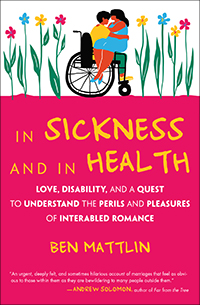
    In Sickness and In Health

    In Sickness and In Health: Love, Disability, and a Quest to Understand the Perils and Pleasures of Interabled Romance
    Ben Mattlin

    “An urgent, deeply felt, and sometimes hilarious account of marriages that feel as obvious to those within them as they are bewildering to many people outside them. Mattlin gives us a testament to the deep humanity that can manifest in any kind of body, and to the passionate love such humanity can provoke in others.”
    —Andrew Solomon, author of Far from the Tree


    Life As Jamie Knows It

    Life As Jamie Knows It: An Exceptional Child Grows Up
    Michael Bérubé

    “In this poignant and genuine collaboration between father and son, Michael Bérubé draws from Jamie’s lived experiences in school, at work, and on the playing field to reflect on the profound philosophical dilemmas surrounding how we measure human worth.”
    —Rachel Adams, author of Raising Henry: A Memoir of Motherhood, Disability, and Discovery


    A Life Beyond Reason

    A Life Beyond Reason: A Disabled Boy and His Father’s Enlightenment
    Chris Gabbard

    “A story of enduring love, and the way that loving someone with a disability can change your world . . . . This bracingly unsentimental book is moving, illuminating, and deeply rewarding.”
    —Michael Bérubé, author of Life As Jaime Knows It


    Mean Little deaf Queer

    Mean Little deaf Queer: A Memoir
    Terry Galloway

    “This is not your mother’s triumph-of-the-human-spirit memoir. Yes, Terry Galloway is resilient. But she’s also caustic, depraved, utterly disinhibited, and somehow sweetly bubbly, a beguiling raconteuse who periodically leaps onto the dinner table and stabs you with her fork. Her story will fascinate, it will hurt, and you will like it.”
    —Alison Bechdel, author of Fun Home


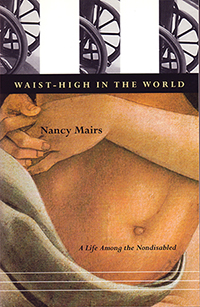
    Waist-High in the World

    Waist-High in the World: A Life Among the Nondisabled
    Nancy Mairs

    “As helpful as Mairs’s book will be to disabled people, what’s most important about it is its lessons for able-bodied readers.”
    —Kathi Wolfe, The Progressive


    Woody Guthrie

    Woody Guthrie: An Intimate Life
    Gustavus Stadler

    “Gustavus Stadler helps Woody Guthrie down from his pedestal as dust bowl icon and helps us to see him as the three-dimensional character he really was.”
    —Billy Bragg, musician and activist

    Third Annual NYC Disability Pride Parade

  • New York City held its first Disability Pride parade on 12 July, marking the 25th anniversary of the Americans with Disabilities Act, was signed into law on July 26, 1990. Photo credit: United Nations, NY.

    New York City held its first Disability Pride parade on 12 July, 2015, marking the 25th anniversary of the Americans with Disabilities Act, was signed into law on July 26, 1990. Photo credit: United Nations, NY.

    This year, the Americans with Disabilities Act has a thirtieth candle to blow out on its birthday cake. The ADA is the widest-ranging and most comprehensive piece of civil rights legislation ever passed in the United States, and it has become the model for disability-based laws around the world. We reached out to some of our authors to reflect on the impact of this landmark in disability history and on the ongoing fight for disability rights. We share their statements with you below.

    ***

    Judith Heumann

    “It’s a milestone in US history. It’s the result of many years of struggle, organizing, and voices of a single people to speak up and out about discrimination and to demand change. Beyond the changes the ADA is making in our lives, we need to focus on how it came about: the ability for Congress to work in a bipartisan way. It required disabled people and organizations of and for disabled people to come together in a more unified fashion, looking for a civil rights law that would clearly articulate that discrimination is illegal in the public and private sector.

    “We need to pay significant attention to the efforts put forth to get the ADA passed and the results of the ADA thus far, because the disability community was and still is, in numbers, very large. But the ability to come together is much smaller. We’re talking about 60 million disabled people. Disability in Section 504 is a broad definition, which is necessary to protect the rights of people who have been discriminated against based on disability. Since disabled people have many types of disabilities, they are still siloed into the label of their disability. Over the past decades, we’ve had to learn about the common issues: denial of equal opportunities; lack of sign language interpreters in hospitals; accommodations for the blind or people with mental health disabilities, for example. We look at ramps, wider bathroom stalls, closed captioning. These are things we benefit from in US society and around the world. They’re universal now. It was disabled people who pushed for these issues, which were adversely affecting nondisabled people, too.

    “In the area of employment, we have seen changes going on in hiring practices, as employers recognize it’s their legal obligation not to discriminate and to affirmatively hire disabled people. We’re seeing a more visible disability community in society overall. But two areas that haven’t made much progress are journalism and media—the most glaring being advertisements. Ads have changed so much in my lifetime. You see a broader diversity of people—no longer just white people or straight people—except in the area of disability. Disabled people continue to talk about that bias and our absence in media, film, television, and documentaries.

    “The ADA raised the expectations of disabled people. It’s the law of the land; it has repercussions to make sure people are compliant. It’s a thirty-year-old law, but many disabled people still don’t know what it is. There needs to be more robust training so that people with disabilities are fully aware of it.”
    —Judith Heumann, Being Heumann: An Unrepentant Memoir of a Disability Rights Activist


    Terry Galloway

    “The ADA was a key part of the great cultural push to recognize people like me as actual people, not half animals or to-be-gawked-at freaks. America, like the rest of the world, has been shameful in its treatment of people who need more help to thrive, especially those people who aren’t regarded as worth the money it would take to keep them alive. The ADA armed people like me with the teeth of the law, something sharp and protective to help us as we claimed our right to live fully in this world. It was the ADA that pushed for TV and movies to be captioned so I could watch and understand them; the ADA that pushed cities to make their buildings and streets and busses and transportation accessible to my friends with mobility impairments so they could go to the movies with me; the ADA that pushed business to consider hiring people like me and my friends for the jobs they’d advertised instead of automatically assuming we couldn’t do those jobs and sending us packing. It was the ADA that said, by law, you couldn’t ignore people like me, shove people like me aside, deny us an education, hide us away, leave us to die or simply gawk as we struggled or get up a flight of stairs, into a bathroom or just across the street. People can be really well intentioned and still not do the good they know they should. The ADA gave those people with good intentions laws to abide and an outline of how they could put their good intentions to work. I’m a far happier person these days. I’ve thrived. The ADA is one of the best examples of reasoned, thoughtful, and compassionate government that values all of its citizens, even—perhaps especially—those of us for whom life has proven tougher and less kind.”
    —Terry Galloway, Mean Little deaf Queer: A Memoir


    Ben Mattlin

    “For the ADA’s thirtieth birthday, Disability Pride marches had to be scrapped because of the coronavirus pandemic. A celebration at the Kennedy Center in Washington, DC, was canceled for the same reason. But the day will be celebrated. The New York Times is running a series of ADA Thirty essays, which is a stark contrast from just five years ago, when it had nothing except for an op-ed piece I’d pitched. And a number of virtual parties are being planned over social media. There is still considerable pushback to gut ADA requirements. There is still a lot of misunderstanding. There is still discrimination. Yet a new generation of disabled people who came of age after the ADA won’t be idle. They’re defending it and working to fill the gaps it left. The story of Disability Justice has only just begun.”
    —Ben Mattlin, In Sickness and In Health: Love, Disability, and a Quest to Understand the Perils and Pleasures of Interabled Romance


    Lennard Davis

    “The ADA remains an effective piece of legislation that guarantees disability rights during a time when many rights and programs are being cut back. It has resisted legal challenges and endures. During the time of COVID, we have seen disabled people being triaged in some states, being pushed to the bottom of the list of lives worth saving. But again, legal challenges and disability activism backed by the ADA have been successful in changing guidelines in some states to make it illegal to discriminate against disabled COVID patients in need of treatment and equipment. The ADA is not a perfect law, but it has teeth and fights back against a tendency to weaken it.”
    —Lennard Davis, Enabling Acts: The Hidden Story of How the Americans with Disabilities Act Gave the Largest US Minority Its Rights


    Maria Kefalas

    “Because of the disability rights movement, which was led by fearless parent and patient advocates, we now live in a world where it is common sense that medically complex children—even the ones who cannot speak, walk, feed themselves, or breathe on their own—get to attend school, live with their parents, and hold down jobs without fear of getting shipped off to institutions ‘for their own good.’ With the ADA, we now live in a country where the fake science of ‘refrigerator’ mothers, whose lack of warmth and nurturing were believed to cause autism and other behavioral and psychiatric conditions, has been debunked as the dangerous nonsense it was. Every day I spend with my daughter Cal in a school or a park or even in our home would not have been possible without a revolution most Americans don’t even know happened.”
    —Maria J. Kefalas, Harnessing Grief: A Mother’s Quest for Meaning and Miracles


    “Because of the United States’ global standing, activists and lawmakers around the world pay attention to what’s happening in America. It’s safe to say that without the ADA, there might not have been the 2000 Barrier-Free Transportation Law, nor the 2016 Law for the Elimination of Discrimination against Persons with Disabilities in Japan. While there is still much work to be done regarding accessibility and opportunity for people with disabilities in the United States and the rest of the world, we can see the way forward thanks to activists such as Judith Heumann, who made the ADA happen. Those activists have also shown the power of peaceful protest and persistence. I think of them every time I come across a ramp or accessible bathroom or see-through mask or lack thereof. While I will always be an ally, I have learned that the best way to advocate for my daughter, who is deaf and has cerebral palsy, is to teach her how to use her own voice and stand up for herself.”
    —Suzanne Kamata, editor of Love You to Pieces: Creative Writers on Raising a Child with Special Needs, author of Squeaky Wheels: Travels with My Daughter by Train, Plane, Metro, Tuk-tuk and Wheelchair 

    Disability Pride Parade

  • By Polly Price

    Face masks

    Photo credit: jardin

    This article appeared originally on plaguesinthenation.com.

    Heartening news from Alabama—Governor Kay Ivey ordered face coverings be worn in public, an emergency measure to slow the spread of the novel coronavirus there as the state reached a new record daily death toll. A recognition in the midst of a still unfolding disaster that face masks work.

    Short of shelter-in-place orders or further business closures, face masks are in fact the only thing that will work. The CDC has said that “cloth face coverings are one of the most powerful weapons we have to slow and stop the spread of the virus—particularly when used universally within a community setting.” The Director of the CDC, Robert Redfield, said, “If we could get everybody to wear a mask right now, I really think in the next four, six, eight weeks, we could bring this epidemic under control.”

    Nearly half of all states now have a mask mandate, and even more states allow decisions about face-coverings to be made at the local level. These are temporary measures to help a town or city beat back an outbreak hitting it disproportionately to other areas in a state.

    But the biggest move is from Walmart, the nation’s largest retailer. It announced customers must wear face-coverings to enter any of its stores anywhere in the nation. The National Retail Federation endorsed Walmart’s announcement, stating “Shopping in a store is a privilege, not a right. If a customer refuses to adhere to store policies, they are putting employees and other customers at undue risk.”

    We seem to be largely beyond the legal question whether an elected official can order face coverings to be worn in indoor spaces. Generally applicable face-covering requirements do not violate your constitutional rights. Chief Justice John Roberts wrote recently that wide latitude should be given to state and local officials in a pandemic: “Our Constitution principally entrusts [t]he safety and the health of the people to the politically accountable officials of the States to guard and protect. When those officials undertake to act in areas fraught with medical and scientific uncertainties, their latitude must be especially broad.”

    So what to make of the Governor of Georgia’s latest move to prevent city and county governments from requiring face coverings be worn in retail establishments and other public venues? It is hard to see the harm to the state if the mayor of Savannah concludes a temporary face-covering requirement is necessary, as he has done (along with the mayor of Atlanta and other towns throughout Georgia). In a Twitter response to the Governor’s order, Savannah Mayor Van Johnson wrote “It is officially every man and woman for himself/herself. Ignore the science and survive the best you can.”

    Is this just a quirk of Georgia law, that the governor can prevent public health measures a local elected official believes necessary? The question is rare nationally, and that’s a good thing for democratic government. Let’s take a look.

    The declaration of a public health emergency in Georgia permits the Governor to issue executive orders imposing social-distancing measures, including temporary business closures, limitations on gathering size, and the like. Face-coverings too, should the Governor deem those necessary. But Georgia emergency law does not give the governor authority to override local face masks requirements in the name of that “emergency.” At best, the Governor may direct the Department of Public Health “to coordinate public health emergency responses between state and local authorities.”

    Here is how local health authority is described by the Georgia Department of Health on its website: “Each of Georgia’s 159 County Boards of Health is also authorized to enact regulations to protect the public health in their jurisdiction, provided those county regulations do not contradict those of the Department. After looking at the Department’s regulations, you may wish to check with your County Board of Health to see if it has elected to enact supplemental regulations on a particular subject.”

    Without the Governor’s executive order, Savannah’s face mask requirement would be perfectly legal under Georgia law. Local face-mask ordinances only contradict state law now because Governor Kemp says they do, to buttress his claim that he could challenge local face-mask requirements in court and win. I think the Governor would lose. But rather than force the question, why not allow local decision-making, as Texas has done, rather than waste time and resources engaging in litigation?

    Governor Kemp is in the distinct minority of Republican Governors on this one. The sky has not fallen since the Texas, Arizona, and Alabama Governors reversed course on face masks. One stunning result of the Georgia Governor’s action is the world’s busiest airport, Atlanta’s Hartsfield-Jackson, is once again mask free. As I wrote previously, the FAA, the CDC, or someone at the federal level should take action to better protect interstate travelers and their destinations. Preventing the spread of COVID-19 in America’s airports should not be left up to mayors or governors, and certainly not be overridden by a governor if a mayor steps up to fill the gap.


    About the Author 

    Polly Price is an award-winning legal historian and professor of law and public health at Emory, and is the author of two scholarly books and numerous articles on issues related to public health. Her book Plagues in the Nation, a narrative history of America through major outbreaks, is a forthcoming title from Beacon Press. Connect with her online at plaguesinthenation.com and on Twitter at @PollyJPrice.

  • By Cornel West

    Ida B Wells-Barnett

    Suffragette. Civil rights activist. Anti-lynching advocate. And as Dr. Cornel West would call her, prophetic journalist. Happy birthday to Ida B. Wells-Barnett, who more than deserves the posthumous Pulitzer Prize honor “for her outstanding and courageous reporting on the horrific and vicious violence against African Americans during the era of lynching”! The era of lynching is still with us. Today we call it policing. Imagine if she were alive, covering our modern-day lynch mobs that took the lives of Breonna Taylor, Sandra Bland, George Floyd, Tony McDade, Ahmaud Arbery, Tamir Rice, and many others. These highlights from Dr. West’s Black Prophetic Fire remind us, on her birthday, why she will always be important figure of the Black radical tradition and resistance.

    ***

    Ida B. Wells is not only unique, but she is the exemplary figure full of prophetic fire in the face of American terrorism, which is American Jim Crow and Jane Crow, when lynching occurred every two and a half days for over fifty years in America. And this is very important, because Black people in the New World, in the Diaspora, Brazil, Jamaica, Barbados, were all enslaved, but no group of Black people were Jim Crowed other than US Negroes. And what I mean by Jim Crow is not just terrorized, not just stigmatized, not just traumatized, but, what we talked about before, niggerized. Black people were first reaching citizenship after the most barbaric of all civil wars in modern times—750,000 dead, we are told now. Black people are made slaves, then citizens, then are remade into subjects who are subjected to an American terrorist order—despite Black resistance. They are no longer slaves in the old sense, yet not citizens, but sub-citizens, namely subjects, namely Negroes, namely niggers who are wrestling with this terror.

    Why is this important? Because, I would argue, Jim Crow in some ways is as important as slavery in understanding the mentality, understanding the institutions, and understanding the destiny of Black folk. A lot of people want to jump from slavery into the civil rights movement. But, no, right when the American social order was providing opportunities for white immigrants all around the world between 1881—Let’s begin with the pogroms that escalate in Russia at the time with the death of the tsar2 and the waves of white immigrants who come to the United States and who begin to gain access to some of the opportunities afforded here—that is precisely the time in which Jim Crow emerged. It consolidates in the 1890s, along with the American imperial order in the Philippines and Cuba, Guam, and other territories. So you get six million people of color outside the United States, and you get the terrorized, traumatized, stigmatized order, which is a Jim Crow order, in the United States. That’s the context for Ida.

    Why is she so unique? Well, the textbook version of Black history is the following. You get W. E. B. Du Bois versus Booker T. Washington: The nice little deodorized discourse of Booker T., who is tied to the white elites, who has access to tremendous amounts of money, who has his own political machine, moving in to take over Black newspapers and pulling Black civic organizations under his control while refusing to say a mumbling word publicly about lynching, which was the raw face of American terrorism against Black people. Then you get Du Bois, who did want to talk about civil rights, who did want to talk about political rights, but in no way targeted the lynching face of American terrorism the way Ida B. Wells did. Ida B. Wells, in so many ways, teaches us something that we rarely want to acknowledge: that the Black freedom movement has always been an anti-terrorist movement, that Black people in America had a choice between creating a Black al-Qaeda or a movement like Ida B. Wells’s, which was going to call into question the bestiality and barbarity and brutality of Jim Crow and American terrorism and lynching, but would do it in the name of something that provided a higher moral ground and a higher spiritual ground given her Christian faith, not opting for a Black al-Qaeda that says, “You terrorize us; we terrorize you. You kill our children; we kill your children.” No, not an eye for an eye, a tooth for a tooth, where we end up both blind and toothless. She said: “We want a higher moral ground, but I’m going to hit this issue head-on.”

    And that is in so many ways relevant today, because we live in an age in which people are talking about terrorism, about terror, all the time. Here we have much to learn from an Ida B. Wells, who was born a slave, orphaned young—both her parents die of yellow fever in Hollis Springs, Mississippi. She makes her way with two of her sisters to Memphis, is run out of Memphis, even as she begins to emerge as a prophetic voice in Free Speech and Headlight, a newspaper that she begins to edit, and then with the lynching of three men in Memphis, brother Tom and brother Calvin and brother Will, on March 9, 1892, the white elite puts a bounty on her head, because she wants to tell the truth—like Malcolm X, parrhesia again, the fearless speech. Thank God for T. Thomas Fortune, who welcomed her to New York and invited her to write for his newspaper, the New York Age. And this was where she published the two classics, Southern Horrors, in 1892, and A Red Record, in 1895.

    And it is important to use the language of American terrorism, because we live in an age where, when people think of terrorism, they usually think of a very small group of Islamic brothers and sisters, whereas, of course, terrorism has been integral to the emergence and the sustenance of the American democratic experiment, beginning with indigenous peoples and slavery. But after the Civil War, we get a new form of terrorism—crimes against humanity—that sits at the center of American life, and Ida B. Wells forces us to come to terms with that.

    ~~~

    As a journalist, she had a vocation to tell the truth at an observational level. It reminds me in some ways of the great text of Theodore Weld and Angelina Grimké, American Slavery As It Is, which became a best seller in 1839. And it was observational; it was like William Cobbett in England or Harriet Martineau, where you observe and picture for your audience in a dramatic fashion the suffering and the misery of your fellow human beings, in this case of Blacks vis-à-vis a white audience. What Ida B. Wells does as a journalist is not just report in a regular way, but she presents these dramatic portraits with statistics, with empirical data, but also stories. Ida was saying: “Let me tell you about these seventeen lynchings, where the myth was to protect white womanhood’s purity and so forth. No, there was a fear of economic competition. No, there was a sense of arbitrary targeting of these Black men that had nothing to do whatsoever with white sisters.” My God, journalism is about dead in America today, given that most journalists are extensions of the powers that be, but in those days there was prophetic witness, and Ida B. Wells was one of the great pioneers of this prophetic journalism.


    About the Author 

    Cornel West is a prominent and provocative democratic intellectual. He graduated magnum cum laude from Harvard and obtained his MA and PhD in philosophy at Princeton. He has taught at Union Theological Seminary (where he has recently returned to teach), Yale, Harvard, Princeton, and the University of Paris. He has written nineteen books and edited thirteen books. He is best known for his classic Race Matters, published by Beacon Press in 1993. His latest books are Black Prophetic Fire, which offers a fresh perspective on six revolutionary African American leaders (Frederick Douglass, W. E. B. Du Bois, Martin Luther King Jr., Ella Baker, Malcolm X, and Ida B. Wells) and The Radical King, a collection of MLK's writings curated and introduced by Prof. West to reclaim Dr. King's prophetic and radical vision as both a civil rights leader and—more broadly—as a human right activist. Both books were published by Beacon Press. Follow him on Twitter at @CornelWest.

  • By Roxanne Dunbar-Ortiz and Dina Gilio-Whitaker

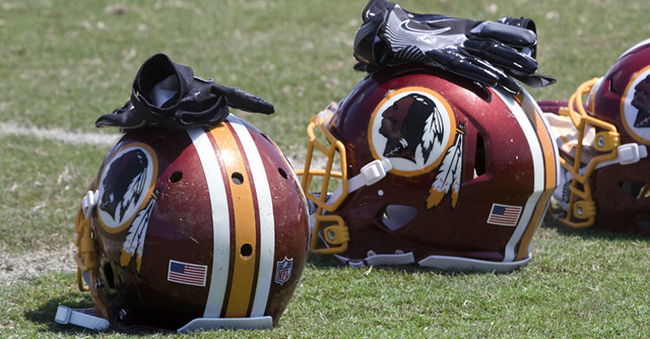
    Washington Redsk*ns helmets

    Photo credit: C Watts

    A silver lining in the cloud of racial injustice and pandemics. The NFL announced that the Washington Redsk*ns will change their offensive name and logo. This is years after owner Dan Snyder crossed his arms and said it would never happen. We never thought this day would come as soon as it did. It was about time. As Roxanne Dunbar-Ortiz and Dina Gilio-Whitaker reveal in this adapted selection from “All the Real Indians Died Off”: And 20 Other Myths About Native Americans, the history of Indigenous anti-mascot initiatives goes further back than you think.

    ***

    Sociologist James O. Young writes that cultural appropriation happens when people from outside a particular culture take elements of another culture in a way that is objectionable to that group. According to Young’s definition, it is the objection that constitutes appropriation, as distinguished from cultural borrowing or exchange where there is no “moral baggage” attached. Native American cultural appropriation can be thought of as a broad range of behaviors, carried out by non-Natives, that mimic Indian cultures. Typically, they are based on deeply held stereotypes, with no basis at all in knowledge of real Native cultures. This acting out of stereotypes is commonly referred to as “playing Indian,” and, as Philip Deloria’s research so eloquently revealed, it has a long history, going at least as far back as the Boston Tea Party. Some forms of appropriation have been outlawed, as is the case with the Indian Arts and Crafts Act of 1990 (IACA). Responding to the proliferation of faux Indian art (which undermines economic opportunities for actual Native American artists), the IACA is a truth-in-advertising law that regulates what can legitimately be sold as Indian art. No such possibility exists, however, for the vast majority of appropriations American Indians endure daily.

    Non-Native people play Indian whenever they don any garb that attempts to replicate Native culture (however serious or trivial their intent) or otherwise mimic what they imagine to be Indian behavior, such as the tomahawk chop, a fake Indian dance, or bogus war whoop. Native American appropriation is so ubiquitous in US society that it is completely normalized, not only rendering it invisible when it occurs, but also adding insult to injury. Native people are also shamed for being “hypersensitive” when they protest. Halloween costumes, popular fashion, and children’s clubs and activities (such as the YMCA’s Indian Guides and Princesses programs and other summer camps) are some of the more obvious ways cultural appropriation occurs through Indian play in mainstream society, but perhaps its most visible form is in school and sports team mascots. Campaigns to put an end to the turning of American Indians into mascots began in the early 1960s when the National Indian Youth Council began organizing on college campuses to remove Indian sports stereotypes. Then, in 1968, the National Congress of American Indians (NCAI), the largest pan-Native representational and advocacy organization in the United States, established its own anti-mascot initiative. Once obscure, the movement to eradicate Indian mascots has snowballed into mainstream awareness.

    In 2013, the NCAI issued a report outlining their position on Indian mascots. It mentions numerous resolutions that have been passed by the organization over the years, including one in 1993 imploring the Washington professional football team referred to as the “Redsk*ns” to drop its name, and another in 2005 supporting the National Collegiate Athletic Association (NCAA) ban on native mascots, nicknames, and imagery.

    The report summarizes the negative impacts that Indian mascots have been shown to have on Native youths, citing, for example, a study by cultural and social psychology scholar Stephanie Fryberg. Her 2004 study revealed that when exposed to stereotypical “Indian” images, the self-esteem of Native youths is harmed, eroding their self-confidence and damaging their sense of identity. This is crucial given that the suicide rate among young American Indians is epidemic at 18 percent, more than twice the rate of non-Hispanic white youth, and contextualized by the fact that Native Americans experience the highest rates of violent crimes at the hands of people from another race. Since the early 1970s, thousands of public and postsecondary schools have dropped their Indian mascots, and hundreds more professional and governmental institutions have adopted resolutions and policies opposing the use of Native imagery and names, including the American Psychological Association, the American Sociological Association, the National Association for the Advancement of Colored People (NAACP), and the US Commission on Civil Rights. In 2015 California became the first state to ban “Redsk*ns” as a mascot name in public schools.

    As the NCAI report indicates, the “Redsk*ns” name is particularly offensive to Native peoples. According to the report,

    The term originates from a time when Native people were actively hunted and killed for bounties, and their skins were used as proof of Indian kill. Bounties were issued by European companies, colonies, and some states, most notably California. By the turn of the 20th century it had evolved to become a term meant to disparage and denote inferiority and savagery in American culture. By 1932, the word had been a term of commodification and the commentary on the color of a body part. It was not then and is not now an honorific. . . . The term has since evolved to take on further derogatory meanings. Specifically, in the 20th century [it] became a widely used derogatory term to negatively characterize Native characters in the media and popular culture, such as films and on television.

    Over the last twenty-five years, at least twenty-eight high schools have abandoned the name, but the Washington football team’s owner, Dan Snyder, has stalwartly insisted that he will never change the name, despite mounting legal challenges to its trademark and public outspokenness by President Barack Obama and other political leaders about its offensiveness. A growing number of media outlets and prominent sports reporters have vowed to stop using the name, and even NFL commissioner Roger Goodell has acknowledged its insensitivity.

    Although arguments to justify the usage of Native images in the world of professional sports are weak at best, there are some instances where the use of Native mascots has been deemed acceptable at the college level, according to the NCAI report. The NCAA ban, for instance, includes a “namesake exception” that allows universities to keep their Native American nicknames and logos when they are based on a specific tribe and they have been granted the permission by that tribe. Such permission was granted for Florida State University (“Seminoles”), Central Michigan University (“Chippewas”), and the University of Utah (“Utes”). The University of North Dakota, on the other hand, due to opposition of the name “Fighting Sioux” from local tribes, was not granted an exemption. At the high school level, at least one high school in New York State has successfully fought to retain its Native mascot despite a request from the state’s education commissioner to boards of education and school superintendents to end their use of American Indian mascots and team names. Salamanca Central High School (SCHS) is located within the boundaries of the Seneca Nation, 26 percent of its student body is American Indian, and the team name “Warriors” is represented by an accurate depiction of a Seneca sachem rather than the cartoonish Plains-style Indian so typical of Native mascots. A name change was opposed by the Seneca Nation of Indians Tribal Council, the SCHS administration and student body, the Salamanca school board, and the Salamanca city council in a show of cross-cultural solidarity.

    Be that as it may, there is a subtle claim to ownership in the realm of mascot names and images that scholars of cultural appropriation have keenly unmasked. With university and college examples like the Florida State Seminoles, the University of Illinois Fighting Illini, and many others, non-Native mascot defenders claim such representations honor particular tribal nations and peoples. But what they really do is assert an imagined indigeneity whereby white dominant society assumes control of the meaning of Nativeness. Professor of professional sport management at Drexel University Ellen Staurowsky characterizes these kinds of fraudulent claims to Indianness as a system of sustainable racism within a “sociopolitical power structure that renders Indianness tolerable to Whites as long as it is represented on terms acceptable to them.” She also points out the inconsistency of tolerating objectionable university Indian mascots with the central mission of higher education.

    The myth that Indian mascots honor Native Americans, then, appears to be little more than a carefully constructed rationale to justify the maintenance of a system of domination and control—whether intentionally or unintentionally—where white supremacy is safeguarded, what Robert F. Berkhofer Jr. famously called the “White Man’s Indian.” And particularly at the level of professional sports, the branding of Native American team names and images also serves more as a rationale to maintain financial empires (explaining the stubborn adherence to racist portrayals of Native peoples in organizations like the Washington Redsk*ns), than dubious claims to be honoring them. But the justifications for American Indian cultural appropriation don’t end with sports team mascot battles and fashion debacles. Appropriating Native cultures by playing Indian permeates US society so broadly it strikes at the very heart of Native American cultures, their spiritually based systems of belonging and identity, which we turn to next.


    About the Authors 

    Roxanne Dunbar-Ortiz grew up in rural Oklahoma, the daughter of a tenant farmer and part-Indian mother. She has been active in the international Indigenous movement for more than four decades and is known for her lifelong commitment to national and international social justice issues. After receiving her PhD in history at the University of California at Los Angeles, she taught in the newly established Native American Studies Program at California State University, Hayward, and helped found the Departments of Ethnic Studies and Women’s Studies. Her 1977 book The Great Sioux Nation was the fundamental document at the first international conference on Indigenous peoples of the Americas, held at the United Nations’ headquarters in Geneva. Dunbar-Ortiz is the author or editor of seven other books, including Roots of Resistance: A History of Land Tenure in New Mexico. She lives in San Francisco. Follow her on Twitter at @rdunbaro. 

    Dina Gilio-Whitaker (Colville Confederated Tribes) is a lecturer of American Indian Studies at California State University San Marcos, and a consultant and educator in environmental justice policy planning. Her research interests focus on Indigenous nationalism, self-determination, environmental justice, and education. She also works within the field of critical sports studies, examining the intersections of indigeneity and the sport of surfing. She is co-author with Roxanne Dunbar-Ortiz of Beacon Press’s “All the Real Indians Died Off” and 20 Other Myths About Native Americans, and author of As Long as Grass Grows: The Indigenous Fight for Environmental Justice from Colonization to Standing Rock. Follow her on Twitter at @DinaGWhit and visit her website.

  • By Howard Bryant

    Officer

    News of police officers murdering Black civilians is on repeat, and so are TV shows like Law and Order and Cops (up until it was recently canceled). As Howard Bryant shows us in this passage from Full Dissidence, the glut of crime dramas is a form of propaganda that glorifies the police force and cosigns white supremacy. The Black community has known about the enforcement of whiteness in the name of of law all along.

    ***

    America prefers to view itself as a civilized society and, as such, the latter is the obvious, proper, and decent response. Yet judging by its obsession with law enforcement, America acts as if the former is its natural order—that violent crime is but a bad mood away and only the shield, the Glock, and the squad car stand between life and senseless death at the hands of our neighbors. Americans cling to this contrived state of emergency despite decades of research confirming that killing as a primary instinct is extremely rare, a dystopian fantasy compared to the socioeconomic factors that drive people to violent crime. Despite a spike in mass shootings, the actual murder rate was roughly the same in 2018 as it was in 1960, according to crime statistics compiled by the New York Times. That most people have no desire to harm others is also, and should always be, unsurprising.

    Where I live, a bumper sticker commonly seen around town reads “Troopers Are Your Best Protection.” It is a specious declaration at best, at worst a cynical attempt to advance the political and economic agendas that come with commodifying law enforcement and the criminal justice system. If data mean anything, prosperity and opportunity, not police, are one’s best protection—yet law enforcement in America is omnipresent. Police are a fixture of the national identity, central to its popular culture and, in post-9/11 America, under the guise of freedom and safety, are emboldened to only further increase their footprint. The land of the free feels occupied by the smothering, militarized presence of police. Police are encouraged—by media-manipulated juries, by a decades-long unaccountability, by supplicant, politicized judges, and, of course, by fear—to ignore or break the law while judges and legislatures endorse propolice, antidemocratic policies. All, presumably, to keep us safe. Though charged with completely different responsibilities, in order to further exploit the fear, police attempt to make themselves indistinguishable from the military, try to look like domestic agents in the War on Terror. As a public relations tactic they have taken a dangerous, divisive job and rebranded it under the reassuring, unimpeachable post-9 / 11 umbrella of a single, uncomplicated word: heroes.

    The public receives these maneuverings with pride. An overpoliced America—in schools, on TV, in train stations, at ballparks—is not considered by the mainstream to be a chilling harbinger of authoritarianism but a source of strength. No other occupation in the country owns as wide a gap between its realities and its public packaging as law enforcement because quite possibly no other occupation owns such distance between its experiences with different slices of the public. For those who are white and middle-class, the police are part of the social fabric, an unquestioned ally. The image of the police diverges almost exclusively along racial and class lines. The white mainstream accepts an image of benevolence, fairness, and justice while those who are black, brown, and poor know firsthand that the police are possibly all of those things but also definitely can be brutal, oppressive, merciless, aggressive, and extralegal. As a defense against criticism and a ploy for bigger budgets and more presence, police departments around the country routinely sell more fear and maintain that ungrateful American citizens are at war with them. If it is true that no occupation in America enjoys as great a distance between fantasy and reality as law enforcement, it is also true that none has spent so much time and money constructing such an illusion of itself. Nor has any other benefited from the assistance of so many powerful enablers—in Hollywood, in the newsrooms, and now at the ballparks—who are invested in sustaining their illusion. There are, indeed, so many ways to tell a lie. Police propaganda may well be America’s favorite.

    ~~~

    What, it must be wondered, is so valuable that these truths, fatal to virtually any other profession, are tolerated, protected, and justified when exposed regarding police? Nearly three thousand killings by police over a three-year period—several of unarmed citizens and captured on video—with a less than virtually nonexistent conviction rate of officers. Evidence that policemen are often aligned with white nationalist organizations. False confessions. Fraud. Illegal surveillance. Billions paid out in civil settlements. The National Center for Women and Policing reported in 2014 that 10 percent of American families experience domestic violence, but for police officers’ families, the number is two to four times higher, one of the highest rates in the nation, though given the issue’s national coverage a first guess would be that the highest rate involves black football players. Though steroids are largely associated with sports, there is a culture of anabolic steroid use among police, as documented in University of Texas professor John M. Hoberman’s searing book Dopers in Uniform.

    This is the evidence, not conjecture or theory, of an institution facing enormous challenges, one in desperate need of reform and oversight. The reality repudiates the public relations. The transgressions, as widespread as they are disparate, explain at least in part the existence of the propaganda, for actual policework is neither clean nor often heroic. After an officer with the Cleveland Police Department killed twelve-year-old Tamir Rice within two seconds of encountering him in 2014, the department paid his family a $6 million settlement of taxpayer money (without admitting wrongdoing, of course) and then publicly and shamelessly said the family should donate the money to charity. Killing a child, then painting the survivors as greedy lottery winners, isn’t quite the appropriate selling point for Cleveland Indians Law Enforcement Appreciation Night.

    In April 2019, USA Today reported that over the previous decade, eighty-five thousand police officers had been investigated or disciplined for misconduct. “Officers have beaten members of the public, planted evidence and used their badges to harass women,” the report read. “They have lied, stolen, dealt drugs, driven drunk and abused their spouses.” The report documented more than two thousand examples of “perjury, tampering with evidence or falsifying reports.” Twenty officers were the subject of at least one hundred allegations each but remained on the job.

    It is not simply power that prevents the public and the corporate machine from challenging law enforcement. (The Catholic Church was an equally if not even more powerful institution and yet has not recovered from its breaking of the public trust and quite likely never will.) The critical difference, beyond the one-liners-and-ammo formula of Hollywood cop-buddy movies, beyond the Blue Lives Matter police union intimidation, and beyond all the post-9/11 hero talk, is what the idea of law enforcement means to white mainstream culture. Policing is the glue of whiteness. Like the white American identity, which has never reconciled with the bloody and murderous roots of its empire, the police propaganda smothering the culture asserts an inherent goodness. Police are good, even when they kill, even when they break or flout the law, even when they roll tanks into Ferguson or occupy minority communities dressed as if they are invading Aleppo, which makes their transgressions forgivable. The same is true of whiteness, when it first appeared on the shores of a brown nation, when it isolates and then displaces to gentrify, when it annexes land, appropriates resources, and colonizes and then leads humanitarian efforts. Its presence must always be concluded to be a positive one. The myth of police as essential to goodness and not to whiteness must be protected as vigilantly as one protects the flag. For if it is not, and law enforcement, justice and whiteness are coupled, as the black and the brown know they always have been, then neutrality crumbles. The government, the law, the Constitution, and the commitment to equality are no longer objective and they must then be seen as the black person sees them—as the enforcement arm of whiteness. Heroism falls apart. The entire idea must be reconstituted.

    Conversely, if police allow themselves to be the enforcement arm of whiteness, then who is the natural target, the obvious threat? It is the nonwhite. Black people have found themselves the targets of a particular phenomenon: white people (white women primarily) across the country calling the police on them. Whether it’s a white woman calling police on a black female student napping in the Yale library, an employee calling police on two black friends awaiting another at a Starbucks in Philadelphia, or a white woman phoning police on a black family barbecuing in an Oakland park, the message is that black people do not belong in public spaces. When they are in public they are being watched not only by police but by average citizens who have chosen to aid in the policing. In 2019, a woman photographed a black Washington, DC, transit worker eating on the Metro, taking the time to tweet her bosses demanding the woman be disciplined.

    Black presence suggests threat and becomes an unintended consequence of the War on Terror’s “If you see something, say something” mandate. Taking this slogan to its natural conclusion, if the public is enlisted as agents of the state, their actions will reflect their fears, and their fear is black people. If the public does not believe black people belong in common, everyday American spaces without tight monitoring, then black people, like the Boston Marathon bombers or ISIS sympathizers, become the threat. The police become the personal protectors of the white public. They will be asked and expected to remove black people from spaces that white people do not believe African Americans have a right to share.

    Calling the police on black people is an extension of the public and police’s willingness to believe in black criminality, which has long been used by white perpetrators of heinous crime. In 1990, Charles Stuart infamously murdered his pregnant wife in Boston and blamed it on a black male. In 1995, Susan Smith drowned her two children and told police a black man killed her children after a carjacking. Two weeks before the 2008 election a twenty-year-old John McCain campaign volunteer named Ashley Todd claimed a black Obama supporter had attacked her and scratched the letter “B” into her face. In each case, law enforcement acted as the perpetrators had hoped, rounding up black suspects, quick to believe in black malfeasance as credible. Black people were used as the bait by the white perpetrators for one reason: they knew that at a first glance, and sometimes a first glance is all it takes, it would work. Existing while black.

    Yet within this dynamic, when white people believe the law is designed to protect only them, and when they know they can act upon this belief at will, brazenly dialing 911 whenever they feel a black person has forgotten his or her place, the idea of white benevolence disintegrates as quickly as the neutrality of law enforcement. Whites can view themselves as both the conqueror and the asset that must be protected. Police are the occupiers, ready at a moment’s notice to enforce the will not of justice for all but of whiteness.

    Without the pretense of fairness, the nostalgia of the self-made fantasy, of police pulling themselves up and out of the lower class through the virtue of aiding justice becomes, finally and inevitably, ridiculous. Police is so tied to whiteness because it was the pathway to the American dream. Law enforcement provided one of the earliest opportunities for so many whites, especially big-city Italians, Poles, and Irish, to rise from immigrant to American. The blue-collar police and fire departments represented their path to legitimacy, to assimilation, built their middle class. It is how the Irish graduated from disorderly to white to hero. It is how the Italians transformed from criminal to white to hero. Just as with the military, there is nostalgia in the dynastic qualities of law enforcement, of how the son followed the father who followed his father into the business, the myth of gallantry maintained, that a valuable and noble trek from the Old World to the New was being completed.

    It is a story darkly revived in post-9/11 America, except the inherent goodness of police transformed from the old Officer Friendly archetype into that of vigilant superpatriot. The former offered the melting pot a chance that community belonged to all people. The latter is a snarling defense of whiteness, patriotism, and xenophobia so deeply embedded into the culture that law enforcement now is cultivated as a patriotic business partner with professional sports leagues. One must ask: If Colin Kaepernick had taken a knee for global warming or education reform, would his industry and his country have lashed out so ferociously, so permanently?

    Telling a different tale—that the Irish and Italian cops in Boston and New York, Philadelphia and Baltimore (not to mention Chicago and San Francisco), joined the American middle class by beating niggers over the head, by maintaining economic dominance over them through graft, corruption, and prohibiting them from joining police and fire departments in large numbers, only to come home and beat their spouses—would not spawn many enthusiastic TV shows. If the heroes weren’t heroes, the nostalgic, self-made-immigrant story dissolves and the badge loses its appeal and becomes, as it has been for black people all along, something to fear.


    About the Author 

    Howard Bryant is a senior writer for ESPN the Magazine and is a correspondent for NPR’s Weekend Edition. He has won several awards for his commentary writing. His books include The HeritageJuicing the Game, and The Last Hero. He lives in Northampton, Massachusetts. Connect with him at howardbryantbooks.com and on Twitter (@hbryant42).

  • By Lori L. Tharps

    Reading the newspaper

    This essay appeared originally on My American Meltingpot.

    I feel like celebrating! More than five years ago, I wrote a post, that then led to an opinion piece in the New York Times, advocating for journalists and publishers to capitalize the B in Black when referring to Black people. On Friday—yes, Juneteenth Day—the Associated Press officially announced that they would be making the change in their stylebook, signaling a universal change as almost every single news organization in the United States follows the guidelines set by the AP. I feel like a major victory has been won.

    Why the Capital B Matters

    I’m not going to rewrite my entire essay explaining why the B should be capitalized. (Quick, just go re-read it!) I will simply say that lowercase b refers to the color black, whereas uppercase B refers to a group of people with a shared culture and history. To refer to Black people with a lowercase letter is factually incorrect, as well as dismissive to a group of people who continuously see their culture mocked, denigrated and ironically, appropriated.

    Why the Change Happened Now?

    For five years, I’ve wondered why after penning my essay—in the New York Times no less—newspapers and the AP Stylebook weren’t clamoring to fix their mistake. I feel like I laid out the argument pretty convincingly, and I certainly wasn’t the only one banging this drum. Many other journalists, advocates, and institutions were calling for this universal change. Not to mention the many writers who weren’t waiting for some official decree and simply capitalized the B in all of their work and fought the copyeditors who wanted to demote their capitals to the lowercase.

    Maybe it was apathy? Maybe it was racism? Maybe a little of both? I’ll never know. But I do know that under the cloud of COVID-19, the murder of George Floyd, and the unrelenting Black Lives Matter demonstrations, something has shifted in America. I’m not going to say the shift is universal. I’m not going to say the shift is permanent. But I will say I am seeing a willingness by individuals and institutions to make changes in their lives that will lead to racial equality. In fact, the AP wasn’t the first to make the change to the uppercase B. They were following in the footsteps of other major media outlets, like the Los Angeles Times and Time magazine, who finally recognized at this moment, that if Black lives matter, they deserve to be recognized with the uppercase.

    What’s Next for the Capital B Campaign?

    I’ve already seen my first AP story where the B was capitalized. So, the change has been immediate. I’m looking forward to seeing that capital B now everywhere I go. (Hello, New York Times!) When I submit my next book manuscript, I know I’m not going to have fight or educate anyone on why all of my Bs are in the uppercase. I look forward to the time when all of the books I buy and articles I read will no longer have that erroneous and disrespectful lowercase b.

    What the Fight for the Capital B has Taught Me

    At the end of the day, this fight for the capital B has taught me that words really do matter. While I know that I have not been fighting this fight alone, that one article I wrote in the New York Timesall those years ago, was cited and shared more times than I can count, in order to explain why this change was warranted. I could be dead, but my words would have lived on in that article and would continue to help change the narrative about this issue. What’s more, as publishers, newspapers, government institutions, and even Fortune 500 companies hopped on board the capital B campaign train, it proved that they recognized that by making this small typographical change, they were signifying that they understood the power of words. They knew that this change wasn’t only about style; it was about race and respect.

    Change Is Coming

    I hope W. E. B. Du Bois is smiling down on me from heaven, because it was his letter-writing campaign to get the N in Negro capitalized in the early twentieth century that inspired me. I feel like this has been my first civil rights protest and victory, and I’m still basking in the glow. But I’m also even more fired up to do more because I know that change can happen—if you use the right words!


    About the Author 

    Lori L. Tharps is an associate professor of journalism at Temple University and the coauthor of Hair Story: Untangling the Roots of Black Hair in AmericaKinky Gazpacho: Life, Love & Spain, and Same Family, Different Colors: Confronting Colorism in America’s Diverse Families. Her writing has also appeared in the New York TimesWashington Post, and Glamour and Essence magazines. She lives in Philadelphia with her family. Follow her on Twitter at @LoriTharps and visit her website.

  • By Jonathan Rosenblum

    Police force at protest

    This article appeared originally in Crosscut and has been updated.

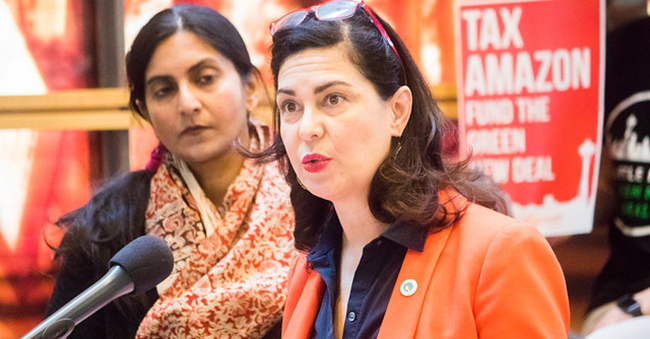
    Twenty years ago, in the middle of historic mass protests against the World Trade Organization, police chased hundreds of peaceful protesters out of downtown, north on First Avenue and surrounded them just half a block beyond Seattle’s iconic Labor Temple, preparing for mass arrests.

    It was December 1, 1999. As the police roundup unfolded, a group of us meeting inside the Labor Temple spilled out into the street. Ron Judd, the head of the King County Labor Council, whom I worked for at the time, was aghast to see the protesters essentially held at gunpoint. Judd announced publicly that any protester was welcome to find refuge in the Labor Temple, and that police were barred from entering the building. We stationed activists at the doors to enforce Judd’s order. As an officer shoved a nightstick at his neck, Judd, standing in the middle of First Avenue, called the deputy mayor to make sure his point got across to the political establishment: This police attack on protesters was an attack on all of labor, and the union movement would not sit idle.

    For those of us standing on First Avenue that afternoon, that scene underscored a fundamental truth that has not changed over the years: There is no place in the house of labor for Seattle’s police.

    Yet in the last twenty years, quite the opposite has happened: The Seattle Police Officers Guild (SPOG), historically unaffiliated with the union movement, joined the labor council in 2014 and exploited that affiliation to advance its hostile interests.

    It’s been well past time to sever that relationship, and June 17’s decisive vote in the Martin Luther King County Labor Council to expel SPOG honors the basic union principle that an injury to one worker is indeed an injury to all. Notably, the 55%-45% delegate vote was a grassroots uprising, initiated by teachers union members and propelled forward by rank-and-file members from a wide range of unions. Both the council president and the council executive secretary—the body’s principal officer—cast votes against booting SPOG.

    The US Justice Department determined, in late 2011, what Black and brown communities have known for decades—that the Seattle Police Department enacted systemic, racially discriminatory excessive use of force practices.

    The subsequent years of court oversight have not changed the fundamentals of police violence in Seattle. Police and their political protectors have resisted true reform. In the eight years since the federal consent decree, whereby the federal government took watch over the use of force, Seattle police have killed twenty-eight more people—all working class and disproportionately people of color. No police officer has been held accountable for these killings.

    Perhaps the most strategic step that SPOG undertook while under court oversight was to affiliate in late 2014 with the labor council, the county federation of local unions encompassing close to 100,000 workers. Coming at the beginning of national Black Lives Matter movement, SPOG’s affiliation was a savvy move. Unfortunately, the labor council leadership in 2014, which had completely turned over in the preceding years and was closely aligned with the city’s political establishment, was all too happy to welcome SPOG. By joining the labor council, SPOG could claim union bona fides while taking advantage of the council’s political chops and credibility.

    SPOG affiliation turned out to be a disaster for working people in and out of unions, especially in Black and brown communities. And it marked yet another example of how far many unions have slid in recent decades from independent, militant, worker-led organizations to bureaucratized institutions whose leaders preferred closed-door hobnobbing with the political establishment over engaging and empowering rank-and-file union members.

    The SPOG affiliation emboldened Seattle police to push back more aggressively against real reform. In 2018, SPOG negotiated a contract with Mayor Jenny Durkan that neutered modest police accountability measures that the Seattle City Council had adopted the previous year. SPOG, hand in hand with labor council leadership and the mayor, lobbied hard to win city council approval of the contract, claiming shamefully that the rollback of police accountability was necessary because of “union rights.”

    Labor council leaders even threatened to run candidates against council members who opposed the SPOG-Durkan negotiated agreement. Surely police deserve good pay, but the labor council and the mayor combined the economic benefits with the accountability rollbacks in a single take-it-or-leave-it package. Only Councilmember Kshama Sawant (whom I now work for) joined with a diverse range of community organizations, along with a number of rank-and-file union members and some local union leaders, to oppose the SPOG contract.

    The labor council leadership’s heavy-handed lobbying for the SPOG contract and their open allegiance to the mayor broadcast a clear message: The labor council leadership stands with the police and the political establishment, not the communities most impacted by police violence.

    Since the SPOG contract approval, Seattle police have killed six more people, beginning in December 2018 with the killing of Iosia Faletogo (a former labor union member, from a family of union members), and most recently with the killing of an African American homeless man in mental distress, whom Seattle police shot five times in Queen Anne just one month ago.

    When I signed my first union membership card decades ago, I was taught that a union is simply a group of workers who come together to fight for the things we need, and to fight to protect one another; that our interests as workers differ from the interests of our employers and from the economic and political elites; and that the only way we have power in dealing with them is to band together as workers.

    Police guilds like SPOG, on the other hand, come together not to join with us in common struggle, but to amplify and legitimate their power to carry out what they are hired to do. Their job, under capitalism, is to serve as an armed, legally-sanctioned force acting on behalf of economic and political elites. In doing so, they are arrayed against other union members, and indeed the entire working class. That is not a union; it is a protectorate of the elite.

    This conflict is exactly what played out on First Avenue two decades ago, at strikes over the years, as police forced open picket lines to allow strikebreakers through, on numerous protests against ICE offices safeguarded by armed cops, and most recently on our streets, as tens of thousands of Seattleites came out to join worldwide protests against police murders of Black and brown people.

    If you still think SPOG is a union, similar to a union of health care workers, machinists, office workers or construction workers, ask yourself this: What other union fights ardently to enshrine their legal right to shoot and kill other people, and to evade public accountability for those killings?

    By embracing SPOG over the past six years, the labor council associated our union movement with this systemic violence. Worse, the labor council’s embrace of SPOG facilitated and enabled racist, violent police behavior. That association was shameful and had to end, not just because of what SPOG is and has done, but because if we hadn’t cut SPOG loose, the labor council would have lost its soul.

    Some argued that SPOG should have been allowed to stay as long as their leadership admitted that racism is a structural problem in law enforcement and agreed to submit to training.

    That argument betrayed a complete misunderstanding—perhaps intentional—of the role of police. As we have seen from countless reform attempts over the decades, no amount of training is going to change the basic fact that Seattle’s police serve, and will continue to serve, the interests of the elites in our capitalistic society. What was true on the streets of Seattle twenty years ago is still true today.

    Kicking SPOG out of our labor council doesn’t change that immutable fact, either. But in booting SPOG, delegates reestablished the principle within the labor council that unions exist to defend the interests of workers, and that the interests of unions are aligned with those of the community, not with the Seattle police and those whom the police protect.


    About the Author 

    Jonathan Rosenblum works as a community organizer for Seattle City Councilmember Kshama Sawant. He is the author of Beyond $15: Immigrant Workers, Faith Activists, and the Revival of the Labor Movement (Beacon Press, 2017), and a member of the National Writers Union/UAW 1981. Find him online at https://jonathanrosenblum.org/ or Twitter: @jonathan4212.

  • By Ryan Lugalia-Hollon

    Cop

    After forty years of mass incarceration and roughly 150 years of police brutality, we are being called to imagine a public safety system without policing. But do our minds even let us go there? Do they let us dream beyond surface-level reforms? Can we envision a wildly new and just infrastructure for peace and protection?

    How we hear the call to reimagine public safety is, in part, shaped by whether or not we have experienced the violence and racism of our criminal justice system.[1] Yet there are also many subtle ways that our imagination is policed by white supremacy, the treacherous yet pervasive idea that white people are in any way superior to Black and non-Black people of color.

    Across the United States, we have convinced ourselves that people of color, especially Black people, are “criminals” at levels that are unprecedented in human history. Without white supremacy, this level of widespread criminalization would not be possible. If white Americans did not harbor the belief that we are better than Black and Brown Americans, then we would never stand for shipping away Black and Brown beings by the millions. Nor would we doubt the ability of communities of color to build out their own infrastructure for community safety; as we do when we insist that each city’s safety operations needs to be centralized and controlled by an armed force with maximum immunity yet minimum ability to heal community harms. The ideas of criminalization, containment, and centralization—which are foundational to our current public safety system—are direct projections of the superiority, fear, and urge to control that we, as white Americans, all too often harbor in our hearts.

    To free us from the ways white supremacy polices our ideas of safety, I propose this list of questions we ask ourselves to free up our imaginations, move past some of our fear, and help to welcome a more effective and healing safety paradigm. I offer twenty-six questions, one per year of life lived by Breonna Taylor, before she was shot and killed by police in my hometown of Louisville, Kentucky. These can be used when facing a mirror, in a small group discussion, or at a family dinner.

    1. Do I live in a safe community?
    2. What role do jobs, housing, food, and health care play in the safety of my community?
    3. Where do my ideas of safety come from?
    4. Are my ideas of safety aligned with my larger beliefs about how the world works
    5. Do I believe there are good and bad people in the world?
    6. If so, where do bad people live?
    7. What mental image do I have for people who are bad?
    8. In my mind, what race / ethnicity are they?
    9. Do I feel safe driving through communities that look differently than my own?
    10. Do I feel safe walking driving through communities that look differently than my own?
    11. If no, how does my fear shape the ways I think about these communities?
    12. What do I look for in another community to determine whether or not I feel safe?
    13. Do I believe that our current public safety system supports those who’ve been harmed?
    14. When I have been harmed, how do I want to be cared for?
    15. When someone I love is harmed, how do I want them to be cared for?
    16. How important are counseling, medical care, and supportive community when healing from harm?
    17. Am I aware of the ways that unhealed harm can lead to future wrongdoing?
    18. Do I believe that our current system reduces future harm in our world?
    19. When I have harmed someone else, how do I want to be held accountable?
    20. What support would I need to keep myself from committing harm again?
    21. When someone I love has harmed someone else, how do I want them to be held accountable?
    22. What support would they need to keep from committing harm again?
    23. Am I willing to help build an approach to public safety that works for all communities?
    24. If yes, what role or roles would I be willing to play?
    25. Can I see myself as a peacemaker, healer, connector, or responder in my own community?
    26. What supports do I need to find to keep imagining a new and more just public safety system?


    [1] For white Americans, like myself, who have never been profiled, harassed, detained, or imprisoned—and never had loved ones endure any of these experiences—the need for a new reality can seem strange and foreign. Conversely, for Black Americans across the country, no matter their level of wealth or achievement, the deep flaws and bias that govern our country’s criminal justice practices are all too familiar, though their full extent can still be difficult to acknowledge.


    About the Author 

    Ryan Lugalia-Hollon is the coauthor of The War on Neighborhoods: Policing, Prison, and Punishment in a Divided City and one of the creators of chicagosmilliondollarblocks.com. He is a long-term champion of restorative justice and has been a part of multiple successful community-based safety projects. He is the Executive Director of UP Partnership in San Antonio, Texas.

  • Black Lives Matter protests

    There is no other way to put it. The start of this year’s Pride Month was painful. We can’t stop thinking of the police killings of George Floyd, Breonna Taylor, Ahmaud Arbery, Tony McDade, and of too many before and after them. Witnessing modern-day lynch mobs during a pandemic is soul-crushing. Do not be tempted to say the upheaval happening now is “unique” or “unprecedented.” Because it is not. The US has centuries of history inflicting violence and death on Black bodies. As Martin Luther King, Jr. said in his “The Other America” speech, “the riot is the language of the unheard.” And the US has not listened since the days of slavery and settler colonialism. So the protests and riots rage on. As we continue to fight against white supremacy and the carceral state, we must repeat: Black lives matter.

    Again: Black lives matter.

    Black lives, of course, include Black queer lives. Like the life of Black trans man Tony McDade. That’s why this Pride Month, we’re giving special attention to our titles by and/or about Black queer folks. Any of these would be a perfect choice to Black out the New York Times bestseller list.

    Get your Black queer read on!

    ***

    How To Be Less Stupid About Race

    How to Be Less Stupid About Race: On Racism, White Supremacy, and the Racial Divide

    “One of the very best reasons to listen to Black women is the fact that doing so will better equip you to understand the complexity of oppression—and what we can do to challenge it.”
    —Crystal Marie Fleming

    Download the readers’ guide for discussion.


    Invisible No More

    Invisible No More: Police Violence Against Black Women and Women of Color

    “There is no question that the shroud of invisibility around Black women’s and women of color’s experiences of police violence has been irrevocably lifted in the post-Ferguson moment and movement. We can no longer be complicit in the notion that we can achieve safety through policing.”
    —Andrea J. Ritchie

    Download the readers’ guide for discussion.


    Looking for Lorraine

    Looking for Lorraine: The Radiant and Radical Life of Lorraine Hansberry

    “She was a Black lesbian woman born into the established Black middle class who became a Greenwich Village bohemian leftist married to a man, a Jewish communist songwriter. She cast her lot with the working classes and became a wildly famous writer. She drank too much, died early of cancer, loved some wonderful women, and yet lived with an unrelenting loneliness. She was intoxicated by beauty and enraged by injustice. I could tell these stories as gossip. But I hope they will unfold here as something much more than that.”
    —Imani Perry


    Notes of a Native Son

    Notes of a Native Son

    “The idea of white supremacy rests simply on the fact that white men are the creators of civilization (the present civilizatioin, which is the only one that matters; all previous civilizations are simply ‘contributions’ to our own) and are therefore civilization’s guardians and defenders.”
    —James Baldwin


    Soul Serenade

    Soul Serenade: Rhythm, Blues & Coming of Age Through Vinyl

    “This burning curiosity about other boys, I figured, would pass . . . . Whatever it was, I didn’t know what to do with it, and I told myself that the feelings would all fade away. The dashikis and clumsy Afrocentric rhetoric would disguise the desire, distract me from it, or maybe erase it altogether.”
    —Rashod Ollison


    Unapologetic

    Unapologetic: A Black, Queer, and Feminist Mandate for Radical Movements

    Unapologetic is a call to queer our movement practices, and honor the contributions of Black feminist and LGBT movements to the Black radical tradition.”
    —Charlene A. Carruthers

    Black Lives Matter protests