By Jeanne Theoharis
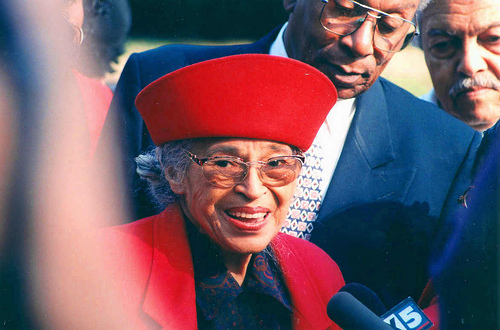
Photo credit: Elvert Barnes
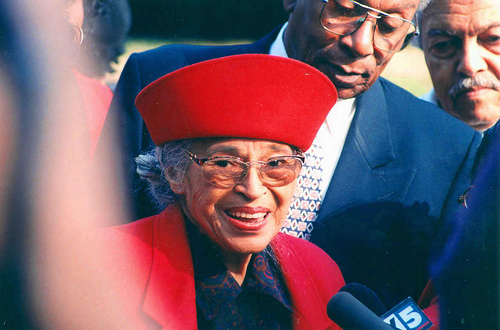
I wrote The Rebellious Life of Mrs. Rosa Parks to challenge the limited stories and troubled uses of Parks and the movement. There was nothing natural or passive about what Rosa Parks did but rather something fiercely determined. It was not a singular act but part of her larger lifelong history of activism, a string of acts of bus resistance in the years preceding her stand, and a collective uprising following her arrest that led to a mass movement in Montgomery. To the end of her life, Parks believed the struggle for racial justice was not over and she continued to press for more change in the United States.
I spent years researching and writing this biography, all while a store of Rosa Parks’s papers, photographs, and other material effects—priced at $ 6–10 million—languished without a buyer in a Manhattan auction house, given to it by a Michigan probate court to sell because of a dispute over her estate. Guernsey’s Auction allowed no scholars to assess the materials, a decision that treated Parks unlike other historical figures.
On August 28, 2014, the Howard G. Buffett Foundation purchased the Rosa Parks Archive for $4.5 million. Buffett had read an article about Parks’s effects having been stuck in storage for years without a buyer and “thought about…what Rosa Parks would want,” which would be to “preserve what’s there for the public’s benefit.” Two weeks later, the foundation announced it would give the papers and photographs to the Library of Congress on a ten-year loan. On February 4, 2015, that collection of 7,500 manuscript items and 2,500 photographs opened to the public. It includes letters to and from Rosa Parks to her mother and husband (including some written during the Montgomery bus boycott and in 1957–1958, when Parks worked at Hampton Institute); notes from speeches she gave during and after the boycott, as well as shards of personal writings; various notebooks and datebooks she kept, with addresses of supporters; tax statements and other financial records; medical bills; church materials; labor buttons from the 1940s; family albums; flyers, programs, and meeting notes, particularly from her post-Montgomery political life; and decades’ worth of photos of Parks. Though somewhat fragmentary, the collection offers a remarkable behind-the-scenes glimpse at Rosa Parks’s life, activism, and political philosophy. A rich artifact of twentieth-century black life, the papers broadly provide much primary source material on black migration, church life, family relations, health care, employment and economic life, and, most significant, the span of black politics and protest in the twentieth century.
Going through the collection was thrilling. The papers supply answers to some questions I couldn’t resolve when I wrote this book, but, more important, they add depth to a number of the arguments I begin in this book. The collection confirms and expands some of the central themes of this biography—in particular, the robustness of Rosa Parks’s political analysis; the key role she played not just in catalyzing the boycott but sustaining it; how much and how deeply she and her family suffered economically and physically in the decade after her arrest; and the breadth and substance of her political work in Detroit and in the half century after the boycott. It requires us to grapple with her ideas and life experiences, not simply honor her symbol.
I have long critiqued the ways that Rosa Parks gets fixed in a single act and not treated as a serious political thinker and lifelong activist. Like Martin Luther King Jr. and Malcolm X, Ella Baker and Angela Davis, Parks had well-developed critiques of white supremacy and thoughts on black struggle—yet she is rarely referenced or even thought of for her political ideas. The Rosa Parks Collection, first and foremost, provides an exceptional view of and reckoning with her political voice, particularly during her Montgomery years, a key theme of this book. (Most of the writings and speeches that have survived appear to date from the mid-to-late 1950s.) On scraps of paper and backs of programs, flyers, and envelopes, Parks’s ideas about the system of segregation, about the toll of growing up in the segregated South and how difficult it was to be a rebel, and about the importance of resistance and the movement she and other activists were trying to build come through. Describing segregation as “a complete and solid pattern as a way of life,” she wrote about being “conditioned to it and mak[ing] the best of a bad situation.” This system of segregation was much bigger than separate drinking fountains or bus seats; it was a pattern of economic, political, and social power for the white man’s “wealth and comfort.”
Parks wrote of the “poverty, segregation, threats” of her youth, along with the spirit of resistance and self-respect inculcated by her grandfather and mother. In the years following World War I, when the Ku Klux Klan moved through Montgomery County, her grandfather “kept his shot gun within hand reach at all times,” and she would stay awake with him, “keeping vigil.” In numerous accounts Parks lyrically highlighted the difficulty of negotiating oneself amidst segregation, writing in one passage: “We soothe ourselves with the salve of attempted indifference, accepting the false pattern set up by the horrible restriction of Jim Crow laws.” Describing how Jim Crow “walks us on a tightrope from birth,” Parks emphasized the “major mental acrobatic feat” it took to survive and that there was “no solution for us who could not easily conform to this oppressive way of life.”
Her resolve to change it began early. Parks’s grandmother worried about young Rosa’s feistiness, scolding her that she wouldn’t “live to be grown if you don’t learn not to talk biggety to white folks.” Parks told her grandmother, “I would rather be lynched than live to be mistreated, than not be allowed to say ‘I don’t like it.’” For Rosa Parks, getting to dissent, to say “I don’t like it,” was fundamental. Parks’s “determination never to accept it, even if it must be endured,” led her to “search for a way of working for freedom and first class citizenship.” She described the “frustration” of her teenage years and young adulthood—“anger, bitterness, hopeless.” With her husband, Raymond, she helped organize around the Scottsboro case and, in 1943, joined the Montgomery NAACP, becoming secretary and being active for the next dozen years, “getting registered to vote, examin[ing] cases of police brutality, rape, murder, countless others.”
***
In the rest of this new introduction for our reissue of The Rebellious Life of Mrs. Rosa Parks, due out on December 1, Jeanne Theoharis continues to describe the other writings she found in the Rosa Parks Archive. These documents attest to Parks’s tenacious spirit that championed social justice even in the face of lifelong hardships. Poverty and health issues resulting from the bus stand took a toll on Parks and her husband. She, nevertheless, charged ahead into her political activities in Detroit during the Black Power era, because for her the work was far from ever being over. Theoharis has done us all an invaluable service bringing to light the entirety of Parks’s story and legacy.
About the Author
Jeanne Theoharis is Distinguished Professor of Political Science at Brooklyn College of the City University of New York. She received an A.B. in Afro-American studies from Harvard College and a Ph.D. in American Culture from the University of Michigan. She is the author of The Rebellious Life of Mrs. Rosa Parks and author or coauthor of six books an numerous articles on the black freedom struggle and the contemporary politics of race in the United States. Follow her on Twitter at .