• By Lennard J. Davis

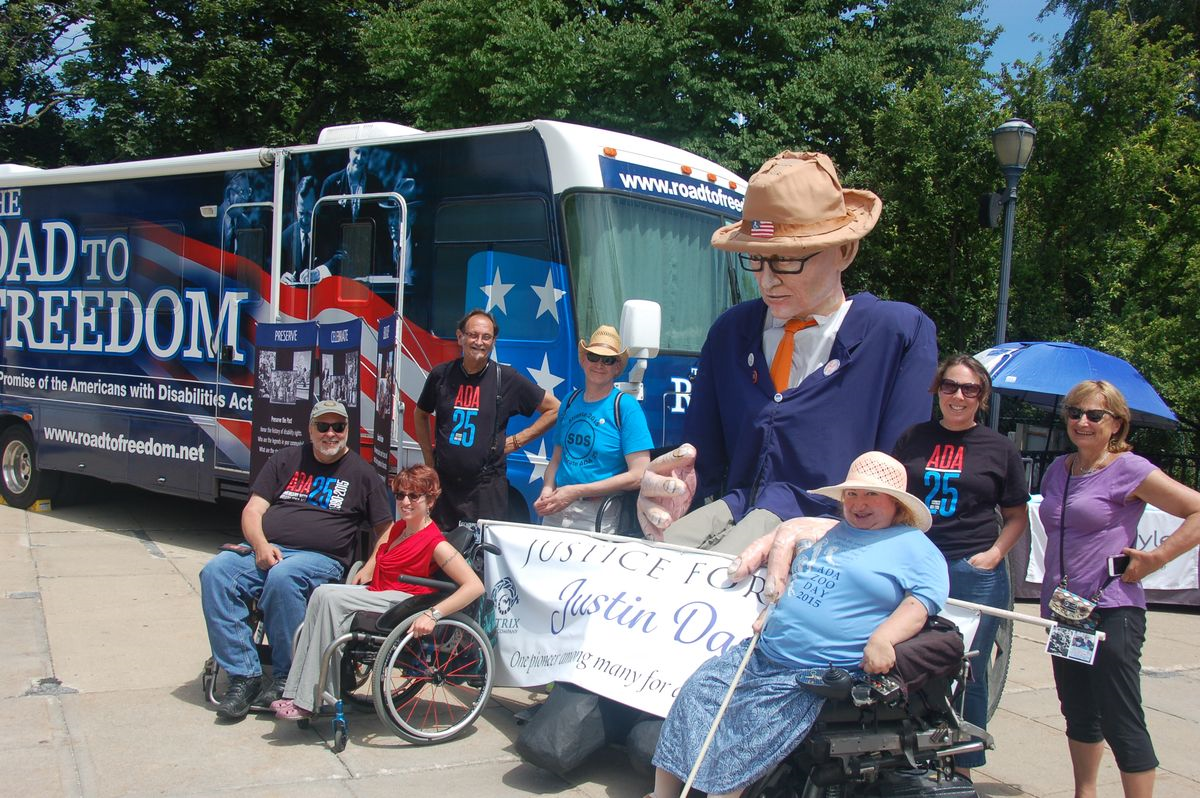
    Davis at the 25th ADA Anniversary

    Davis signing copies of Enabling Acts at the ADA 25th Anniversary Event in Washington, DC

    This blog appeared originally on The Huffington Post.

    While July 26 marked the twenty-fifth anniversary of the Americans with Disabilities Act, we need to recall that discrimination against people with disabilities is not over.

    The ADA accomplished a lot. It banned employment discrimination, made public transportation accessible, opened places of public accommodation and added closed captioning so the Deaf could watch television, to name a few. But discrimination against people with disabilities remains.

    There is economic discrimination. When we talk about the ninety-nine percent and the one percent, we may forget that within that ninety-nine percent there are some groups that suffer the most. There is no group in the US as badly off as people with disabilities who are the largest and poorest US minority.

    (more…)

  • By Carole Joffe

    Planned Parenthood

    Photo credit: Flickr user Fibonacci Blue

    This blog piece appeared originally on RH Reality Check

    As reproductive politics are once again consumed by an attack on Planned Parenthood, it is worth stepping back and asking why this organization is so particularly reviled by the anti-choice movement. This is a demonization that goes well beyond the shady outfit, the Center for Medical Progress (CMP), that organized the latest undercover filming, or its affiliated group, Live Action, infamous for releasing other debunked videos over the last decade. True, Planned Parenthood was reportedly not CMP’s only target, but the videos taken of its physicians have been the only ones to be released. Some Congressional Republicans, we now know, had prior knowledge of these videos, and predictably have issued calls for an investigation of the organization, joined by various Republican presidential aspirants. The videos have also given new ammunition to Republicans’ annual efforts to withhold all funds from Planned Parenthood for Title X services (primarily contraception and cancer screenings), which are subject to a yearly review. In short, the puzzle is why a national health-care organization—in which, as its spokespersons repeatedly point out, abortion only comprises 3 percent of all services delivered—is such a prime target of abortion opponents.

    One answer, of course, is size: Even if only three percent of its services are abortion, Planned Parenthood still performs a healthy share of all the procedures occurring in the United States. But the answer goes well beyond that. It speaks to an interesting historical split among Republicans over matters of reproduction and sexuality—and the eventual triumph of the most socially conservative wing among the party base.

    (more…)

  • By Kim E. Nielsen

    ADA Day Toledo 2015 D

    Photo credit: Kim E. Nielsen

    In the last three months The Family and I have twice piled into the car for eight-plus-hour (one way!) road trips to Washington, D.C. As family road trips, the journeys necessarily included junk food, some nausea, lots of laughter, sunburn, bickering, loud music, crowded hotel rooms, and unscheduled bathroom breaks. Unlike the usual family road trips, however, it’s been the season of Civic Road Trips. 

    On April 28, with thousands of others, we cheered for marriage equality before the steps of the Supreme Court building as the justices heard oral arguments. Road trip preparations had included learning more about the multiple state cases, interpretations of the Fourteenth Amendment’s equal protection clause, looking backwards to the 1968 case of Loving v. Virginia that declared bans on interracial marriage unconstitutional, and arguing about the purpose of dissenting opinions. We fell out of the DC Metro carrying our homemade signs and looking like the out-of-towners that we are. We cried as the plaintiffs emerged from the Supreme Court at the end of the day, weary, optimistic, and surrounded by the love of family. Two elderly men from Nebraska, who had been in love for decades, asked if we would adopt them because their own extended family had rejected them. In the midst of the profound we mundanely argued over who had to stay awake in order to drive home.

    (more…)

  • By Robert L. Fried

    Children in a Classroom

    Photo credit: Michael Anderson

    To a new teacher, or a teacher with years of experience, the twenty-first-century classroom can seem overwhelming.  Along with the traditional challenges that teachers face—disobedient kids, unfriendly administrators, demanding parents, shortages of supplies, or feeling isolated in the classroom—there are so many new aspects to consider, so many new issues to resolve, so many new demands to respond to, coming  at us seemingly from all sides:

    • national Common Core curriculum standards to decipher,
    • state mandates to respond to,
    • standardized tests to prepare for by picking and choosing what to teach,
    • district priorities to pay attention to,
    • school-wide goals to implement,
    • grade-level or departmental objectives to work into your lesson plans,
    • seemingly endless paperwork requirements, and
    • a flood of new technology, with its potential benefits and drawbacks,

    plus the need to respond to diverse children, their special needs, their parents’ expectations.  All in all, enough to make your job as a teacher seem well-nigh impossible.  The climate created by all of these mandates and pressures may well represent a new height of challenges for teachers, enough to make them feel besieged, overwhelmed, inadequate.

    But looked at from another perspective, the goalposts for your success as a teacher can look refreshingly clear and clearly achievable:

    • Help your students embrace these challenges, rather than shrink from them,
    • Recognize that building a strong and mutually respectful connection with your students is very likely to result in higher test scores—enough to protect your creative impulses from censure,
    • Be curious about your students and how they think, and let that curiosity drive your lessons (the best way of enlisting their respect for you and for themselves),
    • Love your subject(s),
    • Make sure that what you teach, and how you teach, relates well to the lives of your students, to their hopes, their current interests and future lives,
    • Help your students teach themselves and each other and feel powerful in doing so,
    • Try your best, when you get frustrated with a student’s behavior to become fascinated, instead,
    • Help them develop pride and confidence in themselves as “smart” in lots of different ways,
    • Resolve, when in doubt, to ask the kids—and listen to what they have to say.

    The difference between the first list of bullets and the second list is the difference between being a “besieged teacher” and being a “passionate teacher.”  Besieged teachers spend their reflective time (on the ride to or from school, when they are exercising, upon waking up in the middle of the night) worrying about all the things they’re supposed to do, all that they are responsible for, all that they must try to “cover.”  Passionate teachers spend their reflective time wondering how they and their students can enjoy their time together more, gain in knowledge and power, and take on the wider world with curiosity, creativity, and zest.  They also think about how they can captivate those hard-to-engage students, and how they can reach out to students who don’t seem to feel valued, or to value themselves.

    Besieged teachers often feel very much alone and vulnerable.  Passionate teachers are surrounded by partners—students, parents, colleagues, community members.  Besieged teachers are often apprehensive about what may happen in class tomorrow.  Passionate teachers can’t wait to get there.

    I recently visited my good friend, Deborah Meier, the author of The Power of Their Ideas and In Schools We Trust and the first public school educator ever to be awarded the MacArthur “genius” prize. Now in her eighties, Deborah is as sharp and as contrarian as ever, but we readily agree that curiosity, empathy, spontaneity, and flexibility—along with experience—are the qualities most likely to lead to great teaching (and, paradoxically, least likely to be emphasized in their preparation as teacher).

    Curiosity. It is a teacher’s genuine curiosity about his or her students, their experiences, their feelings, and their ways of thinking that provides the strongest basis for a mutually respectful and truly collaborative classroom. Try This: For the first week or two of the school year, whatever grade or subject you teach, spend at least half the time talking about things that your students know as much or more about than you do.  Pose the question: “What did you learn this summer that is just as important—or maybe more important—than what you learned in school last year?” or “Who is the greatest teacher you have had outside of school? And what have you learned from this person?”

    Or pick some questions from the subject area you are teaching. Here are some examples:

    Social Studies: “What rights for kids like you ought to be included in the Bill of Rights?”

    Foreign Language: “Who are you going to teach Spanish/French/German to this year?” (because we all know that one of the best ways to learn a language is to teach it).

    English: “If you were going to write a great story about something you know more about than anyone else in this class, what would you write about?”

    Math: “If you had the power to get rid of any part of math—such as fractions, decimals, equations, negative numbers—what would you get rid of? And why?”

    Science: “If you were offered a chance to be on the first space trip to Mars—lasting two years—would you go?  What would you contribute to the space mission?”

    Health: “If you could live to be as old as you wanted to—getting older all the time—what age would you choose to die?”

    Spontaneity. “I never imagined being a kindergarten teacher for more than a year or two, so I never bothered to try to be a professional at it,” recalls Deborah (who taught kindergarten for many years in Chicago before, eventually, creating the landmark Central Park East K-12 public school in New York City in the 1990s).  “I just went into the classroom each day to see what I could discover about how kids learn best and develop their ideas and social skills.  Of course I had a vague plan that included some focus on letters and numbers. But that never interfered with the creative play and story-telling that was our chief activity.” (A recent NPR series has, in fact, highlighted the role of play as essential in developing children’s mental acuity, as well as their social skills.)

    “As a result, my young students rarely felt burdened by the weight of my expectations for them. Instead, they occupied themselves with exploring the materials and friendships that were there for them, which of course included my sometimes explaining to them why they should, or should not, do certain things (this is what is now often referred to as ‘classroom management’—a term I abhor, since I have never yet met a person, young or old, who responded well to being ‘managed’ by someone else). They knew that the questions I asked them were real questions, not ones I already had the answer to. Kids are too smart to be fooled by ‘questions’ that are really didactic statements disguised as questions.”

    Spontaneous human interaction allows teachers and students to learn how to moderate their own behaviors while pursuing learning that seems meaningful and enjoyable. “You can’t just take away Tiffany’s blue crayon, because if we all grabbed the things we want, then the biggest bully would have all the crayons.” We learn most from the mistakes we make (including how we can best rectify them), and it is in a spirit of spontaneity—which entails looking with a fresh eye at each new situation to see what can best be learned from it—that we are likely to make the most productive mistakes.

    Empathy. Most experts agree that all children do the best they can to succeed in life. Often they make mistakes. Sometimes they have not been well treated at home and react angrily or defensively to others. Many fear being embarrassed or humiliated in front of their peers.  If we can say to ourselves, “This kid, who’s causing me such a headache, is trying his best to solve the problems he faces in his life,” we may gain enough perspective to respond sympathetically and creatively, even though this kid is driving us nuts. One psychologist I know, when faced with a kid who in a moment of frustration yells out something vulgar, reacts with, “Well, that was unexpected!” It clears the air, defuses the tension and allows him to follow up, one-to-one, with the child when things have cooled down.

    A former student of mine who now teaches English in a bilingual middle school in Boston prepares her students for standardized testing by spending one day per week helping them figure out how to beat the test. She says stuff like, “A typical short-answer test question offers you four choices. Two are fairly obviously incorrect. One is the right answer. And one is designed by the test-makers to make their kids look smart and you look dumb.” The other four days of the week she devotes to Shakespeare, but because her empathy places herself and her students on the same side, her kids do really well on the tests—and learn to love Shakespeare.

    Flexibility. It’s getting harder to remain flexible in the face of excessive demands placed on teachers by the expectations of school officials and test-makers, so it’s even more essential to try to remain flexible, to take time to pursue an interesting tangent, to invite the class to take a stretch break, to let your students choose a CD to play while they are reading or writing silently—or to change direction for an hour, a day, a week. Such flexibility can combine all the other ideas, of curiosity, spontaneity, and empathy to show your students how deeply you care about ideas and feelings that are important to them. The confidence you will all gain from learning how to break free of the reins, from time to time, will allow you and your students to become true partners in the learning experience.

    The new teacher who goes home in tears every day for the first six months is probably the victim of very bad advice—advice that focused on control and compliance, and that warned “you’ve got to show the kids who’s boss!” Their tears were the result of the teacher’s naturally positive expectation coming smack against an unnaturally hostile and demeaning environment in the school. It’s not you-against-the-kids; it can only be you-and-your-students-against-ignorance.

    You can avoid the “besieged teacher” syndrome and discover (or rediscover) the passionate teacher within if you can discipline yourself to focus on the positive goals for you and your students. And if you make building a respectful and productive relationship with them your first priority.


    About the Author

    Robert Fried is author of The Passionate Learner and The Passionate Teacher and associate professor of education at Northeastern University. He works with teachers in schools around the country, and lives in Concord, New Hampshire.


  • By Amy Caldwell

    Beach in Gaza City

    Beach in Gaza City

    July 8 marks the anniversary of the Israeli-Gazan conflict, one of the subjects that concerns Amy Caldwell, executive editor at Beacon Press. She has acquired The Drone Eats with Me: A Gaza Diary by Atef Abu Saif, a writer and teacher from Jabalia Refugee Camp in the Gaza Strip. Due out next year in time for the second anniversary of the conflict, Saif’s book offers a rare glimpse into the ongoing war for Western readers. Here, Amy talks about acquiring the book and what attracted her to Saif’s story. A preview from the book follows.

    ***

    I was curious and interested immediately because I’d done a certain amount of publishing about issues I find troubling as someone of Jewish descent among Jews in America. Things that I find troubling are what seem to be growing racist attitudes and a right-wing hardening of politics in Israel and America. We’d recently published Alan Wolfe’s At Home in Exile, which argues that Jews are now at home in exile, that living in multicultural environments has been good for Jewish people. Of course, the ongoing tensions and war between Israel and Palestinians are on my list of topics that I’m concerned about and want to publish. But it’s hard to think about how to do it well and what needs to be done. So when editor Ra Page at Comma Press in the UK sent me an email about The Drone Eats with Me, I told him I’d love to take a look at it.

    (more…)

  • By Lennard J. Davis

    image from upload.wikimedia.org

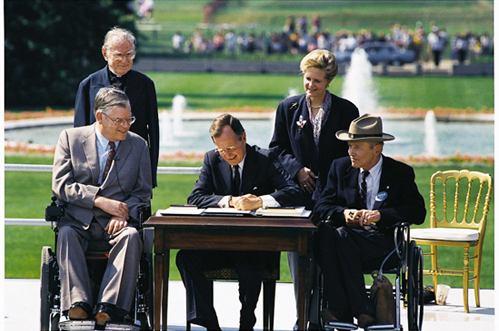
    President Bush signs the Americans with Disabilities Act into law

    This weekend, celebrations marking the twenty-fifth anniversary of the Americans with Disabilities Act will be in full swing. Members of our country’s largest minority will be at pride festivals honoring the history of fighting for the overdue rights that made the world more accessible to them. Published for the ADA anniversary, Enabling Acts by University of Illinois at Chicago professor Lennard J. Davis—whose mother and father are both deaf—traces the nearly twenty years of activism and legislation that gave rise to the ADA. They were, indeed, an intense twenty years. Here we present the opening of his book, and the forty-six words that changed history for those with disabilities.

    ***

    Trying to find a moment when the ADA began is like trying to find the source of the Nile or the Amazon. So many tributaries flow into the making of the ADA that you cannot say if any single stream is the true source. But you can say that at some point, like a mighty river, the movement toward the ADA surged powerfully and in a sense became inevitable.

    But as inevitable as the act now seems in retrospect, Congress might very well have failed to act sufficiently to create a meaningful bill rather than a document simply expressing general platitudes. Certainly, an ADA could not pass Congress today. In fact, ratification of the UN Convention on the Rights of Persons with Disabilities was defeated in the Senate in 2012. Bob Dole, who was instrumental in getting the ADA through Congress, arrived on the Senate floor in 2013 to argue emotionally that the convention should be ratified. At eighty-nine, he’d been in and out of Walter Reed Army Medical Center for two years and appeared drawn and fragile. Despite his dramatic appearance, the convention ratification was defeated. Dole, Harkin, and Hoyer all have asserted that if the ADA came up for a vote in 2015, it would be defeated.

    The ADA is an excellent example of a bipartisanship no longer extant but made possible when a Republican president, George H. W. Bush, worked together with a Democratic House and Senate. The cooperation of Republicans Dole and Hatch together with Democrats Kennedy and Harkin in the Senate, along with Republican Steve Bartlett and Democrat Steny Hoyer in the House, was essential. All these political leaders believed that disability was an issue both parties could agree on. In fact Justin Dart, a conservative Republican, said, “The Americans with Disabilities Act is an authentic issue for conservatives.” And that perennial conservative, bespectacled George Will, whose eldest son has Down syndrome, supportively called the ADA “that last great inclusion in American life.” Today, it is almost impossible to imagine such crossing of party lines for the common good. And the day-to-day workings of the principals and their staffs in passing the ADA should be an object lesson to those presently in the halls of power.

    The 1960s legislation that guaranteed rights and gave benefits to poor people, Vietnam veterans, people of color, and, among others, the disabled, began to open the door to the concept that being disabled was not simply a medical fact or a social stigma. Disability, like ethnicity, was an identity, and as such, it needed to be protected from human rights abuses and civil rights abuses.

    We use the term civil rights a lot, but what exactly are these rights, and why weren’t they just inherently part of citizenship in a country with a bill of rights? Civil rights in general protect citizens’ freedom from governmental or other intrusion into their lives and guarantee that citizens can participate fully in civil and political life. If those rights are applied unequally to citizens or are on paper only but not robustly part of citizens’ lives, then specific legislation detailing how those rights should be protected and enforced is enacted.

    Looking back, you can see the slow accumulation of civil rights legislation that produced precedents for the ADA. Acts passed by Congress piecemeal were deposited on the American shore like pebbles and sediment that would eventually transform the bedrock of the laws of the land. You could take the Civil Rights Act of 1964 as it combined with the establishment of Medicare and Medicaid in 1965. Add to that the Fair Housing Act that was passed in 1968 and prohibited discrimination in the sale or rental of property. The same year, the Architecture Barriers Act announced that all federal buildings or buildings built with federal funds had to be accessible. Then, in 1972, Title IX of the Education Amendments Act moved to add protections against discrimination based on gender in the realm of education. So in a mere eight years, a trend toward expanding protections for people based on their civil rights had developed.

    Of course, it was a particular era in American politics when an expansion of the role of government provided help and services to a wide group of Americans. Lyndon Johnson’s Great Society aimed to eliminate or reduce poverty and spread the postwar wealth to the general population.

    In 1972, Hubert Humphrey, one of the architects of the 1964 Civil Rights Act, made a bold move to amend the act to include disability. On the Senate floor, Humphrey said: “No longer dare we live with the hypocrisy that the promise of America should have one major exception: Millions of children, youth, and adults with mental or physical handicaps. We must now firmly establish their right to share that promise, so well described by Thomas Wolfe [the novelist, in his You Can’t Go Home Again]: ‘To every man his chance; to every man, regardless of his birth, his shining golden opportunity. . . . [This] is the promise of America.’” As the grandfather of a child with Down syndrome, Humphrey was keenly aware of the issues facing people with disabilities. But the idea had absolutely no traction. Despite Humphrey’s efforts, no legislation was passed. It was all right to take a piecemeal approach to protecting various aspects of disability, but when the idea to simply include disability as an identity along with race was proposed, there was no strong force behind it.

    Interestingly, many politicians, including African American politicians and leaders, were wary of “diluting” the signature civil rights established in 1964 by letting in other categories like disability. They also feared bringing the landmark legislation back on the floor. Once there, the legislation might be changed in nonproductive ways. In that way, the rights of people with disabilities were seen as a problem rather than a solution.

    Party leadership proposed to Humphrey that his language from the failed attempt be added instead to the Rehabilitation Act in 1972. This act was itself designed to update the original 1920 act that provided services to World War I veterans who were disabled during the Great War. Now, as disabled soldiers returned from the apocalypse of the Vietnam War, rehabilitation became a national issue again. Although Congress passed the new act after much wrangling, President Richard Nixon twice vetoed it. He did not like the provision of federal funds to the states to pay for independent living for people with severe disabilities. Independent-living centers at this time were in need of funds, all of which were going to vocational rehabilitation centers. These rehab centers focused on a medical model of disability rather than a more humane viewpoint that involved the lived experience of people who were so much more than patients. Independent-living centers were run by people with disabilities themselves and stressed a noninstitutional model—people living at home with personal assistants and working at jobs in a way equal to able-bodied people. After the first veto, Congress proposed an ameliorating change in the bill, but Nixon vetoed it again. Finally, the bill was passed in 1973, this time without the guarantee of federal funds for independent living (although those were restored in a 1978 amendment known as the Title VII program).

    On September 26, 1973, President Nixon signed into law the Rehabilitation Act. The spirit of the act was to shift federal assistance away from mere vocational rehabilitation and toward a more encompassing idea of improving not just job training but the overall lives of people with disabilities. Yet its lasting impact inhered in just four lines of the voluminous act. Like a magic phrase inserted into an incantation, those four lines changed the history of disability rights. In Section 504, the very last section of the last major category, a staffer inserted the following words trying to tie the act to previous civil rights legislation:

    No otherwise qualified handicapped individual in the United States, as defined in Section 7(6), shall, solely by reason of his handicap, be excluded from the participation in, be denied the benefits of, or be subjected to discrimination under any program or activity receiving Federal financial assistance.

    In all the arguing on the Senate and the House floors, all the contention and rewriting of this bill, and all of Nixon’s objections to the bill as a Great Society remnant, barely anyone noticed or commented on this squib. Yet Section 504 became the first brick in the groundwork laid for the ADA. It was the first federal language that clearly and uncompromisingly guaranteed the civil rights of people with disabilities; it was modeled on Title VI of the Civil Rights Act and Title IX of the Education Amendments Act—both of which never mentioned people with disabilities. Section 504 was only forty-four words, yet its tweet-like length belied the volumes of language it would generate in the coming years.


    About the Author

    An award-winning author of eleven books, including Enabling Acts and My Sense of Silence, Lennard J. Davis is Distinguished Professor of Liberal Arts in the departments of Disability Studies and English at the University of Illinois at Chicago. He has written for the New York Times, Chicago Tribune, Nation, and Chronicle of Higher Education, among other publications. He lives in New York City. Follow him on Twitter at @lendavis.

  • By Rev. Dr. William J. Barber II

    This piece was originally delivered as a sermon and appeared previously in Sojourners.

    image from upload.wikimedia.orgDuring my meditation on the messages being sent out from South Carolina this week, three scriptures came to me: 

    Jeremiah 31:15: This is what the LORD says: "A voice is heard in Ramah, mourning and great weeping, Rachel weeping for her children and refusing to be comforted, because they are no more."

    John 8:32: Then you will know the truth, and the truth will set you free.

    Isaiah 58:1-3: Shout it aloud, do not hold back. Raise your voice like a trumpet. Declare to my people their rebellion and to the descendants of Jacob their sins. For day after day they seek me out; they seem eager to know my ways, as if they were a nation that does what is right and has not forsaken the commands of its God. They ask me for just decisions and seem eager for God to come near them. “Why have we fasted,” they say, “and you have not seen it? Why have we humbled ourselves, and you have not noticed?”

    Yet on the day of your fasting, you do as you please and exploit all your workers. Your fasting ends in quarreling and strife, and in striking each other with wicked fists. You cannot fast as you do today and expect your voice to be heard on high.”

    When the Confederate flag was removed from the South Carolina statehouse Friday morning, Gov. Nikki Haley spoke solemnly of the nine Black churchgoers who were shot to death less than a month ago at Charleston’s Emanuel African Methodist Episcopal Church. “We have all been struck by what was a tragedy we didn't think we would ever encounter,” Haley said of the horrifying massacre. Before signing the bill with nine pens that will go to the families of the victims, she called those who were murdered during Bible Study at the historic church, “Nine amazing people that forever changed South Carolina's history.”

    The Governor referenced the “grace” shown by the nine families, when they forgave the white gunman. She said their grace helped usher the state toward this long overdue decision.

    (more…)

  • By Ruthanne Lum McCunn

    image from www.beacon.orgOur 2015 reissue of Ruthanne Lum McCunn’s classic, Thousand Pieces of Gold, is on sale! First published in 1981, McCunn's novel was adapted to film a decade later with actors Chris Cooper and Rosalind Chao. It's been a star of the Beacon backlist for all these years, being adopted by book groups and used in classrooms (middle school, high school, and college). For this new edition, we've reissued it with new historical material. McCunn has written a new essay, taking readers through the challenges she encountered while researching Polly Bemis’s life. Readers will note how her discoveries and the documents she found outline the hardships Polly endured as a legendary pioneer fighting for independence and dignity in Gold-Rush America. 

    ***

    Lalu Nathoy/Polly Bemis left no written records. Neither did the person closest to her: Charlie Bemis. So I looked for the two in pioneers’ recollections, newspapers, photographs, and documents. Sifting through my findings, examining, reexamining each fragment for value, I always feel like a miner panning for gold.

    From the start, Polly’s Certificate of Residence and marriage certificate shone bright. These papers, having survived a devastating fire, must have been important to Polly and Charlie. Why?

    The 1892 Geary Act required each Chinese laborer living in the United States to register and apply for a Certificate of Residence within the year. Those who did not would be presumed to be in the country unlawfully and, therefore, subject to arrest and deportation—unless a white witness swore that the failure to register had been due to illness or accident. Protests and legal challenges by Chinese failed to overturn this law but did extend the period for registration.

    (more…)

  • By Kay Whitlock

    image from mdah.state.ms.us

    This is the second part of the two-part discussion of Harper Lee's Go Set a Watchman begun on July 17 with Michael Bronski's blog piece.

    ***

    What is always at stake in a contest of imaginations is the question of whose lives matter.

    —Considering Hate: Violence, Goodness, and Justice in American Culture and Politics 

    It’s been so long since we’ve caught up with Atticus Finch—a little more than half a century if you count the time between books. It is now the 1950s, twenty years later, and his daughter Jean Louise—Scout—twenty-six years old and living in New York City, returns home to Maycomb, Alabama for a visit.

    And despite the passage of time he really hasn’t changed at all. Despite what some sensation-seeking book reviewers, shocked readers, and disoriented English teachers will tell you, he’s pretty much the same man he always was. We finally have his backstory in print.

    He’s older, has rheumatoid arthritis, and is grooming a successor to his legal practice. Atticus Finch hasn’t morphed from a champion of racial justice to a racist. That he’d long made a comfortable peace with white supremacy was there from the moment Lee’s now classic To Kill a Mockingbird was first published. Despite defending Tom Robinson, a Black man, against a false accusation of rape made by a white woman, he was at home with structural Jim Crow. This was never stated but permeated the story without being critically noted by the author—or countless readers—in any obvious way.

    (more…)

  • By Michael Bronski

    image from media.portable.tvThis blog post is one of two about the publication of Harper Lee's Go Set a Watchman. To read part two, Kay Whitlock's follow-up on the conversation, click here.

    ***

    American readers love stories of political uplift and inspiration rather than forthright, bluntly honest accounts of unpalatable truths and realities. They especially love them when they are spoken by innocent young girls.  

    After just over half a century, Harper Lee, author of the beloved To Kill a Mockingbird, has released Go Set a Watchman, her eagerly awaited second novel. But, with a novelist’s twist, Watchman is, in reality, her first novel, an earlier version of Mockingbird’s characters, but set later in their lives. 

    Lee submitted Watchman in 1957 to Tay Hohuff, an editor at J.B. Lippincott and Co., who felt the manuscript—in which Jean Louise Finch confronts the racism her of father Atticus, her potential lover Henry, and her beloved town—needed considerable work. Hohuff worked with the thirty-one-year-old first-time novelist to rewrite the story from the perspective of a younger version of the narrator, two decades earlier. That version, in which Atticus’s overt racism is erased or obscured, became To Kill a Mockingbird. 

    (more…)