• By Alexis Rizzuto 

    Fort Point photo 1

    Photos by Tom Hallock

    A year ago, when UUA/Beacon left our location on Beacon Hill to move to the Innovation District, I sorely regretted the change of scenery on my morning walk into the office. No more expanses of grass, tree-lined paths, dogs frolicking, tourists feeding the squirrels, songbirds chirping, the occasional hawk soaring over the Common. Instead, the walk through concrete—despite the oasis of the Greenway—was decidedly less green. I had hopes of observing sea life from the bridge on my daily walk over the channel, but the water seemed devoid of anything but ubiquitous seagulls. No happy little seal face broke the surface, no fish jumped, no migratory waterfowl paddled. And yet, over the year and much to my surprise, I learned much about the natural world.

    Fort Point photo 3For one thing, I’ve never lived on the shore, so I had never had the opportunity to observe the tides week after week. I noticed the normal high and low water mark on the pilings in the channel. One day, I was surprised to see the water reaching almost to the top of the pilings, and perilously close to the boardwalk attached to the buildings on the eastern side. Soon after, I noticed the lowest tide I’d seen, revealing more of the gravelly “beach” below the channel’s western wall. What was going on? Had there been a storm? I seemed to recall learning in school something about the tides and the moon, so I looked it up. As most people are probably aware, the tides reach their highest and lowest extremes as the moon is at its most full and when it is new, at the turning of its cycle. But to me, this was an opportunity to observe in the real world a long-forgotten lesson in action: when the sun, moon, and earth are in a line, the gravitational pull is strongest, causing the greatest range of tides.

    I also learned that while the sun rises in the east and sets in the west, it also moves north and south. My route to work fell between two tall buildings, and each day the sun shone directly in my face. Of course, it was morning and I was walking east. Yet as the months wore on, I noticed that I no longer needed to shade my eyes. Wait—I walked in the same direction at the same time every day, but the sun had moved to the right and behind a building. I had just read a book on Cape Cod, The Outermost House, in which Henry Beston writes, “All these autumn weeks I have watched the great disk going south along the horizon of moorlands beyond the marsh…” Now I saw what he meant. For those of us in the northern hemisphere, the sun moves south in the fall and north in the spring. Again, maybe this is common knowledge, but I hadn’t really made the connection and only noticed it because of my daily walk in the concrete jungle.

    (more…)

  • By Martha Ertman

    This post originally appeared in Women's Review of Books.

    One prominent theme of the oral arguments on April 28 in the Supreme Court marriage equality cases (Obgerfell v. Hodges) was the justices’ fear that recognizing same-sex marriage would lead to child marriage, incest, and polygamy. “Slippery slope” is the phrase we use in law-school classrooms to describe a trajectory, or “parade of horribles.”

    As we wait for the decision, it’s worth asking how slippery this slope is. Is it like a forested hillside or more like a playground slide? If the legal and social context is like a forest, then a person skidding from the top of a hill would be blocked by the trees. But if it’s more like a slide, she would almost inevitably reach the bottom. The answers are different for child marriage, incest, and polygamy. 

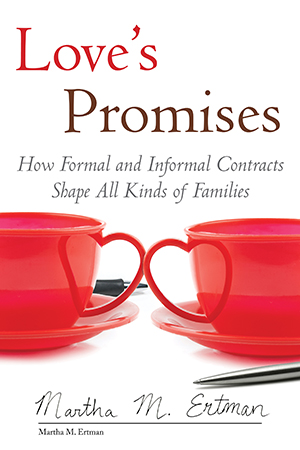
    ERTMAN-LovesPromisesBefore getting into specifics, I should say a few words about how I see marriage, since the institution has meant so many things in different times and places. As a contracts professor, I focus on its contractual aspects. (If you, too, like the idea of consent and reciprocity in relationships, check out my new book Love’s Promises: How Formal & Informal Agreements Shape All Kinds of Families.) Linking love and contracts has a long history. Since the founding, US law has seen marriage as a mix of status and contract, in different proportions at different times. Generally speaking, a status relationship is forever; while contractual relationships usually can be dissolved by the parties according to the contract’s terms.

    As feminist reforms such as married women’s rights to hold property and make contracts took root in the mid-nineteenth century, Sir Henry Maine famously observed in Ancient Law that the trend in progressive societies has been from status to contract. 

    Training a contractual lens on the slippery slope reveals that marriage equality for gay people is unlikely to lead to child marriage or incest. Polygamy, though, is a different story. For a decade now, the movement for marriage equality and gay rights litigation more generally has inspired fundamentalist Mormons to seek to decriminalize their sacred institution, and if that succeeds they may well seek marriage equality for themselves.

    (more…)

  • By Kay Whitlock

      image from static1.squarespace.com

    Think of it as instructive as well as tragic public spectacle, the bizarre eruption of violence between police and members of biker gangs in the parking lot of a Twin Peaks Restaurant in Waco, Texas on May 17, 2015 that produced a wide swath of casualties—all of them bikers.

    Nine people were killed by gunshot, 18 people were sent to hospitals, and approximately 170 were thrown into the clink on felony charges related to the commission of organized criminal activity, with absurd bail set of $1,000,000 per person.

    This unusual armed confrontation among predominantly white participants produced competing (and ludicrous) storylines—about victimization, persecution, danger, and safety—that drove the sensational media story. In largely unexamined ways, the Waco debacle also illuminates the dynamics and public discourse that keep the dominant American imagination stuck in the mire of false assumptions about violence (and who perpetrates it) and public safety.

    We might well regard the lethal Waco events, the politics, and the mass media discourse surrounding the violence as a house of mirrors.

    (more…)

  • By Michael Bronski

    image from upload.wikimedia.org

    Image from Flickr user Laverrue

    As we move into LGBTQ Pride month we are being met with a deluge of public discussions, events, breaking news stories, and potentially groundbreaking legal decisions that impact not only the queer community but American social and political life. The Supreme Court is poised, by the end of the month, to make a major decision. Not on the fate, but the expansion of marriage equality. Caitlyn Jenner’s blossoming appearance on the cover of Vanity Fair moves the public discussion of transgender lives forward in major and surprising ways. The Supreme Court’s 2014 Hobby Lobby decision set a new bench mark for legal definitions of “religious exemptions” and the constantly contested interplay between anti-discrimination laws and religious freedom in America. 

    A decade ago, executive editor at Beacon Press Gayatri Patnaik asked me to edit Queer Ideas and Queer Action, two new series for Beacon Press. We were acutely aware that while smart books on LGBTQ issues are always needed, the news cycle of these issues, not to mention the rapid advances that the movement has been making, could easily render today’s vital topics less important, or even passé and obsolete tomorrow. The challenge was to identify contemporary, critical social and political issues, and find people to write about them in ways that would transcend the political moment and shape and form the conversation for years to come. Looking back, I believe we have done that and more. 

    (more…)

  • By Sharon Leslie Morgan and Thomas Norman DeWolf

      image from www.yesmagazine.org

    This post originally appeared in Yes! Magazine.

    We embarked upon a journey to test whether two people —could come to grips with deep, traumatic, historic wounds and find healing. We had no idea where we would end up.

    Sharon’s Story

    I burst into tears in the parking lot of the Lowndes County Interpretive Center in rural Alabama. Tom and I were five days into the 6,000-plus mile “healing journey” that informed Gather at the Table, the book we wrote about healing the many wounds Americans inherited from the legacy of slavery. We had just crossed the Edmund Pettus Bridge in Selma where, in March 1965, John Lewis (now a 15-term U.S. congressman) and more than 600 protesters tried to begin a 54-mile march to Montgomery. On a day that came to be known as “Bloody Sunday,” Alabama state troopers confronted the peaceful marchers and viciously attacked them with billy clubs. I watched these events unfold on television as a 14-year-old child embraced in the warm comfort of my family home in Chicago.

    My great-grandparents were enslaved in Lowndes County, Alabama, which is at the heart of the historic march route. They lived a lifetime of Bloody Sundays. My great-grandmother Rhoda Reeves Leslie was alive when I was a child. I knew her. I loved her. I had no concrete idea, until that very moment in the parking lot, what anguish she and other members of my family had suffered as slaves, and then as people who were terrorized by Jim Crow laws, disenfranchised from voting, and kept from becoming full citizens in “the land of the free and the home of the brave.” In 1965, there were zero black voters in Lowndes County because of voter suppression through poll taxes and intimidation. Even today, it is deeply impoverished. Tom’'s face morphed into a representation of all white people and everything they had done to people like me.

    Tom's Story

    I didn’'t know what to say. So I said nothing. I sat in the passenger seat next to Sharon while she sobbed. Twenty minutes earlier, on the drive from the Voting Rights Museum, I had asked her, “What would you do if you had lived here then?”

    “I would kill them,” she said, staring straight ahead as she drove, clutching the steering wheel in a death grip. I watched the first tear roll down her cheek.

    I am often accused of being a Kumbaya kind of guy. I believe seriously in love and peace and want everybody to get along. I also believe that people are born with a basic sense of humanity that can enable them to change—not just themselves but the communities in which they live. I know Sharon shares that belief, but it is sometimes hard to keep the faith.

    (more…)

  • By Marilyn Sewell

    image from recoverytalks.files.wordpress.com

    This blog originally appeared in The Huffington Post.

    I don't know about you, but I'm already missing AMC's "Mad Men": nevermore will I see Joan's clothes and fulsome figure striding into the office; Peggy's terrible design sense regarding her own clothes, coupled with her rising sense of self-worth; Roger's off-handed remarks, full of irony and wit; and most of all, Don Draper, who has it all—striking good looks, sexual magnetism, business acumen, and finally, lots and lots of money. But these are not my reasons for regretting Don's departure. I am drawn to him because he is struggling mightily with the worm at the core, a value system that is way off kilter, causing him and those who love him a plethora of pain.

    Why are we so compelled by Don? Well, it is true that a good man is hard to find—but the bad ones are so much more interesting, at least in fiction, if not also in life. Don is not Machiavellian, he doesn't really mean to hurt his wives, his lovers, his partners—no, he is an unconscious bull in the china shop of relationship. He keeps a dark secret that would undo him if it were revealed, but that secret becomes a preoccupation in his subconscious, so distracting that he quite unwillingly becomes a person who undermines his own formidable gifts and leaves a trail of broken hearts and lives in his path. The fact is, Don can't be intimate. He can be gentle, kind, generous, but no not intimate, because he has a hidden history that defines and undermines him at every turn.

    And Don is undone not only by his history, but by the consumer culture that has been the context for all our lives since the '60s—the inundation of advertising driven by corporations, and the ad agencies that manipulate for money. Don has become a hired gun, and no one is better at the fast draw. So the man who is living a lie in his personal life fits perfectly into a culture that is grounded in anything but the truth. The brilliant visuals which open each episode show a man in a suit, spiraling down, out of control. The theological term would be "fallen."

    (more…)

  • Since Timothy Caulfield’s Is Gwyneth Paltrow Wrong About Everything? went on sale this month, the media have been abuzz with cuts against bogus movie star beauty and health regimens. In the first half of his book, Caulfield, professor of health law and science policy at the University of Alberta, debunks the pseudoscience of deep cleanses, snail facials, and super juicing, just to name a few. No matter how deep the cleanse, or how super the juice, your body and well-being will not glow from the purported benefits endorsed by the rich and famous. Caulfield's certainly did not. That his research has practically divested Gwyneth Paltrow of her dubious title of queen of health and beauty is what most media hubs have latched onto. 

    But there is more to Caulfield’s book than Ms. Paltrow’s misinformative lifestyle tips. The heart of his argument, featured in the second half, focuses on the sociological implications of celebrity culture obsession. The countries with the highest level of social disparity are the most obsessed with fame—fame to be earned effortlessly by being one’s self in front of a camera for a reality TV show or by dint of becoming a rock, movie, or sports star. Striving toward fame, or even aspiring to it, is not what it is cracked up to be. In the following passage, Caulfield lays bare some of the adverse side effects. Interestingly enough, the celebrity industry is not entirely responsible.

    ***

    The countries that seem the most obsessed with celebrity culture (i.e., the United States, United Kingdom, South Korea) do not score particularly high in rankings of population happiness. According to the 2013 World Happiness Report, a study prepared for the United Nations, the happiest countries in the world are Denmark, Norway, and Switzerland. Canada ranks sixth. The United States and the United Kingdom, two countries that both produce and consume a great deal of celebrity culture, rank seventeenth and twenty-second, respectively. These same celebrity-loving countries also have a terrible record when it comes to social mobility. The United Kingdom ranks last among the thirty-four nations in the Convention on the Organisation for Economic Co-operation and Development (OECD), and the United States is third from last. In other words, in these countries, moving up the socioeconomic ladder is nearly impossible. If you are born into poverty, you are likely to stay in poverty. If you are a middle-class kid, chances are you will be a middle-class adult. Ditto your kids. (Incidentally, the country that has the highest degree of social mobility? Happy Denmark.)

    Some commentators have gone so far as to call the American dream a myth, a topic I discussed with Howard Steven Friedman, a well-known statistician with the United Nations and author of The Measure of a Nation. “The idea of social mobility, of becoming rich, is core to the American mythology,” Friedman says. “But, ironically, American performance in this area is consistently one of the worst of the developed nations.” Friedman has observed that the statistics are depressing for those “who subscribe to the notion that America is a meritocracy and a ‘land of opportunity.’” And the data tell us social mobility is getting worse.

    (more…)

  • By David R. Dow

    According to the Sixth Amendment, Dzhokhar Tsarnaev, the Boston Marathon bomber, was entitled to a public trial at which he would be judged "by an impartial jury of the State and district" drawn from the community where the crime occurred. Yet while well more than half the people from the Boston community opposed the imposition of the death penalty, Tsarnaev was nevertheless sentenced to death. How did that happen?

    A day after the verdict, a handful of major media outlets, including Esquire magazine and MSNBC, reported the news by observing that it was a big loss for Judy Clarke, Tsarnaev's lead defense counsel, as if the trial were a baseball game, and Clarke had struck out with bases loaded and two outs in the bottom of the ninth. The reality is, to switch metaphors, Clarke and her team had about as much chance as saving Tsarnaev as a craps player has against the house rolling loaded dice. In fact, it would have been miraculous if Clarke and her team had eluded a death sentence for their client, because Tsarnaev's fate had been sealed long before he ever met his lawyer. 

    So when exactly was it sealed? It did not happen on that spring day in 2013 when Tsarnaev placed a homemade bomb in front of the Forum restaurant on Boylston Street, which exploded and killed Martin Richard, an eight-year old child, and Lingzi Lu, a 23-year-old graduate student from China who was studying at Boston University. Nor did it happen on January 30, 2014, when the U.S. Justice Department announced it would seek the death penalty. It was not even sealed on March 4, nearly two years after the horrific bombing, when Tsarnaev's jury was finally selected and his trial began. 

    And it wasn't even sealed during the trial itself. Quite the contrary: According to media reports, three jurors believed Tsarnaev had acted under the influence of his older brother; two believed he was genuinely remorseful. Considering that all it takes to avoid a death sentence is a single juror who holds out for life, the fact that these jurors accepted at least one of the major themes of the defense narrative suggests that Judy Clarke and her team did their job well and that fact reinforces the same question: Why, then, was Tsarnaev nevertheless sentenced to death?

    (more…)

  • By Nicholas DiSabatino

    image from www.beacon.orgIn Love’s Promises, Martha M. Ertman, a law professor at the University of Maryland’s Carey Law School with an extensive background in contract law, explores how deals and contracts create and transform all kinds of families. Love’s Promises forces us to radically “rethink our commonplace—often wrong—assumptions about how we love, commit, trust, and thrive in relationships,” writes Beacon Press’s Queer Action/Queer Ideas editor, Michael Bronski. 

    In advance of my wedding this month, I thought it would be beneficial to check in with Ertman to see how couples (including yours truly) can use her book as a roadmap to “plan for the expected and the unexpected.”

    Nicholas DiSabatino: In Love’s Promises, you talk about the difference between contracts and deals, with contracts being enforceable by the courts and deals being as simple as “I pay the bills and you do the grocery shopping.” In my own relationship with my fiancé, Josh, we have a sort-of unspoken rule. He’s always going to be the brains behind dinner, planning ahead with Ms. Rachael Ray’s 30-minute meals (because who has time for more prep than that?) while I’m always on clean-up patrol. Should we put this deal in writing?

    Martha M. Ertman: First, congratulations!! It’s an amazingly exciting thing to find someone you want to spend your life with, and better still one with whom you enjoy dinner rituals. Your deal is probably the most common one of the many I read and heard about while writing Love’s Promises. While some couples do put this kind of domestic swap into writing—sometimes a playful document that no-one expects will be legally binding—you’re also typical in making an implicit deal through your actions over time. That’s the same way my wife Karen and I came to put gardening on my to-do list and balancing the checkbook on hers. The most important thing is that you and Josh both see the deal. Then if you start sloughing off on the dishes he may suggest you step it up or take over one of his tasks. Grocery shopping perhaps??

    (more…)

  • Rajeev Goyal was in the Kavre district of Nepal when the April 25 earthquake struck and has been involved in relief work since then. He and his team quickly mobilized and have distributed 2,000 waterproof tarps. When the second earthquake struck on May 12, he and his team were in the city of Kattike Deurali. They are all safe and intend to continue their relief efforts. Their goal is to give out 10,000 tarps to families hit hard the most in Kavre. Right now more than 40,000 families have lost their homes. More than 8,000 Nepalese have lost their lives.

    The destruction of homes and deaths reminds Goyal of the terror of the Maoist War in Nepal. In 2001, the Peace Corps deployed him at Namje, a remote village in the eastern hills of Nepal, as a volunteer translator during the conflict. He chronicles his experiences in The Springs of Namje. The passage below recounts the harrowing environment he encountered when he arrived in Gaur, a town at the border of Nepal and India.

    Gaur

    The moment the landing skids hit the ground, we were in a cloud of twirling dust. When the blades finally stopped whirring, it was so quiet that I imagined we were in some desolate location, but outside a thousand dark-skinned men, fresh after the kill, stood motionless, staring at us. Normally the site of a UN helicopter in a village would bring all the schoolchildren out, cheering and howling, but not on this day. We had landed at the site of unspeakable crimes in a Terai town, with the unfortunate name Gaur (pronounced like the English word gore), just a few kilometers from the Indian border.

    “I hope you’re ready for this,” Lena Sundh whispered in my direction as her cloth shoe met the warm ground. As the country representative for the United Nations Office of the High Commissioner for Human Rights (OHCHR), she had more than a vague sense of the horrors that lay ahead. The men parted and allowed her to pass as she made the slow walk toward the Gaur hospital. I zipped up my blue and white vest and scurried after Lena.

    (more…)