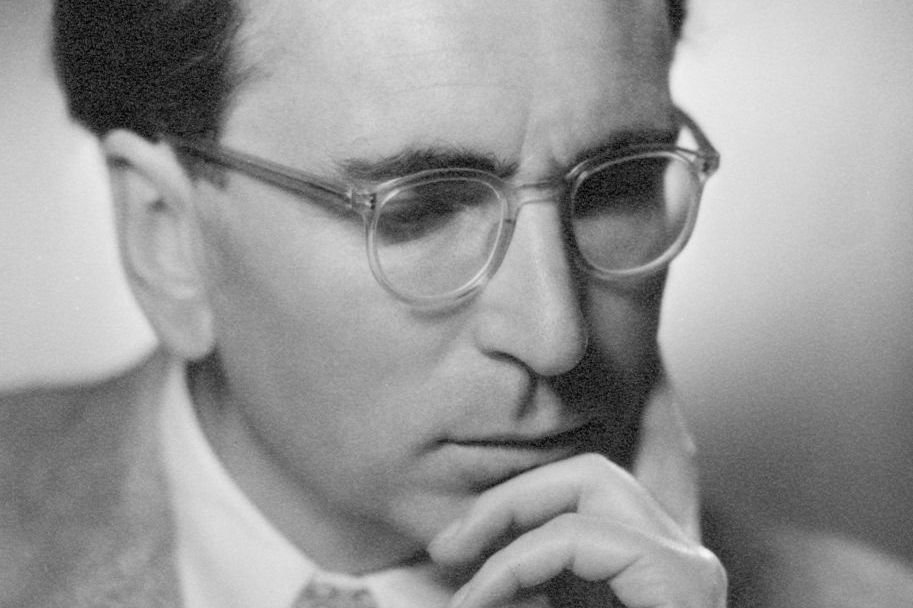
• FRANKL,Viktor (credit ÖNB-Wien)

    Viktor Frankl, the psychotherapist and author of the hugely influential book Man’s Search for Meaning, died seventeen years ago this week.

    Frankl had already begun to establish himself as a prominent neurologist and psychiatrist in Vienna—heir to the legacies of Sigmund Freud and Alfred Adler—when the Nazis invaded Austria in 1938. For a time, Frankl was able to maintain his practice as the anti-Semitic climate continued to grow in Austria. But in September 1942, he and his wife and parents were arrested and deported to Theresienstadt, the “model ghetto” and concentration camp where Frankl’s father would later perish. That would begin a tragic odyssey for Frankl, who was transferred with his wife and mother to Auschwitz in 1944. Only Frankl would survive.

    (more…)

  • Citizen Schools founder Eric Schwarz with students (photo by Paul Mobley)

    Citizen Schools founder Eric Schwarz with students (photo by Paul Mobley)

    Eric Schwarz made a lot of mistakes as a teenager. His great-great-grandfather had founded the iconic FAO Schwarz toy store in 1862, and successive generations of the family found success in New York, but Schwarz himself floundered amid a sea of opportunity—a fact he readily admits. He bounced through three high schools in three different states, faced multiple suspensions, racked up poor grades and regular “Eric is struggling” teacher conferences, and started drinking as a teen. “But every time I stumbled,” he writes, “I had a helping hand and a new chance.”

    (more…)

  • By Michael K. Honey

    Dr. King speaking during “phase one” of  the civil rights movement at the 16th Street Baptist Church in Birmingham, Alabama, sometime before Ku Klux Klan members bombed it on September 15, 1963.  (Joe Chapman)

    Dr. King speaking during “phase one” of the civil rights movement at the 16th Street Baptist Church in Birmingham, Alabama. (Joe Chapman)

    Recently, I returned to my home town and found myself flipping through a fake “yearbook” students assembled that asked students who they thought their peers wanted to be like. Someone wrote “to be like Martin Luther King” for me. It’s true that I grew up as a follower of Dr. King, though I hadn’t realized how obvious it must have been to others.

    I grew up in the small town of Williamston, Michigan, where the only person “of color” I knew of was Mexican American. While I wasn’t exposed to racial or ethnic diversity, I’m grateful to my parents who taught me to be open minded, to treat others as I wished to be treated, to read and reflect—and, also, to pay attention. Like many others, I still vividly recall those images of vicious dogs and fire hoses turned on black children in Birmingham, Alabama, and troopers on horseback, riding people down in Selma. I had spent happy summers in Detroit, where my parents grew up, but not after the summer of 1967, when police brutality set off an unbelievably turbulent inner-city rebellion that makes today’s revolt in Ferguson, Missouri look tame. Detroit had experienced a horrific white race riot in 1943 and most whites in the 1960s still seemed terrified of black folks moving into their neighborhoods or taking their jobs.

    To address the poverty of the inner cities like Detroit, in 1968 Dr. King started the Poor People’s Campaign. He sought to take the poor to the nation’s capitol to demand that money for war be spent instead on jobs, housing, health care, and education. As an Oakland University college student, I helped recruit a busload of people to go to Washington DC. But King never made the journey: an assassin’s bullet cut him down. I will never forget the despair my parents, Keith and Betty, and my brother, Charles, and sister, Maureen, felt at Martin Luther King, Jr.’s death. My mother’s tearful comments echoed the title of his last book, Where Do We Go From Here? Chaos, or Community?

    (more…)
  • By Jeanne Theoharis


    FERGUSON, MO: Demonstrators protest the death of Michael Brown on August 22, 2014

    This column originally appeared on msnbc.com.

    Three young black men were dead at the hands of the police. The police claimed a gun battle, but no weapons were ever found and witnesses said it was an execution. Nonetheless, the officers were not indicted—and the local newspapers were not willing to investigate or press the issue. The community was outraged; the families bereft.

    This was not Ferguson, Missouri in 2014. It was 1967 Detroit and Rosa Parks was outraged by the pattern of police abuse and harassment which had led to the 1967 uprising and the lack of police accountability for their violent behavior during the riot.

    Two weeks ago, fierce protests erupted in Ferguson following the police killing of 18-year-old Michael Brown. While there has been a great deal of criticism of the aggressive police response to the protests, there has been an undertone of concern and fear about the protesters. Many have cast the young protesters as dangerous and reckless and not living up to the legacy of the civil rights movement. Cast as a generation gap, these framings misrepresent these young protesters and the history of the civil rights movement.

    (more…)

  • By Marcus Rediker

    Unknown - New Haven Colony Historical Society and Adams National Historic Site (public domain via Wikipedia Commons)

    One hundred and seventy-five years ago today, La Amistad and its crew of former slaves was captured off the coast of Long Island and towed to New London, Connecticut, where the story of the slaves’ revolt and subsequent trial for piracy and murder immediately became the sensation of the popular press, and a cause célèbre for abolitionists and other sympathizers. In this excerpt adapted from Outlaws of the Atlantic, historian Marcus Rediker takes us back to the first days of the ship’s capture, when the idea of “black pirates” would ignite the imagination of early America and take these fifty-three Africans on a journey from the holds of a slave ship to the halls of the Supreme Court and beyond.

    The story began with a sensational headline: “A Suspicious Sail—a Pirate.” The New York Morning Herald announced on August 24, 1839, that a pilot boat had spotted a mystery ship about twenty-five miles off the coast of New York. On deck were “a number of negroes, twenty five or thirty, . . . almost or quite naked; some were wrapped in blankets, and one had on a white coat.” They were a “strange crew,” all the stranger for brandishing machetes, pistols, and muskets. One sailor “had a belt of dollars round his waist; another called the captain, had a gold watch. They could speak no English, but appeared to talk in the negro language.” Black pirates, armed and flush with plunder, were cruising the coast of Long Island.

    The vessel itself was in eerie disrepair: “Long grass was growing upon her bottom, and her sails were much torn, as if she had been driving about at the mercy of the gale, with her sails set and no one at the helm.” Here, declared the Morning Herald, was the “Flying Dutchman,” the ghost ship that wandered the seas endlessly as a portent of doom. Indeed, doom seemed already to have struck the vessel, which once upon a time had been a slave ship: “It was supposed that the prisoners had risen upon the captain and his assistants and captured her.” Having murdered the master and crew, those aboard could not navigate the vessel. They “are now drifting about bound for no particular port.”

    (more…)

  • By Aviva Chomsky


    NOGALES, AZ: Detainees sleep and watch television in a holding cell where hundreds of mostly Central American immigrant children are being processed and held at the US Customs and Border Protection Nogales Placement Center.

    Note: This post originally appeared on TomDispatch.com.

    Call it irony or call it a nightmare, but the “crisis” of Central American children crossing the US-Mexican border, which lasted for months amid fervent and angry debate, is now fading from the news. The media stories have been legion, the words expended many. And yet, as the “crisis” leaves town, as the sound and fury die down and attention shifts elsewhere (even though the children continue to arrive), the real factors that would have made sense of what’s been happening remain essentially untouched and largely unmentioned. It couldn’t be stranger—or sadder.

    Since late June 2014, the “surge” of those thousands of desperate children entering this country has been in the news. Sensational stories were followed by fervent demonstrations and counter-demonstrations with emotions running high. And it’s not a debate that stayed near the southern border either. In my home state, Massachusetts, Governor Deval Patrick tearfully offered to detain some of the children—and that was somehow turned into a humanitarian gesture that liberals applauded and anti-immigrant activists decried. Meanwhile the mayor of Lynn, a city north of Boston, echoed nativists on the border, announcing that her town didn’t want any more immigrants. The months of this sort of emotion, partisanship, and one-upmanship have, however, diverted attention from the real issues. As so often is the case, there is so much more to the story than what we’ve been hearing in the news.

    (more…)

  • Adams Corner Schulhaus via Wikimedia Commons

    With autumn just around the corner, it’s about time to think about heading back into the classroom. Whether you’re an educator, activist, administrator, parent, or socially-engaged citizen, here are five progressive education titles to put on your personal syllabus this fall:

    (more…)

  • By Jorja Leap


    SAN SALVADOR, EL SALVADOR: A gang graffiti (“Devil's horns”) painted on the wall in the Mara Salvatrucha gang neighborhood in San Salvador, El Salvador. 

    While the country turns its attention to the civil unrest in Ferguson, Missouri, the crisis of undocumented Central American children fleeing gang violence in their home countries has continued to grow. What many Americans don’t understand is that these gangs—18th Street, Florencia-13, and MS-13, to name a few—first got their start here in the United States. Fueled by a cycle of arrest, deportation, recruitment, and reentry, gangs who were once local to the streets of East Los Angeles have now gone international. In the following excerpt adapted from Jumped In: What Gangs Taught Me about Violence, Drugs, Love, and Redemption, sociologist Jorja Leap explores the real origins of these Central American gangs, and reveals in the process how our current border crisis is actually the result of a history of broken immigration policies.

    I want to understand the truth about gang members and the reality of their lives. I do not devise formal questionnaires. Instead, I depend on people in the streets. This includes law enforcement officers, priests, politicians, poets, and gang members—active and former. This is why, two days after meeting with the sheriff, I am in South LA talking to Kenny Green. Kenny is a former gang member who rarely speaks of his street associations. He is no longer active and works as an interventionist and case manager. I settle in for the long haul. Any discussion with a gang member or a former gang member is always a long-term commitment; whenever I sit down with Kenny, I budget a minimum of two hours. I will not leave his office until the sun has gone down. An account of any event even the smallest street altercation—becomes an occasion for a history lesson and a recitation of gang genealogy.

    I ask Kenny to explain the gangs of Los Angeles to me as simply as possible. He thinks carefully, then says, “To understand gangs in LA you gotta remember it’s the blacks and the browns. And the neighborhoods are different, really different. You can ask anyone.”

    (more…)

  •  

    FERGUSON, MO – AUGUST 14: Demonstrators take part in a rally on West Florissant Avenue to protest the shooting death of unarmed teen Michael Brown by a police officer on August 9.

    This week’s firestorm of racial outrage—which had continued to smolder since the July 17 death of Eric Garner at the hands of a New York City police officer—seemed as inevitable as it was horrifying. The shooting death of unarmed teenager Michael Brown by a Ferguson, Missouri police officer is only the latest incident in a series of high-profile and unjust deaths of black men and women by law enforcement, or by civilians with a weapon and a stand-your-ground mandate. That the officer in Ferguson remained anonymous for a full week after Brown’s shooting only fueled the unrest.

    We asked several Beacon authors for their take on what happened in Missouri this week. Their responses were as varied as the contributing factors that compelled this incident to boil over: the shock of a small, Midwestern suburb confronting unjust violence; the deployment of an over-militarized police force; the arrest of journalists and public observers; the close lens of social media. As Jeanne Theoharis says at the end of this piece, and as the photographs this week from Ferguson made clear, the struggle for civil rights seems far from over.

    (more…)

  •  

    A young boy stands in the rubble of his destroyed home in Beit Hanoun, Gaza.

    Cornel West recently spoke at a march on Washington in support of Palestinian civilians caught in the crossfire between Hamas and Israeli military forces. Despite a string of shaky cease-fires, yet more rockets were exchanged last night, and the future remains undecided. 

    “This is a human affair,” Dr. West preached. “Any human being who chooses occupation and annihilation is a war criminal, and especially when they’re killing precious Palestinian babies. A Palestinian baby has exactly the same status as a white baby in Newtown, Connecticut, as a brown baby in the Eastside of LA, as a Jewish baby in Israel.” It’s a powerful moment, a reminder of the indiscriminate nature of warfare, and a military occupation in which an estimated 80% of deaths have been civilians.


    (more…)