• By Marcus Rediker

    Detail from “The Pirates” by Frantz Zéphirin

    Detail from “The Pirates” by Frantz Zéphirin

    The cover art of Outlaws of the Atlantic: Sailors, Pirates, and Motley Crews in the Age of Sail, “The Pirates,” by the eminent Haitian artist Frantz Zéphirin, is something I discovered through a long journey. I began collecting Haitian art in the year 2000; Zéphirin was one the artists who drew me in.

    I had long been fascinated by the history of Haiti, especially its profound revolutionary self-emancipation based on the greatest slave revolt in modern history (1791-1804). The small island nation also boasts one of the world’s greatest folk art traditions—it has more painters per capita than any other place on earth. They paint sheer wonder, as André Breton, leader of Europe’s surrealist movement, discovered when he arrived in Haiti in 1945. When he saw the paintings of the vodou houngan Hector Hyppolite, he remarked that by these astonishing works he recognized his own as failures.

    (more…)

  • Market Basket Protesters (via the Save Market Basket Facebook group)

    Protesters at a rally in support of ousted Market Basket CEO Arthur T. Demoulas 
    (courtesy Save Market Basket)

    “Every once in a while,” Robert Reich, the former US Secretary of Labor, recently wrote, “something happens that exposes the underpinnings of American capitalism.” He was calling attention, in a series of Facebook posts, to a local labor dispute with a twist that’s now gained the national spotlight. For the past several weeks, the non-unionized workers and customers of Market Basket, the small chain of New England grocery stores known for inexpensive prices, have been fiercely protesting the board’s ouster of CEO Arthur T. Demoulas. Now, aisles are going empty, registers have closed. Supply trucks full of food sit near loading docks, unable to offload their rotting cargos.

    While the backstory to the current situation approaches near-Shakespearean levels of complexity and intrigue—involving strong-arm tactics, brutal grabs for power, and an intricate family feud between cousins with nearly the same name—it’s a simpler narrative that people are rallying around. Arthur T., or “Artie T.,” as he’s affectionately called, has over the years become renowned among Market Basket employees for supporting high wages and good benefits, and for offering a profit-sharing program that effectively treats workers as minor shareholders. As Reich put it, Arthur T. had been fired because “he treated his employees and customers too well.”

    (more…)

  • By Anna Morrow


    LOST HILLS, CA : The sun rises over an oil field in California, where gas and oil extraction using hydraulic fracturing, or fracking, has contaminated aquifers in a state damaged by drought. (Photo by David McNew/Getty Images)

    During summers in California’s Central Valley, an inland area that spans the length of the state from Bakersfield to Stockton, it’s not uncommon to hear a local rejoice when “it will only be 100 degrees today!” The sun is relentless and its heat is stifling, especially during a drought, and especially for the thousands of farm workers who are responsible for nearly all of California’s and much of the United States’ agriculture.

    Now, a report from the University of California, Davis explains that if the drought continues for two or more years, Central Valley farmers will be forced to increasingly rely on groundwater reserves, some of which, we are now learning, may have been polluted by fracking wastewater.

    Growing up in the heart of the Central Valley, whose claim-to-fame is being the “Gateway to Yosemite,” my preferred remedy for the afternoon summer heat was to frolic in the lawn sprinklers for hours on end, quench my thirst with gulps of water from the garden hose, engineer makeshift slip-and-slides, and bike to the farmer’s fruit stand down the road.

    The days of moderately worry-free water consumption are long gone as California rightfully encourages reductions in residential water use during this debilitating drought. What I never imagined is that my trips to the farm stand might become a relic of the past not only due to a lack of water, but to a lack of safe water.

    (more…)

  • James Baldwin by Allan Warren (via Wikimedia Commons)

    Ninety years ago this past weekend, on August 2, 1924, James Baldwin was born in Harlem to a single mother, the eldest of nine children, plagued by poverty, and by a deeply divided country where both his race and his sexuality were seen to be liabilities. That Baldwin, who left Harlem first for Greenwich Village and later for Paris, would transcend these difficult beginnings to become a citizen of the world—famously sparring in one instance with then-Attorney General Robert Kennedy on the necessity of civil rights legislation—was evidence of his remarkable talent, unparalleled intellect, and the sheer force of his principles. As the poet Nikky Finney put it in her introduction to Jimmy’s Blues and Other Poems, Baldwin would come to be regarded as “the most salient, sublime, and consequential American writer of the twentieth century.” He spoke about his early life, and of his difficult relationship with his stepfather—a domineering presence in Baldwin’s youth—in a 1963 interview with Kenneth Clark:

    (more…)

  • By Frederick S. Lane


    As the 2014 mid-term elections grind inexorably towards us, the concept of “nullification” has started to pop up with surprising frequency. As used in political circles, the term refers to the supposed ability of a state to nullify, or void, any federal law it finds too onerous or politically unacceptable. Most recently, Iowa’s Republican candidate for the US Senate, Joni Ernst, caused a stir by apparently advocating nullification to attendees of the Iowa Faith & Freedom Coalition.

    “Bottom line is, as a US senator, why should we be passing laws that the states are considering nullifying?” Ernst asked. “I mean, that’s bottom line, is our legislators at the federal level should not be passing those laws.”

    (more…)

  • Martin Luther King, Jr. at a press conference, June 8, 1964 / World Telegram & Sun photo by Walter Albertin (via Wikimedia Commons)

    Martin Luther King, Jr. at a press conference in June, 1964
    World Telegram & Sun photo by Walter Albertin (via Wikimedia Commons)

    In July of 1964, fifty years ago this month, Harper & Row published what has often been applauded as Dr. Martin Luther King, Jr.’s most incisive and eloquent book. Why We Can’t Wait recounts the Birmingham campaign in vivid detail, while underscoring why 1963 was such a crucial year for the civil rights movement. During this time, Birmingham, Alabama, was perhaps the most racially segregated city in the United States, but the campaign launched by Fred Shuttlesworth, King, and others demonstrated to the world the power of nonviolent direct action. King examines the history of the civil rights struggle and the tasks that future generations must accomplish to bring about full equality. The book grew out of ideas in first expressed in King’s extraordinary “Letter from Birmingham Jail,” a passionate response to eight white clergymen who argued that racial segregation should be fought in the courts and not by protest in the streets. That famous letter, which is included in the book, was first composed on scraps of paper and in the margins of a smuggled newspaper. It would eventually bring much needed national attention to the Southern Christian Leadership Conference’s campaign in Birmingham, and become an essential clarion call for the wider civil rights movement.

    (more…)

  • Summer is a time for getting outdoors, listening to the birds, taking long walks in the woods or long naps on the beach. And there’s nothing quite like reading a book outside, or after a day spent basking in the splendor of the natural world. With that in mind, here are five titles to accompany your summer adventures, or inspire your next trip outdoors:

    (more…)

  • By Anna Morrow

    Who Needs a 401(k) Anyway courtesy Matthew Oliphant

    In the late 1970s, the Internal Revenue Service introduced code 401(k). Intended to supplement traditional defined benefit retirement pensions, 401(k)s have instead largely replaced them, prompting a massive shift in how retirement is funded in the United States, and bestowing enormous financial risk upon employees rather than their employers. The result, according to James W. Russell, professor of sociology at Eastern Connecticut State University and author of Social Insecurity: 401(k)s and the Retirement Crisis, has been a massive economic catastrophe, jeopardizing the financial futures of many American workers.

    In a recent conversation with professors Jerry Lembcke and Ellis Jones of Holy Cross College, Russell outlined the inadequacies of the 401(k) system and explained alternatives for Americans who want to maximize their benefits and live comfortably in retirement.

    (more…)

  • By Ayesha Mattu & Nura Maznavi

    "Open book" by DeviantArt user shyfoxling

    If representation is homogenous, then it is inaccurate. Yet, Muslims are daily portrayed and perceived as a monolith—in spite of there being 1.6 billion Muslims spread out over 56 countries, dozens of ethnic groups, and a multitude of legal and cultural practices. 

    Similar to our intention behind our two anthologies (Salaam, Love: American Muslim Men on Love, Sex, and Intimacy and Love, InshAllah: The Secret Love Lives of American Muslim Women), the national #RamadanReads campaign aka “book buying revolution” is meant to smash the Muslim monolith, and to celebrate and support the diverse and divergent stories and storytellers in our community.

    (more…)

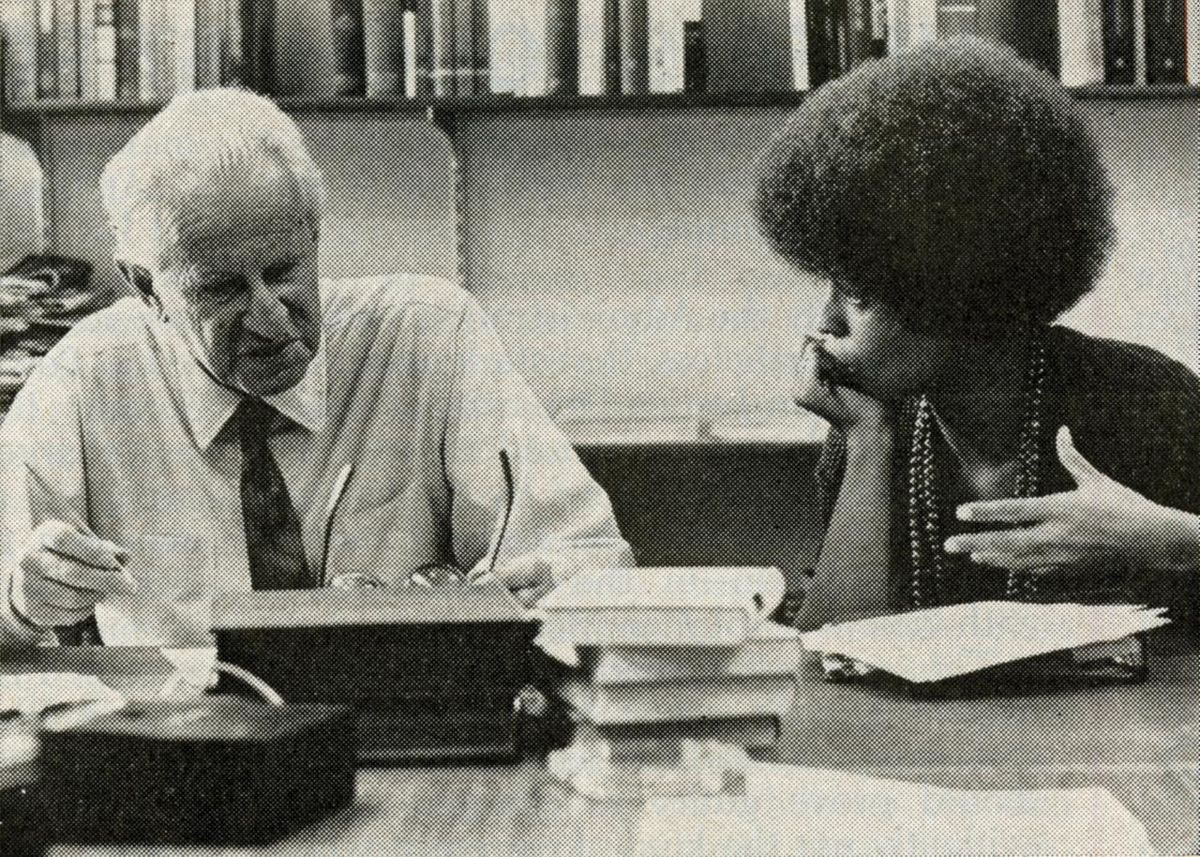
  • Herbert Marcuse with Angela Davis in 1970 (Nancy Chase for Newsweek)

    Herbert Marcuse with Angela Davis in 1970 (Nancy Chase)

    July 19th marks the 116th anniversary of the birth of Herbert Marcuse, the German-born university professor and internationally celebrated social theorist, philosopher, and political activist who went on to become one of America’s most influential intellectuals in the 1960s and 1970s. His analysis of capitalist consumerism and social repression ignited the New Left, inspiring such radical scholars and activists as Abbie Hoffman, Kathy Acker, and Angela Davis, who notably claimed that “Herbert Marcuse taught me that it was possible to be an academic and an activist, a scholar and a revolutionary.”

    (more…)