• By Margaret Regan

    A memorial to migrants who have died trying to cross the border stands in Reynosa, Mexico.

    According to the US Customs and Border Protection, more than 47,000 unaccompanied minors have crossed the border in the last six months, up 92% from the previous year. The humanitarian crisis has sparked new urgency in the immigration debate, one that President Obama recently proposed to solve by increasing the speed of their deportations. Though Obama has since backed off from that plan, seeking instead $3.7 billion in funding to help alleviate the situation, how exactly those dollars will be allocated, or whether even his request will pass the crucible of Congress, remains unclear.

    Meanwhile, unaccompanied immigrant children are still arriving at the border in droves. The numbers, in aggregate, are staggering but they belie the human struggle each of these children have undergone simply to reach the US. It is exactly that struggle that Margaret Regan writes about in The Death of Josseline: Immigration Stories from the Arizona Borderlands. In the following excerpt, Regan, in telling Josseline’s story, shows us the sometimes tragic and all-too-real dangers that many of these unaccompanied minors must increasingly endure.

    Josseline pulled her two jackets closer in the cold. She was wearing everything she had brought with her from home. Underneath the jackets, she had on a tank top, better suited to Arizona’s searing summers than its chilly winters, and she’d pulled a pair of sweatpants over her jeans. Her clothes betrayed her girly tastes. One jacket was lined in pink. Her sneakers were a wild bright green, a totally cool pair of shoes that were turning out to be not even close to adequate for the difficult path she was walking. A little white beaded bracelet circled her wrist. Best of all were her sweats, a pair of “butt pants” with the word HOLLYWOOD emblazoned on the rear. Josseline planned to have them on when she arrived in the land of movie stars.

    She tried to pay attention to the twists and turns in the footpath, to obey the guide, to keep up with the group. But by the time they got to Cedar Canyon, she was lagging. She was beginning to feel sick. She’d been on the road for weeks and out in the open for days, sleeping on the damp ground. Maybe she’d skimped on drinking water, giving what she had to her little brother. Maybe she’d swallowed some of the slimy green water that pools in the cow ponds dotting this ranch country. Whatever the reason, Josseline started vomiting. She crouched down and emptied her belly, retching again and again, then lay back on the ground. Resting didn’t help. She was too weak to stand up, let alone hike this rollercoaster trail out to the road.
    (more…)

  • By Mohammed Shamma

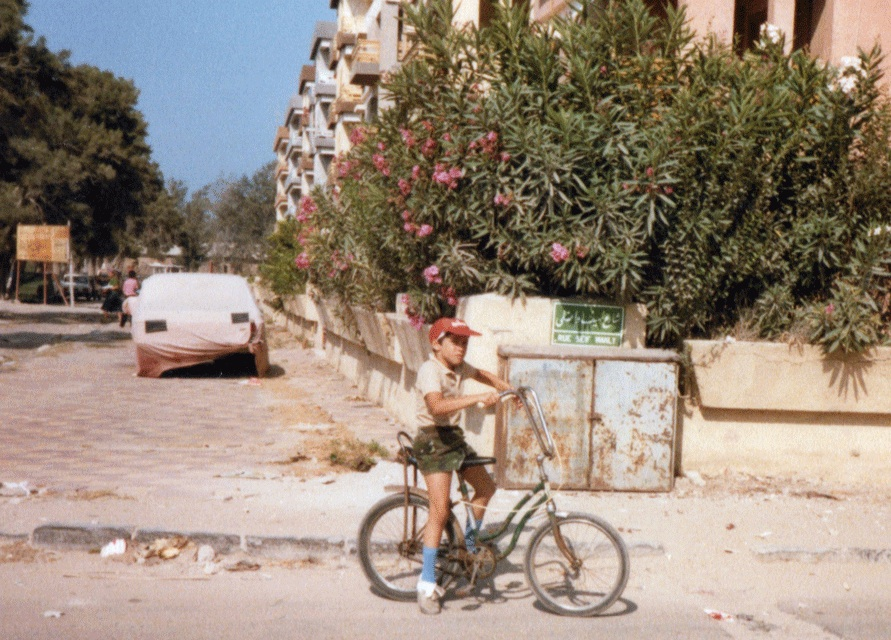
    Mohammed Shamma in Egypt, 1982

    Mohammed Shamma in Egypt, 1982

    I’m a soccer addict. I love playing, watching, and following the “beautiful game” any chance I get. I inherited my love for the sport from my Egyptian father, who sat me down in our Texas home and told me what “football,” really was. He taught me about Pelé and Brazil, and of the great rivalry in his own country between the clubs Al-Ahly and Zamalek. He also taught me about the World Cup and Ramadan. And we can all agree that at least one of them is of great religious importance.

    The World Cup and Ramadan aren’t always mentioned in the same sentence, but this year was different. The Islamic holy month started during the tournament’s knockout stage. In some ways, this was a fitting moment for the Muslim soccer players who had made it that far. They knew the Muslim world would be watching them as they pushed their bodies to their physical limits in the greatest moment of their careers. This was certainly the case for Mesut Özil and Sami Khedira of Germany, who helped seal German soccer supremacy for the next four years.

    The last time Ramadan and the World Cup crossed paths was in 1986 and 1982 respectively. I’ll never forget the summer of 1982. I was in Egypt, visiting my father’s family on a much-delayed bereavement trip. My father had died of cardiac arrest in October of 1981. We buried him in a Muslim cemetery in Houston, Texas and had to wait eight months before we could visit our relatives in Cairo. Those eight months were tough on me, a nine-year-old boy who just lost his father, soccer coach, and mentor.

    (more…)

  • By Rashid Khalidi

    GAZA CITY, GAZA – JULY 15: Palestinian 4-year-old Sheyma Al-Masri, wounded in an Israeli airstrike within the 'Operation Protective Edge', gets treatment at Al-Shifa Hospital in Gaza City, Gaza on July 15, 2014.

    As Israel and Hamas trade blows, and with Israel’s Operation “Protective Edge” entering its eighth day, the casualty count in Gaza continues to climb, with estimates of nearly 200 Palestinians killed and over 1,500 wounded by the airstrike campaign. President Obama recently defended Israel’s right to the bombardment, making a US-brokered peace deal seem further away than ever. It’s a development that adds fuel to an argument that Middle East historian Rashid Khalidi frames in his latest book, Brokers of Deceit: How the U.S. Has Undermined Peace in the Middle East. In it, Khalidi—who recently appeared on the radio show On Point to talk about this latest backslide into violence—asserts that, far from being the unbiased benevolent guide to peace between Israel and Palestine, the US has, in fact, been an agent of continuing injustice, effectively preventing the difficult but essential steps needed to achieve peace in the region. The following is excerpted from Khalidi’s introduction to Brokers of Deceit.

    In politics and in diplomacy, as in much else, language matters greatly. However debased political discourse may become, however disingenuous diplomacy often is, the words employed by politicians and diplomats define situations and determine outcomes. In recent history, few semantic battles over terminology have been as intensely fought out as those concerning Palestine/Israel.

    The importance of the precise use of language can be illustrated by the powerful valence in the Middle East context of terms such as “terrorism,” “security,” “self-determination,” “autonomy,” “honest broker,” and “peace process.” Each of these terms has set conditions not only for perceptions, but also for possibilities. Moreover, these terms have come to take on a specific meaning, frequently one that is heavily loaded in favor of one side, and is far removed from what logic or balance would seem to dictate. Thus in the American/Israeli official lexicon, “terrorism” in the Middle East context has come to apply exclusivelyto the actions of Arab militants, whether those of the Palestine Liberation Organization (PLO), Hamas, Hizballah, or others. Under these peculiar terminological rules, the actions of the militaries of Israel and the United States cannot be described as “terrorism,” irrespective of how many Palestinians, Lebanese, Iraqi, or Afghan civilians may have died at their hands.

    (more…)

  • By Lyn Phillips

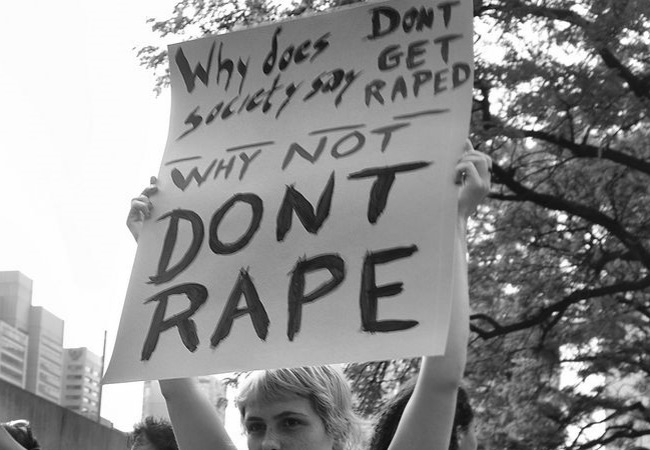
    Don't Rape (courtesy Flickr user Eric Parker)

    In October of 2008, Frank Warren, founder of PostSecret, came to my undergraduate campus in Macon, Georgia, where a single microphone was set up in front of the stage. At the end of his presentation, Frank opened the floor to anyone who wanted to share a secret aloud. A line slowly formed behind the first timid, sharers, as if by speaking each one was passing a baton of courage to the person behind them. The eighth or so speaker was a slender girl who drew back her shoulders before she spoke. “I don’t want to talk about this with anyone after we leave this room,” she said in a voice stronger and larger than expected, “but two years ago, I was raped by my high school boyfriend of five years. And my secret is that, while I can stand here and tell that to all of you, I cannot tell my mother.” With her back still straight, she stepped around the mic and returned to the rows full of anonymous students.

    (more…)

  • By Brad Tyer

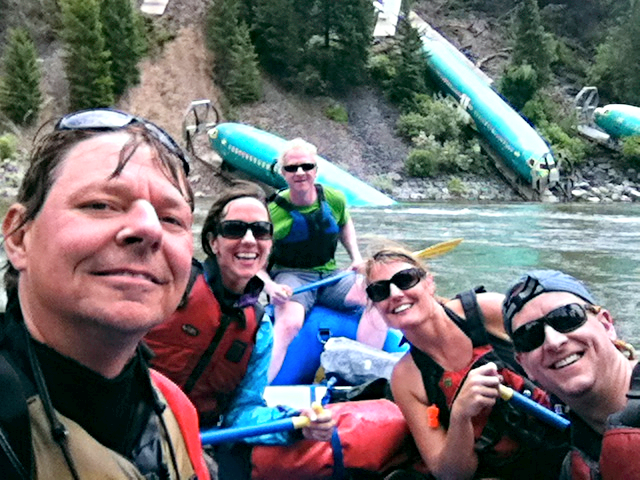
    Missoula whitewater rafter Daniel Berger (at rear) and friends float past three airliner fuselages dumped in Montana's Clark Fork river by a train derailment last week. Photo courtesy Chuck Irestone

    Missoula whitewater rafter Daniel Berger (at rear) and friends float past three airliner fuselages dumped in Montana’s Clark Fork river by a train derailment last week. (Courtesy Chuck Irestone)

    The picture probably showed up in one of your feeds. It fit all sorts of algorithmic criteria for viral interestingness, shapes and colors and scale otherwise unseen in nature: The steep bank of a Montana river littered with the bare fuselages of three Boeing airplanes spilled from a train track above like oversized logs swathed in aquamarine-colored protective wrap. Or maybe not logs, but uniformly skinny whales beached far from any ocean. Either way, an eye-grabbingly irresistible curiosity. In the foreground, always, whitewater rafters taking selfies.

    The river is called the Clark Fork. And I’ve paddled that stretch in canoes and rafts with some of the rafters who showed up in some of those pictures. It’s a section about 40 freeway minutes downstream of Missoula called Alberton Gorge, named for nearby Alberton, Montana—an off-Interstate mountain town of four or five hundred people. Within roughly seven easily accessible river miles are five major rapids that, depending on the flow, range from Class II to Class IV. The last of these is called Fang, and it was just downstream of Fang that the planes were tossed down the bank, coming to scattered rest with their snouts or tails in the water.

    The Gorge is a fun stretch to run, but it makes you pay attention. While drownings are infrequent, substantial injuries are hardly unheard of. Boats are flipped all the time in Alberton Gorge, spilling bodies and gear that is later recovered or washed downstream to the intake grates of the next dam, at Thompson Falls, and trucked off to a landfill.

    The boaters mostly come from Missoula, 35 miles upstream, which is where I lived from 2002 until 2007, and again in 2011 and 2012, the latter stint spent writing a book about the Clark Fork—Opportunity, Montana: Big Copper, Bad Water, and the Burial of an American Landscape.

    You wouldn’t know it from rocky Alberton Gorge, which is host to an almost constant stream of kayakers and rafters during the temperate months, but the Clark Fork is one of the most badly abused rivers in the United States, and simultaneously one of the luckiest.

    (more…)

  • By Michelle Bamberger & Robert Oswald

    In our soon-to-be released book, The Real Cost of Fracking: How America’s Shale Gas Boom is Threatening Our Families, Pets, and Food, we discuss the laws that affect local control of gas drilling in New York and Pennsylvania. At the time of writing, two cases were before the New York State Court of Appeals that would effectively decide if individual towns in New York could ban gas drilling using zoning ordinances (Mark S. Wallach, as Chapter 7 Trustee for Norse Energy Corp. USA vs. Town of Dryden et al. and Cooperstown Holstein Corporation vs. Town of Middlefield). On June 30, 2014, the decision was announced by the Court of Appeals in favor of the Towns of Dryden and Middlefield. It is important to note that “towns” in New York are subdivisions of counties, and constitute most of the land that is not a city or Indian reservation.

    (more…)

  • by J. Jack Halberstam

    your_trigger_warnings_are_triggering_me_by_meiharu-d5j2mey

    I was watching Monty Python’s The Life of Brian from 1979 recently, a hilarious rewriting of the life and death of Christ, and I realized how outrageous most of the jokes from the film would seem today. In fact, the film, with its religious satire and scenes of Christ and the thieves singing on the cross, would never make it into cinemas now. The Life of Brian was certainly received as controversial in its own day but when censors tried to repress the film in several different countries, the Monty Python crew used their florid sense of humor to their advantage. So, when the film was banned in a few places, they gave it a tagline of: “So funny it was banned in Norway!”

    12fdfd9731cdf4f49bdc347bb7841489

    Humor, in fact, in general, depends upon the unexpected (“No one expects the Spanish Inquisition!”); repetition to the point of hilarity (“You can have eggs, bacon, and spam; spam, eggs, spam, and sausage; or spam, spam, spam, and spam!”); silliness, non-sequitors, caricature, and an anarchic blend of the serious and the satirical. And humor is something that feminists in particular, but radical politics in general, are accused of lacking. Recent controversies within queer communities around language, slang, satirical or ironic representation, and perceptions of harm or offensiveness have created much controversy with very little humor recently, leading to demands for bans, censorship, and name changes.

    (more…)

  • By Nancy Rubin Stuart

    Benedict Arnold and Peggy Shippen

    Benedict Arnold and Peggy Shippen

    As we celebrate the 238th birthday of the United States on July 4, 2014, one question remains as important today as it was when we declared our independence. What causes some citizens to be patriotic and others to become traitors?

    Periodically this question arises during Congressional inquiries and in the press when a particular American is revealed as a potential or active domestic terrorist. Equally disturbing are reports about citizens who have emigrated to foreign countries to join anti-American organizations bent on producing death and destruction from afar.

    The reasons for betrayal are complex and often highly personal, but one common thread seems to be the traitor’s long-standing inability to embrace the values of American society. With that in mind, I researched the lives of two late-eighteenth century couples who reacted to the ideals of the American Revolution in vastly different ways.

    (more…)

  • Walter Dean Myers (courtesy Flickr user Madeline Brownstone)

    We are saddened to learn of the death of beloved children’s book author Walter Dean Myers, who wrote so many important and life-changing books for America’s youth, including Bad Boy, Monster, Darius & Twig, Lockdown, and Autobiography of My Dead Brother. He also was a friend to the house, having contributed a wonderful introduction to A Time to Break Silence: The Essential Works of Martin Luther King, Jr. for Students. In that introduction, Myers, who was born in West Virginia but raised in Harlem, wrote about being a young soldier traveling to Louisiana and experiencing segregation there for the first time:

    When I arrived in Louisiana, when I saw what institutionalized racism was, I was shocked. Restaurant signs read “Whites Only” or “Colored Served in Rear.” Some stores wouldn’t serve black people, and there were movie houses in which they were made to sit in the balcony or, in some cases, not even permitted to enter…. The signs did more than make me feel uncomfortable; they made me feel sick. I was being told that I wasn’t as good as some people simply because of the color of my skin. And yet I was in the military, ready and willing to sacrifice my life for this country.

    (more…)

  • By Carole Joffe

    Supreme Court Facade at Dusk (via Wikimedia Commons)

    Nearly 50 years ago, in the 1965 Griswold v Connecticut case, the Supreme Court declared birth control legal for married persons, and shortly afterwards in another case legalized birth control for single people. In a famous study published in 2002, “The power of the pill,” two Harvard economists reported on the dramatic rise in women’s entrance into the professions and attributed this development to the availability of oral contraception beginning in the 1960s. Several years ago, the CDC reported that 99% of US women who have ever had sexual intercourse had used contraception at some point. So the recent controversial Hobby Lobby case no doubt appears somewhat surreal to many Americans who understandably have assumed that contraception—unlike abortion–is a settled, non-contentious issue in the US.

    To be sure, some conservatives, fearful of a female voter backlash in November, have tried to claim the case is about the religious freedom of certain corporations, and not contraception. But the case is about contraception. The Majority in Hobby Lobby made this clear, claiming the decision only applies to contraception and not to other things that some religious groups might oppose, such as vaccinations and blood transfusions.

    So why are Americans still fighting about something that elsewhere in the industrialized world is a taken for granted part of reproductive health care? As Jennifer Reich and I discuss in our forthcoming volume, Reproduction and Society, contraception has always had a volatile career in the US, sometimes being used coercively by those in power, and at other times, like the present, being withheld from those who desperately need it.

    (more…)