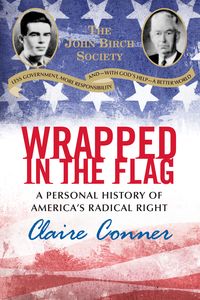
• CONNER-WrappedInTheFlagA narrative history of the John Birch Society by a daughter of one of the infamous ultraconservative organization's founding fathers
     

    Long before the rise of the Tea Party movement and the prominence of today’s religious Right, the John Birch Society, first established in 1958, championed many of the same radical causes touted by ultraconservatives today, including campaigns against abortion rights, gay rights, gun control, labor unions, environmental protections, immigrant rights, social and welfare programs, the United Nations, and even water fluoridation. 

    Worshipping its anti-Communist hero Joe McCarthy, the Birch Society is perhaps most notorious for its red-baiting and for accusing top politicians, including President Dwight Eisenhower, of being Communist sympathizers. It also labeled John F. Kennedy a traitor and actively worked to unseat him. The Birch Society boasted a number of notable members, including Fred Koch, father of Charles and David Koch, who are using their father’s billions to bankroll fundamentalist and right-wing movements today. 

    The daughter of one of the society’s first members and a national spokesman about the society, Claire Conner grew up surrounded by dedicated Birchers and was expected to abide by and espouse Birch ideals. When her parents forced her to join the society at age thirteen, she became its youngest member of the society. From an even younger age though, Conner was pressed into service for the cause her father and mother gave their lives to: the nurturing and growth of the JBS. She was expected to bring home her textbooks for close examination (her mother found traces of Communist influence even in the Catholic school curriculum), to write letters against “socialized medicine” after school, to attend her father’s fiery speeches against the United Nations, or babysit her siblings while her parents held meetings in the living room to recruit members to fight the war on Christmas or (potentially poisonous) water fluoridation. Conner was “on deck” to lend a hand when JBS notables visited, including founder Robert Welch, notorious Holocaust denier Revilo Oliver, and white supremacist Thomas Stockheimer. Even when she was old enough to quit in disgust over the actions of those men, Conner found herself sucked into campaigns against abortion rights and for ultraconservative presidential candidates like John Schmitz. It took momentous changes in her own life for Conner to finally free herself of the legacy of the John Birch Society in which she was raised. 

    In Wrapped in the Flag, Claire Conner offers an intimate account of the society—based on JBS records and documents, on her parents’ files and personal writing, on historical archives and contemporary accounts, and on firsthand knowledge—giving us an inside look at one of the most radical right-wing movements in US history and its lasting effects on our political discourse today. 

    Read an excerpt from Wrapped in the Flag on Everyday EBook

    Read or download Chapter One on Scribd

    Audiobook version is also available: Listen to a sample at Audible.com


    Related articles

    Pride on the Prairie and in the City
    Queer History: The "Persecuting Society"
  • We're reaching the end of commencement address season, so as our supply of hopeful, funny, and inspirational speeches dwindles (some faves this year: Stephen Colbert, Arianna Huffington, Gabby Giffords, and John Green), we wanted to be sure to share this one with you.

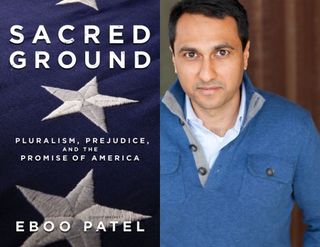
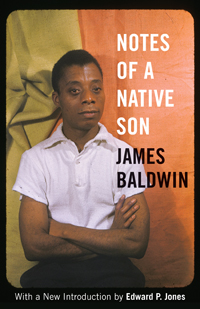
    It's not a surprise that our favorite this year is from Eboo Patel, speaking at Elizabethtown College. What's not to love? Eboo is a visionary and a engaging writer (see Acts of Faith and Sacred Ground for confirmation), and here he's praising the intro to James Baldwin's Notes of a Native Son, another book that we are tremendously proud to have published. 

    But our appreciation of the speech goes beyond the mere pride that a Beacon author was moved to write about a classic Beacon book. Eboo illuminates the revelations and anxieties in Baldwin's text—the feeling of being driven to write, the conflicts inherent in being present in a dominant culture that attempts to exclude you and your experiences, feeling both pride and discomfort in identity—and he shares how that piece of writing helped shape his own growth as a young activist and author. In short, it made us pause and think about all the reasons we love bringing books to readers. Enjoy!  

    Eboo-webIn every phase of my life, there have been texts
    that have lit the path. When I was a kid, and sports were king in the
    schoolyard, the Great Brain books taught me that being smart had its
    uses. In high school, John Steinbeck’s Cannery Row, Ken Kessey’s One
    Flew Over the Cuckoo’s Nest
    and the Grateful Dead’s From the Mars Hotel
    showed me that the American tradition had a rebel streak. In college, my world
    was rocked by Tony Kushner’s Angels in America, essays by bell hooks,
    Paolo Freire’s Pedagogy of the Oppressed and ani difranco’s Not a
    Pretty Girl
    – works that taught me a thing or two about power and identity.

    After
    graduation, when I was asking myself who I wanted to be and what impact I hoped
    to have, the work I found myself returning to over and over again, the piece
    that served as both my prod and my guide, was the opening six pages of James
    Baldwin’s 1955 essay collection, Notes of a Native Son. Those six pages,
    titled Autobiographical Notes, are an account of how James Baldwin
    carved out his commitments and understood their consequences.

    I love
    the piece for its fury, for its stark take on the world as it is, for its
    ability to confront contradiction without resolving it. It reminded me of the
    first two Led Zeppelin albums: the energy of the music so powerful you can feel
    it literally burst through the skin of the studio production.  

    The first
    lines: “I was born in Harlem thirty-one years ago. I began plotting novels at
    about the time I learned how to read … In those days my mother was given to the
    exasperating and mysterious habit of having babies. I took them over with one
    hand and held a book with the other …”

    Listen
    closely to those sentences. Baldwin is articulating how he first heard the call
    of his vocation, how he first felt within himself the beating heart of a
    writer. It did not happen on a fancy trip to Europe. It did not happen in the
    middle of an advanced course in graduate school. It happened in the living room
    of an overfull Harlem apartment, surrounded by squalling babies.

    The
    ability to listen to yourself, to tease out the signal from the noise in a
    world that is a crashing, clanging cacophony, that’s a treasure that is worth
    more than any amount of silver or gold.

    Autobiographical
    Notes
    was written
    in response to a request by Baldwin’s fiction publisher to fill out a
    standardized form for their records – date of birth, city of residence, etc.
    The very idea of the form pissed Baldwin off, so he turned it around and
    started writing on the back. It became the essay that I’m quoting from today.
    Makes me look at every boring form I’m handed and wonder how to turn it into a
    lasting work of art. Also, it confirms my suspicion that an awful lot of
    creativity is at least partially a result of the chip certain people carry on
    their shoulder. I know that chip well. So did Baldwin.

    He says:
    “Any writer … feels that the world into which he was born is nothing less than
    a conspiracy against the cultivation of his talent – which attitude certainly
    has a good deal of evidence to support it. On the other hand, it is only
    because the world looks on his talent with such a frightening indifference that
    the artist is compelled to make his talent important … the things which hurt
    (you) and the things which help (you) cannot be divorced from each other.”

    One of my
    biggest surprises when I graduated from college was just how indifferent the
    world was to me. I suspect I was like many of you here: front row in all my
    classes, eager beaver in every possible extra-curricular. College is an
    environment that nurtures those qualities, and rewards them. The rest of the
    world, not so much. I literally remember thinking to myself a few months after
    I graduated, ‘Where are all the people telling me how great my new idea is,
    congratulating me for committing to read this classic novel, encouraging me as
    I begin a new writing project.’

    That’s
    when I was truly grateful for the faculty and staff who nurtured me through my
    liberal arts education. The gift they gave me was helping develop those
    capacities and values in the first place, supporting me as I flexed those
    muscles. My gift to them would be to continue growing those muscles without
    them by my side.

    Baldwin’s
    essay helped me realize that I had entered a new stage, a stage defined not so
    much by encouragement but by struggle. Nobody was sitting in their office
    waiting for me to walk in so they could give me money for my new organization
    or extra credit for my new intellectual endeavor. The world was not going to
    convince me that I had something worthwhile to offer. I was going to have to
    convince it. This meant I first had to convince myself.  And that is not
    just a question of capacity, it is also a question of identity.

    Identity
    is at the heart of Baldwin’s work. He once told his friend and editor Sol Stein
    that he was born with three strikes against him: he was black, he was gay and
    he was ugly. The third could be disputed, but the first two were definitely
    true.

    Baldwin
    is blunt about “the tremendous demands and very real dangers of (his) social
    situation”. He writes of how being black in America made him “hate and fear the
    world”, putting him in a “self-destroying limbo.” So how does he navigate
    forward? By adopting a different lens looking back.

    Some of
    the most powerful lines in the essay are when Baldwin cites the great masters
    and creations of Western civilization – Shakespeare, Rembrandt, Bach, the
    Empire State Building. He points out that these masters are not really part of
    his heritage. Some of the people would have happily enslaved him, yet he is
    drawn to their ideas and creations nonetheless. So what is he to do?

    He
    writes: “I would have to appropriate these white centuries. I would have to
    make them mine – I would have to accept my special attitude, my special place
    in this scheme – or else I would have no place in any scheme.” 

    On my
    first day as a graduate student at Oxford, some fancy-pants university official
    found out I was an American and said, “Oh, how wonderful. Do you know Bill
    Clinton? Such a charming man.” I thought to myself, ‘Sorry, you got the wrong
    guy. My parents own Subway Sandwich Shops in the Western Suburbs of Chicago.
    Biggest thing I’ve ever done is shake Michael Jordan’s hand in the parking lot
    of the golf course near my house.’

    Everything
    about that situation screamed to me, ‘You don’t belong here.’ I must say, the
    exit sign looked pretty alluring sometimes.

    Instead
    of walking, I took out my Baldwin and re-read that essay. I realized the
    tradition would take no note of me slinking away, nor was it about to magically
    throw open its doors and let me in. It was my responsibility to shape a special
    attitude to it, to knock on its doors, to make my contributions, to not simply
    cry foul but to effect change.

    A crucial
    dimension of a liberal arts education is a long look back, a listening in on
    the great conversations that have threaded through past centuries. But simply
    being conversant in what others have said is not the same as being educated,
    not at least in the Elizabethtown way.

    Asking
    the question: what is my special attitude to those things that have gone in the
    past? Even those dimensions that might have turned their back on people like
    me? How might I learn from them, love them, embrace the parts that are
    humanizing, change the parts that hurt and marginalize, make them my own? How
    can you stand at the crossroads of inheritance and discovery and look both ways
    at once? 

    I love Autobiographical
    Notes
    for how it spoke to me at 22, I love it for its jazz and war. As I
    stand here this morning, I am fifteen years past the days when I re-read Autobiographical
    Notes
    night after night, seeking new insights into my personal drama. Going
    back to it now helps me remember the intensity of that time in my life. Make no
    mistake, I envy you the stage you are about to enter. 

    The final
    lines of the essay are different. For all the passion of the previous pages,
    the searing talk of racism and America and special attitudes, Baldwin doesn’t
    end the essay by making huge demands or issuing earth-shattering proclamations.
    He ends with lines that are both simple and modest, lines that sound almost
    like a prayer, lines that I believe honor a graduating class of a school
    devoted to service and to others. 

    He wants to
    be an honest man and a good writer. He wants to last, and get his work done.

    Read James Baldwin's essay "Autobiographical Notes"

    Read a selection from Sacred Ground by Eboo Patel


    Related articles

    The Ethics of Historical Outing
    A Queer Atheist In the Heart of Mormon Country
    Standing Your Sacred Ground: Talk by Eboo Patel given at Theosophical Society in America
  • James Baldwin (1924-1987) was a novelist, essayist, playwright, poet, and social critic, and one of America's foremost writers. His essays, such as "Notes of a Native Son" (1955), explore palpable yet unspoken intricacies of racial, sexual, and class distinctions in Western societies, most notably in mid-twentieth-century America. A Harlem, New York, native, he primarily made his home in the south of France. 

    His novels include Giovanni's Room (1956), about a white American expatriate who must come to terms with his homosexuality, and Another Country (1962), about racial and gay sexual tensions among New York intellectuals. His inclusion of gay themes resulted in much savage criticism from the black community. Going to Meet the Man (1965) and Tell Me How Long the Train's Been Gone (1968) provided powerful descriptions of American racism. As an openly gay man, he became increasingly outspoken in condemning discrimination against lesbian and gay people.  

    The following essay opens Notes of a Native Son, a collection considered by many his most influential work. We publish it here today in conjunction with an essay by Eboo Patel about the impact this essay had on his life and work.
    0623I was born in Harlem thirty-one years ago. I began plotting
    novels at about the time I learned to read. The story of my
    childhood is the usual bleak fantasy, and we can dismiss it
    with the restrained observation that I certainly would not
    consider living it again. In those days my mother was given
    to the exasperating and mysterious habit of having babies. As
    they were born, I took them over with one hand and held a
    book with the other. The children probably suffered, though
    they have since been kind enough to deny it, and in this way
    I read Uncle Tom’s Cabin and A Tale of Two Cities over and
    over and over again; in this way, in fact, I read just about
    everything I could get my hands on—except the Bible, probably because it was the only book I was encouraged to read.
    I must also confess that I wrote—a great deal—and my first
    professional triumph, in any case, the first effort of mine to
    be seen in print, occurred at the age of twelve or thereabouts,
    when a short story I had written about the Spanish revolution
    won some sort of prize in an extremely short-lived church
    newspaper. I remember the story was censored by the lady
    editor, though I don’t remember why, and I was outraged. 

    Also wrote plays, and songs, for one of which I received a
    letter of congratulations from Mayor La Guardia, and poetry,
    about which the less said, the better. My mother was delighted
    by all these goings-on, but my father wasn’t; he wanted me to
    be a preacher. When I was fourteen I became a preacher,
    and when I was seventeen I stopped. Very shortly thereafter I left home. For God knows how long I struggled with
    the world of commerce and industry—I guess they would say
    they struggled with me—and when I was about twenty-one I
    had enough done of a novel to get a Saxton Fellowship. When
    I was twenty-two the fellowship was over, the novel turned
    out to be unsalable, and I started waiting on tables in a Village restaurant and writing book reviews—mostly, as it turned
    out, about the Negro problem, concerning which the color of
    my skin made me automatically an expert. Did another book,
    in company with photographer Theodore Pelatowski, about
    the store-front churches in Harlem. This book met exactly
    the same fate as my first—fellowship, but no sale. (It was a
    Rosenwald Fellowship.) By the time I was twenty-four I had
    decided to stop reviewing books about the Negro problem—
    which, by this time, was only slightly less horrible in print
    than it was in life—and I packed my bags and went to France,
    where I finished, God knows how, Go Tell It on the Mountain.

    Any writer, I suppose, feels that the world into which he
    was born is nothing less than a conspiracy against the cultivation of his talent—which attitude certainly has a great deal
    to support it. On the other hand, it is only because the world
    looks on his talent with such a frightening indifference that
    the artist is compelled to make his talent important. So that
    any writer, looking back over even so short a span of time as
    I am here forced to assess, finds that the things which hurt him and the things which helped him cannot be divorced
    from each other; he could be helped in a certain way only
    because he was hurt in a certain way; and his help is simply to
    be enabled to move from one conundrum to the next—one is
    tempted to say that he moves from one disaster to the next.
    When one begins looking for influences one finds them by
    the score. I haven’t thought much about my own, not enough
    anyway; I hazard that the King James Bible, the rhetoric of
    the store-front church, something ironic and violent and perpetually understated in Negro speech—and something of
    Dickens’ love for bravura—have something to do with me today; but I wouldn’t stake my life on it. Likewise, innumerable
    people have helped me in many ways; but finally, I suppose,
    the most difficult (and most rewarding) thing in my life has
    been the fact that I was born a Negro and was forced, therefore, to effect some kind of truce with this reality. (Truce, by
    the way, is the best one can hope for.)

    One of the difficulties about being a Negro writer (and
    this is not special pleading, since I don’t mean to suggest
    that he has it worse than anybody else) is that the Negro
    problem is written about so widely. The bookshelves groan
    under the weight of information, and everyone therefore
    considers himself informed. And this information, furthermore, operates usually (generally, popularly) to reinforce
    traditional attitudes. Of traditional attitudes there are only
    two—For or Against—and I, personally, find it difficult to
    say which attitude has caused me the most pain. I am speaking as a writer; from a social point of view I am perfectly
    aware that the change from ill-will to good-will, however
    motivated, however imperfect, however expressed, is better
    than no change at all. 

    But it is part of the business of the writer—as I see it—
    to examine attitudes, to go beneath the surface, to tap the
    source. From this point of view the Negro problem is nearly
    inaccessible. It is not only written about so widely; it is written about so badly. It is quite possible to say that the price
    a Negro pays for becoming articulate is to find himself, at
    length, with nothing to be articulate about. (“You taught
    me language,” says Caliban to Prospero, “and my profit on’t
    is I know how to curse.”) Consider: the tremendous social
    activity that this problem generates imposes on whites and
    Negroes alike the necessity of looking forward, of working
    to bring about a better day. This is fine, it keeps the waters
    troubled; it is all, indeed, that has made possible the Negro’s
    progress. Nevertheless, social affairs are not generally speaking the writer’s prime concern, whether they ought to be or
    not; it is absolutely necessary that he establish between himself and these affairs a distance which will allow, at least, for
    clarity, so that before he can look forward in any meaningful
    sense, he must first be allowed to take a long look back. In
    the context of the Negro problem neither whites nor blacks,
    for excellent reasons of their own, have the faintest desire to
    look back; but I think that the past is all that makes the present coherent, and further, that the past will remain horrible
    for exactly as long as we refuse to assess it honestly.

    I know, in any case, that the most crucial time in my own
    development came when I was forced to recognize that I was
    a kind of bastard of the West; when I followed the line of my
    past I did not find myself in Europe but in Africa. And this
    meant that in some subtle way, in a really profound way, I
    brought to Shakespeare, Bach, Rembrandt, to the stones of
    Paris, to the cathedral at Chartres, and to the Empire State Building, a special attitude. These were not really my creations, they did not contain my history; I might search in them
    in vain forever for any reflection of myself. I was an interloper;
    this was not my heritage. At the same time I had no other
    heritage which I could possibly hope to use—I had certainly
    been unfitted for the jungle or the tribe. I would have to appropriate these white centuries, I would have to make them
    mine—I would have to accept my special attitude, my special
    place in this scheme—otherwise I would have no place in any
    scheme. What was the most difficult was the fact that I was
    forced to admit something I had always hidden from myself,
    which the American Negro has had to hide from himself as
    the price of his public progress; that I hated and feared white
    people. This did not mean that I loved black people; on the
    contrary, I despised them, possibly because they failed to
    produce Rembrandt. In effect, I hated and feared the world.
    And this meant, not only that I thus gave the world an altogether murderous power over me, but also that in such a self-
    destroying limbo I could never hope to write.

    One writes out of one thing only—one’s own experience.
    Everything depends on how relentlessly one forces from this
    experience the last drop, sweet or bitter, it can possibly give.
    This is the only real concern of the artist, to recreate out
    of the disorder of life that order which is art. The difficulty
    then, for me, of being a Negro writer was the fact that I was,
    in effect, prohibited from examining my own experience too
    closely by the tremendous demands and the very real dangers of my social situation.

    I don’t think the dilemma outlined above is uncommon. I
    do think, since writers work in the disastrously explicit medium of language, that it goes a little way towards explaining why, out of the enormous resources of Negro speech and life,
    and despite the example of Negro music, prose written by
    Negroes has been generally speaking so pallid and so harsh.
    I have not written about being a Negro at such length because I expect that to be my only subject, but only because
    it was the gate I had to unlock before I could hope to write
    about anything else. I don’t think that the Negro problem in
    America can be even discussed coherently without bearing
    in mind its context; its context being the history, traditions,
    customs, the moral assumptions and preoccupations of the
    country; in short, the general social fabric. Appearances to
    the contrary, no one in America escapes its effects and everyone in America bears some responsibility for it. I believe this
    the more firmly because it is the overwhelming tendency to
    speak of this problem as though it were a thing apart. But in
    the work of Faulkner, in the general attitude and certain specific passages in Robert Penn Warren, and, most significantly,
    in the advent of Ralph Ellison, one sees the beginnings—at
    least—of a more genuinely penetrating search. Mr. Ellison,
    by the way, is the first Negro novelist I have ever read to
    utilize in language, and brilliantly, some of the ambiguity and
    irony of Negro life.

    About my interests: I don’t know if I have any, unless the
    morbid desire to own a sixteen-millimeter camera and make
    experimental movies can be so classified. Otherwise, I love
    to eat and drink—it’s my melancholy conviction that I’ve
    scarcely ever had enough to eat (this is because it’s impossible
    to eat enough if you’re worried about the next meal)—and I
    love to argue with people who do not disagree with me too
    profoundly, and I love to laugh. I do not like bohemia, or bohemians, I do not like people whose principal aim is pleasure, and I do not like people who are earnest about anything. I
    don’t like people who like me because I’m a Negro; neither
    do I like people who find in the same accident grounds for
    contempt. I love America more than any other country in
    the world, and, exactly for this reason, I insist on the right
    to criticize her perpetually. I think all theories are suspect,
    that the finest principles may have to be modified, or may
    even be pulverized by the demands of life, and that one must
    find, therefore, one’s own moral center and move through
    the world hoping that this center will guide one aright. I consider that I have many responsibilities, but none greater than
    this: to last, as Hemingway says, and get my work done.

    I want to be an honest man and a good writer. 


    Read Eboo Patel's essay on "Autobiographical Notes"

    Read Edward P. Jones's Introduction to Notes of a Native Son

    Read "James Baldwin and Lucien Happersberger" from Outlaw Marriages: The Hidden Histories of Fifteen Extraordinary Same-Sex Couples by Rodgr Streitmatter


    Related articles
    Last week for 25% off all LGBT Titles at Beacon.org. Order Now!
    Queer History: The "Persecuting Society"
    Beacon Buzz: Near Misses and Revolutionary Brides
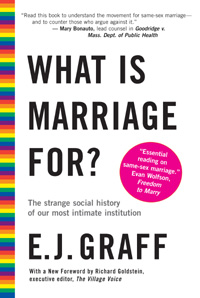
  • It is an historic day for marriage equality in the United States. The Supreme Court decision in US v. Windsor struck down the Defense of Marriage Act; and the more limited ruling in Hollingsworth v. Perry effectively moots Prop. 8 in California. Beacon has been publishing books that promote valuing all families, including but not only through marriage equality, for a long time. Take, for instance, What is Marriage For? by E. J. Graff, which we first published in 1999, and is considered by many "the bible of the same-sex marriage movement." 

    This excerpt from What is Marriage For? explores that public/private intersection of our definition of marriage. We hope that this book continues to inspire people to fight for LGBT equality across the country and around the world. 

    In honor of Pride, we're giving a special discount of 25% off What is Marriage For? and all other LGBT titles at Beacon.org on orders using the Promo Code PRIDE placed during the month of June. 


    What is Marriage For? by E. J. GraffInside Out or Outside In: Who Says You’re Married?

    One of the most basic tensions in the history of marriage is between those two interlocking sides of marriage: marriage as a publicly policed institution and marriage as an inner experience.
    Which one turns your bond into a marriage: a public authority or
    your heart? Are you married when the two of you decide to care for
    each other for life, a decision you live out day to day, a decision only
    afterwards recognized by your community? Or is it the other way
    around: does the family, or church, or state pronounce some words
    over your head, write your names side by side in a registry, and bestow upon you a marriage, a license and legal obligation to carry
    out the responsibilities of a¤ection and care? This may sound like
    one of those faces/vases illusions, and for good reason: marriage
    doesn’t exist unless both parts happen—two human beings behave as married, and everyone else treats them as such. But it does
    matter which side you think counts more: the decisions made
    about individual marriages will be quite different if you think marriage is a publicly conferred status or an immanent state. And each position’s internal contradictions can—and have—caused social
    havoc when unchecked.

    In history, this debate is almost inextricable from the debate
    over which authority rules marriage. Who decides where the enforceable marriage is made—in your heart, or in a registry—and
    why? That decision might be less complex if the only people who
    have to recognize your marriage live within twenty-five miles,
    when the people who see you two behaving as married are also the
    ones who oversee the granting of the widow’s dower. And it might
    be more complex in our world, in which each of our daily lives goes
    beyond our circle of acquaintances to touch dozens of strangers
    and anonymous entities, from the motor vehicles registry to our
    children’s schools. The story of the public/private marriage line is
    therefore also a story of how marriage has shifted, in comparative
    legal scholar Mary Ann Glendon’s words, from custom to law.

    Roman marriage was the immanent kind: when challenged in
    court (over, say, whether a widow inherits or whether a child is legitimate), a marriage could not be proved by anything so simple as
    a public registry. A judge had to investigate whether the two lived
    together with affectio maritalis, ‘‘the intention of being married.’’
    To be married, all a couple had to do was ‘‘regard each other as man
    and wife and behave accordingly.’’ What does that mean, ‘‘behave
    accordingly’’? The Romans may never have defined it, but (like
    Americans and pornography) they knew it when they saw it. A
    judge sized up the couple’s ‘‘marital intentions’’ by such signals
    as whether she’d brought a dowry, or whether he openly called her
    his wife. Augustine and his concubine, for instance, were living
    together without affectio maritalis, since he was intending a later
    power-marriage. But had the same pair intended to be married—with no change in their behavior—they would have been. Marriage
    was a private affair: the state could police only the consequences,
    not the act.

    While the Jewish configuration changed over the millennia,
    what remained central is marriage as a private act: only bride and
    groom could say the magic words that turned them into husband
    and wife. After many centuries the rabbis inserted themselves and their seven blessings into the ceremony, before the big feast, but
    even they knew they were not essential: the pair made the marriage
    within themselves. Which is why, in Jewish law, a court could neither ‘‘grant’’ nor refuse a divorce. If a husband’s inner willingness
    to be married evaporated (sometimes hers counted but often it did
    not), then the marriage itself had evaporated: the rabbinical court
    or bet din could merely decide questions of fault and finances.

    Christianity, as we know, wanted nothing to do with marriage
    for centuries. When asked, some priests might come by and say a
    blessing as a favor, just as they’d say a blessing over a child’s first
    haircut. No one considered marriage sacred, as celibacy was: marriage was one of those secular and earthbound forms rendered
    unto Caesar. But as centuries rolled by, an increasingly powerful
    Church saw that marriage was central to ordering Europe’s civil
    and political life—not so much those few called to sainthood, sacrifice, and martyrdom, but the many ordinary folk who needed to be
    told how to behave.

    And so the Church launched a battle for power over marriage’s
    rules, a battle that lasted roughly a thousand years. Today we have
    the peculiar impression that Catholicism has always had one vision of marriage, but for every marriage rule eventually imposed
    on Europe, the Church’s own debates were abundant. It first formally ruled on marriage in 774, when one pope handed Charlemagne a set of writings that defined legitimate marriage and
    condemned all deviations. After another five hundred years of
    struggle, the Church came up with a marriage liturgy and imposed
    its new and radical rules—the ballooning incest rules, the one-man-one-marriage rule, and most controversial, the girl-must-consent rule—on the powerful clans. ‘‘It is clear,’’ writes one historian, ‘‘that this attempt to impose order on matrimonial practice
    was part of a more ambitious plan to reform the entire social order. . . . regulating the framework of lay society, from baptisms
    to funerals,’’ the most intimate acts of most people’s lives. The
    Church’s push to rule marriage was slow and uneven but very determined. Here and there it would issue a decree and struggle with
    local nobles over whether it would be observed; now it would retract a bit to permit a lord to marry his dead wife’s sister or annul
    his existing marriage; then it would push forward again. 

    It was not until 1215 that the Church finally decreed marriage a
    sacrament—the least important one, but a sacrament nonetheless—and set up a systematic canon law of marriage, with a system
    of ecclesiastical courts to enforce it—and had a fair amount
    of people willing to observe those rules. By 1215, the year that
    the Fourth Lateran Council issued its matrimonial decrees, the
    Church had ‘‘broke[n] the back of aristocratic resistance . . . after
    lengthy individual battles with the nobility, kings included.’’

    And according to the Church, what turned two individuals into
    a married couple? It was—drumroll, please—the couple’s private
    vows.

    Why a drumroll? Because the Church insisted that a private
    promise was an unbreakable sacrament—that marriage was an immanent experience, a spiritual reality created by the pair’s free and
    equal consent. That was practically a declaration of war against the
    upper classes, a radical and subversive idea emphasizing the sacredness of the individual spirit. Marriage, the Church insisted,
    was not just about land and power and wombs, but about human
    feelings.

    Read the rest of "Inside Out or Outside In: Who Says Your Married?" at SCRIBD. 


    What Is Marriage For?: The Strange Social History of Our Most Intimate Institution by EJ Graff by Beacon Press

  • Carlos A. Ball is Professor of Law and Judge Frederick Lacey Scholar at Rutgers University, Newark. He is the author of The Right to Be Parents: LGBT Families and the Transformation of Parenthood (NYU Press, 2012), From the Closet to the Courtroom (Beacon Press) and The Morality of Gay Rights (Routledge).

    During the month of June, From the Closet to the Courtroom and all other Beacon Press LGBT titles are 25% off at Beacon.org. Use the code PRIDE at checkout before June 30, 2013, to receive your discount. Read more at beacon.org/queervoices.

    0078 (1)There are many striking aspects to the Supreme Court's DOMA ruling, but perhaps the most compelling is the role that children and their well-being played in the court's reasoning. For the last twenty years, same-sex marriage opponents have claimed that marriage must remain an exclusively heterosexual institution in part because doing so purportedly promotes the welfare of children. Opponents have contended that children do best when raised by their biological mothers and fathers and that society has an interest in promoting heterosexual marriages because they are the "optimal" way of raising children.

    Unfortunately for opponents of gay marriage, there is a wide consensus among developmental psychologists and other experts that children are not harmed in any way by having lesbian or gay parents. But even putting that issue aside, it is deeply ironic that defenders of "traditional" marriage, in purporting to promote the best interests of children, have consistently ignored the needs of the tens of thousands of children who are being raised by lesbians and gay men.

    This was an issue that Justice Anthony Kennedy raised during the oral argument in the Proposition 8 case last March. Kennedy asked the lawyer defending California's same-sex marriage ban whether it was not the case that the children of same-sex couples were harmed when the state prohibited their parents from marrying. The attorney responded by claiming essentially that whatever harm might exist was a constitutionally permissible price to pay for promoting "traditional marriage."

    Justice Kennedy, in writing the majority opinion in the DOMA case, clearly disagreed. Kennedy emphasized that when the federal government treats state-sanctioned same-sex marriages as "second-tier marriages," it humiliates and stigmatizes the children of those marriages. DOMA, Kennedy explained, made it "difficult for children to understand the integrity and closeness of their own family and its concord with other families in their community and their daily lives."

    Kennedy also emphasized the financial harm that DOMA caused the children of same-sex marriage. He noted, for example, that DOMA made paying for health care more expensive for families because it required the federal government to tax the health benefits provided by employers to their workers' same-sex spouses. DOMA also denied Social Security benefits to a surviving same-sex spouse to care for the couple's child.

    The Supreme Court's opinion in the DOMA case illustrates how it is the marriage equality side that truly has had the best interests of children at heart all along. No child of a heterosexual couple is harmed in any way when the government recognizes same-sex marriages. In stark contrast, when the government refuses to recognize same-sex unions as marital, it harms the children of lesbians and gay men in tangible ways. The Supreme Court understood this, and that is one of the most compelling reasons why it struck down the federal government's unequal treatment of married same-sex couples.

  • All month, we’ve been celebrating LGBT Pride here at Beacon Press. Now, that’s nothing out of the ordinary for us: Beacon publishes some of the best books around about queer history and the fight for equality under the law; gay/lesbian/transgender memoir; religion and homosexuality; and LGBT families, so we don’t need a special month to celebrate. But, like many of you, we just want to wave a rainbow flag and throw confetti from a parade float every year when June rolls around. It’s a time to shout a little bit louder about some books and authors who are very dear to us. 

    So, in honor of Pride, we’re giving a special discount of 25% off all our LGBT titles at Beacon.org on orders using the Promo Code PRIDE placed during the month of June. This discount includes some amazing recent books:

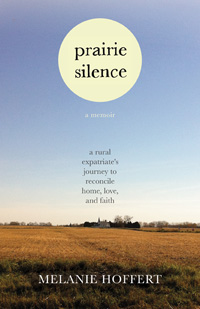
    Prairie Silence by Melanie Hoffert
    Family Pride by Michael Shelton
    Gaga Feminism by Jack Halberstam
    A Queer and Pleasant Danger by Kate Bornstein

    It also includes some books considered classics or quickly becoming so:

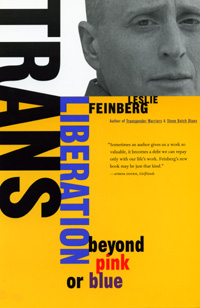
    Trans Liberation by Leslie Feinberg
    The Female Man by Joanna Russ
    My Father's Keeper by Jonathan Silin
    What is Marriage For? by E. J. Graff

    And it evens includes preorders of any forthcoming LGBT title on our site: 

    Read more at Beacon.org/queervoices and order now!

    Related articles

    Queer History: The “Persecuting Society”
    Moms in Writing: Michael Patrick MacDonald, Amie Klempnauer Miller, and Kate Whouley
    Pride on the Prairie and in the City
    What About the Children? Marriage Equality, SCOTUS, and Kids
  • Carlos A. Ball is Professor of Law and Judge Frederick Lacey Scholar at Rutgers University, Newark. He is the author of The Right to Be Parents: LGBT Families and the Transformation of Parenthood (NYU Press, 2012), From the Closet to the Courtroom (Beacon Press) and The Morality of Gay Rights (Routledge).

    During the month of June, From the Closet to the Courtroom and all other Beacon Press LGBT titles are 25% off at Beacon.org. Use the code PRIDE at checkout before June 30, 2013, to receive your discount. Read more at beacon.org/queervoices.

    Ball_FRONT-678x1024

    This post originally appeared at the NYU Press From the Square blog. We thank them for letting us repost it!

    It is in many ways appropriate that the Supreme Court will be issuing its two same-sex marriage rulings—one challenging the Defense of Marriage Act and the other California’s Proposition 8—by the end of the current LGBT Pride Month. Although it is difficult to predict what the Court will do, it is likely that the Court will grapple in some way with the relationship between recognizing same-sex marriages and the well-being of children.

    One of the most telling moments during the oral arguments in the two cases that took place last March was when Justice Anthony Kennedy, who may very well cast the deciding votes, noted that there were about 40,000 children in California being raised by same-sex couples and that these children were vulnerable to an “immediate legal injury” when the government refuses to allow their parents to marry. Kennedy then asked Charles Cooper, a former assistant attorney general during the Reagan administration and the lead lawyer defending Proposition 8, whether it was not correct that “the voices of those children is important in this case.”

    Cooper’s answer revealed much about the internal contradictions and moral limitations of the arguments raised by marriage equality opponents. Cooper’s response to Justice Kennedy’s question was twofold: first, he claimed that there was “no data” showing that the children of same-sex couples are harmed if their parents are not permitted to marry; second, Cooper argued that a law, such as Proposition 8, can “be sustained even if it operates to the disadvantage of a group, if it…otherwise advances rationally a legitimate state interest.”

    There are (at least) two problems with Cooper’s response. First, there is a deep contradiction between contending, as marriage equality opponents routinely do, that the most important reason why society recognizes marriage is to promote the well-being of children, and then suggesting that whether same-sex couples are permitted to marry has no impact on their children. In fact, the federal judge who heard the evidence introduced by both sides during the Proposition 8 trial concluded in 2010 that the children of same-sex couples benefit in meaningful ways when their parents are permitted to marry. Even David Blankenhorn, the president of the Institute for American Values, and the only witness called upon by Proposition 8 supporters to testify during the trial about child welfare considerations, acknowledged that “adopting same-sex marriage would be likely to improve the well-being of gay and lesbian households and their children.”

    0078 (1)Second, Cooper’s response illustrates how marriage equality opponents are willing to use the children of lesbians and gay men instrumentally, that is, they are willing to use them as means to promote (what the opponents believe is) the social good. Cooper essentially told the Court that even if the 40,000 children of same-sex couples in California were harmed or disadvantaged because the state prohibited their parents from marrying, that was a constitutionally permissible price to pay in order to promote “traditional” marriage. Although such a cavalier attitude toward the well-being of children would be troubling in any context, it is particularly so coming from a lawyer representing a movement that supposedly seeks to “defend marriage” based in part on the need to promote child welfare.

    One hopes that the Court keeps children and their well-being in mind when it rules on the constitutionality of Proposition 8 and DOMA. If the Court does so, it will be marriage equality opponents who will be at greatest risk of losing the cases.


    Related articles

    The Ethics of Historical Outing
    Mission Not Accomplished: Homophobic violence a sign of the ongoing battle for safety and equality
  • By Melanie Hoffert

    CIMG9154June. Pride Month. Cities are exploding with rainbow flags and pockets of celebration; the world seems utopian, fluid, full of non-judgment and unity. In days a parade will rumble through Minneapolis’s main thoroughfare and we will cheer for progress made with the recent vote for marriage equality in the state.

    As this month’s Pride festivities unfold, I think of a tiny town in North Dakota of barely 200 people where I attended my most recent parade during a celebration called Uffda Day. The little town’s motto is, as it turned out, “Pride of the Prairie;” and the street I happened to be standing on for the parade is named “Gay Street.” The town seemed its own utopia of sorts—though not, to my knowledge, of the gay sort.

    I stumbled upon this particular Pride of the Prairie town when I was on a “small town tour” that I had mapped for myself to visit several of the towns near where I had grown up. At the time I was in my native North Dakota to experience the unfolding of harvest, where the earth smells of corn and combine lights flicker on the horizon into the dark hours of the night. Something about harvest had always felt mystical to me; like a renewal; a resetting; a time of transition. And I wanted to experience this transition, in full, as an adult.

    The Pride of the Prairie town, with a thriving general store and café, made it feel alive in a way different than its neighboring towns, which resembled the growing inventory of North Dakota ghost towns whose buildings are sunken, paint chipped, and vibrate with memories of times long past. The people I met in this town were generous, open, and welcoming. I was so enamored by my visit that I returned a few days later to experience the town’s yearly celebration, which is how I found myself at Uffda Day.

    During Uffda Day the little town was bustling with people. Several buildings held craft displays; the VFW showcased a lefse station and an accordion player; the streets were crowded with antique tractors and horse drawn carts. As I wandered through the town, I was struck with nostalgia for the bi-annual “Crop Show” that took place in my own hometown. We were known as the “Corn Capital of North Dakota” and during the Crop Show the school transformed into a wonderland of adventure, or at least it seemed that way to my young mind. Candy flowed freely from agricultural-based exhibit booths; each classroom held an activity, including cakewalks, chili contests, photo displays, and 4-H craft exhibits; glass cases filled with pristine crops also lined all of the school hallways. The Crop Show, like Uffda Day, was a time to celebrate a shared place and identity with neighbors; much like, I now realize, Pride.

    4473I found Gay Street in the Pride of the Prairie town during the Uffda Day parade; this discovery caused an ironic smile to spread across my face as it likely would anyone who is gay, from North Dakota, and home. I didn’t ask anyone about the origin of Gay Street because my inability to talk about being gay, while in North Dakota, had become a life-long practice that I didn’t yet know how to break. I feared that if I were to be honest, I would suddenly appear to people as a foreign entity in our shared rural world. Therefore, I roamed the land I loved feeling partial, sadly knowing that my inability to talk perpetuated the myth of my difference.

    My fear of being out as a lesbian back home had often seemed to me a leftover childhood insecurity, borderline ridiculous even. Then, last February, the North Dakota legislature rejected an anti-discrimination bill that would have made it illegal to discriminate based on sexual orientation in the workplace, housing, and government; this means that in my beloved home state, you can be fired for being gay.

    My fear of rejection suddenly seemed not so ridiculous.

    In a twist of coincidence, during the time this bill was brewing, my memoir, Prairie Silence, was published. The book is, in part, about the challenge I had being open about my life when I returned home. I had written for years out of a love of writing, and I didn’t quite think through how I might feel upon publication, when my secret would obviously no longer be under wraps. And so during what should have been the pinnacle of joy in a writer’s life—the publication of one’s first book—I sunk into a state of miserable anticipation, awaiting my home state’s reaction. I even joked to some about how I wished I would have written a preface thanking people for buying the book, but asking those who lived in the zip code of 58081 to please not turn another page and, instead, to give the book away. 

    While I writhed in a state of dueling excitement and misery, I started to hear from my classmates, old neighbors and friends, and even my elementary principal; I heard from pastors and state senators; I heard from people with connections to North Dakota and other rural places. With each email, or Facebook post, or phone call, I took a breath and braced myself for the inevitable rejection—but it didn’t come.

    Rather than ostracize me, people wrote about their own experiences. They shared with me their personal thoughts about the push and pull of home; they talked about their challenges in revealing secret parts of themselves to the people they loved; they offered their opinions about changes in rural areas; and they reflected upon their journeys of evolution around issues of identity and faith. I also heard from LGBTQ people who live in rural areas, some who even live close to my hometown; their stories conveyed challenges, but mostly acceptance. With each story I felt increasingly connected to people through our shared fears, struggles, and journeys. By the time I finally did hear that a handful of anti-gay people had complained to a local paper that ran an article about my book, I was largely unscathed; I had been fortified by the gift of other people’s stories, gay and straight alike. I knew I was not alone in my search for belonging and self-acceptance.

    As I experience this year’s Pride celebration in Minneapolis, I want to imagine a time when Uffda Days, and Crop Shows, and Pride parades will overlap; when Norwegian accordion players, and crafters, and antique tractor collectors, and drag queens, and young gay families, and dykes on bikes, and champion corn growers, and quilters, and chili cook-off winners will join in a celebration of shared humanity. Sometimes this blending of utopian worlds feels close, and sometimes it feels far away; but I do believe that someday, perhaps sooner than I think, I will be able to stand on Gay Street in that North Dakota town with a new and amazing sense of what pride of the prairie can truly mean. 

    About the Author

    Melanie Hoffert grew up on a farm near Wyndmere, North Dakota, where she spent her childhood wandering gravel roads and listening to farmers at church potlucks. Her work has been published in several literary journals, and she holds an MFA in creative writing from Hamline University. Melanie lives in Minneapolis and works for Teach For America. Learn more about her work at melaniehoffert.com.

  • David_plante-american_ghosts 

    For a limited time, visit Beacon Press at Scribd to download a PDF of Plante's extraordinary memoir American Ghosts for free. If you'd rather get a copy of the paperback, order from Beacon for the special low price of $3.99.

    You can also get The Pure Lover: A Memoir of Grief and The Country: A Novel for $3.99 each. Order now: this special offer expires on June 30, 2013. 

    David Plante is the author of more than a dozen novels, including the Francoeur trilogy—The Family, The Woods, and The Country—as well as the nonfiction books Difficult Women, American Ghosts, and The Pure Lover. His work has appeared in many periodicals, The New Yorker and The Paris Review among them, and he has been nominated for a National Book Award. 

    Plante grew up in an isolated, French-speaking community in Providence, Rhode Island, where nuns preserved the beliefs of le grand Canada amidst the profound presence of their deep, dark God. Caught between his silent, part-Blackfoot father and his vivacious but trapped mother, Plante flees this small world, losing his belief in any god and finding the center of his life in love and in writing. Still, the ghosts of his past haunt Plante and drive him to embark on a stunning spiritual and physical journey.

    "This wonderful book takes on what may be the hardest questions by allowing this most observant individual to see and hear in miraculous detail. How, it asks, does any person become American, let alone find a place in the breathing cathedral that is this majestic universe?" —Jane Vandenburgh, Boston Globe

    "A memoir full of doubts and hesitations, a self-scouring undertaken with resolute frankness and considerable stylistic grace . . . Plante shows that origins can work on the spirit with a force as strong as gravity." —Sven Birkets, New York Times Book Review

    "A book, and a life . . . consumed with exploration and examination. It is about asking hard questions, and making hard judgments, and rummaging, mercilessly, through the hidden recesses of a mind that never rests . . . Remarkable. And memorable." —David M. Shribman, Toronto Globe and Mail 


  • Today's post is part of a series of interviews with Michael Bronski about the A Queer History of the United States, the 2012 Lambda Literary Award winner for LGBT Nonfiction. The interviews were conducted by Richard Voos. 

    Phantoms, welcome, divine and tender!


    Invisible to the rest, henceforth become my companions;
    Follow me ever! desert me not, while I live.

    Sweet are the blooming cheeks of the living! sweet
    are the musical voices sounding!
    But sweet, ah sweet, are the dead, with their silent eyes.

    Dearest comrades! all now is over;

    But love is not over—and what love, O comrades!
    Perfume from battle-fields rising—up from fœtor arising.

    Walt Whitman "Hymn of Dead Soldiers," Leaves of Grass (1867)


    The Army Hospital Feb 21, 1863. There is enough to
    repel, but one soon becomes powerfully attracted also.

    Janus Mayfield, (bed 59, Ward 6 Camp[bell] Hosp.)
    About 18 years old, 7th Virginia Vol. Has three brothers also in the Union
    Army. Illiterate, but cute—can neither read nor write. Has been very sick and
    low, but now recovering. Have visited him regularly for two weeks, given him
    money, fruit, candy etc.

    Albion F. Hubbard—Ward C bed 7 Co F 1st Mass
    Cavalry/ been in the service one year—has had two carbuncles one on arm, one on
    ankle, healing at present yet great holes left, stuffed with rags—worked on a
    farm 8 years before enlisting—wrote letter—for him to the man he lived with/
    died June 20th 1863

    Walt Whitman, notebooks


    Listen to Queer History Episode 5-Civil War Violence and the Male Body


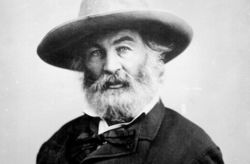
    Walt-whitmanRichard Voos:
    In American history the Civil War forms a
    turning point in American history however one defines it, in terms of the sheer
    number of Americans dead on both sides as well as the transformation of the
    United States into a modern industrial nation. It also has a transformative
    effect on the role of men, the sheer violence on the role of men, as well as
    the ability of women to perform in a different role.

    Michael Bronski: That's totally correct. When we look at the
    Civil War—and the Civil Ward plays such an important role in the mythology of
    American history—it really is central. But I think people don't understand the
    role of violence in the Civil War. We all know that all war is violent, but the
    sheer number of deaths of American men in the Civil War is tremendous. If we
    were to do a percentage, based on our current population, of the Civil War
    versus today and the number of deaths, the number of deaths given today's
    population would be six million deaths. Which is staggering when you think about
    it. So what the Civil War does within the history of American gender is
    something quite unique. If after the Revolution we saw the making of the new American
    man, the divorcing of the Daniel Boone/Davy Crockett type from the effete fop
    from England, that trend continued and the Civil War presents us with a
    complete crisis of masculinity. In the two Whitman quotes we heard, we actually
    see this sort deluge of mutilation and death and harm to the male body
    happening, and at the same time we see this enormous amount of tenderness
    towards the male body. Because well, everybody, North and South, who fought in
    the Civil War was brave, even if they
    were brave for those 35 seconds before they were shot coming into the first big
    battle if they were in the first wave of people.

    And let’s not forget that the
    Civil War deaths were fairly personal: you actually shot people or you
    bayonetted them and they were right in front of you. You did not get to be in a
    tank and shoot people who were 50, 150 yards away from you. The sheer amount of
    death was devastating to the men who fought in the Civil War, and who survived.
    So when we hear the Walt Whitman poems, it’s just this endless elegy to male
    beauty, to male sentiment, to the uniqueness
    of men—and quite sexualized, often, within Whitman's poetry and in his journals.
    On the other hand we have… not the image of the brave Union soldier or brave “Johnny
    Reb,” but in fact the young vulnerable boy who has simply been torn apart. So
    the male body becomes here, and we see this later in World War II, which we'll
    discuss in a later podcast, we see the male body completely heroicized and
    lionized for being brave, and at the same time pitiable in its vulnerability.

    4465RV: How does the violence associated with the Civil
    War continue to influence the definition of manliness after the war?

    MB: Having just spoken about the dichotomy between the
    brave soldier and the vulnerable soldier, I think one thing to keep in mind
    here—and it continues to be a central part of American culture today, but particularly
    up until World War II—is that we see the very definition of manhood changing.
    So the rite of passage for men from the age of 13, 14 up until 50 in the Civil
    War, the rite of passage was actually killing someone. Killing another soldier,
    killing another American, even if they had seceded from the Union. So, the very
    definition of manhood—quite different from Davy Crockett, if Davy Crockett
    proved his manhood by killing animals—the definition during the Civil War was
    actually to kill another American.

    Related articles

    Queer History: The "Persecuting Society"
    Moms in Writing: Chris Stedman and Kevin Jennings on their Moms