• Notable Mentions


    PREVOST-SnobZonesSnob Zones: Fear, Prejudice, and Real Estate
     by 
    Lisa Prevost

    Lisa Prevost discussed "How Zoning Affects the Wealth Gap" with David Brancaccio on NPR's Marketplace Morning Report. 

    “For a housing market, it’s always healthy to have a range of housing so that people can move up the ladder,” she says. “I grew up in New Hampshire and I remember when the small towns did have the bank president living the same place where the farm laborers did. We have lost a lot of that through suburbanization and as we see the deepening inequities between incomes, I think that’s reinforced by some of this zoning.” [Listen]


    Write up on Connecticut
    Magazine’s blog

    In four of the six New England states (excluding Maine and New Hampshire), the recent national "housing bust" hasn't reduced home prices enough to make the median-priced home affordable for the average household. According to the National Association of Realtors, only 25 percent of Americans want a home on an oversized lot, yet that type of housing accounts for 43 percent of the supply in New England. [Read the rest]


    The Point, on Cape Cod’s NPR station, did a segment on narrative non-fiction with their host, a local librarian, and the Cape Cod Times book editor. They mention both Snob Zones and Dirt Work starting around the 24 minute mark. [Listen] Which leads us to…


    BYL-DirtWorkDirt Work: An Education in the Woods
    by Christine Byl 

    National Parks Traveler
    review
    :

    In her book, Ms. Byl recalls long days of clearing brush, digging ditches, building bridges, cleaning up after forest fires, and blasting snow. She learned how to use such unfamiliar tools as crosscut saws, pulaskis, and chainsaws. She grew accustomed to dealing with the harsh living conditions and injuries that are part of the job.

    And, frankly, she learned how to cope in the backcountry, miles from the nearest restroom. Yes, Ms. Byl is not afraid to talk about "dropping her pants in the woods."


    Listen to Christine Byl on Alaska
    Public Radio’s Talk of Alaska
     talking about her tools, her life in the woods, wildlife, and more. Especially great to hear her reading her meditation on the lynx. 


    Take a quick look at what Christine carries in her backpack in this YouTube video:


    Light Without Fire: The Making of America's First Muslim College by Scott Korb

    Reviewed on Caffeinated Muslim 

    Excerpt on Religion & Politics


    Opportunity, Montana: Big Copper, Bad Water, and the
    Burial of an American Landscape
     
    by Brad Tyer

    Review from the Billings
    Gazette
    : “an engaging, almost breathtaking bit of nonfiction.” 


    The Land Grabbers: The New Fight over Who Owns the
    Earth
     
    by Fred Pearce

    Fred Pearce was interviewed about The
    Land Grabbers
    for New Hampshire Public Radio’s Word Of Mouth


    The Most Expensive Game in Town: The Rising Cost of
    Youth Sports and the Toll on Today's Families
     
    by Mark Hyman

    Dave Zirin heaps praise on Mark Hyman and
    The Most Expensive Game in Town on his blog for The Nation.


    Notable Mentions

    Hunting Season: A Story of Home, Immigration, and
    Murder
     
    by Mirta Ojito (November)

    "An account that is as unflinching as it is
    important.  Both an incisive reconstruction of a heartbreaking murder and
    an unsparing diagnosis of a national malady  . . . with HUNTING SEASON
    Ojito has done truth an invaluable service. Extraordinary." —Junot Díaz, Pulitzer Prize winning author of The Brief
    Wondrous Life of Oscar Wao


    Being Both: Embracing Two Religions in One Interfaith
    Family
     by Susan Katz Miller (October)

    A moving, personal story that
    opens new dimensions of life in general and religious life in particular that
    rise out of an interfaith family. Susan Katz Miller writes with the
    passion of experience and with the integrity of being authentic. Its insights
    moved me deeply.”—John Shelby Spong, author of The Fourth Gospel: Tales of a
    Jewish Mystic


    Related articles

    Connecting With Nature on Earth Day and Every Day
    Dirt Work: An Education in the Woods
    Snob Zones: Fear, Prejudice, and Real Estate
    John K. Ross on Zoning
  • Today's post is from Carole Joffe, author of Dispatches from the Abortion Wars: The Costs of Fanaticism to Doctors, Patients, and the Rest of Us. Joffe is a professor in the Bixby Center for Global Reproductive Health at the University of California, San Francisco (however, the views and opinions expressed here do not necessarily state or reflect those of the Regents of the University of California, UCSF, or the UCSF Medical Center). This post originally appeared at RHRealityCheck.

    0128It does not take a rocket scientist to realize that in health-care settings a positive relationship between clinician and patient—one comprised of mutual understanding, respect, and trust—is beneficial to both parties. It is only common sense that when such a  relationship exists, however brief it may be, the provider develops more sympathy for the needs of the patient, and the latter’s overall well-being can improve if she or he senses personal interest and concern on the part of the former.

    Arguably, this point is especially relevant in abortion care because of the extreme politicization and stigma that surrounds the procedure. Some patients, having been exposed to anti-abortion distortions, are terrified of the procedure (one provider told me of a patient who asked, “When are you going to use the steel ball with the knives on it?”) and some do not view abortion doctors as “real” doctors. Some physicians, in turn, depending on the circumstances of their particular facility, have little chance to interact with patients, except when she is on the procedure table, possibly under anesthesia. Therefore, these providers may have an inadequate understanding of the reasons that brought these women to the clinic. Indeed, several research studies of abortion staff done soon after abortion became legal in the United States have shown that those who had opportunities for verbal interaction with patients—for example, social workers and counselors—were more positively inclined toward patients than those whose interactions were confined to just physical care. My own research among abortion providing physicians has revealed that the aspect of this work many find most meaningful is simply talking to patients, and some are wistful that there is not more opportunity for this.

    In the period immediately after Roe v. Wade, it was very common in most abortion settings for designated counselors or physicians to have the opportunity for open-ended discussion with a patient. This kind of encounter, which goes beyond offering the patient the requisite informed consent information and ascertaining she has not been coerced into the decision, has been difficult for many facilities to sustain over the years for various reasons, not the least being that in many states patient-doctor time is eaten up by doctors having to impart to patients legislatively mandated scripts about abortion, many of which contain blatant falsehoods. Nevertheless, most abortion facilities with which I am familiar make every effort to offer additional conversational time to patients who seem most in need of it.

    What do these efforts to maintain meaningful provider-patient conversations have to do with Live Action, the anti-abortion group notorious for its undercover “investigations” of abortion clinics? For several years, Live Action operatives, pretending to be prospective abortion patients, have gone into clinics, questioning various levels of staff about abortion policies and procedures, and when their hidden cameras manage to catch a staff person making an inopportune comment, the organization triumphantly posts videos (typically highly edited) of these visits.

    The latest Live Action “gotcha” moment is in a video of Dr. Leroy Carhart, one of the few providers in the United States who openly provides post-24-week abortions in selected circumstances, and as such is a longstanding target of the anti-abortion movement. In the video, Carhart is repeatedly grilled by a would-be patient, who portrays herself as 26 weeks pregnant, as to the procedure he would use in a pregnancy of that gestation. In response to the woman’s stated concern that a fetus whose demise has been caused by injection “would decay inside of her,” Carhart seeks to reassure her, at one point saying the fetus would soften like “meat in a Crock-Pot.” Predictably, Live Action, and subsequently other anti-abortion groups, have seized upon this statement and used it to further their campaign of what might be called the “Gosnellization” of individuals who provide later abortions—that is, to claim that Carhart and his colleagues are no different than the rogue doctor now on trial in Philadelphia for dangerous and illegal practices.

    But Leroy Carhart and Kermit Gosnell could not be more different as abortion providers. As the New York Times pointed out in its coverage of this incident, “[T]he video provides no evidence of illegal action or subpar medical techniques.” Tracy Weitz, my University of California, San Francisco colleague, further pointed out to the paper the evident concern that Carhart exhibited toward the (imposter) patient, and offered this context to his “Crock-Pot” remark: “Doctors struggle to find terminology to help a client understand what’s happening, and while it may seem wrong to us, it may be appropriate for that conversation.” (The recent film After Tiller also amply demonstrates Dr. Carhart’s compassionate relationship with patients.)

    What will be the upshot of this latest Live Action incident? Dr. Carhart, who previously provided later abortions in the clinic of Dr. George Tiller in Kansas before Tiller was assassinated, will not be deterred from his “mission” to carry on his friend’s work, as the former military surgeon often puts it. In the years since he decided to devote himself full-time to abortion work, Carhart has had extremists burn down his barn with 17 horses inside, seen the state of Nebraska pass a law deliberately aimed at preventing him from performing abortions after 20 weeks’ gestation, and is subject to constant protestors at his two clinics as well as vilification in anti-abortion media.

    But while Dr. Carhart will continue with his work, I do fear that a possible consequence of these well-publicized Live Action videos may be a chilling effect on the free and open conversation between clinic staff and patients that is such an important part of abortion care. Should this occur, I have no doubt the anti-abortion movement will declaim self-righteously about the “coldness” and “impersonality” of abortion facilities.

  • In honor of Mother's Day and moms everywhere, where sharing a few of our favorite Mom moments in Beacon books. In these passages we've posted on the Beacon Press Scribd page, we have three varied perspectives on motherhood. Michael Patrick MacDonald reflects upon his mother's strength in a passage from All Souls: A Family Story From Southie. Amie Klempnauer Miller recounts the decision-making path she and her partner went down on their way to becoming moms in an excerpt from She Looks Just Like You. And, in Remembering the Music, Forgetting the Words, Kate Whouley tells the story of the challenges funnier moments of one Mother's Day with her mom. 


    All Souls by Michael Patrick MacDonald book coverShe Looks Just Like You book cover Remembering the Music, Forgetting the Words book cover


    All Souls: A Family Story from Southie by Michael Patrick MacDonald by Beacon Press


    She Looks Just Like You: A Memoir of (Nonbiological Lesbian) Motherhood by Amie Klempnauer Miller by Beacon Press


    Remembering the Music, Forgetting the Words: Travels with Mom in the Land of Dementia by Kate Whouley by Beacon Press


    Related articles

    Moms in Writing: Chris Stedman and Kevin Jennings on their Moms
    Beacon Authors on the Boston Marathon Bombings and Aftermath
    Further Reading on Marriage Equality
    Beacon Books at Audible: Faitheist
  • In honor of Mother's Day and moms everywhere, where sharing a few of our favorite Mom moments in Beacon books. Today's passages illustrate two beautiful gifts the authors received from their moms: for Kevin Jennings, a love of books; for Chris Stedman, a sense of gratitude. Please feel free to share your own mom memories in the comments!


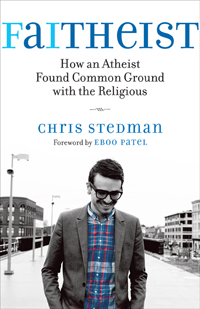
    1439Chris Stedman from Faitheist: How an Atheist Found Common Ground with the Religious

    My childhood was marked by simplicity and hard work and love—which is to say that it was actually quite carefree. My mother did a good job of instilling in us a deep sense of gratitude for the things we had; I didn’t really notice that we had less than other people until I was older and began to look for differences everywhere. It never seemed odd to me that we wore hand-me-down and home-spun clothing, or that we used homemade remedies like covering our hair with mayonnaise and saran wrap when we got lice from someone at school. When we were young children my mom made sure my siblings and I were well cared for—it was only later in life that I started telling myself that my story was that of “the poor kid.” The life she provided was rich, filled with complex colors of every hue, with trips to the beach in the early hours of the day before the parks became overcrowded with people desperate to escape the summer swelter, with arts and crafts and makeshift blanket forts.

    Her inventiveness masked the meagerness we lived with; I never even realized until later in life that during my youngest years she had only owned two pairs of jeans and a few sweatshirts. She had an unparalleled aptitude for spinning straw into gold—our Christmases were full of hand-crafted and recycled gifts, and for birthdays she would set up elaborate party games, hanging pretzels from the ceiling with ribbon, hand-painting a bunny for cotton ball pin-the-tail-on-the-rabbit, and writing up thought-provoking trivia. My earliest years were characterized by imaginative games my siblings and I invented such as “Mean Diseased Cat,” where we manned our alert stations in anticipation of the return of a particularly feral cat that once meandered down our street; by the birthday cakes my mom painstakingly prepared; by the hand-crafted skip-its, teeter-totters, and pajamas that were our most prized possessions; by sitting down together as a family for dinner every single night, even if it was just bottom-shelf macaroni and cheese or saltine crackers topped with melted Kraft Singles, which we ate near the end of particularly tight months. I didn’t realize that you could buy Play-Doh at the store until I was nearly in middle school; we always made ours from scratch. I think we enjoyed it more that way, having concocted it ourselves before using it to build new things. We were deeply invested in everything we did, because most things were an act of creation and an act of love.


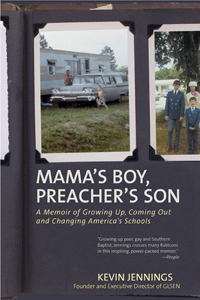
    7147Kevin Jennings from Mama's Boy, Preacher's Son: A Memoir of Growing Up, Coming Out, and Changing America's Schools

    Above all, she taught me to love books and reading. Mom was a voracious reader, a trait she passed down to me. The highlight of our week would be our Saturday trips to the downtown public library in Winston-Salem—the “big one” and just about the only site that would get Mom regularly to venture out of the safety of Lewisville into “the city.” It was always just me and her, as the only thing that bored Paul more than Civil War battlefields was a library. I loved the downtown library. It was beyond a church—it was a cathedral, filled with holy objects, books, so many that I despaired that I would ever be able to read them all. The librarians were friendly and thought it was great, not weird, that I liked to read so much. I would check out as many books as I could carry, usually a stack so large I couldn’t see over them, and would devour them all during the course of the week, returning the next Saturday, eager for more. Library trips were the best. They even beat new trailer shopping.

    At first I would go to the children’s section and Mom to the adult section. By fourth grade or so, I had read all the books that interested me in the children’s section and decided that the rest were too childish for this budding intellectual snob to bother with. I told Mom that I wanted to go where she went, the adult section. This created a crisis for Mom: in the adult section, there was a replica of the Venus de Milo. Mom felt it was inappropriate to have a nude statue in a public place, period, and especially inappropriate for a young boy to see it. (If she only knew…) I begged and pleaded and finally she relented, but only if I first promised not to look at the statue of the “naked lady.” Ignoring the naked lady, I raced in and returned with a forehead-high stack. I was in heaven.

    Related articles

    "Informational Readings" vs. Books: What Common Core Curriculum Misses
    Beacon Buzz: Claudette Colvin and Rosa Parks
    Beacon Books at Audible: Faitheist
    Spotlight: "6 Tips for Christians on Talking to Non Christians" by Chris Stedman
    How Chris Stedman's Faitheist is Helping Me Discover a More Effective and Compassionate Atheism
  • Susie Bright, in addition to being a best-selling author, activist, and podcast host, is editor at large for Audible. Susie's blog, The Bright List, keeps readers and listeners apprised of new audiobooks.

    Today's post is a cross-post from the Bright List.

    STEDMAN-FaitheistFaitheist: How an Atheist Found Common Ground with the Religious, by Chris Stedman

    “Who can we be, together? …The goal should be neither conversion nor the destruction of religion— but rather to make a better world.”

    —Sarah Sentilles, author of Breaking Up with God: A Love Story

    If Chris Stedman had stayed in the church, he'd be everyone's favorite closeted youth pastor.

    But this Fellow from the Humanist Chaplaincy at Harvard University had the bravery to come out as gay and an atheist. He found, as he tried to reach out in the atheist world, that, as organized groups, they were often defined by what they were against, rather than what they were for. 

    Stedman calls for non-religious people to identify their values and work towards a positive identity. He asks the religious to move beyond their assumptions about who atheists are, and to recognize our common humanity.

    Narrated by Corey Snow, who also read Black Hearts: One Platoon's Descent into Madness in Iraq's Triangle of Death.

    –Aretha Bright and Willow PennellRelated articles

    How Chris Stedman's Faitheist is Helping Me Discover a More Effective and Compassionate Atheism
    Beacon Authors on the Boston Marathon Bombings and Aftermath
    Beacon Books at Audible: Straight: The Surprisingly Short History of Heterosexuality by Hanne Blank
    As the Supreme Court Weighs Gay Marriage, Let's Hear It for the Allies
  • If you take the time to watch one TED Talk this week, make it this one. Geoffrey Canada is an educational innovator, and in this video (part of which appeared on PBS) he makes a powerful argument for changing the way we think about public education. 

    Canada knows how to help kids achieve great things: as the president of Harlem Children's Zone, he has changed countless lives and transformed a community. While the Harlem Children’s Zone started out focusing on a single block — West 119th Street — it has since expanded exponentially. It now encompasses more than 100 square blocks and serves an estimated 10,000 children, providing pre-kindergarten care, after-school programs, health care, college planning and classes for soon-to-be-parents.

    Beacon Press is proud to be the publisher of Canada's two books: Fist Stick Knife Gun: A Personal History of Violence (which was also adapted into a graphic book) and Reaching Up For Manhood: Transforming the Lives of Boys in America. 


    Watch and Share Geoffrey Canada: Our failing schools. Enough is enough!


    Fist Stick Knife Gun book coverFist Stick Knife Gun: A Personal History of Violence

    Other formats: Graphic book | Kindle | Nook | Audio 

    Long before the avalanche of praise for his work—from Oprah Winfrey, from President Bill Clinton, from President Barack Obama—long before he became known for his talk show appearances, Members Project spots, and documentaries like Waiting for Superman, Geoffrey Canada was a small boy growing up scared on the mean streets of the South Bronx. His childhood world was one where "sidewalk boys" learned the codes of the block and were ranked through the rituals of fist, stick, and knife. Then the streets changed, and the stakes got even higher. In his candid and riveting memoir, Canada relives a childhood in which violence stalked every street corner.

    "I wish every city had a Geoffrey Canada."
    —President Bill Clinton

    "Geoffrey Canada's realistic yet hopeful voice finds fresh expression through the comic style of Jamar Nicholas. Canada's account of his childhood and the role that violence played in shaping his experiences provides hard-won and crucial lessons."
    —Pedro A. Noguera, Peter L. Agnew Professor of Education at New York University

    "Jamar Nicholas is a master of his craft—his drawings are full of life and truly stunning."
    —Bryan Lee O'Malley, creator of Scott Pilgrim vs. The World

    "Geoffrey Canada is one of this country's genuine heroes. His personal meditation on America's culture of violence is a beacon of hope for our humanity."
    —Charles Johnson, author of Middle Passage

    "Canada has never lost touch with the child within himself or with the fears of the children around him struggling to reach adulthood in the violent streets of America."
    —Marian Wright Edelman, author of The Measure of Our Success

    "Canada takes us on a powerful journey. . . . He is a man of hope and a wonderful storyteller."
    —Henry Hampton, executive producer, Eyes on the Prize

    Related articles

    MLK Was an Interfaith Visionary
    "Informational Readings" vs. Books: What Common Core Curriculum Misses
    TED: Geoffrey Canada: Our failing schools. Enough is enough! – Geoffrey Canada (2013)

  • PREVOST-SnobZonesTowns with strict zoning are the best towns, aren't they? They're all about preserving local "character," protecting the natural environment, and maintaining attractive neighborhoods. Right?

    In this bold challenge to conventional wisdom, Lisa Prevost strips away the quaint façades of these desirable towns to reveal the uglier impulses behind their proud allegiance to local control. These eye-opening stories illustrate the outrageous lengths to which town leaders and affluent residents will go to prohibit housing that might attract the "wrong" sort of people. Prevost takes readers to a rural second-home community that is so restrictive that its celebrity residents may soon outnumber its children, to a struggling fishing village as it rises up against farmworker housing open to Latino immigrants, and to a northern lake community that brazenly deems itself out of bounds to apartment dwellers. From the blueberry barrens of Down East to the Gold Coast of Connecticut, these stories show how communities have seemingly cast aside the all-American credo of "opportunity for all" in favor of "I was here first."
    Snob Zones warns that this pattern of exclusion is unsustainable and raises thought-provoking questions about what it means to be a community in post-recession America.

    About the Author

    Lisa Prevost is an award-winning journalist whose articles have appeared in the New York Times, Boston Globe Magazine, More, Ladies' Home Journal, and other publications. A native New Englander, she has lived and worked as a reporter in four of the six New England states. She lives in Fairfield, Connecticut.

    Read the introduction at Scribd.

    "Zoning Kills Affordable Housing," Review at Reason magazine.

    "New England: Hotbed for Housing Snobs?" Review at the Boston Globe.

    Listen to Lisa Prevost on the Marketplace Morning Report.


    Related articles

    MLK Was an Interfaith Visionary
    Light Without Fire: The Making of America's First Muslim College
    John K. Ross on Zoning
  • Mark Winne was the executive director of the Hartford Food System from 1979 to 2003. He currently consults and writes on food system issues from Santa Fe, New Mexico. He is the author of Food Rebels, Guerrilla Gardeners, and Smart-Cookin’ Mamas: Fighting Back in an Age of Industrial Agriculture and Closing the Food Gap: Resetting the Table in the Land of Plenty.

    A version of this essay appeared in the Hartford Courant.

    StrawberryIf there’s one thing
    that stands out for me during my 25 years in Connecticut, it was the quiet but
    delicious return of good food and local farms.

    For readers who are
    less than 40 years old, please remember, there were no farmers’ markets in the
    state until 1978. Today, according to the Connecticut Department of
    Agriculture, there are 118. There were also no community supported agriculture
    farms. Today, according to Connecticut NOFA, there are 70.

    Throughout the latter
    decades of the 20th century, subdivisions were consuming the state’s
    farmland faster than you could eat a Glastonbury peach. Today, between the
    state’s farmland preservation program and the Connecticut Farmland Trust, over
    325 farms and 40,000 acres have been permanently protected. Overall, the number
    of farms is no longer on the decline but actually on the rise. And with equal
    importance, residents living in lower income neighborhoods are witnessing a
    return of supermarkets to some of the state’s worst food deserts.

    Progress like this
    cannot be taken for granted, nor can it go unattributed. It was due to the
    public will, meaning the actions of thousands of informed Connecticut citizens,
    policymakers, and concerned organizations who thoughtfully reshaped the
    direction of the state’s then atrophying food system.

    4737I sense such a
    destiny-making moment is before Connecticut again. The passage of House Bill
    6519, “An Act Concerning the Labeling of Genetically Engineered Food,” would not
    only make Connecticut the first state to require such labeling, it would also
    give the state’s citizens a chance to chart the direction of their food system.
    Labeling food products comprised of ingredients grown or raised by genetically
    modified means will grant every Connecticut consumer the opportunity to make an
    informed choice, just as they have done for local food, farmland protection,
    and access to healthy food for all.

    The efficacy and
    safety of genetic modification is still in doubt and will be debated for some
    time to come. Clearly, the public must engage in this debate and not concede
    its outcome to a small number of profit-driven biotechnology corporations, scientists,
    and federal officials. But given the pit-bull determination of the food
    industry to fight every attempt to rein it in – a fight financed with
    bottomless coffers – genetically engineered ingredients will remain on grocery
    store shelves for the foreseeable future. That doesn’t mean that we have to
    consume them if we don’t want to. Hence, the need for information, which is why
    savvy marketers like Whole Foods will soon be labeling GE food.

    It is prudent to beware
    of food and farm corporations bearing gifts. Like a Trojan horse that appears
    one morning on the town common, genetically engineered food proponents claim
    that it poses no harm to humans or the environment, and that we need the
    technology to feed the nine billion people expected by 2050.  Consider the claims and the source. Already,
    genetically engineered crops have been associated with the decline of monarch
    butterfly populations as well as a greater degree of herbicide tolerance –
    requiring more herbicides instead of less. Yields from GE seeds have shown
    mixed results, not always exceeding those of conventional or hybridized seeds.
    And United Nation’s bodies have not embraced GMOs as a way to feed a hungry
    world, proposing instead more sustainable agriculture methods and a greater
    emphasis on small-scale farming and social equity in developing nations.

    When entering
    uncharted territory where risk is prevalent, we should employ the precautionary
    principle. This means that the introduction of new technologies require a much
    higher level of certainty and scientific consensus than we currently have with
    GMOs. As my mother taught me when I first learned to cross busy streets, look
    both ways, look again and again, and then proceed with caution.

    I’ve always been
    proud of Connecticut’s independent streak. A tenacious refusal to accept pat
    solutions and the mediocrity of market-driven events has served it well over
    the years. Information is power because it gives people the power to choose and
    to act. Labeling genetically engineered food will give the state’s consumers
    the information they need to make their own choice while allowing its citizens
    to choose the food system that reflects their needs and values.

    Photo by Jessie Bennett. 


    Related articles

    Recommended Reading for World Water Day
    Opportunity, Montana: Big Copper, Bad Water, and the Burial of an American Landscape
    How Bad Conservative Sociology is Used to Attack Gay Families
    Locally owned businesses can help communities thrive – and survive climate change
  • Laurie Essig teaches sociology at Middlebury College in Middlebury, Vermont. She has written for a variety of publications, including Legal Affairs, Salon, and the Chronicle of Higher Education. She is the author of American Plastic: Boob Jobs, Credit Cards, and Our Quest for Perfection.

    This post originally appeared on her blog, Love Inc., at Psychology Today.

    0323Dove's "Real Beauty" has another stunning commercial. In this one, "Real Beauty Sketches," a forensic artist sits with his back turned as a woman describes how she sees herself. He draws her image. Then another woman, an acquaintance, is brought in to describe how she sees the first woman. He draws that image. In the denouement, the woman is forced to look at the portrait he made from her own description and compare it to the far more attractive and realistic one described by her acquaintance. In other words, it is a beautiful illustration of something we already know: women have a warped sense of how they look. 

    But women's hatred of the way they look didn't just appear out of thin air. It was implanted in us in a variety of ways, but primarily through advertising that uses "idealized" images of beauty and asks us to compare ourselves to them.

    After all, women and girls didn't think a whole lot about how they looked before capitalism. Historians such as Joan Brumberg have shown that adolescent girls prior to advertising tended to think about their inner make-up– were they kind and good and devout. But with advertising early on telling women to buy creams, "slim" down, put on a bra and generally engage in what Brumberg calls the "body project," young girls started to worry far more about cellulite on their thighs than goodness in their hearts. Some social psychology studies indicate that even women with high levels of self-esteem will feel worse about themselves after looking at these idealized images found in advertising.

     So capitalism created the problem of women being ugly and also created the solution: beauty products. It is an ingenious business plan. Add to this beauty business certain technologies, such as cosmetic surgery and Photoshop, and you have the completely unreal moment in which we now reside where women spend inordinate amounts of money attempting to make themselves look like images of women who don't actually exist. We are caught trying to be a copy of a copy without an original. 

    This beauty matrix is surely gendered (and raced and classed). Most studies show that women in conditions of hypercapitalism do in fact feel far worse about themselves than men. That's why parodies of the Dove "Real Sketches" have already popped up, with men describing themselves as far more beautiful than others see them. It's funny because it's true. Men aren't as important to the $160 Billion per yearbeauty product industry and continue to make up only about 5% of cosmetic surgery patients. 

    So women- caught in a web of being sold ugliness and the promise of beauty- can be startled, even moved to tears, watching Dove's "Real Sketches," whereas for many men the body project seems laughable.

    But is the solution really loving the way we look? With the aid of products that help us look more "natural" such as those sold by Dove? Or is the solution actually outside the values of the market? "Erotic capital" has always been traded among humans, but the sort of erotic capital that is now demanded from the standards set by advertising is unattainable. Even if we starve ourselves, remain young forever, and get a lot of expensive cosmetic surgery to "perfect" our features, we still exist in a world where blemishes are not touched up, eyes not made brighter, and teeth whiter whenever we look at ourselves.  Unless we can figure out a way to Photoshop our real bodies rather than images of them, we are stuck with imperfection.

    Rather than telling women that they are in fact beautiful, it might be far more revolutionary to say beauty, real or otherwise, just isn't as valuable as other forms of capital, like educational capital or the sort of "goodness" that was valued by girls before the age of advertising.


    Related articles

    How Bad Conservative Sociology is Used to Attack Gay Families
    Love or hate yourself, advertising may be to blame
    Dirt Work: An Education in the Woods
    Poetry You Can Watch for Poetry Month
    "Informational Readings" vs. Books: What Common Core Curriculum Misses
  • David Bacon is a writer and photographer. He is the author of Illegal People: How Globalization Creates Migration and Criminalizes Immigrants and the forthcoming The Right to Stay Home: Ending Forced Migration and the Criminalization of Immigrants. His photographs and stories can be found at http://dbacon.igc.org.

    This post originally appeared at The Progressive.

    Bacon1Seven hundred workers have died in factory fires in Bangladesh since 2005, the most recent being the 112 who burned or jumped to their deaths at the Tazreen factory on November 24th. Now hundreds more bodies are being pulled from the rubble of the Rana Plaza building, in an industrial district 18 miles from Dhaka.

    At Tazreen the owners didn’t build fire escapes. They’d locked the doors on the upper floors “to prevent theft,” trapping workers in the flames. At Rana Plaza, factory owners refused to evacuate the building after huge cracks appeared in the walls, even after safety engineers told them not to let workers inside.

    Workers told IndustriALL union federation representatives they’d be docked three days pay for each day of an absence, and so went inside despite their worries. As a result, the death toll is already over 250 and more are still trapped under debris.

    Perhaps the building codes at Rana Plaza were not enforced, and permits never even obtained, because Sohel Rana, the building’s owner, is reportedly active in Bangladesh’s ruling party, the Awami League. At Tazreen the company was cited by fire inspectors, but never forced to install safety equipment.

    But Bangladesh’s development policy is based on attracting garment production by keeping costs among the world’s lowest. Safe buildings that don’t collapse or trap workers in fires raise those costs. So do wages that might rise above Bangladesh’s 21¢/hour—not a livable wage there or anywhere else.

    The beneficiaries of those costs are the big brands whose clothes are sewn by the women in those factories. They give production contracts to the factories that make the lowest bids. Factories then compete to cut costs any way they can.

    Tazreen made clothes for Wal-Mart, among other big brands. The Rana Plaza building held several factories where 2500 women churned out garments. According to the International Labor Rights Forum, “one of the factories in the Rana complex, Ether-Tex, had listed Walmart-Canada as a buyer on their website.” Labor activists found other documents in the rubble listing cutting orders from Benetton and other labels.

    Workers have been trying for years to organize militant unions to raise wages and enforce safety codes. If they’d been successful, they would have had the power to make the factories safe. The morning after the Rana collapse, 20,000 poured out of neighboring factories in protest—other factory owners had ordered them to keep working as though nothing had happened.

    Meanwhile, the giant companies controlling the industry insulate themselves from responsibility for the conditions they create. And their most important accomplice is the corporate social responsibility industry.

    According to a report just released by the AFL-CIO, Responsibility Outsourced, just before a fire at the Ali Enterprises factory in Pakistan killed 262 workers in 2012, clothing manufacturers hired an auditing firm, Social Accountability International, to certify it was safe. SAI then subcontracted inspection to an Italian firm, RINA, which subcontracted it yet again to a local firm RI&CA. Ali Enterprises was certified that August. “Nearly 300 workers died in a fire two weeks after,” the report charges.

    Certifying factories that kill workers has become an $80 billion industry that “helped keep wages low and working conditions poor, [while] it provided public relations cover for producers,” Responsibility Outsourced says. “Manufacturing work has left countries in which there were laws, collective bargaining and other systems in place to reduce workplace dangers,” it says, while “jobs instead have gone to countries with inadequate laws, weak enforcement and precarious employment relationships.”

    This transfer was enabled by corporate-friendly trade agreements guaranteeing the products of these factories unfettered access to U.S. and European markets. They simultaneously put pressure on developing countries to guarantee the rights of foreign corporate investors and an environment of low wages, lax enforcement of worker protections, and attacks on unions.

    In Bangladesh, after the Tazreen fire, a binding agreement was developed by IndustriALL, the ILRC and other labor NGOs, that seeks to prevent fires and increase safety by guaranteeing workers’ right to organize and enforce better conditions. Some companies, including PVH and Tchibo have signed on. Wal-Mart and Sears, however, not only refused, but would not even pay compensation to the Tazreen fire victims.

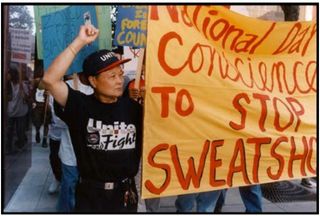
    As Bangladesh workers pull the bodies of their friends from ruin of Rana Plaza, people half a world away wearing the clothes they sew should not turn their faces away. They need real knowledge about how their shirts and blouses are produced, and who produces them. Rather than the image manipulation of Social Accountability International and its competitor, the Fair Labor Association, they should demand the truth, and then use their power as consumers.

    They should drive companies guilty of industrial homicide out of the world’s markets.

    Photo by David Bacon.