• Claire Conner’s father was a national spokesperson for the John Birch Society for more than thirty years; her mother was also a staunch follower. Conner holds a degree in English from the University of Dallas and a graduate degree from the University of Wisconsin. Wrapped in the Flag: A Personal History of America’s Radical Right (coming in July from Beacon Press) gives an inside look at one of the most radical right-wing movements in American history and shows how it impacts our politics today. 

    7750Every year, during
    Holocaust Remembrance Week, the people of the United States promise to “never
    forget” the six million who perished in Hitler’s death camps. I make the same
    promise. Then I add my own personal vow—to never forget Dr. Revilo P. Oliver, a
    classics professor from the University of Illinois and a founding member of the
    John Birch Society. Using an energized, anti-Communist right wing network,
    Oliver peddled his revised history of World War II; one in which the Jews
    invented the Holocaust and foisted the story of their imaginary persecution on
    an unsuspecting world. I heard Oliver spin his vile “Holohoax” ideas right in
    my parents’ living room.

    In late 1958, my
    parents became the first two members of the John Birch Society in Chicago. They
    were welcomed into the brand new organization by founder, Robert Welch, who
    introduced them to Oliver. Welch and Oliver were personal and professional
    friends. Over the years, Welch often described Oliver as one of the “ablest
    speakers on the Americanist side.” 

    Any friend of Welch
    got a warm welcome from my parents. The first time I met the man, however, he
    gave me the creeps. His long face was exaggerated by black hair slicked back
    with greasy pomade, bushy eyebrows and beady eyes and wide handlebar mustache.
    I never saw Oliver smile. But his lips often curled in a nasty snarl,
    especially when he was berating someone who dared to disagree.  

    Oliver was a frequent
    contributor to National Review,
    William F. Buckley’s magazine, and to the John Birch Society’s magazine, American Opinion. In the pages of these
    journals, he expressed some of his most controversial positions including a
    1965 slam against the United States for “an insane, but terribly effective,
    effort to destroy the American people and Western civilization by subsidizing .
    . . the breeding of the intellectually, physically, and morally unfit.”

    Oliver peppered his
    speeches and his articles with racial slurs and discredited historical
    assumption. In his role as a member of the John Birch Society speakers’ bureau,
    he railed against Communist subversion inside our government while insisting that
    President Roosevelt tricked the United States into World War II in order to
    help his friend, Joseph Stalin, the Russian dictator. 

    Along with this
    interpretation of World War II, Oliver peddled his version of the Holocaust,
    one in stark contrast to everything I’d learned from our Jewish neighbors and
    my own father. Gone were the yellow stars and the death camps. Gone were the
    gas chambers and crematoria. Even the witness of American soldiers who
    liberated Buchenwald and Dachau was repudiated. Instead, Oliver said that there
    were no gas chambers and no exterminations. 

    My parents parroted
    Oliver. The Holocaust stopped being so terrible, the death camps turned into
    detention camps. Jews were imprisoned because they were traitors, not because
    of their faith. The “Final Solution” became fiction, and the Nazis were loyal
    military men following orders.   

    I’d met Jews with
    tattoos on their arms. I’d seen photographs from Buchenwald. I knew that
    millions of men, women and children were gassed and their ashes coated everything
    when the fires roared. I knew all of this as well as I knew my name. I was not
    even 14 and I thought my parents had lost their minds. Dr. Oliver had helped
    them

    No matter what Revilo
    Oliver said, he continued to serve (with my father) on the John Birch Society
    National Council, the inner circle of the organization. My parents drank in
    everything he said and repeated most of it, almost verbatim. Robert Welch heaped
    praise on Oliver for his outstanding contributions to the Birch cause.

    All of this Oliver
    devotion stopped abruptly in July of 1966, when Oliver headlined the New
    England Rally for God, Family, and Country, an annual Birch-sponsored festival
    held in Boston and billed as a reunion for conservative Americans. In his
    speech, “Conspiracy or Degeneracy, Oliver talked about “vaporizing” Jews as
    part of the “beatific vision.”

    Oliver’s statements
    generated an avalanche of negative press, followed by internal Birch turmoil on
    how to respond. Oliver had said all of this and more for years and every single
    member of the Birch leadership had heard him. But time this was different. Oliver’s
    public and blatant racism sounded like it echoed John Birch Society policies.
    And the press covered it. 

    In early August,
    Welch told council members that Oliver had resigned. In a split-second, he
    vanished from my parents’ conversation. They pretended that Oliver had never
    been a Birch leader or a personal friend.

    Revilo Oliver lived
    the rest of his life as a hero to neo-Nazis, skin heads and white supremacists.
    His views never moderated. In 1982, twelve years before his death by suicide,
    Oliver wrote that democracy would only be possible by “deporting, vaporizing,
    or otherwise disposing of swarms of Jews, Congoids (Africans), Mongoloids and
    mongrels (mixed-race) that now infest our territory.” 

    Oliver put an
    indelible mark on the John Birch Society, built a network of Holocaust deniers and
    recruited countless followers to spread his message of hate.  This year, the theme of the Holocaust
    Remembrance is “heeding the warning signs.” There is no warning sign of more
    significance than the continuing presence of Holocaust denial in our public
    life. We can’t begin to understand today’s deniers if we don’t take a hard look
    at the man who fueled the denial movement.
  • Today is the 45th anniversary of the day Martin Luther King, Jr. was assassinated at the Lorraine Hotel. One of the often overlooked aspects of King’s life and activism is his commitment to interfaith cooperation. In this post first featured here a couple of years ago, Eboo Patel explores how King used his own faith as a bridge of cooperation. Patel is the founder and Executive Director of Interfaith Youth Core (IFYC), a Chicago-based institution building the global interfaith youth movement. He is the author of the award-winning book Acts of Faith: The Story of an American Muslim, the Struggle for the Soul of a Generation and Sacred Ground: Pluralism, Prejudice, and the Promise of America.

    Today is also the Interfaith Youth Core’s Better Together day, a time to wear blue to raise awareness of interfaith cooperation. Read more about it here.

    Mlk

    One hundred years ago, the great African-American scholar W.E.B. DuBois famously wrote, “The problem of the 20th century will be the problem of the color line.”

    History proved DuBois correct. His century saw the struggles against, and ultimately the victory over, systems that separated and subjugated people based on race—from colonialism in India to Jim Crow in the U.S. to apartheid in South Africa.

    No American did more than Martin Luther King, Jr., to address the problem of the color line. He spearheaded the marches that revealed the brutality of segregation, made speeches that reminded Americans that the promise of their nation applied to all citizens and expertly pressured the nation’s leaders in Washington to pass landmark civil rights legislation.

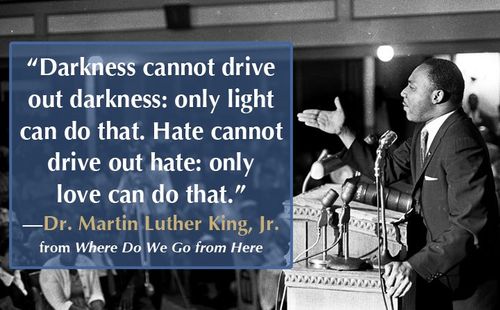
    But to confine King’s role in history only to the color line—as giant as that challenge is, and as dramatic as King’s contribution was—is to reduce his greatness. In one of his final books, Where Do We Go From Here: Chaos or Community, King showed that race was one part of his broader concern with human relations at large: “This is the great new problem of mankind. We have inherited … a great ‘world house’ in which we have to live together—black and white, Easterner and Westerner, Gentile and Jew, Catholic and Protestant, Muslim and Hindu … Because we can never again live apart, we must learn somehow to live with each other in peace.”

    This ethos, as King’s examples make clear, applies not only to the question of race, but to faith as well. In the same way as the headlines of the 20th century read of conflict between races, headlines in our times are full of violence between people of different religions. Indeed, what the color line was to the 20th century, the faith line might be to the 21st.

    Faith as a bridge

    King’s life has as much to say to us on the question of interfaith cooperation as it did on the matter of interracial harmony. A prince of the black church, deeply rooted in his own Baptist tradition, King viewed his faith as a bridge of cooperation rather than a barrier of division.

    When, as a seminary student, King was introduced to the satyagraha (“love-force”) philosophy of the Indian Hindu leader Mahatma Gandhi, King did not reject it because it came from a different religion. Instead, he sought to find resonances between Gandhi’s Hinduism and his own interpretation of Christianity. Indeed, it was Gandhi’s movement in India that provided King with a 20th century version of what Jesus would do. King patterned nearly all the strategy and tactics of the civil rights movement—from boycotts to marches to readily accepting jail time—after Gandhi’s leadership in India. King called Gandhi “the first person in history to lift the love ethic of Jesus above mere interaction between individuals to a powerful and effective social force.”

    Following Gandhi was King’s first step on a long journey of learning about the shared social justice values across the world’s religions, and partnering with faith leaders of all backgrounds in the struggle for civil rights. In 1959, more than a decade after the Mahatma’s death, King traveled to India to meet with people continuing the work Gandhi had started. He was surprised and inspired to meet Indians of all faith backgrounds working for equality and harmony, discovering in their own traditions the same inspiration for love and peace that King found in Christianity.

    King’s experience with religious diversity in India shaped the rest of his life. He readily formed a friendship with the Rabbi Abraham Joshua Heschel, finding a common bond in their love of the Hebrew prophets. The two walked arm-in-arm in the famous civil rights march from Selma to Montgomery.

    Later, Heschel wrote, “Our march was worship. I felt my legs were praying.”

    King’s friendship with the Buddhist monk Thich Nhat Hanh inspired one of his most controversial moves, the decision to publicly oppose the Vietnam War. In his letter nominating Nhat Hanh for the Nobel Peace Prize, King wrote, “He is a holy man… His ideas for peace, if applied, would build a monument to ecumenism, to a world brotherhood, to humanity.”

    Better together

    In his famous sermon “A Time to Break Silence,” King was unequivocal about his Christian commitment and at the same time summarized his view of the powerful commonality across all faiths: “This Hindu-Muslim-Christian-Jewish-Buddhist belief about ultimate reality” is that the force of love is “the supreme unifying principle of life.”

    We live at a time of religious conflict abroad and religious tension at home. This would no doubt have dismayed King, who viewed faith as an inspiration to serve and connect, not to destroy and divide. During King’s time, groups ranging from white supremacists to black militants believed that the races were better apart. Today, the same is said of division along the lines of faith.

    King insisted that we are always better together. Indeed, that pluralism is part of divine plan. To paraphrase one of his most enduring statements: The world is not divided between black and white or Christian and Muslim, but between those who would live together as brothers and those who would perish together as fools.

    This post originally appeared in USA Today.

    Interfaith Activism Reading List:


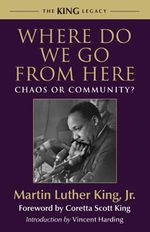
    0067Where Do We Go from Here: Chaos or Community?

    by Martin Luther King, Jr.

    The last book written by
    King—his final reflections after a decade of civil rights struggles

    Read the introduction by
    Vincent Harding.

    In 1967, Dr. Martin Luther King,
    Jr., isolated himself from the demands of the civil rights movement, rented a
    house in Jamaica with no telephone, and labored over his final manuscript. In
    this prophetic work, which has been unavailable for more than ten years, he
    lays out his thoughts, plans, and dreams for America’s future, including the
    need for better jobs, higher wages, decent housing, and quality education. With
    a universal message of hope that continues to resonate, King demanded an end to
    global suffering, asserting that humankind-for the first time-has the resources
    and technology to eradicate poverty.


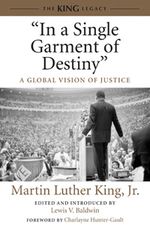
    8605“In a Single Garment of Destiny”: A Global Vision of Justice 

    by Martin Luther King, Jr. Edited by Lewis V. Baldwin

    An unprecedented and timely
    collection that captures the global vision of Dr. King—in his own words 

    Too many people continue to think
    of Dr. King only as “a southern civil rights leader” or “an
    American Gandhi,” thus ignoring his impact on poor and oppressed people
    around the world. “In a Single Garment of Destiny”is the
    first book to treat King’s positions on global liberation struggles through the
    prism of his own words and activities. 

    From the pages of this extraordinary collection, King emerges not only as an
    advocate for global human rights but also as a towering figure who collaborated
    with Eleanor Roosevelt, Albert J. Luthuli, Thich Nhat Hanh, and other national
    and international figures in addressing a multitude of issues we still struggle
    with today-from racism, poverty, and war to religious bigotry and intolerance.
    Introduced and edited by distinguished King scholar Lewis Baldwin, this volume
    breaks new ground in our understanding of King. 

    Featuring the essay: “Beyond Vietnam: A Time to Break Silence.”


    7748Sacred Ground: Pluralism, Prejudice, and the Promise of America

    by Eboo Patel

    An inspiring call for Americans to defend the values of
    inclusiveness and pluralism by one of our best-known American Muslim leaders
     

    There is no better time to stand up for your values than when they are under
    attack.

    In the decade following the attacks of 9/11, suspicion and animosity toward
    American Muslims has increased rather than subsided. Alarmist, hateful rhetoric
    once relegated to the fringes of political discourse has now become
    frighteningly mainstream, with pundits and politicians routinely invoking the
    specter of Islam as a menacing, deeply anti-American force.

    In Sacred Ground, author and renowned interfaith leader Eboo
    Patel says this prejudice is not just a problem for Muslims but a challenge to
    the very idea of America. Patel shows us that Americans from George Washington
    to Martin Luther King Jr. have been “interfaith leaders,”
    illustrating how the forces of pluralism in America have time and again
    defeated the forces of prejudice. And now a new generation needs to rise up and
    confront the anti-Muslim prejudice of our era. To this end, Patel offers a
    primer in the art and science of interfaith work, bringing to life the growing
    body of research on how faith can be a bridge of cooperation rather than a barrier
    of division and sharing stories from the frontlines of interfaith activism.

    Patel asks us to share in his vision of a better America—a robustly pluralistic
    country in which our commonalities are more important than our differences, and
    in which difference enriches, rather than threatens, our religious traditions.
    Pluralism, Patel boldly argues, is at the heart of the American project, and
    this visionary book will inspire Americans of all faiths to make this country a
    place where diverse traditions can thrive side by side.


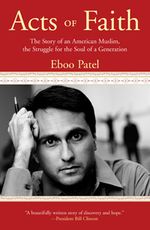
    0622Acts of Faith: The Story of an American Muslim, the Struggle for the Soul of a Generation

    by Eboo Patel

    A renowned Muslim activist’s personal story of building a global interfaith youth movement that might just change the world. Includes a new afterword by the author.

    Acts of Faith is a remarkable account of growing up Muslim in America and coming to believe in religious pluralism, from one of the most prominent faith leaders in the United States. Eboo Patel’s story is a hopeful and moving testament to the power and passion of young people-and of the world-changing potential of an interfaith youth movement. 


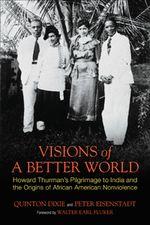
    0045Visions of a Better World: Howard Thurman’s Pilgrimage to India and the Origins of African American Nonviolence

    by Quinton Dixie and Peter Eisenstadt. Foreword by Walter Earl Fluker

    The first biographical exploration of one of the most important African American religious thinkers of the twentieth century—Howard Thurman—and of the pivotal trip he took to India that ultimately shaped the course of the civil rights movement.

    In 1935, at the height of his powers, Howard Thurman, one of the most influential African American religious thinkers of the twentieth century, took a pivotal trip to India that would forever change him-and that would ultimately shape the course of the civil rights movement in the United States.

    After the journey to India, Thurman’s distinctly American translation of satyagraha into a Black Christian context became one of the key inspirations for the civil rights movement, fulfilling Gandhi’s prescient words that “it may be through the Negroes that the unadulterated message of nonviolence will be delivered to the world.” Thurman went on to found one of the first explicitly interracial congregations in the United States and to deeply influence an entire generation of black ministers-among them Martin Luther King Jr.

    Related articles

    Interfaith Youth Core Declares April 4th “Better Together Day”
    Further Reading on Marriage Equality
    Reclaiming MLK as a “Citizen of the World”
    Faith as a Bomb, Faith as a Bridge: Building a 21st Century Interfaith Movement
    Wear blue for interfaith Better Together Day
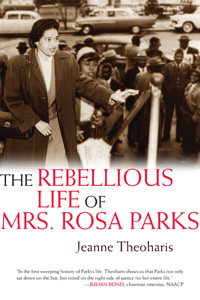
  • 5047Nell Irvin Painter reviews The Rebellious Life of Mrs. Rosa Parks by Jeanne Theoharis for the New York Times Book Review

    Richly informative, calmly passionate and much needed, “The Rebellious Life of Mrs. Rosa Parks” completes the portrait of a working-class activist who looked poverty and discrimination squarely in the face and never stopped rebelling against them, in the segregated South and in the segregated North.

    Author Jeanne Theoharis appeared this morning on Democracy Now! with Claudette Colvin, a civil-rights pioneer who was arrested for refusing to give up her bus seat in Montgomery in March 1955, nine months before Rosa Parks. Jeanne discusses Claudette’s story in the context of her research into the local civil-rights movement at the time, and suggests Colvin’s case help set the stage for Parks and the Montgomery bus boycott. It’s a really special 35-minute interview.

    Watch Jeanne Theoharis on Democracy Now!


    Rashid Khalidi discussed Brokers of Deceit: How the U.S. Has Undermined Peace in the Middle East on Up with Chris Hayes on MSNBC.

    Visit NBCNews.com for breaking news, world news, and news about the economy

    4475More recent coverage for Brokers of Deceit:

    Op/Ed by Rashid Khalidi in the New York Times

    Review in the American Conservative

    Review in The National

    Interview on Democracy Now!

    Interview on The Brian Lehrer Show on WNYC

    Review in Foreign Affairs

    Harpers Six Questions with Scott Horton

    NPR's Weekend Edition

    Huffington Post Live


    0329Opportunity, Montana: Big Copper, Bad Water, and the Burial of an American Landscape
    by Brad Tyer
    made this week's PW Tip Sheet: Best Books for the Week of March 25

    Interview with Brad Tyer with the Missoulian

    MakeitMissoula.com review: "Several times while reading the book, I had to just stop, sit back and admire a chunk of imagery crafted by a man who can just flat-out write. "  

    Mountain West News review: "Montana needs a book like this. We need to remember the past. We need to be mindful of the present. We need to say thanks to all those who strife to do the right thing. We need more journalists like Brad Tyer to keep us humble."  

    Events:

    Country Bookshelf, Bozeman, MT, 3/30/2013

    Hearst Free Library, Anaconda, MT, signing 4/3/2013

    Butte Library, 4/4/2013, at 6:30 PM

    The Montana Book Company, Helena, MT, 4/5/2013

    Elk River Books, Livingston, MT, 4/6/2013

    Shakespeare & Co. Missoula, MT 4/7/2013 7pm

    Brazos Bookstore, Houston, TX, 4/11/2013, 7pm

    Watch the Book Trailer on YouTube


    Michael Bronski (A Queer History of the United States) was on HuffPost Live talking about marriage equality, DOMA, and the Supreme Court. Bronski was also quoted in an article on Huffington Post in the Gay Voices section 

    Michael Bronski, the author of A Queer History of the United States and a Harvard professor, notes that sentimental arguments have become increasingly prevalent, and successful, in social movements over the last century. "Uncle Tom's Cabin was far more effective than quoting biblical texts or making a constitutional argument and abolitionist writings are filled with the tragedy of children being torn away from their mothers," Bronski said in an interview. "Suffragists mostly only used legal arguments but later, second wave feminism did better portraying a talented 12-year-old girl who wanted to play field hockey (or become a doctor) than in arguing for equal wages for female factory workers."


    Outlaw Marriages by Rodger Streitmatter serves up a history lesson for the Supreme Court via this excellent post at Biographile:

    While the Court mulls, however, we'd like to clear up some misunderstanding. Take the "recent" institution of gay marriage, as Justice Samuel Alito seems bent on calling it. Alito is trying to dissuade any major ruling on the grounds that evidence on the effects of same-sex marriage is too little, too soon: "You want us to step in and render a decision based on an assessment of the effects of this institution which is newer than cell phones and the internet?" he asked. "We do not have the ability to see the future."

    Fortunately, we don't have to. We mere humans may not wear the robes of soothsayers (or Justices, for that matter), Mr. Alito, but we do have access to local libraries and the benefit of hindsight. While, yes, the formal institution of gay marriage is recent, author Rodger Streitmatter reminds us that gay folks have been resourcefully affirming their own versions of marriage for centuries. In fact, they've found ways of making it work with or without our questionably-gay-Uncle Sam's nodding approval.


    My Mother's Wars by Lillian Faderman featured as part of a round-up of titles on the post-War Jewish American experience on Biographile.

    My Mother's Wars is the memoir that Mary, a Latvian Jew and New York immigrant, “was never able to write.” Faderman shares her spirited mother’s story from life-altering experiences (the Nazi's brutal annihilation of Preil, the shetl where Mary was born) to mundane city moments.  Each are rendered with poetry and frankness. Beginning in 1914, Faderman chronicles Mary’s futile love affair with commitment-phobic Moishe, the wrenching isolation of immigration and the insidious backdrop of antisemitism. Mary may not have been able to tell her story, but it’s testament to her incredible life that her daughter did it for her.


    What Doctors Feel: How Emotions Affect the Practice of Medicine by Danielle Ofri

    Kirkus Reviews: “An invaluable guide for doctors and patients on how to ‘recognize and navigate the emotional subtexts’ of the doctor-patient relationship.” 


    Upcoming Author Appearances:


    Related articles

    Honoring Rosa Parks Requires More Than a Statue
    Happy 100th Birthday to Rosa Parks
    Before Rosa Parks, another woman defied segregation
    Brokers of Deceit: How the U.S. Has Undermined Peace in the Middle East
    Historical Beacon Buzz: Langston Hughes reviews James Baldwin
  • Susie Bright, in addition to being a best-selling author, activist, and podcast host, is editor at large for Audible. Susie's blog, The Bright List, keeps readers and listeners apprised of new audiobooks.

    Today's post is a cross-post from the Bright List of a roundup of new titles by Hanne Blank, author of Straight: The Surprisingly Short History of Heterosexuality.


    4443This month brings the Audible release of three titles from one of my favorite independent scholars, Hanne Blank. Blank’s curiosity and thorough, critical thinking have brought fresh insights into the fields of human sexuality and history. Her warm, witty, and clever writing has brought me much enjoyment. 


    Straight: The Surprisingly Short History of Heterosexuality

    The title says it all–here’s the real story on how the very idea of “straightness” is a new, and quite flimsy, category if you look at how people have thought of sexuality all along.

    —Funny, brainy, provocative nonfiction. A page-turner.

    Like Joan Roughgarden’s Evolution’s Rainbow, Straight addresses gender, sex and biology, but goes on to explore historical and political attitudes, and perceptions of straightness and homosexuality.

    Narrated by the wonderful Fran Tunno.

    Watch Hanne Blank talk about the invention of heterosexuality.


    41UOPLsSQWL._SL175_Virgin: The Untouched History

    From the “discovery” of the Hymen in ancient times to abstinence-only education in schools and purity balls today, Blank writes about the history of our preoccupation with "virginity." In her analysis, we can see the social construction of virginity, the sexism implicit in it, and the malleable definition of virginity over time.

    Everything you think you know about virginity is up for debate. Blank writes with a great deal of humor and perception: "Of all the countries of the developed world, the United States is the only one that has to date created a federal agenda having specifically to do with the virginity of its citizens."

    Narrated with friendly authority by Fran Tunno who also read Straight.


    51Wj6w+cQVL._SL175_Big, Big Love: A Sex and Relationships Guide for People of Size (and Those Who Love Them)

    This is one of my favorite sex-ed books about any subject. I hadn’t thought about it one way or another, “size and sex”– but there’s a lot to it. This isn’t a PC plea for acceptance, it’s really about FAT SEX, the reality and the creativity!  Skinny people love this book too! 

    “Big Big Love is a ginormous blessing to people everywhere. Not only is it a superb sex manual, it’s positively radical, fun to read, and life affirming—big time.

    "We know that “people of size” enjoy sex as much as anyone, but to talk about it so frankly, to show it, and give explicit details about the ins and outs of it, is as transgressive as it gets in our culture of “thin is sexy.” This book is well worth its weight in gold.”   

    —Annie Sprinkle, PhD

    Narrated by Johanna Taylor who I absolutely believed as Hanne.

    Related articles

    Beacon Buzz: Our Books Feel the Love
    Beacon Classics: Gyn/Ecology by Mary Daly
    Beacon Books at Audible: Mean Little deaf Queer
    Further Reading on Marriage Equality
    How Bad Conservative Sociology is Used to Attack Gay Families
  • In February, we celebrated Black History Month, and now we are reaching the end of Women's History Month. This got us thinking about how we define our shared histories through different perspectives, and how those various ways of seeing history can illuminate one another. In particular, we were interested in examining the intersection of Women's History and Disability History, so we knew exactly who to Skype for an interview.

    Kim E. Nielsen is a professor of history and women's studies at the University of Wisconsin-Green Bay. She lives in Green Bay, and is the author of A Disability History of the United States and two books on Helen Keller and Anne Sullivan Macy. 

    Our interview was conducted by Grace Lapointe, an editorial intern at Beacon. Lapointe graduated from Stonehill College with a degree in English in 2011. She enjoys reading and writing fiction and would love to work in publishing someday. Disability history interests her personally because she has cerebral palsy.


    NIELSEN-DisabilityHistoryGrace Lapointe:
    Did you find that researching American history through the lens of disability is similar to writing women's history, black history, or LGBT history? Or is there a different approach?

    Kim E. Nielsen: In some ways it's similar: recovering pasts that have not been examined too much but really are central to the American story. It's a similar approach of claiming communities and identities that mattered, looking at sources that may not have been looked at before, and looking at sources with new questions.

    Who is considered female has some variability over time, but it's relatively consistent. We define that around anatomy: vaginas, ovaries, and this kind of thing. Gender varies over time, but we still tend to know who fits into that category of "female."

    But who is defined as disabled varies all the time, historically. It's so contextual, and sometimes very apparent, sometimes not apparent. Sometimes it changes over one's lifetime. That category of disability is so fluid and so permeable. It's trying to write the history of an ever-moving point. And so, I found that challenging but also really exciting. I always think about how my body today tends to be read as non-disabled, but I wear glasses and contacts. And a couple hundred years ago, this would have been a really significant impairment for me. So in that regard even, whether or not I would be identified as disabled changes over time. 

    Today I'm wearing pants, and that is not read as anything. But in the 1890s, if I was a woman who went out and wore pants, that could be read as a sign of a very deep mental illness. So, the definition of what's a disability changes all the time. The definition of what is a female does change, and there are variations, but it's not quite as slippery as disability.

    GL: How does the history of disability in America relate to women's history? Was being female ever considered effectively disabling?

    KN: Well, I think they're related at a really base level because lots of disabled people are women. But I also think that being female has been considered to be a disabling condition at different points in time, especially dependent upon race or class. Even for relatively privileged women, their bodies were considered to be defective, weak, and incapable throughout much of US history. So I think they overlap in that regard. The assumption was that women's brains were inadequate and in essence, deformed muscles, and that those ovaries had a big impact on the rest of their bodies. The arguments against women's education were simply that their bodies and brains were too disabled to withstand higher education.

    Women, children, enslaved people, and people with disabilities have tended to share a similar legal status, having a limited legal identity and having their legal ability to act covered by somebody else. They have not been able to make legal decisions. So, if we go all the way back to the Constitution, people categorized as idiots were not given rights. But then, all women were not given some of those same rights. And slaves and children were not. So they shared that same legal category as well. They've shared the presumption of being incompetent.

    GL: You mentioned in the introduction to the book that women and people with disabilities live disproportionately in poverty in the US. Are there any societal factors that create this disparity?

    KN: One limit was educational access. It wasn't until 1973 that school districts even had to educate students with disabilities. Many of them refused to do so. So that's contributed to poverty. And I think still there's restricted or inferior educational access and segregation in education for students with disabilities. And then, when they go in the employment arena, people face discrimination and harassment. I think some people with disabilities face really low expectations, sometimes even from parents and schoolteachers their whole lives, and those low expectations sometimes limit the expectations people have for themselves, too.

    Limited housing options can contribute to levels of poverty. Limited public transportation can limit what jobs people can get. My understanding is that people assume accommodations are going to be expensive in the workplace, and the vast majority, according to the Department of Labor, cost less than $500. But employers have it in their brains that it's going to be incredibly expensive.

    Then you have the social segregation. We still live in a culture in which advancements often happen outside of the workplace, and when people with disabilities aren't included in that–the golfing on Sunday afternoons, going to a bar–the social segregation contributes to poverty as well.

    GL: What are some of the biggest and most unique obstacles that women with disabilities faced throughout US history?

    KN: I think that the various ways in which women with disabilities have been defined as inadequate to reproduce has been a relatively unique bar that they have encountered. It could be discouraging marriage or forced sterilization of women with disabilities. But it was assuming that women with disabilities are not fit to reproduce and also not fit to make their own sexual decisions. We know that women with disabilities have faced a lot of sexual assault and harassment throughout history, much greater than the already-too-high rate for women in general. So I think that these things are related, but that assumption that women with disabilities could not make their own sexual decisions while being placed in situations where they were sexually vulnerable.

    At the same time, there’s the assumption that they can't be good mothers and that it's best for the nation if their reproductive capabilities are limited. Even today, disability is still something that is taken into consideration in custody cases. And parents with disabilities, particularly mothers, have a much greater chance of having limited access to their own children. All the studies today say that parents with disabilities are just as good and just as bad as parents without disabilities.

    GL: Did disability rights activists use any similar tactics to women's rights activists, or did they interact with members of other equal rights groups at all?

    KN: Some of the 19th century women's rights activists, like Dorothea Dix, advocated for reform of asylums and the improvement of insane asylums. So in that way, they advocated for people with disabilities.

    But at the same time, there were suffragists who really tried to elevate themselves by disparaging people with disabilities. They were basically saying, "Look, you characterized us marvelous suffragists with these idiots, enslaved people, and American Indians as non-voters, but we're much better than they are." So they accepted the ableism that dismissed people with disabilities and the racism that dismissed others, but tried to distinguish themselves as better.

    Particularly in the post-World War II period, disabled activists used strategies of simply insisting that as human beings, we have rights and should make our own decisions. Political protest, organizing, and lobbying strategies have been very much the same.

    The civil rights legislation has often impacted more than one group. And there's been a lot of overlap. In the early disability rights movement, feminist groups, racial freedom groups, and some of the gay, lesbian, and queer movements were actively involved. They saw they had a common cause around rights and claiming personhood. That didn't mean they got together all the time, or they perfectly agreed on everything. When you have people involved in multiple movements and when there's the realization that if you can discriminate against that person, then people can discriminate against me, we all have common cause. I think those are the moments when things really happen.


    Related articles

    Women's History Month
    Beacon Classics: Gyn/Ecology by Mary Daly
    Monday Classics: Toward a New Psychology of Women
    Sister Rosetta Tharpe: The Godmother of Rock and Roll
  • If you're following the news today, or seeing all the red equality icons on Facebook, you areno doubt thinking about marriage equality. The Supreme Court hears arguments in two cases this week—Hollingsworth v. Perry and United States v. Windsor—that have the potential to tip the judicial scales in favor of greater legal equality for LGBT families. Here's a selection of reading that will help you dig deeper. 

    How Bad Conservative Sociology is Used to Attack Gay Families

    A Non-Bio Lesbian Mom's Adoption Story

    Straight Talk About Gay Marriage

    United for Marriage? Or for Equality?

    What Kids Have to Say


    Read all Beacon Broadside posts on Marriage Equality


    Beacon Books on LGBT Equality


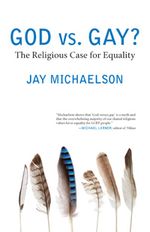
    0147God vs. Gay?: The Religious Case for Equality
    by Jay Michaelson

    Does the Bible prohibit homosexuality? No, says Bible scholar and activist Jay Michaelson. But not only that: Michaelson also shows that the vast majority of our shared religious traditions support the full equality and dignity of LGBT people. In this accessible, passionate, and provocative book, Michaelson argues for equality, not despite religion but because of it.

    Follow Jay Michaelson on Twitter. 

    Watch Jay Michaelson talk about the religous case for equality.

    Read an excerpt of God vs. Gay?: The Religious Case for Equality.


    0334 (1)Outlaw Marriages: The Hidden Histories of Fifteen Extraordinary Same-Sex Couples
     by Rodger Streitmatter

    For more than a century before gay marriage became a hot-button political issue, same-sex unions flourished in America. Pairs of men and pairs of women joined together in committed unions, standing by each other “for richer for poorer, in sickness and in health” for periods of thirty or forty—sometimes as many as fifty—years. In short, they loved and supported each other every bit as much as any husband and wife.

    In Outlaw Marriages, cultural historian Rodger Streitmatter reveals how some of these unions didn’t merely improve the quality of life for the two people involved but also enriched the American culture.

    Among the high-profile couples whose lives and loves are illuminated in the following pages are Nobel Peace Prize winner Jane Addams and Mary Rozet Smith, literary icon Gertrude Stein and Alice B. Toklas, author James Baldwin and Lucien Happersberger, and artists Jasper Johns and Robert Rauschenberg.

    Read an excerpt of Outlaw Marriages.


    4433Beyond (Straight and Gay) Marriage: Valuing All Families under the Law by Nancy D. Polikoff

    Beyond (Straight and Gay) Marriage reframes the family-rights debate by arguing that marriage shouldn't bestow special legal privileges upon couples because people, both heterosexual and LGBT, live in a variety of relationships-including unmarried couples of any sexual orientation, single-parent households, extended biological family units, and myriad other familial configurations. Nancy D. Polikoff shows how the law can value all families, and why it must.

    Read an excerpt of Beyond (Straight and Gay) Marriage.

    Read Nancy Polikoff's blog.


    0078From the Closet to the Courtroom: Five LGBT Rights Lawsuits That Have Changed Our Nation by Carlos A. Ball

    Engaging and largely untold, From the Closet to the Courtroom explores how five pivotal lawsuits have altered LGBT history. Beginning each case narrative at the center-with the litigants and their lawyers-law professor Carlos Ball follows the stories behind each crucial lawsuit. He traces the parties from their communities to the courtroom, while deftly weaving in rich sociohistorical context and analyzing the lasting legal and political impact of each judicial outcome.

    Read an excerpt here.


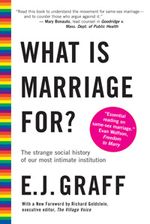
    4135What Is Marriage For?: The Strange Social History of Our Most Intimate Institution
    by E. J. Graff

    Will same-sex couples destroy "traditional" marriage, soon to be followed by the collapse of all civilization? That charge has been leveled throughout history whenever the marriage rules change. But marriage, as E. J. Graff shows in this lively, fascinating tour through the history of marriage in the West, has always been a social battleground, its rules constantly shifting to fit each era and economy. The marriage debates have been especially tumultuous for the past hundred and fifty years-in ways that lead directly to today's debate over whether marriage could mean not just Boy + Girl = Babies, but also Girl + Girl = Love. 

    Read the Discussion Guide here.


    Related articles

    Beacon Books at Audible: Outlaw Marriages by Rodger Streitmatter
    How Bad Conservative Sociology is Used to Attack Gay Families
    A Generational Divide Among Republicans on Gay Marriage
    Which Politicians Supported Gay Marriage and When?

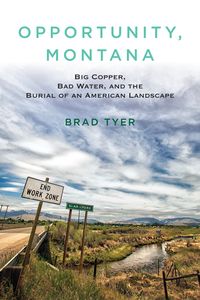
  • TYER-OpportunityMontana-FINALA memoir-meets-exposé that examines our fraught relationship with the West and our attempts to clean up a toxic environmental legacy

    In 2002, Texas journalist Brad Tyer strapped a canoe on his truck and moved to Montana, a state that has long exerted a mythic pull on America’s imagination as an unspoiled landscape. The son of an engineer who reclaimed wastewater, Tyer was looking for a pristine river to call his own. What he found instead was a century’s worth of industrial poison clotting the Clark Fork River, a decades-long engineering project to clean it up, and a forgotten town named Opportunity.

    At the turn of the nineteenth century, Montana exploited the richest copper deposits in the world, fueling the electric growth of twentieth-century America and building some of the nation’s most outlandish fortunes. The toxic byproduct of those fortunes-what didn’t spill into the river-was dumped in Opportunity.

    In the twenty-first century, Montana’s draw is no longer metal, but landscape: the blue-ribbon trout streams and unspoiled wilderness of the nation’s “last best place.” To match reality to the myth, affluent exurbanites and well-meaning environmentalists are trying to restore the Clark Fork River to its “natural state.” In the process, millions of tons of toxic soils are being removed and dumped-once again-in Opportunity. As Tyer investigates Opportunity’s history, he wrestles with questions of environmental justice and the ethics of burdening one community with an entire region’s waste.

    Stalled at the intersection of a fading extractive economy and a fledgling restoration boom, Opportunity’s story is a secret history of the American Dream, and a key to understanding the country’s-and increasingly the globe’s-demand for modern convenience.

    As Tyer explores the degradations of the landscape, he also probes the parallel emotional geography of familial estrangement. Part personal history and part reportorial narrative, Opportunity, Montanais a story of progress and its price, of copper and water, of father and son, and of our attempts to redeem the mistakes of the past. 

    Author Website | Watch the book trailer on YouTube | Read Chapter 1 on Scribd | How to buy


    Buy Opportunity, Montana at Beacon.org | Amazon | Barnes and Noble | Indiebound

    About the Author


    TYER,BRAD-by_Chad_HarderBrad Tyer
     is the managing editor of The Texas Observer in Austin. His writing has appeared in Outside, High Country News, the New York Times Book Review, the Houston Chronicle, the Drake, Texas Monthly, No Depression, and the Dallas Morning News. He’s been awarded a Knight-Wallace Fellowship, a Fund for Investigative Journalism grant, and a Fishtrap writing residency. 

    Visit Brad Tyer’s website.

    Follow Brad Tyer on Twitter.


    Related articles

    Major Clark Fork headwaters cleanup to begin below Warm Springs Ponds
    Group, county commissioners detail Milltown site access concerns
    Recommended Reading for World Water Day
    A Visit to Havana: A Book That Takes on Immigration Myths Makes its Cuban Debut
    Ruining a River
    Let’s Stop Making Migration a Crime

  • Harriet_Ann_Jacobs1894

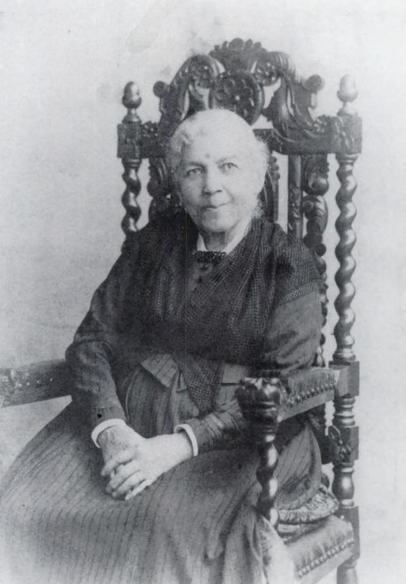
    Harriet Jacobs in 1894

    Harriet Jacobs was born into slavery in 1813 to Elijah and Delilah Jacobs. When Harriet’s mother died in 1819,  she was sent to live with her mother’s owner
    and mistress, Margaret Horniblow, and was welcomed into the family. But, Margaret died when Harriet was 11, and instead of being emancipated like she had hoped, she was bequeathed to her mistress’s three-year-old niece, Mary Matilda. Because of Mary’s young age, her father Dr. James Norcom became Harriet’s master.

    After years of unwanted sexual advances and abuse at the hands of Dr. Norcom, Harriet went into hiding above her grandmother’s home. For nearly seven years she confined herself in a small crawlspace between the storeroom and the roof waiting for
    her chance to escape, all the while listening to her children grow up in the
    home underneath her. In 1842, with the help of a friend, Harriet finally
    escaped. Harriet died in Washington, DC, on March 7, 1897, and was buried in
    Mount Auburn Cemetery, in Cambridge, Massachusetts.

    The following passages are taken from her autobiography Incidents in the Life of a Slave Girl, Written by Herself. It is one of the earliest works by an African American woman writer. Originally self-published in 1861 under the pen name Linda Brent, it was for generations thought to be a work of fiction until its
    authenticity was verified in the 1980s.

    In this section, Jacobs describes the small crawlspace in which she lived for nearly seven years.

    “The garret was only nine feet long, and seven wide. The highest part was three feet
    high, and sloped down abruptly to the loose board floor. There was no admission
    for either light or air. My uncle Philip, who was a carpenter, had very
    skillfully made a concealed trap door, which communicated with the storeroom.
    He had been doing this while I was waiting in the swamp. The storeroom opened
    upon a piazza. To this hole I was conveyed as soon as I entered the house. The
    air was stifling; the darkness total. A bed had been spread on the floor. I
    could sleep quite comfortably on one side; but the slope was so sudden that I
    could not turn on the other without hitting the roof. The rats and mice ran
    over my bed; but I was weary, and I slept such sleep as the wretched may, when
    a tempest has passed over them. Morning came. I knew it only by the noises I
    heard; for in my small den day and night were all the same. I suffered for air
    even more than for light. But I was not comfortless. I heard the voices of my
    children. There was joy and there was sadness in the sound. It made my tears
    flow. How I longed to speak to them! I was eager to look on their faces; but
    there was no hole, no crack, through which I could peep. This continued
    darkness was oppressive. It seemed horrible to sit or lie in a cramped position
    day after day, without one gleam of light. Yet I would have chosen this, rather
    than my lot as a slave.”

    Next, Jacobs explains how she spent her first Christmas in hiding.

    “Even slave mothers try to gladden the hearts of their little ones on that occasion. Benny and Ellen had their Christmas stockings filled. Their imprisoned mother could not have the privilege of witnessing their surprise and joy. But I had the
    pleasure of peeping at them as they went into the street with their new suits
    on. I heard Benny ask a little playmate whether Santa Claus brought him any
    thing. 'Yes,' replied the boy; 'but Santa Claus ain’t a real man. It’s the
    children’s mothers that put things into the stockings.' 'No, that can’t be,' replied Benny, 'for Santa Claus brought Ellen and me these new clothes, and my
    mother has been gone this long time.'

    "How I longed to
    tell him that his mother made those garments, and that many a tear fell on them
    while she worked!

    "On this
    occasion, I was warned to keep extremely quiet, because two guests had been
    invited. One was the town constable, and the other was a free colored man, who
    tried to pass himself off for white, and who was always ready to do any mean work
    for the sake of currying favor with white people. My grandmother had a motive
    for inviting them. She managed to take them all over the house. All the rooms
    on the lower floor were thrown open for them to pass in and out; and after
    dinner, they were invited up stairs to look at a fine mocking bird my uncle had
    just brought home. There, too, the rooms were all thrown open, that they might
    look in. When I heard them talking on the piazza, my heart almost stood still.
    I knew this colored man had spent many nights hunting for me. Every body knew
    he had the blood of a slave father in his veins; but for the sake of passing
    himself off for white, he was ready to kiss the slaveholders’ feet. How I
    despised him! As for the constable, he wore no false colors. The duties of his
    office were despicable, but he was superior to his companion, inasmuch as he
    did not pretend to be what he was not. Any white man, who could raise money
    enough to buy a slave, would have considered himself degraded by being a
    constable; but the office enabled its possessor to exercise authority. If he
    found any slave out after nine o’clock, he could whip him as much as he liked;
    and that was a privilege to be coveted. When the guests were ready to depart,
    my grandmother gave each of them some of her nice pudding, as a present for
    their wives. Through my peep-hole I saw them go out of the gate, and I was glad
    when it closed after them. So passed the first Christmas in my den.”

    Finally, Jacobs
    relates a critical moment in which she was able to briefly speak to the father
    of her children, a newly elected congressman, and ask him to free their
    children.

    “The day before
    his departure for Washington I made arrangements, towards evening, to get from
    my hiding-place into the store room below. I found myself so stiff and clumsy
    that it was with great difficulty I could hitch from one resting place to
    another. When I reached the storeroom my ankles gave way under me, and I sank
    exhausted on the floor. It seemed as if I could never use my limbs again. But
    the purpose I had in view roused all the strength I had. I crawled on my hands
    and knees to the window, and, screened behind a barrel, I waited for his
    coming. The clock struck nine, and I knew the steamboat would leave between ten
    and eleven. My hopes were failing. But presently I heard his voice, saying to
    some one, 'Wait for me a moment. I wish to see aunt Martha.' When he came out,
    as he passed the window, I said, 'Stop one moment, and let me speak for my
    children.' He started, hesitated, and then passed on, and went out of the gate.
    I closed the shutter I had partially opened, and sank down behind the barrel. I
    had suffered much; but seldom had I experienced a leaner pang than I then felt.
    Had my children, then, become of so little consequence to him? And had he so
    little feeling for their wretched mother that he would not listen a moment
    while she pleaded for them? Painful memories were so busy within me, that I
    forgot I had not hooked the shutter, till I heard some one opening it. I looked
    up. He had come back. 'Who called me?' said he, in a low tone. 'I did,' I
    replied. 'Oh, Linda,' said he, 'I knew your voice; but I was afraid to answer,
    lest my friend should hear me. Why do you come here? Is it possible you risk
    yourself in this house? They are mad to allow it. I shall expect to hear that
    you are all ruined.' I did not wish to implicate him, by letting him know my
    place of concealment; so I merely said, 'I thought you would come to bid
    grandmother good by, and so I came here to speak a few words to you about
    emancipating my children. Many changes may take place during the six months you
    are gone to Washington and it does not seem right for you to expose them to the
    risk of such changes. I want nothing for myself; all I ask is, that you will
    free my children, or authorize some friend to do it, before you go.' 

     "He promised he
    would do it, and also expressed a readiness to make any arrangements whereby I
    could be purchased."

    Read
    an extended selection from Incidents in
    the Life of a Slave Girl, Written by Herself
    featured in The Long Walk to Freedom: Runaway Slave Narratives.

    Related articles

    Black History Month: Select books 20% off, plus free gift with purchase
    Incidents in the Life of a Slave Girl – Harriet Jacobs (with the theme of "The Corrupting Power of Slavery")
    Edenton Celebrates Life Of Slave Harriet Jacobs
  • WWD2013 logoToday is World Water Day. Observed every March 22nd, World Water Day reminds people around the globe about the importance of freshwater and urges them to advocate for the sustainable use of freshwater resources.

    This year’s theme is water cooperation, a rallying cry to recognize water as a resource that we are all entitled to and for which management responsibility is shared. On the surface, coming together as a global community for the good of water sustainability seems simple. But freshwater is becoming a scarce resource—one that is not evenly distributed around the world. And, with climate change shifting growing seasons and sea levels, our understanding of water’s boundaries and availabily is becoming even more muddled. To ensure a viable future, water must be a shared, not bought and sold to the highest bidder, not polluted and ignored at the detriment of our communities.

    In addition to the small steps towards water conservation that people
    can take each day, World Water Day asks us to look toward the future,
    understand the realities of the water crisis that we as a planet are
    facing, and take steps to change it.

    At Beacon Press, we have published a number of books over the last decade that explore water usage and sustainability concerns from a variety of perspectives. Below are six titles that focus on the many ways access to water affects our lives, and uncover how the lack of collaboration by individuals, corporations, and government agencies has put us on a perilous path towards international water shortages.

    World Water Day Reading

    Blue Revolution cover
        
    Opportunity, Montana cover
        
    Recovering a Lost River cover
        
    When the Rivers Run Dry cover
        
    The Land Grabbers cover
        
    Springs of Namje cover

    Blue Revolution: Unmaking America’s Water Crisis by Cynthia Barnett

    The first book to call for a national water ethic, Blue Revolution is a powerful meditation on water and community in America. The book combines investigative reporting with solutions from around the globe to show how local communities and entire nations can come together to stretch vanishing water supplies and protect themselves from increasingly devastating floods. Barnett challenges the conventional wisdom that the United States can build its way out of water crisis and argues that no solution would be more powerful than an ethic for water—embraced not only by citizens, but by government and major water users including the energy and agricultural sectors.

    Read chapter one, "The Illusion of Water Abundance;" view five principles for developing a water ethic in your community.

    Opportunity, Montana: Big Copper, Bad Water, and the Burial of an American Landscape
    by Brad Tyer 

    Journalist Brad Tyer moved to Montana looking for big skies, clear waters, and change of scenery. But, soon after he arrived he discovered that “the treasure state” had buried secrets. Opportunity, Montana explores how a century of copper mining devastated the Clark Fork River, which runs through the state of Montana, as it took on the bulk of the pollutants and industrial waste. In the 1980s the Environmental Protection Agency (EPA) designated the river as a Superfund site in need of environmental clean-up—one of seventeen in the state. It took twenty years for the EPA and the responsible parties to agree on what to do about it, and another ten before any change would be seen. How do you fix a broken river, Tyer asks? The financial implications, estimated to be 1.3 billion dollars, were just the beginning. First, 400 acres of toxic sediment had to be dug up and disposed of, and as Tyer discovered, mining waste doesn’t go away, it just gets moved and covered up. For the second time in Montana’s copper history, that burden would fall on the small town of Opportunity.

    Read a selection from part one, "Headwater;" watch the book trailer.

    Recovering a Lost River: Removing Dams, Rewilding Salmon, Revitalizing Communities by Steven Hawley

    In the last decade, the inventory of dams in the United States has been reduced by nearly 500. Though many of those have been small, privately-owned ventures, the positive impact has led to proposals for larger dam removal projects nationally. In Recovering A Lost River, Hawley advocates for the removal of dams and the restoration of the rich and thriving environments that can be found in and around free flowing water. Assessing the current state of freshwater ecosystems nationally, he reports that a third of freshwater species are threatened or endangered, forty percent of freshwater bodies in America are too polluted for swimming or fishing, and half of the nation’s wetlands are gone. This book is a call to action for overcoming corporate and federal obstacles in order to restore free flowing waterways and reinvigorate long suffering wildernesses.

    Read chapter eight, "The Fifth H."

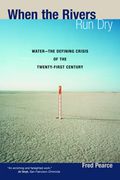
    When the Rivers Run Dry: Water—The Defining Crisis of the Twenty-first Century and
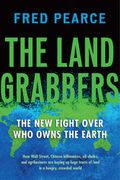
    The Land Grabbers: The New Fight over Who Owns the Earth by Fred Pearce

    In 2007, When the Rivers Run Dry was a groundbreaking exploration on the state of water sources around the world, and the looming possibility of a world-wide water shortage. It is now considered to be required reading for anyone looking to understand the water crisis.

    In 2012, Fred Pearce revisited the issue of water sustainability in The Land Grabbers, exploring how the need for abundant water in industrial agriculture has resulted in wealthy countries and powerful corporations in need of water seeking to obtain it, while impoverished countries with access to water are looking to profit from it. These practices have led to the exploitation of vulnerable land, people, and water, with the potential for devastating consequences.

    Read the introduction to The Land Grabbers; view the land grabbing map.

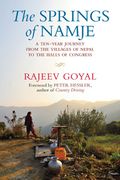
    The Springs of Namje: A Ten-Year Journal from the Villages of Nepal to the Halls of Congress by Rajeev Goyal

    In 2001, at the age of twenty-two, Rajeev Goyal joined the Peace Corps. Assigned to teach English in Nepal, he found himself in the remote mountain town of Namje where villagers spend most of their day walking to and from a far-off stream to fetch water. Goyal sets out to create a water project that would pump water directly into the town, in hopes of improving every part of village life, from health and prosperity to education. With the support and dedication of the villagers, the mission is successful, but the long-term consequences of development go beyond anything Goyal could have imagined. The Springs of Namje explores how water can hold back or propel a community forward.

    Read chapter two, "Baitadi on Fire."


    Written by Caitlin Meyer, senior publicist at Beacon Press.

    Related articles

    Top 10 Ways You Can Celebrate World Water Day