• Laurie Essig, Ph.D., is a professor of sociology and and gender studies at Middlebury College. She is the author of American Plastic: Boob Jobs, Credit Cards, and Our Quest for Perfection which is one of ten Women's History Month titles on sale at Beacon.org for $9.99 through March 31st. 

    This post originally appeared at Psychology Today.

    Bigstock-Fruit-30073As a sociologist who writes at Psychology Today, I must admit that there is some very bad sociology out there. And like bad psychology, bad sociology can be incredibly harmful to individuals and our culture at large. Such is the case with the obviously flawed study produced by sociologist Mark Regnerus last year that was supposedly a measure of the children of gay parents. Of course, it really measured no such thing, but it claimed to.

    The study was a case of comparing apples and oranges and insisting you’ve measured bananas. Because Regnerus could not find a large enough sample of adult children of gay and lesbian parents, he decided to ask adult children of divorced parents whether or not their parents had ever had a same sex relationship. This is a problem. The relationship could have been one time or thirty years. The relationship could have resulted in a gay or lesbian identity or not. We don’t know because Regnerus decided that apples were a close enough measure of bananas. To make matters worse he compared those apples to oranges: he compared the outcomes of adult children of divorced parents to adult children of still married parents and found, not surprisingly, that these adult children were more likely to be depressed, unemployed and alcoholic than those whose parents were still together. I say not surprisingly because even a bad sociologist knows that marriage is highly correlated with socio-economic status. It would make sense that children who grow up in less wealthy and less educated households are more likely to be less wealthy, less educated, more unemployed, and yes, even depressed and alcoholic. Poverty creates all sorts of stress in a person’s life that wealth and well-being do not. That is just sociology of the obvious.

    Normally no one would care that there is some bad sociology out there (and believe me there is), but this work is being used in a variety of court cases that will decide the fate of gay marriage, gay adoption laws and in many other ways the legal future of gay families. And here's the really scary thing: the study was funded by the ultra-conservative Witherspoon Institute to the tune of $700,000 specifically to influence the Supreme Court of the United States decisions. That's right: the conservative funders of the study and the conservative sociologist who conducted it were assuming that the results would show gay families are worse than straight families and recent emails between them retrieved through Freedom of Information Act requests prove it. An article published in the American Independent and the HuffingtonPost reveals that:

    The documents, recently obtained through public-records requests by The American Independent and published in collaboration with The Huffington Post, show that the Witherspoon Institute recruited a professor from a major university to carry out a study that was designed to manipulate public policy. In communicating with donors about the research project, Witherspoon’s president clearly expected results unfavorable to the gay-marriage movement.

    To make matters worse, the peer-review process of this article that was published in Social Science Research seems to have been both highly compromised and highly rushed. Despite an internal audit by Social Science Research, the editors have been unable to explain why the article was submitted before data was fully collected, why reviewers were rushed to approve or disapprove its publication in such a short time frame, why two of the three reviewers were connected to Regnerus, and why they have not yet retracted the study. 

    0323This strange marriage of the anti-gay agenda of the Witherspoon Institute, which is connected through one of its founders to the National Organization for Marriage, a conservative researcher in Regnerus who has publicly staked his claim for heterosexual marriage as the best option for all of us, and some seriously flawed statistics will now be influencing court decisions and gay families for decades to come. 

    Despite an amicus brief filed by the American Sociological Association stating that Regenerus' study

    provides no support for the conclusions that same-sex parents are inferior parents or that the children of same-sex parents experience worse outcomes"

    it will still be considered in Hollingsworth v. Perry, the Supreme Court case to decide the constitutionality of California's Prop 8.  

    Which is just what the Witherspoon Institute wanted. And Regnerus too. But anyone who cares about families, all families, not to mention the integrity of social science, should refuse an invitation to the wedding of bad sociology, anti-family values and just plain mean-spiritedness that this study represents.


    Related articles

    Beacon Books at Audible: Outlaw Marriages by Rodger Streitmatter
    Conservative group tries to sway SCOTUS on gay marriage with flawed study
    For the Love of Family
    Conservative-Backed Study Intended To Sway Court On Gay Marriage
    Beacon Buzz: Prairie Silence, women in the military, and more!
    Widely Cited Anti-Gay Study Meant to Sway High Court, Docs Show

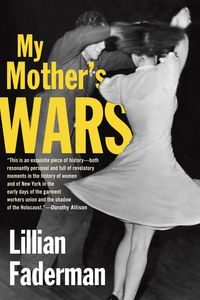
  • FADERMAN-MyMother'sWarsLillian Faderman
     is an internationally known scholar of lesbian history and literature, as well as of ethnic and immigrant history. She is the author of such acclaimed works as To Believe in Woman, Odd Girls and Twilight Lovers, Surpassing the Love of Men, I Begin My Life All Over, and her memoir Naked in the Promised Land.

    Last Thursday, Faderman read from her new book, My Mother's Wars, at one of our favorite bookstores, the Brookline Booksmith. We recorded her reading a few passages from the book, and we're happy to share those videos with you here.

    A story of love, war, and life as a Jewish immigrant in the squalid factories and lively dance halls of New York's Garment District in the 1930s, My Mother's Wars is the memoir Lillian Faderman's mother was never able to write. The daughter delves into her mother's past to tell the story of a Latvian girl who left her village for America with dreams of a life on the stage and encountered the realities of her new world: the battles she was forced to fight as a woman, an immigrant worker, and a Jew with family left behind in Hitler's deadly path.

    The story begins in 1914: Mary, the girl who will become Lillian Faderman's mother, just seventeen and swept up with vague ambitions to be a dancer, travels alone to America, where her half-sister in Brooklyn takes her in. She finds a job in the garment industry and a shop friend who teaches her the thrills of dance halls and the cheap amusements open to working-class girls. This dazzling life leaves Mary distracted and her half-sister and brother-in-law scandalized that she has become a "good-time gal." They kick her out of their home, an event with consequences Mary will regret for the rest of her life.

    In the first passage, Faderman reads about her mother's participation in a garment workers' strike. 

    Lillian Faderman At Brookline Booksmith, Part 1


    In the second passage, Mary makes a desperate attempt to save the lives of her family in Latvia.

    Lillian Faderman At Brookline Booksmith, Part 2


    In the third passage, Mary has discovered that she is pregnant again, after having submitted to two wrenching back-room abortions. Unmarried, Mary faces the prospect of single motherhood.

    Lillian Faderman At Brookline Booksmith, Part 3


    Related articles

    Out Now: My Mother's Wars by Lillian Faderman
    Historical Beacon Buzz: Langston Hughes reviews James Baldwin
    Beacon Buzz: Our Books Feel the Love
    Happy 100th Birthday to Rosa Parks

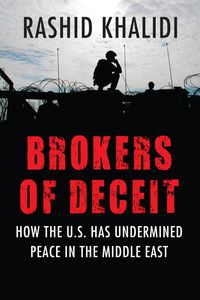
  • KHALIDI-BrokersOfDeceitAn examination of the failure of the United States as a broker in the Palestinian-Israeli peace process, through three key historical moments 

    For more than seven decades the conflict between Israel and the Palestinian people has raged on with no end in sight, and for much of that time, the United States has been involved as a mediator in the conflict. In this book, acclaimed historian Rashid Khalidi zeroes in on the United States's role as the purported impartial broker in this failed peace process. 

    Khalidi closely analyzes three historical moments that illuminate how the United States' involvement has, in fact, thwarted progress toward peace between Israel and Palestine. The first moment he investigates is the "Reagan Plan" of 1982, when Israeli prime minister Menachem Begin refused to accept the Reagan administration's proposal to reframe the Camp David Accords more impartially. The second moment covers the period after the Madrid Peace Conference, from 1991 to 1993, during which negotiations between Israel and Palestine were brokered by the United States until the signing of the secretly negotiated Oslo accords. Finally, Khalidi takes on President Barack Obama's retreat from plans to insist on halting the settlements in the West Bank. 

    Through in-depth research into and keen analysis of these three moments, as well as his own firsthand experience as an advisor to the Palestinian delegation at the 1991 pre-Oslo negotiations in Washington, DC, Khalidi reveals how the United States and Israel have actively colluded to prevent a Palestinian state and resolve the situation in Israel's favor. Brokers of Deceit bares the truth about why peace in the Middle East has been impossible to achieve: for decades, US policymakers have masqueraded as unbiased agents working to bring the two sides together, when, in fact, they have been the agents of continuing injustice, effectively preventing the difficult but essential steps needed to achieve peace in the region. 

    Upcoming Events

    March 13th, 8pm: Cambridge Forum, Cambridge MA. 

    April 1st, 7:30pm: Middle East Institute, Columbia University, New York. 

    April 5th, 7pm: Politics & Prose, Washington, DC.


    Khalidi

    About the Author

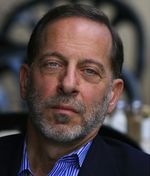
    Rashid Khalidi is the author of several books about the Middle East, including Palestinian Identity, Resurrecting Empire, The Iron Cage, and Sowing Crisis. His writing on Middle Eastern history and politics has appeared in the New York Times, Boston Globe, Los Angeles Times, Chicago Tribune, and many journals. For his work on the Middle East, Professor Khalidi has received fellowships and grants from the John D. and Catherine T. MacArthur Foundation, the Ford Foundation, the Woodrow Wilson International Center for Scholars, the American Research Center in Egypt, and the Rockefeller Foundation, among others. He is the Edward Said Professor of Modern Arab Studies at Columbia University in New York.

    In the Media 

    Click here to read a post by Khalidi at the Foreign Policy website.

    “Unpacking these episodes in sharp, take-no-prisoners prose,
    Khalidi maintains that the U.S. and Israel, ‘by far the most powerful actors in
    the Middle East,’ through successive administrations and a variety of key
    officials … have conspired to deny Palestinians any semblance of
    self-determination. A stinging indictment of one-sided policymaking destined,
    if undisturbed, to result in even greater violence.” —Kirkus Reviews

    “What has happened to the Palestinian people since 1948 is one of the great
    crimes of modern history. Of course, Israel bears primary responsibility for
    this tragedy. However, as Rashid Khalidi shows in his smart new book, American
    presidents from Truman to Obama have sided with Israel at almost every turn and
    helped it inflict immense pain and humiliation on the Palestinians. At the same
    time, they have employed high-sounding but dishonest rhetoric to cover up
    Israel’s brutal behavior. As Brokers of Deceit makes clear,
    the United States richly deserves to be called ‘Israel’s lawyer.’” —John J.
    Mearsheimer, coauthor of The Israel Lobby 

    Drawing on his own experience as a Palestinian negotiator and recently released
    documents, Rashid Khalidi mounts a frontal attack on the myths and
    misconceptions that have come to surround America’s role in the so-called ‘peace
    process,’ which is all process and no peace. The title is not too strong: the
    book demonstrates conclusively that far from serving as an honest broker, the
    United States continues to act as Israel’s lawyer—with dire consequences for
    its own interests, for the Palestinians, and for the entire region. Professor
    Khalidi deserves much credit for his superb exposition of the fatal gap between
    the rhetoric and reality of American diplomacy on this critically important
    issue.” —Avi Shlaim, Emeritus Professor of International Relations at Oxford
    and author of The Iron Wall: Israel and the Arab World 

    “Khalidi has combined history, common sense, and his firsthand understanding of
    Arab-Israeli peace talks, as brokered by Washington, to make the case that
    American national security interests would be best served by a just peace in
    the Middle East. Instead, he writes with great sadness, Washington’s efforts to
    be an honest broker fall ‘somewhere between high irony and farce’—and put
    democratic America, with its avowed commitment to freedom for all, in the
    position of enabling the continued subjugation of the Palestinian people. This
    is an important book” —Pulitzer-Prize winning journalist Seymour M. Hersh, The New Yorker

    “For those of us who believe that a two-state solution is the path to justice
    and peace for Israel and Palestine, Rashid Khalidi’s trenchant analysis is
    powerful and disturbing. The United States has failed repeatedly to be an
    honest broker, accepting the status quo of Israeli occupation and settlements
    when a true peace agreement would be deeply in the interest of all parties,
    Israel, Palestine, and the US itself. Khalidi emphasizes that the deceptions of
    language and deed have serious long-term costs and that the United States might
    soon impose and incur still greater costs through ill-conceived policies
    vis-à-vis Syria, Iran, and other countries in the Middle East.” —Jeffrey D.
    Sachs, author of The End of Poverty 

    “Rashid Khalidi is arguably the foremost U.S. historian of the modern Middle
    East.” —Warren I. Cohen, Los Angeles Times Book Review 

    “With a deep knowledge of the Middle East and a felicitous literary style,
    Khalidi . . . examines the history of U.S. involvement in the area against the
    backdrop of European colonialism.” —Ronald Steel, The Nation 

    “Khalidi’s role is as a historian, working to show how historical forces,
    largely ignored in the U.S., have shaped the modern Middle East. He takes
    particular delight in demolishing the various clichés used to describe the
    Middle East, bred out of what he terms ‘America’s historical amnesia.’” —Chris
    Hedges, New York Times


    Related articles

    Happy 100th Birthday to Rosa Parks
    A Visit to Havana: A Book That Takes on Immigration Myths Makes its Cuban Debut
    Book Talk: Brokers of Deceit
    Covering Hamas and Palestinian society: A response to Peter Beinart
    US Arabs urge Obama to bear message of hope to Palestinians – Jerusalem Post
  • Mary dalyIn honor of Women's History Month, Beacon is celebrating classics of women's history, literature, and feminist thought. Celebrate with us at Beacon.org.

    Mary Daly (1928-2010) was a world-renowned radical feminist philosopher. When her groundbreaking work, Gyn/Ecology, was first released by Beacon in 1978, one reviewer called it “the most important book to come out of the feminist movement since Daly’s last book, Beyond God the Father.”

    “In this deeply original,
    provocative book, outrage, hilarity, grief, profanity, lyricism and moral
    daring join in bursting the accustomed bounds even of feminist discourse.” —The
    New York Times Book Review
     

    “Daly’s insights into the background of radical
    feminism…are brilliant, and her synthesis of theology, mythology, philosophy,
    history, and medicine is absolutely overwhelming.” —Library Journal 

    “Gyn/Ecology is a great leap forward
    in feminist theory…It defies simplistic categorizations of political theory,
    philosophy of religion, or even poetry. The book is all of these yet none,
    because it goes beyond them.” —Janice Raymond, New Women’s Times
    Feminist Review
     

    “A vivid and exciting work, destined to become
    of landmark in the radical feminist process.” —Chrysalis 

    “Brilliant and soaring, Mary Daly’s Gyn/Ecology is
    the most amazing book I’ve ever read. It set me spinning. A wonderfully
    dangerous book.” —Gena Corea 

    “Daly writes with deep healing anger and
    uncompromising vision. Her book gives a shock of awakening such as is found in
    the works of Simone de Beauvoir.” —Publishers Weekly


  • 7322New York Times
     WellBlog regular contributor Danielle Ofri has been praised for turning the triumphs and trials of medicine into riveting and compassionate stories. This eBook exclusive edition offers 98 pages of her best work for $3.99. 

    Buy it from: 

    Amazon
     | Barnes & N
    oble | iTunes Bookstore | Kobo | Google Books

    This eBook original exhibits Danielle Ofri's range and skill as a storyteller as well as her empathy and astuteness as a doctor. Her vivid prose brings the reader into bustling hospitals, tense exam rooms, and Ofri's own life, giving an up-close look at the fast-paced, life-and-death drama of becoming a doctor. She tells of a young man uncertain of his future who comes into the clinic with a stomach complaint but for whom Dr. Ofri sees that the most useful "treatment" she can offer him is SAT tutoring. She writes of a desperate struggle to communicate with a critically ill patient who only speaks Mandarin, of a doctor whose experience in the NICU leaves her paralyzed with PTSD, and of her own struggles with the fear of making fatal errors, the dangers of overconfidence, and the impossible attempts to balance the empathy necessary for good care with the distance necessary for self-preservation. Through these stories of her patients, colleagues, and her own experiences, Intensive Care offers poignant insight into the medical world, and into the hearts and minds of doctors and their patients. These stories are drawn from the author’s previous books and one is from her forthcoming book, What Doctors Feel: How Emotions Affect the Practice of Medicine.

    Praise for Danielle Ofri

    “The world of patient and doctor exists in a special sacred space. Danielle Ofri brings us into that place where science and the soul meet. Her vivid and moving prose enriches the mind and turns the heart. We are privileged to journey with her from her days as a student to her emergence as a physician working among those most in need.” —Jerome Groopman, author of How Doctors Think

    “A gifted storyteller … Ofri describes how her patients’ histories stirred her to practice medicine more compassionately, inspired her with their hope and fortitude.” —Sarah Halzack, The Washington Post

    “Danielle Ofri is a finely gifted writer, a born storyteller as well as a born physician, and through these … brilliantly written episodes covering the years from studenthood to the end of her medical residency, we get not only a deep sense of the high drama of life and death that must face anyone working in a great hospital but a feeling for the making of a physician's mind and soul, and for her bravery and vulnerabilities as she goes through the long years of apprenticeship.” —Oliver Sacks, MD, author of Awakenings and The Man Who Mistook His Wife for a Hat

    “Danielle Ofri stands observing at the crossroads of the remarkable lives that intersect at Bellevue. She is dogged, perceptive, unafraid, and willing to probe her own motives, as well as those of others. This is what it takes for a good physician to arrive at the truth, and these same qualities make her an essayist of the first order.” —Abraham Verghese, author of The Tennis Partner and My Own Country

    “Dr. Ofri is an exemplary model of professional compassion. Her beautiful stories linger at the curtains of disease, of class and culture of life, and of inevitable death. The stories challenge us to create new narratives of caring and listening.” —Bruce Hirsch, Tikkun

    “Danielle Ofri has so much to say about the remarkable intimacies between doctor and patient, about the bonds and the barriers, and above all about how doctors come to understand their powers and their limitations.” —Perri Klass, MD, author of A Not Entirely Benign Procedure and The Mercy Rule

    “Her writing tumbles forth with color and emotion. She demonstrates an ear for dialogue, a humility about the limits of her medical training, and an extraordinary capacity to be touched by human suffering. . . . an important addition to the literary canon of medicine.” —Jan Gardner, The Boston Globe

    Related articles

    Historical Beacon Buzz: Langston Hughes reviews James Baldwin
    Roe v. Wade at 40: Carole Joffe looks back on "A New Day for Abortion Providers"
    Beacon Buzz: Our Books Feel the Love
    Office visits are essential to providing quality care
    The Fallout of a Chance Medical Finding
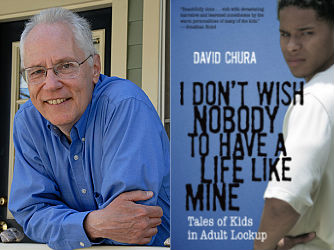
  • David Chura is the author of I Don't Wish Nobody to Have a Life Like Mine: Tales of Kids in Adult Lockup, and he has worked with at-risk teenagers for forty years. His writing has appeared in the New York Times and multiple literary journals and anthologies, and he is a frequent lecturer and advisor on incarcerated youth.

    Over the last few months, Chura's blog, Kids in the System, has featured a series called "Teachers in Their Own Words." Chura invited "a variety of teachers from different educational settings to share their experiences, to talk about why they teach and who they teach, and to tell the stories that keep them in the classroom." It's made for enlightening, inspirational reading. We asked him a few questions about the series for Beacon Broadside.

    David Chura will speak at the Association of Writers & Writing Programs (AWP) conference in Boston this Saturday, as part of Beacon's panel on Literary Nonfiction and Social Activism. See him—along with Courtney Martin, Michael Patrick MacDonald, Marianne Leone, and Beacon Director Helene Atwan—at 9am Saturday in Room 206, level 2. Get more information on AWP panels featuring Beacon authors, and be sure to visit us in the Bookfair at booth 1214 for author signings and a 35% discount on all books. 


    Chura_bookWhat inspired you to ask other teachers to write about their
    experiences?

    The educational debate is lively, fierce at times, and filled with
    voices—of economists, politicians, business executives, unions, academics,
    educational experts. The one voice that is under represented, if not silent, is
    that of classroom teachers, the folks on the front lines of education. But that
    silence hasn’t been my experience. In my many conversations with teachers that
    I know, and in my correspondence with those from across the country who have
    reached out to me through the internet, teachers have a lot to say. Yes,
    they’re concerned about the policies that are being made about curriculum,
    about standardized testing, about teacher evaluation. But what they are really
    talking about is what matters most to them: the everyday classroom and the kids
    that they teach and nurture and care about, and about how they can do their
    best for their students. The absence of teachers’ voices in the educational
    debate has bothered and saddened me. In order to break that silence I began the
    series, “Teachers in Their Own Words,” inviting teachers to write about what is
    most on their minds. 

    Teaching is a demanding job under the best conditions. How do
    teachers who have additional challenges—of teaching kids in lockup, overcoming
    ESL difficulties, getting through to kids who have been abused—find the
    strength to do what they do?

    I think all teachers but especially those working
    with special needs students ask themselves that question: how—and why—do I keep
    doing this? The answer is pretty simple. They’re nourished by the steps—little steps, big steps, leaps and bounds, and sometimes a
    mere eighth of an inch forward—that their students make, students for whom any
    progress is a struggle of effort against some pretty hefty odds. Teachers
    facing the extra challenge of special needs students learn to appreciate not
    just the successes of their students (and there are many) but also to value the
    effort that these kids put into their work. Why teach in challenging
    classrooms? Galway Kinell put it nicely: “everything flowers, from
    within, of self-blessing
    /though sometimes it is
    necessary/to reteach a thing its loveliness.”
    Who wouldn’t show up day after
    day for that? 

    Given that the educational system is always under heavy scrutiny
    and budget pressure, do you think that teachers have to, in some way, be
    activists?
     

    Being a teacher, almost by definition, means being an activist.
    And given the present economic and educational climate, teachers as agents of
    change seem even more imperative. For a teacher, that change happens daily in
    the classroom as he or she is alert to the needs of students: it may be for a
    winter coat, a pair of eyeglasses to see the board, or a dental checkup; or it
    may be a need for protection from bullies, from abusive treatment at home, from
    danger in the streets on the way to school. Any teacher knows that these needs must
    be attended to as soon as possible—there’s no time for the bickering of experts—in
    order to ensure student safety and wellbeing. In turn, dealing with those needs
    on the everyday level often has compelled teachers to become involved in the larger
    national debate on such issues as economic disparity, gun control and health
    care. The insights teachers bring to these issues comes from their knowledge and
    experience of the whole child and their
    firsthand awareness of the impact that these and other social issues have on
    kids’ development and education. It’s a perspective only teachers can bring to our
    national discourse about what is best for our children. It’s a voice we need to
    listen to. 


    Related articles
    Three questions about desegregation for Sarah Garland, author of Divided We Fail
    What it means for parents to support teachers
    Technology lets teachers meet students on own turf
    A Class Act Educator
    Divided We Fail: The Story of an African American Community That Ended the Era of School Desegregation
    English Teaching Fears

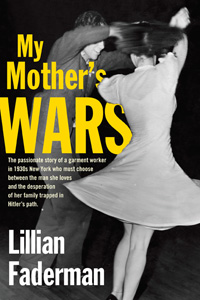
  • 5052An acclaimed writer on her mother's tumultuous life as a Jewish immigrant in 1930s New York and her life-long guilt when the Holocaust claims the family she left behind in Latvia
     

    A story of love, war, and life as a Jewish immigrant in the squalid factories and lively dance halls of New York's Garment District in the 1930s, My Mother's Wars is the memoir Lillian Faderman's mother was never able to write. The daughter delves into her mother's past to tell the story of a Latvian girl who left her village for America with dreams of a life on the stage and encountered the realities of her new world: the battles she was forced to fight as a woman, an immigrant worker, and a Jew with family left behind in Hitler's deadly path.

    The story begins in 1914: Mary, the girl who will become Lillian Faderman's mother, just seventeen and swept up with vague ambitions to be a dancer, travels alone to America, where her half-sister in Brooklyn takes her in. She finds a job in the garment industry and a shop friend who teaches her the thrills of dance halls and the cheap amusements open to working-class girls. This dazzling life leaves Mary distracted and her half-sister and brother-in-law scandalized that she has become a "good-time gal." They kick her out of their home, an event with consequences Mary will regret for the rest of her life.

    Eighteen years later, still barely scraping by as a garment worker and unmarried at thirty-five, Mary falls madly in love and has a torrid romance with a man who will never marry her, but who will father Lillian Faderman before he disappears from their lives. America is in the midst of the Depression, Hitler is coming to power in Europe, and New York's garment workers are just beginning to unionize. Mary makes tentative steps to join, despite her lover's angry opposition. As National Socialism engulfs Europe, Mary realizes she must find a way to get her family out of Latvia, and she spends frenetic months chasing vague promises and false rumors of hope. Pregnant again, after having submitted to two wrenching back-room abortions, and still unmarried, Mary faces both single motherhood and the devastating possibility of losing her entire Eastern European family.

    Drawing on family stories and documents, as well as her own tireless research, Lillian Faderman has reconstructed an engrossing and essential chapter in the history of women, of workers, of Jews, and of the Holocaust as immigrants experienced it from American shores. 

    "This is an exquisite piece of history—both resonantly personal and full of revelatory moments in the history of women and of New York in the early days of the garment workers union and the shadow of the Holocaust." —Dorothy Allison 

    "Faderman's story of her immigrant mother is so vividly imagined that you can taste the borscht Mary eats, squirm at the claustrophobia of her tiny rented room, and be swept up in the sensual delight that will betray her." —Janice Steinberg, the author ofThe Tin Horse 

    "This book is a work of originality, written with such imaginative sympathy that I read it with unabating pleasure from beginning to end." —Vivian Gornick, author of Fierce Attachments "Lillian Faderman is an extraordinary storyteller, one of the few who can tell a painful story, with a complex ending—and imbue it with humor, sensuality and earthy grace, in every sentence." —Amy Bloom, author of Away 

    "My Mother's Wars tells the aching story of immigrant factory workers in the decades preceding World War II — sad lives made sadder by the terrified knowledge that their families in Europe are being extinguished. The book is part memoir, part reconstruction … and all artistry." —Edith Pearlman, author of Binocular Vision

    Listen to Lillian Faderman on Tablet Magazine’s “Vox Tablet” podcast today.

    Read this Q&A with Lillian Faderman at The Philly Q.

    EVENTS:

    New York: Bluestockings, Tuesday, March 5,
    7 p.m.

    Free Library of Philadelphia,
    March 7, 2013 as part of the Free Library of Philadelphia Author
    Events.  

    Brookline Booksmith, March 14, 7
    p.m.

    Book Passage (Bay
    Area, CA), April 14, 1 p.m.

    Los Angeles Times
    Festival of Books, April 20-21.


    My Mother's Wars by Lillian Faderman, preface

    Related articles

    Historical Beacon Buzz: Langston Hughes reviews James Baldwin
    Beacon Buzz: Our Books Feel the Love
    A Visit to Havana: A Book That Takes on Immigration Myths Makes its Cuban Debut
    Happy 100th Birthday to Rosa Parks
    Why the Holocaust was even worse than we thought
  • Women’s History Month Classics: In the thirty-five years since its publication, Toward a New Psychology of Women by Jean Baker Miller, MD, has become famous for its groundbreaking demonstration of how sexual stereotypes restrict men’s and women’s psychological development. Wendy Strothman, former Beacon director, called it “one of our books that overturn an entire field.”

    Toward a New Psychology of Women is $9.99 during Women's History Month at Beacon.org.


    2909The following excerpt is from Chapter 4: Strengths

    Today in psychotherapy a central place is given to feelings of weakness, vulnerability, and helplessness, along with their usual accompaniment, feelings of neediness. These are feelings we have all known, given the long period necessary for maturational development in human beings and, in our society, given the difficulties and lack of support most of us suffer during childhood and indeed in our adult lives. Such feelings are, of course, most unpleasant—in their extreme, they are terrifying—and several schools of psychodynamic thought postulate that they are the root causes of various major “pathologies.” In Western society men are encouraged to dread, abhor, or deny feeling weak or helpless, whereas women are encouraged to cultivate this state of being. The first and most important point, however, is that these feelings are common and inevitable to all, even though our cultural tradition unrealistically expects men to discard rather than to acknowledge them.

    Two brief examples illustrate this contrast. Mary, a gifted and resourceful young hospital worker with two children, was offered a new and more demanding position. She would lead a team attempting an innovative approach to patient care. It involved greater scope for the team members and for Mary a harder job of coordination and negotiation of the workers’ anxieties and difficulties. Mary’s immediate reaction was to worry about her ability to carry out the project; she felt weak and helpless in the face of the formidable task. At times, she was convinced she was totally incapable of doing the job and wanted to refuse the offer.

    Her worry was in some measure appropriate, for the position of team coordinator was a difficult and demanding one that should be approached only after rigorous self-evaluation. She was, however, extremely able and had demonstrated the abilities necessary for the position. She retained some common feminine problems—having trouble admitting to, and easily losing sight of, her strengths. A clear recognition of her own competence would mean the loss of the weak, little-girl image to which she clung, in spite of its obvious inaccuracy. While some fear about the job seemed justified, her reluctance to relinquish the old image exaggerated the fears.

    By contrast, a man, Charles, who was also very gifted, had the opportunity to take a higher-level job, and he was very pleased. In its administrative requirements and responsibilities it was similar to Mary’s and was equally demanding. Just before he undertook the new job, he developed some fairly severe physical symptoms; characteristically he did not talk about them. His wife, Ruth, however, suspected that they were caused by his anxieties about facing the tasks ahead. Knowing him well, she did not mention the problem directly, but opened up the topic in the only way she felt able. She suggested that it might be a good idea to make some changes in their diet, hours, and general lifestyle. His initial reaction was one of anger; he disparaged her, sarcastically telling her to stop bothering him. Later he admitted to himself, and then to Ruth, that when he feels most uncertain of his abilities and most in need of help, he can react only with anger—especially if anyone seems to perceive his neediness.

    Fortunately, Charles is trying hard to overcome the barriers that keep him from acknowledging these feelings. His wife’s attempts opened up the possibility of dealing with them. He could not have initiated the process himself. He could not even respond to her initiation immediately, but this time, fairly soon after the fact he was able to catch himself in the act of denying it. Ruth easily might have remained rejected, hurt, and resentful, and the situation could have escalated into mutual anger and recrimination at the very time he was feeling most vulnerable, helpless, and needy.

    It is important to note also that Ruth was not being rewarded for her strengths. Instead, she was made to suffer for them—by anger and rejection. This is a small example of how women’s valuable qualities are not only not recognized but are punished instead. Even in this case, Ruth was not able to state her perceptions openly. She had to use “feminine wiles.” Important qualities such as understanding of human vulnerabilities and offerings of help can thus be dysfunctional in relationships as they are presently structured and can make a woman feel she must be wrong.

    In no society does the person—male or female—emerge full-grown. A necessary part of all experience is a recognition of one’s weaknesses and limitations. That most valuable of human qualities—the ability to grow psychologically—is necessarily an ongoing process, involving repeated feelings of vulnerability all through life. As the example of Charles illustrates, men have been conditioned to fear and hate weakness, to try to get rid of it immediately and sometimes frantically. This attempt, I believe, represents an effort to distort human experience. It is necessary to “learn” in an emotional sense that these feelings are not shameful or abhorrent but ones from which the individual can move on—if the feelings are experienced for what they are. Only then can a person hope to find appropriate paths to new strengths. Along with new strength will come new areas of vulnerability, for there is no absolute invulnerability.

    That women are better able than men to consciously admit to feelings of weakness or vulnerability may be obvious, but we have not recognized the importance of this ability. That women are truly much more able to tolerate these feelings—which life in general, and particularly in our society, generates in everybody—is a positive strength. Many adolescent boys and young men especially seem to be suffering acutely from the need to flee from these feelings before they experience them. In that sense, women, both superficially and deeply, are more closely in touch with basic life experiences—in touch with reality. By being in this closer connection with this central human condition, by having to defend less and deny less, women are in a position to understand weakness more readily and to work productively with it.

    In short, in our society, while men are made to feel weak in many ways, women are made to feel weaker. But, because they “know” weakness, women can cease being the “carriers” of weakness and become the developers of a different understanding of it and of the appropriate paths out of it. Women, in undertaking their own journey, can illuminate the way for others.

    Until now, women who are already strong in many ways still have had a hard time admitting it. Mary, the woman in the example, illustrates this problem. But even when weakness is real, women can go on to strength and ability once they can convince themselves that it is really all right to let go of their belief in the rightness of weakness. Only someone who understands women can understand how this psychic element operates, how widespread and influential the fear of not being weak can become, and how persistently it can hang on without being recognized for what it is. It is very difficult for men, with their fears of weakness, to see why women cling to it and to understand that it does not, and could not possibly, mean the same thing for women as it does for men.

    There is a further social point here. The fact that these feelings are generally associated with being “womanly,”—hence unmanly—serves to reinforce the humiliation suffered by the man who has such experiences. Women, in the meanwhile, provide all sorts of personal and social supports to help keep men going and to keep them and the total society from admitting that better arrangements are needed. That is, the whole man-woman interaction thus dilutes the push to confront and deal with our societal deficiencies. We all experience too much danger as we attempt to grow and make our way in the difficult and threatening circumstances in which we live. We all lose in the end, but the loss is kept obscure.

    Further Reading

    Q&A With Jean Baker Miller for Changing the Face of Medicine.

    Jean Baker Miller's Obituary in the New York Times.

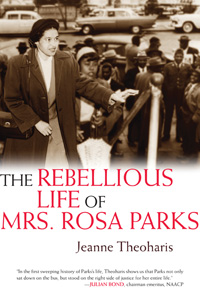
  • 5047At the Nation website, Jeanne Theoharis (The Rebellious Life of Mrs. Rosa Parks) and Marwa Amer take issue with the message sent by the unveiling of a statue of Rosa Parks in the Capitol Rotunda this week:

    On Wednesday, President Obama and a bipartisan collection of Congressional leaders paid tribute to the legacy of Rosa Parks by unveiling a statue of her at the Capitol. The 9-foot bronze figure of Parks desegregated Statuary Hall; hers is the first statue of a black woman to be installed at the Capitol and currently the only statue of a black person (a statue of Frederick Douglass is set to be moved there shortly). 

    Yet, the statue of Rosa Parks—seated and clutching her purse—turned her into a meek and redemptive figure. To the end of her life, Parks believed the United States had a long way to go in the struggle for social and racial justice. Yesterday’s ceremony, however, was largely an exercise in national self-congratulation and a demonstration of American pride and pageantry. It invoked the history of racial injustice to put that history in the past.

    “The statue speaks for itself,” House Speaker John Boehner began, noting how its placement in the hall embodied “the vision of a more perfect union.” “What a story, what a legacy, what a country,” Senator Mitch McConnell extolled at the close of his remarks.

    As these words were spoken, across the Washington Mall, the Supreme Court heard arguments challenging provisions of the 1965 Voting Rights Act in Shelby County v Holder. Only one speaker at the dedication, Representative James Clyburn, made specific reference to the case, which threatens to undermine the gains that Parks helped bring about.
    [Read the rest here]

    Read an excerpt of The Rebellious Life of Mrs. Rosa Parks at Scribd.


    Related articles

    The Rebellious Life of Mrs. Rosa Parks
    Rosa Parks statue unveiled at Capitol
    Happy 100th Birthday to Rosa Parks
    'Strength from stillness': Rosa Parks statue unveiled in US Capitol
  • Sarah Garland is a staff writer at the Hechinger Report. She has written for the New York Times, Washington Post, Philadelphia Inquirer, Chicago Tribune, American Prospect, New York Sun, Newsweek, Washington Monthly, Newsday, New York, and Marie Claire, among other publications. She was a 2009 recipient of the Spencer Fellowship in Education Reporting at Columbia University Graduate School of Journalism.

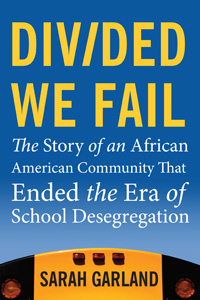
    Garland grew up in a middle-class suburb and was bused to an inner-city elementary school in Louisville, Kentucky. In 2007, a case brought by African American parents in Louisville brought to a close the era of school desegregation, and Garland examines the circumstances around this case in her new book, Divided We Fail. We asked her three questions about the book for our blog. 

    In honor of Black History Month, you can purchase Divided We Fail along with many other Black History titles for 20% off and free shipping at Beacon.org. Use Promo Code FEB2013 at checkout. Buy two or more titles and get a free King Legacy tote bag. 


    0177The traditional narrative of desegregation paints a picture of heroic children like Ruby Bridges marching past angry whites opposed to integrated schools. We don't hear much beyond those first, contentious post-Brown v. Board of Education days. How does this simplification gloss over the achievements and problems of desegregation? 

    Desegregation of the schools was a major achievement—and one that was long fought. But in celebrating that history, the story of black civil rights heroes and their white antagonists often obscures what some in the black community saw as very unfortunate side effects: the closure of traditionally black schools, the firing of black teachers, and a loss of power for black communities in overseeing their schools. No one wanted to go back to the era of Jim Crow, but people were frustrated that in the process of desegregating schools, whites maintained the upper hand and black students still faced many inequities. That’s not to undermine what was achieved with Brown v. Board of Education, but to suggest that desegregation didn’t live up to the hopes many people had for it. 

    Are contemporary school reform movements—charter schools, Race to the Top, focusing on "accountability"—achieving  better results than desegregation in closing the racial gap in education?  

    In a word, no. There is still not a lot of research on how new reform ideas like Race to the Top are impacting schools, and what research there is on charter suggests that while some charters are succeeding in closing the achievement gap, most are not. Desegregation, by contrast, corresponded with the most rapid shrinking of the achievement gap for black children yet. It was not the only factor contributing to those gains, but research suggests it had a hand, and also that diverse environments can be very positive for minority student achievement. That said, the gap didn’t fully close during desegregation (possibly because of the continued inequities perpetuated in the new systems).

    I think reformers today can look back at what worked and what didn’t and learn something. Already some are. Recently, there’s been something of a resurgence of support for integration: Some charter operators are trying to create diverse student bodies and a handful of school superintendents are rethinking the role of racial and economic diversity in schools. 

    How did your experiences as a student bused to an integrated school inform your research and writing? 

    Busing was a formative experience for me. Probably for all of us who went through it. I loved my school, which was near downtown Louisville amid some of the poorest housing projects in the city. I had good teachers and great memories of frequent field trips—we would walk in a line through those inner city streets to get to the museums downtown. I think the experience made the persistence of poverty and inequality in our society vividly real to me. But even though my school was diverse and in this neighborhood very different from my own suburban enclave, my days were spent with classmates who looked just like me. We were divided inside the school into advanced, honors and regular classes, and all but a couple of students in the advanced classes were white and middle class. That disparity also stayed with me, and was one of the main reasons I decided to write the book.

    Related articles

    Divided We Fail: The Story of an African American Community That Ended the Era of School Desegregation
    Book Excerpt: Today's Reforms Could Suffer Integration's Fate
    Judge says Ark. charters don't violate settlement
    Beacon Buzz: Prairie Silence, women in the military, and more!
    Historical Beacon Buzz: Langston Hughes reviews James Baldwin
    'Divided We Fail': The limits of desegregation
    Black History Month: Select books 20% off, plus free gift with purchase