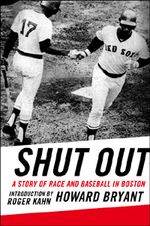
• ShutoutIt is not a requirement that you be a Red Sox fan to work at Beacon Press, but it let’s just say that it helps. There are many Fenway faithful around our offices, and we are fans who must live with the complicated, not always admirable, history of our favorite team. And, ten years ago, we published a great book that addressed the team’s history of racism.

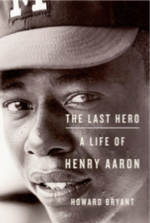
    The author of Shut Out: A Story of Race and Baseball in Boston is Howard Bryant, a native Bostonian who has since gone on to become a senior writer at ESPN and correspondent for National Public Radio. Shut Out won Spitball Magazine’s Casey Jones Award for best baseball book of 2002, and he has also written two other acclaimed books on baseball: Juicing the Game and The Last Hero: A Life of Henry Aaron. When his book on Hank Aaron was released in 2010, we interviewed Bryant in the Beacon offices about his life as a baseball fan. We share that interview today in honor of Fenway Park’s 100th birthday. 

    Fenway seemed to be a pretty hostile place to non-white fans.

    When I was a kid in the 1970s, the adults, the black adults in Dorchester, never went to Fenway Park. When we were kids, we never went to Fenway Park. And this was in the 1970s, when the Red Sox were really, really good. They were a great team–they went to the World Series in 1975. And yet, I’d never been to a baseball game.

    And it wasn’t until my family moved to Plymouth, fifty miles south of Boston, where you’re in a predominantly white community, where the Red Sox were actually part of the family. Where you would go to games as part of your summer vacation. And I remember, when I got older, asking my aunts and uncles, why didn’t they go to Fenway Park. And they told me–it was because it was a hostile place. And I remember one uncle, my Uncle Charles said to me one day, “Why would I go somewhere where I know I’m gonna get beaten up?” And that was quite a comment to me.
    ThelastheroAnd today, under John Henry and Larry Lucchino and Tom Werner, I think they’re cognizant of that. And I think today, when you go to a Red Sox game, that feeling of hostility is not there. I think that you have–you don’t have great diversity because at very few sporting venues across the country are you going to have great diversity. But, at least when you walk in there as an African-American or as a woman or as any minority group, I don’t think that you’re going to go into a place where you don’t feel comfortable. I think the Red Sox are trying very, very hard to make Boston baseball belong to everyone.

    Do you want to talk about the fan bases about Red Sox vs. Yankees? How do you feel the Red Sox legacy affects the fan base? 

    I’m sure it will be pretty embarrassing, and my friends probably not want to hear this, but they already know it because they lived it with me. When I was a kid, growing up in Boston and later in Plymouth on the South Shore, I was a Yankee fan. I will say it, it is true. And the reason was because, even today, as a journalist it’s the same thing, I never rooted for teams as much as I rooted for players, and my favorite player was Dave Winfield. And the reason that I liked Dave Winfield was because as a young, African-American boy, I really was in need of role models. Of seeing someone confident, and Winfield was such a confident player. He looked like he never bowed his head to anybody. And he swung the bat with such confidence, he played in the field and he did so many things that you wanted to emulate.

    And then, the black stars on the Red Sox always seemed so burdened. They always seemed as if they didn’t feel so comfortable. They were always brooding in some ways. Oil Can Boyd had a very difficult time here. Jim Rice, naturally, had a difficult time in Boston. And Ellis Burks had a difficult time in Boston. And so, there were players that you really wanted to root for, and I rooted for all those guys, but they just never seemed happy. Winfield seemed happy, and I said, “That’s my guy.” So I ended up rooting for the Yankees.

    I think that that is changing slightly, but not much, because the Red Sox haven’t really developed African-American players since. So you don’t have that evolution in terms of African-American players, but you have it with the Latino players. David Ortiz, for example, is as ebullient and fun-loving and wonderful a character as the city’s ever had. Ditto for Pedro Martinez, and the same, in his own, wacky way for Manny Ramirez. So, you have that person of color who enjoys playing here, but it’s been very specific to the African-American experience that the black player did not have as good, as comfortable an experience playing in Boston. So I’d like to say that that part of it is changing, but I haven’t seen much evidence of it.

    In Boston today, do you still see some of the racial issues that you talk about in Shut Out?

    I think one of the amazing things about the city of Boston is its history, its evolution, and I think one of the things that I really enjoyed about doing that project was taking the time to look at the different issues in the city and see how they would play out over time. The book came out in 2002, and in the years since, so much has changed in Boston, both in the Red Sox and their ownership, and the fact that they’ve won two championships since then. And also, in the city itself. I think Boston has become much more of a money city. I’m not sure that this is all a good thing. I think on the one hand, as a native Bostonian, I liked the diversity of the city and I like the rough edges of the city even if, sometimes, those rough edges stung, they hurt. I think that today, because you have to earn so much money to make ends meet in Boston, that the city has lost a little bit of that ethnic flavor that made it so special. On the one hand, this is a good thing, because it’s a much more tolerant city, it’s a much more diverse city, it’s got much better food. And I think that it makes for a more inclusive city. On the other hand, it can be bad because Boston is not the Boston that we knew before. Boston is not the same city that I remember growing up and that my dad remembers growing up. The neighborhoods have lost a little bit of that specialness that made the North End the North End, or South Boston… or Roxbury… but the one thing we do know is that the city is going to constantly be changing. Some of it’s going to be for the better, and, on balance, I think it’s a better place than it’s ever been.

  • The Pulitzer board dropped the ball on the 2011 fiction prize, so our staff felt compelled to pick it up. Sure, there's no money and little prestige attached to our nominations, but we figured that we'd join the chorus of those protesting the lack of an award this year by championing our own favorites. 

    ColeFrom Director Helene Atwan:

    This year's PEN Hemingway winner, Teju Cole for Open City.  But a tough choice, so many great books this year, and especially so many great first novels, including the Hemingway finalists, Amy Waldman's The Submission and We Are Taking Only What We Need by Stephanie Watts, and of course The Tiger's Wife by Téa Obreht.

     From Senior Publicist Caitlin Meyer:

    All three finalists were great picks, but I’d have gone for Swamplandia! Karen Russell’s writing is a dream. Given that she’s just 30, and this was her first novel, and that she’s a woman, I would have liked to see her beat the odds and walk away with the prize.

    Production Coordinator Beth Collins chafes against the Pulitzer's temporal and geographical constraints:

    I don’t read a lot of fiction and I usually don’t read things when they first come out. I’m usually a few years behind. For example, my favorite work of fiction that I read in the past year was by A Thousand Autumns of Jacob de Zoet by David Mitchell which was published in 2010, but he’s not American so he’s not eligible.

    Blog Editor Jessie Bennett would have pulled for PEN/Malamud and NBCC Award winner Edith Pearlman:

    I thought it was fantastic for Binocular Vision, a short story collection, to receive high honors from so many. I've been reading it a story at a time over the last month, loving that I'm able to approach each piece individually, but it works as a collection as well. 

    Brittany Weippert in Business Operations throws out the Pulitzer guidelines and throws in her recommendations for Chuck Palaniuk's Choke and How I Became Stupid by Martin Page. Add your own favorite reads in the comments!


  • Cynthia L. Cooper is an award-winning journalist, author and playwright. She is the co-author of Cheating Justice: How Bush and Cheney Attacked the Rule of Law, Plotted to Avoid Prosecution – and What We Should Do About It (Beacon Press 2012), written with Elizabeth Holtzman. 

    0321Nine years ago, I encountered a man from Ohio on a flight from LaGuardia to the Akron-Canton Airport just as the Iraq War was starting. I wish I could talk to him again.

    While sharing armrests but diverging on political leanings, we had a rather heated tête-à-tête about war in Iraq. He was firmly in favor of the war, and, in fact, wanted all the shock and awe the U.S. could deliver. He reasoned that Iraq was linked to al Qaeda and 9/11, and we couldn't let them get away with it.

    I was fresh from the massive anti-war marches in New York and questioned the truth of any connection between Iraq and al Qaeda, although President Bush and Vice President Cheney had drawn the association with regularity. My seatmate's whole body leaned over to the right — literally. "I feel so sorry for you," he said. "How cynical you must be to think that the president would lie."

    Now, nine years later, I feel sorry for all of us. If only, like the Beatles' Revolution 9, played backwards by disc jockeys of the day, we could rewind this tune. The false statements and lies that were used by President Bush and his team to drive the nation to war and occupation in Iraq have caused immeasurable heartbreak with thousands upon thousands of lost and damaged lives — U.S. and allies' personnel, Iraqi civilians and military, international journalists and bystanders. The financial costs to the U.S. have reached $800 billion, according to the American Progress Center's Iraq War Ledger, and the ticker is still going.

    Now we know that President Bush and his team lied repeatedly — investigative researchers at the Center for Public Integrity documented 935 false statements about Iraq in the two years after 9/11 (memorialized in a song by Harry Shearer). More than mere harmless "pants on fire" posturing, these statements violate the federal criminal law.

    In Cheating Justice: How Bush and Cheney Attacked the Rule of Law, Plotted to Avoid Prosecution – and What We Can Do About It, I and co-author Elizabeth Holtzman describe a prima facie case for prosecuting President Bush and Vice President Cheney for conspiracy to deceive Congress under Sections 371 and 1001 of the federal criminal code.

    Now that Bush and Cheney are no longer in office, the law can reckon with them on this and other outrageous incursions, such as wiretapping without warrants and torture. And prosecuting is a mighty good idea if we are to have a robust democracy down the road.

    President Bush deceived Congress in two direct ways — one was a speech; the other was a letter sent to Congress, stipulating that he had met the prerequisites set by Congress in order to launch a war into Iraq.

    The speech came on January 28, 2003 : the State of the Union message personally delivered to both houses of Congress. Two-thirds of the speech was devoted to Iraq, and much of what the president said was simply false. It was here that President Bush asserted that Iraq was buying the uranium needed to build a nuclear weapon from a country in Africa. The "sixteen words," later retracted, were known to be untrue. Their deceptiveness was unmasked when former Ambassador Joseph Wilson wrote that he had traveled to Africa before the war at the behest of the Bush administration and had reported back that Iraq was not buying uranium. (As told in Fair Game, Wilson's statements spurred a vicious White House reaction targeting his wife, CIA agent Valerie Plame.)

    President Bush also said that Iraq was procuring aluminum tubes for nuclear weapons, but that matter had already been dashed as wrong by the International Atomic Energy Agency, noted Joby Warrick in theWashington Post. Finally, President Bush said, as my Ohio seatmate parroted, that "Saddam Hussein aids and protects terrorists, including members of al Qaeda," but those connections had been debunked immediately after 9/11 by counterterrorism expert Richard Clarke.

    Things only got worse in the weeks after the State of the Union. Congress, as the branch of government charged with declaring war, had set stipulations in October 2002 that President Bush had to satisfy before a war could be launched in Iraq. Rather than meet them, the president flouted them. That is, he lied. On March 18, 2003, the president literally signed, sealed and delivered letters stating that a war in Iraqwas a "necessary" action against those who "planned, authorized, committed or aided the terrorist attacks that occurred on September 11, 2001." Not only was war not necessary, Iraq had not aided in the attacks of 9/11.

    The president's letter also certified that Iraq posed a "continuing" threat to the U.S. As the president knew, it did not — it had no weapons of mass destruction (WMD) and none were in development. The president admitted this to Prime Minister Tony Blair before the war, according to leaked British memos obtained by international lawyer and author Philippe Sands.

    Piling on the false statements, the president stated in the letters, untruthfully, that "peaceful means" would not protect the U.S. But weapons inspectors were peacefully in Iraq and, while they had found no WMD, they were willing to continue to look. In addition, the president blew off the UN Security Council andrefused to fulfill the requirement for a critical second resolution before going to war (it would have been vetoed). International lawyers objected vehemently to the rejection of this diplomatic process, and this has become an ongoing scandal in Britain, where the Iraq Inquiry has been taking testimony, much of it damning, on the start of the Iraq war.

    Lying to the U.S. Congress is a federal crime under Section 1001 of the federal code, and working in concert with others to lie to Congress is prohibited by conspiracy laws under Section 371. These are not mothballed laws, but ones that are being used regularly to charge others with crimes. Former Yankees pitcher Roger Clemens was criminally charged for making a false statement to Congress in denying any use of steroids. The American League's 2002 Most Valuable Player Miguel Tejada pleaded guilty in 2009 to making a false statement to Congress about his knowledge of other players' use of banned substances. Of Tejada, Assistant U.S. Attorney Steve Durham said, "People have to know that when Congress asks questions, it's serious business. And if you don't tell the truth — and we can prove you haven't told the truth — then there will be accountability." Tejada was placed on probation, ordered to do 100 hours of community service and required to pay a fine of $5,000.

    Not even that modest level of accountability has been applied to President Bush. Lying about knowledge of steroids is obviously a blip on the scale compared to lying about 9/11, WMD and the need for war. We still have had no clear explanation of why President Bush and his team drove the nation to war and occupation in Iraq; in fact, in his book, Decision Points, the former president said that he had no apologies even though no WMD were found, and he thought the world was better off for the war. He was completely oblivious to the suffering of so many who lost loved ones or were injured, displaced, tortured and permanently harmed.

    We need to put any future president on notice — now — that lying to Congress about the need for war is serious business. Prosecution under the criminal laws of the United States is the best way to hold President Bush accountable. I'd like to find that man from Ohio; I think he'll agree — we can't let him "get away with it."

  • Below is a an interview with Reverend Rebecca Turner of Faith Aloud, conducted by Carole Joffe, author of Dispatches from the Abortion Wars and professor at the Bixby Center for Global Reproductive Health at the University of California, San Francisco. Faith Aloud is a pro-choice religious organization which seeks to eliminate the stigma associated with abortion and sexuality, and to provide support to both women and providers. 

    This post originally appeared on RH Reality Check.

    “Today we pray for women for whom pregnancy is not good news, that they know they have choices.”

    “Today we pray for the men in our lives, that they may offer their loving kindness and support for women’s difficult decisions.”

    “Today we pray for Christians everywhere to embrace the loving model of Jesus in the way he refused to shame women.”

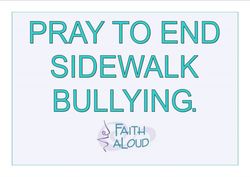
    Pray to end sidewalk bullying poster from Faith AloudAbove are some of the individual components of the 40 Days of Prayer, a series composed by the Rev. Rebecca Turner, a United Church of Christ minister, and the head of Faith Aloud, a pro-choice religious organization based in St. Louis, Missouri. Turner originally wrote these prayers to counter religious-based protests against women's rights to choose abortion. For some years, the “40 Days of Prayer” were used in various ways by clinics but ignored by the anti-choice movement. However, recently when a clinic in northern California reprinted the prayers in a brochure, the movement took notice, and Turner’s prayers—and by extension, the concept of a religiously-based prochoice group—drew much attention from the religious right, including interviews by Fox News and Focus on the Family, and follow up stories in various anti-choice publications.

    Below is an interview I conducted with Rev. Turner about her organization, the 40 Days of Prayer, and the reactions of opponents of abortion when news of her activities went viral.

    What is Faith Aloud?

    Faith Aloud is an interfaith nonprofit organization with a history of 30 years of pro-choice activism. Our mission is to eliminate the religious stigma of abortion and sexuality. We train clergy to talk to women about their pregnancy choices and we receive calls from women all over the country as well as internationally. We also provide spiritual resources for abortion clinics to use to help their religious patients.

    Most women in the US identify as religious, and those seeking abortion are no different. Our resources, created by clergy of several faith groups, offer support to women during times of distress.

    Why did you write the 40 Days of Prayer?   

    I wrote some prayers and offered them to abortion providers to use whenever and however they wanted to. We've since made a full poster of the prayers that is on the walls in many clinics across the country. We were angered by the swarms of protesters that regularly took siege of abortion clinics and would hurl hateful remarks at the women arriving. As a Christian minister, I was especially angered that most of these protesters who were so hateful and judgmental actually call themselves Christian. I wanted women to know that many Christians are compassionate and supportive, and to help them find strength in their religious faith instead of condemnation.

    I also wanted to give spiritual support to the other people [affected] by the daily barrage of hate — the clinic staff and escorts. Few people know what they go through every day because of their dedication to women. And few people understand that many of them-doctors, counselors, administrators-are deeply religious people themselves who have often felt rejected by their faith communities. This is wrong. I feel that I am a pastor to many of the abortion providers who use our services. Religious faith should give us strength and confidence, not guilt and shame. I have never understood why anyone would support a religion that shames and judges and ridicules its own members. That is abusive behavior and should not be tolerated in any setting.

    Tell more about your mindset as you wrote the prayers.

    I wrote all of the prayers in one day. I thought about women's reproductive lives, the difficulties of being female, the choices we make, the relationships we have, the various people who work with pregnant women, and I prayed for them all. Many websites are claiming that we're praying for more abortions, which is silly. They can read the prayers and see that isn't the case. Most of the prayers are really all about women and their reproductive lives. We pray for gender discrimination to cease. We pray for women who are abused. We pray for women who are infertile. We pray for women to have confidence. How can they be upset by this? Really I think the only objection to these prayers comes from a deep misogyny that refuses to acknowledge women as autonomous beings with their own spiritual lives. 

    How would you characterize the main reactions you have received since this flurry of publicity?  

    The media to date has been from anti-choice groups, so most of the people calling and writing to us are their constituents. They are quite hostile, usually rambling, callers are often screaming. They accuse us of pretending to be ministers or Christians. They accuse us of baby-murdering. Emails quote a lot of scripture and tell us we're going to burn in hell.  We have had some new supporters find us through this, though. And we've begun a campaign called "Hate-into-Love" which allows our supporters to pledge donations for each hostile contact we receive. 

    Why do you think the 40 Days of Prayer has hit such a nerve with the Right, once they became aware of it?  

    They claim they think it's a mockery of the 40 days for Life campaign, but I don't think there is any mockery in it. The prayers are quite sincere. Apparently the religious right does not believe that anyone is allowed to pray except those who believe as they do. This is not a biblical idea; it is pure arrogance. The Christian scriptures say "Judge not, lest you be judged" and yet these people want to judge us as "fake" or "delusional" or even "possessed." One person who called us after the news broke asked "Are you planning to get groups of people to rally at abortion clinics to pray your prayers?" My answer was "The people inside the clinics are praying every day."  Prayer does not belong to one group of people. But this seems to be the source of the outrage, that we dare to pray. It is apparently a very scary proposition to them that women might hear a compassionate religious voice and feel strengthened instead of weakened.

    What have reactions to this campaign been in the pro-choice community?

    A few pro-choice [organizations] have helped to pass along the information about our "Hate-into-Love" campaign and have re-posted the stories. We're getting pledges from around the country. We've been gaining a lot of new Facebook friends [who] learned about us through the negative media.   

    Do you think this community is more open now than in the past to a religious presence, such as that offered by Faith Aloud? 

    The independent abortion provider community has always been very welcoming of spirituality, seeing it as an important part of a woman's life and her decisions. But there is an element of the pro-choice community that is less supportive, seeing religion as the problem rather than a part of the solution, and really I can't blame them for feeling that way. They've been threatened and attacked and shamed by religious zealots. But, as I mentioned, most of the women in the United States call themselves religious or spiritual, and so we need to help them use their faith for strength during difficulty. It shouldn't be about we need, but what women need making difficult decisions.

    In the several days that news of the “40 Days of Prayer” has gone viral, you have received much hate mail. Have you received anything from any anti-choice individual or group that suggests some common ground? 

    No. The hate mail tends to fall into these camps "You have no right to call yourself a Christian or pray" or "I'm praying for God's vengeance on you." We're getting some love mail, too, with people finding us for the first time and saying thank you for being a religious voice of compassion and reason.

  • Can we tell you how much I love the Melissa Harris-Perry Show on MSNBC? This Sunday, she invited Kate Bornstein (A Queer and Pleasant Danger) to talk about the Miss Universe pageant in one of the coolest, most informative TV segments on transgender identity I've ever seen on TV. Watch below (or, if the embed doesn't work, click the link here). 

    http://www.msnbc.msn.com/id/32545640

    Visit msnbc.com for breaking news, world news, and news about the economy

    The segment was picked up by some great blogs. Add your own links in the comments and we'll update them here:

    The Advocate

    Philly Mag

    Pam's House Blend

    DC's Metro Weekly 

    Autostraddle 

    The New Civil Rights Movement 

    Julie Bolcer 

    The next segment brought in Kai Wright to discuss the Obama administration's mixed record on addressing discrimination against LGBTQ people. Again, gratitude to MHP for making weekend mornings a time to get smarter. Go #Nerdland! 

    At Daily Beast, Casey Schwartz reviews Kaitlin Bell Barnett's new book, Dosed: The Medication Generation Grows Up, saying of the book, "This conversation is long overdue." You can also watch Kaitlin Bell Barnett on the The Big Picture with Thom Hartmann.

    Watch Elizabeth Holtzman on BookTV discussing Cheating Justice. 

    The Boston Globe's terrific food writer Devra First interviewed Aaron Bobrow-Strain about White Bread: A Social History of the Store-Bought Loaf. The debate over white bread goes all the way back to Plato! 


  • “The author’s clear rending of the tough questions surrounding this knotty topic should make it required reading for anyone touched by this issue.” Kirkus Reviews

    BELL-Dosed-FINAL

    Over the last two decades, we have seen a dramatic spike in young people taking psychiatric medication. As new drugs have come on the market and diagnoses have proliferated, prescriptions have increased many times over. The issue has sparked heated debates, with most arguments breaking down into predictable pro-med advocacy or anti-med jeremiads. Yet, we've heard little from the "medicated kids" themselves.

    In Dosed, Kaitlin Bell Barnett, who began taking antidepressants as a teenager, takes a nuanced look at the issue as she weaves together stories from members of this "medication generation," exploring how drugs informed their experiences at home, in school, and with the mental health professions.

    For many, taking meds has proved more complicated than merely popping a pill. The questions we all ask growing up-"Who am I?" and "What can I achieve?"-take on extra layers of complexity for kids who spend their formative years on medication. As Barnett shows, parents' fears that "labeling" kids will hurt their self-esteem means that many young children don't understand why they take pills at all, or what the drugs are supposed to accomplish. Teens must try to figure out whether intense emotions and risk-taking behaviors fall within the spectrum of normal adolescent angst, or whether they represent new symptoms or drug side effects. Young adults negotiate schoolwork, relationships, and the workplace, while struggling to find the right medication, dealing with breakdowns and relapses, and trying to decide whether they still need pharmaceutical treatment at all. And for some young people, what seemed like a quick fix turns into a saga of different diagnoses, symptoms, and a changing cocktail of medications.

    The results of what one psychopharmacologist describes as a "giant, uncontrolled experiment" are just starting to trickle in. Barnett shows that a lack of ready answers and guidance has often proven extremely difficult for these young people as they transition from childhood to adolescence and now to adulthood. With its in-depth accounts of individual experiences combined with sociological and scientific context, Dosed provides a much-needed road map for patients, friends, parents, and those in the helping professions trying to navigate the complicated terrain of growing up on meds.

    Buy from Beacon Press | Independent Bookstore | Amazon | Barnes and Noble | Powells

    Buy the ebook Kindle | Nook | Google eBookstore | Kobo | Apple iBookstore

    Read an excerpt of Dosed at Salon.

    Kaitlin-b12_4-final2

    Kaitlin Bell Barnett is a journalist and blogger based in Brooklyn. She also blogs about the experiences of young people taking psychiatric drugs at PsychCentral.

    Her work has appeared in the New York Observer, Parents, the Huffington Post, Berkshire Living, Gastronomica, Prevention, InTheFray, Hungry, the Brooklyn Rail, and the Boston Globe, among other publications.

    Kaitlin grew up in Williamstown, Massachusetts, and attended Columbia Journalism School and Dartmouth College, where she served as executive editor of the independent daily student newspaper. From 2005 to 2007, she worked as a reporter at the Monitor, a daily newspaper in McAllen, Texas, on the Mexico border. There, she covered city government, politics, schools, crime and general assignments.

  • OLIVER-SwanIn celebration of National Poetry Month, Beacon Press is giving you a chance to win autographed copies of Mary Oliver's books. VISIT BEACON.ORG FOR MORE DETAILS. 

    • One winner will receive signed copies of New and Selected Poems, Volume Two; Thirst; and Swan; and a poster featuring a poem from Swan.
    • Three winners will receive a signed copy of Swan and a poster.
    • Five winners will receive a poster.

    If you love Mary Oliver's poetry, then enter our drawing!

    We'll take entries starting 9 a.m. EST April 12 and ending at 5 p.m. EST April 30, 2012. You may enter one time per day. Drawing is open to U.S. residents only. Winners will be chosen at random from all entries received and will be notified the week of April 30. TO ENTER, VISIT BEACON.ORG FOR MORE DETAILS. Good luck!


  • Our blog is on a bit of a vacation for the holidays, since the blog editor is celebrating Pesach with her in-laws while also putting together Easter baskets for her kids. This from Susan Katz Miller's On Being Both blog really struck a chord. The author of a forthcoming book on interfaith family life offers her family's solution for honoring their religious traditions when holidays overlap.

    This year, I am fielding calls from reporters wanting to know how we handle the dilemma of Passover starting on Good Friday. I know that, especially for young couples just starting their interfaith journey, this convergence of important holidays may create stress. Say, for instance, your in-laws are expecting you for a raucous Passover seder featuring four glasses of wine and glazed brisket: this could be an alienating experience if you are also commemorating the crucifixion of Jesus and avoiding meat on the solemn Friday of Holy Week.

    As interfaith families become the norm in our culture, rather than the exception, all of us must learn to empathize, to see our own practices through the eyes of the “other.” And as each interfaith couple learns to listen deeply and to support one another, I can imagine that serving salmon, rather than brisket, might be a reasonable accommodation in some families this year. [Read the rest of the post here.]

    Whatever and however you are celebrating–be it Easter, Passover, beautiful spring weather, or a mix–we hope you have a wonderful weekend. 


  • In the early evening of April 4th, 1968 Dr. Martin Luther King, Jr. was assassinated in Memphis, Tennessee. His lifelong philosophy of nonviolence and dedication to economic and social justice moved the nation.

    The King Legacy Series website has many resources available, including teachers guides and biographies of King and the scholars involved with the series. In addition, we include here some links to excerpts from the books as well as audio and video that celebrates the man and his writing.

    The day before he died, he gave the following speech to striking AFSCME sanitation workers. This speech in its entirety is included in All Labor Has Dignity.

  • In the Boston Globe, Nancy Gertner (In Defense of Women) finds fault not only with stand your ground laws, but with the way Florida's law is being applied to George Zimmerman:

    Whatever the justification for the 911 call – and it was thin – nothing justified what happened afterwards, not even under Florida’s infamous “Stand Your Ground” law. Zimmerman fatally shot Trayvon Martin. Florida has led the nation with its “Stand Your Ground’’ law, despite the opposition by prosecutors and law enforcement groups. Palm Beach State Attorney Barry Krisher opposed the law “because it encourages people to stand their ground .. when they could just as easily walk away. To me that’s not a civilized society.” Paul Logli, the president of the National District Attorneys Association said that these laws “give citizens more rights to use deadly force than we give police officers and with less review.” Despite the opposition, many other states followed Florida’s bad example. Indeed, such a law has recently been proposed in Massachusetts by Senator Stephen Breyer and Representative George Peterson. [Read more]

    At Colorlines, Kai Wright (Drifting Toward Love: Black, Brown, Gay, and Coming of Age on the Streets of New York) looks at the cultural demonization of young black men like Trayvon.

    Sadly, it’s necessary to point out that there isn’t an imaginable scenario in which an armed man can shoot an unarmed child to death and it be okay. But set that obvious fact to the side. Trayvon Martin did in fact have it coming. He was born black and male in the United States and was thus marked for death. The cruelness of our economy and of our criminal justice system isn’t reserved for men or for black people. But there is a particularly gendered and particularly racist way in which black men are set upon in this country, most acutely those who don’t have the resources to push back. And it has a very long, still relevant history.

    For the entirety of American history—from the first African captured and enslaved to the moment Geraldo Rivera opened his mouth to pimp Martin’s death for ratings—black men have been relentlessly caricatured as menaces to society. We were dangerous, so chattel slavery was necessary, and a nation’s wealth was born. We are still dangerous, so a police state is necessary in black neighborhoods all over this country, and the wealth of a prison-industrial complex flourishes. This is what Trayvon Martin’s murder is about. It’s not about his high school suspension. It’s not about his hoodie. It’s not even about Florida’s Kill at Will law, at least not at root. It’s about the enduring, dark fantasies to which America still clings, in order to justify a society in which more black men are locked up or on parole today than were enslaved in 1850—to pick just one of many indicators of the scale at which black men are battered. But we’re menaces; we’ve got it coming. [Read more]

    At his Inheriting the Trade blog, Tom DeWolf examines the different consequences for black people and white people in our criminal justice system:

    If a young black man had been walking around his neighborhood with a gun, encountered a white man, and said he felt threatened and shot him to death, he would be in jail; yes, even in Florida with the “Stand Your Ground” law in place. Throughout history, black-on-white crime has generally been investigated and prosecuted far more vigorously than has white-on-black crime. [Read more]

    At CNN.com, Sherrilyn Ifill (On the Courthouse Lawn) calls for us to "Stand with Trayvon's mother for justice":

    The teenage rites of passage that thrill our white counterpoints send fear down a black mother's spine. When your child is old enough to walk to a friend's house in the neighborhood, it can mean the first of many stop-and-frisk encounters with the police. When they turn 18, they can now be arrested and charged as an adult for being in the wrong place at the wrong time. A new driver's license and car opens the door to driving-while-black stops. Just having a flat tire in the road can end with a senseless murder, like the death of Camille and Bill Cosby's son Ennis on the Los Angeles freeway in 1997. [Read more]