• When Alexis Rizzuto was planning the vacation she took this past fall, she didn't pore over travel guides or look to glossy magazines for inspiration. Alexis is an editor at Beacon Press, so she just took a look at the amazing books she's been working on. Our blog editor, Jessie Bennett, spoke with Alexis about her trip, and about the books and authors who inspired it, in particular Michael Lanza's newly published Before They're Gone: A Family's Year-Long Quest to Explore America's Most Endangered National Parks.  

    View a slideshow of her trip at Google+.

    LANZA-BeforeThey're#306E1D4
    A slightly modified version of the Before They're Gone book cover.

    What books inspired your trip or came back to you while you were on the trip?

    I would not have taken this trip if it weren't for Before They're Gone by Michael Lanza. And our upcoming book, Dirt Work by Christine Byl, because she was out on these very trails breaking them for the rest of us. I met our author Brad Tyer, so Opportunity, Montana is another connection to this trip. We were in a different part of Montana than he writes about, but, still, the reason that we went to Montana is the reason he went to Montana: because we wanted to see pristine wilderness and beautiful wildlife. At that time, I hadn't yet realized about the whole extractive resource colony aspect of Montana, but now I appreciate the beauty of it even more.

    And our Steve Hawley book, Recovering a Lost River. We took a rafting trip down the Snake River in his honor. And of course, Mr. Hornaday's War. We not only made a pilgrimage to Mt. Hornaday, but when I saw my first bison in Yellowstone, I almost cried. From then on, we mostly saw bison in herds, but the first bison I saw was alone out on a prairie, and having in mind what I had just read in Stefan Bechtel’s book about the bison slaughter and their recovery, I felt so grateful that this bison was still there, a survivor.

    How did Michael Lanza help you plan your trip?

    He helped me from day one. He inspired the trip, and then I said, "Okay, I want to go see some of these places that you wrote about. What do you suggest?" I said I would maybe like to start with Yellowstone and he said, "Well, if you want to see Yellowstone, you should add on Glacier National Park and the Tetons as well." He  told me what time of year to go, too—September, because the students have to go back to school so there won't be as many families. It wouldn’t be as crowded, and it's still warm then. But the farther north you go, the cooler it gets, so he told us to start north while it's still kind of warm in Glacier and then work our way south to Yellowstone and then the Tetons. And he told me how many hours it would take to drive between these places and where to stay when we got there… I mean, everything. He gave me a whole itinerary.

    IMG_7637

    St. Mary Lake, Glacier National Park. Photo courtesy Alexis Rizzuto. See more photos here.

    This is such a bonus to being an editor here!

    Yeah, like, "I don't want to exploit you, but…" I was so clueless. I had never been to that part of the country before; I had no idea what to do. I was asking him for basic advice, and he just gave me every detail I could have possibly needed.

    How long was your trip?

    It was two weeks.

    What kind of gear did Michael tell you to bring?

    Well, we weren't camping–we were just hiking.

    But did you get bear repellent? 

    (Laughs) Yes, we did get bear repellent.

    Did you have to use bear repellent?

    Thank God we did not. But I thought about that story in the book, about his kid, Nate. He's stalking around with the bear repellent, and Michael turns around and Nate has it aimed at him. He told me that there was an instance where one of his friends discharged the bear repellent in a garage, and even days later you couldn't go into the garage without your eyes watering–it's really serious stuff.

    So we did have it and we did have it at the ready at all times because there were plenty of bears there. We only laid eyes on one, but we would be walking down a trail and somebody would be coming back the other way and they would say, "Oh, we just saw a grizzly up there." And there was another trail we were on where a park ranger came by and said, "We're closing this part of the trail because of bear activity." And then we were on another trail–we were pretty much by ourselves on this one trail–and we came across some large, very fresh piles of bear poop, right in the middle of the trail. And then we heard rustling in the woods. We hightailed it out of there. And just as we were coming out of the trailhead, a park ranger was driving up, and the first thing she asked us was, "Did you see any bears?" We said, "No, but… you know we just saw some pretty fresh scat. And we thought we saw something in the woods." And she said, "Well you probably did–there's a mother grizzly here with her two cubs."

    But it's not like there aren't warnings. At every trailhead, there's a billboard, saying, "You are entering grizzly territory. Here's what you do…" And the main thing to do is make noise. Clap, yell, sing. We had bells that we would shake, I had stuff to clank against my metal water bottle. We made sure that we were making noise, because if they hear you coming they'll just go away. They don't want to see you.

    We went on plenty of trails that said, "Prime grizzly territory: be bear aware." (Laughs) That was the catch phrase in the Tetons area, I think. They had these big stickers everywhere saying, "Be Bear Aware," put away your food, and don't do anything that would attract them.

    Don't carry pic-a-nic baskets?

    Right. (Laughs) So Michael gave us advice about some things to bring, but since we weren't camping, it was just basic hiking gear and protection. And he gave us some ideas about where to stay. We stayed in the parks, in cabins mostly. It was really nice to wake up and be in the park. You’d fall asleep to the sound of great horned owls and wake up to the morning light on the mountainsides.

    Both he and Christine Byl suggested a particular trail in Glacier. You get to this trail by going up this road called "Going to the Sun Road." And all the guidebooks say, "Oh, you have to do the Going to the Sun Road, it's spectacular. Everybody does it. Millions of people a year do it." We renamed that road the "Going in My Pants Road." Because you're on the side of a mountain. There's like a 5,000 foot sheer drop right next to you. And there's a low rock wall that's all that's between you and pitching off the side of the mountain. Millions of people do it every year, and nobody dies, so obviously it's okay, but I was clinging to my husband, I could not look out the window. I was like, "Oh, my God, we're going to die." He was actually feeling the same way. So we get to the top of the Going to the Sun Road, and the High Line trail is the trail that both Michael and Christine said, "Oh, you have to do this trail." We looked at this trail, and we're like, "There's no frigging way we're going to do this trail."

    Was it for more experienced hikers?

    No. There were kids on it. But it was basically the same thing as the road, only narrower and with no rocks between you and the fall. And they said, "You'll see great mountain goats up there, and you'll get great views up there, and everyone should do this trail." But the thing was, the other trail that we picked, we saw mountain goats, we saw beautiful views. Yes, it was a trail that children and old people were also on. But, who cares? It was so beautiful. Wildflower meadows and frolicking animals, sparkling lakes. They call the area the American Alps.

    IMG_7611

    Proof that Alexis saw a mountain goat on the wimpy trail.  

    Children and old people are for me a very good sign that I can handle it.

    Yeah! It was one of the most beautiful hikes we had, even though it wasn't the serious hiker trail. I didn't care. We saw everything we came to see. So I told Michael, "Your children will laugh at me for being such a wuss." They could do the High Line trail in their sleep.

    Did it give you more of an appreciation for all of the stuff that they did in the book?

    Yeah, oh yeah. Definitely. And my husband got so sick of me because everything we did, I said, "Well Michael Lanza did this," and, "Michael Lanza writes about this in his book." "I learned about this from Michael Lanza." He was like, "Michael Lanza! Michael Lanza! Michael Lanza! Why don't you marry HIM?" (Laughs) Actually, they’ve met and get along very well.

    But, I was able to tell Alex, for instance, well… it's not a happy story, but not all the stories in the book are happy. It's about climate change. And one of the things we saw firsthand was that the glaciers in Glacier National Park, as Michael admitted, are really not that impressive any more because they're already such a small percentage of what they used to be. Sometimes it's hard to tell the difference between a glacier and a bunch of snow in a bowl in the mountains. But the other thing I was able to tell Alex about and to see firsthand, which was heartbreaking, is the lodgepole pines are being infested by pine bark beetles because the winters are not cold enough to kill their eggs. It used to be that the winters were cold enough to kill most of the eggs so that when the pine bark beetles hatched in the spring, there weren't enough of them to wipe out entire forests, but now, there are. And these forests–we saw entire, entire mountainsides, brown.

    There were two kinds of tree deaths that we saw. One of them was good, one of them was bad. And I learned this from Michael Lanza, too. The good tree deaths– we would see the remains of the dead trees –those were from forest fires. And, actually, that's good because among the skeletons of the old trees there was lush growth of the younger trees coming up. And the forest fires enrich the soil, and actually allow the pine cone seeds to germinate. They only germinate at the temperatures brought about by forest fires. So we would walk through forests like that and, yes, there was destruction, but there was also life and hope and the proper cycle going on.

    But then, when we would see one of these pine bark beetle forests, it was just heartbreaking, because you could imagine what the mountainside looked like when it was green. And now there's not a shred of life on it. 

    542px-Western_MeadowlarkPhoto by Kevin Cole from Wikimedia Commons.

    The wildlife was amazing. We saw herds of bison, we saw elk, we saw a black bear, we saw mountain goats, amazing bird life–we saw a pair of sand hill cranes, up pretty close, closely enough that we heard their calls and watched them fly off. I'd never seen sand hill cranes. I don't think they're endangered, they're not that rare, but I had never seen them before. We were on a place called Antelope Flats where we saw a herd of pronghorn antelope. And there was a whole flock of western meadowlarks, which are a beautiful bird. They've got a bright yellow chest, and their song was amazing. [Ed's note: You can listen to meadowlark song at the Cornell All About Birds website.]

    We got up close and personal with some mule deer. First we encountered the male on his own. He walked right up to us, we could have fed him, he was so close. And then he went away, and we continued down the trail and there was the female with two fawns. And they also didn't care that we were there. There was a newsletter they hand out in the National Parks where it explains that there are certain distances that you are supposed to maintain between yourself and certain kinds of wildlife. So, obviously, a grizzly bear you're supposed to give a large amount of space. (Laughs) For bighorn sheep, the space is a little shorter. But you're supposed to give deer space as well. But these deer, they were on the trail, and we wanted to give them the kind of space we were supposed to give them, but they just weren't leaving! So we ended up waiting for quite a while, then we just squeezed past them. They didn't care.

    The other beautiful thing is the breathtaking landscapes. Being from the East, you're just not used to the space, and the breadth, and the hugeness of the mountains and the canyons and the plains.

    It's hard to use superlative words and have them actually mean anything these days, but I just kept turning to Alex and saying, "This blows my mind." 

  • In Salon, an excerpt of Billionaires' Ball looks at how economic inequality is bad for democracy:

    A private equity manager receiving, say, $600 million as a capital gain would pay $90 million in tax. If the same income were treated as income from salary, it would be taxed at 35 percent (and also be subject to a 2.9 percent payroll tax), bringing the private equity manager’s tax bill to $227.4 million — almost $140 million more.

    The ostensible purpose of the lower capital gains rate is to compensate investors for the risk they take in investing their capital. But private equity and fund managers aren’t investing their own capital. They’re investing other people’s capital. They’re simply money managers. By claiming capital gains treatment, they are passing off regular income as capital gains, simply to save themselves taxes.

    The fund managers insist that their compensation is still very risky; while some deals may lead to huge profits, others prove disastrous. True. But risk is hardly confined to fund managers. And at lower income levels, the risks are far larger. Indeed, in the last 30 years, vast swaths of the economy could be designated as risky for those needing to earn a living. The sort of stable, lifelong jobs that were common a generation ago have been largely replaced by contract or part-time work, with little or no security. A layoff can mean the loss of the family home or health benefits, or even destitution — far more serious plights than anything likely to befall a hedge fund manager. (For that matter, no one ever seems to argue for special low tax rates for the real risk-takers among us — miners, oil-rig workers, acrobats, firemen, window washers working on tall buildings.) [Read more]

    At Obit, Suzanne Strempek Shea looks back at her not-ready-for-a-Lifetime-movie battle with cancer (which she wrote about in her book Songs from a Lead-Lined Room). 

    As a patient, I didn’t look movie-of-the-week spectacular. I didn’t grit my teeth with determination. I wasn’t funny. I didn’t try. I neglected my husband and my friends. I wasn’t ethereal or telegenic, or anything I would have predicted. Who, after all, imagines such a state ahead of time? There are no books titled This Is How to Act When You Get Sick, no six-weeks-for-$25 course on the correct steps that make us look good as we dance, so admirably, through our big challenges. 
        
    My normal upbeat manner would have had me guessing that if I ever got whacked by life, I’d not only look good in my hospital bed and gown, I’d genuinely feel good, too. And I’d try to cheer others as well, reassuring them that I’d be fine. I’d share inspirational passages, set records in learning how to talk or walk or resume whatever ability I’d lost. “That’s just how I am,” I’d tell those who asked my secret, who maybe wanted to write a bestseller on my impressive demeanor. “I never once got angry about being sick,” I’d assure them. “I never once asked why this happened.”
        
    But I did. I filled with fury, asking Why? again and again. I loved my 41-year-old life and I had a righteous lucky-American incredulity about something altering it even in the least. I’d always been more than blessed in the areas of loved ones, work, geography, and, yes, health, so I guess I was spoiled. Or maybe I was just a normal person who didn’t see – or welcome – a need for any of that to change. I came to understand the quickly parodied “Why? Why?” that Nancy Kerrigan wailed on the air after her Tonya-Harding-hired clubbing. When you were headed down your regular old path and suddenly everything turns, “Why?” is what you ask. [Read more]

    At the Scientific American, a review of White Coat, Black Hat that looks at the tricky problem of being an ethical ethicist. 

    Elliott pushes us to examine whether the dangers that may lurk when the private-sector interests are willing to put up money for your ethical insight. Have they made a point of asking for your take primarily because your paper-trail of prior ethical argumentation lines us really well with what they would like an ethicist to say to give them cover to do what they already want to do — not because it’s ethical, necessarily, but because it’s profitable or otherwise convenient? You may think your ethical stances are stable because they are well-reasoned (or maybe even right). But how can you be sure that the stability of your stance is not influenced by the size of your consultation paycheck? How can you tell that you have actually been solicited for an honest ethical assessment — one that, potentially, could be at odds with what the corporation soliciting it wants to hear? If you tell that corporation that a certain course of action would be unethical, do you have any power to prevent them from pursuing that course of action? Do you have an incentive to tell the corporation what it wants to hear, not just to pick up your consulting fee, but to keep a seat at the table where you might hope to have a chance of nudging its behavior in a more ethical direction, even if only incrementally? [Read more]


  • David L. Hudson, Jr. is a First Amendment Scholar with the First Amendment Center at Vanderbilt University. He teaches at Vanderbilt University Law School and Nashville School of Law. He is the author of Let the Students Speak!: A History of the Fight For Free Expression in American Schools.

    HudsonDissenting opinions obviously don’t have the force of law that majority opinions do. But that doesn’t mean they aren’t better reasoned. Recall that Justice John Marshall Harlan (the first one) was known as “the Great Dissenter” in part for his solitary dissent in the abhorrent Plessy v. Ferguson (1896), in which the Court sanctioned segregation and the noxious separate-but-equal doctrine.

    Judge Rosemary Pooler’s March 22 dissent in the student-speech case Cuff v. Valley Central School District from the 2nd U.S. Circuit Court of Appeals may not rise even close to that level of prominence. Yet it brought some much-needed perspective to an area of law in desperate need of it.

    The case involved a class assignment in 2007 for fifth-graders at Berea Elementary School in Montgomery, N.Y., to color in a picture of an astronaut and write anything on it they wanted. The teacher allegedly told the class: “When I mean anything you want, anything. You can write about missiles.”

    Hearing this, 10-year-old B.C. — in juvenile cases often only initials are used — wrote on his picture that he wanted to “blow up the school with all the teachers in it.” He showed the picture to his classmates and they laughed.

    It was no laughing matter to the teacher, and B.C. received a six-day suspension. His parents sued on his behalf, alleging a violation of his First Amendment rights. When the case reached the 2nd Circuit, the three-judge panel ruled 2-1 in favor of school officials.

    Judge Ralph Winter reasoned that school officials must have broad authority to handle student-speech issues in order to prevent violence or a substantial disruption of school under the U.S. Supreme Court’s famous decision in Tinker v. Des Moines Independent Community School District (1969).

    “Courts have allowed wide leeway to school administrators disciplining students for writings or other conduct threatening violence,” he wrote. “The threat of substantial disruption was aggravated by B.C.’s sharing of his ‘wish’ with fellow students, an act reasonably perceived as an attention-grabbing device.” The reasoning was that other students might engage in distracting copycat behavior that would interrupt education at the school.

    Judge Pooler disagreed with this line of reasoning, noting that Tinker requires at least a forecast of a substantial disruption. To Pooler, B.C.’s act created only a “minor disruption.”

    She also warned that the majority opinion allows a speaker’s First Amendment freedoms to be determined entirely by listeners. She didn’t use the term, but the majority opinion sanctioned the idea of a heckler’s veto on speech.

    “The First Amendment’s protection of free speech cannot hinge entirely on the reaction of a listener to a person’s speech,” she wrote. “If that were the case, the First Amendment would be only as strong as the weakest, or at least the most thin-skinned, listener in a crowd.”

    Pooler did not say that the student should win the case. Disputed factual issues, such as the meaning and relevance of B.C.’s past drawings, required the case to go to jury, she said.

    The majority seemed to declare that any student expression with violent themes justifies school punishment. Pooler dug deeper and questioned such unrestrained deference to school officials by the majority.

    Her opinion brings to mind Justice Abe Fortas’ warning in Tinker: “[I]n our system, undifferentiated fear or apprehension of disturbance is not enough to overcome the right to freedom of expression.”

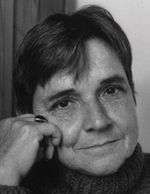
  • The poet Adrienne Rich died yesterday at the age of 82. We ran this post in 2007 for Jewish Book Month, looking at her poetry through the lens of her Jewish identity. The author is Stephen Burt, Professor of English at Harvard University and the author of Close Calls With Nonsense: Reading New Poetry (Graywolf). We republish it today in memory of Rich and her transformative, challenging, and courageous body of work. 

    RICHADRIENNE_198
    Photo by Robert Giard

    You can find Adrienne Rich in anthologies of Jewish American poetry, but most of her many admirers do not think of her first (if at all) as a Jewish poet: they think of her as a feminist poet, as a political poet, as a GLBT activist, as a talented artificer in traditional metrical forms (during the 1950s) as a maker of  harshly original free verse (during the 1960s), as a woman who challenged herself to overcome "the fact of being separate" (as she put it in the early 1970s) in order to speak to and about other people's needs. Though Rich's father was Jewish (as was her late husband), she did not identify herself with any religion for most of her writing life: in high school, she recalled, "I am quite sure I was seen as Jewish (with a reassuringly gentile mother) in that double vision that bigotry allows." Her ambitious, assimilationist father, however, "did not give me the choice to be a Jew."

    Rich's 1982 essay "Split at the Root," from which those sentences come, describes her long-delayed decision to call herself Jewish in print. If you read Rich's poem "Jerusalem" (1966) you will see her view religious heritage as an excuse for violence and a trap: "What I dream of the city," she writes, "is how hard it is to leave." An even earlier poem, "At the Jewish New Year," insisted on Rosh Hashanah that "this day is merely one/ Of thirty in September," and that "whatever we strain to forget/ Our memory must be long": "we" here means not Jews but assimilated Jews, Jews who want to distance themselves (but cannot distance themselves enough) from their shared religious past. [Ed's note: The New Yorker has unlocked this poem in their archives.]

    Rich's later poems, by contrast, show her reclaiming Judaism as something to which she says she might want to belong. These poems often address the Baltimore family in which she grew up. "Grandmothers" (1980), for example, pays belated tribute to Hattie Rice Rich, the poet's father's mother, whose "sweetness of soul was a mystery to me," but in Rich's youth "a convenience for everyone": "you rose with the birds and children, boiled your own egg," "took the street-car downtown shopping/ endlessly for your son's whims, the whims of genius," and "All through World War Two the forbidden word/ Jewish was barely uttered in your son's house."

    Rich is a poet of confrontation, one whose imagination flares at shows of defiant strength, and in this poem she can defy her Jewish father by acknowledging, as he did not want to acknowledge, the hard and quiet work done by her grandmother in bringing him up, work that Arnold Rich (in his daughter's telling) overlooked.  Rich has two grandmothers, but "Grandmothers" has three parts: one part for her maternal grandmother, who "married straight out of the convent school," one part for Hattie Rice Rich, Arnold's mother, and one part for Adrienne herself, entitled "Granddaughter," in which she describes herself as "born a white woman, Jewish or of curious mind," and newly interested in "'blood,' the all-powerful awful theme."

    By "blood" Rich means, here, not the shedding of blood (as she did in "Jerusalem") but the lines of descent, the passing down of habits and beliefs (accompanied, in this instance, by passed-down genes), which enable Rich, the daughter of a Jew and a non-Jew, to call herself Jewish, and to explore, in middle age, the aspects of Judaism that said the most to her. And that is what she did in the book she wrote after finishing "Grandmothers," the book she would call Your Native Land, Your Life.  That book includes Rich's most accomplished poem on a Jewish theme, "Yom Kippur 1984," named for the day of fasting, self-examination and repentance that occurs near, but not at, the start of each Jewish year.

    "Yom Kippur, 1984" explores the twinned Jewish obligations—especially relevant on Yom Kippur— to consider one's own life, to reflect on one's actions inwardly, as an individual, and the obligation—for observant Jews, a matter of Jewish law; for Rich, perhaps, a matter of ethics—to be with other Jews at certain times (Jewish law requires a minyan, at least ten Jews praying together, before certain prayers can be said). "Yom Kippur, 1984" begins:

    What is a Jew in solitude?
    What would it mean not to feel lonely or afraid
    far from your own or those you have called your own?
    What is a woman in solitude: a queer woman or man?
    In the empty street, on the empty beach, in the desert
    what in this world as it is can solitude mean?

    [Read the full poem at the Poetry Foundation website.]

    Rich sees Jewish affiliation, the decision to call oneself a Jew, as one example among many of protective solidarity: "the Jew on the icy, rutted road on Christmas Eve prays for another Jew/ the woman in the ungainly twisting shadows of the street: Make those be/ a woman's footsteps; as if she could believe in a woman's god."  She then admits, vexing herself, that "I also love separateness." Like almost all poets, she needs some time alone, unhindered by what other people expect her to say, whether in a synagogue or at a dinner table. Can she identify herself with a group—with Jews, for example—and still preserve the solitude, the distance from expectations, which all poets need?  The poem ends not by answering but by repeating the question, and asking what it would mean in a just world, a world in which we no longer wanted group identifications—religions, nations, labels of many kinds—for mutual protection, and could no longer use them to keep other people away.

    9780393310825_198Not coincidentally Rich uses very long, end-stopped lines for this poem: she has said that she associates these lines not just with the poetry of the Hebrew Bible but with Walt Whitman, that great poet of connections among Americans, and with Robinson Jeffers, the Californian poet of American misanthropy and solitude. Neither Whitman nor Jeffers were Jewish, but Rich, here, says that she is: she takes a Jewish occasion to reconsider the choices she has made—about where to live, how to spend her time and energy, how to write—and in doing so identifies her own poetic practice with a kind of ethically oriented self-examination we might think of as Jewish too.  On Yom Kippur Jews are asked to consider the previous year as a series of acts and decisions taken or declined; the Kol Nidre prayer, in which we ask divine forgiveness for obligations that we could not have carried out, is part of the service, but so too is the reminder that if we owe something to another human being, we must fulfill our obligation to that human being, not to a divine substitute.

    Rich has used her Jewish material here to think both about family and about herself alone, to think both about solitude and about obligation. She will choose solitary reflection over participation in rituals and social occasions that seem to her false or oppressive (that's one reason she famously refused to accept the National Medal for the Arts). And yet her temperament has always drawn her also to shared tasks, to the ways in which people can work together to improve their lot. That is the Jewish mitzvah of tikkun olam, often and rightly invoked as a religious justification for political activism, and it is one of the ways that Rich, "split at the root" and alert to her contradictions, finds herself, still, writing Jewish books.

  • Want to read something longer than a tweet but shorter than book? Here are today's recommendations from Beacon Press. (And of course you can always browse our Scribd page, where we post sizeable excerpts from our books. Check out our spring releases here.)

    Danielle Ofri, in the New York Times, looks at how emotions can interfere with honest communications between doctor and patient:

    By now, even the most hard-core, old-school doctors recognize that emotions are present in medicine at every level, but the consideration of them rarely makes it into medical school curriculums, let alone professional charters. Typically, feelings are lumped into the catch-all of stress or fatigue, with the unspoken assumption that with enough gumption these irritants can be corralled.

    The emotional layers in medicine, however, are far more pervasive. Emotions have been described by the neuroscientist Antonio Damasio as the “continuous musical line of our minds, the unstoppable humming …” This basso continuo thrums along, modulating doctors’ actions and perceptions, while we make a steady stream of conscious medical decisions that have direct consequences for our patients. Emotions can overshadow clinical algorithms, quality control measures, even medical experience. We may never fully master them, but we must at least be conscious of them and of how they can sometimes dominate the symphony of our actions. (Read more)

    In the American Prospect, E. J. Graff examines her own emotional response to the murder of Trayvon Martin:

    Why, with someone dead, with the evidence of Zimmerman’s past vigilantism and domestic violence charges and arrests and anger management courses, with those horrifying 911 tapes, and all the rest, why is the man still walking around free? 

    Look, Zimmerman may not be guilty of murder. He might indeed have shot his gun in self-defense. It’s horrifying that he’s being tried in the media. So let him be charged and tried in a court of law, with both sides’ evidence marshaled and presented for twelve people to review. Why isn’t that being done?

    More personally, I’ve been puzzling over why I can’t get over Martin’s death. Two weeks after I first heard the story, I am still looking at pictures of that child’s face, ready to burst out crying. I see black kids walking up our street or shooting basketballs on the playground, and want to run over and protect them. (Don’t worry, I know how they’d react to the crazy white lady barreling at them—I do have some restraint.) My own little guy has been subjected to many more hugs and kisses than usual, which can make an eight-year-old very impatient. And despite deadlines, I’ve been taking afternoon breaks to build three-story Lego extravaganzas with him. (Read more)

    On Guernica, Aimee Phan recounts her foreclosure story, and why she may not ever own a house again. 

    After receiving numerous mailings touting the benefits of HAMP, we visited the local HUD agency armed with the required pile of paperwork: copies of our last three years of income tax returns, paystubs, bank statements and utility bills, cautiously optimistic at the possibility of financial relief. After looking at the condo’s devaluation and our monthly expenses, the HUD officer seemed confident that we could lower our principal balance, and negotiate a more reasonable monthly rate. We would no longer have to worry about our ticking time bomb adjustable mortgage rate.

    Instead, Bank of America rejected our remodification request, since we were current on our payments. Due to our combined incomes, they believed we could technically continue to make our monthly payments—and even afford to pay more. Of course they didn’t consider our deflated home value or the fact that we had another dependent, and had to eat. (Read more)


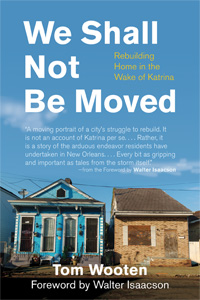
  • Tom Wooten is the author of We Shall Not Be Moved: Rebuilding Home in the Wake of Katrina, forthcoming this summer from Beacon Press.Since graduating from Harvard in 2008 and moving to New Orleans, he has worked as a researcher at Harvard's Kennedy School, as a neighborhood volunteer coordinator, and as a fifth- and sixth-grade writing teacher.

    WeshallnotbemovedNathaniel Rich’s recent New York Times Magazine article about urban abandonment in the Lower Ninth Ward is called “Jungleland.” Fascinated by the process of “nature reclaiming civilization,” Rich describes a dystopian city neighborhood: alligators drink from leaking fire hydrants; shadowy figures emerge from derelict houses to rob and rape honest residents; everywhere, lush green vines envelop blocks that were once densely populated. There is truth to Rich’s Joseph-Conrad-meets-David-Simon portrayal, but it isn’t the whole story.

    Life is being restored to significant portions of the Lower Ninth Ward, and the heroes of this effort are fiercely determined residents who have returned to their blocks and rebuilt their homes. Approximately a quarter of the Lower Ninth Ward’s 20,000 pre-storm residents are back, mostly concentrated in the southern half of the neighborhood on higher ground close to the Mississippi. Shortly after the storm, residents collaborated to reopen the K-8 Martin Luther King Charter School, one of the rare community success stories in an education system increasingly dominated by outsider-run schools. A grocery store is set to begin construction soon on St. Claude Avenue. Considering the unique set of challenges residents faced after the flooding of Katrina and Rita, their progress to date is noteworthy.

    What obstacles have the 5,500 residents who have returned to the Lower Ninth Ward overcome? Because of a particularly severe levee breach, their neighborhood experienced the most concentrated physical destruction in New Orleans. Not only did they have to work harder and spend more to rebuild than other residents, but they also had to overcome a unique stigma. Although the Lower Ninth Ward was no more vulnerable to flooding than dozens of other low-lying neighborhoods, Americans incorrectly inferred that the area was particularly at risk, and a national debate ensued about the merits of rebuilding there. The neighborhood remained sealed off months after the rest of the city reopened, straining displaced residents’ finances and forcing many into permanent exile. Owing to controversy over the Lower Ninth Ward’s fate, utility providers were slow to restore service to hundreds of blocks in the neighborhood, forcing some families to wait for years to return and prompting others to give up and settle elsewhere. The federally funded and state-administered Road Home program awarded rebuilding grants based on pre-storm property values, a policy that yielded higher payouts for residents of wealthy neighborhoods and put black working class areas like the Lower Ninth Ward at a distinct disadvantage.

    In light of these challenges, restoring life in the Lower Ninth Ward has been a collective undertaking by necessity. As occurred in other New Orleans neighborhoods, a remarkable coalition of residents rose up to help their neighbors come home. Patricia Jones founded The Neighborhood Empowerment Network Association in 2006, providing financial coaching, free architectural services, and volunteer labor to hundreds of returning Lower Ninth Ward families. After years of pre-storm work with the Holy Cross Neighborhood Association, the late great Pam Dashiell teamed up with dozens of other residents to found the Center for Sustainable Engagement and Development (CSED). Mack Mclendon had the courage and vision to convert his newly purchased Lamanche Street warehouse into a multi-purpose community center, with the long-term goal of converting the space into a hub for neighborhood youth.

    These community-based efforts are driving the Lower Ninth Ward’s recovery, and not only because of the direct services they provide. For one thing, they have created the social infrastructure needed for outsider-led groups to effectively do work in the neighborhood. Common Ground partnered closely with each of the above groups to provide them with volunteer labor. Brad Pitt’s meetings with CSED resident leaders helped to seal his Make It Right foundation’s commitment to the Lower Ninth Ward, and informed its focus on building physically resilient and energy efficient houses. More importantly, resident-led recovery efforts in the Lower Ninth Ward have given returning families confidence that they are not alone. There is a community meeting every Thursday night at the Greater Little Zion Baptist Church, and the optimism at each meeting is palpable. Every week, families who have just moved home are asked to ring the church bell to announce their return.

    Unfortunately, the Lower Ninth Ward’s tremendous grassroots recovery efforts have not been enough to bring the neighborhood back, which explains the tableaus of abandonment that Rich explores in his article. The Lower Ninth Ward’s plight results from a failure of national will, and it fits into a broader pattern of divestment from American cities. Detroit, St. Louis, and other Rust Belt cities have been gutted from the inside out, and cities as diverse as Trenton and Colorado Springs have eliminated essential city services as a result of federal cutbacks. It doesn’t help when commentators contend that such urban decline is the inevitable result of market forces, or that struggling American cities have simply become obsolete. Similarly insidious is an emerging brand of post-apocalyptic voyeurism that revels in the decay of American infrastructure. The tour buses that rumble through the Lower Ninth Ward without stopping are prime offenders on this front; the winning Sundance film and a forthcoming documentary about scavenging scrap metal in Detroit seem poised to lead viewers into a similar trap.

    So what should our orientation be to struggling urban environments? Without much prompting, Americans felt a profound sense of collective responsibility about rebuilding the World Trade Center site in Manhattan. We should apply the same sense of resolve and moral clarity to other sites. Cities are national treasures. They are centers of tremendous commerce and creativity; they are cultural and religious melting pots; they are humane refuges where Americans can live comfortably without cars. Like interstate highways and public universities, they serve a profound collective good, and they are worth maintaining even if their most direct beneficiaries cannot always foot the entire bill.

    The Lower Ninth Ward is now internationally famous, often standing symbolically for the destruction wrought along hundreds of miles of the American Gulf Coast. With enough genuine will at the city, state, and federal levels, Lower Ninth Ward residents can transform their neighborhood from a symbol of abandonment into a symbol of hope.  

  • Kaitlin Bell Barnett is the author of Dosed: The Medication Generation Grows Up. She is a freelance writer whose articles have appeared in numerous national and regional outlets, including the Boston Globe, New York Observer, Parents, and Prevention. This piece originally appeared at Huffington Post. 

    DosedJournalists love declaring that psychiatric medications symbolize some slice of the zeitgeist. So I can't say I was entirely surprised when I opened my mailbox the other day and saw New York magazine's cover article proclaiming that "If the 90s were the decade of Prozac, all hollow-eyed and depressed, then this is the era of Xanax, all jumpy and edgy and short of breath."

    Translation: Depression is out, anxiety is in, antidepressants are passé (Statistics showing continued robust usage be damned), and anti-anxiety benzodiazepines, around since the 60s, are trendy again, the perfect no-commitment chill pills for a nation of "panicked strivers" contending with a new age of anxiety but without time or inclination to commit to actually changing their lives or going to therapy.

    How convenient, I thought. My psychiatric problems — and corresponding psychopharmaceuticals — match up with the trends! First I was depressed and angsty and got Prozac, then I got anxious and got benzos! Of course, I happen to be getting depressed again lately, but one can't be completely on-trend all the time.

    In fact, if you didn't know me better, you might well mistake me for one of the "functionally anxious" types who dominate journalist Lisa Miller's New York story, rather than the sort of person she quickly shuffles off into another category altogether — the people with an actual, you know, anxiety disorder.

    The people without anxiety disorders who do populate the New York piece are the sort most of us love to hate, but also can't resist reading about in these sorts of articles: Manhattanite professionals who in the Annie Hall era would have been called "neurotic" but who now like to describe themselves as "super stressed," like it's a badge of honor.

    According to the article, they're turning more often these days to drugs like Xanax or Ativan when anxiety from their legitimately high-pressure lives gets to be too much. Prescriptions of these drugs, collectively referred to as benzodiazepines, are up 17 percent since 2006. The article does not mention that prescriptions for other psychiatric medications have increased, too — antidepressant use in adults grew nearly 30 percent between 2001 and 2010 at Medco, one of the nation's largest pharmacy systems, and atypical antipsychotic usage grew a staggering 350 percent. Writing the New York article with a different thesis in mind, one could contend that we're all demoralized over the stalled economic recovery and turning to antidepressants — or that we're frustrated and adding antipsychotics to our antidepressant regimens to give them a boost.

    But back to benzos and anxiety.

    The article makes it sound as though it's terribly easy to distinguish between the ordinary, high-functioning people who turn to benzos every so often when the stress of their lives overwhelms them and the people with diagnosed anxiety disorders. In fact, it can be quite complicated — and that's why psychiatrists are fighting so bitterly over the definitions of the various disorders to be included in the DSM-5, the profession's diagnostic manual, which is under revision and due out in May 2013.

    Doctors are curiously absent from the New York piece, though they are, of course, the ones responsible for actually doling out the prescriptions for benzos and all other drugs. They are quite rightly very concerned about how to determine which anxiety is pathological and overwhelming and warrants such a drug, and which kind might be better dealt with through other means.

    This is a subject that has been troubling the medical profession for decades, In the 70s and 80s, benzodiazepine misuse became enough of a public health problem to prompt doctors to cut down on prescribing — and publish a lot of anguished articles on the subject in medical journals. Some of the increase in use the New York article discusses may even reflect a return in doctor's attitudes to more comfort prescribing the drugs after years of shying away from them. (Recent articles in trade publications have made a case for their judicious use.)

    All this difficulty distinguishing the casual users from the truly stricken lies in the nature of the conditions for which benzos are typically prescribed. Although sometimes given in high doses as sedatives to seriously agitated patients in psychiatric hospital settings, they are more commonly given to people whose anxiety is self-described and not necessarily readily observable to the doctor. This is true even when we are talking about anxiety of the sort that impairs people's day-to-day functioning, as opposed to the kind Miller focuses on in her New York article, which we might call the "just as easily dispatched with a glass of wine variety."

    Anxiety is a funny thing, because although it seems the most all-consuming and obvious thing in the world when you are experiencing it, in fact it's actually quite difficult to detect. When I've been at my most anxious, I suspect that I've struck my psychiatrists and therapists as, at most, a bit agitated. Perhaps they've noticed some circles under my eyes, or that I look a little thin. Conceivably, I would talk a little faster than usual, or my eyes would dart around the room. But they have told me that, frankly, I don't seem all that different. I put on a good façade of normality.

    In contrast, here is what I do experience: When I arrive at the psychiatrist for a "med check," I won't have slept a solid eight hours in weeks. I will have awoken early every morning with a jolt, my heart racing at some threat I can't place. It will continue that way all day until I go to bed. My stomach will churn and the room will spin and I'll be unable to eat. My thoughts will race from one unarticulated worry to another. I will feel desperate for companionship yet unable to listen or focus on conversation. I will feel constantly on the verge of tears. But I would have to tell my doctor all of this. She is not likely to go offering me a benzodiazepine prescription on the basis of some dark circles and a little hurried speech.

    Once procured, such a prescription usually works magic, however. During the three periods of sustained anxiety I've suffered, I have taken a small dose of Klonopin, a long-lasting benzo, every few hours, as a way of keeping a steady level in my system. I've also taken it many other times when I've felt my anxiety flare on isolated occasions.

    Despite the drug's effectiveness — or perhaps because of it — I never feel good about taking it. When my anxiety is pervasive, I need to constantly watch for a resurgence of panic. This makes me feel dependent, like a drug addict eyeing the clock for my next hit. When my anxiety returns in isolated episodes, I wonder if I'm simply the equivalent of the functionally anxious people in the New York article — someone who happens to have a Klonopin prescription but who really doesn't need to be taking it and could just as well go to a yoga class. I tend to feel guilty about it until I get the telltale early morning waking — and then I start to worry that I'm entering another terrible extended anxious phase.

    The other reason articles like the one in New York make me cringe is that benzos, being controlled substances, already carry the taint of misuse, and talk of overworked PR execs popping pills to deal with anxiety over a work presentation or helicopter moms doing so to handle separation anxiety from their preschoolers is likely to make doctors, already cagey about prescribing, even more so.

    Even for those of us with an anxiety disorder diagnosis and a history of benzo prescriptions, there's already an awkward dance involved in procuring a refill. Since benzos are controlled substances, doctors can't call in prescriptions (and may not have emergency appointments available go hand over the precious slip of paper). Anxiety, however, has a tendency to spiral — and quickly. Many people find it useful, therefore, to have a bottle around in case of an emergency. But that means requesting a refill when you are not, technically, quaking under the covers in a fetal position.

    Some doctors are sensitive enough to realize this, but, wanting to avoid tolerance and misuse, the responsible ones generally don't go around offering up refills out of the blue. For many people, especially young people in their 20s and 30s, who happen to be the group most likely to abuse psychotherapeutic prescription drugs according to federal government statistics, this makes asking for refills a delicate and awkward affair. I'm sure that my requests, for example, are accompanied by far too much justifying. One young woman I interviewed for my book on the topic of growing up on psychiatric medication suffered from debilitating anxiety and was so terrified of being judged an addict (She had a family history of alcohol abuse) that she refused to ask for benzo refills at all. This, even though it was patently obvious from the most casual encounter with her that some benzos would have done her good.

    After my last psychiatrist's appointment, during which my doctor upped the dosage of my antidepressant to deal with a creeping recurrence of my depression, she ended the appointment by asking what I was doing for the rest of the day. I told her I was working on a column responding to the apparent news that benzodiazepines were the hot new drugs. She rolled her eyes as though this were the height of ridiculousness. "Benzodiazepines are the hot new drugs? Since when?" She did not ask if I would like a refill on my Klonopin.

  • Judge Nancy Gertner (In Defense of Women) explains why Massachusetts doesn't need a three-strikes law:

    So the notion of using a thermo-nuclear or a three strikes bill for the purpose of targeting the one or two people, who are slipping through the cracks, makes no sense and it’s not costless. I’m not just talking about the cost in terms of money. It’s not costless to send people away for a long time, they get out at some point and then we are dealing with, you know, the rubble of their lives… Massachusetts now has a geriatric prison wing, for people who have been 40 and 50 years. It’s not costless to over generalize in the way these bills do. (Radio Boston)

    The Melissa Harris-Perry Show on MSNBC spoke with Jonathan Metzl (The Protest Psychosis) along with Nicole Bell, Adam Serwer and Ron Allen about the Trayvon Martin murder.  

    Why do more young adults live at home with their parents? 

    A new solution for making ebooks and poetry play nice. 

    Beacon Press has two nominees for this year's Lambda Literary Awards. Wouldn't it figure in the same category (LGBT nonfiction)? God vs. Gay by Jay Michaelson and A Queer History of the United States by Michael Bronski. Very proud to see both of them there!

    Quote of the day: "As a historian, you can almost say the birth of heterosexuality is one of the weirder pieces of fallout that comes from the French Revolution." Hanne Blank interviewed in the Toronto Star. 

    Trend piece of the day: "Many employees abandon sitting while working" at the Boston Globe. I type this post while standing at workstation, a change in work habits that has much improved my well-being. Are you standing or sitting at work?

  • Today's post is an interview with Sam Skolnik, author of High Stakes: The Rising Cost of America's Gambling Addiction. Skolnik began his journalism career as a news aide and freelance writer for the Washington Post. He went on to report for the Legal Times, Seattle Post-Intelligencer, and Las Vegas Sun. He's won several national journalism awards and was selected to be a Knight-Wallace journalism fellow for 2007-08.

    Skolnik spoke with Jessie Bennett, the editor of Beacon Broadside, via Skype earlier this week.

    HighstakesThe New York Times Magazine cover story last weekend was about the financial problems faced by Foxwoods casino. I grew up in Southeastern Connecticut, where the Foxwood and Mohegan Sun casinos were seen as economic saviors for the region. But what are the hidden costs of gambling for regions that choose to embrace it?

    In fairness to that story, it did raise some interesting points. I don't think that it had been widely known that Foxwoods was in trouble to the degree that it clearly is. And the article also raises points that are worth making, even for those like myself who are clearly skeptical about the long-term impact of gambling, about the fact that Connecticut has benefited from the jobs that have come into the state as well as from tax revenues. 

    That said, there are always costs when gambling comes into a jurisdiction, and that is no different in Connecticut than it is anywhere else. New gamblers are created–this is always the case, even in the saturated market that we're in now. A new subset of gamblers are created: those who had never before gambled regularly, but because the casino or new gambling outlet is close to where they live or work, they start gambling. And what happens with those folks is, inevitably and as a result, there's another small subset of those folks who develop addiction problems. Independent studies have shown this to be the case time and time again. And so what happens when these folks become addicted is that it injures lives. Not just the lives of the gamblers, but the lives of their families, of their colleagues, of whole communities.

    On a more concrete level, social costs related to gambling inevitably rise as a result of these new problem or pathological gamblers. You're right to label these as sort of "hidden costs" because, unlike other sorts of addictions, it can be tougher to determine if someone close to you has a gambling problem. The social costs range from indebtedness, home foreclosures, and bankruptcies, to crimes connected with  pathological gambling such as embezzlement and robberies, all the way to domestic types of crimes. And in the worst cases, these social costs include suicides.

    Not so much in Southeastern Connecticut, but in other, more "mature" gambling markets like Atlantic City and Reno and especially Las Vegas, studies have shown that there is a direct connection between these rising social costs connected to pathological gambling and the advent of legalized gambling. Studies have shown that suicide rates are higher in Atlantic City, Reno, and Las Vegas than in anywhere else in the country, and the only conclusion that can reasonably be reached is that there is a direct connection between that and the advent of gambling.

    Anecdotally, very soon after Foxwoods and Mohegan Sun opened up near my hometown—I was working there as a bank teller at the time—the murmuring about problems began. "This one gambled away the life savings… they're getting a divorce because he lost the family business at the casino." These are huge personal costs and they seemed to pop up very quickly. But, long-term, it continues to be a problem—these stories haven't stopped.

    You raise a good point, because the stories that come from individual gamblers and those who are related to them are devastating. I think that the industry and their political supporters like to say, "When you talk about individual anecdotes, it doesn't represent a scientific trend." Well, first off, if you add enough of them together—as represented by an increase in the number of Gamblers Anonymous chapters—it does represent a trend. But if you look on an individual level, what happens is these problem gamblers and the problems that they create affect whole communities. All you have to do to see it is to sit in on a GA meeting—and by the way, there are more of them than ever, all around the country.

    In a recent ten-year period, there was a fifty percent rise in the number of GA chapters around the country. This coincides with an explosion in the amount of legalized gambling, spearheaded by the casino industry, both commercial and Indian casinos like Foxwoods. It would take a huge state of denial to not see that these two trends are directly related.

    The Times article examines the fact that Foxwoods has serious financial troubles to the tune of $2.3 billion in debt. Mohegan Sun just restructured their own one billion plus dollars of debt. There is increasing competition from neighboring states, states from which they have been importing many of their dedicated visitors. Do you think we're seeing a beginning of a move away from these huge destination casinos and towards a more localized style of gambling?

    With the exception of Las Vegas, most gambling around the country already takes place in local gambling rather than destination casinos. The majority of gamblers almost everywhere in the country with the exception of the Las Vegas Strip are "localized" gamblers.

    But, looking at Foxwoods… it was one of the first Indian casinos in the Northeast, and what happened since it opened was that, especially in the last five years, other jurisdictions have come to the conclusion that this is an easy and–they say–relatively painless way to raise revenues. Of course, it's not painless. But what this has done from a strictly economic standpoint is that states around the region have been trying to copy what Connecticut has done by signing new compacts for new Indian casinos. And what they've also done is to allow for commercial casino growth. Massachusetts, Rhode Island, Maine, New York State… almost every state in the Northeast has recently considered or has on the table new commercial casinos, stand-alone slot parlors, or "racinos." Race tracks have seen their revenues decline, so what they've been trying to do is add slot parlors inside the race tracks in order to compete.

    So this might be one of the first signs that we're coming to—around the Northeast and around the country—a saturation point. There is a clear limit as to how much these new revenue streams are going to earn money in the ways that their state overlords think works for them. This isn't unprecedented. If you look back to starting before the signing of the Declaration of Independence, there have been about three big waves of gambling in the United States. From complete acceptance, proliferation, and even inundation throughout the country of various forms of gambling to almost complete prohibition.

    As the author of High Stakes, it was never my ambition to advocate for one side or the other. I certainly don't believe in full-scale prohibition. I don't think it's possible, I don't think it's realistic and, as a gambler, I don't want that to go into effect. But I do think that the negatives are starting to increase at a significant rate, as well as the economic downsides of the inundation of gambling around the country. We might be peaking on this third wave, which started about forty or fifty years ago with the modern state lotteries, which started in New England, and with Nevada legalizing casinos.

    The Northeast is the busiest microcosm of this inundation. It very well might be that over the next ten or fifteen years, especially if the economy gets healthier, we'll see fewer and fewer proposals for more legalized gambling. And we'll see more folks seeing the impact of gambling on loved ones and colleagues and their neighbors.

    The economic arguments for casinos is that they'll employ people. But now internet gambling is becoming a big issue, as states debate whether or not to legalize it. But there are real risks involved with legalizing online poker but without the big jobs payoff.

    Online poker and online gambling were semi-legal or quasi-illegal up until about six months ago. Congress never fully outlawed it, but there were portions of the financial end of things that could be considered illegal. Over the last decade, while millions of Americans were playing, there were these companies which were based off-shore, that were earning their money mostly off of Americans.

    About six or eight months ago, what the poker world calls "Black Friday," the Justice Department shut down three of the biggest poker sites. But recently, the Justice Department appeared to open the door for the states to legalize online gambling and online poker in their jurisdictions. While states have proposals on the table to open bricks-and-mortar casinos, many of them also have proposals to legalize online gambling.

    Now, if local casinos are "convenience gambling," online poker is the most convenient form of gambling there is. You could do it any time of day or night. While some of these companies have safeguards to prevent underage or pathological gambling, there are arguments that these safeguards are patently ineffective.

    Studies have shown that electronic gambling—slot machines and online gambling—are the most inherently addictive forms of gambling. This is because of the speed of these games and the convenience of them, and it's also because electronic gambling draws those who are predisposed to problem gambling: older folks and young adults. Younger gamblers, who are drawn to online poker, have been shown to have fewer inhibitions. And seniors, when you look at slot machines, which are the primary economic driver inside the bricks and mortar casinos, seniors are the ones playing these games. And seniors have been shown to have the same lack of inhibition when it comes to developing gambling addictions at a faster rate.

    These games are unfortunately hitting some of the most vulnerable people in our society.

    New York's Governor Andrew Cuomo was quoted in the Times article as saying, “In a perfect world, there would be no casinos… We have 29,000 gambling machines in this state, more than Atlantic City… You have gaming! You’re just in denial of the reality.” Do you think this is a logical argument, that people are gambling anyway, so you might as well benefit from it?

    I think it's an unfair argument, and I think it's a false argument. And I've heard it time and again, from many proponents, including former Pennsylvania governor Ed Rendell. "Gosh, we're not creating new gamblers, we're just saving folks some gas money and keeping them at home in our state." Sure, there are some people who are already gambling who will shift their allegiances to a home-state casino. There is some credence to the argument, but the politics of casino expansion is that the gambling industry and the politicians they get on their side tend to ignore the downsides regarding the inevitable creation of new gamblers.

    Many of these politicians should know better. Governor Cuomo's father, the former governor Mario Cuomo, even in times of economic hardship, felt that legalized gambling and casinos were clearly not the answer because of the social costs, because of the rising addiction rates, because of the fundamental changes in communities. Andrew Cuomo has come to what is a more expedient answer, but it is an answer that, in the long term, is going to do much more damage to that state.

  • Tanya Erzen is an Associate Professor of religion and American studies at Ohio State University. She is the author of the forthcoming book, Fanpire: The Twilight Saga and the Women Who Love It.

    TwilightEdward Cullen is a twenty-something ruthless CEO who meets Bella when she interviews him for her college newspaper. They experience a magnetic attraction, but he harbors a nasty secret: the only way he can have a relationship with her is if she agrees to sign a written contract agreeing to be his submissive. Edward expects a recalcitrant Bella to engage in whippings, handcuffing, and other bondage games. At one point, when Bella asks, “Does this mean you’re going to make love to me tonight, Edward?” his response is, “No Isabella, it doesn’t. Firstly, I don’t make love. I f$#k . . . hard. … Come. I want to show you my playroom.”

    This delightfully predictable (at least in the world of porn) exchange is to be found not in he famously abstinent pages of the Twilight saga, but in “Master of the Universe,” formerly the most-read Twilight fan fiction story online, and now, in its new incarnation as Shades of Grey, a novel about to receive a 750,000 first print run from Vintage. MofU, as it was known to the fanpire cognoscenti, was written in giddily awaited installments by Snowqueens Icedragon or “Mistress Icy.” “MofU is my own special brand of heroin, an addiction I will have to go into rehab for,” one of the thousands of devoted readers raved. Now, in the first installment of the Fifty Shades trilogy (Fifty Shades of Grey, Fifty Shades Darker and Fifty Shades Freed), Edward and Bella have morphed into Christian Grey and Anastasia Steele (copyright!) and Mistress Icy is using her pen name, E.L. James. 

    MofU was the gritty anecdote to Twilight’s relentless abstinence, part of the vast fan fic parallel universe where the most popular stories are what writers informally call “smut.” It's a genre that re-envisions the relationships in Twilight as sexually explicit and often raunchy. From “clean smut” to “hardcore,” instead of meadows and dazzling vampires, there is promiscuity, sexual abuse, incest, bondage, and sex addiction. In “The Training,” Bella “lives to serve her Master…” In "Never Sleep in a Strange Man’s Bed," Bella is awakened by a stranger named Edward who climbs into bed with her: “She was rubbing her firm little ass against me and moaning! Holy hell and all the devils in it!” In The List, a sexually frustrated Bella catalogues all the ways she’d like to have sex with Edward once they’re married. “To Do: Against the tree in the meadow, on our lab table, on his leather couch . . .” You get the idea.

    The pleasure of reading the Twilight series for millions of fans resides in the books’ titillating fantasy of sexual postponement. Readers endure thousands of pages of erotic tension with Edward and Bella panting at each other with quivering lips and interrupted kisses. Even when they do have sex in Breaking Dawn, the final novel, Twilight fans only get a blank space between when Edward and Bella go to bed on their honeymoon and wake up to drifting feathers, a shattered headboard and her black-and-blue body.  

    The stories that crowd the top-ten lists of fan fiction like MofU provide plenty of salacious sex but stick to a romantic premise. No matter if Edward is a dominant in a bondage relationship, a “smooth-talking motherfucker” who likes to pick up girls in bars for casual sex, or a commitment-averse architect who has never had a long-term relationship: Bella and Edward are soul mates, destined to be together forever. The insatiable demand for books like “Fifty Shades” speaks to the power of the fantasy of true love and the redemption of the damaged hero awakened by the love of the right woman who is either sexually innocent or virginal. Like Twilight, “Fifty Shades” delivers on the romance novel fantasy that a relationship initially based solely on sex will turn into blissful marriage. Anastasia’s virginity ensnares and entrances sexually voracious Christian Grey until he realizes that his feelings for her are emotional rather than just sexual, and his treatment of her becomes kind, solicitous, and caring.

    The fairy-tale success story of James is also seductive for fans, especially the hundreds of hopeful fanfic writers who long to be the next Stephenie Meyer, whose first attempt at a novel was Twilight. Or, they could be the next Amanda Hocking, whose self-published vampire romance novels, My Blood Approves, landed her the million dollar book deal with St. Martin’s Press. And this takes us back to the real romance, to our contemporary narrative of hope and longing: that in our age of mundane and ubiquitous celebrity, the story you’ve written online could catapult you from obscurity to celebrated writer. And a seven figure advance.

    Photo: Book page in a heart necklace by PrettyLittleCharmsUK on Etsy.