• 0136Nearly 50 million kids play organized sports each year, and each of them has a supportive family that digs deep into its pockets to pay for the essentials-uniforms, equipment, league fees, travel to away games. But the buck doesn't stop there. With private lessons, elite sports camps, corporate-sponsored tournaments, and all the hotel expenses and tourist traps that come with them, youth sports is more than just a fun pastime. It's an incredibly profitable market, and it's become crowded with companies and individuals eager to reap the rewards.

    Building on his eye-opening investigation into the damaging effects of the ultra-competitive culture of youth sports in his first book, Until It Hurts, sports dad and journalist Mark Hyman takes us behind the scenes for a startling look at the business of youth sports, how it has changed, and how it is affecting young Americans. Examining the youth sports economy from many sides-the major corporations, small entrepreneurs, coaches, parents, and, of course, kids-Hyman probes the reasons for rapid changes in what gets bought and sold in this lucrative marketplace. He takes us to tournaments sponsored by Nike, Gatorade, and other big businesses. He talks to parents who sacrifice their vacations and savings to get their (sometimes reluctant) junior stars to these far-off, expensive venues for a chance to shine. And he introduces us to videos purporting to teach six-month-old babies to kick a ball, to professional athletes who will "coach" an eight-year-old for a hefty fee, to a town that has literally staked its future on preteen sports. However, the story isn't all big business and bad guys. Hyman also turns the spotlight on individuals cashing in on the youth sports market, but whose goods actually provide (at least) some benefits to kids.

    Through extensive interviews and original reporting, The Most Expensive Game in Town looks beyond the high-energy ad campaigns, the supposedly performance-enhancing sneakers, and the cute baby-sized jerseys to explain the causes and effects of the commercialization of youth sports-and to reveal how these changes are distorting and diminishing family life. The proof is in the price tag. Happily, Hyman unearths promising examples of individuals and communities bucking this destructive trend and using youth sports to uplift and enrich kids' lives, rather than to fill their own pockets.

    Read the introduction on Scribd. 

  • Today's post is from William Ayers, formerly Distinguished Professor of Education and Senior University Scholar at the University of Illinois at Chicago (UIC), and founder of both the Small Schools Workshop and the Center for Youth and Society. His is the author of several books, including Teaching Toward Freedom: Moral Commitment and Ethical Action in the Classroom and A Kind and Just Parent: The Children of Juvenile Court. This post originally appeared as the introduction to the Bankstreet College of Education's Occasional Papers Issue 27. 

    Bigstock_Multiple_Choice_Test_1998911

    Multiple Choice Question: A typical American classroom has as much to offer an inquiring mind as does:

    A) a vacant lot
    B) a country road
    C) a street corner
    D) the city dump
    E) the custodian’s closet
    F) none of the above

    Analogy Test: High-stakes, standardized testing is to learning as:

    A) memorizing a flight manual is to flying
    B) watching an episode of Hawaii Five-O is to doing police work
    C) exchanging marriage vows is to a successful relationship
    D) reading Gray’s Anatomy is to practicing surgery
    E) singing the national anthem is to citizenship
    F) all of the above

    Education is a perennial arena of struggle as well as hope: struggle because it stirs in us the need to look at the world anew, to question what we have created, and to wonder once again what’s worthwhile for human beings to know and experience; and hope because it gestures toward a possible future, toward the impending, toward the coming of the new and the strange. Education is where we ask how we might engage, enlarge, and change our lives; it’s where we confront our dreams and fight out notions of the good life; it’s where we try to comprehend, apprehend, or possibly even transform all that we find before us.

    What does it mean to be human in the 21st Century? What are we? Where have we come from, and where are we headed?

    Education raises these most fundamental questions again and again. It’s a yeasty and combustible brew and a contested space, an essential and natural site of conflict—sometimes restrained, other times in chaotic eruption—and it was always so. 

    In the U.S. today, we are insistently encouraged to think of education as a product like a car or a refrigerator, a box of bolts or a screw driver—something bought and sold in the marketplace like any other commodity. The controlling metaphor for the schoolhouse is a business run by a CEO, with teachers as workers and students as the raw material bumping along the assembly line while information is incrementally stuffed into their little up-turned heads; within this model it’s rather easy to think that “downsizing” the least productive units, “outsourcing” and privatizing a space that was once public is a natural event; that teaching toward a simple standardized metric, and relentlessly applying state-administered (but privately-developed and quite profitable) tests to determine the “outcomes,” is a rational proxy for real learning; that centrally controlled “standards” for curriculum and teaching are commonsensical; that “zero tolerance” for student misbehavior as a stand-in for child development or justice is sane; and that “accountability,” that is, a range of sanctions on students, teachers, and schools—but never on law-makers, foundations, corporations, or high officials—is logical and level-headed. This is in fact what a range of wealthy “reformers,” noisy politicians, and their chattering pundits in the bought media call “school reform.”

    The magic ingredients for this reform recipe are three: replace the public schools with some sort of privately-controlled administration; destroy teachers’ ability to speak with any sustained or unified voice; and sort the winners relentlessly from the losers—test, test, TEST! The operative image for these moves has by now become quite familiar: education is an individual consumer good, neither a public trust nor a social good, and certainly not a fundamental human right. Management, inputs and outcomes, efficiency, cost controls, profit and loss—the dominant language of this kind of reform doesn’t leave much room for doubt, or much space to breathe.

    The forces fighting to create the new common-sense-school-reform-normal are led by a band of dilettante billionaires—Bill Gates, Michael Bloomberg, Sam Walton, Eli Broad, the Koch brothers — who work relentlessly to take up all the available space. Preaching, persuading, and promoting, they often spread around massive amounts of cash to make their points. When Rupert Murdoch was in deep water in the summer of 2011, it came to light that Joel Klein, a leading “reformer” as head of the New York City public schools (and whose own kids attended private schools with small class size, well-resourced classrooms, opportunities for the arts, and more), was on Murdoch’s payroll. Apparently the two saw eye to eye on a core set of education principles: that charter schools needed to expand; poor instructors (the now-famous “lazy incompetent teachers”) should be weeded out; and the power of the teachers union must be curtailed. These new “marketeers” aim to create a certain kind of schooling aligned with a particular social vision.

    Those of us who resist that narrow vision— who enter the contested space intent on fighting for more democracy, more joy and justice, and more diversity of thought and desire—and who hope to live in a more emancipated society, struggle to create and nurture robust schools. In a vibrant and liberated culture, schools would make an iron commitment to free inquiry, open questioning, and full
    participation; access and equity and simple fairness; a curriculum that encourages independent thought and judgment; and a base-line standard that recognizes the humanity of each participant. As opposed to obedience and conformity, the foundational curriculum would promote initiative, courage, imagination, and creativity. Schools in an authentic and animated democracy would put the highest priority on fostering free people oriented toward enlightenment and liberation.

    Schools for compliance and conformity are characterized by passivity and fatalism and infused with anti-intellectualism and irrelevance. They turn on technologies of control and normalization—elaborate schemes for managing the mob, knotted system of rules and discipline, exhaustive machinery of schedules and clocks, laborious programs of sorting the crowd through testing and punishing, grading, assessing, and judging—everyone in a designated place and a place for everyone. Knowing and accepting one’s pigeonhole on the towering and barren cliff becomes the only lesson one really needs, and all of this offends a robust sense of schooling for participatory democracy; it conforms more easily to schooling for a society at the end of empire, bent on permanent war and experiencing the fatal eclipse of the public square.

    3269By contrast, teaching toward freedom and democracy is based on a common faith in the incalculable value of every human being, and acts on the principle that the fullest development of all is the condition for the full development of each, and, conversely, that the fullest development of each is the condition for the full development of all.

    We expect schools in a democratic society to be defined by a spirit of cooperation, inclusion, and participation, places that honor diversity while building unity. Schools in a realized democracy resist the overspecialization of human activity — the separation of the head from the hand, the heart from the brain, and the creative from the serviceable.

    On the side of a liberating and humanizing education is a pedagogy of questioning, an approach that opens rather than closes the process of thinking, comparing, reasoning, perspective-taking, and dialogue. It demands something upending and revolutionary from students and teachers alike: Repudiate your place in the pecking order. It urges, remove that distorted, congenial mask of compliance: You must change!

    The ethical core of teaching toward tomorrow is necessarily designed to create hope and a sense of agency in students. The big lessons are these: history is still in-the-making, the future unknown and unknowable, and what you do or don’t do will make a difference; each of us is a work-in-progress—unfinished, dynamic, in-process, on the move and on the make—swimming through the wreckage toward a distant and indistinct shore; you don’t need anyone’s permission to interrogate the world.

    When the aim of education is the absorption of facts, the acquisition of knowledge becomes exclusively and exhaustively selfish, and there is no obvious social motive for learning. The measure of success is always a competitive one. People are turned against one another, and every difference becomes a potential deficit. Getting ahead of others is the primary goal in such places, and mutual assistance, which can be so natural in other human affairs, is severely restricted or banned.

    On the other hand, where active work is the order of the day, helping others is not a form of charity, something that impoverishes both recipient and benefactor. Rather, a spirit of open communication, interchange, and analysis becomes commonplace. In these settings there is a certain natural disorder, a certain amount of anarchy and chaos, as there is in any busy workshop. But there is a deeper discipline at work, the discipline of getting things done and learning through life.

    Knowledge is an inherently public good—something that can be reproduced at little or no cost, and, like love, is generative: the more you have, the better off you become; the more you give away, the more you have. Offering knowledge and learning and education to others diminishes nothing. In a flourishing democracy, knowledge is shared without any reservation or restrictions whatsoever. This points us toward an education that could be, but is not yet, an education toward complete human development—humanization—enlightenment and freedom.

    This is the urgency: “Generations do not cease to be born, and we are responsible to them because we are the only witness they have,” writes the dazzling James Baldwin (in his essay "Nothing Personal" found in the collection The Price of the Ticket). “The sea rises, the light fails, lovers cling to each other, and children cling to us. The moment we cease to hold each other, the moment we break faith with one another, the sea engulfs us and the light goes out.” This is the burning imperative for school people, parents, and all citizens today, and might become the measure of our determination now.

    Multiple choice test photo from Bigstock.

  • WBblogtourThe White Bread blog tour has been sliced and wrapped, but you can still get a taste at the following blogs:

    At Fannetastic Food, author Aaron Bobrow-Strain discussed how artisan bread baking is less scary than you might think.  

    Stay at Stove Dad posted some ideas for getting kids involved with baking bread. "I was hooked after 'fiery hot' and 'asbestos gloves'—what a great project to try with kids!"

    Read Aaron's "Ode to Stale Bread" at Wasted Food, including advice on tasty ways to use up day-old loaves.

    Food Historian Rachel Laudan interviewed Aaron at her blog. "I discovered a strong sense that America’s diet of abundant industrial white bread made us somehow superior to other nations…  I also found a lot of people who believed that our system of churning out bread was a unique and important gift America had to offer the world."

    Four Pounds Flour asks "What's So Great About Sliced Bread Anyway?"

    And at Food Anthropology, Aaron looks at the "shining aura" that once surrounded the neatly sliced and wrapped loaf of white bread on the supermarket shelf. 

    If reading all of these blog posts doesn't convince you to read a book that Raj Patel called "a social history that is better than sliced bread," you can listen to Aaron on NPR's Weekend Edition, read about how white bread became white trash on Salon, and watch this ridiculously fun book trailer made by film students at Whitman College. 

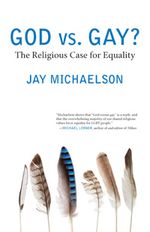
  • Today's post is from Jay Michaelson, author of God vs. Gay? The Religious Case for Equality. Michaelson is a writer, scholar, and activist whose work addresses the intersections of religion, sexuality, spirituality, and law. 

    This post originally appeared at Huffington Post. 

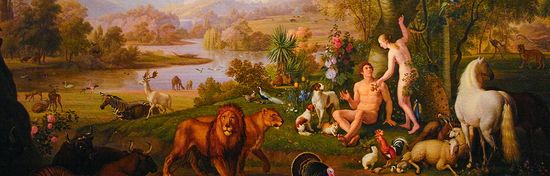
    Bigstock_Adam_And_Eve_By_Wenzel_Peter_2292497
    "It's Adam and Eve, not Adam and Steve."

    We've all heard the cliché, and we all know its meaning: that "male" and "female" are at the heart of God's plan for the world, and that heterosexuality is the only "natural" sexuality. Kirk Cameron, the former child TV star, made this point just a few days ago: that homosexuality is unnatural.

    We know, too, that this is not a scientific claim. Actually, homosexuality is quite "natural"; it's present in hundreds of animal species and in every culture in the world. Sexual diversity is the rule, not the exception — the plan, not the deviation.

    But there is that myth, that story, of Adam and Eve. No matter the scientific evidence, no matter the countless lives of happy, healthy LGBT people, there's that story, that binary, and that claim.

    Well, I'd like to take that story back — to reclaim it for all of us, not just those of us who find love in heterosexual, monogamous life.

    First, let's set aside the parts about God, the Bible, the whole theological aspect of this myth. Let's treat it just as literature — as a text, sacred to many, but first and foremost a story of human origins and human purpose. All of us — religious, atheist, agnostic, Christian, Jewish, Muslim, progressive, fundamentalist — should be able to agree on that.

    Bigstock_Adam_And_Eve_By_Wenzel_Peter_2292497 - Version 2And in that myth, the pairing of Adam and Eve was the solution to a problem. In the more detailed version of the Genesis story, they don't just appear on the stage; human coupling is the result of divine fidgeting. God creates the human being, but then has to tinker with the original plan, because of the first flaw God finds with all of God's creation: loneliness.

    "It is not good for the human being to be alone," God says in Genesis 2:18. In context, this is a shocking pronouncement. Six times, God had remarked how good everything is: light, Heaven and Earth, stars, plants, animals — all of these are "good." The entirety of creation is "very good." Yet suddenly something is not good. Suddenly, God realizes there is something within the world as we find it that is insufficient, something that all of us experience in our own lives and that we all strive to transcend: the existential condition of being alone.

    Notice, too, that Eve is not the first solution God attempts to deal with the problem of Adam's aloneness. God first presents Adam with every animal in the world — birds, beasts, even those animals that would later become domesticated by people. But none suffices. Only then does the story of Genesis 2 tell us that God took the rib from man to make woman. Only human companionship solves the existential problem of aloneness, the first problem our religious traditions set out to address. And, finally, notice that Eve is not created, in this narrative, to make children with Adam; this story is about loneliness and love, not procreation and progeny. Indeed, Eve's femininity is not even essential to be what Hebrew calls an ezer kenegdo, and what antiquated King James English calls a "help-meet": someone able to be with Adam on equal terms and be a companion to him.

    0159In other words, notwithstanding the many problems with this particular myth (it's been used not just against gays, of course, but primarily against women, by those who read it as setting up a gender hierarchy), this is a tale about the importance of human love and companionship.

    Now, for most people, this love is indeed experienced in a relationship between a man and a woman. For about 5 percent of people (we can argue about the numbers; the range is usually 3 to 10 percent), this love is found in a relationship between two men, or between two women. And for some others, love may be found in either kind of relationship, and sexuality may be experienced as fluid.

    Personally, I am one of that 5 percent. During my teens and 20s, as I struggled with my sexuality, I had relationships with women and, as much as I was able, fell in love. But something was always "off," even though at the time I couldn't quite identify it. (Maybe I knew, deep down. I don't know.) It took me 10 years of wrestling, cajoling, self-hating, and self-judging, and finally a serious car accident, which shook up my body and soul, to finally admit that if I wanted true love, the kind that the Song of Songs sings about, the kind that the Genesis myth says is so important, well, my Eve would have to be a Steve.

    This is about much more than sex; it's about love. And that is the most natural thing in the world.

    Now, if we do consider ourselves religious, this point matters, and it influences how we understand our sacred texts and traditions. Surely, a loving God could not want the tyranny of the "closet" — an all-too-cozy metaphor for what is really a life of deceit, loneliness, and alienation. The Kirk Camerons of the world can still pretend that homosexuality is some kind of choice, pathology, or worse. But I have known both the life of the closet (for 10 years of my adult life) and the life of companionship. I know that my life with my partner is not simply about lust. It is exactly as the Genesis myth describes: a life of sharing, companionship, and love. Sure, for most people, "a man… shall hold fast to his wife." But in some cases, a woman shall hold fast to hers. And in some others, a man shall hold fast to another.

    Of course, I know there are other Biblical texts that influence what some people think about homosexuality. In my book God vs. Gay?, I spend a long, long time parsing them out and show that they are obscure and ambiguous, and that they certainly do not contemplate loving, committed relationships. But anyone can interpret Biblical text; that's the easy part. As Shakespeare said, even the devil can cite scripture for his purpose. The hard, and more important, part is deciding which approach to take: one that leads to more love, or one that leads to more aloneness; one that leads to more of the holy, or one that leads to more of the shameful. As I approach these sacred texts, the story of Adam and Eve helps point the way, by reminding me that it is not good to be alone — and it is very good to find someone with whom to share your life.

    Adam and Eve from Bigstock.

  • Carl Elliott is the author of White Coat, Black Hat: Adventures on the Dark Side of Medicine. Elliott is a professor at the Center for Bioethics at the University of Minnesota. His work has appeared in The New Yorker, Atlantic Monthly, the Believer, Slate, the London Review of Books, and the American Prospect. His six previous books include Better Than Well, Prozac As a Way of Life, Rules of Insanity, and A Philosophical Disease.

    This post originally appeared at the Chronicle of Higher Education's Brainstorm blog.

    Bigstock_Texas_State_Flag_Closeup_4812033If Texas ever decides to secede from the Union, I’d be mighty tempted to go along. Lightnin’ Hopkins, Molly Ivins, Bob Wills, Kinky Friedman, the 1966 Texas Western basketball team: Without the Lone Star State, American life would look pretty anemic. When Steve Earle declared, “Townes Van Zandt is the best songwriter in the whole world and I’ll stand on Bob Dylan’s coffee table in my cowboy boots and say that,” I nodded and said, “Amen.”

    Most of all, I like Texas crazy. There is no better value for your entertainment dollar. As a native South Carolinian, I claim some expertise in the topic. My brother says: What Mississippi is to the poverty index, South Carolina is to the index of crazy people. (Our unofficial state motto, provided by James L. Petigru in 1860: “South Carolina is too small to be a republic, and too large to be an insane asylum.”) For many years now, my Texan friend Kathryn Montgomery and I have had a contest over which state has a higher proportion of crazy people, and for many years, thanks to our remarkable politicians, South Carolina has been flat-out killing it. Over the last few months, however, Texas may have pulled ahead.

    The reason is stem-cell tourism. It started when Gov. Rick Perry had a surgeon friend treat his back problems with adult stem cells processed by RNL Bio, a South Korean company famous mainly for its commercial puppy cloning business and “cosmeceutical” preparations such as Dr. Jucre’s Million Stem Cell Magic Concentrate (available online for $1,220.) Pretty soon an entire stem-cell operation called Celltex Therapeutics was up and running, partnered with RNL Bio and backed by a group of Texas oil and gas investors. Unfortunately for the company, there has been a minor bump in the road called “medical research.” Reputable stem cell researchers say there is little medical evidence to show that adult stem cells are effective for the conditions they are supposed to treat (which, according to a RNL Bio spokesperson, range from wrinkles to Alzheimer’s disease). Even worse, the cells may be dangerous. As Paul Knoepfler, a stem cell researcher at UC Davis pointed out recently, “The worst case scenario, even for autologous transplant, is death. The second worse case scenario is severe, life-changing injury.”

    6144You don’t need a marketing degree to understand that “death” and “severe, life-changing injury” are not going to sell a lot of stem cells. So those words don’t appear in the patient testimonials RNL Bio uses to market its services. In fact, the stem cell treatments are illegal in South Korea, where RNL Bio is based, so the company partners with facilities in other countries such as China and Japan to exploit regulatory loopholes. Patients with debilitating chronic illnesses can travel to those countries for stem-cell treatment. Last week, we learned from Nature that Texas has joined that list of countries. A Houston doctor told a Nature reporter that he is paid by Celltex to give adult stem-cell treatments to patients with multiple sclerosis and Parkinson’s disease, who may be charged up to $25,000.

    A few months ago, I had reason to hope that South Carolina might be making a comeback in the craziness sweepstakes. An assistant professor at the Medical University of South Carolina was arrested by the FBI for supplying adult stem cells to an illegal operation in Mexico. But my hopes fell when I read the FBI press release. His co-conspirators, unfortunately, were from Texas.

  • Today's post is from the authors of Cheating Justice, Cynthia L. Cooper, an award-winning journalist and lawyer, and Elizabeth Holtzman, a lawyer, former prosecutor and former member of Congress who served on the House committee that investigated Watergate.

    This post originally appeared at ACSBlog. 

    0321When President George W. Bush and his team left office, mounds of misdeeds were left to fester. Some of their transgressions in office were so shocking – lying to Congress in order to embroil the nation in war and occupation, illegally wiretapping Americans without warrants, authorizing torture that had been outlawed by U.S. and international law – that he and Vice President Cheney probably should have been impeached and removed from office.

    Instead, they completed their terms and sped away. Even though Bush publicly announced in his 2010 memoir that he had personally authorized waterboarding, a recognized form of torture  — “Damn right,” he is quoted as saying – hardly a peep was heard about seeking accountability. But how can that be? Key to preserving our democracy is the concept that no person is above the law.

    In order to ignite a national conversation on the topic, we set out to show how and why the president and vice president should be held accountable – especially, how they can be prosecuted. That meant looking at the available evidence, investigating precisely what laws are implicated and determining, as best as possible, whether a prima facie case could be made. We found enough to make a courageous prosecutor sit up and take notice, although the statute of limitations is ticking in some areas. We found clear problems under laws related to the conspiracy to deceive Congress, foreign intelligence surveillance and U.S. anti-torture laws – each of which needs prosecutorial attention.

    Along the way, we found something else disturbing, too: a repeated pattern by which Bush and Cheney took extraordinary efforts to protect themselves from the sting of the law. In Cheating Justice: How Bush and Cheney Attacked the Rule of Law, Plotted to Avoid Prosecution – And What We Can Do About It, we look at both: how the ex-president and vice-president can be held personally accountable, but, also, how they tried to manipulate the system from inside to keep themselves from being held to account.

    Perhaps the most startling example of their extraordinary actions was the gutting of the War Crimes Act of 1996. This law was a healthy, robust and muscular law when President Bush took office. It had a proud history — introduced in Congress by a Republican from North Carolina, passed by a bipartisan majority, signed by a Democratic president. The law implemented the Geneva Conventions for the U.S. and prohibited U.S. personnel from torturing detainees, and banned degrading treatment, cruelty, acts of humiliation and outrages against personal dignity.

    To understand how far the president and vice president strayed from the War Crimes Act means facing what happened to some detainees. For example, at Guantanamo, Mohammed al Qahtani, a Saudi, was detained under blinding continuous light and extreme isolation, interrogated 20 hours a day, threatened by an aggressive dog, led around on all fours with a leash, exposed to life-threatening cold temperatures, subjected to beatings, forced nudity, forced enemas – and more. Other “approved” techniques included locking a detainee in a closed box and dropping in an insect. The pictures that eventually emerged from Abu Ghraib were only a sliver of the story.

    The evidence shows that the president and vice president authorized and personally approved a scheme of cruel and inhuman treatment of detainees. But when the 2006 Supreme Court decision in Hamdan v. Rumsfeld said that the Geneva Conventions could not be summarily erased, Bush and Cheney knew that they might be held criminally liable under the War Crimes Act. They went into high gear to protect themselves, slipping a series of loopholes into another law, the Military Commissions Act of 2006, under the deceptive sub-heading of “implementation of treaty obligations.”

    These changes shredded the War Crimes Act. Conduct that was previously illegal was suddenly made legal. For example, crimes of “cruel and inhuman treatment” were eliminated from the law in an apparent effort to legalize beatings, sensory deprivation, and the like. Even more astonishing, the law was made retroactive to 1997 — something that may be unprecedented in U.S. history.

    These examples of legal hocus-pocus are windows into the extent of the Bush efforts to create buffers of personal protection from the law. But, even in this area, other laws may still come into play, especially the U.S. anti-torture law and international human rights protections.

    The actions of Bush and Cheney sully our democratic heritage and stain our constitutional system. If they are allowed to “get away with it,” nothing will be able to stop any future president or high official from similarly trampling on our rights and violating other criminal laws. It’s not too late, and people of conscience can make a case, knowing that the country as a whole will suffer if Bush and Cheney remain uninvestigated, unprosecuted and unaccountable.

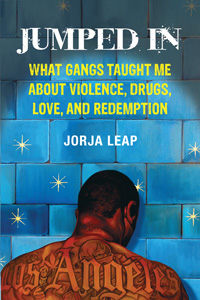
  • 4456When Jorja Leap began studying Los Angeles gang violence in 2002, she encountered a myriad of proposed solutions to the seemingly intractable “gang problem” and set out to discover what was really going on. The stakes—then and now—could not be higher: a child or teenager is killed by gunfire every three hours—and homicide is the leading cause of death for African American males between the ages of fifteen and thirty-four.

    In Jumped In, Leap brings us stories that reach behind the statistics and sensational media images to the real lives of those stuck in—and trying to escape— "la vida loca.” With the eye of an anthropologist and a heart full of compassion, this small, tough woman from UCLA travels some of the most violent and poverty-stricken neighborhoods, riding along in police cruisers and helicopters, and talking with murderers and drug dealers, victims and grieving mothers.

    Through oral histories, personal interviews, and eyewitness accounts of current and former gang members, as well as the people who love and work alongside them, readers come to understand both the people pulled into gangs and those trying mightily to forge alternatives and help their community. In delving into the personal lives of current and former gang members, Leap aims not only to find out what leads them to crime and how to deal most effectively with gang activity, but also to hear the voices of those most often left out of the political conversation and to learn from leaders who offer a different kind of hope, through community outreach and jobs programs.

    As she forges lasting friendships in this community and becomes immersed in others’ triumphs and tragedies, Leap’s personal and professional lives intersect in sometimes incendiary ways. With a husband in the Los Angeles Police Department and a daughter in adolescence, she faces plenty of family dilemmas herself. Ultimately, Jumped In is a chronicle of the unexpected lessons gang members taught her while she was busily studying them, and how they changed her forever.

    Read an excerpt of Jumped In on Scribd.

    Read "Girl Gangs: Female Members on Love and Motherhood" on Huffington Post

    Watch Jorja Leap talk about her book on YouTube.

  • White Bread blog tourWhat do you think about when you hear the words “White Bread”? The wonder food of the 1950s? Fluffy, bland, industrial food? Boring suburban life? Trailer parks and Daisy Dukes? Artisanal sourdoughs with a chewy crust and irregular holes? 

    In this lively history of bakers, dietary crusaders, and social reformers, Aaron Bobrow-Strain shows us that what we think about the humble, puffy loaf says a lot about who we are and what we want our society to look like.

    This week, you can follow the crumbs on the WHITE BREAD BLOG TOUR to some tasty food blogs. And you can watch, listen, and read some interesting media about White Bread: A Social History of the Store-Bought Loaf.

    Click here to Tweet what “White Bread” means to you.

    Read our Storify collection of our favorite #WhiteBread tweets 

    Read “Atomic Bread-Baking at Home” by Aaron Bobrow-Strain in the Believer 

    Read “The Rise and Fall of White Bread” on Salon.com

    Listen to “American History Baked Into Loaves of White Bread” on NPR

    Read White Bread “Chapter 1: Dreams of Purity and Contagion” on Scribd 

    Watch the White Bread book trailer on YouTube

  • WBblogtourThe White Bread blog tour starts today, with a post at FANNEtastic Food. Check the Beacon website for the tour schedule. And White Bread: A Social History of the Store-Bought Loaf is on the Amazon Book of the Month list at Amazon.com

    And, in the meantime, listen to this Weekend Edition interview to find out how American history is baked into loaves of white bread.

    New accolades for Michael Bronski's A Queer History of the United States. It's a Booklist recommended title for 2012 “Over the Rainbow” list. And the Windy City Times monthly book column, “Between the Covers” said, "It is wonderfully readable and looks at the way we understand the history of the United States. The LGBT population moves from the margins to the mainstream and we see that the history of this country also is our history.” 

    NY Times Book Review reviewed Katherine Newman's Accordion Family with Eric Klinenberg's Going Solo: “Klinenberg and Newman flesh out their subjects with expertise and devotion, but neither forgets that ‘accordion family’ and ‘going solo’ are always less definitive terms than rich and poor.”  

    At Skidmore, a preview of Judith Jack Halberstam's forthcoming book, Gaga Feminism. 

  • Carl Elliott is the author of White Coat, Black Hat: Adventures on the Dark Side of Medicine. Elliott is a professor at the Center for Bioethics at the University of Minnesota. His work has appeared in The New Yorker, Atlantic Monthly, the Believer, Slate, the London Review of Books, and the American Prospect. His six previous books include Better Than Well, Prozac As a Way of Life, Rules of Insanity, and A Philosophical Disease.

    This post originally appeared at the Chronicle of Higher Education's Brainstorm blog. 

    WhitecoatblackhatThe pharmaceutical industry gets a bad rap. To listen to the critics you’d think pharmaceutical companies are in the same sleazy category as oil, finance and tobacco companies. But pharmaceutical companies invent life-saving medications, not to mention countless other psychoactive products that many of us enjoy on a recreational basis.  Pharmaceutical companies get blamed for fraud, kickbacks, and research deaths, but they never get the credit for oxycontin.

    That is why I was thrilled to see that GlaxoSmithKline is sponsoring the prize for the British Medical Journal's annual Research Paper of the Year. Sure, the pharma-bashers will whine like infants at the BMJ’s decision to brand a medical research prize with the name of multinational drug company, just as they’re whining about an American editor’s decision to re-locate a leading bioethics journal to the Texas headquarters of a stem cell tourism clinic. These people just don’t get it.  This is not about propaganda or corruption.  It is about developing innovative medications for diseases that we didn’t even know existed.

    In that spirit, my nomination for the GlaxoSmithKline (GSK) Research Paper of the Year goes to a ground-breaking article about GSK’s very own antidepressant, Paxil, which was published in the Journal of the American Academy of Child and Adolescent Psychiatry.  The title of the article is “Efficacy of Paroxetine in the Treatment of Adolescent Major Depression,” but seasoned pharma-watchers know it better as Study 329. The data behind Study 329 showed that Paxil didn’t actually work in adolescents – that, in fact, it was no better than a sugar pill. However, as any marketer understands, bad data cannot be allowed to interfere with a good paper.  By the time Study 329 appeared in print, GSK had used the magic of biostatistics to transform the raw data into a gleaming advertisement for Paxil.  As a result, when FDA eventually decided that Paxil had a few minor side-effects, such as suicide, Study 329 had already done its work: getting a GSK product into the hands of troubled teenagers.  And wait, here’s the beauty part: although the published version of Study 329 was “authored” by leading academic psychiatrists, it was actually written by a GSK ghostwriter.

    Of course, the pharma-bashers have been complaining about Study 329 for years.  Some of them even want the journal to retract it.  The lead “author” who signed the paper, Martin Keller of Brown University, has been beaten up by the Senate Finance Committee, harassed by the New York attorney general, and vilified in the press, all because he put his name on a ghosted article and forgot to report half a million dollars in pharmaceutical income.  To which I say: stand strong, GSK.  Ignore the naysayers and the nitpickers.  It’s about time you gave these good people some public recognition.  Yes, it’s true that Study 329 is eleven years old, but you’re paying the BMJ over $47,000 tosponsor this prize. Surely they can bend the rules, just this once.