• Today's post is by Sophia Raday, the author of Love in Condition Yellow: A Memoir of An Unlikely Marriage.
    RadayAt my book talks I often show side-by-side photos of my husband and me. In mine, I am getting arrested by campus police at a divestment protest at Stanford University. The police are using a “pain compliance” technique on me, twisting my arm behind my back and pressing my hand over in a very effective wrist-crunch. [Ed's note: you can see this photo on Sophia's web site.] In the next photo, my husband is standing in front of the Oakland Police Department’s SWAT helicopter flashing a thumbs up sign and a big grin. 

    Perhaps needless to say, our differences run along major fault lines in the American body politic. He is a Republican; I am a Democrat. He is a hawk; I am a dove. He likes Costco; I like food co-ops. He reads military history; I read poetry. He admires Teddy Roosevelt; I swoon for Obama. You get the idea.

    I know what most of you are thinking: What do you do when you talk politics at the dinner table? How do you keep things from getting ugly? No, we don’t have a skirmish line running down the middle of our kitchen table. In fact, we talk about politics regularly and very amicably. Of course it didn’t start out that way. We argued a lot during our courtship. A lot. But eventually that got really tiring. And kind of boring. We had to figure out how to share our views or break up. And we really loved each other.  So, with some help from a good couples counselor, we stopped arguing and started connecting.

    The trick is adopting an attitude not of antagonism but of curiosity.  Imagine you are an exchange student exploring a foreign country whose customs and history you would like to learn about. Your curmudgeonly conservative Uncle Frank? He’s Bora Bora. Your strident vegan niece Madison? She’s Uzbekistan.

    This idea is not just based on our personal success as a couple but also on cutting edge cognitive science. George Lakoff is a linguist and writer who has come up with a very elegant case for how to explain the differences between conservative and liberal world views in the United States. Each side tells a morality story, with one applying a “strict father” family model (government as father and citizens as children), and the other a “nurturant parent” model. As people relying on a (usually unconscious) strict father family narrative, conservatives value self-reliance above all else. Liberals, on the other hand, tend to believe government should act as a nurturing, supportive parent. They consequently, value empathy above all else.

    I think Lakoff is on to something profound. And I’ve found there’s even more. The story of why Uncle Frank cleaves to his political views and why Niece Madison embraces hers is a hidden treasure trove. Each of us has mapped our particular narrative of the world – shaped by all our life experiences and influences – onto political issues, usually unconsciously. This means that when we talk about politics, we are actually talking deeply about ourselves, without realizing it. The very personal story running underneath each person’s political views is the Lost Ark within the Wall of Souls.

    You, then, must be Indiana Jones.

    You’ve seen the movie. I don’t have to tell you that reaching your goal – uncovering the personal stories underneath political views – involves braving a viper pit. I didn’t say it would be easy or risk-free. But it’s worth it. Because just expressing curiosity about each other’s stories has an almost magical effect of softening our differences. In my sixteen-year relationship we’ve found it to be a tonic for the divisiveness of these times. (And P.S.: it works for other thorny topics besides politics.) Here are some dos and don’ts for budding Indys:

    1. Stay grounded and calm. When we feel under assault, our reptilian brain takes over. We can't hear anything. We can't process complex information. We definitely can't listen. If you are upset, take care of yourself until you can be calm. This is not the time to talk to someone of opposing views. Take deep breaths, excuse yourself to baste the turkey, change the subject. For the same reason, do not take the offensive.

    If, for example, your cousin starts saying “shame on the Oakland Police Department” and wagging her forefinger in your tired Oakland Police officer husband’s face:

    Don’t say, “Oh puh-lease, I am so sick of people ragging on the cops. They get no credit for putting their lives on the line for this city. Why don’t YOU try it some time, huh??”

    Try this instead. Put your hand over your heart and take a deep breath. Then maybe you can say, “Those were definitely some disturbing images. I know crowd control is one of the most challenging aspects of police work. It’s definitely scary for me when my honey is on the line.”

    If not, there is always, “I think I hear the doorbell ringing!”

    2.  Be open to looking at something differently, or learning something new. While it’s good to share your point of view, do not do it with the aim of changing the other person’s opinion. Ask for detail. Uncle Frank might say “when I was a youngster, they just would’ve called in the National Guard and run over those hooligans with tanks!” Don’t respond with “Jesus, Uncle Frank, was everybody a Neanderthal back then?” Try this: “Uncle Frank, tell us about some of the protests that went on in the sixties. Did you know anybody involved in them?”

    3.  Use humor whenever possible. Did you hear the one about the cop and the protestor that got married? Laughter is a great release. I like to tell the story of what happened after my arrest photo was taken. One officer was given the job of driving me to jail. Through the metal barrier, I sang him a lusty version of Jimmy Cliff’s “Peace Officer.” Turned out cops laugh too. 

    Good luck. Don’t worry if it doesn’t work at first. It gets easier with practice. Plus, the attempt will make a difference. Happy Holidays from this bipartisan family to yours, whatever your political views. 

  • Today's post is from Carole Joffe, author of Dispatches from the Abortion Wars: The Costs of Fanaticism to Doctors, Patients, and the Rest of Us. Joffe is a professor in the Bixby Center for Global Reproductive Health at the University of California, San Francisco. This post originally appeared at RHRealityCheck.

    JoffeThere is another 99 percent group in our country, distinct from but inextricably entwined with the now more familiar #99Percent, those everyday Americans, who–in such a brilliant framing by the Occupy Wall Street movement–are to varying degrees affected by the vast economic inequality that characterizes American society. I refer to the 99 percent of American women who have ever had sexual intercourse and have used a birth control method at least some of the time. (As per the original Centers for Disease Control report, this statistic only includes contraceptive use reported by women during heterosexual intercourse).

    Contraception obviously is a deeply held value by American women. But the fact that in the United States a startling half of all pregnancies are unintended makes clear that birth control is used only sporadically by some. There are a number of reasons why this is so, but a chief one is that so many women cannot afford contraception, especially the most expensive—and most effective–methods, such as birth control pills, and long lasting reversible contraception, for example, the newer (and far safer) models of IUDs (intrauterine devices).  In short, the same economic disparities that pervade every other area of American life manifest here as well: poor women depend on publicly-funded programs for their contraceptive services, but, according to the Guttmacher Institute, only a little more than half of the 17 million women who need these services currently receive them.

    This situation of tremendous inadequacy was supposed to improve considerably. In one of the best pieces of news in the otherwise embattled reproductive health world since the battles over health care reform began, the Obama administration announced last August that it would accept therecommendations of a special panel of the Institute of Medicine and include contraception—including all FDA-approved birth control methods—as part of the basic package of preventative health services that health insurance plans must offer, without co-payments.

    Predictably, the August announcement has produced a massive campaign from opponents of contraception, especially the Catholic hierarchy. Though churches in fact have been granted an exemption from this requirement, the U.S. Conference of Catholic Bishops and its allies are pushing for much broader exemptions, for example  to universities, social service agencies and other institutions with a religious affiliation—even if these institutions receive public funding.  Such a move could potentially affect millions of women, of all religious backgrounds (or none), who work in such institutions.

    My young friends who have been involved in the Occupy movement tell me that issues of reproductive justice have been muted, if evident at all, at the various Occupy sites. But as the occupiers put forward their vision of a just society, the old feminist dictum bears repeating: women cannot be full participants in any society unless they can control their fertility. The New York Times quotes the president of the U.S. Conference of Catholic Bishops, reporting on a meeting with President Obama, as saying the latter “was very open to the sensitivities of the Catholic community.”  President Obama, please be open as well to the tremendous struggles of women–members of both 99 Percent groups–who are desperate to control their childbearing in very harsh times. 

    These groups are asking you to join them in telling the White House not to throw women under the bus:

    Emily's List

    Planned Parenthood Federation of America

    NARAL Pro-Choice America


  • Anita Hill spoke with the Takeaway about some of the remarkable women profiled in her book, Reimagining Equality. You can also listen to her read a chapter from Reimagining Equality at Vanity Fair.

    http://www.thetakeaway.org/media/audioplayer/takeaway_player.swf

    // <![CDATA[
    (function(){var s=function(){__flash__removeCallback=function(i,n){if(i)i[n]=null;};window.setTimeout(s,10);};s();})();
    // ]]>

    Jay Wexler talks about The Odd Clauses on Legal Talk Network.

    KGNU's How On Earth spoke with Cynthia Barnett about America's water crisis.

    The Edge calls God vs. Gay? "A pleasurable and intelligent read, this is a book for our times and a book for the ages." And they describe See Me Naked as, "an essential book, and will perhaps begin the national conversation that we deserve." Woot!

    The Advocate bookshelf names the Best Non-Fiction Transgender Books, including two Beacon Press books: Just Add Hormones by Matt Kailey and Transgender Warriors by Leslie Feinberg. Also on the list, the amazing Kate Bornstein, whose memoir will be published by Beacon in 2012. 


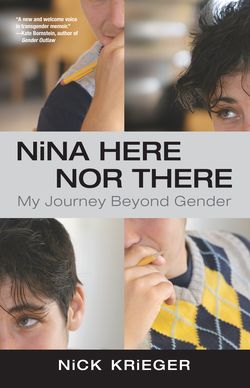
  • Nick Krieger is the author of Nina Here Nor There: My Journey Beyond Gender. You can read more of Nick's blog posts at ninaherenorthere.com. This piece originally appeared in The Advocate.

    KRIEGER-NinaHereNorThere

    A few days ago, I spoke to the gender-neutral housing floor at an Ivy League college about my new transgender memoir. Before introducing me, the faculty advisor wanted to discuss the students’ responses to the recent vandalism (a “fag” slur) on their dorm, and a film they watched, the trans movie Gun Hill Road, which this advisor only brought to campus after ensuring that the trans character is not killed.

    I keep returning to this act of homophobic harassment and the resistance to promoting the historically dominant, tragic trans narrative as I reflect on the approaching Transgender Day of Remembrance on Sunday.

    This is the 13th year the growing community of transgender people and allies commemorates those killed due to anti-transgender hatred and prejudice. The history of this day dates back to 1998, when Rita Hester was brutally murdered in her home, and her friend, Gwendolyn Ann Smith, launched the Remembering Our Dead web project. The following year, a candlelight vigil for Hester was held, and would become the annual Transgender Day of Remembrance.

    TDOR persists to raise awareness of hate crimes against trans folk, and to publicly mourn those who might otherwise be forgotten. Over 100 international events are listed on the website, along with the names (and occasionally) pictures of those we are memorializing.

    In the past couple of years, some activists have brought up concerns over the grave tone and depressing theme. TDOR is the most well known acknowledgement of trans people, and as a trans-questioning person five years ago, the fact that our “special day” focused on violence and murder did little to put me at ease with myself. Almost every trans story I came across focused on pain, tragedy, loss, and suffering. I had to wonder: Is it possible to be a happy, healthy, successful trans person?

    While I kept my own process of internal investigation to myself, I observed my transsexual, genderqueer, and gender non-conforming acquaintances in San Francisco from a distance. Over time, I watched them grow into themselves. I witnessed them find peace, joy, and expressions of their own unique beauty. These people inspired me to come out, and when I sat down to write my own trans narrative, I consciously decided to highlight the positive aspects of my experience, to focus on empowerment, and to find the humor wherever possible.

    Now that I am a happy, healthy, successful trans person (or at least a person working on self-affirmations) invited to speak at a handful of universities as part of their Transgender Awareness Weeks leading up to TDOR, I aim to strike a balance between the somber and the celebratory, to engender hope while also acknowledging the work that still needs to be done.

    Over the last decade, more than one person per month has died due to transgender-based hate or prejudice. A groundbreaking report released earlier this year, Injustice at Every Turn: A Report of the National Transgender Discrimination Survey, revealed the extreme challenges that trans people still face.

    The statistics are alarming: 63% of participants experienced a serious act of discrimination (i.e., lost job, eviction, physical or sexual assault, bullying, homelessness, denial of medical services), and 23% faced a “catastrophic level of discrimination” —defined as being impacted by at least three major life-disrupting events. Across the board, trans people of color fared worse than the white participants.

    As a trans person of many privileges (class, race, and education) talking to other (mostly) privileged college students this week, I find it important to acknowledge the disparities in what my mind links together: a homophobic act of vandalism and the intention to shift away from the tragic trans narrative at an elite university, and the unabated hate-crimes, violence, and discrimination against trans folk, most of whom lack social privileges.

    I link these here intentionally, believing our struggles are all linked. While we may separate ourselves under our various social justice causes, our groups and acronyms must join together in the space of our hearts. We all must fight for equality and human rights – like the right to live – by backing, recognizing, and honoring each other.

    On Sunday, we commemorate the loss of our trans folk. I call to everyone in the GLBTQIQA — buy a vowel, add a letter, become an ally — to visit the Transgender Day of Remembrance website and review some names and pictures. If you are so inclined, attend a vigil in your area, or simply light a candle in your house. Please take a small moment, even if it is right now, in memory of those in our community, this great big community of humanity, who have been killed in the past year for being themselves.

    Then, take a breath and move forward, continue your activism by living honestly and authentically. In honoring our own lives, we remember the dead, something we will continue to do annually until our collective tragic trans narrative is obsolete.

  • The Occupy movement, which began in September in New York's Liberty Square and has since spread throughout the country, has a vibrant outpost at Dewey Square in Boston. Last week, UU World editor Chris Walton, Beacon Press Associate Publisher Tom Hallock, Beacon Broadside editor Jessie Bennett, and author Dan McKanan visited the protest on a rainy afternoon. We spoke with protestors, visited the library and donated a few Beacon Press books, and filmed this interview while we were there. 

    Dan McKanan is the author of Prophetic Encounters: Religion and the American Radical Tradition. He is the Ralph Waldo Emerson Unitarian Universalist Association Senior Lecturer at Harvard Divinity School.

    Be sure to read Dan McKanan's article, "The Spiritual Heritage of the Occupy Movement," at UUWorld.org.

    1315Chris Walton: Your book highlights the religious dimensions of the long history of radical movements in America, and it came out just as Occupy Wall Street was going up in New York. Where would you place the Occupy movement in the American radical tradition? 

    Dan McKanan: When I think of Occupy Wall Street and Occupy Boston, I think all the way back to the 1820s when working people gathered at First Universalist Church in Philadelphia. Wealthy people were consolidating economic activity, and they saw this is a betrayal of the American vision of equality and freedom, and they organized what they called the Working Man's Party. People had a common identity as workers and needed to exercise political power in proportion to that. So this same theme of the ninety-nine and the one is something that's deeply rooted in our history and we have many predecessors to draw inspiration from as we do the work today.

    Chris Walton: What's different about Occupy? Is there a way in which it's unlike previous progressive movements?

    Dan McKanan: The kind of blending on the ethos of the 1930s, when many people were out of work, many people were struggling and organized around that, with the ethos of the 1960s, when college students especially were benefiting from the great economic growth of the previous couple of decades, and were saying, "How can we make sure that that economic prosperity is shared widely?" Now we're seeing a period where all those economic gains of the post-war period are being lost, but we still have that legacy of student activism, so we have chance for really exciting alliances between student activists and persons experiencing homelessness or persons experiencing unemployment… really the whole spectrum.

    Chris Walton: I want to ask about the two words in your title. The first one is "prophetic." What do you mean by "prophetic" and how is something like Occupy a "prophetic" movement?

    Dan McKanan: When I think of the word "prophesy," I think a lot about the ways people are transformed by their encounters with the divine. And I want to suggest that something like that happens here and happened in the Montgomery bus boycott, happened among abolitionists–white and black people standing together to end slavery. When people encounter one another deeply, when they find the power that they have in fighting against oppression, there's something spiritually transformative about that, something like religious conversion, and I want to celebrate that.

    Chris Walton: The other word in your title is "encounters." It clearly has religious dimensions in your book, the way that you use it. In your last chapter, you talk about how the anti-globalization movement, which would seem to be a pretty direct forerunner of this, was more focused on resistance than on encounter. What do you mean when you talk about encounter as a religious term in a political movement?

    Dan McKanan: There are three kinds of encounters that have occurred in different social justice movements in U.S. history that are really important.

    The first is the kind of encounter–I call it the encounter of identity–when people who've been oppressed, who've been marginalized, come together, share their stories, and claim some sort of new identity. When persons who had been enslaved in this country began calling themselves "African" and prizing that identity. When working people said, "We are working men, we're working people and we're proud of that." That's the kind of encounter of identity.

    The second kind of encounter happens when persons of relative privilege see the power that's being generated amongst communities of the oppressed and say, "We want to have a piece of that," and they identify with one particular individual who embodies that. So a lot of people had their lives transformed by the individuality of Martin Luther King or Malcolm X during the 1960s.

    And then there are also the kinds of encounters that happen when people immerse themselves in communities in struggle: Catholic Worker houses, settlement houses, people going on pilgrimage to base communities in Latin America, all these are more collective sorts of encounter.

    One of the things that happened I think among radical movements in the past thirty years is that we saw an upsurge in a conservative movement in this country, of a sort that was almost unprecedented, and radicals put more and more emphasis on resisting or defeating the Right. So you saw a resurgent religious right, and people said the best we can do is to hold them at bay. There was this motif of resistance and maybe something of a loss of utopian thinking, a loss of really imagining what the alternative would look like. And the way I think we get to that positive vision is through encounter. And so what's really exciting for me about the occupy movement is there's space. People are not just coming to one-off demonstration, they're spending deep time together, developing practices of participatory democracy, sharing the wisdom of tradition and the wisdom of right now in a way that I think will help us to imagine what a world beyond the hyper-capitalist reality we have now could be.

  • Today’s post is from Matt Kailey, a transsexual man and an award-winning author, blogger, and community leader, as well as a nationally recognized speaker and trainer on transgender issues. He is the author of Just Add Hormones: An Insider’s Guide to the Transsexual Experience (Beacon Press), a Lambda Literary Award finalist. This post originally appeared on his blog, Tranifesto.

    Matt kaileyAs International Transgender Day of Remembrance grows near, it appears that this year will, unfortunately, be no different from years before – we will be adding names to the list right up until the actual memorial services take place.

    Our society reinforces these heinous acts of violence in many ways – through misogyny, institutionalized racism, and second-class citizenship for trans people, along with a generalized violent ideal that permeates the culture itself. The causes are many, the solutions must be many, and change is slow to arrive. There appears to be nothing on the horizon to indicate that we will not be holding TDORs for many years to come.

    But there are steps we can take to reach people, and the sooner in life we reach them, the better. I support education on sexual orientation and gender identity beginning in elementary school and woven naturally into the topics of study, so that LGBT and queer people are seen as equal contributors in every area of life. I support LGBT and queer teachers and administrators being out with no threat of losing their job, and with education and training for straight and non-trans school personnel. And I support LGBT and queer functions and organizations at every school. But I don’t kid myself that this is going to happen anytime soon, or even in my lifetime.

    However, I’m buoyed by some of the things that are happening at Red Rocks Community College, where I teach part-time. As with many colleges, Red Rocks has an LGBT student organization that is responsible for putting on various events throughout the year. The college also has out LGBT faculty (including myself), staff, and students.

    Last week, I attended a Rainbow Registration event, designed to introduce students to LGBT and LGBT-friendly instructors and allow them to sign up for these particular instructors’ classes if they wanted to, in subjects ranging from psychology to math, and from composition to foreign languages. For many LGBT students, just knowing that their instructor is also a member of that community, or supportive of that community, makes all the difference.

    This year’s Transgender Day of Remembrance event will feature a panel made up solely of the school’s trans instructors and students (or I should say “instructor and students,” since I’m the only trans instructor at the school). The purpose of the panel is to educate students about TDOR and about trans people, and some instructors are offering extra credit for their students who attend.

    Red Rocks is not unique in this regard. There are plenty of other college campuses planning memorials and other TDOR educational activities, and there are plenty of other colleges that support LGBT and queer faculty, staff, and students. But there are plenty more who do not. And it is this type of education and visible support that sends open-minded students out into the world – students that might one day be influential in changing laws and policies that affect trans people.

    7959This kind of atmosphere and these kinds of programs are not just the purview of colleges and universities. Trade schools, apprentice programs, online training programs, high schools (when they are allowed to) and, of course, businesses of all kinds can adopt a welcoming attitude and incorporate a variety of educational resources and events into the fabric of their organizational culture. In fact, schools, businesses, and local government entities are usually way ahead of the federal government on these types of issues, and these local venues are generally where the real changes are taking place.

    So as we enter this very solemn week, I’m not going to offer platitudes of optimism – not when we have recently seen several horrendous incidents of violence against trans women, and when, statistics tell us, we will probably see at least one more over the next few days.

    But I am going to say that there is some hope out there for the future, however minimal it might seem right now. There is the possibility for change, however far away it might appear right now. And hope might seem even more tangible when we hear what is going on in the readers’ schools, organizations, and places of business that might bring about positive change.

    Readers, what can you tell us?

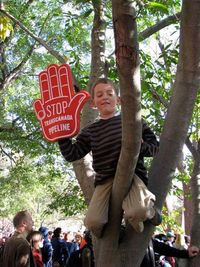
  • On November 6, Beacon Press editor Alexis Rizzuto was part of the Tar Sands Action protest in Washington, DC. She sat down with our blog editor to discuss the protest and its impact.

    DSC_0040
    Beacon Press editor Alexis Rizzuto

    What was the protest about?

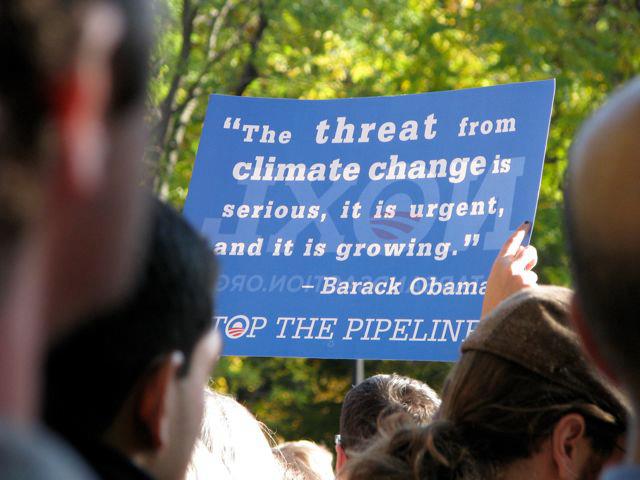
    It was to tell Obama not to approve the Keystone XL pipeline in Alberta, Canada, proposed by TransCanada corporation to run from Canada to Texas. They are cutting down the boreal forest in Alberta and turning it into a toxic wasteland to get at the oil up there. Which is a hugely intensive use of energy—you have to burn a lot of carbon to get the oil out, and you also have to use a lot of water to extract it and then to refine it. Then the heavy oil is sent through these pipelines.

    They had a former union pipeline worker there who used to work for Keystone, John Bolenbaugh. He said that the Keystone 1 pipeline—a smaller one that they had already put in—they had promised that it would only have one leak only every ten to twelve years. In the first year, they had twelve leaks. Because the stuff they're putting in there, called bitumen, is like sandpaper inside the pipes, and it just wears through. Of course they haven’t cleaned it up yet, just covered it up, and people are getting sick.

    They are proposing to put this pipeline through Nebraska, Montana, South Dakota, Kansas, Oklahoma, and Texas. Through wilderness, over waterways, and over the Ogallala aquifer, which provides fresh water for millions of people. So it's an energy-intensive extractive process, the pipeline will certainly leak, and then when it gets to Texas, it will be refined and we'll have more toxic waste down there, and it will use up a lot of water that Texas does not have. Maude Barlow said it takes 2-3 barrels of water per unit of tar sand oil. And in the end, it will just be exported, so we can't really say that it's going to help give the US any energy independence.

    Most importantly, the message is that we should not be using energy and contaminating the environment to continue our dependence on fossil fuel (as we are with fracking for gas and mountaintop removal mining for coal) when we should instead be putting our federal resources behind developing our alternative energy sector—as we are behind most other industrialized countries in doing.

    Alexis-tarsands4How many people were there?

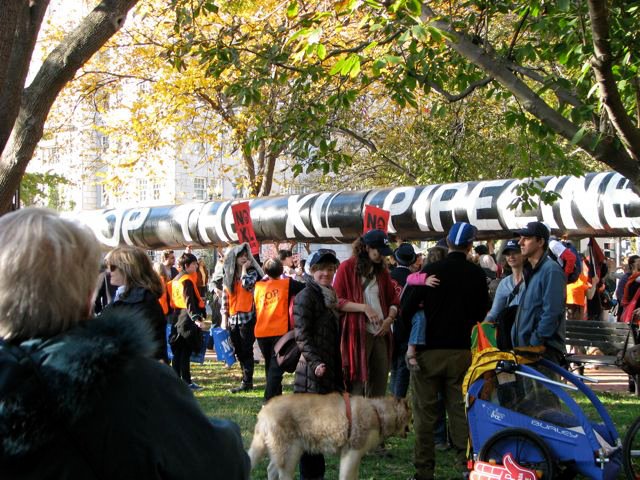
    Twelve thousand people showed up for this protest. The idea was to have us encircle the White House completely. Bill McKibben, who was the organizer and emcee, said that he was originally thinking that in order to get all the way around the White House, we were going to have to stretch out our arms to try to touch each other. But in fact the circle around the White House was three people deep, and he said this had not been done since Viet Nam.

    What types of people did you see there?

    There were little kids, college kids, parents, older people, a great diversity of age and of ethnicities.  Labor leaders, Nebraskan farmers, Native Americans, even several  Army officers in full dress came out to support us. (One of them was Don’t Ask, Don’t Tell activist Lt. Dan Choi.) The group that I was marching with happened to have some people with great voices, so we were singing, "If I Had a Hammer," in harmony. The speakers were powerful. They had Gerald Amos, a leader from the First Nations in Canada, author Maud Barlow, and John Adams, former director of the NRDC, who is our own author. [John Adams HuffPo post on the protest: http://www.huffingtonpost.com/john-adams/tar-sands-pipeline-protes_b_1079733.html] Reverend Jim Wallis, he really got people fired up! Van Jones sent a statement, calling for us to support the president when he’s right and oppose him when he’s wrong.  And calling for us to oppose this with civil disobedience if it goes through. I think most of us would be ready to stand in front of bulldozers.

    Alexis-tarsands3There were three people dressed up like polar bears. And someone had a huge beach ball that looked like a globe, and a sign that said, "Occupy Earth."

    One of our chants was, "Stop the Pipeline. Yes we can!"  Because Obama asked us to be the change, so we were like, "Here we are, dude. Can you hear us now?"

    The Obama administration pushed back the decision on the pipeline permit until after the next election, and TransCanada announced that it plans to reroute the pipeline to avoid the Sand Hills and the Ogallala Aquifer. Is this a victory? 

    Yes, it is a victory in that Obama has sent the project back for further environmental study, which will take over a year. The delay—and a more honest, independent assessment than was done before– will most likely kill the project. So people are considering this a win in the US. And I am glad that Obama acted as the leader we elected him to be.

    However, the tar sands are still being extracted in Alberta, and TransCanada is trying to build a pipeline west to the Pacific, to export the oil to China. Many Canadian tribes (whose land this will go through) are fighting it.

    So, we need to support the Canadian efforts against pipelines from the tar sands to the Pacific, however we can. Eva Saulitis sent me a list of organizations working on the issue, including dogwoodinitiative.org and ecojustice.ca.

    Photos from the protest by Alexis Rizzuto.

    Alexis-tarsands1

    Alexis-tarsands2

    Alexis-tarsands5

    Recent Beacon Press titles edited by Alexis Rizzuto:

    BARNETT-BlueRevolution MONTGOMERY_FATE-CabinFever  HAWLEY-RecoveringALostRiver
    SEIDL_HigherGround WINNE_FoodRebels DRACOS_Biocidal

  • Rita Nakashima Brock, Ph. D. is Founding Director of Faith Voices for the Common Good (www.faithvoices.org). She was a professor for twenty years, directed the Fellowship Program at the Radcliffe Institute for Advanced Study, Harvard University, a prominent advanced research institute, and from 2001-2002, was a Fellow at the Harvard Divinity School Center for Values in Public Life. Her latest book, Saving Paradise, co-authored with Rebecca Parker, was chosen by Publishers Weekly as one of the best books of 2008.

    [Rev. Dr. Gabriella Lettini co-authored this piece. We led the team that organized the Truth Commission on Conscience in War and are members of the leadership team for "The Soul Repair Project."]

    By year's end, 40,000 U.S. troops will return from Iraq and, according to President Obama, "America's war in Iraq will be over." But the long nightmare of the Iraq War will not be over for either side of the conflict. The U. S. will see a new surge of suffering, and it will not be over for generations.

    The fatalities will not end when the troops come home. Though veterans are only 7% of the population, they are 20% of all U.S. suicides, 6000 a year, an average of 18 a day. Veterans under 30 have record-breaking suicide rates, despite mental health screenings for returning troops, better research on and treatment of PTSD, and increased VA suicide prevention programs. Between 2005 and 2007, the rate among veterans under age 30 rose 26%; in Texas, rates rose 40% between 2006 and 2009.

    Recently, VA clinicians proposed another cause for suicide, a wound they call "moral injury," which may aggravate or precipitate PTSD. As Harvard psychiatrist Judith Herman notes in Trauma and Recovery, once someone begins to recover enough from PTSD to construct a coherent memory of their trauma, they can reflect on their experience. Then, the moral and religious questions emerge.

    Moral injury is a wound in the soul, an inner conflict based on a moral evaluation of having inflicted or witnessed harm. It results from a capacity for both empathy and self-reflection on moral values, which means it happens to healthy human beings. The current wars are especially morally compromising because the lines between innocent civilians and combatants are so blurred. Even women, children, and pets can be dangerous or be used as shields.

    Though an action in war may have saved someone's life or felt right at the time, a veteran may come to feel remorse, shame, or guilt for having had to inflict harm that violates his or her core values. Moral injury can result not only from active behavior, such as torturing or killing, but also from passive behavior, such as failing to prevent harm or witnessing a close friend be slain. And it can involve feeling betrayed by persons in authority. Just having to view and handle human remains can sometimes cause it.

    In betraying their most deeply held moral beliefs, veterans often cannot forgive themselves and can no longer make sense of the world. They often abandon their faith. Such moral anguish is not PTSD, not a temporary medical or psychiatric disorder to be "treated," but a lifelong spiritual and moral struggle to live honestly, courageously, and compassionately with memories of war. It can take a long time to reconstruct a world of meaning in which it is possible to see how one's life matters to others.

    The term moral injury names a deep and old dilemma of war. It may be a new clinical concept, but the moral anguish of warriors defines much literature about war from ancient times, such as the Greek Iliad, Indian Bhagavad-Gita, and the Hebrew prophets in the Bible, to the present, in memoirs of the wars in Afghanistan and Iraq. However, secular clinical approaches to such feelings usually treat them as neuroses that inhibit individual self-actualization and interfere with authentic urges and feelings. Veterans are, therefore, often misunderstood and struggle with moral conscience, loss of meaning, and spiritual despair in isolation.

    In Packing Inferno: the Unmaking of a Marine, Tyler E. Boudreau, a former Marine Captain and veteran of Iraq, reflects on the apparent inability of societies to learn about the torture war inflicts on the souls of veterans, despite the many witnesses in works of art and history. He concludes that societies have understood it only as much as they really wanted to learn about it and its deeper meaning. For instance, after World War I, the prescribed process of reintegration silenced and pathologized the moral suffering of veterans, treating "shell shock" as an individual inability to put war behind.

    Not everyone was so unable or unwilling to understand, Tyler observes. In Mrs. Dalloway, Virginia Woolf portrayed the suicidal anguish of Septimus Smith as if she were a veteran herself. Tyler notes:

    She was just a writer. That tells me, if nothing else, that the information was there. The capacity to know existed. It wasn't beyond human understanding. They weren't too primitive. If Virginia Woolf knew about combat stress, everybody else could have known, too. They did not know because they didn't want to know.

    Still, not even Tyler could face telling the truth about war. After he left the Corps, he worked as a Casualty Assistance Calls Officer (CACO), which required him to call the parents of wounded Marines. He could not bring himself to call soldiers' families and report honestly that, among the wounds they suffered, "Your boy is coming home with a broken heart." Never once was he able to say it, and he regrets it still that he did not.

    We have to support veterans in telling the truths of war. Though the term moral injury is new among VA clinicians, the concepts underlying it ring true to many spiritual and religious people. We know that the loss of faith and meaning, the sense of isolation, and the self-condemnation characteristic of moral injury cannot be repaired by short-term therapies. While around 90% of the public claim a spiritual affiliation, only around 40% of clinicians claim one. VA psychiatrist Jonathan Shay, who received a MacArthur "genius" award for his work on PTSD, noted in 2002,

    Medical-psychological therapies…are not, and should not be, the only therapies available for moral pain. Religious and cultural therapies are not only possible, but may well be superior to what mental health professionals conventionally offer.

    Rev. Dr. Kent Drescher, who works with veterans, notes that the more judgmental and punitive a veteran's idea of God and religious authority, the more difficult is the recovery from moral injury. Veterans who grieve the losses of war and seek ways to make amends for the harm they have done need trusted places to have conversations about meaning and ethics with others who understand such issues. They need the company of others who understand the lifelong struggle to be their best selves after they have violated their deepest moral values. Recovery includes the restoration of trust in a power strong enough to carry the weight of all inner anguish and honest prayers, and, for many, it comes through trusting in a benevolent spiritual power who is deeply moved by injustice, violence, and human suffering.

    Religious professionals are familiar with the personal transformations that occur in worship and community practices when they are repeated over time. Such activities embed the moral values of the community in the whole person and support their being lived out. More veterans seek counsel from clergy than from clinicians, and the clergy they need are those willing to offer a benevolent and caring presence. In addition to veterans who seek out clergy themselves, those in clinical treatment who ask moral questions and express grief, contrition, and shame are usually referred to chaplains because the formal training of mental health professionals does not include theology, discussions of faith, or philosophical questions about evil.

    Veterans who do not identify as either spiritual or religious also need communities where they can explore their moral struggles and address their moral injury. More such spaces need to be created, and more civilians need to be trained in understanding the moral injury of war. Whether support for moral injury in veterans occurs in religious or secular spaces, we civilians must understand that we are not only to serve as witnesses of veterans' struggles, but we must also engage in our own ethical questioning in relation to war.

    Moral injury is not only about "them;" it is also about "us." In his powerful testimony at the Truth Commission on Conscience in War, Tyler Boudreau challenged the members of the audience to remember that they will never be able to speak the truth about war until they can speak the truth about themselves. Moral injury is an issue for civilians, not just veterans. Regardless of our personal positions on a war, a society that engaged in warfare must come to terms with its responsibilities for its effects and with its own moral injury.

    The hidden wounds of war do not heal when left unattended; instead, they may fester for years in depression, homelessness, addiction, and a half-lived existence finished by suicide, which doesn't end the suffering for those who knew and loved the one who died. Unattended, moral injury will linger for generations. Understanding moral injury is a necessary first step in a much longer societal healing process. We should begin that process today.

  • BarnettBottle2Win a copy of Cynthia Barnett’s new book, Blue Revolution: Unmaking America’s Water Crisis, and an aluminum water bottle from Beacon Press to get you started developing your own water ethic! Drawing is open to residents of the United States. Entries will be accepted through Friday, November 18, 5 pm EST. You may enter once per day.

    For details, visit Beacon.org.

    Click here to read a blog post by Cynthia Barnett on Scientific American’s website.

    Click here to listen to an interview with Cynthia Barnett on New Hampshire Public Radio’s The Exchange.

    Click here to read a review of Blue Revolution in OnEarth Magazine.

    5 Principles for a Water Ethic in Your Community by Cynthia Barnett on Scribd(function() { var scribd = document.createElement(“script”); scribd.type = “text/javascript”; scribd.async = true; scribd.src = “http://www.scribd.com/javascripts/embed_code/inject.js&#8221;; var s = document.getElementsByTagName(“script”)[0]; s.parentNode.insertBefore(scribd, s); })();