From an award-winning black journalist, a tough-minded look at the treatment of ethnic minorities both in newsrooms and in the reporting that comes out of them, within the changing media landscape.
From the Rodney King riots to the racial inequities of the new digital media, Amy Alexander has chronicled the biggest race and class stories of the modern era in American journalism. Beginning in the bare-knuckled newsrooms of 1980s San Francisco, her career spans a period of industry-wide economic collapse and tremendous national demographic changes.
Despite reporting in some of the country's most diverse cities, including San Francisco, Boston, and Miami, Alexander consistently encountered a stubbornly white, male press corps and a surprising lack of news concerning the ethnic communities in these multicultural metropolises. Driven to shed light on the race and class struggles taking place in the United States, Alexander embarked on a rollercoaster career marked by cultural conflicts within newsrooms. Along the way, her identity as a black woman journalist changed dramatically, an evolution that coincided with sweeping changes in the media industry and the advent of the Internet.
Armed with census data and news-industry demographic research, Alexander explains how the so-called New Media is reenacting Old Media's biases. She argues that the idea of newsroom diversity-at best an afterthought in good economic times-has all but fallen off the table as the industry fights for its economic life, a dynamic that will ultimately speed the demise of venerable news outlets. Moreover, for the shrinking number of journalists of color who currently work at big news organizations, the lingering ethos of having to be "twice as good" as their white counterparts continues; it is a reality that threatens to stifle another generation of practitioners from "non-traditional" backgrounds.
In this hard-hitting account, Alexander evaluates her own career in the context of the continually evolving story of America's growing ethnic populations and the homogenous newsrooms producing our nation's too often monochromatic coverage. This veteran journalist examines the major news stories that were entrenched in the great race debate of the past three decades, stories like those of Elián González, Janet Cooke, Jayson Blair, Tavis Smiley, the tragedy of Hurricane Katrina, and the election of Barack Obama.
Uncovering Race offers sharp analysis of how race, gender, and class come to bear on newsrooms, and takes aim at mainstream media's failure to successfully cover a browner, younger nation-a failure that Alexander argues is speeding news organizations' demise faster than the Internet.
A public school student should have the right to wear a T-shirt in support of a gay-straight alliance. But a controversy at a high school in Madisonville, Tenn., highlights the reality that censorship is alive and well when it comes to sexual orientation.
Chris Sigler, a student at Sequoyah High School, wore a T-shirt with the messages “SQHS” and “Gay Straight Alliance: We’ve Got Your Back.” Sigler alleges that his principal, Maurice Moser, verbally and physically assaulted him on Sept. 30 for wearing the T-shirt.
If true, such an attack is unacceptable and likely violates the student’s First Amendment free-speech rights.
The American Civil Liberties Union of Tennessee sent a stern letter Oct. 4 to the director of Monroe County (Tenn.) Schools regarding the incident. The letter states that the T-shirt did not constitute a substantial disruption or material interference with school activities.
“It is totally unacceptable that a young man who was peacefully exercising his First Amendment rights would have his speech shut down by the public school principal,” said Hedy Weinberg, executive director of the ACLU of Tennessee, in a news release.
Under the U.S. Supreme Court’s famous student-speech decision, Tinker v. Des Moines Independent Community School District (1969), school officials cannot censor student expression unless they can reasonably forecast that the speech would cause a substantial disruption or material interference with school activities, or invade the rights of others.
The principal may have acted out of a fear that some students would pick on or bully students who wore shirts supporting the attempts to form a gay-straight club at the school. But as the ACLU indicates in its letter, “when students engage in harassment or bullying, whether their purported reason is a T-shirt or something else, the school administration is obligated to stop the harassment and maintain order and safety.”
Even if the T-shirt supporting the formation of a gay-straight alliance provoked bullying, the school should stand up for Sigler. Otherwise, the school would allow bullies to impose a “heckler’s veto” upon protected speech.
The bottom line is that a principal should be protecting a student’s constitutional rights to wear a T-shirt either for or against a gay-straight alliance. He certainly shouldn’t be in the business of censoring and harassing a student for wearing one.
This piece, published yesterday at the Huffington Post Religion, was written on Sunday. Monday night, I went back to Occupy Boston as a Humanist with the Protest Chaplains, to serve as a witness and ensure that people stayed safe. Unfortunately, 141 people people were arrested—including members of "Veterans for Peace"—and officers used unnecessary force. The violence I witnessed is not a part of my vision for America, and underscores to me the fierce urgency of coming together in cooperation and understanding.
When I was in high school, civil disobedience excited me. I participated in a school walkout in protest of the Iraq War, staged a demonstration outside of a conference for anti-gay "reparative therapy," and regularly got together with friends to make T-shirts boasting our political positions. Though the underlying political motives behind these actions were sincere, I recognize in hindsight that a big part of why I was drawn to such activism was that it hinged on solidarity and cooperation.
I was reminded of these efforts this weekend, when I decided to take my Saturday night off to check out the Occupy America (a national movement born out of Occupy Wall Street in New York City) effort in my city.
I decided to go because I have been tracking it online for some time, and many of my friends and peers have been involved from the beginning. While the participants I encountered on Saturday ranged in ages, Occupy America has frequently been referred to as a "youth-driven" movement, and the statement isn't without merit. Though participation has been and continues to be intergenerational, there seems to be a particularly strong representation from young people.
As a 24-year-old, I'm part of the Millennial Generation – the generation following Generation Y, born in the 1980s and 1990s. We're a generation that, according to studies by Pew and others, is supposed to be unconcerned and unengaged with the political process. Yet we defied such classification by coming out in droves for the 2008 Presidential election, and I believe that the Occupy America movement is demonstrating once more that we can surprise prognosticators and muster up unanticipated energy and organization to mobilize for social change.
Still, we remain a generation that is, in some ways, defined by apathy. This is perhaps no more obvious than it is in Millennials' relationship with religion.
Some 22 percent of Americans age 18-29 report having no religion. However, only about 2 percent of Americans describe themselves with labels such as atheist, agnostic or Humanist. That suggests that the majority of nonreligious Americans consider themselves either spiritual but not religious, religious but not practicing, or irreligious and apathetic.
This certainly seems to be the case among many people I know. Many people I talk with across the country say that religion doesn't concern them and is unimportant; they claim to not even think much or care much about religion.
But what this irreligious, apathetic stance toward religion and the religious doesn't account for is the fact that we live in a world where many people do think and do care about religion — a lot. Even in America, religious fundamentalism is experiencing a radical surge. The 2010 Pew study on American Millennials found that not only is "the intensity of [religious Millennials'] religious affiliation… as strong today as among previous generations when they were young," but that "levels of certainty of belief in God have increased" and that religious Millennials are "more inclined than their elders to believe their own religion is the one true path to eternal life." Sociologists once predicted that religion would decline as a result of modernization, but precisely the opposite phenomenon has occurred as religious movements have grown by leaps and bounds in recent decades both in the United States and around the world. Sociologists, as such, have since changed course on those predictions. As Peter Berger recently wrote in The American Interest: "Most sociologists of religion… [have] looked at the world and concluded that secularization theory — that is, the thesis that modernization necessarily leads to a decline of religion — does not fit the facts of the matter."
It seems that, for now anyway, religion is unlikely to become irrelevant. And in a world where religious conflict is in the headlines on a daily basis and religious illiteracy is widespread, it actually feels increasingly relevant. The dangers of acting like it isn't are clear: when fraught issues related to religion arise, being unable to contextualize them or understand their implications makes it difficult to know how to respond.
This is why I've committed myself to the cause of encouraging interfaith cooperation. Cultivating positive relationships between people of diverse religious and nonreligious identities not only helps prevent conflict by creating invested relationships — it also combats ignorance by giving people the opportunity to educate one another about their beliefs and backgrounds.
The night I spent at Occupy Boston was eye opening. Seeing the general assembly meeting and all of the structure on site — including my friends at the Protest Chaplains tent–was fascinating. Everyone had a role in helping things run, and everyone had a voice.
As an interfaith activist working to mobilize people from diverse religious and nonreligious backgrounds toward cooperation, it was an inspiring sight. The collective commitment to work together and give voice to the disempowered was a testament to the power of uniting people from different backgrounds for a common goal. Like the interfaith coalition that led the American Civil Rights movement, there was a recognition that success will require respecting the many different reasons people come to the table.
Unless we strive to understand people's religious beliefs and practices, efforts that hinge on solidarity will fail. Without knowing and understanding the spectrum of moral and religious beliefs that compel people to act, we will remain siloed. As the Occupy America movement continues to occupy our collective moral imagination, coming together to talk about our convictions, our challenges, and our values seems more important than ever.
We, as Millennials but also as Americans, must reject apathy — about politics, yes, but also about religion.
As we celebrate National Coming Out Day – a day to stand up for who we are, honor our individual and collective power, and stand up for what we believe in – dozens of LGBT groups are “coming out” against a federal program that places thousands of LGBTQ people and communities at risk of violence and violations of our human rights.
The Secure Communities Program – dubbed “S-Comm” because there is nothing secure about it – dramatically widens the immigration enforcement dragnet by sweeping everyone fingerprinted by local police into the sights of immigration authorities. While there are already immigration agents stationed in many of the country’s jails to check the immigration status of anyone detained while awaiting trial or sentenced after conviction of a crime, by requiring that all fingerprints taken at the point of arrest be forwarded to immigration authorities, S-Comm dramatically increases the number of people subject to scrutiny of their immigration status. Under S-Comm, anyone arrested and fingerprinted by police – regardless of whether the charges against them are ultimately dropped, found to be baseless, or dispensed with through community service or a diversion program – could potentially be placed in deportation proceedings, regardless of whether they were profiled, arrested without any basis whatsoever, or picked up on a minor offense.
The program is coming under increasing attack from all quarters – not only by immigrant rights advocates, but also law enforcement agents and politicians. The governors of Illinois, New York, and Massachusetts all decided to pull out of the program, only to be told they couldn’t when the federal government took all pretense of consent out of the picture and made the program mandatory. After some minor adjustments, the administration set up a task force to assess and address concerns with the program. The task force’s listening tour was met with growing criticism, protests, and walk-outs. Ultimately, a number of task force members resigned prior to the release of the final report, including a former Sacramento Chief of Police. At the same time the National Day Laborers Organizing Network (NDLON) released a report highlighting the devastating impacts the program has already had on immigrants across the country.
As I was speaking at the recent Lavender Law conference about the issues raised by Queer (In)justice, someone said “there was time when we would be arrested just for being who we are.” The sad truth is that all too many of us continue to be arrested just for being who we are – particularly if we are poor, of color, young or immigrants in addition to being LGBT or Q. Under S-Comm, arrests based on persistent, pervasive and deeply rooted perceptions of LGBTQ people as inherently disorderly, sexually deviant, and violent will be more likely to lead to immigration detention and deportation for LGBTQ immigrants.
As documented in Queer (In)Justice, LGBTQ people, and particularly LGBTQ people of color, immigrants and young people, continue to be profiled by police at alarming rates on a daily basis as more likely to be engaged in “lewd conduct,” “loitering for the purposes of prostitution” and other sexual offenses – often without any basis beyond gender nonconforming appearance or expression. LGBTQ people, communities and establishments continued to be targets of discriminatory enforcement efforts. Thousands of LGBTQ youth who live on the streets because they have been pushed out of or runaway from their homes or foster care programs are at risk of arrest every day for minor offenses such as turnstile jumping or sleeping on a train because there is nowhere else safe for them to sleep at night. These are the members of our communities for whom the criminalization of LGBTQ people and the injustices of the criminal legal system will only be compounded by programs such as S-Comm.
I need look no further than my own client files to put faces on the people in our communities who will be affected by S-Comm: a Latino gay man falsely arrested for “lewd conduct” based on a police officer’s entirely false accusation that he inexplicably dropped his pants as he took a walk in a park near his home in Queens; a homeless gay man who may in fact have been looking for some anonymous companionship in a remote area of Central Park where no one but the officer who arrested him was present, while heterosexual couples make out freely on the Great Lawn; a Latina transgender woman profiled as being engaged in prostitution as she walked to the store; a homeless LGBTQ teen arrested for “loitering”; a lesbian immigrant who was arrested when the police were called to respond to violence against her, who now lives in fear that the next time they come she will be arrested again. All were released from police custody shortly after arrest and never went to jail. Under S-Comm, because fingerprints taken from them at the police precinct would be forwarded directly to ICE, those among them who also happen to be undocumented would immediately find themselves in the cross hairs of immigration enforcement, even as the original charges against them were dismissed.
Concerns about the consequences of S-Comm for LGBTQ people go far beyond what will happen once they are deported – homophobia, transphobia, violence, and denial of basic needs await them in U.S. immigration detention facilities. Christina Madrazo, a Mexican transgender woman, was raped by a guard at the Krome Immigration Detention Center in 2000. Antonio O., a gay man and legal permanent resident from El Salvador arrested on a minor drug offense in 2007 was repeatedly denied HIV medication at an ICE processing center. Victoria Arellano, a Latina transgender woman held at the same facility, ultimately died shackled to her bed after being denied appropriate HIV/AIDS medication and treatment over an extended period of time.
It’s time for more LGBTQ groups and advocates to follow their lead and join the chorus of voices speaking out against S-Comm, and the license to profile, detain and deport LGBTQ people it creates. Come out against S-Comm, sign onto the statement, and let’s put our energies, advocacy, and political capital behind our signatures. S-Comm is one of my top 6 LGBT Equality issues – I hope you’ll make it one of yours.
The Reverend Fred Shuttlesworth, a courageous leader of the civil rights movement, died today at the age of 89. You can read his obituary at the New York Times or at the Washington Post. In Rev. Shuttlesworth’s memory, we share the words of Dr. Martin Luther King, Jr.:
There was one threat to the reign of white supremacy in Birmingham. As an outgrowth of the Montgomery bus boycott, protest movements had sprung up in numerous cities across the South. In Birmingham, one of the nation’s most courageous freedom fighters, the Reverend Fred Shuttlesworth, had organized the Alabama Christian Movement for Human Rights—A.C.H.R.–in the spring of 1956. Shuttlesworth, a wiry, energetic, and indomitable man, had set out to change Birmingham and to end for all time the terrorist, racist rule of Bull Connor.
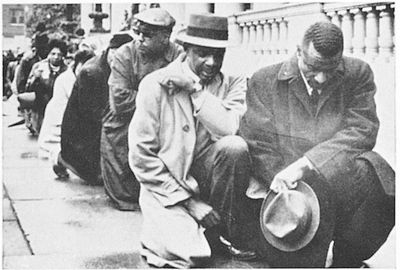
Fred Shuttlesworth leads Birmingham marchers in prayer before their arrest. (Joe Chapman)
At an organizing meeting at Harry Belafonte’s apartment in New York City, Shuttlesworth and King spoke to supporters of the situation in Birmingham, and of the risks faced by those willing to take action:
Shuttlesworth, wearing the scars of earlier battles, brought a sense of the danger as well as the earnestness of our crusade into that peaceful New York living room. Although many of those present had worked with S.C.L.C. in the past, there was a silence almost like the shock of a fresh discovery when Shuttlesworth said, “You have to be prepared to die before you can begin to live.”
Why We Can’t Wait by Martin Luther King, Jr. (p 60)
The Jewish High Holidays are an ironic time. It's the time more Jews go to synagogue than any other, yet it foregrounds a theology least likely to appeal to them, one highlighting sin and repentance, judgment and guilt. Is this a good thing?
This is not, strictly speaking, a theological question; it is a psychological one. Let us set aside the question of whether God actually exists. We know, most of us, that our images of God are metaphors, invented for our benefit. So the question really is whether this particular image—the judging God—is helpful or harmful.
To be sure, it's not an either/or decision. In Jewish tradition, God is both the dayan emet, the true judge, andharachaman, the compassionate/womb-like one. God is Mother, Father and Friend; Teacher, Consoler and Lover. For that matter, God is Everything and Nothing, Immanent and Transcendent, Earth and Sky. Surely, the Kabbalists were right that, experientially, we humans relate to the Infinite according to traits, genders, energies and perspectives that are different for different people and at different moments. So it is not that the judging God is the only God-image we have.
But on Yom Kippur, He (and He is a He) is the dominant one. So the question remains: Is it a good image to have, or a bad one?
Today, many object to the image of the judging God on the grounds of history. How can we speak of a God who judges in the wake of the outrage of the Holocaust? Surely, this objection argues, whatever we may wish to say about God, we cannot say that God judges fairly.
Others object to the image on the bases of gender, politics and family psychology: This judging God is like an abusive father (or husband), they say, meting out punishment and doling out rewards from above. We would all be better off without such an exemplar of abuse, patriarchy and hierarchy.
Still others, and I may be among them, object to the image of the judging God on psychological grounds. Much of what we ascribe to noble motives of repentance is really just guilt warmed over. I learned this the hard way, as I came to accept my sexuality, and slowly understood that so much of my own theological talk was just plain old guilt and self-hatred.
This is true for all of us. Is it really such a healthy thing to feel oneself to be inadequate, judged and deficient? Does it really make us better people, or does it just make us tougher, more defensive and more judgmental ourselves? Does it comport with mystical experience, which radiates acceptance and compassion? Does God judge us, or only love?
I do not have a neat answer to these questions, but I want to suggest that while the judging God is an image of God that is experientially accurate, it is ultimately something to be transcended.
First, guilt is part of human nature, and not an entirely bad part; it keeps us honest, checks the ego, and reminds us that we all have the capacity to be selfish and cruel. The judging God, in this light, is simply the superego projected toward the heavens; it accords with our experience of remorse. And as a form of social control, it is an effective story that doubtless keeps many of us from acting on our baser instincts. It just needs periodic updating from time to time.
But the essential part of this image, particularly on Yom Kippur, is that it is not a static one. God judges in order to inspire us to change, in order that God can forgive. Again, let's stay with experience, not myth. The point is that we judge ourselves so that we can introspect, right our wrong behaviors, taste the sweetness of forgiveness—and then move on. The catharsis of Yom Kippur serves its function, and then ends. The shofar is sounded, the book is closed, the process is complete.
Or is it? Actually, the tradition says, the book is really open for another couple of weeks. And God is always watching you and always judging. And it never ends. I remember, during my more observant days, debating whether to eat non-kosher-supervised cheese, a legal debate that goes on within the Conservative movement to this day. Believe it or not, I really racked my brain and searched my heart over this technicalhalachic issue. The rules seemed nonsensical. But was I just trying to rationalize doing what I wanted? Did God really care? Was the system out of whack, or was I being lazy and indulgent?
Today, the whole thing looks like neurosis. Yes, there's a certain nobility to suffusing every aspect of one's life with holiness and participating in a millennia-old tradition of law. But all this angst—about cheese! Couldn't the emotional energy be better spent on giving more money to the poor, rectifying the sins of racism and sexism, or, well, just about anything? Is the sense of God's judgment helping us do what's right, or making us neurotic about anything and everything?
The narrative arc of judging-introspection-forgiveness remains, for me, an important one, because it calls attention to my own tendency to judge myself and my attendant need to forgive. But if it gets stuck in the middle, it turns into craziness.
It would be funny, if it weren't tragic. Because with judgment comes—if we judge ourselves worthy—arrogance, self-justification and the judging of others, or—if we do not—self-hatred, anxiety and defense mechanisms aplenty. We make ourselves tough, argumentative and always right because we fear that otherwise we will be found lacking.
The judging God is a stage along the psychological path, both individually and communally. It is important to hold ourselves to a high standard of ethical, and possibly ritual, behavior. But at a certain point, it becomes more important to forgive ourselves for not meeting that standard—and, as a culture, to learn to be more loving and understanding, less judgmental and strict. Of course, there are always personal and political instances where strictness is appropriate. But do we really think that what the world needs now is more judgment?
It's a shame that so many Jews go to shul only on the Days of Awe. I wish they would turn up for the Days of Love, Rest and Celebration (Sukkot and Shabbat are good starts, as are meditation retreats). Those, it seems to me, are what we need more of: more love, more authenticity, more openness. And they yield experiences of something which deserves to be named as "God."
When love, rather than judgment, fills my heart, I see a natural world which we are lucky to inhabit, in bodies which are miraculous in construction, and I feel loved in return. I feel the imperative to pursue justice, not out of judgment or toughness, but out of compassion. Terrible things still happen. But I feel God's presence in the companionship and response to such adversity, in intimacy, in love, in the healing and the mending.
About the Author
Jay Michaelson is the author of God vs. Gay? The Religious Case for Equality. He is a writer, scholar, and activist whose work addresses the intersections of religion, sexuality, spirituality, and law. Follow him on Twitter at @jaymichaelson and visit his website.
“With extraordinary grace and clarity, Anita Hill weaves the story of her family with that of other American families struggling to find and define homes for themselves. What emerges is a powerful story of our nation’s ongoing quest for equality of opportunity, viewed through the eyes of the people who have been deeply engaged in that quest. Beautifully written, elegantly seen, compellingly argued.” –Robert Reich
From the heroic lawyer who spoke out against Clarence Thomas in the historic confirmation hearings twenty years ago, Anita Hill's first book since the best-selling Speaking Truth to Power.
In 1991, Anita Hill's courageous testimony during the Clarence Thomas confirmation hearings sparked a national conversation on sexual harassment and women's equality in politics and the workplace. Today, she turns her attention to another potent and enduring symbol of economic success and equality-the home. Hill details how the current housing crisis, resulting in the devastation of so many families, so many communities, and even whole cities, imperils every American's ability to achieve the American Dream.
Hill takes us on a journey that begins with her own family story and ends with the subprime mortgage meltdown. Along the way, she invites us into homes across America, rural and urban, and introduces us to some extraordinary African American women. As slavery ended, Mollie Elliott, Hill's ancestor, found herself with an infant son and no husband. Yet, she bravely set course to define for generations to come what it meant to be a free person of color. On the eve of the civil rights and women's rights movements, Lorraine Hansberry's childhood experience of her family's fight against racial restrictions in a Chicago neighborhood ended tragically for the Hansberry family. Yet, that episode shaped Lorraine's hopeful account of early suburban integration in her iconic American drama A Raisin in the Sun. Two decades later, Marla, a divorced mother, endeavors to keep her children safe from a growing gang presence in 1980s Los Angeles. Her story sheds light on the fears and anxiety countless parents faced during an era of growing neighborhood isolation, and that continue today. In the midst of the 2008 recession, hairdresser Anjanette Booker's dogged determination to keep her Baltimore home and her salon reflects a commitment to her own independence and to her community's economic and social viability. Finally, Hill shares her own journey to a place and a state of being at home that brought her from her roots in rural Oklahoma to suburban Boston, Massachusetts, and connects her own search for home with that of women and men set adrift during the foreclosure crisis.
The ability to secure a place that provides access to every opportunity our country has to offer is central to the American Dream. To achieve that ideal, Hill argues, we and our leaders must engage in a new conversation about what it takes to be at home in America. Pointing out that the inclusive democracy our Constitution promises is bigger than the current debate about legal rights, she presents concrete proposals that encourage us to reimagine equality. Hill offers a twenty-first-century vision of America-not a vision of migration, but one of roots; not one simply of tolerance, but one of belonging; not just of rights, but also of community-a community of equals.
These two statements, the first by Jon Kyl, a U.S. Senator, the second by Michelle Bachmann, a Congresswoman who is also a Presidential candidate, have each received wide public attention. Each of these statements is blatantly untrue. These statements are a disturbing reminder that the field of reproductive health is particularly susceptible to politicians playing fast and loose with the truth in order to curry favor with social conservatives.
Reproductive health services have always stirred controversy, intersecting as they do with issues of sexuality, morality, parental rights, and so on. But it was during the presidency of George W. Bush that the attacks on this aspect of health care—especially abortion care—became increasingly disengaged from the truth.
As I have detailed in my recent book, Dispatches from the Abortion Wars, the Bush Presidency was marked by scandals such as government websites being pressured to list false information on the alleged links between abortion and breast cancer, and the purported ineffectiveness of condoms. An investigation of the curricula used in federally funded “abstinence only” programs found shocking evidence that some 80% of these programs gave misinformation to young people, such as “sweat and tears can lead to HIV transmission.”
The reproductive health community hoped that with the transition to a new administration these egregious distortions would stop. And in some respects the situation has improved. In the thank-goodness-for-small-favors department, we can be gratified that government websites no longer post such gross misinformation. But clearly, as the two quotes above make clear, untrue and irresponsible statements about reproductive health matters have not gone away in public discourse.
In the case of Senator Kyl’s statement, Planned Parenthood restated its frequent claims that abortions constituted 3% of its services, not the 90% the senator had claimed. The incident concluded, to the delight of many late-night comedians, with a Kyl spokesman acknowledging that “the senator’s remark was not intended to be a factually based statement.”
In the case of Congresswoman Bachmann’s “mental retardation” claim, this statement clearly proved to be a costly, possibly fatal error for her politically. Numerous commentators, including medical authorities, pointed to the complete lack of evidence for any link between the HPV vaccine and retardation. Bachmann appeared to worsen the situation when she responded to the growing backlash by stating defensively, ”I am not a doctor, I’m not a scientist, I’m not a physician. All I was doing is reporting what this woman told me last night…”
The dangers of non-factually based political discourse
Why do these untrue statements matter? After all, presumably most people—most importantly, the millions of women who go to Planned Parenthood for contraception, cancer and STI screenings—know Kyl was massively off base. Michelle Bachmann’s statement was roundly disputed by experts and seemingly has damaged her political fortunes. Nonetheless, I believe statements like these do very much matter. The normalization of lying about health care issues by prominent figures is a very serious breach of trust, and degrades our culture as a whole.
More specifically, these statements point to two different ways in which the field of reproductive health can be weakened by such deliberate distortions. In the case of Planned Parenthood, the attacks by Kyl and numerous other politicians who have sought to demonize the Federation have created a clever rhetorical trap, where the defense becomes, as shown above, that “only 3% of what we do is abortion.” In a version of the old “have you stopped beating your wife” question, these attacks succeed in further marginalizing abortion from other reproductive health care services in the public’s eye.
The serious damage done by Bachmann’s HPV anecdote is best illustrated by a headline that appeared shortly afterward in the New York Times Science Section: “Remark on HPV Vaccine Could Ripple for Years.” The article makes clear the dismay felt in the public health community about this incident.
In simplest terms, as the author puts it, “When politicians or celebrities raise alarms about vaccines, even false alarms, vaccination rates drop.” The HPV vaccine—most effective when given to young girls at ages 11 or 12, before they have started sexual activity—was already quite controversial, because some in the public felt it was a “license” for promiscuity (and there is increasing distrust of vaccines generally among some parent groups). As a result, even before the Bachmann remark, uptake of the vaccine was below expectations. Now, as a member of the American Academy of Pediatrics quoted in NYT article put it, “These things [politicians' misstatements] always set you back about three years, which is exactly what we can’t afford.”
She was pretty upfront about it: she didn’t want me there.
“It’s not you personally,” Marge explained. “It’s the book.”
Marge was the moderator, researcher, engine, really, of a local reading group. She was good at what she did, I was told, and I believed it. She was pretty thorough at listing all the reasons why she didn’t want to read or recommend to the group my book I Don’t Wish Nobody to Have a Life Like Mine: Tales of Kids in Adult Lockup, about my ten years teaching teenagers in adult detention.
“The title, for one. It’s all wrong. Even the third graders I used to teach would know that it wasn’t correct,” she started off. “It’s just poor grammar. And what about that cover? It put me off.”
I happened to think Beacon Press did a terrific job with the cover—the title, in hip-hop script on a blue background and, in profile, the photograph of a young African American male, sixteen at most, looking out at the reader with a somewhat challenging look yet with the inevitable vulnerability of any teenager.
But I knew where Marge was headed.
“Besides, I don’t like the topic, sounds too depressing,” she said. And then she got blunt. “What’s it got to do with me?”
I’d heard the objections before, although not quite so frankly stated. I did some mild reassuring, but I didn’t work at it. I knew that Marge had called to invite me to speak to the group despite her opposition. Two friends who were a part of the book club had read the book, liked it, and lobbied for it.
When I arrived at the community center the night of my talk, I thought things might have changed.
“We don’t usually do refreshments, but I thought this time it might be nice,” Marge said, greeting me warmly at the door, then leading me to a table covered with plates of home-baked cookies and pastries, a coffee urn, and two pitchers of fresh-squeezed lemonade.
And indeed things had changed. At first when Marge introduced me, she was true to form. I winced as she laid out all her objections and doubts about the book in excruciating detail. “Oh boy, what kind of night is this going to be?” I thought.
But then, with equal clarity, Marge told the group of about thirty how the book had changed her thinking and answered all her doubts. How she understood now that the title reflected the fractured yet still human lives of many of the kids I wrote about, especially Ray, the young man who was damaged by years of abandonment and drugs, and from whom I took the quote for the title. She said how the cover itself mirrored these kids’ lives—on the one hand it showed the fragile world of childhood with the book jacket’s blue background and playful lettering, and on the other, the gritty world of the streets with that scowling, discontented-looking young man. How, yes, the stories that she expected to depress and alienate her did make her sad at times, as she learned about these children’s lives in and out of jail. Yet at the same time they made her smile and laugh and admire those same children for their resilience and generosity and willingness to forgive society for what it had done to them, although society didn’t forgive the children for their mistakes.
“It was pretty obvious to me by the end of the book that I had a lot more in common with those kids than I could ever have imagined,” Marge concluded.
Listening to Marge, I smiled to myself and began to wonder why I’d made the trip there (well, there were those delicious-looking brownies), since she was telling the group all the things I would have said.
And I wondered if Marge realized that what had happened to her is what I always hoped would happen whenever I handed one of my locked-up students a book: their perceptions of the world would shift; that places they’d never been to, were excluded from, would open up to them; that people they’d never gotten the chance to meet, or who they refused to meet because of all the protective barriers they put up, would suddenly became more like them than they could have ever realized.
I didn’t think Marge, now, after reading the book, would mind being in the company of Warren, who, finally, at the age of fifteen and reading on a fourth-grade level, had completed his “first-ever book,” as he put it, or Frankie, who made it through a long stint in solitary confinement devouring the novels (all good ones, I might add) I brought him; or Larry, who began to see that even a life like his wasn’t foreign to the pages of literature after he finished reading Richard Wright’s Black Boy.
Readers like Marge and Warren and Frankie and Larry and all the others out there are the reasons why writers like me write their books and why teachers like me stay in the classroom despite the struggles. We want to do nothing less than change the world (and a few hearts while we’re at it) book by book.
For an elite group of American CEOs, sacrifice is for chumps.
As the nation struggles with budgetary constraints, Congress has exempted a group of imperial CEOs and their companies from contributing to the solution.
One special group of CEOs enjoys huge compensation packages while presiding over companies that pay little or no taxes. Twenty-five companies paid their CEOs more last year than they paid in U.S. corporate taxes, according to a new report from the Institute for Policy Studies that I co-authored.
Instead of building better products or providing superior customer service, they spend millions to lobby Congress to change the tax laws so they don't have to pay.
The ranks of these profitable tax dodgers include Honeywell, General Electric, Verizon, eBay, International Paper, Boeing, Dow Chemical, Ford Motor, and Qwest Communications.
John Lundgren, the CEO of toolmaker Stanley Black and Decker, got a 234 percent pay hike in 2010, bringing his compensation to $32.6 million. Meanwhile the company is shedding thousands of jobs and moving more operations and profits offshore. They have 50 subsidiaries in offshore tax havens. Instead of paying taxes, they collected a $75 million refund.
Twenty of these 25 companies spent more money lobbying than they paid in taxes. When confronted by their tax dodging, their PR flaks complain, "We are just obeying the law." Last year, these 25 companies spent $150 million to influence the law, through lobbying and campaign expenditures.
These companies win gold medals in accounting gymnastics, using subsidiaries in low- or no-tax countries to avoid their tax obligations. Here's how the game works: A corporation pretends its profits are earned in offshore subsidiaries while its losses are incurred in the United States. At tax time, these corporations report to Uncle Sam that all they have are losses. Together, these 25 companies have 556 subsidiaries in tax havens like the Cayman Islands, Ireland, and Bermuda.
These U.S.-based companies use our taxpayer-funded infrastructure, including roads, bridges, broadband, and transportation. They benefit from taxpayer-funded research and spin-off products like the Internet, advanced jet engines, and drug research. Their corporate assets are protected by the U.S. military, police departments, and firefighters — and they rely on our U.S. justice system to defend their intellectual property.
Yet 20 of these companies paid no taxes in 2010. They didn't chip in one dime to pay for the services they enjoy — and that contribute enormously to the success of their businesses. Five companies paid symbolic amounts of taxes, less than the paychecks of their CEOs. But most, in fact, collected checks from Uncle Sam.
We taxpayers just hired Boeing for $35 billion to build new aircraft for the U.S. military. Honeywell also receives huge U.S. government and military contracts. But we don't require either company to pay a nickel for national defense or public services.
As wages for most Americans have remained stagnant over the last several years, these imperial CEOs saw their compensation jump 27.8 percent between 2009 and 2010. The average CEO of an S&P 500 company collected $10.8 million in compensation. But the CEOs of these notorious tax dodgers were paid an average of $16.7 million in 2010.
Shareholders should reward CEOs for building better products or delivering better services, not for accounting gymnastics that game their tax bills down. Shareholders at Stanley Black and Decker are trying to reverse their CEO's pay grab.
Congress should pass the Stop Tax Haven Abuse Act, which would generate an estimated $100 billion in revenue annually. It would save jobs at patriotic U.S. companies that are forced to unfairly compete with corporate tax dodgers on an unlevel playing field.
Our nation needs all hands on deck, with everyone pulling their weight to address our fiscal challenges. As we try to recover from the worst economic depression since the 1930s, middle-class taxpayers and domestic businesses shouldn't have to carry these slacker companies on their backs.
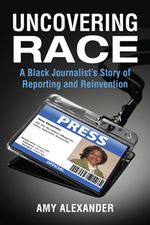 From an award-winning black journalist, a tough-minded look at the treatment of ethnic minorities both in newsrooms and in the reporting that comes out of them, within the changing media landscape.