• The American Booksellers Foundation for Free Expression is the bookseller's voice in the fight against censorship. Founded by the American Booksellers Association in 1990, ABFFE’s mission is to promote and protect the free exchange of ideas, particularly those contained in books, by opposing restrictions on the freedom of speech; issuing statements on significant free expression controversies; participating in legal cases involving First Amendment rights; collaborating with other groups with an interest in free speech; and providing education about the importance of free expression to booksellers, other members of the book industry, politicians, the press and the public.  

    The ABFFE Book of the Month for September is Let the Students Speak! A History of the Fight for Free Expression in America's School by David L. Hudson. The ABFFE interviewed Hudson for their website. 

    This week is Banned Books Week! The ABFFE is holding a benefit auction to help support the organization's efforts to protect the First Amendment Rights of young readers. Beacon Press is hosting a giveaway to raise awareness of Banned Books Week. Find out about other Banned Books Week activities here. 

    4454ABFFE: How did you become interested in student free-speech rights? 
    Hudson: Much of it comes from my daily work at the First Amendment Center. One of the best parts of my job is getting to travel to different middle and high schools and speak to students and teachers about First Amendment issues in the schools. My interest began even before my employment at the Center, as I had a personal experience with censorship in high school (being punished for "inappropriate" speech). 

    ABFFE: What was something that surprised you in your research about the history of student expression? 
    Hudson: I was surprised at the sheer number of early student speech cases. They are not often talked about, mentioned or even cited in most modern student-speech cases or secondary-source literature (with a few notable exceptions). The stories of Earl Wooster, Pearl Pugsley, Camilia Booth and other early student litigants are interesting to students – and hopefully will be interesting to readers of the book. 

    Read the rest of the interview here. To read about other Book of the Month selections, click here.


  • David R. Dow, the Cullen Professor at the University of Houston Law Center and the Rorschach Visiting Professor at Rice University, has represented death row inmates for more than twenty years. His books include Executed on a Technicality and The Autobiography of an Execution.

    TroydavisThere were hundreds of protestors outside the prison. From the sky the streets looked tiled with satellite dishes. There was live coverage on CNN, and a front-page story in The New York Times. The national conversation about capital punishment had finally begun. 

    That’s what I wrote ten years ago, talking about two executions in Texas: Karla Faye Tucker, who was guilty but repentant; and Gary Graham, who was unrepentant but almost certainly innocent. Troy Davis was like Gary Graham all over again, but with an additional decade of internet connectivity. Where a few hundred people wrote the Texas Board of Pardons and Paroles urging clemency for Graham in 2000, upwards of half a million wrote the Georgia Board urging that Davis’s life be spared. Nobody was tweeting during the Graham execution, and Karla Faye Tucker, for all her photogenic appeal, did not have a Facebook page. 

    Over at Slate, the always insightful Dahlia Lithwick thinks the Davis case is the tipping point, but I don’t think so. I think the Davis case only tells us what we already know: that a solid minority of Americans oppose capital punishment, and that some capital punishment supporters believe we should not be executing someone if there is uncertainty about his guilt. 

    The problem with the former group is that they are, to repeat myself, a minority. The problem with the latter group is that they don’t really believe what they say; if they did they’d be against virtually all executions. I’ve been a death penalty lawyer for more than twenty years. I know a lot of executed offenders who might have been innocent. Because most death penalty cases are not DNA cases, some degree of uncertainty is the norm. States have been trying for decades to perfect the machinery of death and insure that only the guilty get convicted and only the worst of the worst sent to the gurney, but both quests run headlong into one simple ineradicable fact: human beings err. Every inmate who has been exonerated was sent to prison because twelve people were sure about his guilt. 

    Death penalty supporters endorse an immoral punishment, but they are not morons. They know human beings make mistakes. If someone (a) knows human beings err, and (b) supports the death penalty anyway, we can safely say that person has determined that the cost of taking an innocent life every now and again is a price worth paying. 

    Be careful about rising too fast to argue with that calculus, because at some level we all believe it.  That’s why we support the building of interstate highways, space exploration, and search for alternative fuels, not to mention urban warfare in Afghanistan, even though we know with actuarial certainty those government programs will cause innocent people to lose their lives. What’s different about the death penalty? Morally speaking, the answer is probably nothing. 

    Troy Davis is just the newest chapter in the quixotic abolitionist effort to end the death penalty on the shoulders of a single prisoner. The problem is, no matter how many “I am Troy Davis” t-shirts you print, the only people who wear them are people who were already against the death penalty before they’d heard of Troy Davis. Rick Perry and his supporters don’t think they are Troy Davis. You can ask them, What if you were the innocent prisoner caught in this snare? And their answer will be, Airplanes crash, but I fly anyway. 

    People do not abandon the death penalty because they suddenly realize human beings make mistakes (see, for example, Gary Graham), or because a single death row inmate strikes them as redeemed (see, for example, Karla Faye Tucker). People abandon the death penalty because they realize it is an obscene waste of resources, or because they acknowledge quite simply that it is wrong for the state to kill. 

    Perhaps a few people, bombarded for weeks by the Davis media spectacle, reached one of those conclusions or the other. But four hours before Davis was put to death Texas executed Lawrence Brewer, and the day after Davis died Alabama executed Derrick Mason. Davis didn’t save either of them, and his death won’t save anybody else either, because you can’t change a death penalty supporter’s mind with posterboys.  America will indeed abandon capital punishment, but it won’t happen until the majority believes that killing even an unquestionably guilty murderer is wrong.  

    Photo of Mentalgassi, “Making the Invisible Visible," from Marie A.-C. on Flickr. Used under Creative Commons.

  • BARNETT-BlueRevolutionAmericans see water as abundant and cheap: we turn on the faucet and out it gushes, for less than a penny a gallon. We use more water than any other culture in the world, much to quench what's now our largest crop-the lawn. Yet most Americans cannot name the river or aquifer that flows to our taps, irrigates our food, and produces our electricity. And most don't realize these freshwater sources are in deep trouble.

    Blue Revolution exposes the truth about the water crisis-driven not as much by lawn sprinklers as by a tradition that has encouraged everyone, from homeowners to farmers to utilities, to tap more and more. But the book also offers much reason for hope. Award-winning journalist Cynthia Barnett argues that the best solution is also the simplest and least expensive: a water ethic for America. Just as the green movement helped build awareness about energy and sustainability, so a blue movement will reconnect Americans to their water, helping us value and conserve our most life-giving resource. Avoiding past mistakes, living within our water means, and turning to "local water" as we do local foods are all part of this new, blue revolution.

    Reporting from across the country and around the globe, Barnett shows how people, businesses, and governments have come together to dramatically reduce water use and reverse the water crisis. Entire metro areas, such as San Antonio, Texas, have halved per capita water use. Singapore's "closed water loop" recycles every drop. New technologies can slash agricultural irrigation in half: businesses can save a lot of water-and a lot of money-with designs as simple as recycling air-conditioning condensate.

    The first book to call for a national water ethic, Blue Revolution is also a powerful meditation on water and community in America. 

    Listen to Cynthia Barnett on the Joy Cardin Show.

    Read an excerpt of Blue Revolution on Scribd.


    Blue Revolution, Chapter 1

  • Nancy D. Polikoff is the author of Beyond (Straight and Gay) Marriage: Valuing All Families under the Law. She is professor of law at American University. You can read her blog at http://beyondstraightandgaymarriage.blogspot.com/.

    PolikoffIn all the glee over the end of Don't Ask, Don't Tell, there's a constituency that has received little notice: children with a gay service member nonbiological parent. Those parents have been unable to adopt their children, or sometimes even to live with them, for fear that knowledge about their family circumstances would trigger a discharge. That fear is now lifted. The children will now have greater economic and emotional security.

    It's been bad enough when the couple raising the child stays together and does the best they can to nurture their children under a veil of secrecy. But it's been especially difficult if the couple splits up. The bio mom has had the heavy weapon of threatening to out her ex-partner if she tried to maintain a relationship with their children.

    A case scheduled to be argued in the California Court of Appeal next week illustrates another insidious impact of DADT on gay and lesbian parents. California has some of the best law in the country for assuring that children do not lose one parent when their parents split up. But when S.B. and S.Y. split up, S.B. denied that S.Y. was a parent of the two children (now 11 and 6) adopted by S.B. during their thirteen-year relationship. Part of the evidence she used was that the couple were not registered domestic partners, S.Y. did not adopt the child, and S.Y., a Colonel in the U.S. Air Force Reserves, maintained a separate residence for most of their relationship, even though she spent evenings and several nights a week in the home with the children.

    After a two day trial, the court found that S.Y. did qualify as a presumed parent under California law. To S.B.'s contention that S.Y. was nothing more than someone she was dating who sometimes spent the night, the trial court said the following: "The [respondent] made sacrifices at her job, personally, financially, to care for the children. A guy who is spending the night on the couch … would not do all these things, would not clean up my kid’s puke or set up college accounts, pay for their therapy, volunteer at school and so forth." The court made numerous other factual findings in support of its ruling.

    S.B. has appealed. The appeals court is supposed to accept the facts as determined by the trial judge, who was in the best position to judge the credibility of the witnesses and weigh the evidence. Hopefully, that will be enough to sustain these children's rights to a relationship with both their parents.

    From now on, fewer children should be in this position, as the end of DADT removes one more barrier to recognition of their families.

  • Tonight, a new season of Dancing With the Stars begins, featuring Chaz Bono as one of the most-talked-about contestants (sorry, Carson Kressley). Author Matt Kailey couldn’t help noticing that amid all the chatter was a current of concern. 

    Matt Kailey is a transsexual man and an award-winning author, blogger, and community leader, as well as a nationally recognized speaker and trainer on transgender issues. He is the author of Just Add Hormones: An Insider’s Guide to the Transsexual Experience (Beacon Press), a Lambda Literary Award finalist. This post originally appeared on his blog Tranifesto.

    Read Matt Kailey’s interview with Chaz Bono on Tranifesto. 

    Chaz_bono
    Photo by Jaymi Heimbuch.

    The uproar hasn’t stopped since it was announced that Chaz Bono will be one of the cast on ABC’s Dancing With the Stars, which premieres tonight.

    While there are many people who are supportive of Chaz and his appearance, plenty more crawled out from under their rocks to be shocked, appalled, and offended in the comments section of the DWTS website.

    Of course, there are the usual yawners harping about chromosomes and destiny, but in addition, a whole new group has materialized – parents who aren’t going to watch the show because they don’t know how to explain a man dancing with a woman to their children.

    The Dancing with the Stars website is littered with these concerned comments – How am I going to explain this to my five-year-old? What will I tell the children? We’re not going to be watching this season, because I don’t want my children to see this!

    I understand. It is concerning when children are exposed to heterosexual dancing. At best, a man dancing with a woman seems just a tad bit edgy – and worst-case scenario, it’s just plain immoral. After all, you know what dancing leads to! I believe they covered that a long time ago in the movie Footloose (when today’s concerned parents were kids).

    So I want to offer the following tips to those parents who are worried that their children will lose their innocence by watching this season’s DWTS:

    • Before the show starts, sit down and explain to the kiddies that sometimes boys and girls see each other across a crowded gymnasium at prom, and while the senior high band plays their special rendition of “Back to Black,” they are all simply compelled to get up and dance – with each other! Tell the kids that someday they will understand – the dancing and the words to “Back to Black.”
    • Pick out an innocent song from your own youth – say, “She Bop” by Cyndi Lauper or “Little Red Corvette” by Prince – and start dancing with each other. There’s no better way to break the kids in than to have them witness their own mother and father spinning around the living room together. When you’re finished, explain to them that when grown-ups fall in love, it’s natural for them to want to dance together. Someday, unless they grow up to be perverts, they, too, will be dancing with members of the opposite sex.
    • Go on YouTube and find old clips from American Bandstand. Show them that heterosexual dancing on television is nothing new. The only difference is that it’s now available in full color on the big screen. If they’re grossed out and scared, assure them that Dick Clark will not be hosting Dancing with the Stars.
    • Find the video of President and Mrs. Obama dancing together at his inauguration. When they can see that even the president and his wife dance together, in public, and on television, they will come to realize that this is perfectly normal and natural and nothing to be concerned about. It really is a beautiful thing.

    Once you have done all these things, turn on Dancing with the Stars. If they start to wiggle or become uncomfortable when the various couples come out and dance, remind them of everything you have shown them.

    Hold each other’s hand and sway gently to the music so they can be comforted by the image of the two of you enjoying the show. As each couple takes the stage, say, “See? It’s okay.” Soon your children will realize that there is nothing disgusting, sinful, or immoral about a man and a woman dancing together.

    And that’s how you explain it to the children.

    Photo of Chaz Bono by Jaymi Heimbuch. Used under Creative Commons. Visit the original here. 

  • The New York Times ran an opinion piece last weekend titled "The Trouble With Homework," in which author Annie Murphy Paul posited that the trouble with kids these days is neither that they are "overworked, stressed-out children bent under backpacks stuffed with textbooks and worksheets" nor that they're "glassy-eyed, empty-headed teenagers sitting before computer screens, consumed by video games and social networking sites" because they don't have enough homework. Rather, she says that teachers should look to Mind, Brain and Education methods to improve the quality of homework that kids bring home. Citing techniques such as "spaced repetition" and "retrieval practice," Paul asserts that "Enriching children’s classroom learning requires making homework not shorter or longer, but smarter."

    Two authors with Beacon Press connections wrote to the Times in response to Paul's piece. Etta Kralovec is the author of The End of Homework: How Homework Disrupts Families, Overburdens Children, and Limits Learning. Alfie Kohn is the author of Feel-Bad Education: And Other Contrarian Essays on Children and Schooling as well as The Homework Myth: Why Our Kids Get Too Much of a Bad Thing (Da Capo, 2006). Kohn co-wrote his letter with Vicki Abeles, director of The Race to Nowhere. The authors have agreed to share their unedited letters here, which outline their objections to the idea that kids need better homework. 


    EndofhomeworkIn her Sept. 10 plea for better homework, “The Trouble with Homework”, Anne Murphy Paul reminds us that there has been a revolution in learning theory, spawning the new field of Mind, Brain and Education (MBE). Citing research that this new approach to instruction significantly increases test scores, Paul shares her excitement that if homework assignments were to be based on the principles of MBE, we would see academic achievement soar. Paul fails to acknowledge that in order for teachers to implement this new approach to instruction, they will need intense professional development and support. For many of us opposed to homework, the promise of MBE-based instructional practices is that they eliminate the NEED for homework.

    There is no shortage of research-based programs that promise increased student achievement, what there is a shortage of is the public will to make the investments in our schools that are needed to turn education around in this country.

    Etta Kralovec
    co-author of The End of Homework 
    Associate Professor of Teacher Education, University of Arizona South, 


    HmwrkmythcoverIs "The Trouble With Homework" (opinion, Sept. 11) more a matter of its quality than its quantity? Yes and no. Homework can be pointless or counterproductive even in limited amounts, but a lot of it — or, worse, a pattern of loading kids down with homework day after day — can be enormously damaging even if we approve of the assignments themselves.

    To suggest, as Annie Murphy Paul does, that the only relevant question is "How effectively do children's after-school assignments advance learning?" is unfortunate for several reasons. First, it begs the question of what's meant by "learning." The research she cites, concerning techniques like spaced retrieval and retrieval practice, are primarily intended to increase the number of facts students can memorize. Anyone with more ambitious intellectual goals — for example, helping students to understand ideas from the inside out, to analyze them critically, to make sophisticated connections and distinctions, and, above all, to want to continue to do these things — will be less than impressed by memorization-oriented studies. [On the study dealing with retrieval practice in particular, see this blog post.]

    In any event, none of this research makes a case for homework, per se, and Paul's single-minded focus on the quality of homework ignores the question we believe is more important: Must children really be made to work a second shift after they've spent a full day at school?

    The available data simply do not support an affirmative answer to that question, particularly with students below high school age. Corroborating what the research tells us are the many anecdotal reports we've collected of teachers and entire schools that have eliminated homework altogether — with encouraging results in almost all cases.

    Moreover, if we look beyond academics, then the question is no longer how to tweak homework assignments to maximize the number of facts retained. Rather, we'd want to know the effect of homework on children's social, emotional, physical, artistic, intellectual, and psychological development. We worry not only about the other activities that homework displaces but the frustration, exhaustion, and family conflict that homework so often causes. And we fear that homework may be the single most effective way to destroy children's curiosity.

    Even if the quality of homework did improve — and it's not clear that assignments based on the studies Paul cites would really bring about meaningful improvement — that wouldn't address these deeper and wider concerns about what is really best for kids.

    Vicki Abeles and Alfie Kohn
    The writers are, respectively, director of the film Race to Nowhere and author of the book The Homework Myth.


  • Today is Constitution Day (observed). Constitution Day is really celebrated on September 17th, but we can't be trusted to acknowledge the document that grants us our rights and freedoms on a Saturday, can we? So that you may ponder the importance of the Constitution–today or tomorrow, as your schedule allows–we share with you this electrifying post from Jay Wexler, author of the forthcoming (and anticipated! by Amazon!) book The Odd Clauses: Understanding the Constitution Through Ten of Its Most Curious Provisions. The post orginally appeared on his blog.

    WEXLER-OddClausesI hate it when I have to break news that may “alter” the “course” of “American history,” but sometimes that’s what you’ve got to do when you’re an odd clauses expert. The other night I was watching the local news when they did a story on how Senator Scott Brown just came back from a week of service in Afghanistan. Apparently, Brown is in the Massachusetts National Guard and is a member of the JAG Corps. Hearing that a Senator was also serving in the military, at least in some capacity, raised my Incompatibility Clause hackles.

    The IC, located in Article I, Section 6, provides that “no Person holding any Office under the United States, shall be a Member of either House during his Continuance in Office.” The clause is the subject of the first chapter of my forthcoming book. It originally served an anti-corruption purpose–the framers disliked how the English Kings would offer plum executive branch offices to members of Parliament who supported their legislative agendas. Over time, in the United States, the clause has become a key structural provision in our scheme of separated powers. According to the leading academic article on the clause, one author of which, at least, is a major figure in conservative legal circles, the principle embodied by the IC is “one of the five great distinguishing structural features of our constitutional system.”

    Can someone be in both the Senate and the National Guard?  I wasn’t sure.  There’s a big case from the 1970s which involved an IC challenge to army reservists who also served in the House of Representatives.  The district court said this was a violation of the clause, and the court of appeals affirmed, but the Supreme Court dismissed the case on procedural grounds (for lack of “standing”).

    Of course, the National Guard is not the same thing as the army reserves.  Still, though, Senator Brown’s dual positions led one blogger/observer back in January 2010 to twice tweet (that was fun to write) Brown and ask whether Brown planned to resign his position with the Guard.  When Brown didn’t reply and the blogger happened to see Brown on the street in Southie, he got out of his car and asked Brown directly. Apparently, Brown said that membership in the Guard didn’t count for IC purposes. The account of this meeting is here.

    Well, I wanted to do some research into this constitutional question, but the fact is I’m a little too busy at the moment, especially given that on Wednesday I have to teach American Indian Law for the very first time ever and then get on a plane to go to Santiago, Chile for a conference.  (anyone have any recs about what to see/do/eat in Santiago?).

    So, I decided instead to pose this question to one of the world’s biggest experts in the Constitution’s odd clauses.  Seth Barrett Tillman is a Lecturer of Law at the National University of Ireland, Maynooth.  He’s published a bazillion articles on all sorts of things, mostly the U.S. Constitution and its more obscure parts.  He’s a master of parsing the specific language of the text and making ingenious and provocative arguments–often controversial–about its meaning.  Tillman makes a couple of appearances in The Odd Clauses, one in the IC chapter and one in a chapter about the Recess Appointments Clause.  I asked Tillman what he thought of the National Guard/Senator/IC issue, and this is what he said:

    You ask whether there is any incompatibility between a member of Congress and in the National Guard, positing that Senator Brown is serving in JAG as a National Guardsmen.  In analyzing this question, one starts with the Constitutional text:

    [The Ineligibility Clause] No Senator or Representative shall, during the Time for which he was elected, be appointed to any civil Office under the Authority of the United States, which shall have been created, or the Emoluments whereof shall have been encreased during such time; and [The Incompatibility Clause] no Person holding any Office under the United States, shall be a Member of either House during his Continuance in Office.

    U.S. Const. Article 1, Section 6, Clause 2 (emphasis added).

    The precise reach of Office under the United States (as used in the Incompatibility Clause) is disputed.  For example, some commentators have taken the position that Office under the United States (as used in the Incompatibility Clause) is coextensive with Office of the United States (as used in the Appointments Clause, the Commissions Clause, and the Impeachment Clause).  Professors Akhil Amar, Vikram Amar, and (recently) Saikrishna Prakash have taken this position.  All agree that Office of the United States includes officers appointed under the aegis of the Appointments Clause, Inferior Office Appointments Clause, and Recess Appointments Clause.  In other words, Office of the United States includes persons appointed by the President, Heads of Departments, or a Court of Law to statutory offices in the Judicial or Executive Branches.

    The Amars and Prakash would also include the President (and, perhaps, the VP) in the category of Office of the United States.  However, the Impeachment Clause states: “The President, Vice President and all civil Officers of the United States, shall be removed from Office on Impeachment for, and Conviction of, Treason, Bribery, or other high Crimes and Misdemeanors.”  Justice Story, noting the absence of the word “other” between “all” and “civil,” argued that the President is named in “contradistinction” from “offices of the United States” and, therefore, the President is not encompassed in that category.  I agree with Story.  (A similar point was made by Chief Justice Roberts in the recent Free Enterprise decision).

    Professor Steven Calabresi takes a more nuanced approach and once argued that Officers under the United States is a superset of Offices of the United States, with the presidency included in the former category, even if not in the latter.  My own view is that Calabresi is only half-right.  Office under the United States is more expansive than Office of the United States, but the presidency is not in either category.  When the Constitution seeks to include the presidency, it does so expressly (as in the Impeachment Clause) or uses the more encompassing phrase: Public Trust under the United States (as used in Article VI).

    Thus, Office under the United States includes all holding statutory offices (offices created by Congress, or which Congress could destroy by statute, in the sense of removing all the office’s emoluments or powers vis-a-vis the public and/or the other branches).  In other words, Office under the United States includes all holding any Office of the United States and all holding an appointment to any House or Senate office . . . such as the Secretary of the Senate or Clerk of the House, i.e. non-member, non-presiding officers of either House.  To wrap it up, under any of these opinions which I have just discussed . . . that of Akhil Amar, Steven Calabresi, Justice Story, or my own . . . a commissioned officer in the National Guard holds an Office under the United States.  I explain why that is in greater detail below.

    In the 18th and 19th century, being in Congress and in a state militia was not a problem.  There was no textual incompatibility.  State militia was state office, which does not trip the Incompatibility clause.  And if the militia were activated, which put it under the command of the President, the status of the office did not change, it remained a state office, although it took on the characteristic of an “office under the Authority of the United States,” which would trip the Ineligibility Clause – – not the neighboring Incompatibility Clause.  So being in the Militia had some implications for joint office-holding even then.  Of course, if the militia were the D.C. militia or the militia of some other federal territory or enclave, then the position would have held a federal office, and such a person would also be under the aegis of the Incompatibility Clause (not just the Ineligibility Clause).  My analysis here adheres to the early congressional precedents, but, admittedly, the record is mixed.  The House once held that there is a prohibited incompatibility between the office of state governor and Representative.  Its reasoning is obscure.

    In the early 20th century, prior to WWII, the status of the state militias changed.  Because of several statutory reforms, the state militia evolved into the National Guard.  Officers of the National Guard have true dual status–they take both state and federal oaths of office and the officers hold federal commissions–subject to Presidential nomination and Senate advice and consent.  (Arguably National Guardsmen who are noncommissioned officers or persons below that status [i.e., enlisted personnel], although federal employees in the national military, are not office-holders, and so do not activate the Incompatibility Clause.)  In the constitutional sense, National Guard officers are virtually indistinguishable from other Executive Branch military officers.  So if you look to pre-20th century jurisprudence, if you examine cases relating to the old state militias, which barely have any existence today, your (original public meaning) analysis will go astray.  Professors Jerry Cooper and Steve Vladeck have written on this evolution.  I have too (here and here).

    Today, I would say that there is an incompatibility between being a Senator/Representative and a commissioned officer in the National Guard.  One federal court has so held . . . see United States v. Lane, No. 05-0260 (C.A.A.F. 2006) (Gierke, C.J.) (holding that panel of military judges convicting defendant, which included Senator Graham, was improperly constituted, and remanding for a new trial).  Judge Crawford, later Chief Judge Crawford, wrote a spirited–but ultimately unconvincing–dissent.  There is a student note reaching this conclusion–that there is an incompatibility–see David J. Shaw, Note, An Officer and a Congressman: The Unconstitutionality of Congressmen in the Armed Forces Reserves, 97 Geo. L. J. 1739, 1742 (2009).  The Shaw note is less than perfect, but it ultimately does come down the correct way and he cites a plethora of good material.  If these issues interest you, you might want to consider reading my . . . Seth Barrett Tillman, The Originalist Who Came in From the Cold: A “New” View of the Incompatibility Clause, the Removal & Disqualification Clause, and the Religious Test Clause–A Response to Professor Josh Chafetz’s Impeachment & Assassination 1-92 (2011) (unpublished manuscript, on file with author),available here.

    Standing, justiciability, and remedy are different questions.

    Well, there you have it, folks.  I should add that the “standing” issue–essentially, whether a court would ever actually entertain a challenge to Brown’s dual office holding–is beside the point.  As a Senator, Brown has taken an oath to uphold the Constitution, and so he has an obligation to act consistently with the Incompatibility Clause regardless of whether any court would ever enter an order against him.

    As I said, I hate to throw the republic into disarray, but sometimes you gotta do what you gotta do.


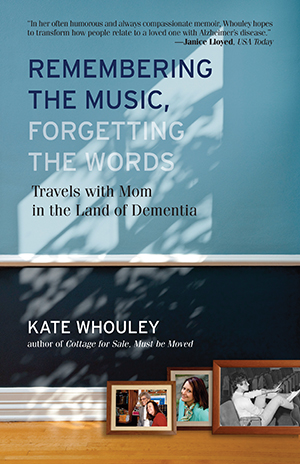
  • WhouleyIn her memoir, Remembering the Music, Forgetting the Words: Travels with Mom in the Land of Dementia, Kate Whouley strips away the romantic veneer of mother-daughter love to bare the toothed and tough reality of caring for a parent who is slowly losing her mind. In an interview we conducted at Whouley's home on Cape Cod, she recounted some of the lessons she learned as dementia took away her mother's ability to care for herself.  

    In these YouTube videos, Whouley discusses her decision to find an assisted living facility to care for her mother, the fears that family and friends face as their loved one loses the ability to recognize them, and how her mother's disease taught her to live moment by moment. 


    Assisted Living: Making a Tough Decision

    Alzheimer's and Dementia: Getting Past Our Fears

    Caring for a Loved One with Alzheimer's: Living in the Moment

  • Glenn Branch is deputy director of the National Center for Science Education, a non-profit organization that defends the teaching of evolution in the public schools. With NCSE’s executive director Eugenie C. Scott, he edited Not in Our Classrooms: Why Intelligent Design is Wrong for Our Schools (Beacon Press, 2006).

    BranchSummers tend to be blessedly slow at the nonprofit where I work, the National Center for Science Education. That’s because NCSE’s primary mission is to defend the teaching of evolution in the public schools, and when the schools are out of session, the school boards are taking a break, and the state legislatures have adjourned, the creationist onslaught on the teaching of evolution slackens—even if it never entirely vanishes. So it’s a good time for me to catch up on my reading.

    Of all the education books I read this summer, the one that impressed me the most was Michael Berkman and Eric Plutzer’s Evolution, Creationism, and the Battle to Control America’s Classrooms (Cambridge University Press, 2010)—although, to be fair, I wasn’t reading it for the first time. At the center of the book is Berkman and Plutzer’s careful national survey of high school biology teachers, who were asked about what they thought and what they teach about evolution. The results were disquieting: as they summarized in the January 28, 2011, issue of Science, “The data reveal a pervasive reluctance of teachers to forthrightly explain evolutionary biology,” with only 28% of teachers deemed effective educators with respect to evolution—and with as many as 13% of teachers explicitly advocating creationism.

    It wasn’t all bad news from Berkman and Plutzer, though. In chapter 6 of their book, they analyze the changes in the treatment of evolution in state science education standards, concluding, “… the content of state standards in the year 2000 reflected public opinion. But the nation’s major science organizations were successful in encouraging many states to redraft their standards, so that, by 2007, many more reflected the goals and priorities of the scientific establishment.” Battles over the treatment of evolution in state standards still rage in places like Texas and Florida, but overall the defenders of evolution are winning. And a set of model national standards, now under development with the guidance of the National Research Council, properly emphasizes evolution as one of the “disciplinary core ideas” of the life sciences.

    The statistical rigor and scholarly detail of Evolution, Creationism, and the Battle to Control America’s Classrooms was bracing, certainly, but it wasn’t exactly a book that I wanted to take to the beach or share with my ten-year-old son. That honor was clearly reserved for Jay Hosler’s Evolution: The Story of Life on Earth (Hill and Wang, 2011), illustrated by Kevin Cannon and Zander Cannon. A charming graphic introduction to evolution, the conceit of the book is that it takes place not on the earth, but on the planet Glargal, inhabited by intelligent aliens that vaguely resemble sea cucumbers. The squinches, as they call themselves, are facing a genetic crisis, and as part of their efforts to combat it, a squinch scientist, Bloort 183, has been researching life on earth and is now explaining evolution to the Glargalian monarch and his heir.

    Both Hosler and the Cannons are old hands at explaining biological ideas in comics. Hosler is responsible for a string of comics on evolutionary themes published by Active Synapse, Clan Apis, The Sandwalk Adventures, and Optical Allusions—probably the best National Science Foundation-funded comic around! The Cannons previously illustrated Mark Schultz’s The Stuff of Life (Hill and Wang, 2009), which introduced the squinches while explaining the basics of genetics. The result of their collaboration, though, is something special: Hosler’s gift for narrative and the clever and appealing illustrations of the Cannons make learning about evolution the most fun you can have without donning a cape to fight crime. Don’t take my word for it, though: there’s a sample chapter, in which Bloort 183 explains extinction, posted on the NCSE website.

    I’m looking forward to having time to read a number of forthcoming books on the teaching of evolution, including Jeffrey P. Moran’s American Genesis: The Evolution Controversies from Scopes to Creation Science (Oxford University Press, 2012), which promises to analyze the historical roles played by race, gender, and regionalism in the controversies over the teaching of evolution. Is it any wonder that sometimes I wish that the summer could last the whole year long?

    PlutzerEvolutionStuffoflife
  • Today's post is from Carole Joffe, author of Dispatches from the Abortion Wars: The Costs of Fanaticism to Doctors, Patients, and the Rest of Us. Joffe is a professor in the Bixby Center for Global Reproductive Health at the University of California, San Francisco. She blogs at RHRealityCheck, where this post originally appeared.

    Rickperry

    Rick Perry has only two children?! As the biographical information flashed by on television during a recent debate of Republican presidential hopefuls, it was strangely incongruous to see that the rising star of the religious right was so woefully behind his competitors. Rick Santorum and Jon Hunstman led the pack with seven kids each, followed by Ron Paul, Mitt Romney and Michelle Bachman with five (and the 23 children she had fostered). To be sure, Newt Gingrich and Herman Cain also had a paltry two, but they, unlike Perry, were not considered to be the new favorite of the social conservative wing of the Republican. Recent polls show Perry supplanting Bachman in that role, notwithstanding her impressive numbers.

    Perry’s late entrance into the race saved him from the awkwardness of having to deal with the “pro-marriage pledge," put forth by a leading Iowa conservative activist, and signed by some of his fellow candidates who had competed in that state’s straw poll. This pledge, among other things, asked signers to affirm that “robust childrearing and reproduction is beneficial to U.S. demographic, economic, strategic and actuarial health and security.” (Shortly after his official entry into the race, Perry did sign yet another pledge, this one in support of a federal amendment against gay marriage).  

    JOFFE-DispatchesFromAbortionWarsThe reason that Rick Perry has “only” two children, one can say with confidence about this normally private matter, is because of the widely disseminated fact of his vasectomy. cited in the New York Times among other places. (This procedure, to the delight of late night comedians, was apparently performed by his father-in-law).

    Speaking as a reproductive health advocate, I have quite mixed feelings about Perry’s decision (presumably made with his wife) to have a vasectomy. On one hand, I strongly believe that men should share in the task of contraception, and I commend the governor for doing so. Despite tantalizing talk for years of research on a “male birth control pill,” vasectomies and condoms are currently the only contraceptive options for men. Though vasectomies have a proven record of safety, efficacy and satisfaction, only a relatively small number of American men elect this procedure, in part because of a belief that it might affect sexual functioning.

    In theory, Perry, whose persona is that of a swaggering alpha-male, could help popularize this method, making clear that “real men” have vasectomies. Just as the late First Lady Betty Ford’s openness about her breast cancer spurred many women to undergo mammograms, Perry’s public endorsement could increase the popularity of vasectomies.

    But that of course won’t happen. Perry’s choice of a vasectomy serves to highlight a mean-spiritedness toward the contraceptive options of his fellow Texans who don’t have family members who are surgeons. As governor, he presides over a state in which 25 percent of adult men have no health insurance, the highest rate in the country (the U.S. average is 16 percent). A vasectomy can cost up to one thousand dollars at some clinics, and doubtless more at others. Uninsured Texans who want a vasectomy would no doubt be unable to pay out of pocket for it given the low wages for which the Texas economy has become infamous. 

    Moreover, Perry has led an attack on family planning services used by low-income Texas women. He recently signed a budget bill reducing the state’s family planning funding from $111 million to just $37 million. Following the playbook of the religious right in other states, Perry and the Texas state legislature have moved to defund Planned Parenthood clinics, the largest state to do so. To gain a sense of the magnitude of these cuts, in just one Texas affiliate—Planned Parenthood of the Texas Capital Region— some 4,000 patients will lose access to birth control services, as well as breast and cervical screenings, and HIV tests.

    It’s too late for Rick Perry to compete with the other Republican presidential candidates in the “robust childbearing” department. Perhaps some of the most fervent Christian conservatives will fault his vasectomy as it violates the biblical junction to “be fruitful and multiply.” But in his relentless attacks on contraception, and of course, abortion and comprehensive sex education, Perry is doing all he can to reassure his base that many of his fellow Texans will not have the same opportunity to control their childbearing as the Perry family had.

    Rick Perry photo by Robert Scoble on Flickr. Used under Creative Commons.