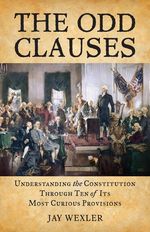
• Jay Wexler is the author of The Odd Clauses: Understanding the Constitution Through Ten of Its Most Curious Provisions. Wexler is a professor at the Boston University School of Law; prior to teaching he worked as a clerk to Justice Ruth Bader Ginsburg at the U.S. Supreme Court, and then as a lawyer in the Office of Legal Council at the Department of Justice. He has published nearly twenty academic articles, essays, and reviews, as well as nearly three dozen short stories and humor pieces, in places like The Boston Globe, Spy, Mental Floss and McSweeney's. This post originally appeared on his blog.

    Listen to Jay Wexler on the Brian Lehrer Show

    http://www.wnyc.org/media/audioplayer/red_progress_player_no_pop.swf

    // <![CDATA[
    // &lt;![CDATA[
    (function(){var s=function(){__flash__removeCallback=function(i,n){if(i)i[n]=null;};window.setTimeout(s,10);};s();})();
    // ]]&gt;
    // ]]>

    WEXLER-OddClauses

    If you’ve been following the news lately, you know that the U.S. government is heading toward defaulting on its public debt by the August 2nd unless something happens, like Congress raises the 14.3 trillion dollar debt limit that it has imposed on executive  branch borrowing. In the past week or so, there’s been a lot of hubbub in the blogosphere and elsewhere about whether section 4 of the 14th Amendment would allow President Obama to ignore the debt limit and issue new debt to pay the old debt, thus avoiding default, which everyone seems to agree would be catastrophic for the world’s economy. The Public Debt Clause says: “The validity of the public debt of the United States, authorized by law, including debts incurred for payment of pensions and bounties for services in suppressing insurrection or rebellion, shall not be questioned.” I am talking about this issue today (at 11:25 am) on WNYC and won’t go much into the substance of the issue here (I’ll post a link to the interview if one becomes available UPDATE: click here to listen), except to say that I don’t think this provision gives the President any authority to issue new debt above the debt limit, because it is not a grant of power to the President. The only grant of power in the Constitution regarding debt is in Article I, section 8, which gives Congress the authority to borrow money on the credit of the United States. Congress has delegated that power to the President, but consistent with its authority, it has also cabined that delegation through the debt limit. The President has no independent authority to exercise power beyond the limits of Congress’s initial delegation. If you’re interested in the merits of the issue, I’d start with this post and the links in there, and then you might also check out this or this post and those links.

    Myself, I’m fascinated by the hubbub here more than the substance of the hubbub because it goes directly to why I wrote The Odd Clauses in the first place. I wrote the book to point out that although we talk about the Constitution a lot in the United States, we usually talk only about a few of the big time clauses like the First Amendment or Fourth Amendment or the Equal Protection Clause, while in fact the document is filled with all sorts of things that rarely if ever get talked about, at least until there’s some issue that comes up once in a decade or century that makes us wonder what the Constitution has to say about it. This happened recently with the hullabaloo over whether the President could sign the Patriot Act extension with an autopen, and here we have the phenomenon happening again, this time with even higher stakes. The Constitution is a fascinating document for all sorts of reasons, and we can only understand it by paying attention to all of its various seemingly obscure and even just plain weird, but (as this dispute shows) incredibly important provisions. Nearly nobody had mentioned the Public Debt Clause for about 140 years until about a week ago, and now it’s the center of constitutional argument in the United States. Next week (or the week after, or on August 3, but soon), most likely, it will fall silent again. But who knows, maybe September will witness some other odd clause’s resurgence.  If so, Odd Clauses Watch will be there.  Because I’m always there for you. I love you.

    Ahem, sorry. By the way, read that Public Debt Clause again. Notice how it’s written in the passive voice. “Shall not be questioned.” What in the world does that mean? What if I right here say “I question our public debt”? Have I violated the Constitution? Boy I hope not. But what a weird way to write a constitutional provision! I question our public debt, I question our public debt, I question our public . . . [enough]

    Here’s another thing I’ve been wondering. In the book, I analogize many of the odd clauses I write about to odd animals. In other words, maybe the First Amendment is a lion, and the Fourth Amendment is a grizzly bear, but the Letters of Marque and Reprisal Clause is like an Egyptian Plover (because, like the plover, who eats bits of food out of a crocodile’s teeth, the M & R Clause is really interesting because of its relationship to another part of the Constitution–the Declare War Clause–rather than being interesting for itself). Or the Third Amendment is a potential coelocanth (a prehistoric fish that scientists thought was extinct until they found one in 1938) because although right now it does nothing, maybe one day it will suddenly be found again and prove to be important. So, anyway, if the Public Debt Clause were an animal, what animal would it be?  I’m not sure. Love to hear your thoughts though. 
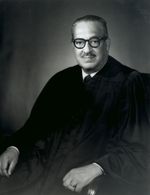
  • Michael Avery is a Professor of Constitutional Law at Suffolk University School of Law.

    Thurgood_marshall_photoSaturday, July 2, was Thurgood Marshall’s birthday, and it is high time President Obama remembers who Marshall was and what he meant to the struggle for civil rights and social justice in this country. Obama should announce now that at the first opportunity he intends to appoint someone to the Supreme Court with the experience, vision, courage and integrity that made Marshall such a great lawyer and great justice. 

    The son of a railroad porter who was born in 1908 in Baltimore, Maryland, Marshall endured racism first-hand. The future Supreme Court Justice was barred from the University of Maryland School of Law in 1930 because it was segregated. Marshall addressed that problem soon after graduating from Howard Law School, joining Charles Hamilton Houston in persuading the Maryland courts to order the school integrated in 1936. Marshall argued: “What’s at stake here is more than the rights of my client. It’s the moral commitment stated in our country’s creed.” In 1980 when the school named the law library after Justice Marshall he refused to attend the dedication ceremony, declining to be used as a vehicle for the school to salve its conscience.

    As a lawyer, Marshall literally risked his life to argue for civil rights. He traveled through the Jim Crow South in a 1929 Ford, writing papers on a manual typewriter in his car, representing common people who had the courage to challenge the prevailing order. He sat in their homes, listened to their stories, felt their pain and then told truth to power, taking their cases to the highest court in the land. He worked for the NAACP for twenty-five years, twenty-three as lead counsel. He won 29 of 32 cases he argued in the U.S. Supreme Court, including of course, Brown v. Board of Education.  

    President George H.W. Bush replaced Thurgood Marshall on the Supreme Court with the conservative Clarence Thomas, whose principal civil rights “contribution” had been undermining the mission of the Equal Employment Opportunity Commission as its chair. When George W. Bush ran for office he promised to appoint conservative justices like Thomas and Antonin Scalia, and, as president, he did, making John Roberts the chief justice and putting Federalist Society stalwart Samuel Alito on the court. President Obama should have campaigned on the promise he would find a worthy replacement for Justice Marshall.

    My argument is not that Obama needs to appoint an African-American justice. It is that he needs to appoint someone who has a visceral understanding– based on repeated exposure and opposition to injustice– of what the Constitution promises and how those promises have been broken. 

    Many such lawyers exist. Stephen B. Bright, senior counsel at the Southern Center for Human Rights, is a brilliant lawyer, author and professor who has devoted his life to fighting racial discrimination and representing poor people accused of crime, particularly in death penalty cases. If the president wanted a somewhat younger person with the promise of a longer tenure on the court, he could choose Bryan Stevenson, the executive director of Equal Justice Initiative. Stevenson, recipient of a MacArthur Fellowship and a professor at NYU Law School, has represented capital defendants and death row prisoners in the South for more than 25 years. Mary Bonauto has been the civil rights project director at Gay & Lesbian Advocates and Defenders since 1990. She argued the Massachusetts case where the Supreme Judicial Court held that prohibiting marriage to same-sex couples is unconstitutional.   As a principal architect of the campaign for marriage equality in New England, she evokes the experience of Thurgood Marshall, Charles Hamilton Houston and the NAACP in overcoming state-sponsored apartheid.  All three are widely respected, and any of them would be a worthy heir to Justice Marshall. It is time for the president to honor his memory by promising to nominate a civil rights veteran to the Supreme Court.

  • "The suicides and murder-suicides, the property crime, the child neglect — we often assume these are tied to problem gambling … but we rarely tie the disparate pieces together into the obvious whole." Review of High Stakes in the Las Vegas Sun, July 5, 2011

    Book Cover for High Stakes: The Rising Cost of America's Gambling Addiction by Sam SkolnikAmerica is becoming hooked on gambling. From the millions of dens and dorm rooms lit by online poker games to the neighborhoods transformed by new casinos and slot machine parlors, legalized gambling has become an integral part of our lives.

    With a singular blend of investigative journalism and poignant narratives of gambling addiction, award-winning journalist Sam Skolnik provides an in-depth exploration of the consequences of this national phenomenon. The result is High Stakes, an unflinching look at the explosive growth of legalized gambling in our country, the concurrent rise of addicted gamblers, and what it all means.

    Thirty-five years ago, casinos were legal in just one state, Nevada. Today, legalized gambling has morphed into a $92 billion industry established in all but two states. As elected officials are urging voters to expand gambling's reach, the industry's supporters and their equally impassioned detractors are squaring off in prolonged state-by-state battles. Millions of Americans are being asked to decide: Are the benefits worth the costs?

    Industry officials and their political allies assert that gambling is an effective way to raise revenue and create jobs. But these rewards come at a steep price. Fast-rising numbers of addicted gamblers are causing higher indebtedness and bankruptcy rates, as well as increased divorces, suicides, and gambling-related crime. Skolnik shows how the gambling industry is targeting Asian Americans-and why this population, more than any other ethnic group, is likely to develop gambling problems. He also illustrates how gambling has helped turn Las Vegas into America's most dysfunctional community, and how the upsurge of poker and Internet gambling has created a new generation of gambling junkies.

    In High Stakes, we meet politicians eager to promote legalized gambling as an economic cure-all, scientists wrestling with the meaning of gambling addiction, and ensnared players so caught up in the chase that they've lost their livelihoods and their minds. Throughout it all, Skolnik-an avid poker player-never loses sight of the human side of these struggles.

    Book Trailer for High Stakes on YouTube

    Read an excerpt if High Stakes here or on Scribd

    // <![CDATA[
    // &lt;![CDATA[
    // &amp;lt;![CDATA[
    // &amp;amp;lt;![CDATA[
    (function() { var scribd = document.createElement(&amp;amp;quot;script&amp;amp;quot;); scribd.type = &amp;amp;quot;text/javascript&amp;amp;quot;; scribd.async = true; scribd.src = &amp;amp;quot;http://www.scribd.com/javascripts/embed_code/inject.js&amp;amp;quot;; var s = document.getElementsByTagName(&amp;amp;quot;script&amp;amp;quot;)[0]; s.parentNode.insertBefore(scribd, s); })();
    // ]]&amp;amp;gt;
    // ]]&amp;gt;
    // ]]&gt;
    // ]]>

  • Beacon Press is celebrating Pride Month with a giveaway. Enter by tomorrow, June 30th, to win an autographed copy of A Queer History of the United States by Michael Bronski, a book The Bay Area Reporter called "A monumental achievement."

    Michael Bronski's A Queer History of the United States features many people and pivotal events from U.S. History, those both well-known and lesser-known. Today we share three moments from America's queer history.

    VelazfpVelaztpVelaz61

    June 26, 1842: Loreta Velazquez is born in Havana, Cuba. She is one of approximately 1,000 women who assumed male identities in order to fight in the Civil War. Velazquez, who married a Texas army officer, enlisted in the Confederate army under the name Harry T. Buford without her husband’s knowledge. Velazquez continued to fight after he was killed, and reportedly served at Bull Run, Ball’s Bluff, Fort Donelson, and was a spy for the Confederacy in Washington D.C. She published her memoirs in 1876.

    June 28, 1969: New York City police raid the Stonewall Inn in Greenwich Village causing protests and violent street altercations between the homosexual community and the police over several days. Raids on gay clubs and bars were routine at the time, and the “Stonewall riots” were among the first instances of the homosexual community fighting back against government-sponsored persecution. A larger culture of political militance followed Stonewall, with slogans like “Gay Power” and Gay Liberation Front (GLF) emerging in its wake.

    June 26, 2003: The Supreme Court rules on Lawrence v. Texas, throwing out 500-year-old sodomy laws across the country. The case arose when, on an anonymous tip, Houston police entered the apartment of the plaintiff and discovered him having consensual sex with another man. Both men were arrested and convicted under a Texas law that prohibits “deviate sexual intercourse.” In a 6-3 vote, the Supreme Court decided that these laws violated the individual’s right to engage in private, consensual sex and were therefore unconstitutional."

    Watch our trailer for A Queer History of the United States on YouTube

    Images of Loreta Velazquez from the University of North Carolina at Chapel Hill. They may be used freely by individuals for research, teaching and personal use as long as this statement of availability is included in the text. Link.

  • Today's post is from Frederick S. Lane, an author, attorney, expert witness, and lecturer who has appeared on "The Daily Show with Jon Stewart," CNN, NBC, ABC, CBS, the BBC, and MSNBC. He is the author of six books, including American Privacy: The Four-Hundred-Year History of Our Most Contested Right and the just-released Cybertraps for the Young.

    Cybertraps-for-the-young-133x200 The scandal that cost Anthony Weiner his seat in Congress may seem to many parents like yet another reason to turn off the news. That's an understandable reaction: parenting is challenging enough without the added burden of explaining why a Congressman would want to send an explicit photo of himself to someone he didn't really know.

    But believe me, your kids already know a lot more about sexting than you might suspect (or like). After all, former-Rep. Weiner is hardly the first high-profile sexter, and your children don't have to be news junkies to know that Rep. Christopher Lee, ex-quarterback Brett Favre, celebrity mechanic Jesse James, and golfing legend Tiger Woods have all been caught with their cell phones down. And it's even more likely that your kids have followed the sexting exploits of celebrities closer to their own age, like "Hannah Montana" alter ego Miley Cyrus or "High School Musical" star Vanessa Hudgins.

    In middle schools and high schools around the country, it's common knowledge among students that some of their classmates take and exchange nude photos. The exact percentage of kids engaging in this behavior is a matter of debate (1 in 10? 1 in 5?), but the fact that it happens and that large numbers of kids know about it is not.

    That's one of the main reasons that I wrote my newest book, Cybertraps for the Young." It is designed to educate parents and teachers about the legal trouble that kids can get into online. Whereas most Internet child safety books approach the topic from the perspective of the child of victim, I think that the time has come to seriously discuss the potential dangers of the child as perpetrator.

    So rather than turn off the news in disgust or try to change the channel, parents should embrace the Weiner scandal for it what it is: a great opportunity to educate their children about the risks of online behavior. The conversation obviously need to be adjusted to reflect each child's age and maturity level, but here are some basic concepts that every child should be taught if they're using electronic devices, regardless of their age:

    1. It's WAY TOO EASY to Be Stupid Online
    Rep. Weiner is actually one of the more technologically-savvy members of Congress. But as Bianca Bosker of the Huffington Post Tech page pointed out, he got into trouble because he made a simple, careless mistake: typing the "@" symbol instead of "D" for "direct message," which meant that the photo of his briefs went to the general Twitter feed rather than directly to his intended recipient. The so-called "direct message fail" is merely one of the seemingly endless number of ways your child can be tripped up online. Everyone makes mistakes, of course, but what kids need to understand is that if they make a mistake online, the consequences can be much more far-reaching and longer-lasting than they realize.

    2. Just Because You Can Do Something Online Doesn't Mean You Should
    Technology makes it all too easy to take inappropriate photos or type inappropriate messages, and share them with the entire world. Often, it's only a couple of clicks of a button, which can make it incredibly tempting to do. But just because something is easy doesn't mean it's the right thing to do. Tell your child to THINK!! and then to ask herself, will posting something online hurt her family, friends, or future?

    3. If It's Digital, It's Public
    As the Weiner fiasco painfully demonstrates, if your child digitizes something, it is virtually inevitable that he will lose control of it. That's even more true if he shares it on a social network site or via e-mail. Even if former Rep. Weiner had typed his tweet as he no doubt intended, the simple fact of the matter is that he was still sending a digital file to someone who could save it, re-tweet it, post it to the Web, or sell it to a news outlet or blogger (most of which happened). As Stewart Brand once said, "Information wants to be free."

    4. Employers, Colleges, and Journalists Will Find Out
    All major employers and most of the better colleges are looking at social media sites when they review job or college applications. If your child has posted an embarrassing or inappropriate image of himself on a social media page, the odds are very good (regardless of his privacy settings) that it will be seen by someone making a decision about his future.

    5. They're Called "Privates" for a Reason
    Your child (or your boyfriend, for that matter) may think it's hysterically funny or irresistibly flirtatious to take explicit self-portraits and distribute them online, but it is stupid, embarrassing, and dangerous to do so. Rep. Weiner may be an adult, but if your child is under the age of 18, he or she is violating state and federal child pornography laws by following his example. The potential penalties are severe, including expulsion from school, incarceration, and/or registration as a sex offender. None of that looks good on a college or job application.

    In my previous book, American Privacy: The 400-Year History of Our Most Contested Right, I describe in some detail the corrosive impact that technology has had on the concept of personal privacy. The core value in the concept of privacy is the ability to control what information you release and to whom, and to control how that information is used. The value of individual control over one's personal information is infused into the Bill of Rights, and is essential not only to our individual safety and freedom, but also to the long-term well-being of our democracy. We may laugh at the late-night jokes told at Anthony Weiner's expense, but they mask the far more significant issues raised by the relentless collection of information about our shopping habits, our preferences, our opinions, and our beliefs.

    The time to talk to your kids about these types of issues (particularly the avoidance of criminal activity) is always about three years before you think they're ready. It may be five years before YOU'RE ready to have these conversations, and that's understandable. If you just don't think either you or your child is prepared to discuss this right now, don't worry: there'll undoubtedly be other high-profile cases for you to discuss in the months and years to come. But remember, the goals here are not only to help your kids avoid serving as an object lesson for some other generation of kids, but to help them understand the importance of personal privacy in our democracy. They'll thank you for it someday.

  • Laurie Essig teaches at Middlebury College and is the author of American Plastic: Boob Jobs, Credit Cards and Our Quest for Perfection. Essig writes for the Chronicle of Higher Education's Brainstorm Blog, where this post originally appeared.

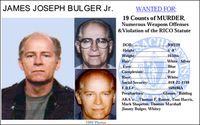
    Catherine-Greig Have you seen the movie “The Departed”? Jack Nicholson played a character based on James “Whitey” Bulger, a Boston mobster and FBI informant who disappeared, seemingly into thin air way back in 1995. The now 81-year-old Whitey, who has been connected to 19 murders, had a $2 Million dollar reward on his head and managed to escape capture, despite sightings in London and around California. But it was his longtime companion, Catherine Greig, and her commitment to the beauty project that led to FBI to finally track him down yesterday.

    According to the New York Times,

    The arrest came after the F.B.I., stymied in its efforts to find Mr. Bulger, had doubled the reward for information leading to the arrest of Ms. Greig, to $100,000, and began broadcasting public service television advertisements on shows geared to women viewers, such as Dr. Oz, as part of an effort to find Mr. Bulger through Ms. Greig.

    Ms. Greig liked to have a nip here and a tuck there (as well as lots of cosmetic dental procedures). Which is why the FBI targeted women’s shows as well as cosmetic surgery publications in their latest campaign to find Whitey.

    In fairness to Ms. Greig, they were living in Santa Monica and letting herself go would have probably attracted more attention than her strict cosmetic maintainence did.  But one does wonder what sort of love held these two together that they remained a couple despite the obvious fact that it made them easier to track down?

    Book Cover for American Plastic by Laurie EssigPerhaps they were concerned about the increased stigma attached to divorce? According to recent article, divorce is now less and less common among the upper middle classes (and with hundreds of thousands of dollars in cash in their apartment, these two certainly were of a certain set).  Not only is divorce less common, but there’s an increasing amount of shame attached to it, especially when there are children involved. And although Whitey and Ms. Greig did not have children, they did have a dog. Perhaps they thought it would be too traumatic for their canine companion if they did not stay together through thick and thin?

    Whatever the reasons, it was beauty that brought down the beast. And although many in Boston may be mourning the end to a legend, a man of the people who escaped the law, we ought to be mourning how beauty and love are a trap for all of us, even a cunning criminal like Whitey.


  • "No one made us feel better about where we lived than Whitey Bulger. Whitey was the brother of our own Senator Billy Bulger, but on the streets of Southie he was even more powerful than Billy. He was the king of Southie, but not like the bad English kings who oppressed and killed the poor people of Ireland. No way would we put up with that. He had definite rules that we all learned to live by, not because we had to, but because we wanted to." — Michael Patrick MacDonald, All Souls: A Family Story from Southie

    Whitey_bulgerWhitey Bulger was apprehended yesterday in California, after sixteen years on the run, a time during which Whitey sightings were greeted in Boston with an excitement to rival those of Elvis Presley or Sasquatch. But unlike Big Foot or the late King, Whitey was really out there–a fugitive from justice, wanted for racketeering and murder–and still very present in the Boston media and minds of everyone around these parts (and the FBI). Now, an old man, he's surrendered and, allegedly, confessed his sins.

    Whitey was a larger-than-life presence in profoundly poor South Boston, where Michael Patrick MacDonald grew up, and a driving force behind the violence that claimed the lives of many–not just those nineteen souls for whom he's been officially charged. The Southie of MacDonald's youth was an insular community that, out of desperation, embraced Bulger as its king, but suffered under his rule. 

    MacDonald, speaking to the Boston Phoenix in 1999, after All Souls was first released by Beacon Press, said this of the environment where Bulger thrived:

    I'd "gotten out," as we like to say — though we don't say it too loud because it insults the people that are there and offends a lot of people. But when I went back, I saw a lot of the people that had been affected by crime and violence in the '80s, who had lost family members, and who were still living in silence. […] The world that was created by organized crime and Whitey Bulger — the culture of death, the culture of drugs, death, and denial.

    Of course, Bulger was not the only terrifying force in the neighborhood where MacDonald grew up. In the same interview, Sarah McNaught asks him, "Did you ever draw back for a moment and think, it may not be good, it may not be in my best interests to tell this story?" to which MacDonald responded, "I wasn't scared of neighbors, I wasn't scared of organized crime — I was scared of my mother."

    Read the interview (on the "classic" Phoenix website), read the excerpt "Looking for Whitey" on Scribd, and, most of all, read the book to learn more about Southie, Whitey Bulger, and MacDonald's indomitable Ma.

    All Souls: A Family Story from Southie, excerpt

    // <![CDATA[
    // &lt;![CDATA[
    (function() { var scribd = document.createElement(&quot;script&quot;); scribd.type = &quot;text/javascript&quot;; scribd.async = true; scribd.src = &quot;http://www.scribd.com/javascripts/embed_code/inject.js&quot;; var s = document.getElementsByTagName(&quot;script&quot;)[0]; s.parentNode.insertBefore(scribd, s); })();
    // ]]&gt;
    // ]]>

  • In honor of the first day of summer (and a glorious first day it is here at the top of Beacon Hill), here is some inspiration from Mary Oliver. She reads her poem, "The Summer Day," the audio of which is available on At Blackwater Pond: Mary Oliver reads Mary Oliver. The poem first appeared in House of Light, and was reprinted in her National Book Award-winning New and Selected Poems: Volume One. 

    Echoing the words of the poet, we ask "[W]hat is it you plan to do/ with your one wild and precious life?"

    Mary Oliver reads "The Summer Day"

  • Beacon Press is celebrating Pride Month with a giveaway. Enter to win an autographed copy of A Queer History of the United States by Michael Bronski, a book The Bay Area Reporter called “A monumental achievement.”

    Watch our trailer for A Queer History of the United States on YouTube

  • Michael Bronski's A Queer History of the United States features many figures from U.S. History, those both well-known and lesser-known. Today we share two moments from America's queer history.

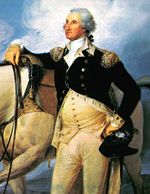
    The Marquis de Lafayette George Washington at Valley Forge

    June 12, 1799: The Marquis de Lafayette writes a passionate letter to George Washington expressing his deep affection for the General. Lafayette writes, “There was never a friend… so tenderly beloved, as I love and respect you.” These “romantic friendships” were not uncommon in Washington’s day. Enlightenment ideals such as brotherhood and rational love paved the way for a “homosocial” sphere in society, one where intense same-sex friendships became an important outlet in (and complement to) marriage.

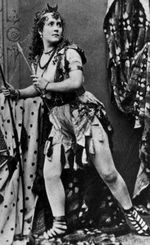
    Adah Isaacs Menken Adah Isaacs Menken as Mazeppa

    June 15, 1835: Poet and actor Adah Isaacs Menken is born. Menken became internationally infamous when she took the male lead in Mazeppa, a play based on the narrative poem by Lord Byron. At the show’s climax she appeared, practically nude, riding a live horse across the stage. Her work as an actress, coupled with the fact that Menken had both male and female lovers, lead public moralists to portray her as a socially dangerous and “unruly woman.”

    Listen to Michael Bronski discuss A Queer History of the United States on The Callie Crossley Show and Radio Boston today. And you can see him read at Harvard Bookstore in Cambridge tonight.