• Nick Krieger is the author of Nina Here Nor There: My Journey Beyond Gender. You can read more of Nick’s blog posts at ninaherenorthere.com
    KRIEGER-NinaHereNorThere

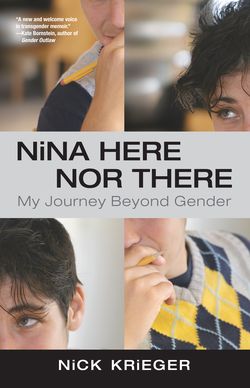
    I might have made a huge mistake. A cardinal trans sin, really. The equivalent to tattooing my birth name on my forehead. And then shoving my forehead into the faces of friends, strangers, the whole world. I decided to use my birth name in the title of my memoir, Nina Here Nor There: My Journey Beyond Gender.

    It started with a friend, an idea offered in the kitchen, a funny play on words, a title for my new blog back when “Nina” was still my name. Then three-and-a-half years later, this phrase ended up on the cover of my book, and I now have a friend who holds out her hand for royalties, or at least a hundred-dollar-bill bookmark, every time I see her.

    Sometimes it seems like the book title just sorta happened, but I made decisions along the way, specifically the decision to let my old name linger while I adapted to my chosen name. Had I published my memoir two years ago, when “Nick” was brand new, I could not have handled “Nina” staring back at me everywhere. Shit, I couldn’t even utter the word at that time. It wasn’t so much that I disliked my old name. I was just using dog training, or maybe dolphin training, strategies. If I wanted people to call me “Nick,” it had to be all “Nick” all the time. Perpetual constant reinforcement, not only for others but for myself.

    As I broke in “Nick,” the sound shaped itself to me, conformed around me, and soon it fit as comfortably as a pair of worn slippers. Once I became more physically, emotionally, and mentally at ease with myself, I was less frustrated when certain friends would mention my old name, less controlling of it. While I occasionally told them it wasn’t theirs to speak, I also understood that they were revisiting a scrapbook, a memory, and to my surprise, I found that I too wanted to hold on to my past, keep it as it was without revision. Occasionally, I even wanted to share it, whisper my old name into a lover’s ear, an offering of the most intimate piece of myself. 

    Now, part of me is proud to render “Nina” indelible, to have it serve as a tattoo, maybe not on my forehead but on the underside of my wrist, so I can turn it up and share the singular word that was closest to me for thirty years. To watch such a word unexpectedly change shape, morph from name into title, transform into something new, come to mean something new, seems as beautiful and wondrous as a gender transition itself. For me, seeing both “Nina” and “Nick” in the same place at the same time is symbolic of my gender, the unification of the woman and man in me.

    Whether others will allow me both, to live my present while loving my past, is yet to be seen. There is implicit risk to blasting my old name into the world, to giving others access to something that has been used again and again in ignorance and fear to hurt trans people. I am still recovering from the slip-ups, mistakes, and careless cruelties, and my heart still tingles with raw sensitivity in the presence of my mother, who, despite good intentions, reverts to a “Nina”-spewing machine around me.

    Nick_Krieger_IMG_4670-Melinda Bagatelos Which is why it seems crucial to let it all go, to reclaim my old name as mine, to own the power and let it stand for something other than pain. I also believe there is change going on around us. Trans folk and allies have fought for visibility, rights, and respect, paving the way so that I can live happily and joyfully without the weight of heavy armor and without needing to maintain a constant state of self-defense. I aspire to continue the fight, and for me that means believing in the change, not allowing cisgender (non-trans) people who have fucked up in the past to prevent me from trusting those with the potential to see and embrace me in my totality. I am making a leap of faith, hoping that my old name will be respected, as a character in a book and part of a title, not as some “real” “truth” that makes the Nick of here and now invisible.

    I have been living with my decision in somewhat of a vacuum, save for one trans friend who always seems a bit bothered by the choice I made. Whether it is my old name, his old name, or the larger cause that unsettles him, I do not know. But I do know I am only one person, with one voice, and I’d like to hear yours–I’d like everyone to hear yours. So please, whether you are trans or not, how do you feel about your name? If you changed your name, how would you feel about going public with your old one? Are we as a trans community as diverse in our decisions as I truly believe we are? Are we living in a time with more space for each of us to express our unique experiences?

    And as long as we’re answering my questions, can someone please tell me how long it’s going to take for me to stop unconsciously doodling my old name in all of my notebooks?

    This post originally appeared at Original Plumbing.

  • In honor of Father's Day, we share this excerpt adapted from Cabin Fever: A Suburban Father's Search for the Wild. Tom Montgomery Fate is the author of five books, including the collection of essays Beyond the White Noise and the spiritual memoir Steady and Trembling. He is a professor of English at the College of DuPage in Illinois, where he lives with his family. His cabin is in southwest Michigan. 

    Image of Tom Montgomery Fate and son in the woods My son, Bennett, has a fever today and can’t go to school. So I’m staying home with him. As I write this — on my laptop in the family room — he is playing on the floor at my feet. In spite of his illness, he is happily lost amid two gallons of LEGOS, which we just found at a garage sale. Their newness, and the infinite possibilities, seem to enthrall him. He sits rapt on the carpet inventing and quietly talking to himself––as if conferring with another seven-year-old inventor.

    Every fifteen minutes or so, after he has clicked a few more of the red, blue and green plastic pieces together, he shows me something. “Look Daddy. See this guy? He’s driving the ship.” Then a bit later: “Look Daddy I put a coffee maker on the main ship. But I put a lemonade maker on the shuttle.” “Which is the shuttle?” I ask, now understanding it was a rocket ship, rather than a sailing ship. “Here. Look!” he says, unhitching a red match-box sized platform from the main ship. A driver sits in a little chair and I assume a green thimble-sized cylinder attached to the back is the lemonade maker. He flies the shuttle completely around the sofa, making a whooshing noise all the while and pausing twice to fire imaginary machine guns at a couple of Hot Wheels cars below him. Then he lands it on my thigh. There he takes the driver out, straightens his legs, and walks him to my knee, which is now clearly a precipice looking out on an alternate universe. An inch tall, the plastic, square-headed man surveys the messy terrain of the family room. “He’s an explorer,” Bennett said. “What kind of explorer?” I asked. “I don’t know. Like a Power Ranger, or maybe an Indian,” he said.

    Well, I wasn’t expecting Meriwether Lewis, but the odd contrast of cultures fascinated me, as did the power of Bennett’s raw imagination––all that he saw and discovered in a pile of discarded plastic LEGOS. He was the explorer that most impressed me.

    Last week he brought me a red truck to repair. He broke off its wheels while “driving” (bouncing) it down the stairs and then left it on my work bench in the basement. The cracked wheels were plastic and couldn’t be glued or replaced––a lost cause. Or so I thought. “That’s OK. I’ll keep it Daddy,” Bennett had said and carried it back upstairs to the playroom. I see it now on the carpet—a red plastic sled hitched up to a three legged horse with a Star Wars character riding in the flatbed. Luke Skywalker seems to be lashing the horse with his light saber. I’m still not sure why the horse is standing upright, or how Bennett knew that it would. I just don’t see that way.

    This feeling, this inability to see, is not new. I used to get it each day when I dropped Bennett off at the preschool at the college where I teach. Because it was a lab school there was a long one-way teaching mirror in the front hallway. Students and parents could look in at the kids without them seeing us––our window was their mirror. But it took me several days to even notice this. I was often in a hurry. After the sign-in sheet, the hug, the nod to his teacher, I usually bolted off to my office with my briefcase to do important things.

    Book Cover for Cabin Fever by Tom Montgomery FateYet one day, on the way out, I paused for a moment and caught a glimpse of my distracted self in the window. That’s not the way it’s supposed to work. The kids are supposed to see themselves on the other side. But when I took two steps toward my faint, self-absorbed reflection, it disappeared. My “I” yielded to my eye, which suddenly saw through to the world on the other side, the world I so often just walked by: children sprawled everywhere on the carpet in a kind of wild and holy innocence—working wooden puzzles, reading board books, rocking dolls, singing silly songs. My God, they were delirious with curiosity, and I was thrown into their childhood, and my own, so abruptly that I found myself in tears.

    What was it about this window?

    I could see the kids, but they couldn’t see me. If they tried to look back at me all they saw was themselves and their own world: Four-year-old Maggie, in pink, glittery slippers and a baggy, green velvet dress and two strings of white plastic pearls, stirred a pan of air on a little wooden stove with a rubber spatula and intently adjusted the dials until the temperature was just right. Then James came running over with a little snake he had rolled from a ball of blue Playdoh and popped it in Maggie’s pan. This perturbed her at first, but soon she began to stir it in and to readjust the dials. Bennett, who wore a black and silver stethoscope, sat cross-legged on the carpet next to Maggie and diligently checked the heart rate of the stuffed green dinosaur he was cradling. Then he tucked it into to a wooden crib and whispered something to it—perhaps a bedtime prayer.

    How odd it was to see Bennett but not be seen by him, to be in the same room with him, yet not. When I got up to leave for the office, and was several feet away from the window, I again turned it into a mirror, again caught my dim likeness in the glass. It was then that I finally saw the obvious: I was watching Bennett through the dim reflection of myself, weighing my own childhood against his, the known against the unknown. That’s a hard thing for parents—to stop seeing ourselves in our children. And to stop waiting—consciously or not—for them to demonstrate that one attribute or flaw that would mark them as a part of us. As they get older, I wonder who will be blessed with a modicum of musical or athletic ability, and who might inherit my impatience or depression.

    But thankfully, the dimming mirror is also a sparkling clear window.

    And I think that paradox was the source of my tears and confusion that day at the lab school. I saw myself in the presence of those little kids and wanted to crawl on all fours back into their world, to dress myself up in their total surrender to the now, and in a kind of vision that could turn LEGOS into spaceships and play-doh into edible blue snakes. When, I wonder, did I first begin to lose my faith in the moment I was living in? When did my life first start to feel like a sprawling “to do” list?

    * * *

    Like me, my own dad sometimes struggled to see life’s blessings amid its burdens, and to shift from the I to the eye, from self to world. He too could get overwhelmed by work, and the future, and struggle to get back to the present. Or at least that’s how it seems now, in the shadows of memory. But that was all a long time ago. Dad and Mom are close to 90 now. And though they have sharp minds and still swim most days, their bodies are wearing down, as they approach the deepest mystery of all.

    Yet, it was just forty years ago that Dad was my age and I was a little kid. And he sometimes picked me up at the lab school in Ames, Iowa, where he was a young pastor with a large church and four sons. I can see him leaning on the chain-link fence on the edge of the preschool playground, watching me play freeze tag on the blacktop with my four-year old friends. And there, in his sport coat and slacks, I imagine him waiting and watching us for a few slow minutes before calling my name, before waving me in—before hugging me, zipping up my open coat, adjusting my hat, and taking me home. Just a minute or two of pause, of revision, before returning to real time.

    Maybe it’s because I’m now almost exactly in-between my son and father—forty years older than Bennett and forty years younger than my Dad–that these small moments seem sacred. This morning I’m wondering how my Dad found such moments along the way—amid the chaos of family and church, amid all those sermons and meetings and potlucks. But I’m hoping he did sometimes, while lingering on the edge of that playground. That my little friends and I, in our crazy games of tag and kickball, could, like Bennett did for me, somehow loosen the grip of time—giving him a moment of presence, of prayer.

    * * *

    By mid morning Bennett is still lost in his LEGOS. I tell him I’m going into the kitchen to clean the floor. He says “OK,” but after about ten minutes he calls in to me, “Where’d you go Daddy?” “I’m in the kitchen,” I say. “O.K.” he says, again seemingly satisfied. A few minutes later he carries in an arm load of Lego spaceships and shuttles and sets up shop on the kitchen table. Soon he is sailing off to other galaxies and planets while I scrub the floor on all fours. It is not long before he flies one of his Lego ships over my head and dramatically ejects the pilot into my pail with a soapy kurplunk! and a squeal of laughter. “He can’t swim! He can’t swim!” I say. Bennett laughs.

    The rest of the morning seems to pass quickly, or I barely notice that it’s passing. Bennett keeps drawing me back into his play, and then I return back to cleaning. I know this is “parallel play,” and that I should be fully engaged with him rather than trying to finish my work projects. But this is the best I can do today. And he seems pretty happy. Later, when I get out a sleeve of Ritz crackers and a can of Seven Up, he looks both excited and thankful for the simple snack. “I like staying home with you Daddy,” he says, as he starts to make lean-tos and little towers out of the crackers. “Yeah, I like it too,” I say.

    His gratitude startles me and awakens my own. And again, for a brief moment, I can see just beyond my own reflection into a greater presence.

  • Protesters throughout this Arab Spring have been inspired by the legacy of the American civil rights movement. Nico Slate, author of the forthcoming Colored Cosmopolitanism (Harvard University Press), explains below how this transnational affinity echoes that of an earlier era, a hidden history of bonds of sympathy and solidarity forged between African Americans and Indians during their freedom struggles of the late nineteenth century through the 1960s.

    This post originally appeared on the Harvard University Press blog.

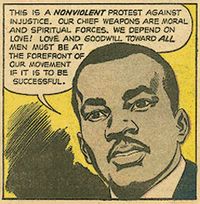
    Mlk_comicA 50-year-old comic book about Dr. Martin Luther King Jr.'s approach to nonviolent resistance has been translated into Arabic and has been circulating amongst protesters in Egypt and throughout the Middle East for months. According to a recent article by CNN, the cartoon is only one manifestation of a broad interest in the civil rights movement amongst today’s nonviolent activists. The comic book in question, Martin Luther King and the Montgomery Story, itself documents an older link between the civil rights movement and freedom struggles throughout the world. The comic book, which can be found here, traces King’s leadership back to the nonviolent civil disobedience campaigns led by Mahatma Gandhi in India.

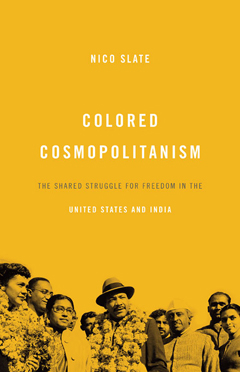
    As I detail in my forthcoming book, Colored Cosmopolitanism: The Shared Struggle for Freedom in the United States and India, connections between Indian and African American freedom struggles go well beyond the relationship between Gandhi and King. The comic book was published by the Fellowship of Reconciliation (FOR), a pacifist organization that by the time of the Montgomery Bus Boycott had been working for decades to translate Gandhian methods for use in the struggle for racial equality in the United States. FOR helped organize the Congress of Racial Equality (CORE), an interracial organization that launched sit-ins modeled on Gandhian protest in the early 1940s and later pioneered the freedom rides. Many civil rights activists—some now famous and others largely forgotten—turned to Gandhi for inspiration and ideas.

    Fifteen years before Rosa Parks refused to give up her seat on that bus in Montgomery, two young Black women were arrested on a bus near Petersburg, Virginia. Like Parks, both women were already actively engaged in the struggle for racial equality. By the time they boarded an old bus bound for Durham, North Carolina in late March 1940, Pauli Murray and Adelene McBean had long discussed how they could most effectively challenge racial segregation. The poor condition of their bus gave them the opportunity to translate their thoughts into action. Seated near the back of the bus, directly over a wheel, the two young women suffered with every bump. When McBean began to feel a sharp pain in her side, she and Murray occupied seats in the middle of the bus. The driver told them to move back. They refused and, after a lengthy debate with the driver and local police officers, were arrested. Murray wrote friends soon after her arrest, “We did not plan our arrest intentionally. The situation developed and, having developed, we applied what we knew of Satyagraha on the spot.”

    Colored_CosmopolitanismGandhi used the word satyagraha, combining the Sanskrit for “truth” and “holding firm,” to refer to his particular approach to nonviolent civil disobedience. In her memoirs, Murray remembered that when she and McBean were arrested their knowledge of satyagraha was “sketchy” and they had “no experience in the Gandhian method.” Like Murray, many Americans would learn the “Gandhian method” in the process of applying it against racial injustice. Less a rigid system than a series of guiding principles and a source of inspiration, Gandhian satyagraha would be reinvented in restaurants, department stores, buses and jails throughout the United States.

    Connections between South Asians and African Americans extended beyond nonviolence, as Manning Marable’s new book on Malcolm X makes clear. Marable’s work demonstrates the breadth of linkages between African American Muslims and global Islam. Colored Cosmopolitanism reveals that such linkages were part of a larger constellation of connections in which nonviolent activists, Black and South Asian Muslims, Hindu reformers, Christian missionaries, followers of Marcus Garvey, African American soldiers, Indian immigrants, labor organizers, and many others forged links across freedom struggles. What provided coherence to these multifaceted linkages? I argue that a transnational conception of color came to serve as a bridge between people struggling against racism throughout the world. African Americans and South Asians together imagined a colored cosmopolitanism, a “dark” or “colored” world united in the struggle against racism, imperialism, and other forms of oppression. Advocates of colored cosmopolitanism fought for the freedom of the “colored world” even while calling into question the meanings of both color and freedom.

    If you liked this post, you may also be interested in Visions of a Better World: Howard Thurman's Pilgrimage to India and the Origins of African American Nonviolence, forthcoming from Beacon Press, and Proud Shoes, Pauli Murray's book about her grandparents' lives in the pre-Civil War and Reconstruction era in the South.

  • We love Scribd, and apparently many others do, too, since we're fast approaching 100,000 reads of the book excerpts we've posted there. 

    If you haven't checked out the enormous wealth of reading material at Scribd, perhaps you can start with our LGBT Pride Collection. For Pride Month, we've pulled together excerpts from a dozen books: memoir, history, and ideas. Click on the covers below to read an excerpt from each book:

    Nina Here Nor There by Nick Krieger She Looks Just Like You by Amie Klempnauer Miller Mama's Boy, Preacher's Son by Kevin Jennings The Tricky Part by Martin Moran
    BRONSKI_QueerHistoryBALL-ClosetToCourtroom 5039 4133
    WHITLOCK-Queer(In)Justice 4433 7966 7972

    And if our excerpts whet your appetite for more, here are some interesting Scribd posts from other publishers we like. 

    Harvard University Press: How Sex Changed: A History of Transsexuality in the United States

    NYU Press: When Gay People Get Married

    U of Chicago Press: No Place Like Home: Relationships and Family Life Among Lesbians and Gay Men

    Workman: The Real World Guide to Coming Out

  • “It seems to me that what the Pentagon Papers really demonstrated 40 years ago was the price of that practice,” he said. “Which is that letting a small group of men in secret in the executive branch make these decisions — initiate them secretly, carry them out secretly and manipulate Congress, and lie to Congress and the public as to why they’re doing it and what they’re doing — is a recipe for, a guarantee of Vietnams and Iraqs and Libyas, and in general foolish, reckless, dangerous policies.” — Daniel Ellsberg in the New York Times, June 8, 2011

    Tovell_gravelRev. Robert N. West, UUA President, and Senator Mike Gravel (D-Alaska) hold a press conference on Nov. 5, 1971 concerning Beacon Press' publication of "The Pentagon Papers" and ongoing harassment of the UUA by the FBI. Photo courtesy Robert N. West.

    Forty years ago this month, the New York Times began publishing excerpts from what has been popularly referred to as "The Pentagon Papers," and officially known as "the Report of the O.S.D. Vietnam Task Force." The papers, which were smuggled out of the RAND corporation by Daniel Ellsberg, were published a few months later by Beacon Press as the Senator Gravel Edition of The Pentagon Papers: The Defense Department History of United States Decisionmaking in Vietnam. The story of their publication is a gripping tale, one that involved heroic stands by Ellsberg, Senator Mike Gravel, Beacon Press director Gobin Stair, and UUA President Robert West against immense pressure from the Nixon administration.

    It has taken four decades for the government to officially release the papers. We aren't worried here about the new, "official" publication affecting sales: the five volumes– a whopping 7,000 pages– have long been out of print, and were never a commercial "success." In fact the cost of producing the books combined with the associated legal fees was a huge financial burden for the press. Loans from the Unitarian Universalist Association and a significant donation from the Unitarian Universalist Veatch Program at Shelter Rock, combined with smaller donations from supporters and from other publishing houses (led by a $2,500 donation from Random House), helped allay the enormous expense. But the reasons for publishing the papers were never financial. In 2002, during an interview with Susan Wilson in preparation for Beacon’s 150th anniversary, Stair referred to The Pentagon Papers as “a test of our purpose,” before concluding, “We were publishing what needed to be published."

    We aren't sure why it took forty years for the government to declassify these papers, but we look back at that moment in the history of Beacon Press with great pride. Subpoenas, FBI investigations, and even calls from President Nixon himself deterred neither Beacon Press nor the Unitarian Universalist Association from doing what was right, and it is our goal today to function by the same principles that guided those brave decisions.

    Related reading, listening, and viewing:

    Beacon Press and the Pentagon Papers 

    National Archives and Presidential Libraries Release Pentagon Papers

    "The Most Dangerous Man in America" documentary on PBS

  • Book Cover for Finding Higher Ground: Adaptation in the Age of Warming by Amy Seidl While much of the global warming conversation rightly focuses on reducing our carbon footprint, the reality is that even if we were to immediately cease emissions, we would still face climate change into the next millennium. In Finding Higher Ground, Amy Seidl takes the uniquely positive-yet realistic-position that humans and animals can adapt and persist despite these changes.

    Drawing on an emerging body of scientific research, Seidl brings us stories of adaptation from the natural world and from human communities. She offers examples of how plants, insects, birds, and mammals are already adapting both behaviorally and genetically. Within ten years, one plant species in a drought-stricken area has evolved to fit its life cycle into the shorter growing season. Red squirrels are breeding earlier to take advantage of the food supplied by an earlier spring. And some birds are migrating shorter distances, or not at all, as their northern habitats become milder.

    While some species will be unable to adapt to new conditions quickly enough to survive, Seidl argues that those that do can show us how to increase our own capacity for resilience. She tells of a young farmer experimenting with adaptive strategies for local crops, architects using biomimicry to design buildings that actually contribute to their surrounding ecosystems, and the establishment of decentralized and renewable energy banks. While Seidl admits that these efforts alone won’t change the world, she hopes that taken together they can form the basis for a new, revolutionary set of ideas to live by, much like the efforts that brought about abolition, women’s suffrage, and the eight-hour workday.

    In looking at climate change as an opportunity to establish new cultural norms, Seidl’s perspective inspires readers to move beyond loss and offers a refreshing call to evolve.

    Read an excerpt from Finding Higher Ground on Scribd

    //

  • Shelina Zahra Janmohamed is the author of Love in a Headscarf. She is a leading commentator on British Islam, a columnist for EMEL magazine, a regular contributor to the Guardian and the BBC, and author of the award-winning blog, Spirit21. This post originally appeared on The National.

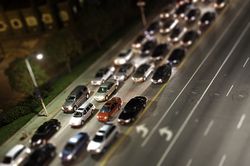
    5741580306_6e7bfd25f1 With all the recent media coverage of women not being permitted to drive in a certain Middle Eastern country, I got thinking – what would it be like if men weren’t allowed to drive?

    I came to one simple conclusion: we women would be much safer.

    Think about the dangers of male drivers. Men have higher rates of speeding, they are involved in more accidents and cause more deaths on the road. Their high-testosterone brains ignite higher incidences of road rage. They are notorious tailgaters, failing to observe any measure of safe stopping distance. And, they can’t even be bothered to ask directions when lost. The solution is simple: bar them from driving.

    If men start to whine and whinge about their “rights” being infringed, then just to stop their “waagh waagh waagh” moaning, consider this modest proposal.

    Driving lanes could be segregated by gender. Or, better still, we introduce gender-segregated streets, some for men, and some for women. This way, we women would not have to look at the horror of their balding heads, especially those of middle-aged drivers in convertibles, their toupees or comb-overs flapping in the wind.

    By limiting their access to certain streets, we would also be safe from their high-speed antics and reckless driving, which, due to their biological design, they are compelled to engage in. They can’t help it, poor things. Have petrol, will accelerate.

    Where there are roads that men insist they need access to (although what kind of roads these could be, I just don’t know – perhaps ones with football stadiums on them?), a timetable could be devised with restricted hours for men to use them at essential times only. Of course, these hours would exclude the times that the men ought to be at home putting out the rubbish, fixing shelves or cleaning out the drains.

    Segregated lanes, limited access and a timetable could be combined into a new road system based on Gender Prioritisation and Separation (GPS).

    Book cover for Love in a Headscarf by Shelina Zahra JanmohamedMale drivers are genetically predisposed to road rage, and if we are to permit them to drive, then we must warn them they will only have themselves to blame if they are attacked in any altercation that ensues. Not driving is for their own good, so if they choose to ignore this, they must bear the consequences.

    Of course, we must ensure that these male drivers are not a source of temptation for women. And even more importantly we must take steps to prevent them from driving willy-nilly around on frivolous activities like collecting the children from school, caring for sick relatives or attending places of employment to earn wages to buy food.

    In fact, now that I think about it, these tasks are entirely trivial and the men can manage them quite comfortably by hiring a female chauffeur to drive them around. If they are in the back, then they won’t be able to use their wiles to tempt the poor female driver.

    When it comes down to it, I am of the view that men don’t really want to drive, but they think it’s fashionable to say that they do. I mean, why would they bother with the hassle of parking? Why get hot under the collar trying to navigate traffic?

    In short, men are simply not designed to drive. We tell them and tell them that driving is not good for them, and it’s not good for society. But that’s typical of men isn’t it: they just won’t listen.

  • Tourist season is in full swing here in Boston. (Heck, we even had an Alaskan walking the Freedom Trail yesterday.) So we thought it would be nice to share with you some of our Boston authors' favorite places in "the hub of the universe."

    You can find out more about Beacon's books on Boston and its rich history at beacon.org.

    Book cover for A City So Grand by Stephen PuleoBook Cover for The Paradise of All These Parts by John Hanson MitchellBook cover for Banned in Boston by Neil Miller

    Stephen Puleo is the author of three acclaimed books on Boston's history: A City So Grand: The Rise of an American Metropolis, Boston 1850-1900, The Boston Italians, and Dark Tide: The Great Boston Molasses Flood of 1919.

    My outdoor choice is Castle Island in South Boston. Great place to walk anytime, but particularly with the onset of Spring when the ocean air smells great and a hot dog at Sullivan's is the perfect reward for circling the whole Sugar Bowl. 

    Castle_island_bpl_mapHot Dog From Sullivan's, Castle Island, by Rob Bellinger
    Castle_island

    Castle Island Map from the Boston Public Library's Flickr Stream. Hot Dog and Pleasure Bay photos by Rob Bellinger, used by permission.

    The historic spot is the Old South Meeting House. Though there are many wonderful spots in Boston to experience its history, anytime I'm in this church, I can practically feel the place pulsating with 5,000 angry colonists on the eve of the Boston Tea Party.

    Old_South_BPL
    Old South Meeting House from the Boston Public Library's Flickr Stream. 

    And of course, the North End touches me personally in a way no other place in Boston does. All three of my immigrant grandparents lived there, my dad was brought up there, my parents dated at restaurants in the neighborhood, and the Italian experience is still vibrant and unrivaled. I feel comfortable there always, at one with my past, whether walking the crooked, narrow streets, spending a few minutes inside St. Leonard's Church, or enjoying dinner with friends. I've never lived there, but it's always felt like home.

    IMG_0892 IMG_0891 St Leonard's Church, North End, Boston
    Photos of North End by Jessie Bennett. Photo of St. Leonard's interior by wgdavis on Flickr.

    John Hanson Mitchell is the author of The Paradise of All These Parts: A Natural History of Boston. concentrated much of his earlier early work, including, most famously, Ceremonial Time, on a square-mile tract of land known as Scratch Flat, located thirty-five miles northwest of Boston. He is the author of numerous books and editor of the award-winning magazine Sanctuary, published by the Massachusetts Audubon Society. Mitchell lives in Littleton, Massachusetts.

    Not an easy question, actually, there are so many favorites, but two stand out:

    The main one is probably the little warren of cobblestone streets in the North End between the Copp's Hill Burying Ground and the Paul Revere Mall and Hanover Street. I don't even remember the names of the streets and enjoy very much getting lost there.  

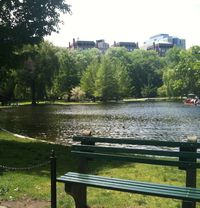
    The other is whichever quiet corner of the Public Garden is least occupied. Both these spots have an Old World flavor you don't find in other American cities.   

    IMG_0954 IMG_0951
    Photos by Jessie Bennett.

    Neil Miller is the author of Banned in Boston: The Watch and Ward Society’s Crusade against Books, Burlesque, and the Social Evil. He teaches journalism at Tufts University.

    Do Cambridge or Somerville count? Two of my favorites are: True Grounds Cafe in Ball Square, Somerville– the best scones and most artful lattes in town. Also Porter Square bookstore in Cambridge, a wonderful independent bookstore with a warm atmosphere and a great series of readings.

    True_grounds_cafe Porter_square_books
    Photo of True Grounds Cafe from interactivesomerville on Flickr. Photo of Porter Square Books from their website.

    Editor's note: I don't usually chime in with my own opinions, but I have to add that Beacon Hill is one of the most beautiful places in the Boston area, and it's an absolute joy to work here, especially in the springtime. Here are a few photos of my favorite spots, including, of course, Beacon Press headquarters! — Jessie

    Acorn_street Beacon_press
    Instagram-beacon_hill
    Photo of Acorn Street from Greater Boston Convention and Visitors Bureau on Flickr. Photo of Beacon Press from Wikimedia Commons. Photo of Beacon Hill in the springtime by Jessie Bennett (using Instagram).
  • The "D" word: Danielle Ofri thinks about expiring, passing, and "going to Chicago."

    David Gessner dispenses writing advice: get some momentum!

    On WHYY's Radio Times, listen to Mark Hyman talk about excess in youth sports. 

    "There are really bad cancers and there are really innocuous ones that never go anywhere, and we're not good at sorting them out." Dr. H. Gilbert Welch in an article at Time. You also should go listen to this interview with Dr. Welch at The People's Pharmacy. 

    The Bay Area Reporter gives great reviews to two Beacon books: A Queer History of the United States and Nina Here Nor There.

    Check out Nina Here Nor There author Nick Krieger's latest post at 365gay.com: Why Can't LGBTs get along with each other?

  • Rebecca Alpert is Associate Professor of Religion and Women’s Studies at Temple University and the author of Out of Left Field: Jews and Black Baseball (Oxford University Press, 2011). This post originally appeared on the Oxford University Press blog. 

    Out-of-left-field Growing up as a baseball fan in the 1950s and 60s, I could not wait until the All-Star game rolled around every July. (Imagine my delight during the years when there was a second game in August!) Back then, fans didn’t choose the players, so I would eagerly anticipate the announcement of the teams in the newspapers. Then I would rummage through my baseball card collection to pull out the All-Stars and admire their accomplishments. Watching the game on television was thrilling to me, no matter the outcome. If I was in summer camp, my mother would dutifully send me the newspaper clippings and box scores. My parents were avid baseball fans, but this exhibition game meant nothing to them. I am not really sure why it appealed to me, then or now. Taking my son to the game when it took place in Philadelphia in 1996 was a peak moment. For me it is an annual ritual on my sacred calendar, a holy day to celebrate like the birthdays of family and friends, Thanksgiving, Passover.

    When I began to do research on the roles Jews played in black baseball a few years ago, I was delighted to find out that the Negro Leagues had their own all-star game (called the East-West game and held in Chicago every year) that was the centerpiece of the black baseball season. From its inception in 1933 the East-West game provided an opportunity for all the men of African descent who could surely have been in the majors if not for the color line to showcase their talent in a very public way. This knowledge permitted me to justify my obsession with the All-Star game; now not only a guilty pleasure but also a potential vehicle for a political message.

    Imagine my despair when I learned last year that the 2011 All-Star game would really be a vehicle for another kind of political message. Despite serious protests this year’s game will be taking place in Arizona, home of the infamous SB 1070, the bill that would permit law enforcement officials to request documentation from anyone who might appear to be an illegal immigrant. Almost one-third of those on major league rosters are now Latino. Doesn’t the baseball establishment understand that this Arizona law is demeaning to people of Latin American ancestry? Don’t they see the connections to the embarrassing color line that forced black Americans to be second class citizens in baseball for so many years? Why wouldn’t they want to move the game to another venue to support their players who could be subject to this humiliating (and possibly unconstitutional) law?

    Rebecca-alpert Immigration rights groups have called for a boycott, and I have signed their petitions, but the game is surely not being moved. How could I possibly observe my annual ritual this summer? While wondering whether I should even participate in the voting for the starting line-ups, it occurred to me that voting held the answer to my dilemma. What if, like the East-West game, all the starting players were from one racial/ethnic group, only in this case Latino? Wouldn’t that send a message to Arizona and Major League Baseball? So that’s what I intend to do with my 25 votes. And I encourage you to do the same.

    It’s easy. Just go to the ballot and vote for your local team (in my case Placido Polanco , Carlos Ruiz, and Raul Ibañez of the Phillies), future Hall of Famers (like Vladimir Guerrero, David Ortiz, Albert Pujols, or Alex Rodriguez), perennial stars (Carlos Beltran, Bobby Abreu, Alfonso Soriano, Melky Cabrera, Aramis Ramirez, Adrian Beltre, Miguel Tejada, Jorge Posada) or this year’s standouts (Placido Polanco again, José Bautista, Adrian Gonzalez, José Reyes, Miguel Cabrera, Gaby Sanchez, Maicer Izturis, Alberto Callaspo, Yadier Molina, Martin Prado, Starlin Castro, Jhonny Peralta, Yunel Escobar, Jonathan Herrera, Asdrubal Cabrera, Emilio Bonifacio, Orlando Cabrera, Robinson Cano) or 2010 World Series heroes (Elvis Andrus, Nelson Cruz, Freddy Sanchez, Pablo Sandoval).

    Don’t wait—vote early (you have until June 30) and often (25 times on the internet and whenever you’re at the ball park) and send a message to the majors that the All-Star game should showcase not only our best players but also our best values.

    If you liked this post, you may also be interested in Raceball: How the Major Leagues Colonized the Black and Latin Game. Read an excerpt of Raceball on Scribd.