• Today's post is from Kim E. Nielsen, an award-winning educator, the recipient of a National Endowment for the Humanities We the People stipend, a Fulbright lecturer, the author of many journal articles, and frequent public speaker. She is the author of Beyond the Miracle Worker: The Remarkable Life of Anne Sullivan Macy and Her Extraordinary Friendship with Helen Keller. She lives in Green Bay, Wisconsin where she is Professor of History & Women's Studies at the University of Wisconsin-Green Bay.


    5458427543_9349655beb

    I'm afraid to turn on my television. Really, it terrifies me. This is not based on a fear of alien mind-melt, a fear of governmental snooping, or a fear of the little people who live inside the box (no flat screen at my house).

    I fear clicking the remote control because I live in Wisconsin. Click: teachers are sucking the state dry. Click: public employees are lazy bums. Click: those guys who plow my street again and again and again (and now once more) are just selfish. Click: collective bargaining rights, the right to help shape our own workplaces, are an unnecessary privilege exploited by the spoiled. Click: it's just petty of people with disabilities to think transportation is necessary to get to work. Click: let's pay everyone as little as we get can get away with. Click: education, the essential core of any democratic society, the best grounding for healthy human beings, the cause to which I've dedicated most of my waking hours since I was five years old, doesn't have to be that good and really isn't very important. Mediocrity, indeed, is just fine.

    Really, I'm terrified to turn on my television.

    Fear, however, is not helping me out. Fear doesn't make for happy people, fear doesn't lead to quality and transformative teaching, fear hinders parenting, and fear certainly obstructs good policy decisions. For my college students, fear is not a place from which good learning happens. Fear is just no fun. And because I'm a historian, and it's secret requirement of the Ph.D. that I quote FDR (don't tell anyone that I told you), "We have nothing to fear but fear itself."

    Courage, I tell myself, courage despite fear. Courage to spite fear. At 8 a.m. I will walk before a classroom of students. I will convey to them that they can transform their lives, their family's lives, and their world for the better—and that an education is their tool to do so. That is, of course, why they are in my classroom.

    My students, it turns out, have plenty of courage. Most of my students are of the first generation in their families to attend college. They fear not finding employment. They fear that their parents will lose the family home. They fear the loss, or the continued absence of, healthcare. They fear sitting in the classroom while being haunted by memories of rape, of military combat, of things they can't identify. They fear each tuition bill. They fear, more than anything, the loss of hope. They, however, are brave enough to show up in my classroom. And they need, they need, they need me to have hope.

    Professor Nielsen, one announces proudly, I got a B on my biology exam. Another student emails me after class, thank you for your concern and I'm sorry I walked out of class but too many of my friends have been raped and I can't even think about these issues. Professor, says a particularly quiet young man, I worked harder on this paper than I've ever worked before. Another student stops by my office… for no stated reason at all, for the third time. One boisterous student who calls me Dr. Kim is thrilled because she just spoke to a state legislator for the very first time. Another cries because her mom attempted suicide, and at nineteen she has to care for her younger brother. One amazed student tells me over and over again that she just can't believe how cool the suffragist Alice Paul was. Amidst all of this, they bolster their courage, they try to study, and they seek meaning.

    This morning I woke dispirited, but I need courage for my students and I need courage for me.

    Over the last several weeks I've encountered tens of thousands of courageous Wisconsinites. A 12 year old gave her first public speech with a bullhorn, before 5,000 people, in the state capitol rotunda. I love my teachers, she proclaimed, and they deserve more money—not less. Off duty police officers, with signs proclaiming "cops for labor," handed out water to the chanting protesters circling my state capitol as we thanked them for their presence. A wonderful, gruff retired steelworker told me that he didn't think he'd have lived this long without the basic protections his union provides. I laughed along with an animated high school senior, who refused to be cowed by a Republican legislator who threatened to call her truancy officer after she'd spent a day protesting peacefully. She stood proud, proud of herself and of her many teachers who had laughed and hugged while insisting that they deserved the basic human right of collective bargaining. A man who cleans public buildings shows up at our local rallies and sings to the protesters. Assembly Representative Peter Barca, who guaranteed his constituents continued access to him by moving his desk to the cold Wisconsin outdoors after Governor Scott Walker locked the capitol building despite a court order, makes me smile and cheer (send that man wool socks). And the Wisconsin 14 –those wonderful, courageous state Democratic senators who reportedly are braving the wilds of Illinois—are my heroes (especially Dave Hansen, my local Green Bay senator).

    The labor rights of the people of Wisconsin, and of the rest of the nation, matter and their loss will impact all of us. My students and the quality of their education matter. The man who plows my street matters. The disability activists who staged a sit-in at Wisconsin Republican Party headquarters matter. Frankly, I and my colleagues matter. And it is unconscionably immoral to have the goal of paying people as little as one possibly can. Most importantly, however, the emerging labor alliance of nurses, social workers, snow plow drivers, fire fighters, college professors, electricians, janitors, ship builders, teachers, and police officers are pivotal to the future economic and social health of this nation. We are the future—not the Koch brothers and not Wisconsin's Governor Scott Walker.

    Photo by Mark Riechers, shared under Creative Commons. See original.
  • Rashid Khalidi, author of Sowing Crisis: The Cold War and American Dominance in the Middle East, The Iron Cage: The Story of the Palestinian Struggle for Statehood, and Resurrecting Empire: Western Footprints and America's Perilous Path in the Middle East, writes about events across the Arab world in the current issue of The Nation. Khalidi is the Edward Said Professor of Modern Arab Studies at Columbia University.

    Suddenly, to be an Arab has become a good thing. People all over the Arab world feel a sense of pride in shaking off decades of cowed passivity under dictatorships that ruled with no deference to popular wishes. And it has become respectable in the West as well. Egypt is now thought of as an exciting and progressive place; its people’s expressions of solidarity are welcomed by demonstrators in Madison, Wisconsin; and its bright young activists are seen as models for a new kind of twenty-first-century mobilization. Events in the Arab world are being covered by the Western media more extensively than ever before and are being talked about positively in a fashion that is unprecedented. Before, when anything Muslim or Middle Eastern or Arab was reported on, it was almost always with a heavy negative connotation. Now, during this Arab spring, this has ceased to be the case. An area that was a byword for political stagnation is witnessing a rapid transformation that has caught the attention of the world.

    Three things should be said about this sea change in perceptions about Arabs, Muslims and Middle Easterners. The first is that it shows how superficial, and how false, were most Western media images of this region. Virtually all we heard about were the ubiquitous terrorists, the omnipresent bearded radicals and their veiled companions trying to impose Sharia and the corrupt, brutal despots who were the only option for control of such undesirables. In US government-speak, faithfully repeated by the mainstream media, most of that corruption and brutality was airbrushed out through the use of mendacious terms like “moderates” (i.e., those who do and say what we want). That locution, and the one used to denigrate the people of the region, “the Arab street,” should now be permanently retired.

    Read the rest of the article on TheNation.com

  • Today's post is by Adele Barker, author of Not Quite Paradise: An American Sojourn in Sri Lanka. She has taught at the universities of Arizona and Washington. Most recently, she received a Fulbright Senior Scholar grant to teach and write in Sri Lanka.

    Book Cover for Not Quite ParadiseThe war in Sri Lanka has been over for almost two years. I've been back to the island twice in that time. My most recent trip took me up to Trincomalee on the northeast coast this past December where I was doing some volunteer work at a home for girls. I also wanted to see how the city and its people were putting the pieces of their lives back together again since war's end. Government propaganda aside, no one on this island believes that this is going to be an easy process. Ethnic distrust and hatreds between the Tamils and the Sinhalese; 300,000 civilians forced into IDP camps after the war; families separated from one another; civilians used as human shields in the last days of the conflict– these are memories that are not dislodged easily.
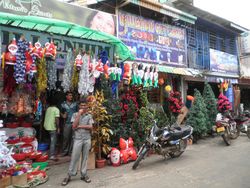
    This was my second trip to Trincomalee. My son and I had been there during a short-lived cease fire in 2002 and had witnessed a city nailed shut by war. I remember how silent it was. This December, Trinco, as it is known here, had shaken off war's stupor and come to life again. The sounds of buses, trishaws, and cars competing for one square lane in the center of town told me that there was petrol again. I was plunged into a shopper's paradise. Plastic Santas, Christmas tree ornaments, and toys all hung outside the Muslim shops, and the downtown area was marching to the beat of shoppers and bala music. Religion wasn't a factor here. Christmas was an excuse to celebrate. For Hindus, Buddhists, Christians, and Muslims, it was a time to eat, dress up, give gifts, and visit with family and friends. People were cleaning their houses and cooking in preparation for the festivities.

    PC230460 Along with everyone else in Trinco, I went down to the open air market in the center of town and bought vegetables and curry leaves. But mainly what I bought were mangoes. Lots of them. Jaffna mangoes to be precise. They are known as karatacolomban . I knew about them because for the better part of 20 plus years, no one south of the war zone could get hold of them. Roads were closed. Trains had stopped. Commerce between north and south had come to a standstill. Someone had told me "You'll know when the war is over when the Jaffna mangoes appear again."

    And they had!

    I made a little fist of victory with my hand, stuffed them into my straw basket, and headed back to the orphanage. In my other bag I had a kid's badminton set, a couple of stuffed animal, two puzzles, some Bombay sweets, and lots of hair clips.

    Make no mistake. War's residue remains part of the daily fabric of life in the northern part of this island. And it will be that way for years, if the present is any barometer. The final bloodbath in this civil war took place in Mullaittivu, less that 100 kilometers north of Trinco. Fishermen displaced from their homes in the last weeks of the conflict still wait in Trinco to be allowed to return to their villages. Half an hour inland sit Sinhalese villages that were overrun by the LTTE (Liberation Tigers of Tamil Eelam). The villagers are in the process of moving back to their land that was razed and burned, their homes destroyed. Many are still trying to find family members from whom they were separated in the final weeks of the conflict. Others, newly released from the IDP camps, come home to houses with no people in them, or to no home at all. The wounded wait for the government to deliver on its promises of rehabilitation. Tamil fruit sellers in town worry that the Sinhalese have retained control over the market. And almost two years after war's end, roads that scream for repair are still lined with Sri Lankan Military, young Sinhalese soldiers in bunkers bearing rifles. The aftereffects of war linger with stunning tenacity.

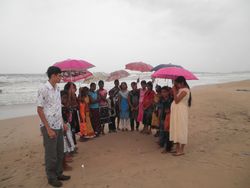
    PC250511 There is also the small matter of several very large waves that destroyed 900 lives on Dec. 26, 2004. This December, on the day after Christmas and under a driving rain, Trincomalee stopped and remembered. The Buddhist temples held special ceremonies, the Hindu kovils special poojas. We took the girls from the orphanage out onto the beach and organized an impromptu ceremony of our own. From there we went inside and lit candles in memory of the victims. I looked at the girls standing there. Some were too young to have much of a memory of what had happened. Others had lost family members that day, a moment in time that explained why they were standing in front of me now.

    Part of recovery from war's trauma, from any trauma, is the process of re-finding the life and the person you were before the trauma. This past Christmas, the people in Trincomalee did just that. The women got out their saris, wrapped themselves in elegance and set off bearing fruits and cake to see friends and relatives. A friend went to buy a new shirt. We had cake and chicken at the orphanage, swam at the beach and dove between each other's legs. It was all part of the process.

    There is much still to do on this small island of twenty one million people. Part of that long, slow journey towards recovery begins with a cake, a pot of something boiling on the stove, a new shirt and a bala dance. Sometimes the rest can wait for another day.

  • On March 1, 1961, President John F. Kennedy signed an executive order establishing the Peace Corps. The idea for the Peace Corps came from an impromptu speech made a few months earlier by then-Senator Kennedy at the University of Michigan, in the final few weeks of his presidential campaign. At about two in the morning on the steps of the Michigan Union, he presented an idea to a crowd of restless students for an organization that would rally American youth in service. Though the speech lasted barely three minutes, his germ of an idea morphed dramatically into Kennedy's most enduring legacy. From this offhand campaign remark, shaped speedily by President Kennedy's brother-in-law, Sargent Shriver, in 1961, the organization ascended with remarkable excitement and publicity, attracting the attention of thousands of hopeful young Americans.

    Watch President Kennedy's announcement made fifty years ago today.

    President John F. Kennedy Announces The Executive Order to Form Peace Corps (YouTube)

    Whentheworldcalls Of course, what transpired in those months between an inspiring speech and the establishment of a transformative institution– not to mention what has happened in the fifty years since– is a fascinating story, one you can now read in When the World Calls, the first complete and balanced look at the Peace Corps's first fifty years. Revelatory and candid, Stanley Meisler's engaging narrative exposes Washington infighting, presidential influence, and the Volunteers' unique struggles abroad. Meisler deftly unpacks the complicated history with sharp analysis and memorable anecdotes, taking readers on a global trek starting with the historic first contingent of Volunteers to Ghana on August 30, 1961.

    The Peace Corps has served as an American emblem for world peace and friendship, yet few realize that it has sometimes tilted its agenda to meet the demands of the White House. Tracing its history through the past nine presidential administrations, Meisler discloses, for instance, how Lyndon Johnson became furious when Volunteers opposed his invasion of the Dominican Republic; he reveals how Richard Nixon literally tried to destroy the Peace Corps, and how Ronald Reagan endeavored to make it an instrument of foreign policy in Central America. But somehow the ethos of the Peace Corps endured, largely due to the perseverance of the 200,000 Volunteers themselves, whose shared commitment to effect positive global change has been a constant in one of our most complex-and valued-institutions.

    This past weekend, the LA Times published an essay by Meisler about the legacy of the Peace Corps:

    Fifty years on, what has the Peace Corps accomplished? It's possible to cite the pounds of fish sold or the pounds of honey produced under volunteer projects. But how do you measure the influence of an inspiring teacher? Or the effect on an impoverished teenage boy such as Alejandro Toledo, who, with volunteers' help, goes on to college and becomes the president of Peru?

    But there is no difficulty measuring the impact of the Peace Corps on the United States. Half a century after Kennedy's call, the Peace Corps' greatest achievement may be the volunteers themselves.

    Peace Corps alumni include two U.S. senators — Chris Dodd of Connecticut and the late Paul Tsongas of Massachusetts — and nine members of the House of Representatives, as well as governors of Wisconsin and Ohio and the mayor of Pittsburgh. One Cabinet member was a volunteer: Donna Shalala, Health and Human Services secretary in the Clinton administration and now the president of the University of Miami. Ten other volunteers are presidents of universities and colleges.

    More than 20 have served as ambassadors or assistant secretaries of State; others went on to become teachers, doctors, economic development specialists. The novelist Paul Theroux heads a long list of Peace Corps writers, and the roster of journalists includes Chris Matthews of MSNBC and George Packer and Peter Hessler of the New Yorker. The founders of Netflix and the Nature Co., and the board chairs of Levi Strauss and the Chicago Bears, were also volunteers.

    In all, some 200,000 Americans have lived, often in the remotest of villages, in countries in Africa, Asia, Latin America, the Pacific and Eastern Europe — places most other Americans can't find on a map. We would not have this enormous asset today without the Peace Corps. That is surely worth a birthday celebration.

    This Thursday, Meisler will appear at the John F. Kennedy Library at a forum celebrating the anniversary. Register to attend here or watch the live webcast on the JFK Library website.

    Read an excerpt from When the World Calls here or at Scribd. Did you or someone close to you serve in the Peace Corps? Please share your memories in our comments.

    When the World Calls: The Inside Story of the Peace Corps and Its First Fifty Years, excerpt
    http://d1.scribdassets.com/ScribdViewer.swf

  • Michael Honey is a historian and Haley Professor of Humanities at the University of Washington, Tacoma. He is editor of All Labor Has Dignity and author of Going Down Jericho Road: The Memphis Strike: Martin Luther King’s Last Campaign.

    This post originally appeared at Colorlines.

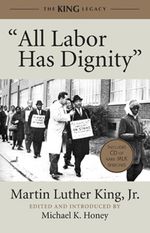
    Alllaborhasdignity In light of the clash of wills in Wisconsin, we should remember the teachings of Dr. Martin Luther King, Jr. One of King’s slogans that we rarely hear is this one: “all labor has dignity.”

    King spoke these words in Memphis on March 18, 1968, in the midst of a strike of 1,200 black sanitation workers that had lasted over a month. After rousing them to a fever pitch, King called for a general strike by all workers to shut the city down on behalf of the sanitation workers.

    What was the demand of these workers? Improved wages and benefits, yes, but their key demand was that the City of Memphis grant collective bargaining rights and the collection of union dues, without which they knew they could not maintain their union.

    These are the very two items that Wisconsin’s Gov. Scott Walker wants to take away from public employees. He knows, as did Mayor Henry Loeb in Memphis, that if you can kill union bargaining rights and dues collection, you can kill the union.

    Also like Loeb, Walker is a fiscal conservative. As he cuts taxes for business he raises costs for workers and says ending union power will benefit the fiscal health of the state. Walker wants to end the right of public employees to bargain collectively, even though the workers have accepted a tripling of their health-care costs and a wage cut to help offset the state’s fiscal crisis.

    In nearby Ohio, Gov. John Kasich wants to take away the right to join a union for 14,000 state-financed child-care and home-care workers, among the most overworked and underpaid of public servants. In other states, Republicans want to adopt “right to work” (for less) laws that would take away the requirement that workers in unionized jobs pay union dues. This would undermine the unions while, in King’s words, providing “no rights and no work.”

    Even in Midwest states that have been union strongholds, Republicans now have public-employee unions in their cross-hairs. This is the latest and potentially most deadly phase of government assault on unions. Ever since the Reagan counterrevolution, government policies joined with private sector profiteers have vastly worsened racial-economic inequalities, created a gambling casino on Wall Street and paved the way for the current economic crisis.

    Conservatives rationalize their attacks on unions by saying unionized public workers are unfairly privileged. But they only look privileged by comparison to the rest of the working class, which is suffering economic catastrophe and has almost entirely lost the benefits of unionization. Yet class envy is an easy means to divide and rule.

    Racism is another part of the Republican arsenal of divide and rule. Thanks to the destruction of manufacturing jobs and unions, black and Latino workers in manual occupations have disproportionately suffered high rates of poverty and incarceration as many of their families disintegrate. The one toe-hold many black and minority workers (and especially women among them) still have in the economy is in unionized public employment. Now, the Republicans want to take that away.

    In one stroke, by eliminating both bargaining rights and union dues, Republicans can insure that organized, dues-paying workers and particularly minorities and women will no longer provide a potent base for the Democratic Party. There will be few grassroots organizations left to counter the huge infusion of money into politics by the rich.

    Workers in Wisconsin have agreed to make sacrifices to get state government out of its budgetary hole. But it would be a huge mistake for anyone to go beyond that and buy into attacks on public employee unions. Loss of unions will further decimate the spending power of working people, thereby intensifying the economic crisis while further removing the voice of workers from politics. That’s a downward spiral.

    Republicans most especially wants to undermine the American Federation of State, County, and Municipal Employees (AFSCME). Founded in Wisconsin, AFSCME flowered after King died in the fight for union rights in Memphis in 1968. AFSCME became one of the largest unions in the country, with King regarded as an honorary member and practically a founder of the union.

    In King’s framework, killing public employees unions today would be immoral as well as foolish. He said the three evils facing humankind are war, racism and economic injustice, and that the purpose of a union is to overcome the latter evil. King said the civil-rights movement from 1954 to 1965 was “phase one,” to be followed by a second phase—the struggle for economic advancement. We are not doing very well in phase two, and unions remain essential to carry it out.

    I’ve recently finished a new collection of King’s remarkable speeches, titled All Labor Has Dignity,which shows that throughout his life, King stood up for union rights. There is no more important time than the present for us all to follow his lead.


  • Beacon Press is committed to talking about African-American history year-round, but don't always hand out our books for free! For Black History Month, check out our recommended reading list and enter to win.

    One winner will receive five books out of the list of recommended titles for Black History Month. Five winners will win one book. Only one entry per person. Entries will be accepted through February 28. Winners will be chosen on March 1.

    Winners can choose from the following books: 

    All_labor "All Labor Has Dignity
    Author: Martin Luther King, Jr.
    Edited and Introduced by: Michael K. Honey

    Including twelve previously unpublished speeches, "All Labor Has Dignity" is an unprecedented and timely collection of Dr. Martin Luther King, Jr.'s speeches on labor rights and economic justice.

    "His insights show us the way of transformation from consumers divided by race and ethnicity into an active, united citizenry." —Nell Irvin Painter, author of The History of White People

    Why_we_cant_wait Why We Can't Wait
    Author: Martin Luther King, Jr.
    Introduced by: Dorothy Cotton

    Often applauded as Dr. Martin Luther King, Jr.’s most incisive and eloquent book, Why We Can’t Wait recounts the Birmingham campaign in vivid detail, while underscoring why 1963 was such a crucial year for the civil rights movement. King examines the history of the civil rights struggle and the tasks that future generations must accomplish to bring about full equality. The book also includes the extraordinary “Letter from Birmingham Jail,” which King wrote in April of 1963.

    Letters_black_america Letters from Black America: Intimate Portraits of the African American Experience

    Letters from Black America presents the spectrum of African American experience in the most intimate way possible-through the heartfelt correspondence of those who lived through monumental changes and pivotal events, from the American Revolution to the war in Iraq, from slavery to the election of Obama.

    "An extraordinary peek at what went on behind the closed doors of black America for nearly three hundred years." —James McBride, author of The Color of Water

    Raceball Raceball: How the Major Leagues Colonized the Black and Latin Game
    Author: Rob Ruck

    On Sale March 1, 2011

    From an award-winning writer, the first linked history of African Americans and Latinos in Major League Baseball.

    “Rob Ruck serves up a seamless mix of sports and politics that educates and entertains in the way that great political writing—and great sports writing—aspires to do.”—Dave Zirin, author Bad Sports and A People’s History of Sports in the United States

    Fskg Fist Stick Knife Gun: A Personal History of Violence

    In his candid and riveting memoir, Canada relives a childhood in which violence stalked every street corner. This new edition, includes the story of the founding of the Harlem Children's Zone.

    "Canada takes us on a powerful journey.…He is a man of hope and a wonderful storyteller." —Henry Hampton, executive producer, Eyes on the Prize

    Fskg_graphic Fist Stick Knife Gun: A Personal History of Violence
    Author: Geoffrey Canada 
    Illustrated by: Jamar Nicholas

    The brilliant graphic adaptation of the classic memoir by the renowned activist and children's advocate Oprah Winfrey called "an angel from God."

    "Jamar Nicholas is a master of his craft—his drawings are full of life and truly stunning." —Bryan Lee O'Malley, creator of Scott Pilgrim vs. The World

    Powerinwords Power in Words: The Stories behind Barack Obama's Speeches, from the State House to the White House

    "Considering the number of books written about President Obama, you would think we've heard enough. Not to say that I'm the decider of these things but my vote should count for something, and I think that Power in Wordsdissects the rhetoric of the president in unprecedented ways. A while back I began to see this movement the president is leading as a kind of cultural transformation, and in this book the stories behind the famous addresses come to life." —Bill Cosby

    Nobodyturnmearound Nobody Turn Me Around: A People's History of the 1963 March on Washington

    A dramatic account of the 1963 March on Washington–the demonstration that changed America.

    "The March on Washington was a demand to make the Constitution of the United States work for black people.…Nobody Turn Me Around—Charles Euchner's superb book—brings it all back in vivid detail." —Roger Wilkins, author of Jefferson's Pillow

    Mornignhaiku Morning Haiku
    Author: Sonia Sanchez

    From a leading writer of the Black Arts Movement, poems of commemoration and loss for readers of all ages.

    "Sonia Sanchez's latest book resonates as boldly as a jazz ensemble; clear and poignant, it is intransigent in her subject matter. Her impassioned reflections come in the loose form of the American haiku. . . . Sanchez's haiku is as simple and clear as breathing, but with everything that brings energy and vivacity to being alive." —Rain Taxi Review of Books

    Kindred Kindred

    Dana, a modern black woman, is celebrating her twenty-sixth birthday with her new husband when she is snatched abruptly from her home in California and transported to the antebellum South. Rufus, the white son of a plantation owner, is drowning, and Dana has been summoned to save him. Dana is drawn back repeatedly through time to the slave quarters, and each time the stay grows longer, more arduous, and more dangerous until it is uncertain whether or not Dana's life will end, long before it has a chance to begin.


  • David Chura is the author of I Don’t Wish Nobody to Have a Life Like Mine: Tales of Kids in Adult Lockup. He has worked with at-risk teenagers for the past 40 years. For 26 of those years, he taught English and creative writing in community based alternative schools and in a county penitentiary. His writings have appeared in the New York Times as well as other scholarly and literary journals.

    Chura It seems that no matter how tough politicians and education pundits talk the obstacles remain. Massachusetts is a good example. The Boston Globe reports that among 3rd graders last year, minority and low income students were twice as likely as white students to score lowest in the state's standardized tests. These are discouraging numbers for everyone, and they are pretty much replicated nationally.

    Nobody is satisfied with our schools, and there's blame all round as experts scramble for solutions: We label schools as failing. We fire whole teachings staffs. We tweak curricula. We script teachers' every move. We increase the school day and student seat time at the expense of art, music and recreation. Still things don't improve.

    Maybe we're not listening to the right people. Somebody like Dick Gregory, for example. Yeah, Dick Gregory. You may remember him (if you're old enough)—African American comedian, civil rights activist, 1968 presidential candidate, author, and nutrition guru? His list of accomplishments doesn't include education specialist, but he knew quite a lot about why schools fail and about the "achievement gap." He went to one of those failing schools and was trapped in that gap.

    Most of my students—kids serving time in an adult county jail where I taught high school—didn't know who Dick Gregory was when I announced that we were going to read a short chapter entitled "Shame" from his autobiography. At first they weren't interested. They assumed (like so many teenagers) that the reading, any reading would be boring. Then when I mentioned that he was black, and had marched with Dr. King there was a spark of curiosity. It was enough to get us into the chapter. After that they were hooked.

    In a page and a half, Gregory tells the reader (and America if we would only listen) why poor kids of color fail in school. In heartbreaking detail he writes about being in the third grade filled with shame—the shame of poverty, of being a "welfare kid," of being abandoned by his father, of living in the projects, of wearing dirty clothes because once again there wasn't any hot water, of having little food, and of living with rats and bugs.

    When my locked-up students read that he was a "troublemaker" in school, the little kid who spent more time in the corner facing the wall than he did at his desk, none of them was surprised. And when Gregory wonders out loud why the teacher didn't understand that maybe he caused trouble not because he was bad or stupid but because he was poor and hungry and too tired to concentrate you could hear the whispered, "Ya got that right," followed by, "bitch" when she berates him in front of the class, talking about "you and your kind."

    The reading may seem dated to those of us comfortable with the gifts of life; after all that was back in the late 30s. But my students had no problem with what Gregory described. Most of them lived similar lives, although I would venture to say, much harsher and more embattled ones. They grew up in neighborhoods overrun with drugs, guns and random violence, in households fractured by unemployment, disease and substance abuse. My students went to schools that never had enough books or supplies or staff to go around, in falling down buildings in neighborhoods unsafe to walk. A friend of mine works in a school where it's not unusual that kids can't play outside at recess because of drive-by-shootings.

    If it wasn't good in Dick Gregory's day, it's far from good for minority students today. The 2010 Census confirms this: Black children are three times as likely to be poor as white children. Forty percent of black children are born into poor families compared with 8% of white children. An even more alarming statistic is that an African American boy born in the past decade has a 1-in-3 chance of being incarcerated in his lifetime.

    There's a poignant moment in Jonathan Kozol's Savage Inequalities: Children in America's Schools when he goes into an East St. Louis grade school classroom that is dirty, dilapidated, and overcrowded. At one point Kozol reports that as he came into a classroom a young boy looked up at him with an expression that asked, "What did I do to deserve this?" The "achievement gap"—which is just that young boy's unspoken question in a different form—will never be closed until our policymakers, educational and otherwise, aggressively address the underlying issues of poverty and racism that cripple every aspect of poor and minority children's lives. Maybe those policymakers need to stop talking and listen for a change to people who know a lot more than they do about failing schools, and about failing lives.

  • Today's post is from Carole Joffe, author of Dispatches from the Abortion Wars: The Costs of Fanaticism to Doctors, Patients, and the Rest of Us. Joffe is a professor in the Bixby Center for Global Reproductive Health at the University of California, San Francisco.

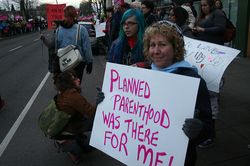
    5467119196_e521b5c1e7 Though many people are shocked by Congress’ recent withdrawl  of funds from Planned Parenthood clinics to provide family planning services, in fact right wing attacks on this organization are nothing new.   For example, the Texas legislature in late 2005 passed legislation that redirected millions of dollars from Planned Parenthood and other family planning providers in the state to Crisis Pregnancy Centers, organizations which promote pregnancy and offer no contraceptive services.  Here is an excerpt from a blog written by an impoverished Latina woman, “Tanya,” the day this new policy was announced:

    So this morning I dragged myself out of bed before dawn to be at planned parenthood at 730 and wait in the freezing morning shade until 9 for my annual exam. At 930, myself and the 25 other women (of color) grumbled in solidarity and confusion, wondering why we were still waiting and shivering, finally an employee opened the doors, and corralled us inside just to inform us that there would be no walk-in exams today. or tomorrow. or ever. Boys at the texas state legislature cut pp’s funding by 40% last Friday.

    I stood at the office stunned, while 3 mothers began to cry. Another woman, at least 65 years old, turned to me and asked, “que dijo?” (what did she say?). as I tried to explain what I still didn’t understand, I began to feel my anger swell. Overnight one of the safest, most reliable, most critical social services vanished.

    As Tanya’s blog makes clear, low income women come to Planned parenthood clinics for a variety of services. As Planned Parenthood spokespersons endlessly repeat, only 3% of the organization’s services involve abortion, and no public funds are used to subsidize those procedures. The elderly woman mentioned in the blog was presumably there,  like Tanya herself, for an annual exam that includes breast and cervical cancer screenings, and Tanya was there as well for reduced -costs birth control pills.

    Joffe So, to address the obvious question: why these attacks, at both the state and federal levels by virulent opponents of abortion, on an organization whose mission, contained in its very name, is to reduce unplanned pregnancies?  How did Planned Parenthood come to be so demonized? This after all, is an organization once so mainstream that the wife of conservative icon Barry Goldwater founded its Arizona chapter and in 1965 former presidents Harry Truman and Dwight Eisenhower agreed to be co-chairs of an honorary advisory board.

    For me, the two most compelling answers to this question lie in the reframing of contraception within antiabortion circles, and the continued dominance of the religious right in Republican circles, all the buzz about the Tea Party notwithstanding. As I discuss at greater length in my recent book, Dispatches from the Abortion Wars, while once politicians on both sides of the abortion divide viewed contraception as true “common ground” (in the late 1970s, as a Texas congressman, George H.W. Bush was such an enthusiast for subsidized family planning, that his nickname in the House was “Rubbers”), over time this understanding broke down.

    Particularly after Ronald Reagan was elected in 1980 with the active help of social conservatives, contraception, and the facilities that provided such services, such as Planned Parenthood clinics, came to be seen as “supportive of the abortion mentality,” because often these two services were delivered in the same building (albeit with strict separation of funding). Also, as abortion opponents frequently put it, with a certain logic, those who tried to prevent conception were more likely to choose an abortion if contraception failed.

    In yet another evolution, the attack on contraception escalated from   being seen as “supportive” of abortion to actually  being an “abortifacient,” that is something that causes an “abortion.”  Therefore, by the late 1990s, the pharmacy became a new battleground in the U.S. reproductive wars, with numerous instances of “prolife”  pharmacists refusing to dispense both emergency contraception and “regular” birth control pills.

    Finally, the attacks on Planned Parenthood (as well as other recent appalling legislation we have seen in Congress, for example the Orwellian named “Protect Life” act, which allows hospitals to deny abortions in life-threatening situations) are occurring because clearly the Republican leadership thinks such moves are good politics. The massive budget cuts proposed by Republicans, egged on by Tea Partiers, will not create jobs; indeed economists such as Paul Krugman have argued that such massive cuts are job weakening. Moreover, such cuts have the potential to create hardships for conservative families as well as the hated liberal ones, and in any case, these budgetary actions will not survive intact, after the Senate and the president deal with them. The one part of the Republican core constituencies that can be reliably rewarded is the religious right, an absolutely crucial group for the Party, both in terms of donations and precinct level electoral work.  

    Of course, one can reasonably hope that neither the defunding of Planned Parenthood nor the various legislative attacks on abortion will survive either, in their present form, once they reach the Senate. But these votes reassure the base that their concerns are being heard, and most importantly, do serious damage by moving the “center” of reproductive politics farther to the right. It may be too much for the Democratic-led Senate or the president to defund Planned Parenthood entirely, but it will seem a reasonable compromise to significantly cut the group’s allotment, and to continue the longstanding policy of inadequately funding contraceptive services more generally. Maybe hospitals will not have the option of letting women die if an abortion would save their lives, but other cruel restrictions (refusing an abortion if it would cause serious health damage) will, again, be seen as acceptable—or at least, necessary–compromises. Until enough American voters see the absurdity of these compromises—not to mention the misogyny of denying poor women cancer screenings at a Planned Parenthood clinic—the United States will fall even further behind other industrialized countries with respect to basic reproductive health care.

    Photo by S.MiRK on Flickr. Used under Creative Commons.

  • Queerinjustice In March 2003– three decades after Stonewall– police stormed the Power Plant, a private Detroit club frequented by African American LGBT people. Over 350 people were handcuffed and subjected to homophobic slurs. Some were hit on the head and back; others were slammed into walls. Their supposed crime was later chalked up to a bizarre infraction: "loitering inside a building." Three years earlier, Freddie Mason, a thirty-one-year-old Black gay man was arrested after a verbal altercation with his landlord, and then anally raped with a billy club covered in cleaning liquid by a Chicago police officer. Bernina Mata, a Latina, was sentenced to death on the theory that being a "hardcore lesbian" caused her to kill. A Tennessee police officer's brutal beating of Duanna Johnson, a Black transgender woman, was even caught on camera. Within a year, she was dead– the third African American transgender woman in Memphis in three years whose murder remains unresolved. Events such as these illuminate a long shadow of criminalization of LGBT people in America.

    Drawing on years of research, activism, and legal advocacy, Queer (In)Justice is a searing examination of queer experiences– as "suspects," defendants, prisoners, and survivors of crime. The authors unpack queer criminal archetypes– like "gleeful gay killers," "lethal lesbians," "disease spreaders," and "deceptive gender benders"– to illustrate the punishment of queer expression, regardless of whether a crime was ever committed. Tracing stories from the streets to the bench to behind prison bars, the authors prove that the policing of sex and gender both bolsters and reinforces racial and gender inequalities. A groundbreaking work that turns a "queer eye" on the criminal legal system, Queer (In)Justice illuminates and challenges the many ways in which queer lives are criminalized, policed, and punished.

    Read an excerpt of Queer (In)justice: The Criminalization of LGBT People in the United States
    http://d1.scribdassets.com/ScribdViewer.swf

  • Today's post is from S. Craig Watkins, author of The Young and the Digital: What the Migration to Social Network Sites, Games, and Anytime, Anywhere Media Means for Our Future. Watkins is a researcher with the MacArthur Foundation’s initiative on Youth, Digital Media and Learning where his work explores the intersection of youth culture, social media, and learning. He blogs at theyoungandthedigital.com, where this post originally appeared.

    Watkins In the wake of the uprising that shook up Egypt and ended the thirty year regime of Hosni Mubarak a growing debate around the role of social media has ensued.  The press, looking for catchy headlines, characterized the uprising as “the first Twitter revolution,” or “Facebook revolution.”  Conversely, a number of critics and academics cry foul, proclaiming that people, not technology, conducted the revolution.

    Anyone who has even a pedestrian understanding of social movements knows that they are often caused by the convergence of social, economic, cultural, and political factors. And this is certainly true in the Arab world. Decades of government corruption, elite economic self-interest, the arrogance of power, and historic economic inequalities were the primary catalyst for what Newsweek magazine called, “a youthquake that is rocking the Arab world.” A recent tweet by former U.S. Secretary of Labor Robert Reich is subtle but profound: “We cannot in good conscience continue to reward the rich, penalize the poor, and ignore the middle. There will be a day of reckoning.” While Reich was referring to the current political and economic climate in the U.S., the tweet speaks to the wider global condition. While social media was not the catalyst of the Egyptian protest, it was certainly a tool for mobilizing protest.

    The five million Facebook accounts in Egypt make it the second most popular site in the country. YouTube is the third most visited site. Whereas protestors used Facebook to organize, set dates, and “peercast,” that is, share mobile pictures and video with peers, Twitter became the social media backbone of the movement’s day-to-day machinations.

    I recently had a chance to speak with a young man who made Tahrir Square his home during parts of the uprising.

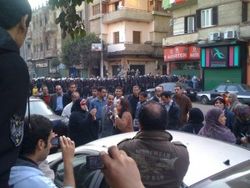
    Watkins Karim (this is a pseudonym) studies social media and told me that he felt like he was participating in history. On February 5 he sent me a number of pictures from his Facebook album that captured various aspects of the massive demonstrations in Egypt. The pictures, of course, had an ethnographic aesthetic about them and offer a much more intimate perspective of the movement than did the highly selected images most people viewed on television. The Facebook album included pictures of people protesting, confronting the police, nurturing the wounded, laughing, celebrating, and, most important, bonding together in a common cause to transform their country. In many of the pictures (see photo at right) I also noticed people capturing the protest with their mobile devices.

    In literally thousands of instances they streamed pictures, videos, tweets, and Facebook updates for their comrades around Egypt and the world.  his kind of media production is a hallmark feature of the digital media age. Egyptian protestors were not only consuming images of their efforts, they were also producing and sharing those images with the world and giving new meaning to the notion of participatory politics.

    Karim explained the popularity of photos this way. “As you might know, sometimes these demonstrations are not safe; so, as soon as we reach Tahrir Square, we take photos of the demonstration and upload them to our Facebook profiles to tell our friends that we are participating and encourage them to come over.”

    Curious about the adoption of technology in the uprisings, I asked Karim how did social media influence the events in Egypt. Karim replied that, “the demonstration started on January 25 and the call for it was done mainly through Facebook.” Facebook emerged, in part, as an efficient way to coordinate and organize protestors. The first Facebook post related directly to the events in February was made on January 14 at 11:18 pm, eleven days before the first massive protests in Tahrir Square. The main tag simply read: رسالة إلى شعب مصر: ليكن 25 يناير هو شعلة التغيير في مصر.  (Rough)Translation: “Message to the people of Egypt: Let the January 25 is the torch of change in Egypt.”

    According to Karim, social media was crucial from the outset of the movement because it gave people on the ground an information technology that they could control. “Because of the government’s heavy control over all the traditional media,” he explained, “the Internet is the only available option for all opposition parties and movements.” That is also why after two days of protest the government shut down the internet and mobile phone service. Determined to keep the momentum people used everything from dial-up modems to proxy-servers.

    The first and what will likely go down in history as one of the most famous Twitter hashtag’s in the Egyptian revolution was “#jan25,” created by a twenty-one year-old woman named, who goes by the Twitter name, @alya1989262. Follow the “#jan25” feed (created January 15, one day after the above Facebook announcement) and one of the most striking features is the range and complexity of communication that took place via Twitter. In many ways, Twitter became the mediated eyes, ears, and voice of the day-to-day life of the protest.

    #jan25 is, in essence, a transcript of history, a log not merely of what people were tweeting, but what they were thinking and, most important, doing. Twitter was used in a variety of ways during the protest.  At times it was used as a tool for real time communication betwen protesters, informing each other about the location of police, where protestors should go, and what media around the world were saying about the events on the ground.  According to @alya1989262, Twitter, “most importantly, allow[ed] us to share on the ground info like police brutality, things to watch out for, activists getting arrested, etc.”

    Twitter was also used to rally, recruit, and encourage people to come out and show their solidarity with the protestors. In other instances it was used as a broadcast medium, a technology that allowed the protesters to tell their side of the story, their side of history.  In societies were freedom of the press is severely constrained and the press is often the mouthpiece of the government, social media emerges as an alternative broadcasting platform, a way to communicate and connect with the world. There is historical precedence for this.

    In the 1960s leaders of the U.S. civil rights movement came to understand the power of television and how the images of police brutality turned the tide against the state sanctioned southern hostility toward freedom fighters and their demands for political equality.  In the student led movement against the Vietnam War in chants like “the whole world is watching” was an effort to leverage the power of television to mobilize widespread support for their social movement.  By staying connected to Twitter the protestors in Egypt were also able to track how well their efforts were trending beyond home.  What did they see?  The whole world really was watching them but this time on YouTube, Facebook, Twitter, and other social media platforms in addition to television. @alya1989262 acknowledged this, “Twitter trends also help us gauge how visible we are to the international community.” What makes social movements in the age of social media so distinct is the real time nature of communication in the execution of protest as well as the ability to share perspectives, narratives, and experiences that establish an ambient connection to the outside world.

    As we gain a better understanding of what happened in Egypt and other parts of the Arab world we will also learn more about who used mobile devices and social media to energize their efforts to create democratic freedoms.  Karim contends that, “the youth who called for the first demonstration on January 25 belong to upper middle class in Egypt and most of them, if not all, have Internet access.” @alya1989262’s account is similar. “A certain class of activists are armed with smartphones, which allow them to live-tweet the protests.” Does this suggest that the movement was ignited by a generation of tech savvy and college educated citizens?  Not necessarily. But the idea of this segment rising up to confront power is not all that surprising when you consider their condition. Roughly a third of the population in the middle east is under thirty and a noteworthy percentage of them have college degrees.  The young and the digital in the middle east are connected to the world in a way that previous generations could not even have imagined. And yet, the unemployment rate of young college educated persons in the middle east is staggeringly high. A recent report from NPR notes that 40% of young persons with college degrees in Saudia Arabia, for example, are unemployed.  Faced with the prospects of a life with few if any meaningful opportunities to utilize their cultural capital—education—many young people realized that they had nothing to lose by confronting the Mubarak regime.

    What happened in Egypt is yet another confirmation of what our research has consistently demonstrated regarding young people’s engagement with social media: young people use social media not as a substitute for face-to-face interactions with their peers and the world but rather as a complement. Young people in Egypt did not use social media to avoid gathering with each other or to passively participate in their country’s revolution. They used it to encourage gathering with each other for the expressed purpose of actively participating in the revolution. Twitter and Facebook did not start the revolution but they did help generations of Egyptians realize a world that not that long ago would have been impossible to imagine.