Overdiagnosed, Dr. H. Gilbert Welch's look at the phenomenon of widespread medical testing, aggressive treatment, and unnecessary anxiety about disease, has been roundly praised, and Dr. Welch has become a hot interview. Take your pick of reading and listening opportunities:
Sometimes a book in our backlist gets an unexpected review. We were very pleased to see this delightful write-up for The Daddy Shift on the Kids These Days blog.
Frederick Lane discusses Facebook, privacy, and employment on CBS News.
"You should not have to be subjected to being raped or sexually assaulted because you volunteered to serve this nation." — Susan L. Burke, lead lawyer in a case filed this week against the Department of Defense.
On Tuesday, two men and fifteen women filed a class action lawsuit against former Secretary of Defense Donald Rumsfeld and current Secretary Robert Gates, claiming that the Pentagon leadership failed to protect servicemembers against sexual assault. We asked Helen Benedict, author of The Lonely Soldier: The Private War of Women Serving in Iraq, about her book, which chronicles the lives of several women serving in the military, and the accusations in the case.
Why did you decide to write this book?
I was unhappy about the Iraq War from the start, but I wanted to hear what the soldiers who had actually been fighting it thought. Then I met my first woman soldier, and she told me, "There are only three things the guys let you be if you're a girl in the military: a bitch, a 'ho, or a dyke." She also told me that no one believed that she'd served in a war because she's a woman. Then I discovered that more women were fighting, being wounded and dying in the Iraq War than all US wars put together since World War Two. All that made me know I had to write about women soldiers.
How long did it take, and how many people did you end up interviewing?
I interviewed for about three years. I interviewed over 40 women who'd served in Iraq, as well as some who had served in Afghanistan and earlier wars. I also talked to male soldiers. Of all these people, I picked five women to spend a lot of time with, visiting their homes, seeing them several times, talking to them for many hours, both in person and on the phone.
What surprised you in the course of your research and interviewing?
I never expected to hear so many stories of the women being relentlessly harassed, sexually assaulted and raped by their own comrades – while they were training or actually at war. I was also surprised by how engaged in ground combat these women were, despite the Pentagon's ban against women doing this job. They were raiders and gunners and guards. They were fighting.
Finally, I was surprised by how much I liked and sympathized with the women, and how touched I was by the idealism of the young.
A play was produced as a direct result of your book. How did that come about, and what was it like for you to see your book come alive?
I wrote the play myself, The Lonely Soldier Monologues. Then, through sheer luck, I found a director (William Electric Black) who had a theater ready to go. He suggested I expand the play, and he figured out how to stage it.
It was humbling to see the words come alive on the stage, but as the play was in the words of the real soldiers I had interviewed, it was also odd. As I watched the actors perform, I could see the actors, the real soldiers behind them like ghosts, and hear the words in my head as I had written them down – all at once. I also learned how many fewer words you need when a human being adds expression and gestures to them. I learned how much I could cut!
What kind of effect has the book and play had as far as you can tell?
The effects have been gratifying, and numerous.
Top members of the Defense Department have read the book and implemented some of the changes I suggested.
I have been invited to testify to Congress twice on behalf of women soldiers.(Read testimony from May 2010 here.)
Many articles have been written about the book and its subject, here and abroad. (The book is out in Italy now.)
And a lawyer named Susan Burke came to see the play, and subsequently read the book, and then she contacted me and we met. She said she was inspired by the soldiers' stories to start a class action suit against the Pentagon on behalf of military women who have been sexually assaulted while serving. That suit is now a reality.
I have also received dozens of emails thanking me and the soldiers — and the actors — for bringing this great injustice to light.
Last, but not least, the real soldiers came to see themselves portrayed in the play, and it was a moving experience for them, the actors and the audience alike.
The class action lawsuit you mentioned accuses the Department of Defense of allowing a military culture that fails to prevent rape and sexual assault, and of mishandling cases that were brought to its attention. The case claims that the Pentagon violated the plaintiffs' constitutional rights. Can you explain the claims in the case? Do you think that the leadership has failed to protect service members?
This case came about for several reasons. Too many female servicemembers have reported rapes and assaults only to be countercharged with threat of court martial to keep them quiet. Military culture fosters and encourages a blame-the-victim attitude that intimidates women out of telling anyone about sexual persecution. And among those cases that are brought the trial, the vast majority are either dismissed, or result in non-judicial and absurdly light punishments for the perpetrators. The details are in the book, but, in short, the command from the top down has done little to either prevent or punish the sexual harassment and assault of its female servicemembers, and this has been the case since women were first allowed into the military over 100 years ago.
It is probably safe to say that Glenn Beck will never be a big champion of many of the books we publish here at Beacon Press. But his recent attacks on sociologist Frances Fox Piven, author of, among many other books, Why Americans Still Don't Vote: And Why Politicians Want It That Way, have contained a vitriol that is beyond the pale, and inspired death threats in the comment threads on his website, the Blaze.
The Nation wrote recently about Beck's targeting of Piven as a "threat":
This fusillade was evidently set off by Piven's recent Nation editorialcalling for a mass movement of the unemployed ["Mobilizing the Jobless," January 10/17]. But Beck has had Piven in his cross-hairs for some time. In the past few years he's featured Piven, along with her late husband, Richard Cloward, in at least twenty-eight broadcasts, all of which paint them as masterminds of an overarching left-wing plot called "the Cloward-Piven strategy," which supposedly engineered the financial crisis of 2008, healthcare reform, Obama's election and massive voter fraud, among other world-historical events (see Richard Kim, "The Mad Tea Party," April 12, 2010). Cloward and Piven, Beck once argued, are "fundamentally responsible for the unsustainability and possible collapse of our economic system." In his most recent diatribe against Piven (January 17) he repeatedly called her "the enemy of the Constitution." In Beck's telling, because Piven and her comrades on the left support civil disobedience in some circumstances, it is they—not the heavily armed militias of the radical right—who threaten Americans' safety.
I've known Frances Fox Piven for over 50 years and have been her literary agent for her last nine books. We are the closest of friends. I was upset and anxious by the recent death threats to her, all choreographed by Glenn Beck to his gun-crazy followers. Instead of Frances making herself scarce and hiring body guards, she, typically went into "organizing" mode. She spread the word, lined up supporters, wrote op-ed pieces and many others came to her defense She went about her business of being a radical sociologist who puts for the truth in writing and speeches to the world. My friend has courage! And fierce convictions. Glenn Beck can't stop her, but WE can stop Glenn Beck and his calls to deadly violence. That's OUR job. Let's do it!
Louisiana’s “Crime Against Nature” statute punishes solicitation of oral or anal sex for compensation more harshly than the state’s criminal law penalizes prostitution generally. Not only does a second or subsequent offense of offering oral or anal sex for money carry much longer prison terms and higher fines than any number of prostitution convictions, it also subjects individuals convicted of Solicitation of Crime Against Nature (SCAN) to mandatory sex offender registration. No state other than Louisiana requires anyone convicted solely of selling sex for money to register as a sex offender. Only in Louisiana does merely offering to provide oral or anal sex in exchange for something of value land you on the sex offender registry.
Far from being a technical requirement, being required to register as a sex offender affects nearly every aspect of a person’s life. In Louisiana, sex offenders are required to carry a driver’s license or state ID with the words “sex offender” emblazoned across it in bright orange capital letters.
Once on the registry, an individual’s picture, address, identifying information, and crime of conviction also appear on a publicly available website. Moreover, you are required to pay $60 a year to register, and between $200 and $750 to send out postcards to all of your neighbors featuring your picture, address, and the crime you were convicted of.
Imagine all of your neighbors receiving a postcard informing them you are a convicted sex offender. Most will think that you are dangerous, violent and prey on children, when in reality you were convicted for offering to engage in oral sex with an undercover officer for $50 bucks ten years ago when you were struggling through tough times. Imagine your kid or family members googling your name and learning more about your past than you ever wanted them to know. Imagine trying to explain to a prospective landlord, employer, or romantic interest that you have never harmed a child, or engaged in any conduct involving force, a weapon, or lack of consent.
Whether or not you end up having to register as a sex offender for 15 years – or the rest of your life if you are convicted of SCAN more than twice – is completely up to the police officer who decides to arrest you and the prosecutor who decides what to charge you with. Because the same conduct is covered by the prostitution statute, which prohibits solicitation of any kind of sex (vaginal, anal, oral, manual, and whatever else the imagination can conjure) for money, someone accused of offering oral or anal sex for compensation can either be charged with prostitution or solicitation of a Crime Against Nature – or both.
Police and prosecutors are given no guidance whatsoever in making that decision, which can change the entire course of a person’s life. You can either wind up with a misdemeanor criminal conviction, or a felony that requires you to register for a sex offender for 15 years to life.
As Queer (In)Justice argues, such unfettered discretion in the hands of law enforcement lends itself to overt and implicit policing of race, gender and gender identity, sex and sexuality, and poverty. The numbers bear it out – the vast majority (80%) of people required to register as sex offenders solely because of a SCAN conviction in New Orleans are African American. An overwhelming majority (97%) of women who are registered as sex offenders must do so solely because of a SCAN conviction. And, predictably, along with poor Black women involved in street-based economies, transgender women and gay men of color are singled out for SCAN charges.
Clearly, the disparity in sentencing consequences for the solicitation of oral and anal sex stems from historical condemnation of sexual activity that is non-procreative or traditionally associated with homosexuality. How can this still be happening almost ten years after the U.S. Supreme Court decided Lawrence vs. Texas, the historic case which was hailed by Lambda Legal as "a legal victory so decisive that it would change the entire landscape for the LGBT community," and supposedly eliminated criminal penalties for conduct associated with homosexuality? That’s what I thought when I first heard about this. Then I read this fateful line in the Supreme Court’s decision in Lawrence, which was decided on the basis of privacy.
This case does not involve … public conduct or prostitution.
In other words, while Lawrence eliminated criminal penalties for those engaged in consensual homosexual activity in private, it has been interpreted – erroneously, we argue – to not provide any relief to queers who engage – or are perceived as being engaged – in public sexual conduct or the sex trades. Their landscape remains, in fact, the same.
People like Michael (a pseudonym), a Latino man who was kicked out of his home for being gay at age 13 and forced to make his own way on the streets, are unfairly punished by this law. Because Michael once offered an undercover cop oral sex in exchange for $50, he was convicted of SCAN, spent 4 years in jail, and was forced to join the ranks of the Louisiana sex offender registry. He is now HIV+, and he can’t stay in a homeless shelter, get a job, or find housing because he is branded as a sex offender – and will be for the next 15 years. People like Stella (also a pseudonym), a young African American transgender woman who, like so many other transgender women, is often profiled as being a sex worker and is constantly arrested for and charged with solicitation of Crimes Against Nature every time she steps into New Orleans’ storied French Quarter as a result, is forced to register as a sex offender for the rest of her life. She’s not alone – as one person put it, “I feel like if trans women are just walking down the street, they hit them up with that charge…”
People like Frances (also a pseudonym), a middle-aged African American grandmother who was arrested and charged with SCAN as a teenager trying to make her way through high school despite grinding poverty, will continue to live in shame and fear of humiliation and harm.
Yes, this law also affects middle-aged grandmothers. As Queer (In)Justice highlights,
Cathy Cohen points out in her groundbreaking essay Punks, Bulldaggers, and Welfare Queens, gender conforming heterosexuals can also be policed and punished for exhibiting behavior or indulging sexual desires that run contrary to the vast array of punitive rules, norms, practices, and institutions which “legitimize and privilege heterosexuality.”
…
…women of color [are] by definition outside the bounds of heteronormativity, and therefore inherently subject to gender policing and punishment. For instance, Black feminists have consistently highlighted the development of a number of controlling narratives casting Black women as dangerous, gender deviant, “castrating matriarchs,” or as sexually aggressive, promiscuous, and depraved, to justify their regulation as both inherently criminal and as “breeders” of criminals. Cohen also points to the use of heteronormativity to exclude single mothers on welfare, predominantly perceived to be almost exclusively women of color, and sex workers, from who is “normal, moral, or worthy of state support” or legal recognition.
One African American woman forced to register under the Crime Against Nature statute asks "I was raped and used myself a lot of times. I never hurt anyone – why am I on the registry as a sex offender?" Another, who has struggled with poverty and addiction and has spent most of her life behind bars, in large part due to SCAN charges, as a result says: “There are children getting raped every day, but no, you want to go after me, and go after the transsexuals out there … It just vex my spirit.”
In other words, there is both theoretical and real common ground among poor non-transgender Black women and transgender and gay men of color who are, or are perceived to be, involved in the sex trades, on which multi-racial and multi-issue organizing can be solidly built. The disparate punishment of certain types of commercial sexual exchanges based on ancient notions condemning queer sex should also be considered an LGBT rights issue that affects both queers and heterosexuals.
Unlike earlier efforts to challenge the statute post Lawrence, the campaign currently underway to, spearheaded by local harm reduction agency Women With A Vision, focuses on the experiences of both queers and heterosexuals of color who share experiences of policing and poverty. In this way, it represents exactly the kind of organizing Queer (In)Justice hails as the future of a progressive queer movement. Led by lesbians of color, bringing together civil rights, racial justice, women’s health, AIDS, LGBT, juvenile justice, and anti-police brutality attorneys, advocates, and organizers, and centering the voices and experiences of all people affected by the law, the campaign recognizes that issues of poverty, race, criminalization, gender, sex, and sexuality are inextricably intertwined.
Join Women With A Vision’s No Justice Campaign in demanding the repeal of Louisiana’s Crime Against Nature statute and retroactive removal of everyone who is on the sex offender registry solely as the result of a non-violent SCAN conviction. It’s just one step toward ensuring that no queer is left behind.
Queer (In)Justice: The Criminalization of LGBT People in the United States, by Joey L. Mogul, Andrea J. Ritchie, and Kay Whitlock went on sale in bookstores across the country on February 15, 2011.
For Black History Month, read an excerpt from a book that tells the story of African American history through their own letters
Letters from Black America, edited by Pamela Newkirk, fills a literary and historical void by presenting the spectrum of African American experience in the most intimate way possible-through the heartfelt correspondence of those who lived through monumental changes and pivotal events, from the American Revolution to the war in Iraq, from slavery to the election of Obama.
In this excerpt, you can read the words of enslaved people reaching out to family members, the love letters a devoted young couple wrote to each other during their engagement, a note from W. E. B. Du Bois to his teenage daughter, and Alice Walker's letter to President-elect Barack Obama, written the day after his election.
Three months ago I heard my mother's voice for the first time since I was nine. When I first heard her voice I said, "Mom! You have a Texas accent!" All those years of reading her lips and I had never really known that. We both laughed ourselves sick.
When she was six months pregnant with me, she'd been given an antibiotic that saved both our lives, but left me with a chemical imbalance that insidiously ate away at my hearing.
As I wrote in my memoir, "By the time I was nine the voices of everyone I loved had all but disappeared."
That was my life for 51 years. Then, last May, I was given a cochlear implant. I'd resisted it like crazy. I was used to my hearing aids and couldn't believe the operation (which is, after all, a brain surgery) could offer anything better than I already had. I'd worked hard to understand as much as I could and to be myself in the world. But one day, after attending a meeting with my Vocational Rehab counselor and me, my lover and sweetheart Donna Marie said to me, “Why should you have to work so hard?"
So there was that. And the fact that my counselor had almost exactly the same type of hearing loss I did (profound) and she had two implants. Her audiologist, who is my audiologist, told me that to watch her after she had had the implant was like seeing someone put points on their IQ.
So I had the operation. They implanted receivers in my brain, tucked a magnet under my scalp. It took me a month to heal. And then they brought out the gem– the cochlear computer itself. When I first began thinking of the cochlear I had imagined the machine to be the size of half my head– a huge, robotic, unabsorbed twin.
The real deal looked sweet in its little box. It slipped easily behind my ear. And the coil that ran from the computer to the magnet inside my head was no bigger than the thumb of an alderman.
When they first turned it on, I was in a soundproof room alone with Katherine Gray the audiologist, an intern, Donna, and Diane Wilkins, who was taping it for a documentary about the process we're doing called Rewired.
They turned it on and that soundproof room turned on in my head like a space shuttle– filled with sounds that everyone else in the room had long learned to ignore. It tore my head off.
That's why Katherine had insisted on holding my hand. The rush of sound is like the rush of blood and makes you sick with the excess.
I was terrified that I wouldn't be able to adapt. And then Katherine let go of my hand and took out a small child's bell and rang it.
And that tiny little bell sounded in my brain so sweetly, so clearly, my whole soul turned to it.
That was the beginning of my new love affair with sound. The world is exactly what I thought it would be — a miraculous, buzzing confusion. And my brain is already beginning to categorize the different meanings of different sounds. So, yes, there are birds — which I kind of believed in because I had seen the fluttering through the skies but never really believed that they made the cacophony that everyone claimed. But then I heard them clanking and clattering. And they were all one until again my brain became to sort through them and tell me, well, this is one kind of bird and it makes a sweet trill; and this other yaks like a gossip. And this one over there — and, god, I actually could locate it by its singing– and the song sounded (or so I imagined) first like yearning and then changed. Of course in my state of mind I defined that change of tone as happiness.
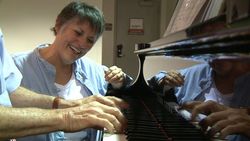
Photo of Terry Galloway enjoying piano taken for the documentary Rewired.
About the author
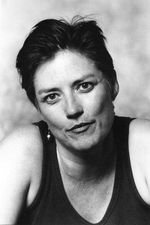
Terry Galloway, a 2013 Alpert Award nominee, is a writer and performer who writes and performs. Her theater work has been produced in venues ranging from the American Place Theater in NY to the Zap Club in Brighton England; her short videos have been featured in film festivals all over the world; and her poems, essays and flights of fanciful non fiction have been widely anthologized; and three of the three theaters she co-founded over the course of her career are still going strong. Read her memoir, Mean Little deaf Queer to find out more. You can also visit her website for more info and follow her on Twitter.
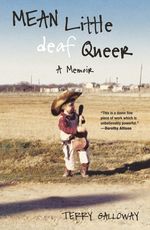
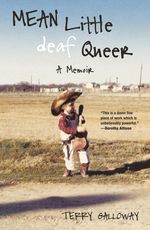
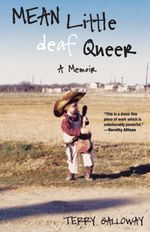
This week, we've been sharing stories by Terry Galloway, author of Mean Little deaf Queer: A Memoir. Today, we're posting an excerpt from that book, in which she explains the difference between Big-D and Little-d deaf.
We're giving away five signed copies ofMean Little deaf Queer. To enter, leave a comment on today's post, like any post about the book on our Facebook page, or share a link on Twitter. We'll choose winners at random at the end of the week from entries across our social media empire.
I recently read that hearing is the last of the senses to go. I’ve taken this to mean I’m going to be buried alive, because, deaf as I am, I won’t know I’m not already dead. This alarming new bit of information moved me to take up the nonhearing exercises I used to indulge in when I was younger. I put my hearing aids aside, stretch out on the bed, and get myself ready for what’s in store. The mattress trembles with every passing car and so do I. When a train rumbles and chugs along the tracks three blocks to the north, my body rumbles and chugs right along with it. Thunder shakes the walls of the little house where I live and the shocks of it make the headboard and my own heart thwack. Lying there awake too long breeds in me a deep unease, a fear that I ought to be feeling something I’m not. My longtime love, Donna Marie, calling for help in the back room; our cat, Tweety, yowling piteously to be let in. Those are the times when going deaf the way I have, in fits and starts, seems most akin to dying. I’m losing, will lose, have lost. And each step of the way, my body seems to have been trying to tell me something new, something it seems I ought to have known all along.
In 1961, the year after I was diagnosed, my body reached a tipping point and I began to lose my hearing in big old chunks. It was a loss as erratic and unsettling as a Ukrainian train schedule. I’d lose a decibel or two of sound, then my hearing would stabilize. A day, a week, a month later, whole conversations would fade into gibber- ish. Familiar noises like the purr of the refrigerator would simply vanish and I’d have to adjust all over again. One late afternoon I fell into a doze on the couch listening to my parents’ muttered lazy Sunday conversation, then woke a handful of minutes later to what seemed like nothing. For two days even my own voice was an echo in my head.
I loved the crispness of my own speech, a trait both Trudy and I picked up from our German maids. When we first moved from Germany to Texas my precise enunciation marked me as somehow superior to those who drawled or squeezed words through their noses. After my deafness took hold, my speech began changing, every vowel out of my mouth taking on a soft slur that people took for south- ern. I didn’t love the South then, the way I love it now. And that change to my voice embarrassed me, but not as much as it did to see the new incongruities of my voice reflected in people’s faces, the wince when I was talking too loudly, the grimace when I wasn’t talking loudly enough, or the skeptical twist of brow when I’d swear I didn’t mean my tone to be angry, that I had no idea I sounded sardonic when I’d meant to sound sincere. I could feel all the lilt and color draining from my voice, feel it becoming a monoto- nous drone. I’d forget to give the end of a sentence a vocal twist to make it mean this one thing, or drop the sound in the middle to make it mean another. I found it hard to remember how words I knew sounded, harder still to learn new words I couldn’t quite hear. My two sisters loved playing teacher, and made exaggerated facial displays, showing me how my lips should move to form the new syllables. But even with my new hearing aids it was hard to piece the muted gabble of sounds together into any kind of sense.
Hearing aids or no, I was constantly being taken unawares, and that made me jumpy, almost paranoid. I didn’t realize someone was running around the corner until the body was upon me, didn’t answer the voice calling from the bathroom until they’d got up off the toilet to scream, didn’t know anyone was pounding at a locked door unless I accidentally opened it and they came tumbling through. I was a private child, made even more private by the con- fusion and intensity of my sexual desires, and everyone seemed to be sneaking up on me. I needed a big hunk of uninterrupted solitude to play out my needs to their natu- ral conclusions, and it divided my focus having to keep one eye on my closed bedroom door and the other on my Barbie and Midge dolls having sex.
At the same time, I was discovering, to my repeated embarrassment, the Freudian element in lip reading. One memorable afternoon as I was inching forward in the lunch line, I looked up at the lips of the fourth-grade sex bomb who had just cut in front of me, and was wonderfully taken aback when she deigned to address me: “Hey kid, you’ve just made my day!” My heart started thumping like a happy Disney bunny until her flat inflection, her narrowed eyes, and the pinchy look around her nose clued me in to what she’d really just said, which was, “Hey pig, get out of my way.” Who knew deafness could be so ironic?
All my mother and father knew of deafness was what they’d seen in a film called Johnny Belinda, about the rape of a tragically clueless deaf and mute girl doomed, like me, always to be taken by unwelcome surprise. All they knew about the deaf was that they signed. My parents didn’t know what to think of Sign. They knew it to be a real lan- guage, but it was an alien one, something neither one of them—even my father, with his spy’s proficiency in Ger- man and Russian—could ever imagine learning. When the Texas school system offered them the choice of leav- ing me in public school or enrolling me in a school for the deaf, they had no idea how to choose, and left it up to me. I’d seen only one person sign before, and the symbols her hands carved out of air seemed akin to the soundless lan- guage of the TV Apaches I so admired. I was already using my hands anyway—to gesture, touch, and feel. Sound was quickly seeping away from me, leaving me in a void I was anxious to fill. I would have welcomed that new way to understand. But for my mother’s sake I wanted to appear whole again. I already knew how to do that—act cool and pretend all was well. Over pancakes one Sunday morning, my parents asked me if I wanted to transfer to a special school where they’d teach me to sign. I didn’t even bother to think about it, just downed my cocoa and rolled my eyes as if they’d told the biggest joke in the world. “Sign? Hah. Not for me, thank you. And pass the syrup, please.”
At public school in Fort Hood, I sat up front and did the best I could to learn, and each afternoon served out a two- hour sentence in the gulag known as special ed. Special ed was usually held in a one-room annex that looked like a trailer on stilts. There was a steep ramp with handrails running from the ground to the door. The room was dark and close and stuffy, just big enough to hold the handful of us special kids. There was usually someone in a wheel- chair, someone blind, someone dull and thuggish, and at one point a sister and brother who seemed old to be in elementary school—they both had a shadow of a beard and a look about their eyes that reminded me of dogs turned mean after being poked at, beaten, and teased. I realize now they were probably mildly retarded, because when- ever they talked, which was seldom, their faces would con- tort in rubbery exaggeration, as if they had to fight their own muscles to get the words out right. We did nothing productive those two hours we were together. Zero. Zilch. We sat, fidgeted, or stretched out and whiled away the hours. Since I was able-bodied I helped empty the pee bags and sometimes I’d read aloud while the volunteer assis- tant, whose Texas twang thrummed like an overtightened string, would correct my pronunciation, teaching me to say “fir” instead of “for” and “enny” instead of “any.”
I was a clever little schemer and a voracious reader, so I managed to keep up in my regular classes at school, getting hard-won B’s and A’s even though the teachers had a bad habit of turning their backs as they were speaking to write on the blackboard. I’d read their lips as they said, “We call the theory that there is only one . . .” then they’d turn their backs and the rest would be lost in puffs of chalk. It didn’t occur to me to ask my teachers to change their behavior, to look at me when they were talking, to slow down so I could read their lips. I was a child and thought I had no agency. But I knew I was flying by the seat of my pants, that every answer I gave was guesswork, that I couldn’t really spell or diagram a sentence; and at age ten, then eleven, then twelve, I was still using my fingers to add and subtract. It wasn’t until years later that I found out I’d been one of the lucky ones.
As a child I didn’t pay much heed to other deaf chil- dren, because I didn’t know any. The deaf as a people don’t regard themselves as disabled but simply a culture entire, like the Amish. And, like the Amish, they keep to themselves. There is a definite hierarchy in that deaf cul- ture. If you are deaf of deaf—a deaf person born to deaf parents—and your language is Sign and the company you keep is primarily deaf, you are Deaf with a capital D. If you are hearing-born to deaf and you sign and live and play primarily within the deaf community, your blood is still pure. It dilutes a bit with every variation from those first golden means, but lowest on the deaf totem pole are the waverers like me who came to deafness gradually or late and were “mainstreamed” to be part of the hearing world. As a general rule we suck at Sign. My own Sign is on par with my Spanish, which can get me to the bathroom, but after that, nada. We are known as the little-d deaf.
Growing up, I knew none of this. I was twenty-five before I went to my first deaf gathering, and I was taken aback to encounter hostility and suspicion there. When I introduced myself as Deaf, overenunciating and gesturing broadly with my hands, one of the women signed to me furiously, her eyes getting harder by the second as she re- alized how little I understood. I wasn’t Deaf but deaf, and when she signed the lower-case d I could almost smell its rotten tang. I’d gone there thinking I’d be embraced like a prodigal daughter and instead found myself under fire for, so I thought—the same curse that had befallen me at the Lions Camp for Crippled Children—not being disabled enough. Hostility makes me hostile in return. It was all I could do not to stick out my tongue and grimace and pos- ture like a Maori warrior. I walked out of there thinking they were a closed, provincial bunch and I was better off outside their preachy little circle. I remained smug in my lowercase superiority until a few years later when I devel- oped a crush on a deaf woman who was a consultant for the PBS television series for disabled children I was cowriting. She spoke as well as signed and it was she who told me these stories.
Once upon a time in certain institutions for the deaf, Sign was out of fashion and something called total communication was in. Total communication simply meant that deaf children would be taught any and all ways to communicate, and that meant lip reading as well as Sign. In some places the message got skewed and in those places the fashion of the day became for deaf children, all deaf children, to learn to lip-read and speak. Sign was frowned upon if not strictly forbidden. As an expert lip-reader I can tell you, lip-reading is a true talent and hard as hell to learn. Most people never can.
The children who couldn’t learn to lip-read tried to please their teachers by moving their lips while mimicking what they thought were the right sounds. But the sounds they made were random, based on raw physicality, the feel of air moving through the throat and head. Hearing par- ents didn’t like their children vocalizing this way, because it was too close, they complained to the teachers, to the grunting of animals. If the sounds the children were mak- ing weren’t the “perfect” ones, their teachers would tape the children’s mouths as punishment. The children were trying their hardest to please, to communicate, so they’d gesture as they tried to form the shapes of the words in their minds, shapes for which they had no sounds. That struck their teachers and their parents again as looking too animal, too vulgar, too much like Sign, so to teach them better, the teachers would tie the children’s hands to their chairs. “Read the lips,” they were told over and over again, but those children couldn’t do more than guess what they were being asked to read. It was next to impossible for them to find the essence of elusive sounds in the swift mo- tion of the mouth. Many of them grew up without language—a whole generation who couldn’t speak, couldn’t sign, and could barely read or write.
She had other stories to tell me too, of unbearable disregard. A child was born to hearing parents, both doctors, full of high expectation for their children, but this infant girl wasn’t thriving like her two brothers. She seemed indifferent to language, slow to respond to the simplest commands. They were ambitious, busy people who had no time to waste on a child who was, for whatever reason, less than perfect. They diagnosed her themselves as being mentally retarded and had her committed as a toddler to a state institution. Years later a new attendant who was fond of the child noticed her collecting gum from under the tables and chairs. As he watched her fashion intricate and fantastical figures from the raw material, it began to dawn on him that a mistake had been made. He stood behind her and clapped his hands. She didn’t respond. That was all it took to find out she was simply deaf.
Years later I met that girl. By then she had become an artist, living on her own. She wore two hearing aids like mine and also had pulled off a miracle—she not only signed, she lip-read. She vocalized too. But when we talked, I remember thinking how interesting it was that her facial expressions were identical to those of the brother and sister I knew from special ed. I never shared my observation with her. I didn’t want her to be disturbed about something she couldn’t change. Besides, she probably already knew the oddities of her own speech, the same way I know that when I talk—despite all my pains—the words out of my mouth are cottony, blurry around the edges, as if they’re in danger of being swallowed back down my throat. Exactly the way a little-d deaf like me would speak.
This week, we’re giving away five signed copies ofMean Little deaf Queer, Terry Galloway’s memoir that Kirkus called “frank” and “bitingly humorous.” To enter, leave a comment on today’s post, or share this post on Facebook or Twitter. We’ll choose winners at random at the end of the week from entries across our social media empire.
To give you an idea of Terry’s warmth and humor, we made some videos with her prior to her cochlear implant surgery a few months ago. In yesterday’s installment, she spoke at length about her deafness and why she decided to get the surgery. In today’s video, she discusses how she thought the surgery will make her different and how she’ll stay the same.
Transcript: Terry Galloway, author of Mean Little deaf Queer, talks about her upcoming cochlear implant surgery.
So they turn it on, and then they start to teach your brain how to hear again. And in my case, because I had sound, and I lost my hearing gradually, my brain’s going to remember.
So once upon a time I might have heard birds signing. Once upon a time I heard the insects doing whatever the insects do, I don’t know what they do, I’m hoping it’s a symphony! Once upon a time… and so my brain remembers.
But that part of it hasn’t been stimulated… in years. And all of a sudden it’s going to be going hmmmmmmmm.
Just like with the little digitals. When I first got these, it was like, “Oh my god what is that ungodly sound?” And it was a train. And I hadn’t even realized that there was a bridge with a train–the years that I’d been living in the neighborhood— that there was a bridge with a train, that the train went over every single day. I didn’t even realize it until that moment.
But then at night, you take it off. Or when you get sick of it and you can’t take it any more, you take it off. And you’re deaf again. And there is a kind of bliss in the silence. It’s so profound. And you genuinely can be lost in… it’s not just self-contemplation, but it’s the contemplation of silence.
And so I don’t have to miss that. I’m going to keep that.
What do you think will remain unchanged about you after the surgery?
I don’t know. One would assume, and I assume, that I have a core of behavior that has been untouched by both the loss and will be untouched by the restoration of hearing. I would assume that, but, God, I don’t know. What if all of a sudden, I get my hearing back and I turn into a complete and utter shit? And I have been in my life a complete and utter shit, so it’s very easy to contemplate. I remember, as a kid, a real strain of selfishness. And a real strain of… something mean. And I kind of hope I’ve had that wrung out of me. I kind of hope that– and I’m not talking about self-pity that does it—but I kind of hope that because of all of this, and because of the way I’ve had to go at my own ambitions aslant, that I became, or have become, kind. I hope I’ve become kinder.
Terry Galloway is the author of Mean Little deaf Queer: A Memoir. In 1959, the year Galloway turned nine, the voices of everyone she loved began to disappear. No one yet knew that an experimental antibiotic given to her mother had wreaked havoc on her fetal nervous system, eventually causing her to go deaf. As a self-proclaimed "child freak," she acted out her fury with her boxy hearing aids and Coke-bottle glasses by faking her own drowning at a camp for crippled children. Ever since that first real-life performance, Galloway has used theater, whether onstage or off, to defy and transcend her reality. With disarming candor, she writes about her mental breakdowns, her queer identity, and living in a silent, quirky world populated by unforgettable characters. What could have been a bitter litany of complaint is instead an unexpectedly hilarious and affecting take on life.
A few months ago, Galloway underwent cochlear implant surgery to restore her hearing. Prior to the surgery, we spoke to her about her hopes and fears about cochlear implants. We'll be giving away copies of the book on Facebook and Twitter this week. Fan and Follow, and we'll choose the winner at random at the end of the week from all entries.
Join all three co-authors in celebrating the national launch of Queer (In)Justice at Creating Change, February 2 – 6 in Minneapolis Minnesota http://www.creatingchange.org/! They will be hosting a workshop on policing, prosecution and punishment of LGBT people and developing responses to violence against queers on Friday, February 4 from 10:45 am – 12:15 pm and joining Queers for Economic Justice for an evening reception celebrating QEJ's achievements and the book's publication at 8:30 pm. Both events at the at the Hilton Minneapolis,1001 Marquette Avenue South, see conference signage for room locations.
Kay Whitlock and Joey Mogul will also be appearing at University of Minnesotal-Twin Cities on February 4 from 3:00PM to 5:00PM in Room 609 Social Sciences,and at St. Catherine's Universityfrom 11:30 – 1:00 pm on February 3 at the Department of Sociology/Critical Studies of Race and Ethnicity.
This past month, both houses of the Illinois General Assembly passed bill SB 3539, which would repeal the death penalty in Illinois. The bill is now awaiting Gov. Pat Quinn's signature. If he signs the bill, Illinois will become the 16th state to repeal the death penalty in the United States and the third to do so in the past three years; it would also take its place alongside 95 countries that have abolished the death penalty.
Quinn has not decided whether he will sign the legislation, and has indicated that he wants to hear from the people of Illinois before making his final decision. Here are the reasons you should make that call urging him to sign the bill.
In addition to repealing the death penalty, the bill would redirect its necessary funding toward services for murder victims' family members and for law enforcement. The funds currently spent on the death penalty are quite significant, particularly in light of the crushing budget crisis we are facing in Illinois. According to the Illinois Coalition to Abolish the Death Penalty (ICADP), more than $100 million in taxpayer money was spent on the death penalty in 2003 alone. It is well known that implementation of the death penalty is far most costly than imprisonment.
The passage of this legislation is the culmination of a mammoth effort led by the ICADP. It follows decades of litigation, investigative journalism and organizing that have uncovered mountains of evidence demonstrating that the death penalty is fatally flawed and beyond repair. (Read more…)