• Jay Wexler uncovers the truth behind the euphemisms in the Supreme Court's "F-Word and S-Word" case (a.k.a. FCC v. Fox Television Stations). And the Globe takes note of his book, Holy Hullabaloos, in anticipation of his reading Wednesday night at the Brookline Booksmith.

    In the run up to Father's Day, there's been a lot of chatter about stay-at-home Dads and Jeremy Adam Smith's The Daddy Shift. We'll have Smith on Beacon Broadside later in the week, and he has numerous radio gigs in the coming days. In the meantime, check out the first installment of his Father's Day link roundup at Daddy Dialectic, read up on Daddy bloggers, or check out this review of The Daddy Shift by a fellow stay-at-home Dad.

    With the release of Believer, Beware: First-Person Dispatches from the Margins of Faith on the horizon, Jeff Sharlet introduces a series of "from the archives" posts over at Killing the Buddha.

    Can you find spiritual inspiration in BusinessWeek? When the Rev. Forrest Church is there, you can.

    Live Science talks about youth sports and overuse injuries.

    Michael Patrick MacDonald's memoir All Souls shows up on Boston.com's list of 100 Essential New England books. How many have you read? 

  • Happy Loving Day! On this day in 1967, the Supreme Court made interracial marriage legal.

    June 12th also marks the day Medgar Evers was murdered and the day Anne Frank was born.

    A law prof talks about his paternity leave.

    Is contemporary literature doomed to “the Gothic fate of poor slain poetry“? But, wait! Poetry’s not dead yet!

    Watching a family friend turn into a Nazi.

    A conversation between a traditional nun and her gay cousin about sexuality and the Catholic Church.

    Good-bye, Shaman Drum Bookshop.

    Congratulations, GLSEN founder Kevin Jennings, on being appointed to the Department of Education. Now someone needs to counter the conservative backlash.

  • Today’s post is from Nancy Polikoff, author of Beyond (Straight and Gay) Marriage: Valuing All Families under the Law. Polikoff is a Professor of Law at American University Washington College of Law, where she teaches Sexuality and the Law and has taught Family Law for more than 20 years. This post originally appeared at her Beyond (Straight and Gay) Marriage blog.

    Book Cover for Beyond (Straight and Gay) MarriageEarlier this week, Tel Aviv University was the site of the 9th annual queer studies conference An Other Sex. I was honored to deliver a keynote on my book, Beyond (Straight and Gay) Marriage.

    Israel has a distinctive legal regime within which to consider same-sex relationships. There is no civil marriage in Israel, only religious marriage. This keeps many straight couples from marrying because, for example, a Jew cannot marry a non-Jew. So there has been pressure for years for different-sex couples to not make marriage the dividing line between relationships that count and those that don’t.

    Israel recognizes the legal status of those “known in public” as spouses. It also allows couples to register foreign marriages (they say Cyprus does a thriving business marrying different-sex couples who can’t marry in Israel). Because of this (after much litigation), Israel will register the marriages of same-sex couples who marry elsewhere and will recognize same-sex unmarried couples in ways that are similar to those accorded unmarried different-sex couples.

    There is a push for civil marriage here — but it would be for different-sex couples only. So this is not a good thing for lesbian and gay families.

    (more…)

  • Today’s post is from law professor and humorist Jay Wexler, author of the forthcoming Holy Hullabaloos: A Road Trip to the Battlegrounds of the Church/State Wars. He studied religion at the University of Chicago Divinity School and law at Stanford, and worked as a clerk to U.S. Supreme Court justice Ruth Bader Ginsburg. Wexler teaches at the Boston University School of Law, and he blogs at holyhullabaloos.typepad.com, where this post originally appeared.

    Book cover for Holy Hullabaloos links to Beacon Press page for bookSo Monday, Justice Ginsburg issued a stay of a lower court’s approval of the whole bankruptcy deal involving Chrysler and the sale of a bunch of its assets to Fiat and whatnot. Though it doesn’t happen often, individual justices of the Supreme Court have the authority to grant stays of lower court decisions when they believe that the stay is necessary for the Supreme Court to decide whether to decide the case on the merits.; In other words, if a lower court decision would result in some irreversible action (like the whole Chrysler deal), and if there’s a plausible argument that the lower court decision involves some legal issue that might be worthy of Supreme Court review, the adversely affected party might ask a justice to issue an emergency stay of the lower court decision so the whole Court will have some time to decide whether in fact the case is worthy of review. The request goes to the justice who has authority over the geographical area where the case comes from; Justice Ginsburg is the justice in charge of the second circuit area, which includes New York, and so the request went to her. The justice has the option of either just deciding whether to grant the stay him or herself, or alternatively to bring it to the whole Court to decide whether to grant the stay. A decision to grant a stay doesn’t mean that the Court will actually go ahead and decide the case on the merits; it just means that the Court thinks the issue is important enough that it needs some time to consider whether to decide the case on the merits.

    When I was clerking for Justice Ginsburg in the 1998-1999 term, I had occasion to work on one of these stay requests. It was late in the term–maybe June or something–and as usual I went on a long lunch break. I can’t remember whether it was one of those days when I went back to my rat-infested apartment to eat and watch a rerun of Good Times or whether I went to the Au Bon Cafe with friends or what, but I remember coming back after lunch to find this big file on my desk involving a request for an emergency stay in a really famous religion case– one in which I discuss in Holy Hullabaloos. Now, I’m good at certain things, but one thing I’m not good at is dealing with emergencies. Luckily, there generally aren’t any emergencies at the Court. Clerks do a lot of work, but you always know what’s coming and you generally have a good amount of time to do it. This allows you to plan your work in a rational fashion and not have to worry that something unexpected is going to come up and bite you in the ass. Well, this file bit me on the ass, and I freaked out. I said something like: “Ahhhh” and wet myself. OK, I didn’t wet myself, but I got very nervous and worried and also a little irritated because now I was going to have to do all this work to figure out what the stay application was all about, which meant that I wasn’t going to have time to watch more television or work on my unbelieveably horrible novel about a blueberry muffin called “Arrivederci, Loser,” the title of which was based on a piece of hate mail that my wife once received from a former nutso friend who thought that my wife had abandoned her for me (she had).

    The case in which the stay was requested is too confusing to describe fully here. It basically involved a first amendment Establishment Clause (church/state separation) challenge to the state of New York’s decision to grant a community of Satmar Hasidic Jews its own school district so it could administer publicly funded assistance to disabled children in the community. Back in 1994 the Court had invalidated the first version of this arrrangement in the Kiryas Joel v. Grumet case that I discuss in the book.  In subsequent years, the state made several attempts to comply with the Court’s decision in that case while still giving the Satmars the authority they wanted. The thing I worked on was a request to stay a lower court decision holding the most recent attempt unconstitutional. Luckily for me, Justice Ginsburg, as usual, knew exactly what to do and didn’t really much need my help and so it all turned out fine (the Court in fact granted the stay but didn’t end up hearing the case, though a few justices thought they should have), but I still sharply remember the feeling of YIKES I had coming back to lunch to find the latest iteration of a famous case in my field of interest sitting on my desk.

  • Looking for some good gardening books? We recommend the one about weeds. 

    So why would an accomplished jurist address the hot-button topic of race? Perhaps because, if you're Sonia Sotomayor, people keep asking you about it.

    Six questions for Rashid Khalidi about the Cold War and the Middle East.

    Enthusiasm for The Daddy Shift on Mike Adamick's SF Chronicle blog.

    Connecticut becomes the first New England state to apologize for slavery.

    A recent report on women in science shows gains at research universities, but don't break out the champagne yet.

    So many people have been sharing their personal stories of terminating their pregnancies in the late second or third trimester, in the wake of the murder of Dr. George Tiller. This personal story is about a pregnancy that eventually went to term because, in spite of early tests that showed a possibility of a severe defect, the parents had the option of a late-term abortion.

    Great interview with Mark Hyman for Baltimore's Press Box. Embedded here, but if it doesn't display in your browser, visit here.

    http://vimeo.com/moogaloop.swf?clip_id=4848911&server=vimeo.com&show_title=1&show_byline=1&show_portrait=0&color=&fullscreen=1

    Inside PressBox May 17, 2009: Youth Sports from PressBox on Vimeo.

  • Today’s blog post is from Carole Joffe, author of Dispatches from the Abortion Wars: The Costs of Fanaticism to Doctors, Patients,
    and the Rest of Us
    (Beacon Press, forthcoming January 2010) and Doctors of Conscience: the Struggle to provide Abortion before and after Roe v Wade (Beacon Press, 1996) and professor of sociology at the University of California, Davis.

    Book Cover for Dispatches from the Abortion Wars “It comes down to who is the patient. Is the woman the patient, or is the fetus the patient? One or other is the patient. I’ve never heard a fetus talk to me. I’ve heard thousands and thousands of women share their pain, their desperation, and their hopelessness.” These words were spoken to me some twenty years ago by Dr. George Tiller, as I was researching a book on abortion providers’ experiences before and after Roe v Wade. Tiller, who was brutally assassinated in his church on May 31, was one of the most compassionate– and feminist– individuals I have ever encountered. “Trust women” was his well-known motto, prominently displayed at his clinic in Wichita, Kansas.

    He was asked repeatedly by friends how he could continue his work in the face of the unending violence and legal harassment that he endured in the years leading up to his murder: his home and office were frequently blockaded (I recall hearing that he and his wife had to be helicoptered out of their house to attend a child’s wedding, as antiabortion fanatics were surrounding his home); he was shot in both arms in 1993; and he was subjected to numerous lawsuits brought by a grandstanding anti-abortion Attorney General in Kansas and by Operation Rescue operatives, all of which he ultimately won, but which took a huge toll, financially and emotionally. His answer was always the same: “Where else can these women go?”

    Tiller’s answer was not a rhetorical one. He was one of the very few physicians in the United States who provided abortion care well into the third trimester of pregnancy. It is this fact that made him so reviled in antiabortion circles, and unquestionably the most controversial abortion provider in the country. Operation Rescue relocated their offices to Wichita a few years ago, with the specific intent of closing him down. Each day, the women who came to him from all over the U.S., and from abroad as well, had to go through a gauntlet of protestors holding grotesque posters and screaming about “Tiller the baby killer.”

    It is hardly surprising that antiabortion zealots would find Dr. Tiller such a convenient target, focusing on his late term procedures. What has been more surprising, and disappointing, to me has been the inadequate coverage of Tiller’s work in most of the mainstream media in the days since his murder. I myself have spoken to a fair number of reporters, have read numerous stories from papers across the country, and consumed a great deal of television and radio reporting on this event. I have been struck that although all reporters mention that he offered late term abortions, as a way of explaining his notoriety in antiabortion circles, remarkably few of these print or radio and television journalists explained why Tiller did this, and who actually were the recipients of these procedures. The fact that so many of those reporting on Tiller were so oblivious of the circumstances of his patients is in itself a powerful indication of the marginality of both abortion providers and patients in American culture.

    (more…)

  • Today’s post is from Carlos A. Ball, Professor of Law at the Rutgers University School of Law (Newark). He has written extensively on gay rights issues and is
    the author of The Morality of Gay Rights: An Exploration in Political
    Philosophy
    . He lives with his family in Brooklyn, New York.

    Book cover for From the Closet to the CourtroomNow that it has been a week since the California Supreme Court’s decision upholding Proposition 8, it is a good time to take stock of what is happening with same-sex marriage not only in California, but also in other parts of the country. For those of us who support LGBT rights, the California court’s decision was disappointing and frustrating. But in the long run, I think that the LGBT rights movement will benefit politically as a result of the court’s ruling.

    I say this because if the court had struck down Proposition 8 as unconstitutional, that would have created a political firestorm in California and elsewhere. Although there is a solid legal argument to be made that Proposition 8 should have been struck down because it was inconsistent with core principles contained in the state constitution, the politics behind the case are more complicated. If the court had sided with the plaintiffs, many would have seen the ruling as an affront to basic democratic values. The court, after all, would have overturned the expressed preference of a majority of Californians who voted in the November election.

    There can be no doubt that if the court had struck down the Amendment, conservative political activists would have used the ruling to fire up their supporters by attacking the court for its supposed activism and lack of accountability. That kind of anti-judicial rhetoric has unfortunately proven quite effective in convincing voters in more than half the states to approve constitutional amendments banning same-sex marriage.

    (more…)

  • WinslowToday’s post is the latest in a Beacon Broadside series: Observation Post by journalist and foreign correspondent Philip C. Winslow. Over a career that has spanned more than twenty-five years, Winslow has reported on world events for the Christian Science Monitor, the Toronto Star, Maclean’s magazine, ABC radio news, CTV News, and CBC radio. He also served in two United Nations peacekeeping missions and worked for the UN in the West Bank for nearly three years. He is the author of Victory For Us Is to See You Suffer: In the West Bank with the Palestinians and the Israelis and Sowing the Dragon’s Teeth: Land Mines and the Global Legacy of War.
    Memorial Day in Jamaica Plain

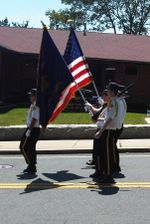
    On a perfect Memorial Day morning, I bicycled out of Boston to a Veterans Affairs medical center in Jamaica Plain, to see if there might be a commemorative service for patients. It’s no longer an inpatient facility, and was closed for the holiday. But as I rounded a corner not far from the hospital, I heard The Marines’ Hymn (“From the Halls of Montezuma, to the shores of Tripoli…”) and a medley of other armed forces songs booming off the walls of a highway overpass. At American Legion Post 76, small flags were stuck in the lawn, and spectators snapped pictures as a color guard formed up in the parking lot. A half dozen former soldiers, young and no longer young, stood at parade rest holding flags and old bolt-action carbines and exchanging a few wisecracks while the sound system was adjusted. There were short speeches, a prayer and a song with the refrain “God Bless the U.S.A,” and several of the spectators sang along. The parade was short because the post is close to the highway and an intersection, and the color guard marched out of the driveway, around the building and back to the starting point.

    I was struck by the span of their ages and the conflicts in which they served. The post’s last World War I soldier died a couple years ago, someone said. The World War II veterans moved with deliberation, and a couple of the Vietnam vets looked to be getting creaky knees, although Vietnam seems not that long ago.

    One Navy man there was Eddie MacDonald, in his late eighties. MacDonald was an underwater demolition specialist and among the first to hit the shores of France clearing mines in advance of the D-Day landing. Another Navy man, in uniform and with a lot of stripes on one sleeve, was gently said to have “seen a lot of war service”; everyone shook his hand or patted him on the back.

    Joe Ratta, aged 81, an Army tank driver in World War II, was there and so was his younger brother, Frank, an infantryman in Korea. Next to Paul DeCoste, a six-foot-plus Marine who served in Vietnam, were two young men – both named Mike – from our current Iraq and Afghanistan era. When the speeches were over and the service plaques had been handed out, the good-humored crowd ambled past the flags and headed for the bar.

    “This goes on in every little town across the country on Memorial Day and Veterans Day,” Joe Ratta told me later. He added that every civilian cemetery in the country is covered by a veterans’ organization such as the Legion or Veterans of Foreign Wars. “Ever notice the small flags in the cemetery on Memorial Day?” Joe asked. “We put them there every year.” This year the Jamaica Plain post placed 1,500 flags on veterans’ graves in Forest Hills cemetery alone.

    (more…)

  • Today’s post is from Steven I. Apfelbaum, author of Nature’s Second Chance: Restoring the Ecology of Stone Prairie Farm. Apfelbaum is founder, president, and senior ecologist of the firm Applied Ecological Services, known for its international science-based ecological design and restoration work. He lives in Juda, Wisconsin, on Stone Prairie Farm.

    Book Cover for Nature's Second ChanceDreaming about Stone Prairie Farm. 7:30 am, Saturday, May 31, 2009

    This week I’ve been in Gainesville Florida on a project and right now, this beautiful Saturday morning, I’m waylaid in the Atlanta airport hoping to get back sometime today to Milwaukee, and then drive the several hours back west to Stone Prairie Farm. Gainesville’s live oaks and pendent, draping Spanish moss, a relative of pineapple (not a moss at all), and the old stalwart loblolly pines create such a different ambience than the open prairies at Stone Prairie farm. When we drove by fields, even plowed up farm fields, my eyes and spirits perked.

    These views over the landscape were more familiar, more like home, and I dreamed about the farm. While I’ve only been gone a few days, I’m missing those rare idyllic spring days and evenings, where the wafting fragrances of blooming phlox fill the air and remind me of how comfortable it is before summer’s heat and humidity sets in.

    Thinking and writing is being disrupted: “Any standby passengers needing a seat assignment and a boarding pass please come to the gate D5 immediately for flight 435 to Milwaukee.” Computer and brain shutdown and I race to the gate, to home, to Stone Prairie Farm.

    (more…)

  • Two good posts about the importance of raising heck in a religious context: Peter Laarman Putting the ‘Protest’ Back in Protestant, and Rachelle Mee-Chapman espousing the Spiritual Benefits of Being Pissy. (That second link is via the Dating Jesus blog.)

    UUWorld covers Beacon’s recent announcement of the King Legacy, a partnership with the Estate of Martin Luther King Jr., which you can read more about here and here. 

    Hands-on dads handle the stress of unemployment better than traditional dads, says Jeremy Adam Smith. Also check out Smith’s Q&A with Lisa Belkin on the Motherlode blog.

    Slate’s Double X features a military wives roundtable.

    Wendy Kaminer offers a brief analysis of the Obama v. ACLU wrangling over the torture photos.

    A plea for a female heroine in animated film–one who isn’t a princess.

    Dr. George Tiller was shot to death in church yesterday. Online today, many reactions to his murder, some of them highlighting the perils of providing healthcare to women in an environment of raging political hyperbole and constant threats to clinic workers and volunteers. Among the other posts, Marc Ambinder on free speech issues and the murder, this mea culpa from a former member of the pro-life movement, and this DailyKos diary from a former patient of Dr. Tiller.