• Today’s post is from Penny Coleman, author of Flashback: Posttraumatic Stress Disorder, Suicide, and the Lessons of War. Coleman writes frequently on Veterans’ issues for Alternet, where this story originally appeared.

    Sarah Palin’s decision not to pay for rape kits when she was mayor of Wasilla was an issue in the campaign for the White House. But allow me to introduce the large pink elephant that has been sitting quietly in the corner of the room:

    At the Winter Soldier Investigation* in March, Spec. Patricia McCann, who served in Iraq with the Illinois Army National Guard from 2003-4, read a memo issued to all MEDCOM commanders clarifying that “SAD kits”– which are forensic rape kits–“are not included in TRICARE coverage.”

    TRICARE, the United States Department of Defense Military Health System that covers active duty members, will only pay for rape kits if the victim is seen in a military or a VA facility.

    But the Pentagon acknowledges that 80 percent of military rapes are never reported. And that 80 percent who go off-base to protect their anonymity (and/or their careers) are on their own. If a soldier is on leave, or is five-hours from the nearest VA, or if a soldier is simply delivered to the nearest hospital by the local ambulance driver, their rape kits are not covered under TRICARE. Neither are other forensic exams that might be used in domestic violence situations.

    Front-line treatment shouldn’t be conditional on where a rape occurs or where the nearest treatment is available. This is not only a parity issue, but a further obstacle to treatment and justice.

    (more…)

  • Today's post is from Karen Kahn and Patricia A. Gozemba, co-authors, with Marilyn Humphries, of Courting Equality: A Documentary History of America's First Legal Same-Sex Marriages. The former editor of Sojourner: The Women's Forum, Karen Kahn also edited Frontline Feminism: Essays from Sojourner's First Twenty Years. A former professor of English and Women's Studies, Patricia A. Gozemba is the coauthor of Pockets of Hope: How Students and Teachers Change the World. Kahn and Gozemba were married in September 2005. Watch their new video at www.youtube.com/courtingequality.

    Courting Equality Book Cover, links to Beacon Press page for book
    Last week, America voted for hope, not fear. For peace, not war. For love, not hatred. The election of Barack Obama represents what is best in the American spirit—fairness, equality, respect for hardworking people, a belief in a better tomorrow. It has been a long time coming. As Obama has said again and again over the last 21 months, America is a nation defined by its continued desire to form "a more perfect union."

    Unfortunately, for the LGBT community, voters who went to the polls in record numbers on Tuesday, voted their fears on the issues that matter to us most—respect for our families. We lost votes on marriage equality in three states: California, Florida and Arizona. And in Arkansas, voters banned unmarried couples from serving as foster or adoptive parents. This measure, clearly aimed at gay families, is perhaps the most damaging of this year's initiatives in that it so blatantly carries the message that gay people are harmful to children.

    If history provides any lessons, Arkansas and the nation can be heartened by the Massachusetts story. In 1986, when a similar policy was introduced in Massachusetts, it galvanized the LGBT community. In our book Courting Equality, we tell the story of how the Massachusetts foster care controversy set our community on the path toward full equality—culminating in Massachusetts becoming the first state in the country to legalize same-sex marriage. Arkansas homophobes beware!

    (more…)

  • This anonymous poem was blown into a slit trench in Tunisia during a heavy bombardment in the early days of World War II. It was included in Poems to Live By in Uncertain Times, edited by Joan Murray.

    A Soldier—His Prayer

    Stay with me, God. The night is dark,
    The night is cold: my little spark
    Of courage dies. The night is long;
    Be with me God, and make me strong.

    I love a game; I love a fight.
    I hate the dark; I love the light.
    I love my child; I love my wife.
    I am no coward. I love Life,

    Life with its change of mood and shade.
    I want to live. I’m not afraid,
    But me and mine are hard to part;
    Oh, unknown God, lift up my heart.

    You stilled the waters at Dunkirk
    And saved Your servants. All Your work
    Is wonderful, dear God. You strode
    Before us down that dreadful road.

    We were alone, and hope had fled;
    We loved our country and our dead.
    And could not shame them; so we stayed
    The course and were not much afraid.

    Dear God that nightmare road! And then
    That sea! We got there—we were men.
    My eyes were blind, my feet were torn,
    My soul sang like a bird at dawn.

    I knew that death is but a door.
    I knew what we were fighting for:
    Peace for the kids, our brothers freed,
    A kinder world, a cleaner breed.

    I’m but the son my mother bore,
    A simple man, and nothing more.
    But—God of strength and gentleness,
    Be pleased to make me nothing less.

    Help me, O God, when Death is near
    to mock the haggard face of fear,
    That when I fall—if fall I must—
    My soul may triumph in the Dust.

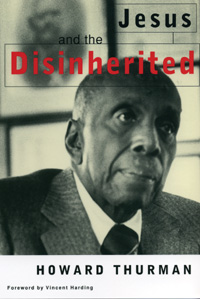
  • Today's post is from Peter Eisenstadt, who is currently at work, with co-author Quinton Dixie, on The Fatherhood of God, the Brotherhood of Man: Howard Thurman in India and the Birth of the Civil Rights Movement. Eisenstadt was editor-in-chief of the Encyclopedia of New York State and editor of Black Conservatism: Essays in Intellectual and Political History.

    Jesus and the Disinherited book cover, links to Beacon Press page for book
    The religious and spiritual roots of Barack Obama's worldview have been discussed and debated since he emerged on the political scene. Now that he has been elected to the presidency, these questions have only gained in their importance. Unfortunately, much of the discussion about Obama and the Black Church has concerned the controversy over his one-time pastor, the Rev. Jeremiah Wright. If the Wright controversy has no other positive results, it fostered discussion of Obama's religious heritage. One of the most lucid of these contributions was an article by Darryl Pinckney last summer in the New York Review of Books, "Obama and the Black Church," in the course of which he allots several paragraphs to Howard Thurman, surely one of the most distinguished 20th century American religious thinkers, black or white.

    Although Pinckney does not mention it in his article, Obama has acknowledged a debt to Thurman. Howard Thurman I think represents some of the best in America. In an interview with filmmaker Arleigh Prelow, Obama said "I constantly refer back to the work that's been done by Dr. King, Dr. Thurman, and others whose shoulders really I stand on." (The film is not finished, but excerpts from the documentary in progress can be viewed at the Freedom Theater at the Museum of the African Diaspora (MoAD) in San Francisco.

    (more…)

  • "The Poet Goes to Indiana" by Mary Oliver was featured on the Writer's Almanac recently.

    Bill Ayers was interviewed by the Washington Post for this piece that ran that day after the election—the New Yorker's David Remnick was there, too. Last week, Garry Trudeau offered this commentary on the pre-election media.

    On Slate, one more eloquent defense of scholar Rashid Khalidi made it in before the election.

    Colm Tóibín wrote this piece for the New York Review of Books about similarities between Barack Obama's Dreams of My Father and James Baldwin's Notes of a Native Son.

    Kevin Scott appeared on New Hampshire Public Radio to discuss The Porning of America.

    Amy Alexander and Dr. Alvin Pouissaint co-wrote a pre-election article for The Root about managing the stress of history and led this post-election discussion about African-American reactions at Washington Post.

    Latoya Peterson analyzed the ways we talked about race and identity during the campaign.

    Jay Wexler submits a Supreme Court Humor Special Report on the "F-Word and S-Word Case" (except that he uses bad words). Frederick Lane discussed the lower court ruling here.

    Recent Posts on Beacon Broadside

    Memories of Studs Terkel from One of Thousands of Good Friends

    Before the Victory Celebration: Religious Scholars in Chicago

    Thoughts on Race, Identity and the Obamas

    Greenspan Passes the Buck

  • Studs Terkel passed away last week at the age of 96. Rick Ayers, the author of Studs Terkel's Working: A Teaching Guide (New Press, 2002) and Great Books for High School Kids (Beacon Press), shares here some of his memories of the great oral historian.

    When my friends and I met Studs Terkel, in 1963, we were a bunch of high school suburban rebels, living twenty miles west of Chicago. We sought freedom by turning our dial to the black music stations, WVON and WYNR – discovering the beat of Bo Diddley and the heart of Aretha Franklin. And we also came across WFMT, Chicago's "fine arts" radio station. We would sit up with the funky and eclectic folk and blues show, Midnight Special, on Saturday nights and listen to Studs Terkel interviews in the mornings.

    One day we ventured down to the loop to take a record album in to the Midnight Special producer. As we sat in the WFMT studio, Studs came bustling out, all distracted and busy, his hair flying, a sheaf of papers, notes and records under his arm. In all his hurry, though, he stopped and said, "Hello, you young people, what are you doing here?" He immediately gave us all of his focus. Leaning over, then sitting on the edge of a chair, he wanted to find out all about us. Soon he boiled down his search to a central question, one he came back to again and again in our years of acquaintance, "I wonder, though, what made you bunch of suburban kids – you're supposed to be training to be bank managers, you're supposed to be practicing your swing at the country club – what made you come down here to Chicago, what made you dissatisfied with your world? What is making these kids from the suburbs go down south, go on picket lines? What makes you tick?"

    With that, we began to think differently about ourselves. We weren't just confused and bored and dissatisfied. We were a phenomenon. We were pioneers. We were interesting. You can't imagine what that means to a teenager.

    In many ways, the interviewer, the documenter, tells you back your story with more clarity than you told it. If the interviewer is sloppy, selfish, or narrow, you will resent the story he tells and deny its truth. If he is Studs, you recognize its essential truth and begin to understand yourself, and your life, better.

    (more…)

  • Today's post is from Amy Caldwell, Executive Editor at Beacon Press.

    This year's American Academy of Religion conference took place in Chicago, home of Barack-mania, and while the academy wasn't claiming divine foresight for discerning back in 2000 or so that this would be the place to be in 2008, a few folks thought the unseasonably warm and sunny weather was clearly a sign of divine favor. The scholars of AAR decidedly tend towards the Democratic Party, and a general feeling of guarded optimism and excitement suffused the conference. At the beginning of outgoing president's Emilie Townes' plenary address Saturday night, cries of "Yes We Can" even briefly erupted from the crowd.

    Which is not to say that everyone is sanguine about the outcome of the election. In his opening remarks at a session on the effects of the "War on Terror" on American Muslims, Omid Safi, chair of the AAR's study of Islam section and Professor of Religious Studies at the University of North Carolina, described a propaganda DVD that has recently appeared in the mailboxes of voters in swing states. Entitled "Obsession," the message of this DVD is that Muslims are the second coming of the Nazis, that 2008 is equivalent to 1938, and that we must rise up and stop them. The DVD was distributed in copies of the New York Times and the Chronicle of Higher Education delivered in the Midwest. In contrast to this disturbing incitement to violence against innocent Americans, Safi tartly noted that ritually stating, at any public event, "we hate and decry terrorism" has become a virtual sixth pillar of Islam for American Muslims.

    (more…)

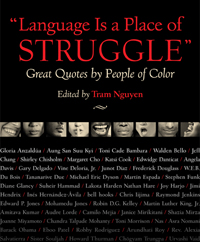
  • Today's post is from Tram Nguyen, the former editor of ColorLines magazine, author of We Are All Suspects Now: Untold Stories from Immigrant Communities after 9/11, and editor of a forthcoming collection, "Language is a Place of Struggle": Great Quotes by People of Color.

    Link to Beacon Press page for Language is a Place of Struggle: Great Quotes by People of Color
    The quote that got Michelle Obama into trouble actually made me like her even more, not only for her candor but for articulating something I've started to feel for the first time in my adult life too.

    Here's what she actually said: "People in this country are ready for change and hungry for a different kind of politics and… for the first time in my adult life I am proud of my country because it feels like hope is finally making a comeback."

    For me, as a first-generation, former refugee from Vietnam, it's taken a long time to sort out my cultural, national and political identities, and I resisted calling myself American for most of my life – until recently. If absolutely necessary, it was always a hyphenated version, Asian-American or Vietnamese-American, but even those were never all that convincing to me. The American part was the troubling one, because it didn't seem like I could ever really be part of this country except from the very margins.

    (more…)

  • Intellectual and political leadership should be neither elitist, nor populist; rather it ought to be democratic, in that each of us stands in public space, without humiliation, to put forward our best visions and views for the sake of the public interest.
    —Cornel West, Scholar

    It is not enough merely to call for freedom, democracy, and human rights. There has to be a united determination to persevere in the struggle, to make sacrifices in the name of enduring truths, to resist the corrupting influences of desire, ill will, ignorance, and fear. Among the basic freedoms to which men aspire that their lives might be full and uncramped, freedom from fear stands out as both a means and an end.
    —Aung San Suu Kyi, Burmese leader

    We need each other. Each of us is responsible for what happens on this earth. We are each absolutely essential, each totally irreplaceable. Each of us is the swing vote in the bitter election battle now being waged between our best and our worst possibilities.
    —Leonard Peltier, American Indian activist

    These quotes are included in "Language Is a Place of Struggle": Great Quotes by People of Color, edited by Tram Nguyen.

    Find your polling location.

  • Scott Horton, in his always excellent blog at Harpers, skewers the "New McCarthyism" in a defense of Rashid Khalidi. More commentary in support of Khalidi, a respected scholar at Columbia University and author of the forthcoming Sowing Crisis: The Cold War and American Dominance in the Middle East, is flooding the web and mainstream media. Check out this piece in the Washington Post and this DailyKos diary responding to it, and this video posted at Talking Points Memo where John Judis concedes that this campaign is even dirtier than the Bush-Dukakis campaign.

    Bill Ayers recently spoke on education in New York.

    Rev. Forrest Church discussed his memoir Love & Death and his diagnosis of terminal esophageal cancer on NPR's Fresh Air.

    Kate Clinton proposes action for Nov. 5th, whether or not Prop. 8 is defeated in California.

    Looking for some good reading? Five librarians got together to compile this list of the Best of the Best of University Presses. Watch their presentation on BookTV. Two Beacon Press books, Once in a Promised Land and Without a Map, made the list.

    A quick look at some reviews of recent Beacon Press releases:

    PopMatters on The Porning of America

    New Orleans Times-Picayune on Confessions of an Eco-Sinner

    Cape Cod Times on The Muse of the Revolution

    Winston-Salem Journal on Saving Paradise

    And recently on Beacon Broadside:

    Greenspan Passes the Buck by Marilyn Sewell

    Zombie Jamboree in Texas by Glenn Branch

    Factory Farms, Dirty Water, and the Bible: Part One and Part Two by Mark Winne