• Eight of Mary Oliver‘s poems were set to music by Ronald Perera and performed by the The New Amsterdam Singers this past Sunday afternoon. From the New York Times:

    Ms. Oliver’s poetry, which has drawn comparisons to the work of
    Emerson and Thoreau, reveals an awestruck regard of nature that verges
    on the religious: “What wretchedness, to believe only in what can be
    proven,” she writes in “I Looked Up,” the fifth poem in Mr. Perera’s
    cycle. Her work also demonstrates a discerning eye and an ability to
    render vivid images with a few deft strokes.

    Mr. Perera
    sensitively underscores both attributes in a cycle spanning a day from
    one dawn to the next, linked by a subtle, recurring four-note motif.
    His music neatly conjures Ms. Oliver’s rippling pond, wary crows,
    flitting bats and lazily unspooling snake. At the same time, the work’s
    dramatic progression, from the shivering anticipation of “Morning at
    Great Pond” to the radiant affirmation of the concluding title poem,
    “Why I Wake Early,” does justice to the poet’s more transcendental
    intents. Enhanced by Mr. Perera’s estimable knack for setting English,
    this is a substantial addition to the choral canon.

    Listen to an excerpt of "Why I Wake Early" on Mr. Perera’s website.


    Bob Herbert, in an op-ed about our current economic mess, quotes John Edwards’ introduction to The Missing Class: Portraits of the Near-Poor in America:

    “When we set about fixing welfare in the 1990s, we said we were going
    to encourage work. Near-poor Americans do work, usually in jobs that
    the rest of us do not want — jobs with stagnant wages, no retirement
    funds, and inadequate health insurance, if they have it at all. While
    their wages stay the same, the cost of everything else — energy,
    housing, transportation, tuition — goes up.”


    The Springfield, MA, Republican (the paper, not the party) ran a piece about Suzanne Strempek Shea’s ambitious and illuminating adventure that resulted in the forthcoming Sundays in America: A Yearlong Road Trip in Search of Christian Faith. Suzanne has posted here about two of the churches she visited (Christmas Eve in Bethlehem and Barack Obama’s Church) and this Sunday we’ll run another about St. Patrick’s Day at All Saints Episcopal in Brookline, MA.

  • by Martin Moran

    Trickypart
    I write from the edge of Washington, DC, on a freezing day. I’m here performing a one-man play, The Tricky Part, which was developed from my memoir of the same title.
    There’s an Obama event going on at a Virginia high school some
    blocks from here. A massive motorcade — cycles, black sedans, police
    cars — is streaming past my apartment window. It is the picture of
    momentum itself: wheels and steel and flashing lights, the gathering
    force of change, a traffic nightmare, a future president? The high
    school they’re headed to, T.C. Williams, was the subject of a feature film some years ago starring Denzel Washington as the coach of the
    school’s football team, the Titans.

    I’m watching all this, here at my computer, while struggling to
    write a script, a film adaptation of my book and play. The
    autobiographical
    tale is sensitive and complex and I am finding the task of transforming
    the material into yet another genre daunting if not impossible. This
    accounts for all the looking out the window.

    Let me lay out the essentials. When I was twelve, a camp counselor
    molested me. Our illicit sex went on for three years. I grew taller
    and older while holding the boy inside me hostage because I blamed him
    for being bad, for doing wrong, for succumbing to desire. I
    couldn’t help it and it was agonizing. I got even older and started
    writing about what happened, became obsessed with remembering, with
    using language to seek meaning in the story. A day would arrive when I
    stood to face a pasty old man crumpled in his wheelchair, the counselor
    who’d wronged me when I was a child. The one who ignited my aching
    sense of complicity. I looked at that man, at his stained pajamas; his
    puffy cheeks and I felt my heart break. For the fragile human in front
    of me, but more so for the boy I once was. And somewhere in that
    breaking was the beginning of forgiveness. Somehow, because I’d spent
    so much time piecing together the narrative of my own life, I was able
    to see, to feel, how that boy was blameless and how forgiveness was the
    gift I must
    give to myself.

    (more…)

  • Helen R. Deese is the author of Daughter of Boston: The Extraordinary Diary of a Nineteenth-century Woman, Caroline Healey Dall, and she is the Caroline Healey Dall editor
    for the Massachusetts Historical Society. She lives in Flint and Ann
    Arbor, Michigan

    Deese
    Each time I hear a news report of an American woman's breaking a new gender barrier–Madeleine Albright's becoming the first woman named as Secretary of State, Nancy Pelosi's becoming the first woman elected as Speaker of the House of Representatives, or, more recently, Hillary Rodham Clinton's coming to be the first woman who is a serious contender for a major party's presidential
    nomination–I can't help wondering what Caroline Healey Dall would have thought. Dall is the woman who has been my almost daily companion for almost a quarter of a century. Although she died nearly a hundred years ago (in 1912) at the age of ninety, Caroline Dall remains a lively presence for me, and I frequently play the game of trying to analyze what she would do or think in response to a particular twenty-first century event or dilemma. As both an abolitionist and a feminist, would she think it a higher priority for the country to elect its first black president or its first woman president? Although I cannot be certain of her position on such questions, I am sure that she would have been engrossed by them. I am also confident that she would have known her answers instantly and that the chances of her changing her mind would be almost nil, for she was a strong-minded and highly opinionated woman. 

    (more…)

  • by Margot Adler

    HereticsheartIt’s not something you read in a newspaper or hear on an ordinary news show; it’s only on the comedy shows like Real Time with Bill Maher where you hear it whispered: the idea that John McCain has PTSD, and that it would be scary to have his finger on the button. Whether or not this is the same kind of slur we hear from those who say Barak Obama was schooled in a madrassa, it seems perfectly reasonable to wonder if anyone who spent five years in a tiger cage might have some remnants of PTSD – even decades later.

    So when I heard it on Bill Maher the other night, it reminded me that we are living in a society where thousands of young men and women, our very future, are returning home every day scarred from battles in Iraq and Afghanistan. Some of those scars are painfully visible; many others are not. Few people are really looking deeply at what this means for families and relationships, even what it means for our daily lives as Americans. Only one person that I know of in the mainstream media has delved deeply and movingly into this issue. For more than a year, in a series of searing pieces, Daniel Zwerdling at NPR has chronicled the plight of military personnel to get the mental health care they need. In many cases, veterans with PTSD have been kicked out of the military for bad behavior and are unable to access mental health services.

    Ten years ago, I wrote a book called Heretic’s Heart about my own life during the 1960’s. Several chapters of that book were letters between me, as a twenty-year-old University of California – Berkeley student and activist, and Marc Anderson, a soldier fighting in Vietnam whom I met through the mail after he wrote a letter to the campus newspaper that could only be described as a cry from the abyss.

    (more…)

  • Is Margaret Seltzer, aka Margaret B. Jones, aka the latest memoirist to be exposed as a fraud, a sociopath who skillfully manipulated her benefactors in the publishing industry? Amy Alexander, co-author of Lay My Burden Down: Suicide and the Mental Health Crisis among African-Americans, ponders the question of blame in the Nation:

    Could it be as simple as a case of innocent victims–the editor, the
    agent, the writing teacher–being duped by one sociopathic young lady?

    Maybe. But it also may also be true that when it comes to a hard-luck
    gang story, McGrath, Bender and others involved in the publication of
    Love and Consequences were more inclined to err on the side of
    sensationalism and exploitation over the hard work of grooming an author
    who might give readers genuine authenticity. And it is more than a bit
    ironic that their apparent quest for vividly told ghetto authenticity
    led them to nurture and promote a white woman writer whose story, even
    if it were true, represented only a one-dimensional version of the
    Authentic Black Experience.


    Mariamitchell_2 The Nantucket Independent highlights the life of native daughter Maria Mitchell, whose life in science is explored in the forthcoming Maria Mitchell and the Sexing of Science by Renée Bergland.

    Throughout the book, Bergland examines Mitchell’s rise from 1847, when
    she witnessed the flash of a comet… to becoming the "computer of Venus"
    employed by the Nautical Almanac to calculate by math the orbit of that
    planet; to her hiring as the first professor of astronomy at Vassar
    College for women; and to the close of the 1800s when women’s roles in
    the sciences were discouraged and Mitchell lamented that she might be
    the last of the nation’s female scientists.

    Bergland
    notes that while the word "scientist" had no masculine association at
    the start of the 19th century, by 1873 a male Harvard Medical School
    faculty member posited that women were physiologically unable to study
    science and that those who pursued the subject with vigor risked
    becoming "thoroughly masculine in nature or hermaphroditic in mind."

    As of 1875, 10 years after Mitchell was appointed to her professorship,
    the move toward a male scientific role model had gained societal
    dominance.


    The Rev. C. Welton Gaddy compiles the worst moments in the race for "Pastor-in-Chief." Watch them on YouTube, where the video has been added to the Beacon Broadside favorites. Mitt Romney’s speech on faith in America didn’t even make Gaddy’s top ten.

  • by Mara Sapon-Shevin

    Wideningthecircle
    When I was in middle-school, the way the “popular kids” tormented those of us who weren’t so lucky, was through something called “Slam Books.” A popular kid (it was usually a girl) would start a notebook with individual pages headed with the names of unpopular students. The book would be passed around to the other “popular” kids and they would take turns making nasty entries under the unpopular students’ names. Under Beth’s name, for example, they would write, “Ugly,” “Bad complexion,” “Stupid,” and “Slutty.”

    There would be lots of snickering and giggling as the notebook was passed (not that unobstrusively) between the popular kids who were writing the nasty comments. Slam books were the source of public humiliation, and they made the lives of some of us miserable. It was never clear whether or not teachers were aware of what was going on, but I don’t remember any intervention at the time.

    Now, however, we have entered the era of high technology, and the ways in which students torment one another are far more sophisticated. Cyberbullying is a growing and distressing phenomenon that has recently received extensive media attention.

    (more…)

  • "Near Arctic, Seed Vault Is a Fort Knox of Food", in the New York Times last week, discussed the efforts to create a seed repository as a backup of our seed supply. Claire Hope Cummings, in her new book, Uncertain Peril: Genetic Engineering and the Future of Seeds, discusses the "Doomsday Vault" in more depth, and ties its mission to the struggles to maintain genetic diversity in agriculture despite the increasing privatization of seeds by agribusiness. You can hear Cummings on NPR’s OnPoint tomorrow. [UPDATE: Here’s the link to the segment.]


    Check out Nancy Polikoff, author of Beyond (Straight and Gay) Marriage, at the Washington Post, the Washington Blade, the Los Angeles Times, and on her new blog, where Polikoff, an expert on gay and lesbian family law, highlights issues in the news that affect the legal rights of all families.


    Mark Winne, author of Closing the Food Gap, appeared on WUWM’s Lake Effect radio show. Listen here.


    Kathryn Joyce, whose book Quiverfull: Inside the Christian Patriarchy Movement, is forthcoming from Beacon Press in 2009, wrote in the Nation about the real motives behind worries that there’s a looming European "demographic disaster." The piece was cross-posted at RHRealityCheck, where Kathryn has previously posted about Quiverfull, an anti-birth control movement that urges Christian families to "leave the number of children they have entirely in the hands of God."


    Glenn Branch sent us an update to his post on the evolution debate in Florida (also added as an update to the post):

    It happened. On February 29, state senator Ronda Storms (R–Valrico) introduced a bill, SB 2692 [pdf],
    styled “The Academic Freedom Act.” Purporting to protect the right of
    teachers to “objectively present scientific information relevant to the
    full range of scientific views regarding biological and chemical
    evolution in connection with teaching any prescribed curriculum
    regarding chemical or biological origins” and the right of students not
    to be “penalized in any way because he or she subscribes to a
    particular position or view regarding biological or chemical
    evolution,” the bill would not affect the content of the standards,
    although it is clear that it was introduced at the behest at those who opposed their excellent treatment of evolution. A string of similar bills in Alabama—HB
    391 and SB 336 in 2004; HB 352, SB 240, and HB 716 in 2005; HB 106 and
    SB 45 in 2006—failed. With only sixty days in the regular legislative
    session, perhaps the Florida legislature will be able to find something
    useful to do, instead of wasting its time mollifying creationists.

  • Jay Wexler is Professor of Law at Boston University. He is the author of Holy Hullabaloos: A Road Trip to the Battlegrounds of the Church/State Wars and The Odd Clauses: Understanding the Constitution through Ten of Its Most Curious Provisions.
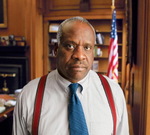
    Thomas
    The Supreme Court has a lovely tradition whereby each Justice’s group of law clerks gets to go out to lunch with each other Justice once during the term. This tradition, which dates back to the sixteenth century, allows the Court’s thirty-six or so law clerks to have at least a little face time with all the Justices. When I was clerking for Justice Ginsburg during the 1998-1999 term, for example, my three co-clerks and I were lucky enough to share Indian food with Justice Breyer, pizza and red wine with Justice Scalia, and classic American with Justice Stevens. The only Justice we didn’t have lunch with was Justice Kennedy, and that was only because on the day of the event, we were notified that we would have to get dressed up to be seen with the Justice in public. Since we generally showed up to work in bathrobes and hair curlers, we were forced to decline the invitation. 

    When people ask me which Justice seemed the most like a regular, normal person, they often appear surprised when I say that it was, without any doubt, Justice Thomas. Not that “Most Normal Supreme Court Justice” is a particularly difficult title to achieve, but during our lunch, Justice Thomas impressed me as being a totally friendly and incredibly down-to-earth guy, and I say this not just because he laughed at my “Why- did- the- guy- get- fired- from- the- orange- juice- factory?- Because- he- couldn’t- concentrate” joke.

    Obviously my time up close with Justice Thomas was extremely limited, but I did get the sense that he cared a great deal about the people who he worked with at the Court. He’s the guy, for example, who supposedly knows the name of everyone who works at the Court, from the cafeteria workers to the Curator’s assistant to the security guards. At the time of our lunch, one of my co-clerks was having a family problem that Justice Thomas knew something about. The next day, I was working on some memo or something when the door to the chambers opened.  It was Justice Thomas with a book that he wanted my co-clerk to have. It’s hard to communicate how unusual it is for a Justice to just pop into the chambers of another Justice, much less anywhere near where the clerks sit. Perhaps it’s some evidence of how startling it was that, when I saw Justice Thomas suddenly standing in front of my desk, I immediately projectile vomited all over my memorandum.

    It has been widely reported recently that Justice Thomas has not asked
    a question from the bench in over two years
    . This fact is about as
    interesting as one of my hangnails, and somewhat less important. Many
    in the blogosphere and elsewhere have taken Justice Thomas’s silence as
    a sign that he is not engaged
    or is not fully doing his job. For some
    it’s evidence to support their already existing views that Justice
    Thomas is a bad judge or a bad person. These criticisms are unfair.
    Oral argument may play an important role in the lower courts, where it
    can help judges figure out what’s going on in a case with messy facts,
    but in the Supreme Court, where cases are only heard if they clearly
    present a discrete legal issue, oral argument simply isn’t a big deal. More than anything, the Justices use the time to argue with each other,
    albeit indirectly, through questions posed to the lawyers. This will
    probably come as a huge surprise to many readers out there, but some
    lawyers, even judges, like to talk just to hear themselves talk.
    Justice Thomas has indicated that he sees no reason to talk for this
    purpose, and I have to say I kind of admire him for it.

    Please don’t get me wrong.  I wish Clarence Thomas was not on the
    Supreme Court.  Justice Thomas’s jurisprudence threatens to send the
    nation back to the middle ages.  In my own field of study, church-state
    law, Justice Thomas has said that the First Amendment’s “Establishment
    Clause” does not apply to state and local governments.  This means that states and localities would be free to promote religion by, for instance, putting up huge crosses on public property, teaching creationism, and leading school prayers. Probably they could even set up their own
    official religions.  Just thinking about this makes me want to cry.

    In other areas of law, from the Fourth Amendment’s prohibition on
    unreasonable searches to the Eighth Amendment’s ban on cruel and
    unusual punishment to the breadth of executive power, Justice Thomas’s
    crabbed approach to constitutional interpretation has similarly
    resulted in the abuse of individual rights.  This is plenty reason
    enough to lament Justice Thomas’s presence on the bench (and, sweet
    mother of God, to vote Democrat in November), without resorting to
    criticisms about his silence there.  Indeed, given Justice Thomas’s
    reactionary views, liberals should probably be happy that he doesn’t
    speak during oral argument.  If only somehow he could be persuaded to
    write as few opinions as he asks questions, now that would be something
    worth talking about.

    Related articles

    Seven-Year Itch: Thomas Breaks Silence
    Beacon Buzz: Gather at the Table, Faitheist, and more!
    What Gun Control Advocates Can Learn from the Anti-Choice Movement
    Supreme Court Justice Clarence Thomas breaks seven-year silence
    Quote of the Day: Justice Thomas Speaks!
    Thomas Breaks His Silence
  • By Chris Mercogliano

    I am in absolute agreement with Bruce E. Levine: it isn’t ODD at all that our society has stepped up its efforts to pathologize young people with biopsychiatric labels like Attention Deficit Disorder (ADD) and Oppositional Defiance Disorder (ODD), when they either cannot or will not march in step with the majority culture, and then dose them with the corresponding biopsychiatric drugs.

    Teachingtherestless
    As Levine reminds us with his deft bit of historical research, America has a long tradition of marginalizing anyone who deviates from established norms—which currently are narrowing at an alarming rate. Or as French philosopher Michel Foucault pointed out in Discipline and Punish, the control of its citizens has always been a primary aim of the state, and what we are witnessing in modern times is the evolution of increasingly subtle ways in which to do so. Today, instead of relying on brute force as was the case in the days of pharaohs and emperors, social institutions like schools, the military, and the mass media subliminally enforce a conformity so pervasive that overt forms of control are no longer necessary. All who resist and refuse to take their places in the social and economic machine, according to Foucault in Madness and Civilization, are labeled with some form of abnormality, and then, as I argue in my book, Teaching the Restless, about the ongoing ADHD hoax, they are medicated with powerful psychotropic drugs that extend society’s control all the way down to the biochemical level.

    This business of labeling and drugging kids who won’t sit still, can’t keep up, or don’t fit in became a deep concern of mine in my role as a teacher at the Free School, a noncoercive, democratic, inner-city school for sixty-five students ages two through fourteen in Albany, NY. In the early 1990s there was a sudden spike in the number of students who came to us having been labeled in their previous schools, and so, curious as to why, I embarked on an exhaustive review of the already considerable ADHD literature.

    (more…)

  • by Glenn Branch

    Mellonhelmet_2
    The missing link?

    The recent battle over the place of evolution in Florida’s
    state science standards wasn’t quite ripped from the pages of a Carl Hiaasen novel—as far as I could
    tell from my office in California, at any rate, there were no greedy
    developers, lubricious politicos, or redneck gangsters involved, and no feral
    ex-governors emerging from the swamp to save the day. But zaniness was abundant
    among the creationist opponents of the standards, from the fellow who testified that, according
    to evolution, oranges are "the first cousin to somebody’s pet cat,"
    to the student who argued
    that evolution was unprovable because "no one was around 6,000 years ago."
    (Then who was it who left a bottle gourd
    at the Windover site outside Titusville, Florida, about 7,290 years ago?)
    Ultimately, however, on February 19, 2008, the state board of education voted
    to accept a new set of
    state science standards that recognize evolution as a fundamental concept
    underlying all of biology.

    That’s quite a change. The previous set of state science
    standards sedulously avoided even using the e-word, and when the Thomas B.
    Fordham Foundation conducted its review of state science standards in 2005, it commented,
    "The superficiality of the treatment of evolutionary biology alone
    justifies the grade ‘F’." But hostility toward evolution education in the
    Sunshine State is nothing new: after William Jennings Bryan retired to Florida
    in 1920, he lobbied for legislation prohibiting "the teaching as true of
    Darwinism or any other evolutionary hypothesis that links man in blood relation
    with any form of animal life below man." Bryan was only partly successful;
    in 1923, the legislature passed a resolution that described such teaching as "improper
    and subversive," but stopped short of prohibiting it altogether. Two years
    later, the Tennessee legislature passed a law outright banning the teaching of
    evolution, and the Great Commoner eventually hauled himself from Florida to
    Dayton, Tennessee, for the trial
    of John Thomas Scopes.

    Note, in Bryan’s proposal, the phrase "as true."
    In a letter to a Florida state senator (quoted in Edward J. Larson’s excellent Trial
    and Error
    ), he explained, "A book which merely mentions
    [evolution] as a hypothesis can be considered as giving information as to views
    held, which is very different from teaching it as fact." Bryan died just
    after the Scopes trial, but his position—that it’s okay to teach about
    evolution, but only as a theory, something conjectural or speculative, and not
    as a fact—continues to resonate. Creationists who weren’t pressing for
    creationism (whether in the old-fashioned form of creation science or in the
    new-fangled form of intelligent design) to be added to the Florida state
    science standards were following Bryan in trying to stigmatize evolution as
    just a theory. A father in the Panhandle put a Möbian twist on the
    slogan, saying
    of his daughters, "I just don’t want them to hear a one-sided fact."

    (more…)