• A link rescue from the not-to-distant past: Carl Elliott, who has a forthcoming Beacon book about consumerism and corruption in the medical industry, had a harrowing piece in the New Yorker about professional human guinea pigs, which is now available on their website.

    Most professional guinea pigs are involved in Phase I
    clinical trials, in which the safety of a potential drug is tested,
    typically by giving it to healthy subjects and studying any side
    effects that it produces. (Phase II trials aim at determining dosing
    requirements and demonstrating therapeutic efficacy; Phase III trials
    are on a larger scale and usually compare a drug’s results with
    standard treatments.) The better trial sites offer such amenities as
    video games, pool tables, and wireless Internet access. If all goes
    well, a guinea pig can get paid to spend a week watching “The Lord of
    the Rings” and playing Halo with his friends, in exchange for wearing a
    hep-lock catheter on one arm and eating institutional food. Nathaniel
    Miller, a Philadelphia trial veteran who started doing studies to fund
    his political activism, was once paid fifteen hundred dollars in
    exchange for three days and two G.I. endoscopies at Temple University,
    where he was given a private room with a television. “It was like a
    hotel,” he says, “except that twice they came in and stuck a tube down
    my nose.”

    And one more link rescue, to a story that has timeless importance and made the rounds of AP newspapers a week or so ago: "Ignoring Racist Remarks Is Wrong Lesson For Kids."
    Many of us have been faced with an uncomfortable situation where
    someone has made a racially insensitive or offensive comment. Beverley
    Daniel Tatum, author of Can We Talk About Race,
    urges parents to broach the issue with the speaker,   but in a way that
    isn’t accusatory or confrontational. The article is a great guide for
    how to teach children about racism and the importance of honesty,
    integrity, and diversity.

    Over at Street Prophets, this week’s Weekly Faith Roundtable is on Unitarian Universalism. Here are a few of the highlights from the discussion:

    Lonespark’s explanation that she picked the UU church because "I didn’t fit into any other boxes."

    On the plus side, I love being in a place where my agnostic husband would fit right in if he ever got up that early, where some of my favorite childhood hymns get performed, where all families are valued, where "service is our prayer," and where a dude in my covenant group is very interested in hearing about how I blot to Thor.

    A lengthy discussion of where the Seven Principles originated and the possibility of being a "devout UU."

    So here’s a broader one. We lay claim–lightly–to all of human experience, all science, all scripture, all wisdom traditions as being the heritage of humanity. We draw from those and from individual, personal experience.

    So…
        Scripture–check. Our canon is a shade larger and not sealed, however.
        Tradition–check. We see it not as a foundation, but rather as more of a sea anchor.
        Reason–check. Oh yeah. Fiercely. We’re coming back around to a wary acceptance of the non-rational, but the irrational is going to be savaged–and that’s tradition going back at least to Servetus.
        Experience–check. Very, very much so.

    A selection of UU jokes

    Great job on the part of Sister Quarterstaff, ogre, lonespark, and bleeding heart, who hosted the discussion.
  • by Jane Eisner

    MEADVILLE, Pa. – In this pretty, snowy college town deep in Pennsylvania’s
    north country, enterprising college students are mapping out how to fix the
    way we nominate presidential candidates. Their ideas are too good to ignore.

    EisnerThe Center for Political Participation at Allegheny College is embarking on
    a two-year Nomination Reform Initiative, and its inaugural event yesterday (Feb.
    13th) was inspiring, indeed. Representatives from 15 regional colleges studied
    the nomination process through an on-line course provided by the New York Times
    Knowledge Network. They learned the intricacies of the primary process, enumerated
    its benefits (some) and its flaws (many), examined proposals for reform, and
    then came up with their own ideas.

    While there were unique and intriguing features in some of the reform ideas
    – I’ll get to my favorites in a moment – there were also unmistakable common
    threads. The students uniformly agreed that the system now on display in 2008
    is too long, too messy, too confusing, and just plain unfair. Interestingly,
    many of the students wanted to retain a central feature of the current primary
    calendar – that is, the opening roles played by small states such as Iowa and
    New Hampshire. The opportunity for retail politics, to share conversation with
    a potential president while sipping coffee at a diner, still holds tremendous
    appeal even to young Americans groomed in cyberspace.

    They do, indeed, want to be able to reach out and touch their candidates. They just don’t want to relocate to Iowa or New Hampshire for the privilege.

    (more…)

  • by Sherrilyn A. Ifill

    Banished
    In the flush of the current presidential campaign, when crowds of blacks and whites caught up in Obama fever chant together, “race doesn’t matter,” and even the mainstream media seems delirious with the possibility that the U.S. may be poised to elect its first black president, it’s hard to remember that only a few months ago college campuses, high schools and workplaces from Louisiana to New York were sites of racial intimidation. 2007 was the year of the noose. Dozens of incidents, in which nooses were hung in places designed to intimidate black workers and students, seemed to engulf the country. Many of these noose hangings seem to have been set off by the case of the Jena Six — a Louisiana case in which black high school students faced serious criminal charges after a series of violent conflicts with white students. The friction between the students arose after white students hung nooses from a tree that had long been regarded as reserved as a meeting place for white students. Many whites minimized the noose hangings at Jena and in other places as mere pranks. Blacks, by and large, regarded the noose hangings as hate crimes – messages of intimidation and white supremacy inspired by the nearly 5,000 lynchings of black men and women that took place in the 20th century.

    Today, it’s almost tempting to dismiss the rash of noose incidents and attendant focus on the history of lynching as just a strange autumnal anomaly — some kind of retro race moment, a last gasp of 20th century racism. Nooses had fallen so far outside the national conversation that it came as somewhat of a shock last Tuesday when President Bush finally condemned noose displays in a ceremony at the White House commemorating Black History Month. The noose, said the President “is wrong . .. [and has] no place in America today.” The President forcefully insisted that displaying a noose is “not a harmless prank, and lynching is not a word to be mentioned in jest.” Instead the noose, said the President, “is a symbol of gross injustice.”

    The timing of the President’s statement was curious. Months earlier, when noose incidents were on the front page of major newspapers every day, a presidential statement denouncing the display of nooses would have been a powerful and authoritative repudiation of racist symbols. Yet at that time, the President was silent on the issue. As a result, President Bush’s statement last week seemed strangely out of time. It read like a random selection from a stack of draft presidential statements, hauled out for Black History Month. Clearly drafted months ago [and perhaps embargoed for unknown reasons], the President’s statement provided no guidance on how to reconcile the rash of noose displays four months ago with the current mood of racial harmony and possibility sweeping the country.

    (more…)

  • Breaking_silence_2Beacon author Philip Winslow, in his recent book Victory for Us is to See You Suffer, several times quotes and highlights the activities of the Israeli group Breaking the Silence, "an organization of veteran Israeli soldiers that collects testimonies
    of soldiers who served in the Occupied Territories during the Second
    Intifadah
    ."

    Breaking the Silence sponsors tours to Hebron, and has organized exhibits to illustrate the enormous strain the occupation places on the soldiers who are assigned to protect settlements, as well as the myriad injustices and indignities inflicted upon the Palestinians in the Territories. Currently on display in Philadelphia until February 24, and coming to Cambridge March 1, is their exhibit of photos taken by soldiers (including the one featured here), artifacts of the occupation, and video testimonies from former soldiers. Hours and locations are available on their website, as well as photos, video, testimonies, and more information about the group and their goals.

    Via Philocrites, the Unitarian Universalist Service Committee just returned from a trip to Kenya. The emergency delegation was dispatched to assess the political and human rights situation there in the wake of the election in December. UUSC President Charlie Clements, in addition to submitting testimony to Congress on the mission (pdf), sent blog dispatches describing the unrest:

    Kenya feels like it is on the edge of a precipice. Anguish and anger are
    pushing people into a free fall toward communal violence, which neither
    the leaders nor the security forces may be able to easily stop once it
    begins. As Kisumu, and now perhaps Nakuru (if the reports we got this
    afternoon are true), slip toward economic meltdown, the volatility of
    the situation will only increase. I fear that both Kibaki and Raila may
    be too insulated by hardliners to sense that they are engaged in a
    dangerous game of brinkmanship.

    For more information on the crisis, visit the UUSC’s Kenya Crisis page.

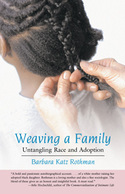
  • by Barbara Katz Rothman

    Weavingafamily
    It’s an interesting historical moment to be a white mother of a Black child, as another white mother’s Black child is running for president of the United States. Who’d have thought?

    I too am a white mother of a Black child. When my Black child, Victoria, was in kindergarten or maybe first grade, sitting around the morning meeting at her politically progressive Quaker school, they were talking about how there’d never been a woman president, or a Black president, or a Jewish president. Victoria
      piped up: "I could do it; I could be the first of all of them!" Now that she’s older, I think a presidential career is pretty well out for Victoria–the first multi-pierced, Mohawk-wearing, tattooed, electric-bass player president? Probably not. But back when she was in kindergarten, I’d have thought the chances of someone with Obama’s family background becoming president were unimaginably slim.

    In case you’ve not seen a news report this year: Obama had an African father and a white American mother-from Kansas, no less, though ultimately her son was raised mostly in Hawaii. Too bad that his mother isn’t here to see this; she died, too young, of ovarian cancer. She did live long enough to see him in the Senate, miracle enough that was! If she was here now, I wonder how she’d be responding to the inevitable media attention: people are blogging about why we’re calling him "Black" rather than "mixed race,"about his "white heritage,"wondering if he is "Black enough," thinking about his thoroughly unusual and so thoroughly American story.

    (more…)

  • by Sasha Abramsky

    Abramsky
    In the years after World War II, California’s prisons were seen as being some of the most progressive correctional institutions in America. They were generally well funded, and the officials in charge of the system had a real interest in utilizing new rehabilitation tools within their facilities. In the late 1960s and 1970s, a wave of prison riots and rebellions put the skids on reform-based strategies. By the 1980s, when the first waves of the nationwide tough-on-crime, tough-on-criminals movement washed ashore, conditions in the prisons were deteriorating fast.

    As the courts sent evermore prisoners into the prison system, even the massive prison-building spree California embarked on couldn’t keep up with the numbers. The prisons got more and more crowded, gyms were converted into dorms, access to medical, mental health, drug treatment, education, and job training services and programs declined. By the 1990s, the state prison system was being rocked by a series of scandals – guards beating inmates, seriously mentally ill inmates being placed in solitary, prisoners dying because they were denied adequate medical care.

    A couple years back, the federal courts got so frustrated with the Department of Corrections and Rehabilitation’s inability to deliver basic healthcare to the state’s 170,000 inmates that they hired an independent receiver to push through change. The receiver, Bob Sillen, used his office to force prisons to invest more in basic items, such as specialized vans to take sick prisoners to hospitals; and he also promoted more systemic changes – higher pay for prison doctors and nurses, the investment of tens of millions of dollars in on-site medical facilities.

    (more…)

  • by Victor Tan Chen

    DollarheartIf there’s a lesson from the recent debacle over an economic stimulus package, it’s this: Republicans need to stop engaging in class warfare.

    Class warfare, as the Republicans have pointed out time and time again, is when public policy is unduly influenced by the interests of one group at the expense of everyone else.

    Unfortunately, the Republican leadership has been guilty of such hypocrisy in its negotiations over individual tax rebates in the economic stimulus package, which the Senate approved last Thursday. First there was talk of making any legislation contingent on extending President Bush’s tax cuts for the wealthy. Then the Republicans sought to kill proposals to extend government checks to the poor, while demanding tax rebates for wealthy Americans. And they stamped out an effort by Senate Democrats to lengthen unemployment benefits.

    So, how is this class warfare? An effective stimulus package, according to economists ranging from Ben Bernanke to Martin Feldstein to Lawrence Summers, should be timely, temporary, and targeted. Targeting the stimulus means putting money in the hands of poor and middle-income households. They’re more likely to use that money to buy things rather than saving it or using it to pay down debt. (See these articles by economists Paul Krugman and Mark Zandi for more on this point. For some contrarian views, see this summary of recent research on tax rebates — though it’s axiomatic in social science that you shouldn’t put too much faith in surveys of what people say they will do in the future.)

    Missingclass
    The legislation that both houses of Congress approved will give some
    benefits to the poor — a $300 tax rebate check to individuals with at
    least $3,000 in income — but many will not receive the $600 maximum
    rebate for individuals or $1,200 maximum for couples, plus $300 per
    child, because they do not pay enough income tax. (This is also true
    for certain segments of the near poor, the group that Katherine Newman
    and I study in our book The Missing Class.) In passing their own
    version of the legislation yesterday, the Senate also extended tax
    rebates to Social Security retirees and veterans with disabilities,
    though, as for the poor, the benefit will be just $300.

    (more…)

  • by Philip C. Winslow

    Open Letter to:

    President Mahmoud Abbas, Ramallah
    Prime Minister Ismail Haniyeh, Gaza City
    Occupied Palestinian Territories

    Dear President Abbas and Prime Minister Haniyeh:

    I write to you in frustration and some alarm as the latest violence unfolds in the Gaza Strip and in Israel. I write as a journalist and humanitarian aid worker who has lived in the West Bank, believes in a two-state solution, and supports no political agenda. The violence, driven by factions that should be under your control and then by subsequent Israeli strikes, has again reached dangerous levels. Your leadership and a radical new approach are urgently required.

    The week’s news photos were familiar to me, as they were to you and all Palestinians and Israelis. Body parts and glass shards littering the street after the suicide bombing on February 4 – the first in more than a year – at a shopping center in Dimona in southern Israel. The same week, more pictures of Israelis standing in their shattered living rooms in traumatized Sderot after the latest barrage of Palestinian rockets from Gaza. The photos that preceded and followed were equally familiar, of the inevitable funerals of Palestinians killed by Israeli air raids: mourners wearing green Hamas headbands and shouting for revenge and hoisting aloft youthful corpses in open caskets; grieving Palestinian mothers holding photos of their martyred sons.

    The empty statements were as disappointing as ever. The script could have been lifted verbatim from any incident between 2001 and 2004 when I lived and worked in the West Bank. Same slaughter, same excuses, just change the place and the name of the speaker.

    (more…)

  • by Glenn Branch

    Charles_darwin_l
    Not so long ago in Birmingham,
    England, it was a reggae
    version
    of the Origin of Species with a video to match, but
    soon in San Diego, they’ll be listening to the Galápagos
    Mountain Boys
    playing their own brand of scientific bluegrass. In Oslo,
    Norway, they’ll be attending a series
    of scholarly lectures on the evolution of language, while they’ll be throwing
    another shrimp on the barbie
    by way of celebration in Melbourne, Australia. In Terre Haute,
    Indiana; Albuquerque,
    New Mexico; and Salem,
    Oregon, they’ll be sitting down to watch the hilarious documentary Flock of Dodos, but in
    Philadelphia, they’ll be on their feet to play badminton at the
    Penn Museum.
    In Seattle, a Darwin impersonation contest
    is part of the festivities, while across the Puget Sound in Bremerton, it’s a
    one-man show
    with Darwin live and in concert. To
    top it all, in Whitewater, Wisconsin, the reception is going to feature
    what’s billed as the world’s largest edible tree of life.

    Yes, Darwin Day is back, and
    still going strong. February 12, 2008, is the 199th anniversary of the birth of
    Charles Darwin, and colleges and universities, schools, libraries, museums,
    churches, civic groups, and just plain folks across the country—and the
    world—are preparing to celebrate Darwin Day, on or around February 12, in honor
    of the life and work of Charles Darwin. Last year, over 850 such events took
    place worldwide, and 2008—just one year shy of the Darwin bicentennial—is
    shaping up to be just as abundant in celebration. Darwin Day provides a
    marvelous opportunity not only to celebrate Darwin’s birthday but also to
    enjoy, and engage in, public outreach about science, evolution, and the
    importance of evolution education. The Darwin Day Celebration website,
    administered by the Institute of Humanist Studies, maintains a useful registry
    where you can find
    a Darwin Day event near you and spread the word
    about your own.

    (more…)

  • Books are great—we all love books around here—but seeing a
    writer in person, giving a reading or a talk, can stimulate the intellect, illuminate
    the work, and delightfully entertain.

    Mary Oliver is one of Beacon’s most popular writers, and,
    according to the Poetry Foundation, author of five of the
    top seven best-selling poetry books last year
    . When she tours, she fills
    auditoriums, which, as any poet in America can tell you, doesn’t often happen
    for poetry readings. In fact, her reading on Monday as part of Seattle’s Arts
    and Lectures series sold out in
    record time
    , and tickets were reported to be changing hands on Craigslist
    for as much as $100 per seat.

    So does she live up to the hype? Beautifully, says Seattle
    Post-Intelligencer book critic John Marshall
    , who says "the poet
    orchestrated her reading like a maestro, alternating poems of humor with poems
    showcasing bittersweet truths and honest emotions."

    Many were drawn to the Oliver event by her
    approachable verse with its intense focus on the natural world and its quiet
    delights, but she soon dispensed with any notion that the evening was destined
    to be some sort of ecumenical worship service of nature or the poet herself.
    That seemed a possibility when many in the crowd of 2,500 gave Oliver a
    standing ovation even before she had uttered a word.

    But Oliver’s self-effacing sense of humor soon
    punctured such awe, delivered with a Seinfeldian sense of timing.

    "I have a little dog and I’m working hard to
    make him famous," Oliver said.

    Knowing murmurs rippled through the crowd.

    "And he deserves it," she added, to
    widespread laughter.

    Another Beacon author, Sherrilyn Ifill (On the
    Courthouse Lawn: Confronting the Legacy of Lynching in the Twenty-First Century
    ),
    recently spoke at University of Maryland Law School about a troubling time in
    the history of race relations in America. Introducing the documentary film Banished,
    scheduled to air on
    Independent Lens on PBS later this month
    , Ifill discussed  "’racial
    cleansing’ of blacks from communities that have remained virtually lily-white,
    even in the 21st century."
    In this Baltimore
    Sun
    article, columnist Gregory Kane talks about the importance of
    acknowledging the history of banishments, and of making reparations to citizens
    whose property was stolen from them after they were driven from their homes in
    at least twelve different counties:

    That dreaded "R-word" is
    indeed dredged up in Banished. When
    blacks were driven from Forsyth County in 1912, many left behind land that they
    owned. They were never paid for that land. It was simply gobbled up and sold by
    whites who saw an opportunity to make a quick – and easy – buck. Neither the
    blacks who lost land nor their descendants have been compensated.

    But you don’t need to leave your house to see a reading or a
    book talk anymore—in fact, you don’t even need to leave your desk chair! The
    Cambridge Forum
    , which has featured Katherine Newman,
    Philip Winslow,
    and Fred Pearce,
    among other Beacon authors, has audio and video available on their website.
    Unfortunately, we can’t link to the Cambridge Forum videos via our new YouTube profile, but
    there are a lot of other good tidbits to be found: Thich Nhat Hahn, Eboo Patel, even Wallace Shawn reading Howard
    Zinn
    . For your enjoyment, here’s one of our favorites at the moment: Lester Young and
    Billie Holiday performing "Fine
    and Mellow".