• Halabyoncepb
    During
    graduate school, I worked at the library with an African American girl named
    Carmon. One quiet Saturday morning, she
    asked if I would mind trimming her hair. Carmon had handfuls of thin braids that she wanted layered in the back so there would be a cascading effect.

    We sat
    outside the library–our fifteen minute break–and I snipped away as
    instructed.I was curious about the
    texture of the braids and she explained that in weaving you could choose what
    kind of hair you wanted, synthetic or human and that human hair was usually
    Asian. When I wondered aloud why I
    almost never saw braids on White women, she explained that Black hair was very
    dry, which was why it was more suited to adding braids to than White hair that
    tended to get oily.

    Over the years, this conversation
    evolved into a larger look at hair choices made by African American women and
    what it meant politically and socially to have braids or an afro or dreadlocks
    or to use a relaxer. I learned a great
    deal about African American culture during those conversations (because it was
    never only about hair) and I have always been grateful to Carmon for being so
    open with me.

    During
    those same years, she asked me a lot of questions about the Middle East, about women, and particularly about Islam. I was happy to offer whatever knowledge I had
    and was often struck by the overlap in what we each had to say: personal
    decisions often carried larger social or political reverberations; and you are
    always an ambassador for your culture. To
    this day I am thankful for those years of talking we shared and I firmly
    believe that we widened one another’s horizons with our conversations.

    In the
    intervening years, the last few in particular, I have been approached with all
    sorts of questions about the Middle East and Islam–some of the very same ones
    Carmon asked me, though usually presented in a rapid-fire sort of way, without
    any context or conversation to go along with them. The questions range from the simple (why do
    women cover their hair?) to the more complex (how can you tell the difference
    between Sunnis and Shiites?–which sounds like it’s going to be a joke rather
    than a question) to the personal (how are you raising your children?) to the
    ignorant (does your husband wear a turban?) to the blatantly racist (how can
    you show that Islam is not a violent religion?).  I am always happy to offer any understanding I
    can to offset American “jahiliyya,” or generalized ignorance of other cultures,
    but more and more I am struck by the assumptions that are made in the asking of
    these questions, first and foremost that any and all questions are acceptable,
    and second that Arabs/Muslims are almost solely governed by their ethnicity/religion.

    (more…)

  • Doctors of Conscience"I haven’t sorted out the penalties…of course there’s got to be some penalties to enforce the law, whatever they may be." So spoke George H.W. Bush, in one of the major gaffes of his first presidential run in 1988, during a debate with his opponent, Michael Dukakis. Bush, who had only recently begun to trumpet his antiabortion sentiments to dubious Republican social conservatives, was responding to a question about appropriate punishment for women who would obtain illegal abortions should Roe v Wade be overturned. The next morning, after frantic late night discussions, Bush’s handlers called the press for a "clarification." Bush meant to say doctors who performed abortions, not women who received them, should be jailed in such a situation.

    Twenty years later, Mike Huckabee, running for the Republican nomination, makes no such missteps. With none of the discomfort that Bush I showed, Huckabee at his rallies gets the party line of the antiabortion movement right: if Roe is overturned, doctors who perform abortions should be punished, while the recipients of such abortions must be seen as "victims."

    But Huckabee, a former Baptist preacher and the candidate of choice of evangelicals, is an exception in the clarity and consistency of his position on abortion. There is a long history of "evolution" on abortion from politicians in both parties. For example, Bill Clinton and Al Gore, both from Southern states, had mixed records of support for abortion early in their careers before they each went on to become staunch allies of the abortion rights movement. But in the campaign of 2008, it is mainly the Republican candidates who are squirming.

    (more…)

  • Bill Ayers, founder of the  Small Schools Workshop and the Center for Youth and Society, is an expert on urban schooling. He also, incidentally, wrote the excellent Teaching Toward Freedom: Moral Commitment and Ethical Action in the Classroom (Beacon Press, 2005). His blog is pretty low-traffic, so it’s always a great happiness to see him show up in the feed reader. Last week, he posted a piece co-authored with Therese Quinn and Erica Meiners about the increasing militarization of the Chicago school system.

    Today, Chicago has the most militarized public school system in the
    nation, with Cadet Corps for students in middle-school, over 10,000
    students participating in JROTC programs, over 1,000 students enrolled
    in one of the five, soon-to-be six autonomous military high schools,
    and hundreds more attending one of the nine military high schools that
    are called “schools within a school.” Chicago now has a Marine Military
    Academy, a Naval Academy, and three army high schools. When an air
    force high school opens next year, Chicago will be the only city in the
    nation to have academies representing all branches of the
    military. And Chicago is not the only city moving in this direction:
    the public school systems of other urban centers with largely Black and
    immigrant low income students , including Philadelphia, Atlanta and
    Oakland, are being similarly re-formed—and deformed— through
    partnerships with the Department of the Defense.

    Unsurprisingly, these military schools "are located overwhelmingly in low income communities of color, while schools with rich curriculums including magnet schools,
    regional gifted centers, classical schools, IB programs and college
    prep schools are placed in whiter, wealthier communities, and in
    gentrifying areas." Ayers, Quinn, and Meiners are troubled by this and other problems with the academies, including the inherent problems with transforming public civilian education into a military recruiting tool, the fact that military academies promote conformity and discourage individual freedom of thought, and the discrimination practiced by the military via the "Don’t Ask, Don’t Tell Policy."

    Responding to last weekend’s New York Times Book Review‘s Islam Issue, Eboo Patel (Acts of Faith: The Story of an American Muslim, the Struggle for the Soul of a Generation, reviewed recently here), addresses the struggle between white Europeans and their Muslim neighbors. Citing Philip Jenkins, Patel draws parallels between the African-American struggle for civil rights and the situation in Europe,  where young Muslims are not offered the same opportunities as their white counterparts. Part of the problem, he says, is that "Europe proudly “tolerates” its minorities, but it continues to view even the second and third generations as foreigners."

    Tolerance allows you in and indulges your needs, but treats you like an
    infant and an outsider. Pluralism respects you and your identity enough
    to require that you make a contribution to the broader society. One
    reason for the success of American Muslim immigrants compared to their
    European co-religionists is America’s instinct towards pluralism.

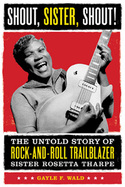
  • Gayle F. Wald, a professor at George Washington University, is the author of Shout, Sister, Shout!: The Untold Story of Rock-and-Roll Trailblazer Sister Rosetta Tharpe and Crossing the Line: Racial Passing in 20th -Century U.S. Literature and Culture. She wrote the liner notes for a critically acclaimed 2003 Rosetta Tharpe tribute album. Wald lives in Washington, D.C. Read more about Sister Rosetta Tharpe at www.shoutsistershout.net.

    Wald Sister Rosetta Tharpe was gospel’s first national superstar: the musician who, beginning in the late 1930s, took the sounds of the “Good News” music then developing in black churches to popular stages and Saturday-night audiences. Rosetta Tharpe had honed her skills as a singer-guitarist on the southern Pentecostal tent-meeting circuit, which she traveled with her mother, the evangelist Katie Bell Nubin, but her ebullient personality and masterful showmanship translated well to such prestigious New York nightspots as the Cotton Club and the Savoy Ballroom. Her defiance of church strictures against engaging with the “wordly” world made her an outcast in some Christian circles, but it also made her a trailblazer and the most important popularizer of gospel before Mahalia Jackson.

    Like many musicians, Rosetta Tharpe struggled to stay professionally viable as musical styles and industry allegiances changed. “Sister Rosetta” (as she was known in the church) was a force to be reckoned with in the 1940s, when she had hits such as “Strange Things Happening Every Day” and (with fellow singer Marie Knight) “Just Above My Head” and “Didn’t It Rain.” In 1951, more than 20,000 fans paid good money to attend her wedding at a baseball stadium in Washington, DC, where she entertained the crowd by playing electric guitar in her wedding finery. By the 1950s, however, as record-buyers gravitated to rhythm and blues, she was reduced to playing small gigs and was dropped by her longtime label, Decca Records. Her career was boosted in the 1960s by a series of successful European appearances (especially in England and France), and when Rosetta died, in Philadelphia in 1973 from a massive stroke, few people—in or out of the gospel world—seemed to notice.

    Today Rosetta Tharpe lies in an unmarked grave in Philadelphia’s Northwood Cemetery, a casualty of short memory spans and, perhaps, an ongoing inability—even now—to reckon a female gospel musician from Cotton Plant, Arkansas, one of U.S. popular music’s most forceful innovators. Thanks in part to fans like Bob Dylan, who has showcased her on his popular satellite radio show, Rosetta Tharpe has become a minor sensation on YouTube, where her dazzling guitar moves, charismatic singing, and even a pre-Chuck Berry duckwalk amaze viewers. Notwithstanding this and other recent accolades—a 2003 tribute CD featuring the likes of Joan Osborne, Maria Muldaur, Bonnie Raitt, and Sweet Honey in the Rock; a 2007 induction into Blues Foundation Hall of Fame—Rosetta has never quite gotten her due. The unmarked grave is a potent symbol of that neglect.

    A concert at the Keswick Theatre in suburban Philadelphia on January 11, 2008 (which Pennsylvania Governor Edward Rendell  has proclaimed "Sister Rosetta Tharpe Day") promises to pay tribute to Tharpe and, in the process, do some fundraising to finally get her that gravestone. It features Philadelphia stalwarts and gospel greats The Dixie Hummingbirds, the legendary singer Odetta, and Rosetta’s old partner, Marie Knight, now embarked on her own resurrected gospel career. If you haven’t seen ’Birds lead singer (and original member) Ira Tucker get down on his knees to sing, you’re missing an essential gospel experience.

    Related articles

    The Essence of Rock 'n' Roll: 'American Masters: Sister Rosetta Tharpe' (Review)
    Sister Rosetta Tharpe: The Godmother of Rock & Roll
    Little Known Black History Fact: Rosetta Tharpe
    Happy 100th Birthday to Rosa Parks
    The gospel roots of the 'Godmother of rock 'n' roll'
    Beacon Buzz: Gather at the Table, Faitheist, and more!
  • Dow
    When the death penalty was resurrected in 1976, following a brief four-year
    hiatus, death penalty lawyers made a fateful tactical decision. They decided to
    abandon the goal of abolition and instead elected to chip away gradually. Rather
    than arguing that the death penalty is always
    unconstitutional – that it is necessarily
    arbitrary, that it is necessarily
    racist or class-ist, that it is necessarily
    cruel and unusual, that it is always
    wrong for the state to execute – lawyers representing the condemned chose to
    home in on a particular feature of their client’s case that made his death sentence unconstitutional,
    while leaving other death sentences intact.

    A lawyer’s job is to save her client, not to save the world.
    For that reason, the legal strategy that death penalty lawyers have embraced
    over the past generation is undoubtedly the correct one. Lawyers will save
    individual lives, but not every life, because abolition will not come from the
    courts – especially not the current Supreme Court. The courts believe in
    perfection, and perfection is the enemy of abolition.

    Abolition will come anyway, because perfection (even if
    there is such a thing) costs a bundle. You can send a murderer to prison for
    life, or you can spend a million dollars more and execute him. In Texas, more than four
    hundred men and women have been executed in the modern death penalty era. Four
    hundred million dollars could have built quite a few schools; it could have raised
    teachers’ salaries, provided health care for uninsured kids, and filled lots of
    the state’s potholes. It could have paid for more police and more social
    services that would have averted many of those murders in the first place.

    (more…)

  • by Mark Winne

    An imbalance between rich and poor is the oldest and most fatal ailment of all republics.
    —Plutarch

    Winne
    We have in America today a tale of two food systems—one for the poor and one for everyone else. The poor cobble together their week’s groceries from a combination of food stamps, food bank donations, and bus trips to Wal-Mart. If they are lucky, parents won’t be forced to skip meals to feed their children. The rest of us, driven by an ever expanding food consciousness, choose from an unprecedented abundance which increasingly leans toward the organic, local, and expensive end of the food chain. Our toughest choice is whether to pay for our food with Visa or Mastercard.  And as the numbers attest—35 million hungry or food insecure Americans (USDA); 50,000 emergency food sites visited annually by 10 percent of the country’s population (America’s Second Harvest); 26 million people receiving food stamps—we have allowed a significant segment of American society to eat at the lowest end of the food chain. These parallel food systems have become the norm, and like the streets and buildings that surround us, we have come to accept them as just part of our everyday landscape.

    The United States is unique among developed nations in that it has evolved a stingy, crazy quilt of a social welfare system that places a disproportionate emphasis on food relief. Rather than address hunger’s underlying cause—poverty—in a direct and aggressive fashion, we rely on fifteen separate USDA nutrition programs, a vast network of private emergency food sites, and thousands of community-based food projects to, in effect, manage poverty.

    (more…)

  • Read the Spirit, an ambitious and thoughtful site devoted to
    issues of spirituality and religion, is devoting a portion of their impressive
    energies to a month of Interfaith
    Heroes
    . Featured so far, brief, illuminating essays on the lives of such
    disparate voices for tolerance as Moses Maimonides, Jaluddin Muhammed Akbar, and Roger Williams.

    (Incidentally, we also owe a word of thanks to Read the
    Spirit for their link to us and a very flattering mention for Beacon Press generally and the blog
    specifically
    .)

    In other good reviews of work from Beacon, the L.A. Times
    ran a thoughtful and moving piece by Susan Salter Reynolds about Our World, a book that collects
    Molly Malone Cook’s photographs with accompanying text by her life partner, the
    poet Mary Oliver.

    The photographs Oliver has chosen reflect Cook’s intuitive
    relationship with her subjects (even inanimate objects). The little girl on the
    stoop in New York City looks directly at the photographer, as does a kindly
    Robert Motherwell and a fierce, almost intimidating Walker Evans. Even though
    most of the photographs are dominated by a central person or object, there is a
    lot to look at in the margins, all part of the story. The stance of her
    subjects — reading a book, looking through a telescope — is always
    distinctive, creating the mood of the entire composition. The two photos of
    Oliver could have been taken only by someone who knew the subject well.

    Marketplace ran a story over the holiday break that many, including Judith Warner on the New York Times opinion blogs, found troubling.
    The story highlighted the practice of "womb
    outsourcing," an increasingly popular surrogacy option involving hopeful
    parents from wealthy countries paying what amounts to "bargain rates"
    (when compared with the high cost of surrogacy in the U.S.) for surrogates in India.
    Amy Tiemann at MojoMom condemned the practice – "Is this what colonialism looks like in the 21st century?" – and
    invited Barbara Katz Rothman, author of Weaving a Family: Untangling Race and Adoption, to comment as well:

    We women of the wealthy world profit from the exploitation
    of poor women, men and children with almost every shirt we put on our backs,
    almost every bite of food we take. We exploit people in poverty and never have
    to think about it. And now we can profit in our motherhood — but unlike the shirt
    and the food, this time the product is going to grow up and demand an
    explanation. (Read more here)

    And, to return to a topic  we discussed during Veterans Day Week last November, Penny Coleman, author of
    Flashback: Posttraumatic
    Stress Disorder, Suicide, and the Lessons of War
    , has been writing
    about the issue of veteran suicides regularly at Alternet. Her latest post is an account of her experience testifying before Congress alongside Mike and Kim
    Bowman, who lost their son to suicide after he returned from Iraq. In the piece she
    quotes Rep. Cliff Stearns of Florida, who displayed a stunning lack of tact and
    understanding of the issue when he passed the buck to the Bowman family for
    their son’s death:

    "The building up of the self-esteem is the key,"
    he said, "and the parents somehow have to convince him or her that
    everything is going to be all right, we’re going to work through it. And in
    this case it didn’t happen, and so, tragic and sad."

    It is precisely because of this tendency to blame the victims that the work that Coleman and the Bowmans do is so important. The hearing ultimately resulted in a dressing down of the head of mental health at the VA by the chair of the Veterans Affairs Committee, Bob Filner, along with the appeal that the VA start listening to the stories of families who have lost loved ones to suicide. Excuses and passing the buck are not going to save any lives.

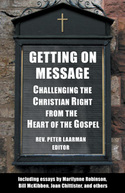
  • LaarmanThere was never any question that religion would play a huge role in the electoral pageant now fully unfolding as those frozen Iowans at last begin to caucus.

    After everyone saw how the well-organized voting faithful on the Right gave Bush his margin of “victory” 2004, the Democrats vowed (and here I will paraphrase losing candidate George Wallace from 1958) never to be out-Jesused again. No Democratic candidacy that didn’t feature an effective religious outreach operation could thereafter be taken seriously.

    Not that it ever really went away, but religion in our politics is back with a vengeance.

    So now barely a day passes without reports on whether Obama continues to receive the most donations from individual clergy members, whether Hillary actually has a vast United Methodist network to tap into, and (most entertainingly) whether Mike and Mitt can avoid turning the race for the GOP nomination into a doctrinal throwdown reminiscent of the 17th century religious wars in Europe.

    As historian Charles Mathewes observes, the appropriate point of reference for understanding the politics of piety is Dwight Eisenhower’s famous (and also somewhat hilarious) pronouncement that “our government makes no sense unless it is founded in a deeply felt religious belief, and I don’t care what it is.”

    (more…)

  • by Rev. C. Welton Gaddy

    Gaddy_firstfreedomfirst
    As a Baptist
    minister and as a patriotic American, I’m deeply disturbed—although no
    longer surprised—by the inappropriate use of religion as a political tactic in
    presidential campaigns. I’m particularly disheartened by former Gov. Mike
    Huckabee comparing his sudden rise in the polls and his new frontrunner status
    in Iowa to the biblical miracle of Jesus feeding the multitudes. Even more
    alarming, his Iowa state chairman claimed on MSNBC’s Tucker that Huckabee’s training as a pastor makes him better
    qualified to run the “war on terror [because] it’s a theological war.”

    In my
    capacity as president of The
    Interfaith Alliance
    , I have written Gov. Huckabee  two letters recently asking that he and his
    surrogates refrain from such statements and that he reexamine his understanding
    of the Constitution and the responsibilities of the presidency.

    Maybe in
    light of Oprah’s endorsement of Senator Barack Obama, Gov. Huckabee decided that
    he had to go beyond his own endorsement from Chuck Norris. But there are
    limits. I asked him to make it clear that while he endorses God, he should make
    no claim that God endorses him.

    (more…)

  • First and foremost for a publishing house, of course, are the books: in the reflection bank, the books we published in 2007; in the resolutions file, those we look forward to publishing in 2008. For any of you unfortunate enough to have missed reading Beacon books this past year, here’s hoping 2008 brings relief in large doses. We’re really looking forward to publishing books which tackle some urgent issues in this election year.

    As you know if you’re reading this page, one of our new ventures in 2007 was this blog. When we launched it in Banned Books Week back in September, it was our hope to offer some interesting and provocative posts that might lead readers back to books. But after only three months, I’ve come to feel that the blog in and of itself is an achievement and well worth reading even if it doesn’t lead you back to the printed word (though I won’t deny that we all still fervently hope that it will).

    So I want to take a minute to thank all of the Beacon Press authors who have contributed to the blog in 2007, and especially to thank the authors who are not (or not yet) published by Beacon for their posts.  And to thank you for dropping by to sample their contributions. Keep coming back; we’re resolved to make it well worth the trip.

    May your New Year be full of good reading, no matter where you find it.

    Helene Atwan

    Helene Atwan began her career in publishing at Random House in 1976; she worked at A.A.Knopf, Viking Press, Farrar, Straus and Giroux, and Simon and Schuster, before being named director of Beacon Press in 1995.  She served for eight years on the board of PEN-New England and is the Administrator of the Hemingway Foundation/PEN Award.