• Megaphone

    Photo credit: Jeffrey Smith

    February: a month that’s too short to celebrate the centuries’ worth of contributions Black Americans made to American history—and in 2019, evidently, a hot mess of a breeding ground for racial stupidity in the news! Whether it’s Liam Neeson revealing his past racist vendetta. Virginia Governor Ralph Northam admitting he was in a racist yearbook photo involving blackface. Or Gucci apologizing for and removing its “blackface” sweater. So much blackface. Even though we’re in 2019, it keeps happening. And because it keeps happening, we need to keep learning why and what to do about it. Time to hit the books! Again! In the spirit of Ibram X. Kendi’s anti-racism syllabus, we put together our own, featuring books from our catalog that speak to the dumpster fire of prejudice and racial ignorance that never runs out of kindling. (Garbage in, garbage out, people!)


    White Fragility: Why It’s So Hard for White People to Talk About Racism
    Robin DiAngelo

    In a Good Morning, America interview, after talking about his racist vendetta, Liam Neeson said he wasn’t racist. How do you reckon that, Liam? You wanted to kill an innocent Black man. Is it because you think that since you’re an overall good guy—after all, you’ve been playing vigilante action heroes in your last films—you couldn’t possibly be racist? And that only mean, detestable people are? That’s the good/bad frame Robin DiAngelo writes about in White Fragility, and it’s a false dichotomy. Her book will give you something vital for your very particular set of skills, Liam: the acumen and courage to examine your white fragility!


    How to Be Less Stupid About Race: On Racism, White Supremacy, and the Racial Divide
    Crystal M. Fleming

    Crystal Fleming makes it clear that it’s not just white people who are prone to racial stupidity. So are people of color. Take Michelle Rodriguez for example. She said Liam Neeson couldn’t possibly be racist because of the way he kissed co-star Viola Davis in the film Widows. Er, that’s not how racism works, Michelle. Racism and white supremacy are systemic, and as Fleming shows in chapter six, an interracial relationship, real or otherwise, doesn’t guarantee that it’s anti-racist. Crack open her book, Michelle. She wrote chapter six just for you.


    Success Through Diversity: Why the Most Inclusive Companies Will Win
    Carol Fulp

    Does Gucci have staff members of color? When you see the photos of Gucci’s “blackface” sweater, you have to wonder why on earth anyone at their offices would think it looked like a good idea in the first place. There’s no way a Black staff member would say, “Yeah, that looks bomb! I’d gift it to my loved ones for Christmas.” If you ask how diverse and inclusive their staff is, this racially stupid slipup makes sense. A Black staff member could’ve put in a word to prevent this. And as Carol Fulp argues in her book, a racially and ethnically diverse workforce help make businesses more profitable. Gucci should study her book and learn from what Eastern Bank, John Hancock, PepsiCo, and other corporate cultures have done.


    Some of My Friends Are . . . : The Daunting Challenges and Untapped Benefits of Cross-Racial Friendships
    Deborah L. Plummer, PhD

    Does Kati Perry have Black friends? Just like how good friends don’t let friends drink and drive, good friends from diverse backgrounds don’t let friends design racist footwear. It’s good that Kati Perry immediately removed her blackface shoes from her website, but she could’ve avoided the whole thing. Because when friends of color call out their white friends for racist missteps, it means they value the cross-racial friendship and want to keep it. Having those difficult and challenging conversations about race is part and parcel in cross-racial friendships as Deborah Plummer writes about in Some of My Friends Are. . .


    The Price for Their Pound of Flesh: The Value of the Enslaved from Womb to Grave in the Building of a Nation
    Daina Ramey Berry

    Virginia Governor Ralph Northam’s racist yearbook photo isn’t an isolated incident. It’s part of the bigger picture of American society dehumanizing the country’s Black population. We only need to look at the American slave trade to see how an inhumane institution reduced enslaved Africans to commodities—and the repercussions of it through time. Daina Berry’s The Price for Their Pound of Flesh takes a humane look at this ugly part of our past by centering the voices of the enslaved and following them through every phase of their lives. Something for Northam to read in order to remember that the descendants of enslaved Africans are human and that they don’t deserve to be debased with racist cosplay.

  • By Richard Blanco

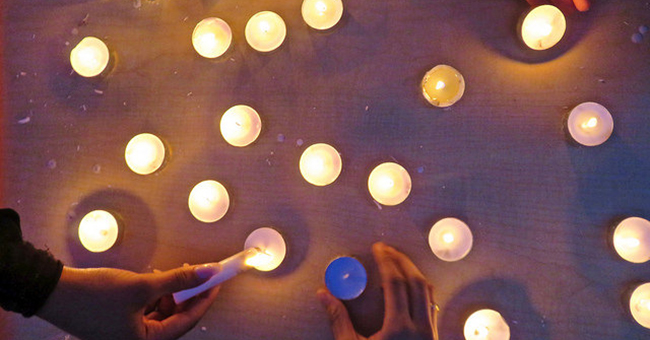
    Tam High Vigil for Parkland School Shooting

    Tam High Vigil for Parkland School Shooting. Photo credit: Fabrice Florin.

    One year ago today, we saw yet another tragic chapter in our country’s waking nightmare of gun violence. Seventeen students and staff members were killed in the mass shooting at Marjory Stoneman High School in Parkland, Florida. To honor their memory, inaugural poet Richard Blanco wrote “Seventeen Funerals.” 

    ***

    Seventeen suns rising in seventeen bedroom windows. Thirty-four
    eyes blooming open with the light of one more morning. Seven-
    teen reflections in the bathroom mirror. Seventeen backpacks or
    briefcases stuffed with textbooks or lesson plans. Seventeen good
    mornings at kitchen breakfasts and seventeen goodbyes at front
    doors. Seventeen drives through palm-lined streets and miles of
    crammed highways to Marjory Stoneman Douglas High School at
    5901 Pine Island Road. The first bell ringing in one last school day
    on February fourteenth, 2018. Seventeen echoes of footsteps down
    hallways for five class periods: algebra, poetry, biology, art, history.
    Seventeen hands writing on whiteboards or taking notes at their
    desks until the first gunshot at 2:21pm. One AR-15 rifle in the hands
    of a nineteen year old mind turning hate for himself into hate for
    others, into one hundred fifty bullets fired in six minutes through
    building number twelve. Seventeen dead carried down hallways
    they walked, past cases of trophies they won, flyers for clubs they
    belonged to, lockers they won’t open again. Seventeen Valentine’s
    Day dates broken and cards unopened. Seventeen bodies to iden-
    tify, dozens of photo albums to page through and remember their
    lives. Seventeen caskets and burial garments to choose for them.
    Seventeen funerals to attend in twelve days. Seventeen graves dug
    and headstones placed—all marked with the same date of death.
    Seventeen names: Alyssa. Helena. Scott. Martin—seventeen ab-
    sentees forever—Nicholas. Aaron. Jamie. Luke—seventeen closets
    to clear out—Christopher. Cara. Gina. Joaquin—seventeen empty
    beds—Alaina. Meadow. Alex. Carmen. Peter—seventeen reasons
    to rebel with the hope these will be the last seventeen to be taken
    by one of three-hundred-ninety-three-million guns in America.

    ***

    Listen to Richard Blanco read “Seventeen Funerals.” Look for it in his forthcoming collection How to Love a Country.


    About the Author 

    Selected by President Obama to be the fifth inaugural poet in history, Richard Blanco joined the ranks of such luminary poets as Robert Frost, Maya Angelou, Miller Williams, and Elizabeth Alexander. Standing as the youngest, first Latino, first immigrant, and first openly gay person to serve in such a role, he read his inaugural poem, “One Today,” as an honorary participant in the official ceremony on January 21, 2013. Blanco was made in Cuba, assembled in Spain, and imported to the United States, meaning that his mother, seven months pregnant, and the rest of the family arrived as exiles from Cuba to Madrid, where he was born. Only forty-five days later the family emigrated once more and settled in Miami, where Blanco was raised and educated. The negotiation of cultural identity and universal themes of place and belonging characterize his three collections of poetry, which include City of a Hundred Fires (awarded the Agnes Starrett Poetry Prize from the University of Pittsburgh Press), Directions to the Beach of the Dead (recipient of the Beyond Margins Award from the PEN American Center), and Looking for The Gulf Motel (winner of the Patterson Poetry Prize, a Maine Literary Poetry Award, and the Thom Gunn Award). His poems have also appeared in the Best American Poetry, and Great American Prose Poems series, and he has been featured on CBS Sunday Morning, and National Public Radio’s All Things Considered and Fresh Air, as well as major US and international media, including CNN, Telemundo, AC360, the BBC, Univision, and PBS. Blanco is a fellow of the Bread Loaf Writers Conference, recipient of two Florida Artist Fellowships, and a Woodrow Wilson Visiting Fellow. A builder of cities as well as poems, he is also a professional civil engineer currently living in Bethel, Maine. Follow him on Twitter at @rblancopoet and visit his website. 

  • By Thomas Norman DeWolf

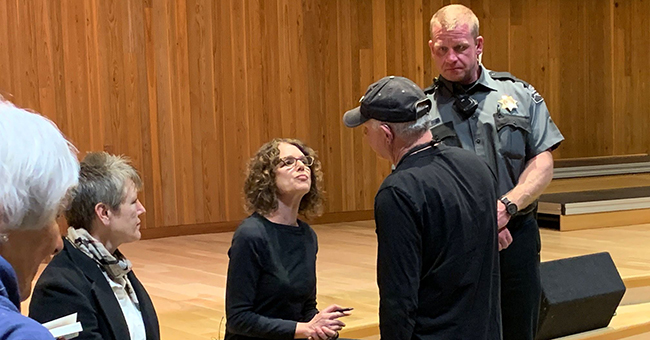
    Robin Robin DiAngelo in Bend, Oregon, with security.

    Robin DiAngelo in Bend, Oregon, with security. Photo credit: Thomas Norman DeWolf

    I looked forward to Dr. Robin DiAngelo coming to the town where I live, Bend, Oregon, since her appearance was announced a few months ago by The Nancy R. Chandler Visiting Scholar Program of Central Oregon Community College (COCC). She was the featured speaker for this year’s Season of Nonviolence. I’m a big fan of her work, and we share a publisher: Beacon Press. I’ve not had the opportunity to see her present until now. I reserved tickets for her Wednesday evening presentation as well as her workshop the following morning. I attended with several friends, members of our local Coming to the Table affiliate group.

    I’ve read Dr. DiAngelo’s New York Times bestseller, White Fragility, and consider it one of the “must read” books for white people to become more fully aware of our own “stuff” around race, how we perpetuate it, and how we become “fragile” in defending ourselves against charges of racism. My coauthor Jodie Geddes and I include White Fragility in the Recommended Reading section of our new Little Book of Racial Healing.

    “I don’t want you to understand me better. I want you to understand yourselves. Your survival has never depended on your knowledge of white culture. In fact, it’s required your ignorance.”—Ijeoma Oluo, 2017

    From this early slide, Dr. DiAngelo spent an hour and a half naming what white people desperately need to know and acknowledge, and what so few of us do. She explained what white fragility is:

    “The inability to tolerate racial stress. Racial stress is triggered when our positions, perspectives, or advantages are challenged. White fragility functions to block the challenge and regain white racial equilibrium.”

    If you are white and reading this post, please read White Fragility: Why It’s So Hard for White People to Talk About Racism. Check out a similar presentation to what she shared in our town on YouTube. She names the problems, the wounds, the challenges, the racism. She points out that in North America, “we live in a society that is deeply separate and unequal by race.” She doesn’t couch things in comforting words. In fact, her book and presentations are decidedly uncomfortable for most white people, because we haven’t done our work in understanding our own connection to racism, its perpetuation, and its impact on all people of color.

    So, that’s your homework, my white friends.

    But my main purpose in writing this essay is to ponder the meaning(s) of the presence of the security guards.

    I sat in the third row with several friends in the sanctuary of the Unitarian Universalist Fellowship. The presentation was moved from Central Oregon Community College to accommodate more people. Her presentations both filled completely, plus waiting lists. When the event began and Dr. DiAngelo was introduced, a tall, strong, white man in uniform stood at the front of the room on the left. Another stood to the right. They looked out at the gathered crowd with serious looks on their faces. They never moved; never showed any emotion or response to anything Dr. DiAngelo said. A few more security guards were stationed elsewhere throughout the sanctuary. During her talk, she shared that she received a death threat last week. Well, I thought, that explains the security guards.

    At the conclusion of Dr. DiAngelo’s presentation, one of the guards moved to stand a few feet to her left as she sat on the front edge of the stage to talk with attendees and sign copies of her book. He didn’t move. He didn’t blink. No nonsense. Deadly serious.

    To the friends I sat next to, including an African American man, I said at the conclusion of her presentation, “I found it really disturbing to have the security guards standing there throughout her talk.”

    “I could hardly listen to what she had to say,” my friend replied. “I’m black and he’s a cop.”

    I stared at him for a moment, shook my head, and said, “I realize that as disturbing as it is for me, it is so much more for you. In all honesty, I was thinking this is completely unnecessary here. Nothing bad will happen in Bend, Oregon. Especially not in this church. But of course, it can. And my inclination to think otherwise highlights my own racial blinders.”

    “This is what I need you and other white people to understand,” said my friend. “This is the impact that I deal with every day.”

    I walked over to one of the organizers of the event. I learned the college had received messages from close to a dozen people who were very upset that COCC would bring Robin DiAngelo to town. Very upset. Enough so, apparently, that a team of security guards was hired and was very visible.

    After most everyone had left, I spoke to one of the security guards who had been positioned at the front of the room. I asked him how he felt about needing to be there. He started sharing what sounded like a “company line” of just doing his job, etc., etc., and I interrupted.

    “What I’m asking is about you personally. How do you feel inside that we live in a town where your presence is needed for an event like this?”

    He looked into my eyes, then. It felt like he was really seeing me. “There are some really angry people in the world. They can cause a lot of damage. It’s too bad, but I’m glad we can help make sure everyone stays safe.”

    I appreciate the event organizer and the security guard being open with me. Their words remind me of my own blindness to what goes on in our world . . . in my town. White people unwilling or unable to see our own stuff. White people willing to use violence—in letters to a local college, or in acts of violence—to avoid understanding and admitting that we are the problem. White people are the problem. In a nation founded on racism and white supremacy (the enslavement, murder, rape, and centuries of abuse of African people, the annihilation and forced removal of Indigenous people, the violence directed at, and theft of land of Mexican people, and so much more)—the foundational elements in the creation of the United States—white fragility is very much alive and well today, causing ongoing harm, and sometimes violent death, to people of color.

    Let me be as clear with my readers as Dr. DiAngelo was with us that night. It is up to white people to understand that our ancestors created racism. We have inherited it. Our denial and deflection and fragility perpetuate it. It is on us to eradicate it.


    About the Author 

    Thomas Norman DeWolf is the author of Inheriting the Trade: A Northern Family Confronts Its Legacy as the Largest Slave-Trading Dynasty in U.S. History, and co-author of Gather at the Table: The Healing Journey of a Daughter of Slavery and a Son of the Slave Trade, (both published by Beacon Press). His latest, The Little Book of Racial Healing, was published in January. Tom DeWolf facilitates workshops and speaks regularly about healing from the legacy of slavery and racism at colleges, conferences, and other venues throughout the United States, and serves as Executive Director for Coming to the Table. Learn more at http://tomdewolf.com/. Follow him on Twitter at @TomDeWolf and on Facebook.

  • By Feminista Jones

    Black Girl Magic

    Photo credit: Johnny Silvercloud

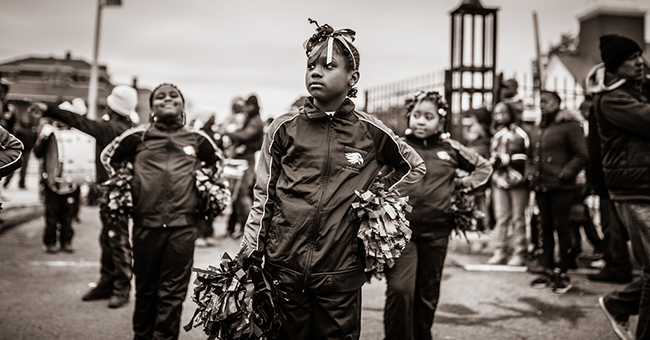
    Black women have endured generations of being treated, by media and community alike, as if we are unworthy of love and respect, are unattractive and undesirable, and we are expected to rise above the negativity and continue to put others before ourselves. We can no longer internalize this hateful, damaging nonsense, and we have to do everything we can to make sure the next generation of little Black girls coming into this world know they are valued, told they are beautiful, encouraged to reach their fullest potential, and embody the “Black Girl Magic” that lives in each of us. Janelle Monáe warned us in her song “Django Jane” that because Whites can’t stand our magic, they’ll try to deny us the right to claim it. Black Feminism can be a protection and a guide, and as more of us become parents, we have a responsibility to change the narrative, minimize the harm, and shift our culture and communities toward appreciation and respect for Black women and girls everywhere. Bringing our daughters up believing in and never questioning the existence of their own “magic” is restorative and promising, electrifying and declarative, radical and hopeful.

    When CaShawn Thompson, a fortysomething mother of two, was growing up in Washington, DC, she knew no other truth to be more consistent and potent than the idea that she and other Black girls like her were magical. It was not a trifle notion of whimsy but rather a truism as commonly understood as fire being hot and humans needing oxygen to breathe. She grew up believing in the fairy tales her parents read to her when she was just a small child, so the lines between reality and fantasy were often blurred for her, and she was perfectly content with that.

    In January of 2018, I interviewed Thompson because I wanted to share her story and the origins of #BlackGirlsAreMagic, the hashtag she began to use to highlight Black women’s accomplishments and as a rallying call for our empowerment. She was beginning to pick up momentum with being recognized as the creator of the movement, and more people were reaching out to her to include her in conversations, panels, and projects related to “Black Girl Magic.” Having known Thompson for many years and having supported the movement from the beginning, I wanted to provide her an opportunity to share her story and clear up any misconceptions about what #BlackGirlsAreMagic is all about. Below are excerpts from our conversation:

    ~~~

    Feminista Jones: So this was something that you knew from an early age and it just kind of carried you. Tell me about “Pretty Brown Girl,” ’cause we cannot talk about Black Girl Magic without talking about Pretty Brown Girl. Tell me how you got into that.

    CaShawn Thompson: “Pretty Brown Girl” was a moniker that I used for myself when I was logging on MySpace, like, ten years ago. It came from my father telling my sister and I that. My parents are very pro-Black, if we are going to call it anything. We were raised to know “Black is beautiful,” “Say it loud say it proud,” raised in that way, like, completely immersed in Black cultural music, food, literature, everything was always around us. I remember I never had to go away from my people to find myself as a Black person, as a Black girl, as a Black woman. It was, like, literally ingrained in me from birth.

    FJ: Were your parents involved in any Black organizations or anything like that?

    CT: I remember them being a part of this organization here in DC called Black Seeds, and we would go to their meetings and their children’s workshops and different things like that.

    FJ: It was like a community organization?

    CT: Yeah, it was really local from what I understand, and they have a calendar. I think they [her parents] still get it. They had a calendar and they even published some of my mother’s poetry. That was way back when.

    FJ: So they really instilled early on that Black is the truth and you should be happy you’re Black? And your dad called you his pretty round girl?

    CT: Yeah.

    FJ: When you created the blog on MySpace, what spaces did the blog exist on [after that platform ended]? I know you migrated and you had your own blog. Were there any other platforms that you used for Pretty Brown Girl?

    CT: After MySpace, I started spending a lot of time on Very Smart Brothas. When it first started, in its early, early, earliest days, everybody always thought I had good advice. “Oh you should do an advice column, you should do an advice column,” so I had one called “Hey, You Asked.” I did that for a little while, and then I decided that I was into nail polish and Black beauty, so I did a nail polish blog called 52 Flavors. It just started out like that because I wanted to do fifty-two nail polishes in a year, and I did that and various kinds of beauty posts. And then after that, I just wanted to do a lifestyle blog where I put all those things in one spot. I asked a friend of mine, “What would you call a lifestyle blog by me? Something where I talk about life and my experiences and understandings, and also nail polish and makeup and outfits and hair and all that kind of stuff?” She was like “Dirty Pretty Things,” and so Dirty Pretty Things was a blog I had for a while. It actually won one of those awards. What was that, Black Bloggers Association or something? I cannot even remember.

    FJ: When did you join Twitter?

    CT: I joined Twitter October 2008, and I did not honestly start using it until the end of that year, beginning of next year, like January of 2009.

    FJ: And then were you sharing your blog links on Twitter, with people?

    CT: Definitely. I was sharing my blog links on Twitter at the time, and that’s how the word kind of got around. I thought Twitter was the best platform for me because it is for wit and brevity, which people seem to know me for. At least they seemed to at that time, and it worked for me so well. I think organically I just started growing followers because I was able to use the platform so deftly in a time when we still had 140 characters. You remember how it used to be back in the day!

    FJ: So take me back to when you first started talking about Black Girls Are Magic or when you first started using the hashtag.

    CT: I first used Black Girl Magic I want to say June of 2013.

    FJ: 2013 is coming up in my research too. Someone else had used it before you, but she did not make it popular.

    CT: The difference was, I was the first person to use it and reference Black girl empowerment. Other times it was used before, it was always something about Black girl’s and Black women’s hair. I was the first person to use Black Girl Magic or Black Girls Are Magic in the realm of uplifting Black women. Not so much about our aesthetic but just who we are.

    FJ: Before you started selling the merchandise, how popular was this idea, this hashtag? Did you start seeing other people start to use it?

    CT: I did see a few people starting to use it, like you and a few other people. It was very like, you know, my homegirls that I talked to on Twitter and that was pretty much it, you and Sydette (@Black Amazon) were using it back then.

    FJ: What made you want to turn it into merchandise?

    CT: I think somebody just said listen, it should be on a T-shirt, you know. I had seen other people use Teespring when Teespring first popped off, and I thought, “This is a simple enough way to do this, and maybe I can sell about thirty shirts and my friends will have one; it will be a nice thing to have.” But it turned into a lot more than I expected it to. That first [campaign] sold 330 shirts.

    FJ: How long did it take to sell 330 shirts? Was that in the first month, three months . . . ?

    CT: That was probably within the first month. Yeah, it did not take long to sell that many shirts.

    FJ: When people started wearing the shirts and posting the pictures, what was some of the initial feedback?

    CT: All the feedback I got in the beginning was good. I never got a negative comment about Black Girls Are Magic or Black Girl’s Magic until just, was it this year? Maybe last year? Yeah, but all the feedback was positive.

    ~~~

    Hashtags like #BlackGirlsAreMagic or the more popular, abbreviated version, #BlackGirlMagic, serve as a call to action for Black women. They function as a reminder of our power and our unique beauty, internal and external. When Black girls and women make the news, breaking barriers and making history, we highlight their accomplishments with these hashtags. When Black girls and women show up, for ourselves and for others, we want the world to know this is who we are and how we have always been. We do not have to be supernatural or superhuman to be magic—we just need to be. The continuation of our mere existence is magical in itself, and the ways in which we are able to shine and thrive, against all odds, should be honored and celebrated. What started as a hashtag has transformed into a movement that has changed how we speak about Black girls and women, and the world is beginning to see us and appreciate us for all of our contributions to forward progress. There is so much that would not exist were it not for us, and sometimes we just need a reminder that we are, indeed, magic.


    About the Author 

    Feminista Jones is a Philadelphia-based social worker, feminist writer, public speaker, and community activist. She is an award-winning blogger and the author of the novel Push the Button and the poetry collection The Secret of Sugar Water. She was named one of the 100 Most Influential People in Philadelphia and one of the Top 100 Black Social Influencers by The Root. Her writing has been featured in the New York Times, Washington Post, and Time, Essence, and Ebony magazines. Follow her on Twitter at @FeministaJones and visit her website.

  • By Richard A. Serrano

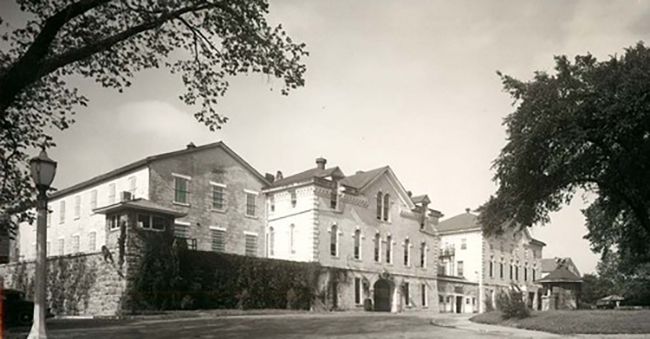
    Military prison at Fort Leavenworth, Kansas, where John Bennett and eight other black soldiers would be hanged between 1955 and 1961.

    Military prison at Fort Leavenworth, Kansas, where John Bennett and eight other black soldiers would be hanged between 1955 and 1961.

    For years, I have carried around in my head a haunting tale—that of a handsome young black army soldier named John Arthur Bennett, and what occurred along a snowy winter creek in Austria and deep in the bowels of death row basement at the army’s Fort Leavenworth prison.

    The story for me reared up whenever I heard of another soldier condemned to die, or another April 13 shadowed the calendar. It especially hit home in 2003, when I witnessed a black man legally put to death for raping and killing a white female.

    I first learned in the late 1970s of John Bennett, a descendant of southern Virginia plantation slaves. I was then a cub reporter for the since folded Kansas City Times, once the morning newspaper in my hometown. Still young at the craft, I pulled Sunday duty and often sat around the newsroom with Jim Fisher, a legendary reporter, columnist, and editor. He regaled me with past newspaper triumphs, including how he had once officially witnessed an army hanging at nearby Fort Leavenworth, Kansas. He especially talked of Bennett, condemned to die for raping a white girl in Austria. Covering a hanging, Fisher instructed, was a rite of passage for any budding newspaperman.

    Instantly, I was mesmerized. A decade later, in the mid-1980s, while a city desk editor, I would drive night after night to Leavenworth to interview retired army officers and prison guards, lawyers and chaplains, eventually the army’s hangman himself. I papered the federal government, the courts, and the Pentagon with FOIA requests for more on Bennett, and filled boxes with transcripts, court records, army reports, and other material, including stark black-and-white photographs of Bennett and other condemned soldiers. Driving out to Southern California in 1987 to start a new job with the Los Angeles Times, I detoured to Waco, Texas, to interview Bennett’s prison chaplain and stopped in Albuquerque, New Mexico, to visit a husband and wife who had known the soldier and his victim in Austria.

    And still the story traveled with me—to the nation’s capital where I later worked for years as a Washington correspondent and eventually to Indiana to cover that one legal execution. Only when I retired from newspaper work at the end 2015 did I examine deeper the Bennett case and compare it with his fellow death row prisoners. Then the story morphed from one condemned soldier to a much larger account of racial injustice. All eight of the white soldiers were commuted and paroled and returned home. In those same years, the late 1950s, those crucible early chapters of the Civil Rights Movement, the army hanged only black prisoners.

    How could that be?

    Even at that late date, the army still largely resisted the order to integrate the US Armed Forces, demanded by President Truman a decade earlier. White prisoners, as a rite of birth, enjoyed a vaulted privilege. The army, the courts, and the Eisenhower administration repeatedly found ways to commute their sentences and spare their lives. Local politicians and official Washington lobbied for leniency. The press clamored for clemency, too.

    Black soldiers could claim no friends in high places. Their individual files at the Eisenhower Presidential Library in nearby Abilene, Kansas, are often thin, maybe a mere letter or two from a desperate mother in the Deep South, barely able to correctly spell her words in pleading for help.

    The guards themselves, those death row officers who watched over the condemned men day and night, recognized that dual system of justice. Even then, they realized that justice did not shine fairly upon black soldiers. Some of the black men had committed far less heinous crimes than the whites, and yet white men were reprieved while black soldiers were marched from their cells to the army gallows.

    Many hoped, expected even, that Bennett would break this tragic trend, and live. Twice, many of the white guards celebrated when Bennett won two stays of execution. Some agreed with army psychiatrists who concluded Bennett may have been suffering from a mental impairment when he raped the white girl in Austria, and should be spared. Above all, they knew that Bennett had killed no one, unlike all the white men, and hoped he would beat a third execution date of April 13, 1961.

    Indeed, when his case rolled into the early months of 1961 and was taken up by President Kennedy, a Catholic, a Democrat, a liberal, many at the old army prison believed surely the new commander in chief would end such a disgraceful tradition of hanging blacks only, and always at the 12 AM hour

    Or would Bennett too, like all the other black soldiers before him, be summoned at midnight?


    About the Author 

    Richard A. Serrano is a Pulitzer Prize-winning former Washington correspondent for the Los Angeles Times. He spent 45 years covering the Pentagon, the wars in Haiti and the Middle East, the Justice Department, the FBI, and the War on Terror. He is also the author of four books: One of Ours: Timothy McVeigh and the Oklahoma City Bombing; Last of the Blue and Gray: Old Men, Stolen Glory, and the Mystery that Outlived the Civil War; American Endurance: Buffalo Bill, the Great Cowboy Race of 1893, and the Vanishing Wild West; and My Grandfather’s Prison: A Story of Death and Deceit in 1940s Kansas City. Serrano lives in Fairfax, VA.

  • Jennifer Canela

    In these times when readers are responding to our books “more than ever,” when our authors—including Cornel West, Anita Hill, Robin DiAngelo, Charlene Carruthers, Howard Bryant, and Christopher Emdin—are appearing in the media, their ideas going viral on social media, their voices being heard on so many platforms, we thought it might be good to take a break to focus on some of the staff who work hard to find, shape, edit, produce, and promote those works. Our blog series “Beacon Behind the Books” introduces to you a member of our staff and gives you a behind-the-scenes look, department by department, at what goes on at our office.

    For the month of February, we introduce you to our sales assistant, Jennifer Canela! 

    What drew you to publishing, Jennifer? How did you find your way to Beacon?

    I was an English major in college and worked on online publications and art journals while there, because I wanted to be directly involved with spreading the good word of the works that I thought were important. I always knew I would be in publishing in some capacity after realizing I could manage paper deadlines, print deadlines, and still have that passion and drive to work on projects long term. I was a publicity intern at Beacon my last semester in college, and then I stayed on as an editorial intern after graduating and I’ve never left.

    What’s a typical day in the life of a sales assistant?

    My days as a sales and marketing assistant start off by answering tons of emails, mainly from sales prospects and potential opportunities. I follow up with many of our accounts at that time as well. Then I make a list of the tasks I need to complete that day, whether that be writing online copy and making sure it has both marketing and sales potential, tracking sales for that day and making sure the numbers make sense, researching organizations that Beacon Press can potentially partner with, and making a connection or coordinating with event organizers to make sure Beacon books are present where they need to be. One thing is for sure: No day is the same!

    What do you wish someone had told you about publishing when you were entering the industry?

    Something I wish someone had told me before I got into publishing is how involved we become in the whole process. As someone who has overseen publications from start to finish, I thought my input would be limited by my responsibilities here. I was surprised and happy to know that this is a truly collaborative process.

    What skills have you taken from previous jobs to help you do your work at Beacon?

    Customer service experience has played a huge role with all the client facing I do now. Working in sales and retail has also helped in interpreting sales opportunities and managing expectations when it comes to a title and its potential in certain markets. The life of a book is a long one, and keeping track of sales and trends is something I focused on in previous jobs, so it’s been incredibly helpful to have that experience under my belt. I think this position is the intersection between my experiences and passions, so I’m lucky to be able to develop those skills in this space.

    What other departments does your department interact with? And how?

    I interact with our publicity team the most regarding events. I am working in sales but also as a marketing liaison for some titles, which means I’m working closely with our Director of Sales and Marketing and the marketing team in making sales as well as marketing plans for books. I interact with our finance department frequently to bring sales to a close.

    In an alternate universe, what career would you have?

    Movie director. High-power attorney. Talk show host. Spider-Man.

    Hobbies outside of work?

    Visiting breweries and creating my own flights.

    Favorite/recommended podcast?

    Right now, I’m listening to season 1 of Slate’s Slow Burn about Nixon and the Watergate scandal.


    About Jennifer Canela 

    Jennifer Canela was an intern at Beacon Press before joining the sales and marketing team. She is a graduate from the University of Massachusetts-Boston with a BA in English and Professional Writing. While in school, she worked with two distinguished arts and creative writing journals, transcribing print to digital media. She is a proud Latina, a lover of words, and a firm believer in knowing the rules before you can break them. Sometimes she talks exclusively in puns.

  • By Howard Bryant

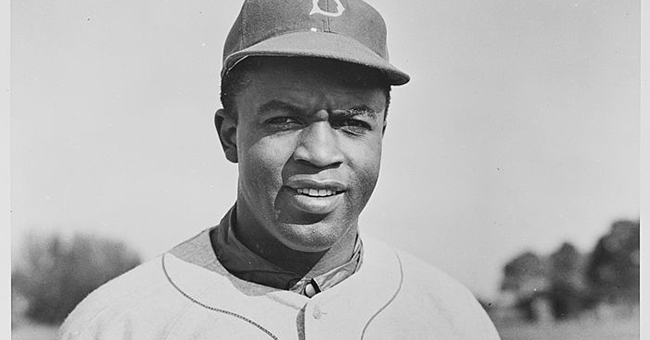
    Jackie Robinson

    We wouldn’t have Colin Kaepernick without Jackie Robinson. Long before Kaepernick bore the backlash of taking a knee, most of the public in Robinson’s time wanted him to “shut up and play,” too. The field, an escape haven for many white sports fans, was no place for Black athletes to speak out for their civil rights. Robinson was one of the master builders of the Heritage, the legacy of the politically-engaged Black athlete. Kaepernick stands as one of its most visible inheritors. In honor of Robinson’s hundredth birthday, let’s take a closer at this complex figure in these passages from Howard Bryant’s The Heritage: Black Athletes, a Divided America, and the Politics of Patriotism.

    ***

    For black men, sports was not as promising an employment opportunity as it appeared. Their bodies were valuable, but beyond playing, chances to coach, evaluate personnel, or run or own teams were as remote as they were in the non-sports world. And as for the Heritage, Jackie Robinson had created the template of the black political athlete, but it was still a game, and employees were still just ballplayers, with plenty of visibility but not nearly enough security (the million-dollar, guaranteed contract was a decade and a half away), so the tolerance for speaking out about social issues was low. Even during the obvious inequality of the Jim Crow era, the white mainstream was still confounded by the black demand for equality. Some whites admired Robinson. Many more simply admired his playing, and most of the public had forgotten he had done the government the solid of testifying against Paul Robeson and wanted him to shut up about politics and the constant demands of black people (“What do they want now?”). This prompted resentment from whites and wariness from the black establishment: pull back; don’t rock the boat, lest we risk everything being taken away.

    By 1964, Robinson had already been retired nearly a decade. Two years earlier, he had been enshrined in the Baseball Hall of Fame. He was a living legend. Robinson’s face was heading for the immortality of an American stamp, with streets and schools, scholarships and highways, to be named after him.

    Yet to the young people who were emerging as the activists of the era, Jackie Robinson was a fossil, too old, too establishment to reach anyone under the age of forty. He was their parents’ age, and no self-respecting radical listened to his parents. In retirement, though, Robinson was more radical than he’d been as a player, all of which burnished the future legend, but at that time, Robinson was seen as an out-of-step old man. He was a Nixon supporter during the 1960 presidential election and remained a moderate Republican for the rest of his life. Younger blacks thought the times had passed him by, even as Robinson traveled to the Deep South to stand with the civil rights movement, marching side by side with Martin Luther King Jr., registering people to vote, showing his face. Robinson also never quite lived down his role in the House of Un-American Activities Committee’s takedown of Paul Robeson, an infamous moment Malcolm X never let him forget in their public war of words. By today’s mild standards of dissent, Robinson sounds like Malcolm X, but at the time, Malcolm X referred to Jackie Robinson, who carried America on his shoulders until it broke him, as an Uncle Tom. Robinson already knew what America’s African American youth thought of him, and Malcolm was unrelenting in his criticism of Jackie’s moderation: “They see me in a suit and tie and they look at my white hair and they’re too young to remember what I did, or they don’t care. I began to talk and some shouted ‘Oreo.’ You know, the cookie that’s black outside and white underneath.”

    ***

    While Robinson’s influence may not have made an imprint on younger activists, it couldn’t be denied that it solidified the Heritage for years to come.

    ***

    The Robinson influence on the baseball traditions of the Heritage led to a tightly knit network of African American players that would span generations, both leagues, and the entire country. “We had to take care of each other,” former Major League Baseball manager and retired player Dusty Baker said. “There weren’t that many of us. You knew the game didn’t always want you. You had to pass on what you knew, like, prepare the ones that were coming. That was your responsibility.”

    The spirit of activism defined sports in the 1960s. In 1964, NBA players—the league of Russell and Chamberlain, Jerry West and Elgin Baylor—nearly boycotted the All-Star Game over the pension policy. In 1965, after being treated with racial hostility in New Orleans, black AFL players boycotted the game. In 1966, Major League Baseball players hired labor negotiator Marvin Miller and built the most powerful union in the history of professional sports, a model for athletes coming to understand their rising power in the workforce. The 1968 Olympics were seismic and could have been more so if the athletes had decided to push further and not gone to Mexico City. In 1969, Curt Flood took the first step toward defying baseball at the Supreme Court when he refused to be traded from St. Louis to Philadelphia, challenging the reserve clause, baseball rules that teams owned players for life. Along with artists in the fast-growing music industry, black athletes were the most visible black professionals in the world. The public wanted them to be grateful for their talent, but athletes didn’t just have talent; they had power. If the best prospect for black America was not going to be education but the lottery ticket of sports, body over brain, then the most physically gifted African Americans were bound to interrupt America’s fun and games when the times demanded their political participation. This was the Heritage. It was the special inheritance of the black athlete. It belonged to them now, even if it was a burden the next several generations of athletes did not always seem to want.

    For all the gauzy tributes and reflections of the 1960s, there was no mistaking a central fact: the Heritage and all of its political strains, from the conservative push of moderate integration to radical wings of the movement, were never welcome by the suits who signed the checks or the executives who picked the talent. Jim Brown told his biographer Dave Zirin that he considered Paul Robeson his “number-one guy, a great man . . . who was doing it, fighting, for decades before anyone knew Dr. King.” Robinson was a Republican, an integrationist, but never shied from asserting his rights.


    About the Author 

    Howard Bryant is a senior writer for ESPN.com and ESPN the Magazine and has served as the sports correspondent for NPR’s Weekend Edition Saturday since 2006. He is the author of The Last Hero: A Life of Henry Aaron; Juicing the Game: Drugs, Power, and the Fight for the Soul of Major League Baseball; Shut Out: A Story of Race and Baseball in Boston; and the three-book Legends sports series for middle-grade readers. A two-time Casey Award winner (2003, 2011) for best baseball book of the year, Bryant was also a 2003 finalist for the Society for American Baseball Research Seymour Medal. In 2016, he was a finalist for the National Magazine Award and received the 2016 Salute to Excellence Award from the National Association of Black Journalists. He lives in Northampton, Massachusetts. Follow him on Twitter at @hbryant42 and visit his website.

  • By Kay Whitlock

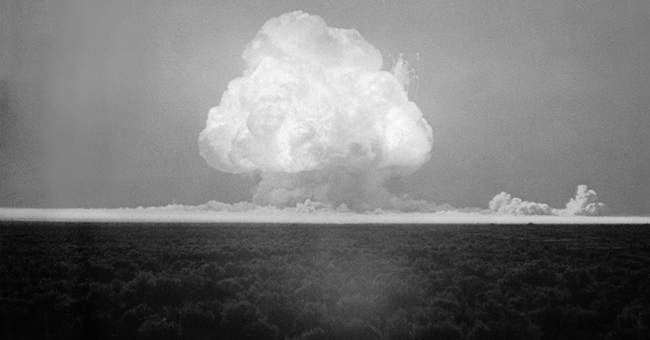
    A fireball begins to rise, and the world's first atomic mushroom cloud begins to form, nine seconds after Trinity detonated on July 16, 1945.

    A fireball begins to rise, and the world's first atomic mushroom cloud begins to form, nine seconds after Trinity detonated on July 16, 1945. Photo credit: US Department of Defense.

    August 8, 1945

    Dear Folks,

    We have been getting all this atomic bomb dope today and yesterday. I don’t know what to think. If only a third of this dope is factual it revolutionizes the whole world; necessitating a complete new set of ideas . . . If this is a fact the war is over, I am coming home, but the whole idea scares me. I guess the first thought that flashes thru anyone’s mind is what is going to happen in the future when two nations go to war with this equipment . . .
    —from a letter written by my partner’s father, then a young naval officer serving aboard a minesweeper in the Pacific


    Download the full PDF of “The Luminescence of Trinity: Consecrating Nightmare at the Center of a Sacred World,” as the two-part series is presented in its original narrative format.


    I am often drawn to historical battlefields and sites by a sense that the memories, the ghosts, the landscape will somehow reveal more than I have yet learned through book-and-documentary-related study. And by the inchoate sense that I may even be changed by it, that in mysterious ways, my justice vision will be moved toward greater wholeness. In solitary reflection in places where something terrible happened, I listen to the land, to winds, to the rustle of leaves. I cull histories, photographs, poetry, and survivor accounts to try to conjure in my imagination the people and the place and the moment. And sometimes something close to that happens, a quiet ripple in time and perception that somehow shifts how I see and experience everything. When I lived in southern Colorado, long before a national historic site was created, I periodically drove out east to Sand Creek, where a long-ago cavalry massacre of Cheyenne and Arapaho peoples—mostly women, children, and elderly people—took place. There, I sat alone for hours and in silence on land unmarked by buildings or pathways. For whatever reason, Shiloh still disquiets me in a way many other historic battlegrounds do not.

    Perhaps Trinity Site, part of a vast, desert landscape, with blue mountains off in the distance, had metamorphosed into that, an elegiac lamentation murmured by earth and sky.

    First-hand witnesses to the Trinity test use vivid words to describe what they felt, heard, and saw as this new force, capable of annihilation on a global scale, was released: “breathtaking,” “awe,” “grandeur,” “fantastic.” They reported that the flash of light came first. Then, as Val Fitch, an enlisted man with the Army’s Special Engineer Detachment noted, “It took the blast wave about 30 seconds. There was the initial loud report, the sharp gust of wind, and then the long period of reverberation as the sound waves echoed off the nearby mountains and came back to us.”

    The expanding fireball and shockwave of the Trinity explosion, seen .025 seconds after detonation on July 16, 1945.

    The expanding fireball and shockwave of the Trinity explosion, seen .025 seconds after detonation on July 16, 1945. Photo credit: US Department of Defense.

    I imagined the memory of that sound would yet be echoing; that the ground would still tremble, at least in my heart. But the ghosts had fled. We were greeted on arrival by imposing banks of port-a-potties and a few scattered tables where friendly local people behind gas grills offered hot dogs and hamburgers for purchase.

    From there, it was a quarter-mile’s walk to Ground Zero, marked by a stone obelisk erected long after the test, and surrounded by a tall chain link fence. Along the pathway, cheerful people at a mobile souvenir stand sold commemorative mushroom cloud t-shirts, pins, and other ephemera. The clicking of Geiger counters on display tables confirmed the still-radioactive nature of trinitite, a greenish, glasslike substance of fused sand and other particles created by the intense heat and force of the first atomic blast.

    If Trinity Site is a shrine, trinitite is its sacred relic. Collectors have acquired a lot of the stuff—allegedly before its taking was banned in 1952—and we saw scattered bits of it on the ground, though most has been buried. While visitors are assured that no health risk is posed by its presence, signs warn that taking trinitite is theft of government property. But we saw teenagers scrounging for some in the dirt. On the way out, just the other side of Stallion Gate, we encountered many weekend vendors hawking chunks of trinitite for sale out of their cars and trucks.

    A series of large Manhattan Project-related photographs is displayed along a northern segment of the Ground Zero fence. Save for the photo of the Trinity Site Polo Team, these are iconic images of the bomb and the buildup to the test, long familiar in bomb lore. There are no photographs of the devastation to the peoples and landscapes of Hiroshima and Nagasaki.

    Courtesy buses took us a short distance out to the McDonald ranch house—the Army seized the house from a local family under protest in 1942 and never returned it—where final assembly of the active plutonium core for “the gadget” took place before the completed bomb was transported to the test tower. Because there are so few “things” to actually see at the site, people flocked to an empty room to take selfies under a single lightbulb dangling on a cord from the ceiling with a sign marking the space as “Plutonium Assembly Room.”

    Of the few hundred people we saw at Trinity Site, more than a few were Japanese Americans and visitors from Japan. There were also many young men, predominantly white, who had served in Iraq or Afghanistan and were accompanied by buddies, wives, and girlfriends. They made jokes about The Bomb, but the laughter that greeted them was short-lived and uncomfortable, a series of staccato barks. Some people, not many, brought their kids who seemed bored. Others, like us, were in their sixties and older; many of these men wore hats or other indicators of their status as veterans of earlier wars and eras. Mostly, there was silence, which did not seem so much reverent or contemplative as baffled: What the hell?
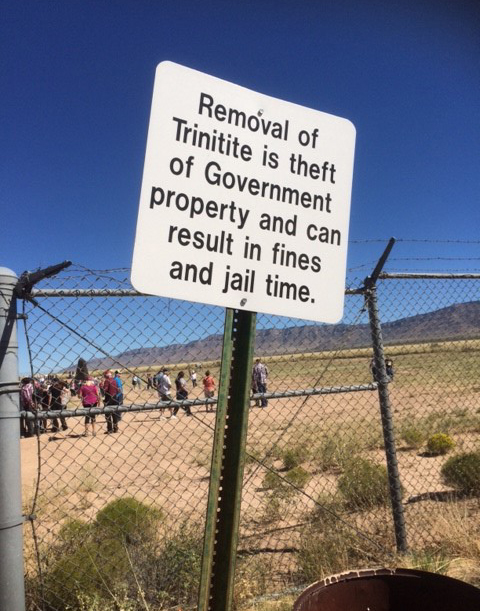
    Trinity Site

    Trinity Site. Photo credit: Kay Whitlock

    Whatever anyone was looking for, I doubt that they found it.

    All this is to say: Trinity Site is a monument of erasure. A memorial offering only the assertion that something awesome took place here, and that Americans did it. And by “erasure,” I don’t mean what many people consider the emptiness of a desert landscape. I grew up on a shortgrass prairie. It has always been the arroyos, the deserts, the tablelands and plateaus, the spare places where movement always seems to happen only at the corner of vision that most stir my soul.

    No, this void is intentional. Crafted entirely by humans, it is something akin to a hidden entombment. Buried somewhere deep beneath the assertion of magnificent accomplishment is something no one is supposed to notice.


    Part III: Sacrifice

    But Mr. F was wrong yesterday when he said that this country is so old it did not matter what we Anglos do here. What we do anywhere matters, but especially here. It matters very much. Mesas and mountains, rivers and trees, winds and rain are as sensitive to the actions and thoughts of humans as we are to their forces. They take into themselves what we give off, and give it out again.
    —Edith Warner, journal entry, June 24, 1933, In the Shadow of Los Alamos


    At an unmarked place along the roadside on the way to Los Alamos, at the edge of lands belonging to the San Ildefonso Pueblo, stand the remains of a small adobe tearoom/café run by Edith Warner and her friend and companion Tilano, a pueblo elder. Once open to the public, the government permitted the teahouse to remain open during the intense Manhattan Project years solely for the purpose of providing refreshments and brief respite to Robert Oppenheimer, the theoretical physicist who led the A-bomb development effort, Niels Bohr, and other atomic scientists and their wives.

    One overcast and rain-swept morning, my partner and I drove to Los Alamos. On our way,

    following the careful directions provided by a friend, and without encroaching upon San Ildefonso lands, we stopped near a small turnout and walked back to look at the remnants of small buildings where Warner lived and worked. Peggy Pond Church, who knew Warner and Tilano, notes that the lives of tearoom visitors were all heavily-surveilled, filled with tension, and circumscribed by stringent restrictions and security measures. Accordingly, she writes, “there were many people at Los Alamos who felt that only their evenings at Edith Warner’s kept them human.”

    Warner’s story deserves to be encountered on its own terms, especially in her own writings and journals, most of which were published after her death. Although she did not know any details until after the Trinity test, she almost certainly sensed and feared a terrible weapon in the making. Yet she did not hate the scientists. Nor did she justify their work, nor did she comfort herself by simplifying in her mind the magnitude or violence of what was being created. Instead, rooted in the love of earth, water, and sky, and recognizing the ultimate importance of respectful, compassionate, evolving relationship—to people and all beings as well as to the earth—she saw more deeply, and with clearer vision, what this all meant. Hers was not an activist vision, but nonetheless it quietly subverts supremacist notions by refusing to see human beings as somehow separate from or in dominant relation to nature. Rooted in Indigenous understandings, it  recognizes well-being can only result from just, respectful, and non-destructive relationship in many intersecting realms.

    This is where—along the road, near a crumbling adobe teahouse, in that particular New Mexico landscape that includes the San Ildefonso Pueblo, and in the writings of Warner—I finally caught a sentient glimpse of larger in relation to Trinity. A powerfully sensate inkling of wholeness, or at least something closer to it, that goes far beyond daylight recognition. And that’s when I began to recognize the luminescence of Trinity for what it really is: part of a murder-suicide pact on a global scale. I didn’t agree to this pact—though new generations of cheerleaders cling to the dream of the technological fix—and neither did most of you.

    The luminescence of Trinity touches everything; it has since the first test, and it continues to touch lives and ecologies, mostly in ways that are harmful, not immediately visible, forgotten, and ignored. And it violates every possible, sane understanding of “right relationship.” The same is true for all structural forms of violence.

    For the most part, political perceptions and discourse are so fragmented, so hopelessly rent, not only in the mainstream, but along the liberal/progressive/left spectrum. I know that transformative change is fought for, and begins to arrive, in bits and pieces; in fits and starts. But our animating analyses and visions should never be piecemeal.

    Mainstream political and economic conversation depend on disassociation as an organizing principle of dialogue, policy, platform. There is a civic habit, deeply engrained, of never addressing wholeness and the kinship of human and other sentient beings. It could be done. Not by ignoring the constituent parts of structural violence—white supremacy, economic violence, gender violence, ecological devastation, genocide, mass extinction—but by addressing them specifically and with regard to the dynamic relationships among them. Yet many of us say that is impossible because “it’s too overwhelming,” or “we’ll lose focus.” Often: “we’ll lose our funding.”

    But what is the cost of voluntarily spinning endlessly in the lethal centrifuge of cosmetic change and fatalism created by accepting existing terms of debate? It’s time to establish new ones; to work as hard to shift consciousness as we do policy. Groundbreaking efforts by abolitionists and Alexandria Ocasio-Cortez to shift both consciousness and priorities already provide some heartening models for thinking differently. Others will emerge. The alternative is to let fear, rage, and failure of imagination triumph.

    Structural violence is not “inevitable,” nor is it “necessary.” Its varied forms constitute a series of interrelated murder-suicide pacts organized by dominant power hierarchies around the rhetoric and practices of supremacy, survival, and security. These pacts are then invested with a quasi-holy status. But it is a shabby holiness, and phony, manufactured at the bipartisan crossroads of greed and an unquenchable thirst for domination.

    Eventually, these pacts will take us all down—peoples, other sentient beings, cultures, ecologies, smaller caring economies—but some have long been going down first and hardest, in alignment with the dictates of racial capitalism which require never-ending blood sacrifice. The geographer and abolitionist Ruth Wilson Gilmore has defined racism as “state-sanctioned or extralegal production and exploitation of group-differentiated vulnerability to premature death.” And this group-differentiated vulnerability to premature death is not only raced but classed, gendered, and overtly or covertly eugenic to the end.

    Better to name and publicly withdraw consent to these unwritten pacts. Better to expose and discard the consecration of nightmare. Better to go larger. 


    Read part 1 of “The Luminescence of Trinity: Consecrating Nightmare at the Center of a Sacred Word.”

    Download the full PDF of “The Luminescence of Trinity: Consecrating Nightmare at the Center of a Sacred World,” as the two-part series is presented in its original narrative format.


    About the Author 

    Kay Whitlock is a writer and activist who has been involved with racial, gender, queer, and economic justice movements since 1968. Her political vision is unapologetically abolitionist. She is coauthor of Considering Hate: Violence, Goodness, and Justice in American Culture and Politics with Michael Bronski, the award-winning Queer (In)Justice: The Criminalization of LGBT People in the United States with Joey L. Mogul and Andrea J. Ritchie, and cofounder and contributing editor for the weekly Criminal Injustice series at CriticalMassProgress.com. She lives in Missoula, Montana. Follow her on Twitter at @KayJWhitlock.

  • By Kay Whitlock

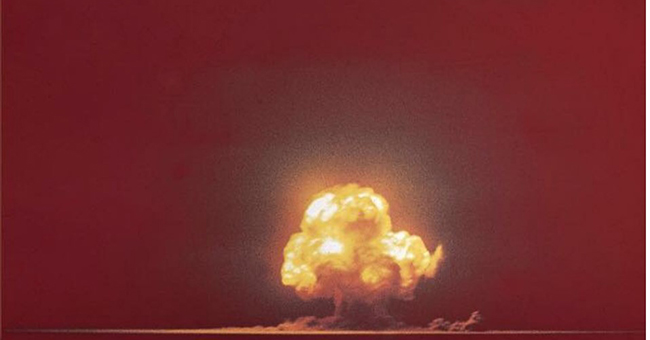
    Trinity test explosion at 25 seconds in

    Trinity test explosion at 25 seconds in. Photo credit: US Department of Defense.

    She died    a famous woman    denying
    her wounds
    denying
    her wounds    came    from the same source as her power

    —from the poem “Power,” by Adrienne Rich,
    occasioned by reflection on Marie Curie, who conducted pioneering research into radioactivity and the isolation of radium


    Download the full PDF of “The Luminescence of Trinity: Consecrating Nightmare at the Center of a Sacred World,” as the two-part series is presented in its original narrative format.


    In the autumn of 2017, my partner and I joined a long car caravan winding slowly across White Sands Missile Range. Organized semiannually by the Alamogordo, New Mexico Chamber of Commerce, the trek set out from an empty lot adjacent to the local high school’s athletic fields. Journey’s end, Trinity Site, is where the first atomic bomb—scientists and officials working on the device called it “the gadget”—exploded at 5:29 a.m. on 16 June 1945. It is open to the public only two days each year, the first Saturdays in April and October. 

    That I finally made the trip still surprises me, though I have long been an avid student of the history of The Bomb and its human, ecological, political, and cultural impacts. I’d always intended to visit Trinity Site at some vague moment in the future. But it’s the kind of destination that self-generates a continuous avalanche of even better reasons for not going. For decades, each time I contemplated the journey, I just as quickly abandoned the idea.

    That may have something to do with the engraved metal dog tag I wore on a chain around my neck many years ago. Along with other grade school children in my home town, my sister and I were physically tagged as potential nuclear war casualties. These tags, stamped with our names, addresses, and phone numbers, also bore a P for Protestant, C for Catholic, or J for Jewish. My mother wrote our blood types on the back in nail polish. In this way, The Authorities could identify young dazed, scorched, irradiated survivors of nuclear blasts or our sad little corpses—assuming that the IDs and human detritus were not completely vaporized.

    Color photo of Trinity test explosion

    The school district and my parents thought the dog tags, evoking those identifying military war casualties, were a good Civil Defense measure in the post-Atomic, Cold War era. I don’t recall whether they were mandatory, but the purpose was clear. We ducked under desks, covering our heads with our arms, during school safety drills (today’s version is school lockdowns). No one I knew could afford a real fallout shelter, but along with countless other mothers all over America, my mom amassed canned goods, bottles of Coca-Cola, and flashlight batteries in the basement. As the catechism of the nuclear age might have it, these were “outward and visible signs of an inward and spiritual terror.”

    While cleaning the house following my mother’s death many years later, I found a dozen cans of Dinty Moore beef stew still stashed away. They either bulged or, through explosive rites of transubstantiation, had already burst into puddles of gelatinous, purple goo covering the shelves.

    I often wonder: beyond the usual reductive political and religious pronouncements, what is there to say about the character of a society that seeks its own life and light through the ability to control, dominate, devastate, destroy? About a society that claims this life and light by framing such power as exceptional, inevitable, moral, and sacrosanct?

    These questions stalk all of my work about structural violence, sometimes obliquely. This violence—ranging from policing and prisons to genocide to gender violence to laying waste entire ecosystems—can’t ever be effectively addressed as a series of separate, single “issues.”

    I am speaking here of routine forms of massive violence, enabled and carried out legally and often with significant popular support, by respectable people in public and private institutions. These are structural components of everyday normalcy. Nothing exists in isolation; race, economics, gender, disability, culture, and ecological disruptions are always dynamically interrelated, always shaping one another and the larger social reality. But when public opinion begins to raise some uncomfortable questions, it is almost always within the narrow confines of mild tsk-tsking presented as, “Well, the basic intention is right, and it started out OK. They’ve just gone a little too far.” That mindset ushers us into the delusional task of measurement: how much routine violence is too massive, and how much is just right.

    This is deranged territory, where any deal cut, however understandably, only reifies the foundations of structural violence by yielding to its terms of debate. Accordingly, I have abandoned the search for reasonable answers to any of my questions. Now I look more for clues, trail markers, symbols, and fragments that hint at something much . . .  well, larger.

    That’s probably why I finally showed up at Trinity Site, in search of larger.


    Part I:  Rites, Ritual, and Celebration

    “Gotta light?”
    The Woodsman, Part 8, Twin Peaks: The Return

    By larger, I mean: my usual interpretations are no longer sufficient for comprehending, much less responding to, the titanic reach and intricate influence of structural violence. That is to say, the violence of coercion, conquest, colonization, exploitation, limitless extraction, poverty, privatizing what must be collectively held in order to ensure collective well-being, the expansion of the carceral state, and endless war. The quest for larger bolsters my willingness to engage complexity; to simultaneously, and without apology, engage mind, heart, and spirit—without feeling obliged to be polite about it.

    With regard to the lethal legacies of Trinity, it matters that acculturation to the atomic age was never focused on doom and gloom. It was also, in part, heady and humorous; thrilling and suspenseful; filled with celebrity endorsement. Earlier expressions of concern and protests from scientists who’d worked on developing the atom bomb—and then argued against its deployment—had been squashed. In the aftermath of bombing of Hiroshima and Nagasaki, any number of philosophers, scholars, physicians, scientists, and artists cried out against the inhumanity and warned of future dangers. But politics and popular culture framed such concerns as unpatriotic and rendered them largely invisible. Endless Civil Defense public service announcements on radio and television broadcast a whiff of upbeat determination and normalcy along with alarming, mostly useless, dollops of information (“When you see the flash, cover your eyes!”). Popular culture was replete with songs filled with braggadocio and defiance, neon signs, menu items, and knick-knacks related to the Atomic Bomb. Post-World War II tests in the Pacific and in the Nevada desert—the US alone conducted at least 1054 of them between 1945 and 1992—came with false assurances that there would be no lasting danger to those in the area or downwind of the tests. The problem of nuclear waste disposal would only emerge as a public concern further down the road—and, in the Trump years, become a small feature in a much larger (and fraudulent) politics of austerity. The atmosphere in those days was replete with a grotesque blend of existential anxiety tempered by American atomic triumphalism. We embarked on a never-ending journey into the Twilight Zone, most of it fed by a steady drumbeat of Red Scare propaganda.

    Public doubts emerged, along with some laudable Ban the Bomb activism in Europe and the US, but the optimism of supremacist vision won, as it usually does. After all, who wants to believe the worst? It’s so depressing. Better to file the jagged edges off reality. Problems, actual and potential, are brushed away by pretending that, through the intervention of “experts,” every terrible thing is manageable and survivable, at least for those who (by the raced/classed/gendered calculus of worthiness) really matter. But that’s the simple part. The more exhilarating challenge is to make the crusade holy; to create images, rites, rituals, spectacles, and ceremonies intended to bind the dominant segments of a nation together, across generations, through the twinned rubrics of survival and supremacy.

    Throughout the country from the late 1940s into the early 1960s, buttressed by a whitewashed storyline about the 1962 “Cuban missile crisis,” civic officials and families were drafted into a series of absurd, often short-lived, survival schemes. A member of my extended family told me that as a young mother living outside of New York City, she was instructed to send her two young sons to school draped in white sheets, with a hole in the center cut out for their heads. These coverings would, she was told, help deflect the heat of a nuclear blast as children walked to and from home. To her credit, this young mother, the very antithesis of a political radical, responded to school authorities with a blistering refusal.

    It was the perfect American metaphor. Send (primarily) white kids to school dressed in white sheets for safety’s sake.

    So my avoidance of Trinity Site is, I hope, understandable. Yet I have often experienced synchronicity, the idea of meaningful coincidences, and in the end, this was the deciding factor. Something in the material world coincides with a person’s state of mind, conscious or unconscious, in some personally significant way. You know how it goes: you’ve been thinking of someone you haven’t seen or talked to for years and, quite unexpectedly, that person calls you or writes or news about them suddenly appears. Or you’ve been avoiding thinking about Trinity site this year because it’s too twisted a destination, and blam. I generally regard synchronicity as a nudge—sometimes a painful kick in the ass—to pay attention to something I’m not seeing clearly enough.

    Blam began early in 2017 with a deluge of images and popular culture depictions of Trinity and its legacies. Especially the brilliant and unnerving Part 8 of Twin Peaks: The Return, with its evocation of the test—a power source unleashing forces of unimaginable evil—set against the musical backdrop of  Krzysztof Penderecki ‘s Threnody for the Victims of Hiroshima.

    Two friends, also visited by thoughts and shadows of Trinity, introduced me to unexpected books I’d never heard of, more books, poetry, and two mesmerizing (and moderately steamy) seasons of a critically acclaimed fictional TV series set in Los Alamos, New Mexico, where a critical mass of scientists gathered under the expansive umbrella of The Manhattan Project to create The Bomb.

    Around this time, the news was stalked by specters of things nuclear, the progeny of Trinity. Fukushima radiation and the Tokyo 2020 Olympics. The appalling reality that Donald Trump was in charge of US nuclear policy. The staggering power of today’s nuclear weapons. Uranium mining, with its deep connection to environmental racism. The possibility, later confirmed, of plutonium thefts. The geopolitics of nuclear energy and weaponry. Grandiose nuclear contamination containment schemes. Nuclear power’s seductive, false promises.

    How much synchronicity does it take to make a dent in my personal stockpile of avoidance? A sledgehammer’s worth, apparently. But finally, over a long weekend in early October, my partner and I found our way first to 109 East Palace in Santa Fe, New Mexico, where Manhattan Project scientists and workers reported for duty, then to Los Alamos, and finally to Trinity Site. All celebrations of a relentless “can do!” stampede of technological know-how and American triumphalism.

    Contrary to popular assertion, dropping the bomb was not necessary to defeat Japan in World War II. But once the atomic bomb was created, the compulsion to use it was all but inevitable. While at this writing, the US is still the only nation to have deployed nuclear weapons against another nation, American nuclear fear is focused on the terror that somebody else might do to “us” what “we” already did to “them.”

    The American solution to the problem of truth is to organize around a false and contradictory but compelling binary: the US is omnipotent and superior, even while the US is also an unjustly persecuted victim under constant assault by hostile forces who “hate us for our freedoms.” The only way to successfully manage both ends of the binary is with overwhelming force. Dominate. Devastate. Demolish. Destroy.


    Read part 2 of “The Luminescence of Trinity: Consecrating Nightmare at the Center of a Sacred World.”

    Download the full PDF of “The Luminescence of Trinity: Consecrating Nightmare at the Center of a Sacred World,” as the two-part series is presented in its original narrative format.


    About the Author 

    Kay Whitlock is a writer and activist who has been involved with racial, gender, queer, and economic justice movements since 1968. Her political vision is unapologetically abolitionist. She is coauthor of Considering Hate: Violence, Goodness, and Justice in American Culture and Politics with Michael Bronski, the award-winning Queer (In)Justice: The Criminalization of LGBT People in the United States with Joey L. Mogul and Andrea J. Ritchie, and cofounder and contributing editor for the weekly Criminal Injustice series at CriticalMassProgress.com. She lives in Missoula, Montana. Follow her on Twitter at @KayJWhitlock.
  • By Dina Gilio-Whitaker

    Nathan Phillips at the 2017 Indigenous Peoples March

    Nathan Phillips (right) marching in the Indigenous Peoples March in Washington, DC, 2017. This is where the incident with the Covington Catholic school boys would take place on January 18, 2019. Photo credit: Mike Maguire.

    The incident with the Covington Catholic school boys has been an astonishing exhibition of not only an intensely polarized country, but a dizzying conglomeration of issues. There were countless mixed messages contained in the assortment of video clips of Nathan Phillips and Nick Sandmann who appeared to be in a standoff. As an American Indian journalist and academic trained to analyze information from all possible angles and come to some kind of understanding of the evidence, I agree that much of the reactionary rhetoric and hateful response to the Covington students was misguided and outright wrong. The students did not deserve death threats.

    But I think there are bigger questions to ask that get to the root of why there is so much outrage that is apparently so easily triggered. Who is outraged, and what are they outraged about? What are the different interpretive narratives circulating, and are they raising legitimate concerns, despite the “unfairness” the students have been handed?

    I think different people will approach those questions in different ways. From an American Indian perspective, I can say that the confluence of factors of the incident are stunningly complex, and arguably, not understood by the vast majority of people who viewed the various videos. Nick Sandmann’s statement is incapable of capturing the complexity of the situation, just as Nathan Phillips’ cannot tell a larger story. It’s not a matter of the boy’s actions simply being misunderstood and mischaracterized. Nor is it about Phillips inciting a confrontation.

    Factoring in the Black Hebrew Israelites, American Indians entering the scene singing the American Indian Movement song (a song of resistance, victory, and healing), and the fact that an all-boys, predominantly white Catholic high school group who were present to protest woman’s rights over their bodies, and you have a toxic brew of ingredients backed by hundreds of years of injustice at the hands of white men fueling the conflagration, and providing a much larger context.

    The MAGA hats and shirts were the visual cue that brought all those things into focus in a way that made anything but a confrontation impossible. And the adult chaperones allowed it all to happen.  

    Even if we accept that Sandmann was not being overtly disrespectful (which I don’t), and was, as he claimed, trying to defuse the situation (copy-catting Phillips’s original claims), there was still obvious disrespect in the crowd. There was mocking (tomahawk chops and fake Indian singing and dancing); there was cultural appropriation (a faux Maori haka); there was the fact that Phillips was surrounded by the boys in a way that can easily be interpreted as threatening.  

    And there was the statement, “it’s not rape if you enjoy it.”  

    The question also needs to be asked: would Sandmann’s stare-down in the face of a singing elder have been tolerated had the elder been, say, a white priest? I think we all know the answer to that question. How in the world could an elderly man playing a drum and singing have been construed by him as threatening, as he implies in his statement?

    And the comment about “lands being stolen, that’s the way the world works,” that gets at the very root of the problem.

    This incident is exemplary of not just racism, but of systemic colonialism bent on Indigenous extermination. For American Indians, unlike any other demographic in the US, while racism is part of a genocidal system, it is not the defining characteristic of it—elimination is. The elimination of Indigenous peoples has always been about obtaining our lands and replacing us. That is the unspoken, invisible context framing what’s really going on here.

    This history is the irreducible core element of this conflict. There is no getting around it, and any analysis that sidesteps it just contributes to the whitewashing of history and upholds the settler colonial system that American Indians like Nathan Phillips are still fighting. The boys’ actions—however convoluted—the lack of action on the part of the chaperones, and even the vile, hateful words of the Black Hebrew Israelites are all part of a larger reality that is not being acknowledged by the majority of the media and other commentators.

    The entire incident is a classic display of settler privilege and fragility. Only in a society that systematically and simultaneously denies and justifies its genocidal foundation can an elderly Native man singing and playing a drum surrounded by hundreds of frenzied white males dressed in attire that to American Indians represents the colonial wrecking ball be construed as menacing.

    It is the replaying of a centuries-old narrative. Native people standing their ground, peacefully or not, are a threat to the white settler population and are, therefore, assailable. The assault is always justifiable, and accountability is absent. White Catholic school boys—like their interloping pioneer ancestors before them—are thus painted as the innocent victims while Nathan Phillips is the degraded Native—the savage, a liar, always suspect, undeserving of a legitimate perspective, let alone an apology.

    Until the US accounts for its history at every level of society, this scenario will play out relentlessly, in endless configurations.


    About the Author 

    Dina Gilio-Whitaker (Colville Confederated Tribes) is a lecturer of American Indian Studies at California State University San Marcos, and a consultant and educator in environmental justice policy planning. Her research interests focus on Indigenous nationalism, self-determination, environmental justice, and education. She also works within the field of critical sports studies, examining the intersections of indigeneity and the sport of surfing. She is co-author with Roxanne Dunbar-Ortiz of Beacon Press’s “All the Real Indians Died Off” and 20 Other Myths About Native Americans, and her forthcoming book, As Long as Grass Grows: The Indigenous Fight for Environmental Justice from Colonization to Standing Rock, is scheduled for release by Beacon Press in April 2019. Follow her on Twitter at @DinaGWhit and visit her website.