• By Daisy Hernández

    Daisy Hernández and the Spanish translation of her memoir A Cup of Water Under My Bed

    Author photo: Jorge Rivas

    My mother carried me in her arms on my first trip to Colombia. I was eight months old. She stuffed me in a fluffy pink snowsuit, and we took a picture with the pilot. On my second trip, I was a toddler. Mami couldn’t carry me because I wouldn’t let her. Already hell bent on freedom, I scampered up and down the plane’s carpeted aisle as it made its way from New York City to Colombia. On my third trip, I ran away from my mother at the airport in Bogotá, leaving her with the baby sister in the stroller, careening past adults with worried foreheads, and not even stopping when I spotted the men in uniforms, the rifles in their hands. I didn’t know about the civil war or the drug war, and the Avianca flight getting blown up in the air and killing all 107 people onboard was a few years into the future. It was 1982. I barreled toward the line of familiar voices past the doors: my primas and tías and tíos. An uncle who drove a school bus had brought it to the airport filled with everyone to pick us up.

    I didn’t visit Colombia again for more than two decades. It felt reasonable. There was the flight that blew up. There were the kidnappings. There was the grandmother with the long white braid who died. My mother sighed her grief. 

    Of course, many good moments also happened in Colombia: a new Constitution recognized the rights of Afro-Colombians, at least on paper. Bogotá voted for a progressive mayor, and the city made headlines as a go-to city for cyclists. The country recognized the rights of lesbian and gay couples and then two years ago legalized gay marriage. I returned to Colombia one year with Mami and another time with one of the tías. We toured the city museums and ate the really good arepas from Ramiriquí.

    I don’t know how straight white folks mark their “adulting” moments, but I can tell you how the queer children of immigrants do it: the first flight to the motherland without your mother.  

    Earlier this year, I boarded a plane in Miami bound for Bogotá. I was dressed in comfy sweatpants and a T-shirt. The young man in ironed slacks across the aisle looked me up and down and practically sneered. I was definitely not following the “tía tradition,” which was apparently also the Colombian tradition in general: dress up for a flight as if you were going on a job interview.

    The young man in his ironed slacks did not know the worst of my transgressions. My memoir, A Cup of Water Under My Bed, first published by Beacon, had been translated into Spanish and was coming out from Rey Naranjos, an independent editorial house based in Bogotá. Forget that all my cousins (my sister counted forty at one time) and aunties and tíos were about to find out that I’m bisexual. I would be promoting a book about queer life, immigration, and feminism in a country still known for its conservative bent. Would anyone even show up to the launch event? Would they shudder at my revelations? Would they mock my Spanglish or be appalled for the way I can sound so brazen in my mother tongue because, apparently, I am over-the-top in multiple languages? 

    I took some small comfort in that my memoir was being launched at the country’s international book festival, La Feria del Libro Internacional de Bogotá, a two-week event that brings writers from all over the Americas and Europe. Teju Cole would be there, and so would the poet Ana Blandiana who had fought the dictatorship in Romania with her verses and actual organizing. I didn’t know either, but I felt it was a good sign that I would be in the company of other folks whose writing lives had challenged social mores much more than my own did.  

    The hotel was nice. I mean really nice. The windows gave me a view of the mountain range and clouds so thick I finally understood how someone would worship them. I drank good hot coffee and photographed the antique sewing machines installed in the lobby as works of art. I posted existentialist questions on social media: how was it that I, the child of a seamstress, now had a room in a fancy hotel where the machine that had once made it possible for my mother to buy steaks and bananas now served as objects of beauty—and all thanks to me writing my mother’s stories?

    The night of the book launch, I focused on one person in the audience: He—She? They? Let’s say they—They had astonishingly blond hair and caramel eyes and sat in the front row and smiled at me. They were probably in their early twenties and grinned at me like we had just spent the night before drinking in a gay bar and lamenting loves that never worked out. They grinned at me like we were friends, and I remembered when I was first coming out in college and how I would walk into a room and look for other queer kids, for as we used to say: “chosen family.” Here now in my mother’s home city was the queer kid, my chosen family. I hoped they would stay until after the talk.

    The room with its dozens of chairs filled up. Correction: the room filled up with women I didn’t know. These were not my cousins or tías. They weren’t even my friends. Who were all these women? My translator, Juan F. Hincapié, asked me questions. My cousin, Diego, took pictures. I tried to argue for reclaiming language used against women. Why not call each other perras, the equivalent of bitches, in Spanish? We had to start somewhere. The audience burst into friendly laughter.

    And the queer kid did stay. Actually, many of the women stayed. The queer kid and I hugged as if we were long lost friends finally reunited. They had a sweet voice and told me they identified like my sweetheart back in the States: genderfluid, genderqueer. We took pictures on their phone. I signed their book. And then the women came, one after another, to have their books signed and to tell me their secrets:

    “This book is going to help me. My brother is in the closet.”

    “I’m bisexual, too.”

    “I think you’re so brave.” 

    “I’m bisexual, too.”

    One woman looked me straight in the eye and declared, “I think writing a book is a humanitarian act.”  

    My mother had told me when I was twenty-five that Colombia didn’t have gay people. She didn’t say it in a mean way. That sort of thing just didn’t have happen in Colombia, she said. Now here stood a line of women in Bogotá telling me otherwise. Even when they weren’t queer themselves, they knew someone who was, someone they loved. And they were so kind to me—abrazo after abrazo—that even now as I write this I burst into tears. At a time when so much about political life in the United States feels like a sharp rock, here were women, whose faces reminded me of my own mother, reminding me that books still inspire the most intimate of connections.


    About the Author 

    Daisy Hernández is the author of A Cup of Water Under My Bed: A Memoir and coeditor of Colonize This! Young Women of Color on Today’s Feminism. She teaches creative writing at Miami University in Ohio, and you can read more about her work at www.daisyhernandez.com. Follow her on Twitter at @daisyhernandez.

  • By Emily Powers and Bella Sanchez

    Lorraine Hansberry

    Photo credit: Molly Malone Cook

    Imani Perry’s Looking for Lorraine: The Radiant and Radical Life of Lorraine Hansberry is a watershed biography of the award-winning playwright, activist, and artist Lorraine Hansberry. If people know anything about Lorraine (Perry refers to her as Lorraine throughout the book, explaining why she does so), they’ll recall she was the author of A Raisin in the Sun, an award-winning play about a family dealing with issues of race, class, education, and identity in Chicago. Lorraine’s extraordinary life has often been reduced to this one fact in classrooms—if she is taught at all.

    Lorraine’s papers, including her letters and unpublished works, were private for years, with the public hearing only whispers or half-formed truths about some of the most significant aspects of Lorraine’s identity: her sexuality and her radical political leanings. In 2014, the Lorraine Hansberry Literary Trust published a wealth of never-before-seen letters, writings, and journal entries, “her heart and her mind put down on paper.” Perry pored over these pages, and four years later wrote Looking for Lorraine. In the book, readers get bits and pieces of Perry, too, as she describes her journey with Lorraine, detailing her thoughts as both an admirer, and a biographer.

    Perry truly brings Lorraine to life in this intimate book. I found myself wishing I could have been Lorraine’s friend, or at the very least, a fly on the wall during some of her passionate discussions about politics, race, literature and art with friends and colleagues. It seems illogical that someone who was such a font of creativity, so full of life and laughter and accomplishments, had such a tragically short life. Lorraine died at age thirty-four from pancreatic cancer. Here are nine radical and radiant facts from Looking for Lorraine to introduce you to one of the most gifted, charismatic, yet least understood, Black artists.

    ***

    Fact 1: The one fact you might already know! Lorraine Hansberry was the first Black woman to have a play produced on Broadway. She was also the youngest playwright and the first Black winner of the prestigious Drama Critic’s Circle Award for Best Play.

    Fact 2: Lorraine was raised in the South Side of Chicago. When she was young, her family famously fought against racial segregation, attempting to buy a home that was covered by a racially restrictive covenant—ultimately leading to the Supreme Court case Hansberry v. Lee.

    Fact 3: Lorraine was a talented visual artist. In college, she took classes in stage design and sculpture, and turned her dorm room into an art studio.

    Fact 4: Lorraine worked at the progressive black Freedom Newspaper (published by Paul Robeson) with W. E . B. Du Bois, who served as one of her mentors. The paper published articles about feminist movements, global anti-colonialist struggles, and domestic activism against Jim Crow laws. Lorraine identified as an American radical and believed that extreme change was necessary to fight against racism and injustice internationally. Perry explains that though the term “radical” has negative associations, for Lorraine, “American radicalism was both a passion and a commitment. It was, in fact, a requirement for human decency” (150).

    Fact 5: Indeed, Lorraine was an outspoken political activist from a young age. She was the president of her college’s chapter of Young Progressives of America, she and worked on progressive candidate Henry Wallace’s presidential campaign. Her friend Nina Simone said, “we never talked about men or clothes or other such inconsequential things when we got together. It was always, Marx, Lenin and revolution—real girls’ talk.”

    Fact 6: In 1963, she met with Attorney General Robert F. Kennedy in New York City days after the protests and unrest in Birmingham Alabama (along with her close friend James Baldwin, Harry Belafonte, Clarence Jones and Jerome Smith, among others). Lorraine was graceful, poised, and elegant (journalists and critics always also seemed to mention her petite frame or “collegiate style”), but could be icy and confrontational when the situation demanded—and sometimes it was demanded. The group told Kennedy that the federal government was not doing enough to protect the civil rights of African Americans, but the attorney general didn’t agree. Baldwin remembers:

    “Her face changed and changed, the way Sojourner Truth's face must have changed and changed . . . ‘We would like,’ said Lorraine, ‘from you, a moral commitment.’ He did not turn from her as he had turned away from Jerome. He looked insulted–seemed to feel that he had been wasting his time . . . Then, she smiled. And I am glad she was not smiling at me. She extended her hand. ‘Goodbye, Mr. Attorney General,’ she said, and turned and walked out of the room. We followed her.” (James Baldwin, The Cross of Redemption) 

    Fact 7: Nina Simone’s song “To Be Young, Gifted and Black” was written in memory of her close friend Lorraine. The song has also famously been recorded by artists including Aretha Franklin and Donny Hathaway. The title of the song comes from a speech she gave to young people.

    Young, gifted and black
    We must begin to tell our young
    There’s a world waiting for you
    This is a quest that's just begun 

    Fact 8: Though she married a man, Lorraine identified as a lesbian. Risking public censure and process of being outed to the larger community, she joined the Daughters of Bilitis, a lesbian organization, and submitted letters and short stories to queer publications Ladder and ONE. In one of her stories, “The Anticipation of Eve,” Lorraine describes the moment the protagonist Rita is about to see her lover Eve with lush, tender language:

    I could think only of flowers growing lovely and wild somewhere by the highways, of every lovely melody I had ever heard. I could think only of beauty, isolated and misunderstood but beauty still . . . Someday perhaps I might hold out my secret in my hand and sing about it to the scornful but if not I would more than survive (86). 

    In Perry’s words, this moment captures “the tension . . . between family and gender expectations and the way homophobia could crush intimacies in the most heartbreaking of ways even as romantic love made space for them” (86).

    Fact 9: This isn’t a major life milestone of Lorraine’s, but it’s too fascinating not to include it!) In April 1960, she wrote a fascinating list of what she liked and hated. Among the “likes”: her homosexuality, Eartha Kitt, and that first drink of Scotch. Among the “hates”: being asked to speak, cramps, racism, her homosexuality, and silly men.


    About the Authors 

    Emily Powers joined Beacon in 2016 after three years at Cornell University Press. Previously, she worked as an intern at the UN Refugee Agency and Harvard Common Press. She is a graduate of Le Moyne College. Follow her on Twitter at @emilykpowers.

    Bella Sanchez is a recent graduate from Boston University, and the marketing intern for Beacon Press.

  • By Howard Bryant

    Colin Kaepernick

    Colin Kaepernick. Photo credit: Mike Morbeck

    You know how else you can tell NFL season has begun in our post-Ferguson climate? Debates about what counts as a “political act” or “patriotic act” on the football field flare up. Patriotic, in this case, being preferred by sports fans, because it doesn’t get in the way of enjoying the game. Former San Francisco 49er quarterback Colin Kaepernick taking a knee during the National Anthem was political. While the act earned him backlash, including from the president, it’s secured his place in the heritage of politically-engaged Black athletes. Let’s take a trip down memory lane in Howard Bryant’s The Heritage: Black Athletes, a Divided America, and the Politics of Patriotism to revisit the moment Kaepernick made history.

    ***

    Look at the ugly faces, twisted but not betrayed. The betrayed face contains a hint of hurt, that layer of justified anger that makes you stop and feel a little compassion. This is not that. These are the faces of rage.

    They don’t get it. Well, that part isn’t exactly true. They get some of it. They get half of it, their half, the half that convinces them they’ve always been the good guys, and when you’re the good guys, then there is no other half. When they look down from their seats at the football field, they get the enormous American flag unfurled across the field bigger than Rhode Island. They get the color guard, faces stoic, grimly professional, the immaculate Navy uniforms, with the porcelain-white gloves holding the massive flag. And the soldiers? They always get the soldiers.

    “They” are typical American sports fans in general and paying customers in particular at Qualcomm Stadium in San Diego before the Chargers play the San Francisco 49ers in a meaningless preseason game on September 1, 2016. “They” are the fans who die a little when a receiver drops a pass, in part because it may have cost their fantasy team, or maybe it turned a good call to the bookies into a bad one from the bookies. They’re the ones with the curious relationship to the golden youths on the field, whom they at once idolize and can’t stand for making all those goddamned millions money for playing a kid’s game. (That the owners make all those goddamned billions from that same kid’s game, well, that’s another story.) When things go sideways, they fume at the players (“I coulda made that play!”). Through all the wins and losses, wings, tailgates and fantasy drafts, they resent the players. They resent the money, the fame, the seemingly easy life. Underneath the anger at the key fumble or joy at the last-second touchdown is the root of the resentment, so often racially tinged, toward the black players from the underprivileged backgrounds performing for the predominantly white ticket buyers. It’s coded in the language of sports, this player “doesn’t play the game the right way,” while that one is “undisciplined.” The words are repeated by the machine of fans, coaches, and, especially, by talk radio, creating the filter through which the majority-black sports of basketball and football are viewed. According to Barrett Sports Media, eighteen of the twenty sports-radio shows in the country were hosted by white men.

    Yet for all the resentment, fans are quick to bathe in the hero worship, to tell the guys at work they met Von Miller at baggage claim. Thirty years past puberty, they’re the ones in the stands wearing the size 52 Junior Seau jersey. It’s complicated.

    The fans who can afford season tickets are predominantly white, and on this day and on virtually every day during the National Football League’s 2016–2017 season, their faces are contorted into spit-cannons all pointed in the direction of the biracial, kneeling San Francisco quarterback, Colin Kaepernick.

    The half with the police singing the national anthem and the soldiers, that part they get. This other half, Kaepernick’s half, the half that grew exhausted of video after dashcam video of unarmed African Americans being shot by police, the crumpled, defeated faces of families after expecting justice but receiving another jury acquittal of police, the inconceivable reality to these fans that for millions of people, police are not their friends or even positive elements of a community; that’s the part they don’t get. Two reasons especially stand out: the first is that they don’t want to. They came to see football. They paid out huge dollars for sacks and interceptions, beer and bratwurst. They came to see twenty-two guys crash into each other, not Kaepernick or his teammates kneeling during the national anthem. To them, politics is irrelevant, or so they think. They don’t care about Greenpeace, black lives mattering, or the teach-ins for the youth Kaepernick donates his money to. And they certainly don’t care about the catchy name the mainstream now uses to describe the players’ sudden rediscovery of a social conscience: athlete activism. They are here for one reason: to be entertained. The players may earn a hundred times more in salary, but the fans are the leisure class.

    The second reason for fans’ attitude is that they don’t see the ubiquitous deference to the military—the camouflage-printed baseball caps, the police officers, or the fifty-foot American flag in the middle of a football field—as politics at all. Even though much of the escalation of the on-field military spectacle has taken place with two wars ongoing, since the September 11 attacks, the military-cop nexus in sports has rarely been framed as a political response to perhaps the worst day in modern American history. Political is a word describing something fans don’t like, like that Sunday after Thanksgiving, when after a loss to the Miami Dolphins, Kaepernick wore a T-shirt of Malcolm X and Fidel Castro to his post-game press conference, two days after Castro died. In Miami. Now that, the fans surely understood, and it inflamed them, evidenced by a sign in the window in front of Cowboy Bill’s Salsa Loca, a Key West sports bar on Duval Street that refused to let Kaepernick’s face grace the flat screen, even in a game against the playoff-bound home team, the Dolphins.

    To my valued customers,

    Due to Colin Kaepernick’s total disrespect for this countries [sic] national anthem, I will not televise a single game the 49ers play in. Sorry for the inconveniance [sic].

    Thx,
    Bill

    Political, fans think, describes an individual act of dissidence, not a collective one perpetrated against the public by the state, the mainstream media or your local sports team. Kaepernick walking off the field after beating the Rams, raising a fist in the air, the “Power to the People” salute of the Black Panthers, as he entered the tunnel to the locker room? Political. The Los Angeles Dodgers hosting “Law Enforcement Appreciation Night” in the scarred city of Rodney King and O. J. Simpson during a time of high racial tension between minority communities and the police? Not so much. John Skipper, the former president of ESPN, once hosted a focus group of Trump voters in New York with the Republican political consultant Frank Luntz. “They were quite clear that the flag, football, veterans, and the national anthem was not politics,” Skipper said. “They were also clear they did not want politics in their sports, but they did make a distinction that was a little artificial that politics didn’t include the flag or the military. That wasn’t politics. That was patriotism.”

    After the Chargers preseason game, Colin Kaepernick received a phone call from Carmelo Anthony, at the time the star forward for the New York Knicks, who congratulated him on his stance. Anthony was undergoing a similar political awakening in the wake of the 2015 death of Freddie Gray at the hands of police in his hometown of Baltimore, but Kaepernick had been the most effective at coupling the anger and frustration over the lack of police accountability in the streets to the fundamental American ideals of justice and fairness by challenging the country’s most powerful symbol—the flag. Soon, Kaepernick was on the cover of Time magazine, kneeling in his red 49ers uniform, the background completely black, a metaphor for his isolation. He now symbolized a movement.

    Anthony told him he was “courageous.” He also cautioned Kaepernick that an isolated gesture would nullify his message and quite possibly do more harm than good. The communities that needed his leadership would expect this protest to be just the beginning. Now that Kaepernick had walked through the door, he couldn’t stop. “If this is just a one-time thing,” Anthony says he told Kaepernick, “you’re fucked.”

    Kaepernick was not vague or reckless in his indictments. He said he had no conflict with veterans or the military, ostensibly the honorees of the national anthem and the patriotic ritual at ballgames. While cultivating a response to the police, he spoke with Nate Boyer, the former long-snapper for the Seattle Seahawks who was also a Green Beret. Kaepernick told Boyer that he wanted to make a public stand against police killings but also wanted to be respectful of the military. Boyer suggested quietly taking a knee during the national anthem.

    Kaepernick also consulted with Dr. Harry Edwards, the legendary sociologist and activist who organized the iconic Olympic protest in 1968 that culminated with Tommie Smith and John Carlos raising their fists, black gloves high in the thin Mexico City air, on the medal stand. “For me, I just got to a point where I wasn’t concerned about myself or what would happen in my future,” Kaepernick said. “I got to the point where I knew this was the right thing to do. I knew I had to stand up for people who aren’t being treated fairly, and I felt strongly enough about that to be willing to take that risk.”

    It was the gesture that directed the country’s attention toward the police and a justice system completely unwilling to convict officers whose use of deadly force seemed to be the first and only option in confrontations with African American citizens. “I am not going to stand up to show pride in a flag for a country that oppresses black people and people of color,” Kaepernick said, before adding, “There are bodies in the street and people getting paid leave and getting away with murder.” Kaepernick did not advertise his protest. He knelt far behind his teammates, inconspicuously behind the coolers of Gatorade—and he’d done it for three games before anyone even noticed.


    About the Author 

    Howard Bryant is a senior writer for ESPN.com and ESPN the Magazine and has served as the sports correspondent for NPR’s Weekend Edition Saturday since 2006. He is the author of The Last Hero: A Life of Henry Aaron; Juicing the Game: Drugs, Power, and the Fight for the Soul of Major League Baseball; Shut Out: A Story of Race and Baseball in Boston; and the three-book Legends sports series for middle-grade readers. A two-time Casey Award winner (2003, 2011) for best baseball book of the year, Bryant was also a 2003 finalist for the Society for American Baseball Research Seymour Medal. In 2016, he was a finalist for the National Magazine Award and received the 2016 Salute to Excellence Award from the National Association of Black Journalists. He lives in Northampton, Massachusetts. Follow him on Twitter at @hbryant42 and visit his website.

  • By Ayla Zuraw-Friedland

    College students

    “OMG! Did Carl and Becky really just tell me they can rap along to all the lyrics of ‘Bodak Yellow’ because they have a ton of Black friends?” *Internal screaming intensifies*

    It’s back to school season. After several months of anticipation, worrying over first-year seminar selections, and at least one public melt-down in a Target parking lot while shopping for dorm room essentials, thousands of college freshmen across the country are packing up and doing the cross-country shuffle. There are communal bathrooms to scope out, clubs to sign up for, and perhaps most importantly, roommates to get acquainted with. This person can either be your partner in crime on a journey of self-discovery and youthful mischief, or your most treasured nemesis . . . or a semi-anonymous entity with whom you share mini-fridge space and see once every three days.

    Beyond assessing whether they’re the kind of person that might leave a graveyard of nail clippings around the trash-bin or wet towels on the carpet, there is a lot to learn about this person. In a moment when our political and racial divisions are clearer than ever, the ideological leanings of your new roommate can be more important than ever. Where are they coming from? What’s their deal? Do they know what the word intersectionality means? Do they understand how racial privilege works? Do you know?

    Never fear! Author of White Fragility; Why It’s So Hard for White People to Talk About Racism Robin DiAngelo looks at the ways in which white people make necessary conversations about race much harder than they need to be. White fragility comes in many shapes and sizes, but all are toxic. Much of her advice is geared toward recognizing and treating these symptoms in the workplace, so I’ve taken the liberty of imagining some ways in which they might manifest in your dorm room.

    I imagine these as possibilities, because they are, in part, taken from my own experience of being the roommate with white fragility and saying some cringeworthy things that revealed what DiAngelo refers to as “racial stupidity”—something that everyone who lives in our society is susceptible to because white supremacy is a potent drug. It’s something we’ll (myself included!) spend our entire lives unlearning, and what better time to start than now?

    You can tell if your roommate has white fragility by these telltale signs:

    1. They’re from a sheltered town in Massachusetts or some other place with a white reputation. Like Connecticut. Or Ohio.
    2. Their town is mostly-white, and they reassure you that they regret that, but their parents had to move there because of the good schools.
    3. Alternatively, they grew up “urban” and poor around a lot of Black people, but they “got out” to come to college.
    4. Wherever they’re from, they’re white. And they’re here now and they’re your freshman year roommate, and it’s gonna be a great year!!
    5. On your first night of living together, they suggest agreeing on some “norms” to make sure you’re both on the same page. They contribute the following and hang the sheet of paper above their desk: 1) Don’t judge; 2) Don’t make assumptions; 3) Assume good intentions and vibes 4); Speak your truths; 5) Be cool.
    6. They have “a ton of Black friends” which is why they can rap along to all the lyrics of “Bodak Yellow.” Yup, all of them. Despite this unprompted declaration, when you look up at the rows of photos they spent two, painstaking hours hanging above their bed, they are all of white people.
    7. They have a saved Instagram file of white people with dreadlocks because they’ve been thinking about “trying them out.” Because like, why not? They look dope.
    8. They text you that there is “really yummy ethnic food!” in the common room.
    9. When you ask about their parents, they gush that they’re pretty much the best, and that they so admire them for volunteering at a phonebank for Obama during one of the campaigns.
    10. In fact, had they been old enough to vote, they would have voted for Obama. Twice. You know this because any time any Black politician or actor or person comes up they tell you.
    11. They bring a couple of friends back to the room. When you enter, one of them is in the middle of telling some joke about three men of different racial identities finding a genie lamp. The punchline, unsurprisingly, is incredibly racist. Your roommate and their friends laugh. You don’t, but you also don’t say anything and instead go to bring out the trash. When you bring it up later, their eyes go wide and they assure you that the guy, Robby, isn’t racist, but you have to get to know him to understand his humor. Your roommate thinks he might have an adopted Asian sibling.
    12. One morning, they might bring up that it doesn’t seem fair to them that freshman who weren’t white got a special pre-orientation. “Doesn’t that just make the problem of race worse?” You aren’t sure whether to agree, so you suggest that you go check out the involvement fair.
    13. They complain about the lack of white representation in rap music.
    14. After they do their homework, they watch Mad Men on Netflix and get misty-eyed about how cool it would have been to live in the fifties.
    15. When you say you’re going to buy shampoo at the Wal-Mart down the turnpike, or at the CVS off campus, they offer to come with you, because that area, regardless of where it is, is just “so sketchy.”
    16. They didn’t mean to offend your friend/coworker/professor/you. That is, they’re sorry if you were upset by whatever thing they said. They didn’t intend to upset you, and if you really knew them you would know that. They suggest hanging out more so you can understand their truth, gesturing to your previous agreement.
    17. They use the fact that their high school performed Hairspray! The Musical to demonstrate that their school district was segregated but not like, the most segregated.
    18. Their stories begin with “Not that it has anything to do with race, but my Black/Asian/Hispanic/African professor . . . ”
    19. Prominently displayed COEXIST sticker on their laptop or poster of Bob Marley made up of a lot of smaller pictures of Bob Marley—making it the greatest number of Black people they may have ever encountered.
    20. They have an aunt or a cousin or a father-in-law or a best friend with an aunt or a cousin or a father in law that is Asian, or maybe Mexican, or maybe Filipino? Whatever it is, they spent a lot of time together at the annual Fourth of July party.
    21. They learned AAVE from The Wire.
    22. They ask your Black coworker at your campus job whether they’ve read [insert any book by any Black author] every time they see them, regardless of their original answer.
    23. Went on a mission trip to [insert any country in the Global South] and lived among the [Westernized name for whatever people lived there before colonization], and it’s beautiful.
    24. Instagrammed a display of books at a local bookstore for “Books from Shithole Countries” with the caption “#resist.”
    25. Is sure that “Black women will save us all!”
    26. Doesn’t understand why race has to be brought up all the time? Because the Civil Rights Movement/Brown v. Board/the Emancipation Proclamation/Obama fixed all of that.
    27. Their grandparents marched in the 1960s, so they can’t be racist, because apparently, anti-racism is genetically passed down between generations like an evolutionary trait.
    28. Their Common App essay was about being bullied by a Black girl in elementary school, concluding that they forgave her because she “probably” came from a single-parent home/was poor/lived in the projects/didn’t know any better. They can’t recall this girl’s name, but somehow, all of those suppositions are intact.
    29. When you ask how many non-white kids are in the daycare classroom they volunteer in, they accuse you of being racist for asking them to notice race. When you ask again, they tear up and leave the room.
    30. Is so glad to be in such an educated, liberal place like [insert any Northern town, city, or state or California], but could never live in the South, because Southerners are all racists.
    31. They leave their sociology paper in the printer. It is for a class about race and education, but doesn’t once refer to race, instead using terms like “diverse,” “urban,” “disadvantaged,” and “under-privileged.”
    32. Thinks Dear White People is funny but that they could have gotten to a white audience better if they made fewer generalizations and were just nicer.
    33. Very aware of Irish slavery but can’t remember the year of the Emancipation Proclamation.
    34. Agrees with affirmative action until they aren’t accepted for a [insert specialized class, job, mentoring program], at which point it seems unfair that qualified people like them should be denied opportunities in the name of political correctness.
    35. Wants to move to Harlem for the culture and because no one has discovered how crazy cheap the rent is and they want to get in early.
    36. Makes long-winded post on Facebook about the anniversary of the tragic death of Trayvon Rice.
    37. After racist graffiti appears in the student center, there is a campus-wide forum about racism at your college/university—mandatory for all students. When you ask if they went, they say, apologetically, that they were just so swamped with homework and projects. “I just didn’t need that kind of toxicity in my life right now. Self-care, you know?” Also their mom said they didn’t have to go if they didn’t want to.
    38. Their favorite movies are The Blind Side, Freedom Writers.
    39. Offended when their classmates of color point out that they are white.
    40. Shrugs off information that everyone in the education internship program they are doing is white because “sometimes it just happens that way.”
    41. After a racial bias training held in the dorm, they compliment the facilitator for making everyone feel comfortable.
    42. Brings up the struggle of being gluten intolerant and maybe even having Celiac’s—they don’t know, they haven’t gotten tested yet—whenever a person of color expresses frustration about microaggressions/outright discrimination/the experience of being a person of color.
    43. Thinks the world would be better if everyone just chilled/was nicer/didn’t give off harsh vibes.
    44. Complains to lecturer giving a presentation on race that they didn’t talk enough about how difficult it is to be discriminated against because of your gender.
    45. Offers obvious answers to racism that include but are not limited to dressing nicer, working harder, being patient, being kind, and not giving up no matter what!!


    About the Author 

    Assistant editor Ayla Zuraw-Friedland joined Beacon Press in 2015. She is a graduate of the Literatures in English program at Connecticut College, and spends the better part of her time haunting the indie coffee shops and bookstores along the Orange Line.  

  • Christian ColemanIn these times when readers are responding to our books “more than ever,” when our authors—such as Robin DiAngelo, Cornel West, Anita Hill, and Christopher Emdin—are appearing in the media, their ideas going viral on social media, their voices being heard on so many platforms, we thought it might be good to take a break to focus on some of the staff who work hard to find, shape, edit, produce, and promote those works. Our blog series “Beacon Behind the Books” introduces to you a member of our staff and gives you a behind-the-scenes look, department by department, at what goes on at our office.

    This September, meet our associate digital marketing manager, Christian Coleman! 

    How did you find your way to Beacon, Christian?

    Finishing my last year of undergrad, I had the intention of becoming a high school teacher of Spanish and French. The pedagogy courses I took, however, convinced me that I didn’t want to teach after all. On top of that, I had to pay my way through college on my own, and when you’re competing in the Student Debt Olympics, year after year, you reconsider taking on a job that would barely cover rent and the cost of that luxury called food. I had to think of something else.

    My first job out of college was in finance. I would’ve left that merciless grind after two years, but the recession thundered onto the scene and spooked us all. There we were, crapping into our Grown-Ass Pampers out of fear of not finding another job if we left. I stayed for another four years until moving on, in every literal sense, to work at two nonprofits in California: one dedicated to environmental issues, the other a support organization for LGBTQ+ South Asians. The marketing, writing, and copyediting jobs I had at these places primed me for the digital marketing associate position that opened at Beacon.

    Even though I’ve been a voracious reader and writer since the age of five, I didn’t see myself working this side of publishing, at least not until I looked into working professionally with books. I just took a scenic, jaggedy route to get here.

    So what exactly does digital marketing entail?

    For some people, the best part of waking up is Starbucks or Dunkins in their cup. (Sorry, Folgers!) For me, it’s social media: posting campaigns on Twitter, Facebook, and Instagram throughout the day to get word out about Beacon’s books and our authors. At the same time, I’m keeping tabs on our authors and trending news online. Then I update and upload content—book covers, copy, author photos, and bios—on Beacon’s website and vendor websites, such as Amazon, Barnes and Noble, and IndieBound. Beacon has a SoundCloud account where I upload samples of our audiobooks. Twice a month, I put together and send out e-newsletters. I track weekly and monthly online statistics to see which social media posts are most effective and which ones aren’t. And last, but not least, yours truly edits the very blog you’re reading. That’s the gist of it.

    What helps you focus when you’re at work?

    A walk along the harbor in the afternoon to clear out the brain when it’s oversaturated. Sometimes I turn to music, but it depends on the task at hand. While working on copy, drafting tweets and Facebook posts, or even writing this Q&A piece, I find music with words distracting. Too much language to juggle and parse. So, I cue up my instrumentals.

    You should ask me what I jam to.

    But that question is supposed to come toward the end.

    That’s OK. You can ask me something else when we get there.

    . . . OK. What do you jam to? 

    Béla Bartók. You can’t go wrong with his String Quartets, Two through Six, though the Third and Fourth are my absolute jam. And they help me stay laser focused. Dense, intricate counterpoint has that effect on you. That also goes for his piano work, like his Piano Sonata, Out of Doors Suite, and First Piano Concerto. Alfred Schnittke’s Piano Quintet keeps me focused, too. And all of Herbie Hancock’s discography. I’ve recently rediscovered Dmitri Shostakovich’s Eight String Quartet, which I performed years ago in a string orchestra arrangement. YouTube offers some new gems I’ve discovered, like Alfa Mist’s Nocturne.

    Now, if I’m editing a piece for the blog, I can listen to music with lyrics. Songs give me the mental distance I need from a text. And I can listen to songs when I need to power through all my other tasks. Bring on Chaka Khan, Björk, Grace Jones, The Police, The Doors, Janelle Monáe . . .

    What’s one book on our list that has influenced your thinking on a particular issue?

    That would be Roxanne Dunbar-Ortiz’s An Indigenous Peoples’ History of the United States. Although I was born and raised in the Southwest, I took the presence of Native American history and culture for granted. It was right there, outside my doorstep. A school field trip to Taos Pueblo wasn’t a big deal to me. (My hometown, by the way, is the city made famous formerly because of Bugs Bunny, but now made infamous because of a TV show about that chemistry teacher-turned-meth mogul.) Her book dredged up all my previous knowledge of America’s settler-colonial history and completely rewired it, making connections with other branches of history I hadn’t seen before. Learning how Native American history intersected with that of enslaved Blacks, for example, was eye-opening—and sobering!

    What do you wish someone had told you about publishing when you were entering the industry?

    That there’s more to a publishing house than the editorial and design departments. It ought to seem obvious when you’re holding a book in your hands. These days, some authors give shout-outs in their acknowledgments to the teams that turn their manuscripts into the bound word sandwiches we bookworms feast on. When you’re in writing workshops, you’re often not thinking about the other departments in publishing, such as marketing, publicity, and production. I sure wasn’t when I was taking writing courses at Grub Street and the Clarion Workshop. Working at Beacon has shown me the entire lifecycle of a book and how all the departments work together.

    Favorite food?

    The longer I live in New England, the more I crave the Mexican and New Mexican grub I ate growing up. The authentic stuff is nonexistent in the Boston area. It’s watered down and spiceless. If you want authentic, the spice must flow. Don’t even tell me you’ve found a good Mexican restaurant here, because you haven’t. Nuh-uh! Where I grew up, restaurant servers ask you “Red or green?” when it comes to choosing the chili pepper you want. The absence of pepper is not only blasphemy but simply not an option.

    What are you reading right now?

    I just finished reading Nana Kwame Adjei-Brenyah’s debut short story collection Friday Black. I’m also reading Andy Duncan’s short story collection An Agent of Utopia, Chinua Achebe’s Anthills of the Savannah, and Richard Dawkins’s Unweaving the Rainbow.

    You’ve written previously on Beacon’s blog that you read and write speculative fiction. Here’s a thought experiment for you: In an alternate timeline, what career would you have?

    In one alternate timeline, I didn’t have a falling out with music and gave the composer-pianist gig a go. I studied music for sixteen years—performance (violin, piano, and voice), theory, composition—but found out that performing on stage and the classical music scene in general weren’t my thing. I have fond memories, though, of performing in chamber groups and composing. I’ve written some chamber pieces, cowritten others with my brother, who’s a cellist and composer, and scored some short indie films. In fact, my fifteen minutes of fame as a composer-pianist are recorded in IMDb.com. You can find me there.

    In another alternate timeline, I’d be working as a stop-motion animator. In high school, my brother and I made stop-motion videos, starring our action figures and other toys, with a camcorder. While I love and admire the cell animation of shows like Ren and Stimpy and Rocko’s Modern Life, stop-motion animation appeals to my fascination with miniatures and detail. Just look at the Wallace and Gromit films. I love seeing the animators’ fingerprints on the plasticine figures, the craft involved in designing and building the figures and the sets. Plus, the nightmares stop-motion animators have sound like a blast! They dream about disembodied tongues, teeth, and lips—all in miniature!

    And favorite book ever?

    Books, honey. Always plural. Never singular. And who said anything about favorite? These books are canon—my canon, anyway. We don’t play favorites. Here are a few:


    About Christian Coleman

    Before joining Beacon in 2015, Christian Coleman worked in writing, copy editing, and marketing positions at Sustainable Silicon Valley and Trikone. He graduated from Boston College and the Clarion Science Fiction & Fantasy Writers’ Workshop. Follow him on Twitter at @coleman_II.

  • By Rashod Ollison

    Aretha Franklin

    We’ve lost our queen, and no one else—nobody!—will be able to replace her. She was the Queen of Soul, Aretha Franklin, dead at age 76. May she rest in power. As pop music critic and culture journalist Rashod Ollison wrote in her obit, “her music was more than just a rallying cry, more than a singular merger of gospel, jazz, the blues and whatever else the queen felt like tossing in at the time. At its best, Franklin’s music was as redemptive as a baptism. It saved lives, mine included, many times.” This excerpt from his memoir Soul Serenade: Rhythm, Blues & Coming of Age Through Vinyl shows how her music was a constant in his home, providing solace and coherence during the rough times of his upbringing.

    ***

    As the shattered pieces of the marriage settled around her, Mama knelt at the altar of Aretha.

    She played Amazing Grace, the legend’s landmark 1972 gospel double LP, seemingly every waking hour during the turbulent years of the marriage, the only years I remember. The album often played on Sunday mornings as we got ready for church.

    The fiery, holy sounds of Aretha shouting the good news, shadowed by the Southern California Community Choir, sometimes filled the house well into the night.

    Daddy wasn’t home much during the last two years of the marriage. Some of his things (his shoes, his clothes, many of his albums) disappeared. I didn’t know where he stayed. Clara Mae’s? Big Mama’s? Whenever he showed up, he and Mama fought.

    Daddy, as usual, was drunk and the first to lay hands, shoving Mama against a wall, on the couch, on the floor. But she always fought back: kicking, scratching, and biting.

    She clocked him in the head once with a phone. Her nostrils flaring, Mama set it down, carefully placing the receiver back on the base. Then she looked at us as we stood there scared and shocked.

    “Y’all get somewhere and sit down,” she said, stepping over Daddy, as he moaned and writhed on the floor, holding his head.

    But whenever Aretha was on, order seemed restored. Her majestic voice grounded us, especially Mama. After she came home from her job at Coy’s restaurant, where she prepared fancy salads all day, Mama often reached for Aretha.

    The songs she played indicated her mood. If “Respect” or “(Sweet, Sweet Baby) Since You’ve Been Gone” rocked the house, her spirits were up; soaring ballads such as “Angel” and “(You Make Me Feel Like) A Natural Woman” meant she was reflective; moody cuts like “Ain’t No Way” and “Do Right Woman, Do Right Man” meant she didn’t want to be bothered. So we tiptoed around her.

    Even as a child I gathered that Aretha’s music, especially her classic Atlantic recordings, was an extension of church. The air changed. A sense of reverence rained down as her voice soared from the speakers. I straightened up and listened. Coupling the sky-ripping strength of Aretha’s voice with Mama’s warrior-woman presence, I felt protected in Daddy’s absence.

    So much of Mama’s life was reflected and refracted in Aretha’s lyrics: the longing, the loss, the hope, the faith, the perseverance. In 1967, the year of the singer’s pop breakthrough, Mama turned seventeen. She entered womanhood with the Queen of Soul as a cultural guidepost.

    Aretha was the natural woman/genius from down the block, world-weary and accessible, nappy edges and all on full display. She mingled the muddy funk of the Delta with the cosmopolitan sleekness of the North. And in her music, Mama seemed to always find a home. She admired other dynamic black female singers of her generation and played their music often. Diana Ross and Gladys Knight come to mind. But her reaction to their songs wasn’t the same as when Aretha sang. Mama swayed and rocked. She waved her hand in the air, the way she did in church. Sometimes she cried. In 1983, her marriage fell in sharp glittering pieces all around her. My oldest sister, Dusa, was fourteen; Reagan, the youngest, was five; and I was six. Garden Street was bleak, save for the aural sunbeam of Aretha singing through the surface noise of well-worn vinyl, assuring us that God would take care of everything.


    About the Author 

    Rashod Ollison is an award-winning pop music critic and culture journalist. He has been a staff critic and feature writer for the Dallas Morning News, Philadelphia Inquirer, Journal News (Westchester, New York), Baltimore Sun, and Virginian-Pilot. He also wrote a music column for Jet magazine. He is the author of Soul Serenade: Rhythm, Blues & Coming of Age Through Vinyl. A native of Little Rock, Arkansas, Ollison lives in Virginia Beach. Follow him on Twitter at @rashodollison and visit his website.

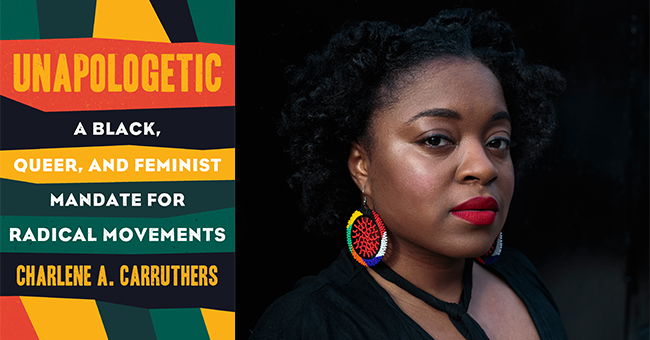
  • By Charlene Carruthers

    Charlene A. Carruthers - Unapologetic

    Unapologetic is an offering to our ancestors, my family, our movement, and the generations who will hold the struggle for Black liberation to come. I began writing this book over five years ago as a personal exploration of freedom, liberation, and movement building. Much like my life in general, where I landed in the book is both far away from and close to where I began. I was born and raised on the South Side of Chicago to parents whose own parents migrated from the Deep South. Their ways of talking, eating, and dealing with life still live in my body and in the choices I make.

    I left home at eighteen and spent nearly ten years exploring the United States and the world. As much as Chicago made me, the world has raised me. Whether my work took me to Murfreesboro, Tennessee, to door-knock and gain support for comprehensive health-care reform or to Haiti to learn how to support nation-building efforts, I learned that change was not only possible, it was inevitable. I also learned that the change needed for my people has only come because we insisted on it. Frederick Douglass famously observed that “power concedes nothing without a demand.” I believe that we must go further and say that power concedes nothing without an organized demand.

    Growing up in Chicago taught me about power even before I could define what it meant for my mother, my family, and myself as a little Black girl. My earliest memories about power come from the visits I took with my mother to the public aid office. I remember walking into a nondescript brown building on Root Street where we would enter a room full of Black and Brown women. Most of the women had children with them and, like my mother, were there to secure food stamps or cash to support their families. The room was colorful and always noisy. We would walk up to the front desk, which was placed on high, and even then the symbolism of this was evident to me, and I found the arrangement uncomfortable and odd. I also didn’t understand why we had to wait in a room all day for a conversation of no more than fifteen minutes with a caseworker. I didn’t understand why the caseworker asked my mother invasive questions about my very present father. I didn’t know the government viewed Black fathers as a barrier to need and Black mothers as unworthy of dignified treatment.

    Those childhood visits to the welfare office with its fluorescent lights, along with experiences of growing up in Back of the Yards, Woodlawn, and Gage Park, stuck inside me as I began to learn about community organizing. But it was a visit to South Africa at the age of eighteen that blew my mind and was a watershed moment. As a young Black woman from the racially segregated city of Chicago, I had little understanding of what apartheid meant in a global sense. But unlike the hours of documentaries I watched about the US civil rights and Black Power movements as a child, that experience affected me viscerally and sparked my commitment to improving the conditions of oppressed people worldwide.

    Reflecting back, in college, where I should have been exposed to books and materials about the Black radical tradition, I didn’t have the language I now have to understand oppression based on race, class, and gender identity. I didn’t have the words to explain why Black students had access to vastly different educational environments depending on their zip code. I surely did not understand why Blackness was most often talked about in the media as monolithic, why identities and experiences that most closely fit the dominant culture were praised, and why anyone on the margins of gender and sexuality was criminalized, degraded, or rendered invisible.

    Under the guidance of Dr. Venus Evans Winters, I read sociological texts that matched my personal experiences of racism, housing segregation, and policing that helped bring global anti-Blackness, patriarchy, and capitalism into focus so I could fit the pieces together. History courses exposed me to the role of the “race women” who, at the turn of the century, practiced Black activism in the South after the disenfranchisement of Black men. I was hooked on racial justice and started to understand the expansive nature of Blackness and what it meant worldwide.

    People in social justice movements taught me to think more expansively about Black freedom and collective liberation. Sitting at the feet of reproductive justice leaders, queer and transgender leaders, and elders and hearing their stories taught me what I didn’t learn as a college student. Being in movement work taught me how to take information, put it into context, and produce my own knowledge to understand current conditions and to create a vision for the future. Movement work put the histories of Black feminist and LGBTQ movements on my radar. In political education sessions, I learned about anti-Blackness.

    Unapologetic is based on centuries of such information and context created by people committed to collective liberation. Black abolitionists, race women and men, nationalists, communists, socialists, feminists, theologians, and queer and transgender liberationists have built the foundation for what must be done today. our movement taught me the value of study, rigorous thinking, and discipline to take action. Thanks to the movement, I know what actions are necessary and why we must take action. The movement taught me that work for justice has always been done and that my generation has a responsibility to carry the struggle for liberation forward. And the movement taught me the necessity of showing up for all oppressed people.

    I am one of many who have taken up that responsibility in my generation. Since 2013, I have steered the growth and development of BYP100 (Black Youth Project 100), one of the most prolific and integral Black liberation movement organizations of the twenty-first century. Our team is full of brilliant liberationists who believe that a Black freedom movement is possible in our lifetime and that it must be Black, queer, and feminist. Following the vision of BYP100 leader Fresco Steez, we made it cool and relevant to be “unapologetically Black.” It was not popular to build an all-Black activist organization or common for a membership-based organization such as ours to be led by young, Black women and LGBTQ folks, but we did it anyway.

    We intended that the organization’s chapters be its lifeblood, but even with our best efforts, we didn’t always get it right. As the sole staff member during the first year, I also helped build the Chicago chapter from the ground alongside Jasson Perez, Rose Afriyie, Asha Ransby-Sporn, Janae Bonsu, and Johnae Strong, who soon expanded their roles to become national leaders in the organization. As BYP100 developed, our roles grew and lines blurred. My efforts were split—with half in Chicago and the other half in the national organization. Sometimes it felt I couldn’t do justice to either effort, and sometimes I longed to focus on local organizing. Still, I recognized that much of our strength came from the varying perspectives and landscapes throughout the country. So, when I was not developing the Chicago chapter leadership, I traveled to support the building of chapters in New York City, Philadelphia, the San Francisco Bay Area, and Washington, DC. With little money at the beginning, I often slept on couches. I wasn’t a typical executive director in that I did at least as much work building chapters as I did fundraising and doing media work. It was hard to know if I always made the right call in how I spent my time, but I believe that our influence will continue to be felt for years to come. BYP100 is a part of our generation’s vanguard, and I feel blessed by our ancestors to be among its leaders.

    In today’s struggle for Black liberation, I have been a witness to grave injustices against our people. Because we are not yet free, I continue to put my body on the line in Black-led uprisings and rebellions across the United States of a scale not seen since the 1960s and 1970s. Because of my experiences and what I know of history, I carry the knowledge and traumas of Black insurgency into the twenty-first century.

    My journey has been mentally, physically, emotionally, and spiritually challenging. I’ve doubted my leadership and abilities on several occasions. When it would have been easy to boast, I remained quiet and worked. Where it would have been easy to fire back publicly against character attacks, I shared my anger and remorse with a circle of trusted comrades who are now family. Since then, though, I’ve learned that grace is an insufficient response to injustice. In the past, on occasion, I have been afraid to speak for fear of being too aggressive and taking up too much space. Unapologetic is a public declaration that I am no longer afraid to say what must be said and that our movement has a mandate that will not be silenced or disappeared.

    Unapologetic exists at the crossroads of retrospection and vision. It is a testament to my own and our collective past and present, as well as a look to the future. It is a work of history, theory, practice, and vision. Use it to help expand your understanding of the Black radical tradition. Use its examples of community organizing and intellectual labor to answer old questions and ask new ones. For me, completing this book was a risk worth taking. I wanted to bear witness and to state clearly a mandate for what must be done in our movement today. Unapologetic contains histories that help tell a more complete story of the Black radical tradition. It is also a call for commitment, a call for action, a call for us all to be transformed, dismantling what doesn’t serve our collective work, and for contemporary examples that illuminate how this generation of Black activists is carrying forth the Black radical tradition.

    I don’t expect my work to end here, with these pages. Whether your work begins or continues after digesting this, my greatest hope is that of any good organizer. I hope it shakes you, agitates you, and leaves you uncomfortable enough to take revolutionary action for the sake of our collective liberation. If I succeed in that, then I’ll be deeply grateful and consider this labor of love and commitment a job well done.


    About the Author 

    One of America’s most influential activists, Charlene A. Carruthers has spent over a decade developing leaders as an effective strategist, community organizer, and educator. She is a Black lesbian feminist and founding national director of the BYP100 (Black Youth Project 100), a leading organization of young activists in the movement for Black liberation. Her work has been featured in outlets including the Nation, NBC News, BBC News, Huffington Post, the New Yorker, Al Jazeera, Ebony, USA Today, and the Washington Post. Carruthers was born, raised, and still resides on the South Side of Chicago. Follow her on Twitter at @CharleneCac and visit her website.

  • A Q&A with Mark Warren, Jitu Brown, Zakiya Sankara-Jabar, and Jonathan Stith

    Lift Us Up Don't Push Us Out

    Students of color and their parents, community organizers, and educators have been fighting systemic racism in schools by creating a new intersectional educational justice movement. Their movement also addresses immigration, LGBTQ rights, labor rights, and the school-to-prison pipeline. Their stories of resistance are collected in Lift Us Up, Don’t Push Us Out!: Voices from the Front Lines of the Educational Justice Movement. Written by Mark Warren with David Goodman, Lift Us Up! will outrage, inform, and mobilize parents, educators, and concerned citizens about what is wrong in American schools today and how activists are fighting for and achieving change. Our blog editor Christian Coleman caught up with Warren and three of the contributors to the book—Jitu Brown, Zakiya Sankara-Jabar, and Jonathan Stith—to ask what they feel is the most important thing the educational justice movement needs to do and other questions.

    This is the second part of the roundtable post. Read part one.

    Listen to the full roundtable discussion here: Lift Us Up Session

    Christian Coleman: What do you believe is one important thing your group or alliance has accomplished?

    Mark Warren: Unlike the other people in the book, I am not exactly in a group or an alliance, so let me just say something about what I believe that I have accomplished or tried to accomplish as an education researcher. That is, to create a different way of thinking about how we are going to transform the education that our young people receive, particularly youth of color in our urban and rural communities. I believe that the current way that education researchers and the education policy world approaches this is broken. It’s a top-down method that just focuses on technical changes or organizational changes, the kind of curriculum are we teaching. It doesn’t get at the systemic racism that our young people are facing in our schools. The school-to-prison pipeline is a very good, essential example of that. I believe that the only way we’re really going to be able to change what’s going on in our schools—and not just try to improve them a little bit here or there but actually transform the education that our young people receive—is with a ground-up strategy. Because I believe that the failures of our educational system are part of the disempowerment in communities of color, the broken relationships with young people, with parents. To change that, we have to organize from the ground-up so that our policy solutions and our policy approaches come from working with people who are the most affected by educational injustice, and not trying to impose something in a top-down way on them. I won’t go into all the examples, but I think the book is filled with examples and we’ll have some of them here, showing what parents and young people and communities have been able to achieve by organizing themselves to build power, and to form larger alliances with educators, advocates, and others to create the kind of change we need in our communities and our schools.

    Jitu Brown: There is so much that I’m proud of that Journey for Justice Alliance (J4J) has accomplished. We’ve got a lot more to do. I think if I had to point to one thing, I would say that J4J has brought together some of the most brilliant black organizing minds in the country, and that people have actually won real tangible victories. Because of that, I think J4J has really impacted the education justice organizing world by helping to create and push the notion of sustainable community schools, by impacting the language that we use, impacting the NAACP and inspiring them to call for a moratorium on school privatization. I think that J4J has really brought together many of the people that are directly impacted to say that we can solve these problems ourselves, and we’re stronger than we often think we are. 

    Zakiya Sankara-Jabar: I’ll start with the most recent victory, which I think is huge for Racial Justice NOW!, which is the story that I talk about in the book. Racial Justice NOW! was the organization I co-founded about eight years ago. The most recent victory was a statewide moratorium on suspensions and expulsions for Pre-K through third grade students that we had been organizing and working on for about six years. I feel it’s important because I know that other states have done it. I know that other communities on the coast have done it years ago, but this one is particularly important to me, because we did this in a very conservative state like Ohio, with two conservative legislators and a Republican Governor signing the bill. I don’t know if that’s the case in other places.

    These were black parents, poor, working-class black parents, working directly with the Republican legislator, Peggy Lehner, for years. We didn’t know whether we could trust her, but she was our representative. Who else were we going to talk to? She was the Chair of the Senate Education Committee. We had to talk to these people at some point if we wanted to change some policies. What’s important about that relationship is that she really listened to us. She took our feedback, but not only that; we pushed other organizations in the state, like ACLU of Ohio, Children's Defense Fund in Ohio—all of these other advocacy groups who have been there for years, who were afraid to push the envelope and ask for what the parents really needed.

    We’re not advocating on behalf of ourselves; we’re advocating for ourselves. When we sit in those rooms and in those meetings at the Ohio legislature, we just said what we wanted. We said, “This is what we need.” Now, did we get everything that we needed? No, because that’s what happens in the negotiation process. But I do think that is going to definitely save some lives of some young people, black students in particular. Black students are still the most suspended and expelled around the state. I’m most proud of that most recent victory, because it's a statewide victory. Again, it was led by poor and working class black parents in Dayton, Ohio.

    Jonathan Stith: I think one of the things we can look at—and we talk about in Chapter One—is that for many, the idea of a school-to-prison pipeline did not exist, and so now it is almost common language and an accepted reality that black and brown young people face discriminatory discipline. It came at the death of Trayvon Martin before the Obama administration really talked about it to try to move the conversation forward. Now we’ve been able to stop suspensions in the long scale. The number of suspensions have gone down, but the racial disparity remains the same. That, I think for us, beginning to look at what is the next set of work that needs to happen to really get at the root of racial justice in schools. That’s part of a thread in the book, and it runs through all of our experiences. I think for the Alliance for Educational Justice, I’m looking at the assault at Spring Valley, and how the Alliance has moved into action, and then what it’s creating on the back end in terms of how this movement is pushing for police-free schools.

    CC: In your view, what is the most important thing the educational justice movement needs to do?

    MW: I think that there are a lot of things that social justice movements need to do. It’s obviously not only what the movement does, but how those in power choose to respond to the movement, oppressing it or opposing it as opposed to working with it. I will say that I think one of the big challenges that we face is connecting the work that we are doing to transform public education with the struggles that people are leading for immigrant rights, for LGBTQ rights, for housing, for economic development. The problems that we’re facing in schools are systemic problems in our larger society that are connected to poverty and racism, and we're not going to change that only by targeting schools. We like to say that it can’t just be a Route-One issue, because people don’t live single-issue lives. Young people are affected by what’s going on in the economic status of their families, in the environmental pollution of their communities, as well as being oppressed in schools. A challenge for all of our movements right now, particularly in the Trump era, is to find ways to connect with each other. We do address this quite centrally in the book, and we have folks who are thinking about it from a point of view of the labor movement. How does the labor movement need to support the educational justice movement, and vice-versa. We do believe that in many ways, education lies at the intersection of a lot of these forms of oppression. It centers the lives of youth of color and low-income communities. Education is not just an issue; it’s fundamental to democracy, to the liberation of peoples, going back to the struggles of slaves for the right to learn to read and write. We do believe this is key to our future, what happens in our schools, not narrowly be thought about, but in a bigger way. Will young people end up as cogs in a corporate machine? Will they be fodder for prison? Or will they be our next generation of social justice warriors?

    JB: First, I want to acknowledge what we’ve already done. We have, to a large degree, stopped working in our silos. For example, Jonathan and I have worked together since 2007, 2008. Zakiya and I worked together. All of us worked together. We are all allies. I think that we are actually building campaigns that go across issues. I think we need to continue to do work like that. To make it plain, we need to kill the privatization movement, and we kill the privatization movement by advancing our vision, advancing our vision through organizing wins. Not just what we’re against, but what we’re for. I believe that the movement is picking up steam. We’re winning more and more significant victories. I think what Zakiya mentioned gives you a sense of how powerful the worker has been—that in a state like Ohio, which historically has no love for people that look like us, they were able to move a Republican-elected official to actually pass something so significant. There are stories like that happening all over the country. One of the things we’ve been able to do is make sure people around the country know that we’re winning in different places. That has inspired people to wage the fight. Something that’s happening now, is we’re starting to hear on a regular basis the connection between school privatization, the loss of affordable housing, and the removal of black people from urban spaces. That’s becoming a regular part of our messaging. That’s important as we begin to organize across issues.

    ZSJ: I definitely think that a lot of our movements in this country are often siloed. I think there should definitely be more of a supportive ecosystem around all the different movements in a place where we can find our important intersections of common interests, and begin to work in those particular lanes together. I definitely think that there should be some kind of coming together of these movements, and especially around displacement and gentrification and housing, affordable housing. All of that impacts education. To Jitu’s point regarding killing the privatization movement: I believe the privatization movement is just another iteration of white domination and white supremacy. I think our goal is to kill white supremacy and white domination and capitalism. I mean, you know that’s pie-in-the-sky, but I think that still needs to be within our vision. Because we’ve had movements in the past, we’re the next iteration of picking up the mantel, so to speak, from the human rights and Civil Rights movement, and continuing to push toward that goal of liberation. That’s my goal: ultimate liberation from oppression.

    JS: I think the education justice movement needs to read and study this book. Use it as a handbook to guide your struggle moving forward. I would like it to be seen or be used in the same spirit of Michelle Alexander’s The New Jim Crow, for education organizers, so that we can understand the educational struggle, particularly for black folks and people of African descent. When this country started, when we first got here under penalty of death, lead to now that it is, it leads into that story, and it’s a roadmap of where we left off and where we’re supposed to pick up this struggle should advance from. I think we’ll have to fight the forces that will privatize our schools or turn them into prisons. Like Jitu and Zakiya, I think they are the same forces, and that there is a fight ahead. For us, beginning to advance this idea of overthrowing the notion that society shapes the school. All of the problems that we see in the larger society are of schools. Our revolution is to flip that, transforming schools that can then transform society. 


    About the Speakers

    Mark R. Warren is professor of public policy and public affairs at the University of Massachusetts, Boston, and the founder and cochair of the Urban Research-Based Action Network. The author of three books, including most recently A Match on Dry Grass: Community Organizing as a Catalyst for School Reform, Warren studies and works with community and youth organizing groups seeking to promote equity and justice in education.

    Jitu Brown is a community organizer for the Kenwood Oakland Community Organization in Chicago. He is cofounder and national director of the Journey for Justice Alliance. 

    Zakiya Sankara-Jabar is cofounder and former executive director of Racial Justice NOW! in Dayton, Ohio. She is the national field organizer for the Dignity in Schools Campaign.

    Jonathan Stith is national director of the Alliance for Educational Justice. He is the father of three young people who went to public schools in Washington, DC.

  • A Q&A with Mark Warren, Jitu Brown, Zakiya Sankara-Jabar, and Jonathan Stith

    Lift Us Up Don't Push Us Out

    Students of color and their parents, community organizers, and educators have been fighting systemic racism in schools by creating a new intersectional educational justice movement. Their movement also addresses immigration, LGBTQ rights, labor rights, and the school-to-prison pipeline. Their stories of resistance are collected in Lift Us Up, Don’t Push Us Out!: Voices from the Front Lines of the Educational Justice Movement. Written by Mark Warren with David Goodman, Lift Us Up! will outrage, inform, and mobilize parents, educators, and concerned citizens about what is wrong in American schools today and how activists are fighting for and achieving change. Our blog editor Christian Coleman caught up with Warren and three of the contributors to the book—Jitu Brown, Zakiya Sankara-Jabar, and Jonathan Stith—to ask about the inspiration behind the collection and more.

    This is the first part of the roundtable post. Read part two.

    Listen to the full roundtable discussion here: Lift Us Up Session

    Christian Coleman: Why did you feel it was important to put this book together?

    Mark Warren: I’ve been working, studying, and working with community organizing groups, working with parents and youth of color and communities, low-income communities across the country, for many years. I felt the work that parents and young people in communities are doing to fight for educational equity and justice was important. Over the past ten years or so, I saw that local organizing groups were now coming together in new ways to form much more of a larger movement for educational justice. This movement was often led by people of color, as are represented in the book, but that most people don’t know about this movement, and in many ways, different parts of the movement aren’t always as connected to each other as they could be. Putting this book together was a chance to work with amazing organizers, education activists, and other kinds of movement builders to help them tell their stories of how they’re working to build a movement, present some of their hard analysis of systemic racism in our schools, lift up successful strategies they’ve been using, and organizing efforts, and tell these stories and bring this out to a national audience. It was also the opportunity for different parts of the movement to be represented all together in one book. We have organizers, teacher activists, teachers from other movements like the LGBTQ movement, who are working with youth of color, LGBTQ youth of color, and others to build a new movement for educational justice. I feel that this movement has to be brought to light so that people can understand why we need a movement led by people of color to really fight for educational equity and justice in this country.

    Jitu Brown:  I think Mark has done excellent work in the past, helping to shine light on work that people have done for educational justice. I think there’s a level of trust for who the messenger would be. There’s an old proverb that says, “Until lions have their own historians, the story of the hunt will be told by the hunter.” I think it’s really important to take every opportunity to share what the state of public education looks like through our lens. Often, people make policy systems based on racist assumptions and opinions of other groups, as opposed to people’s real-lived experience. I think that’s really the reason I feel it’s important to make sure we’re taking every opportunity to share our perspective and to put our worldview out in the public.

    Zakiya Sankara-Jabar: I felt it was important to contribute a story, particularly from black parents’ perspective. For me, I came to this work really organically, responding to my son at the time who was being pushed out of preschool. Just as a response, pushing back, not accepting the narrative that the school system was providing regarding my son, asking questions, but not only that, taking it a step further to engage other black parents in that same space, to ask them the same question, “Are you having this experience?” When I realized that it wasn’t just me and this was much bigger and had been happening for decades in this country, I felt the need to start an organization to continue to organize our particular community, the parents, to push back on the cradle-to-prison pipeline, and make sure that black parents knew they had a voice, that they had a right to speak up, that they had a right to ask questions, and that they had a right not accept what the school system was saying about our children.

    Jonathan Stith: I think it was important to tell the story of young people, particularly black and brown youth, and what they’ve been experiencing in their schools, and how they have sought to organize themselves to fight for assistance to reach the highest level in influencing federal policy. This felt like the moment to document our struggle up to this point so that we can learn from it and so that others can learn from it as well. The book harvests the fruits of about a decade—maybe a decade and a half—of education organizing.

    CC: How did you get involved with educational justice?

    MW: I’m primarily a scholar and I’m a professor and a writer, but at the same time, I would say that I also consider myself an activist and an organizer for educational justice. My own story starts from growing up in an all-white, segregated, blue-collar family and community in Springfield, Massachusetts. In that family, my father, who was a big influence on me, was a union activist in the Teamsters Union, and really taught me that working people had to fight for their rights if we were ever going to make any real gains for our families and our communities. Unusually, for a white, working-class man at that time, he was also an anti-racist. He was a very clear supporter of the Civil Rights Movement, and raised me to believe that working people of all races had to find a way to work with each other and support each other, and create a larger movement for freedom and justice. Those are the values I took with me into my life. I actually did work as a community and labor organizer for many years. Then when I went back to school and got my PhD to become a professor and a scholar, I wanted to use my privileges, my skills, and my position to help support the movement that I saw happening for educational justice in communities across the country.

    On a personal note, I’m also a father. I’m married to a black woman, so my children are black, bi-racial girls. I had the personal experience of seeing them and their friends face racism in school, and particularly harsh discipline, the school-to-prison pipeline has impacted many of their friends. I think that has also strengthened my commitment to really finding ways to work with people. Not to be a scholar above people, but to go out into communities and work with people to help them build a movement. I consider myself part of a larger, educational justice movement, and I’m always encouraging other young scholars to think of themselves that way.

    JB: It’s a winding, twisted tale, so I’ll make it short. I was in the music industry and was on PolyGram Records and had done a promotional visit to a school and was challenged by a young person, basically saying that everything I was saying sounded good, but he knew I wasn't coming back. I lived in a neighborhood that was beginning to gentrify. I saw a lot of issues, liquor stores on every corner of our block, and I was presented an opportunity. We were able to get a release from PolyGram Records. I was offered the opportunity to either sign with MCA Records as a solo artist, or to volunteer at the Kenwood Oakland Community Organization. For whatever reason, I made the right decision.

    I left the industry and started volunteering at this local community organization where I learned so much around the core issues that are going on in our community, and also real strategies to make change. That it really wasn't about finding a leader, it was about creating the spaces where the people can be their own leader. That first experience with youth changed my life. It gave me a sense of purpose.

    I worked with young people. My first organizing victory that I was a part of was working with students to hold a grocery store accountable for the conditions. This was in 1993. I couldn’t believe that a group of students could make a grocery store that’d been in our community since the 1940s clean their act up, but we did. I was sold. This is what I wanted to do. This work has done everything from teach me discipline, teach me humility through messing up, to also helping me develop a sense of what I can really contribute by winning some things, and building my sense of myself as a man. I owe everything to the struggle.

    ZSJ: I entered as an organizer, not through any formal training or anything like that, but again, really out of being directly impacted by the system as a parent. Similar to Jitu, I’ve learned a lot from organizing black parents, particularly poor and working-class black parents. I tell people, “If you can organize in a small town like Dayton, Ohio, and win some pretty significant victories, you can organize just about anywhere.” Dayton is a very small town, really impacted by the removal of the auto plants. Many of our parents are working in the service industry, barely making it in a lot of ways. When they realize after the organizing and a couple of victories that Racial Justice NOW!, the organization I co-founded, was able to win in the local school district, many of them became galvanized and realized their own power as parents. They had been so oppressed and depressed in a lot of different ways by the ecosystem, just in the community when it comes to schools, hospitals, all kinds of other things, have just been impacted in a way where the community feels totally abandoned.

    Having those small victories helped to solidify that a small group of people who are determined and pushing back and making sure that people know we’re here and we have a voice, has been transformative for me, even as I’ve moved on to the national organization, Dignity in Schools. It has helped shape how I work with other organizers, how I work with parents, in particular, and helped me to work with other parent organizations within our membership.

    JS: I’m not going to tell you all mine, because it’s in the book and I want you all to read the chapter, so no spoiler alerts. But I will talk about the first time I discovered Ella Baker, for youth organizing and education justice and really carried that tradition. I remember we were, as a organization in the book, we talk about how I came to youth organizing. One of the after-stories around that was that as we were trying to figure out how to do these organizing meets, started to read, I’ve Got the Light of Freedom. I remember coming in excited the next day to my other co-worker. We both said to each other at the same time, “Ella Baker.” That just became the motto of what we wanted to be about in our organizing. The other side of the story was the guy who introduced it to us didn’t actually believe in youth organizing. I remember many years later, after the youth education alliance, the youth group that I used to lead in DC, had won the School Modernization Act of $2.3 billion. I got a newsletter from his organization, talking about how they had won 535 million. I kind of chuckled to myself and I was like, “Yeah, you might not believe in youth organizing, but I do, and it produced results.”


    Stay tuned for part two of this roundtable Q&A.


    About the Speakers

    Mark R. Warren is professor of public policy and public affairs at the University of Massachusetts, Boston, and the founder and cochair of the Urban Research-Based Action Network. The author of three books, including most recently A Match on Dry Grass: Community Organizing as a Catalyst for School Reform, Warren studies and works with community and youth organizing groups seeking to promote equity and justice in education.

    Jitu Brown is a community organizer for the Kenwood Oakland Community Organization in Chicago. He is cofounder and national director of the Journey for Justice Alliance. 

    Zakiya Sankara-Jabar is cofounder and former executive director of Racial Justice NOW! in Dayton, Ohio. She is the national field organizer for the Dignity in Schools Campaign.

    Jonathan Stith is national director of the Alliance for Educational Justice. He is the father of three young people who went to public schools in Washington, DC.

  • School yard

    Students across the country are returning to the classroom, and our concerns for them run deep. The Trump administration’s rampant anti-immigrant sentiment has fueled policies that separate migrant families. And it is affecting the lives of immigrant children who are going to school. What can educators do to fight against it, to become co-conspirators of resistance during our troubling times? This back-to-school season, we reached out to some of our authors to find out and share their responses with you here.

    ***

    William Ayers“I’m tempted to say we can lock arms with our students and families and declare our spaces Sanctuary Classrooms. Why not?

    But there’s something else that takes thoughtfulness, wisdom, and courage, too, and it’s something that good teachers at every level already do: we create a classroom ethos that might be called ‘learning to live together.’ It’s not a rule book nor a set of potential crimes and punishments, but rather an overarching ethic: respect yourself and respect other people; respect the world and respect the work.

    This stands in sharp contrast to the obsession with obedience, standardization, conformity, and control that characterize too many classrooms—enforced with a vengeance in schools attended by the descendants of enslaved people, immigrant children from poor countries, and First-Nations youth. Knowing and accepting one’s place on the grand pyramid of winners and losers, insiders and outsiders, becomes the core lesson in those schools, and they become places to recover from rather than experiences to carry forward. Good teachers resist.

    From the perspective of a humane or democratic nation/community, the authoritarian approach is always backward—it subverts the participatory spirit of democratic living; it disrupts community; it aims to destroy independent and free thought; and it undermines critical reasoning. Education in a free society is based on the principle that every human being is of incalculable value, that the fullest development of each is the condition for the full development of all, and that the fullest development of all is the condition for the full development of each. A vital democracy requires participation, some tolerance and acceptance of difference, independent thought, a spirit of mutuality—in other words, learning to live together. Good teachers already embody that essential value.”
    —William Ayers, “You Can’t Fire the Bad Ones!” And 18 Other Myths About Teachers, Teachers’ Unions, and Public Education


    Bettina Love photo credit Tiffany Stubbs“To be an educator who is a co-conspirator fighting against the anti-immigrant sentiment that fuels the policies separating migrant families, you have to be working in solidarity with grassroots and national organizations committed to reuniting families and helping everyone involved heal from the trauma of family separation. Children will need their trust restored in adults; co-conspirators must be trusting, patient, and honest so children can learn to trust again.”
    —Bettina L. Love, We Want to Do More Than Survive: Abolitionist Teaching and the Pursuit of Educational Freedom  


    Eileen Truax“More than ever, we need people talking about what’s happening in our country. Sometimes, educators speak about ethnicity or race in a ‘neutral’ way in order to be polite or to avoid putting a few students in the spotlight. But these times demand from every person with authority around children to make clear statements. We are all equal, but unfortunately, there are people trying to make us think we are not. We all deserve respect and solidarity, but the most vulnerable people around us—immigrants, people of color, Mexicans, Muslims—need us to take a stand for them when they’re attacked. There’s something going on that is wrong; we can work to make it right.

    It’s not difficult to share this message in classrooms, in conversations. If we create a safe narrative environment for children, they will feel comfortable sharing their fears and concerns, and maybe their stories. In my experience, nothing is stronger that a personal story from someone close to us.”
    —Eileen Truax, How Does It Feel to Be Unwanted?: Stories of Resistance and Resilience from Mexicans Living in the United States


    Mark Warren“Educators need to teach themselves, their students, and families about the history of anti-immigrant backlash in the US and help them understand the dangers of fascism. But they also need to become activists in their unions and pro-immigrant community organizations to join immigrants in the fight for an open and democratic country.”
    —Mark Warren and Roberta Udoh, “Lift Us Up, Don’t Push Us Out!”: Voices from the Front Lines of the Educational Justice Movement


    Linda K. Wertheimer“Teachers, while obligated to keep political views private, can and often do teach about current events and put them in historical context. They can ask students questions about the current immigration policy and get them to think critically about what’s ethically and morally right. They can mirror the teaching I saw about religion when I reported for my book, Faith Ed. By teaching about stereotypes of Islam and other religions, teachers I observed are aiding in the battle against religious intolerance. They succeeded by educating, not opining. They used factual information to debunk the stereotype, for example, that all Muslims come from the Middle East.”
    —Linda K. Wertheimer, Faith Ed: Teaching About Religion in an Age of Intolerance


    School yard