• A Q&A with Sherrilyn Ifill

    Ifill-blog-image

    The racial trauma of lynching, which took the lives of 5,000 African Americans between 1890 and 1960, still resonates across the United States today. In the newly revised edition of On the Courthouse Lawn: Confronting the Legacy of Lynching in the 21st Century, Sherrilyn Ifill, president and director-counsel of the NAACP Legal Defense and Educational Fund, offers concrete ways for communities with histories of racial violence to heal. A clarion call for our troubling times, this edition features a new foreword by Equal Justice Initiative founder and executive director Bryan Stevenson. It also features a new afterword in which Ifill reflects on the recent strides made throughout the country to break the silence surrounding lynching and to recognize the victims of violence. Beacon Broadside editor Christian Coleman caught up with her to chat about the book.

    Christian Coleman: Why did you feel it was important to do a revised edition of On the Courthouse Lawn?   

    Sherrilyn Ifill: Our national engagement with this history of lynching is a process, and so I think it’s important to offer new opportunities to new generations of readers who want—or maybe will discover they need—to learn more about this important part of our past.

    CC: What are some changes of our country’s attitude toward its history of lynching since the initial publication of the book? 

    SI: Thanks to the many books that were published around the same time as On the Courthouse Lawn, and due largely to the Lynching Project launched by Bryan Stevenson at the Equal Justice Initiative, there is a greater willingness, I think, to recognize lynching as a kind of seismic and defining aspect of American history and identity. Lynching is not a series of “incidents.” Lynching is a unique and powerful historical phenomenon that defined race in twentieth-century America and continues to shape our understanding of who we are as a nation.

    CC: The National Memorial for Peace and Justice and the Legacy Museum opened this April in Montgomery, Alabama, and we still have monuments honoring the Confederacy. How do we deal with this conflict of racial reconciliation and acknowledging our history? 

    SI: We deal with it by getting our hands around the truth. One of the reasons I wrote the book is because lynchings were too often delegated to the status of “ghost stories.” I wanted to provide a detailed historical account and to explore, as I do in the book, the implication of democratic institutions in abetting violent and odious acts of racial terror. So it’s truth-telling first and foremost—whether about the white supremacist foundation of the Confederacy, the lie of the “Lost Cause,” or the suppression of the history of how domestic racial terrorism shaped America in the twentieth century.

    CC: What would you like readers to take away from the book during our current administration?       

    SI: A key impetus for me in writing the book was my own effort to understand how ordinary white people—housewives and pharmacists and law students and law enforcement—could participate in, cheer on, or even just observe without intervention, the most horrifying acts of cruelty and savagery imposed on other people. I’m obsessed with the process, danger, and consequences of “othering” fellow human beings. There are profound lessons for us at this precise and dangerous moment in America to understand how this happens and how we become complicit in acts of terror. Most of all, I hope we can think more carefully about how our institutions—media, the justice system, government—must be equipped and prepared to help democratic societies forestall a descent into our worst impulses.


    About Sherrilyn Ifill 

    Noted civil rights attorney Sherrilyn Ifill is the seventh President and Director-Counsel of the NAACP Legal Defense and Educational Fund, Inc. and former professor at the University of Maryland School of Law. Ifill is a nationally recognized advocate for civil rights, voting rights, and judicial diversity. She is the author of On the Courthouse Lawn: Confronting the Legacy of Lynching in the 21st Century. Follow her on Twitter at @Sifill_LDF.

  • By Louis Roe

    Quilt pattern

    All cover art images: Louis Roe

    Now that we’re in summer’s final stretch, Beacon’s design department is busy putting together jackets for our Fall 2018 titles. Our cover designs are typically finalized about a year in advance of the on sale date for in-house and marketing purposes, so there’s finally enough emotional distance from the design process to reflect on these! Here’s a peek at a few of my favorites from this list.

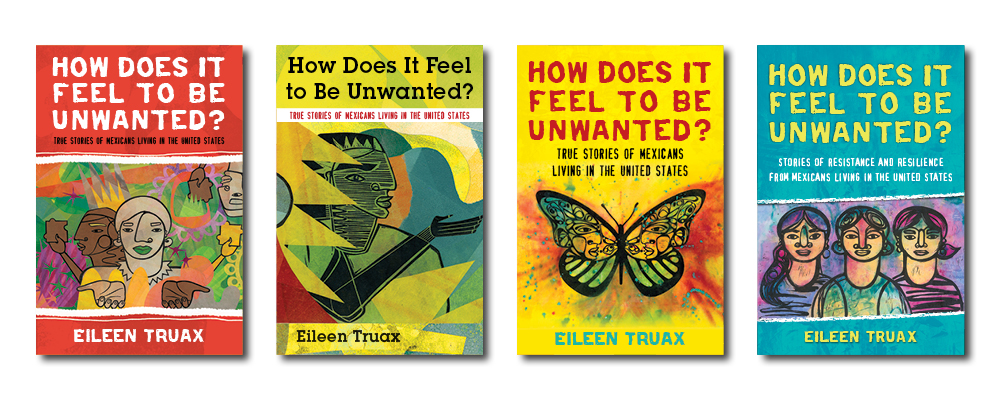
    Eileen Truax’s How Does It Feel to Be Unwanted?

    Sometimes, the best thing an author can do for a designer is hand off the manuscript and take a step back. And another. And another . . . until they’ve found a comfortable place to wait for a couple of versions to show up in an email. Certainly with an open mind, and perhaps with a glass of wine. That being said, we always invite aesthetic suggestions if the author has them, and How Does It Feel turned out to be one of those occasions when an author’s recommendation led us in just the right direction. Through community connections, Eileen Truax put us in touch with a few talented artists. The prints of Oakland-based Favianna Rodriguez stood out to me immediately as vibrant and well-suited for cover design. With a little digging, I learned that Favianna herself is a queer and Latina activist, deeply involved in advocating for sexual freedom, decolonization, and migrant rights—an excellent fit for a book sharing the stories of Mexican immigrants living in the United States.

    Big thanks to Eileen for introducing me to Favianna’s work, which continues to give me inspiration and information when immigrant detention and deportation feels like an insurmountable obstacle. 

    Cover art for How Does It Feel to Be Unwanted

    This video is a great introduction to Favianna and her art.

    Charlene A. Carruthers’s
    Unapologetic: A Black, Queer, and Feminist Mandate for Radical Movements

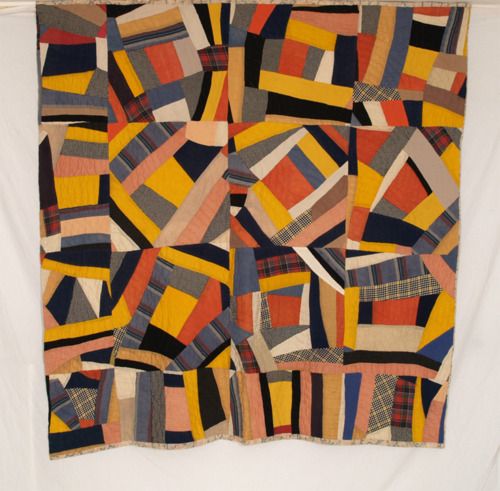
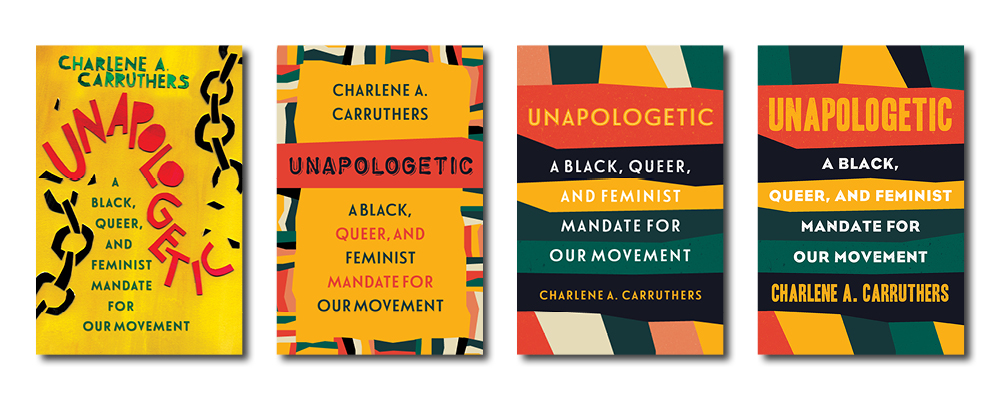
    Some cover designs call for more aesthetic research than others. In the case of Unapologetic, we knew we wanted the subtitle to do most of the work, so the visual elements would need to be something simple—like a texture or pattern—but it also needed to signal Black, queer feminism. I ended up Googling images of African American quilts for inspiration, which led me to Gee’s Bend quilts. This style of quilting emerged from a tiny, rural community in Alabama, passed from one generation of Black women to the next, and it’s characterized by its improvisational and minimalistic qualities.

    African American quilt

    I built a pattern borrowing some shapes and colors from these quilts, then played with different arrangements of text within the pattern. The final layout earned consensus with considerably more ease than the particular colors and fonts, but in the end, we were able to settle on a design that satisfied all the decision-makers’ preferences.

    Cover art for Unapologetic

    Crystal M. Fleming’s How to Be Less Stupid About Race

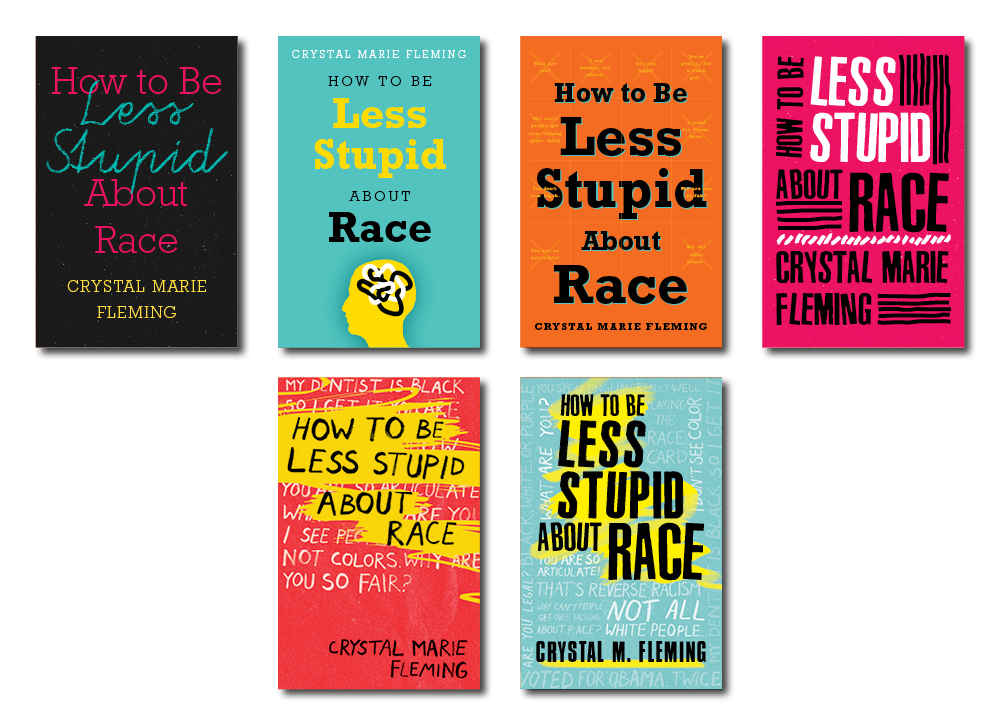
    If one book gets the award for being the most fun to work on this season, How to Be Less Stupid About Race gets the gold star. Which is lucky, because according to my save history, it took six months! Given the subject matter, though—coupled with Crystal Fleming’s fresh, no-bullshit writing style—I couldn’t help but feel excited brainstorming ideas for this cover. I also love opportunities to collaborate with my colleagues across departments, so I invited our editorial director Gayatri Patnaik and editorial assistants Maya Fernandez and Molly Velazquez-Brown to send me examples of off-handed racist comments they’d received through the years from friends and strangers alike. They sent me an enormous list. They’re phrases that someone might’ve said to you, or perhaps you might’ve said at some point. Things like:

    • My [insert random acquaintance] is black, so I get it.
    • I see people, not colors.
    • Not all white people . . .

    One of my favorite directions with these phrases was a bingo board, a play on the meme used for calling out cliché behaviors across numerous subcommunities. We ultimately moved toward a design that allowed the phrases to be more readable.

    Cover art for How to Be Less Stupid About Race

    The phrases immediately give meaning to “racial stupidity”—and whichever side of the phrase you’ve been on, there’s a good chance they’ll sound familiar. Beneath the cover is the opportunity to unpack that.


    About the Author 

    Louis Roe, Designer: Louis has been designing at Beacon Press since 2015, after graduating from Emerson College’s Writing, Literature, and Publishing program and a brief stint in content marketing. He previously interned at Wind Ridge Books in Shelburne, VT.

  • By Philip Warburg

    Billboard along State Highway 24, near the Cloud County town of Miltonvale.

    Billboard along State Highway 24, near the Cloud County town of Miltonvale. Photo credits: Philip Warburg

    Amidst all the reportage on swing states and swing districts crucial to the 2018 Congressional elections, I recently decided to buck the trend. I ventured instead to a remote community in north-central Kansas where Democrats seldom run for political office and rarely win if they do. In visiting Cloud County, I was hoping to find a few strands of hope that might span the chasm between red and blue America.

    “A strong work ethic, a strong Christian faith base, caring for each other, and taking care of our own” are the paramount values guiding life in Cloud County, according to Amy Lange, the enterprising city manager of Concordia, the county seat. Those values resonated throughout my conversations with farmers and ranchers, business leaders, and community service professionals. They are grounded in an ethos reaching back to what State Senator Elaine Bowers reverentially calls “the frontier.”

    State Senator Elaine Bowers in her office at the family-owned Concordia Auto Mart.

    State Senator Elaine Bowers in her office at the family-owned Concordia Auto Mart.

    Though the frontier vanished well over a century ago, guns are a widely accepted way of life in Cloud County and through most of Kansas. Senator Bowers, who welcomes gun-toting customers to her car dealership in Concordia, said her fellow Kansas legislators are not inclined to consider any proposals to restrict the possession of firearms. From a number of people I heard the canard that it’s people, not guns, who commit violent crimes. 

    On a woman’s right to choose, the lines are as firmly drawn. Highway billboards condemning abortion as murder set the stage for my conversations. Cabinet maker and innkeeper Duane Warkentin intoned: “God says, ‘I knew you in the womb.’ We believe those unborn babies are people.” I asked: “From the moment of conception?” He answered: “From the moment of conception.”

    Duane’s wife Cathy tried to inject some pragmatism into our discussion. “If a woman finds herself pregnant, there are so many options that are available and programs that can help.” One group she cited, Heart Choices, does pregnancy counseling in three local communities. Its website provides a list of risks attributed to abortion, including breast cancer, sepsis, perforation of the uterus, and death. There is no parallel recounting of pregnancy-related risks or the economic and psychological hardships endured by unwanted children and their mothers.

    These views were what I expected. When probing attitudes toward immigration, however, I encountered a broader range of opinions. My visit took place amidst the raging debate about separating children from parents caught illegally crossing the border. Duane Warkentin sees no problem with this treatment, likening illegal migrants to ordinary criminals. “If they are so concerned about their children,” he said, “they shouldn’t be committing crimes.” Phyllis Struble, a retired biology teacher, takes a more charitable stance. “The poor little kids! That’s what I’m worried about right now.” When asked what should be done about these children and their parents, her response was unequivocal: “Let them in!” America has long been a haven for immigrants, a tradition that she feels should continue to be honored.

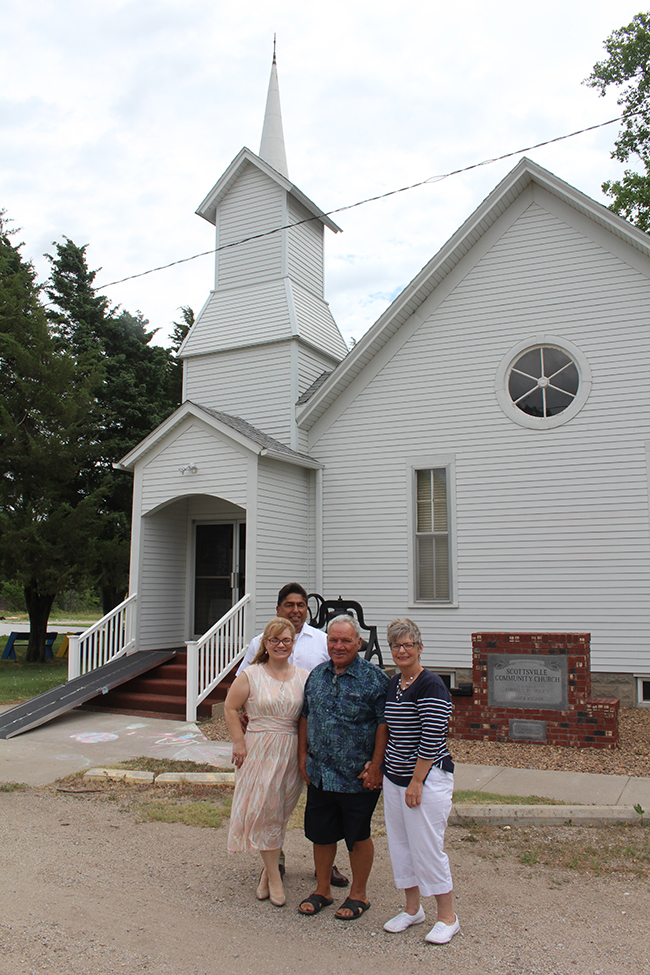
    Wayne and Cathy Warkentin, on right, with their daughter and son-in-law Crystal and Al Paredes. Al is a pastor at Scottsville Community Church

    Wayne and Cathy Warkentin, on right, with their daughter and son-in-law Crystal and Al Paredes. Al is a pastor at Scottsville Community Church.

    While I heard several voices in support of Trump’s zero-tolerance border policy, others acknowledged the gaps that immigrants fill in the Kansas labor force, including the meat-packing industry. When Tyson Foods recently began exploring the possibility of opening a chicken-processing plant in Concordia, some residents of this 95 percent white community objected to the prospect of Somali Muslims and other African immigrants settling in their midst, just as they have been drawn to other localities hosting meat-packing operations. Instead of caving to these apprehensions, City Manager Lange looked for ways to ease immigrants’ adjustment to Cloud County. Consulting with the local Sisters of St. Joseph and the community college, she received offers of help in providing support services, such as English language instruction and coaching on American social norms.

    Tyson’s plans remain uncertain, but Lange continues to be forward-looking in her search for new businesses willing to set up shop in Concordia. She prides herself on being part of “a changing of the guard” in Cloud County. Her colleagues in this new leadership cohort include Dr. Adrian Douglas, an African-American woman who is the newly appointed president of Cloud County Community College. Together they meet regularly to discuss the community’s future. “We are looking ten, twenty, fifty years down the road,” Lange told me. “What can stay the same and what is going to have to change?”

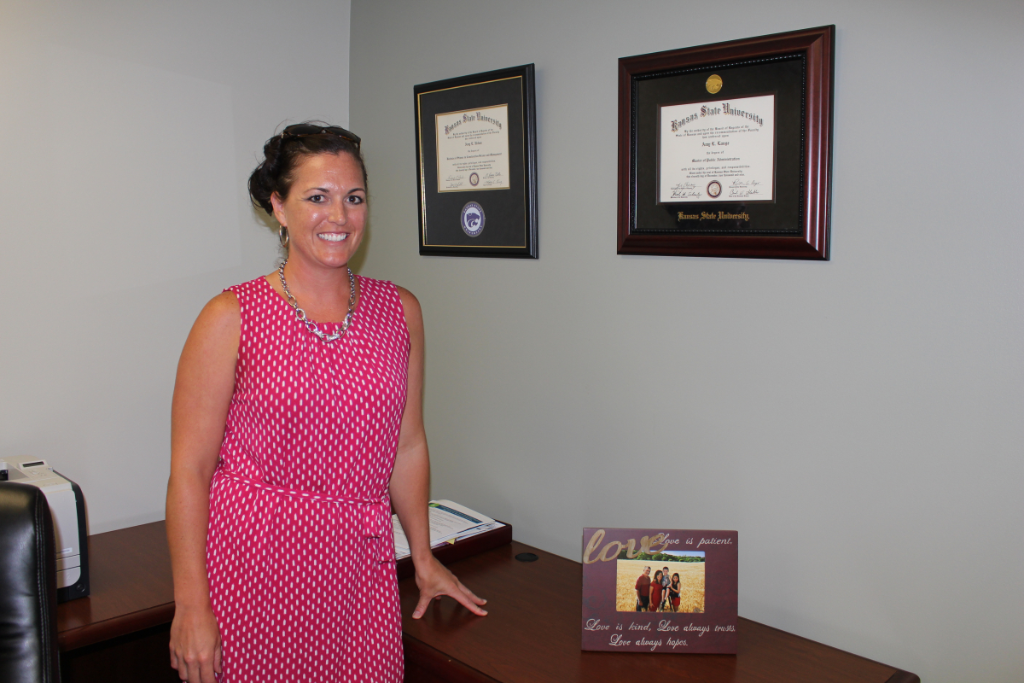
    City Manager Amy Lange, part of Cloud County’s “changing of the guard.”

    City Manager Amy Lange, part of Cloud County’s “changing of the guard.”

    One thing unlikely to change is the devout Christianity that runs through Cloud County. In that regard, I was taken aback by the pervasive readiness to overlook Donald Trump’s deplorable—yes, the word does apply here—behavior on so many fronts. “We all know that his style may be a little bit abrasive for some,” Amy Lange admitted. But his business successes inspire her confidence. Never mind about his debasement of women, his shameless philandering, his bold-faced lies, his racist slurs. Repeatedly, people reminded me that we all are sinners who can be forgiven through repentance before God. 

    Retired state court judge Tom Tuggle was more forthcoming with his misgivings about Trump’s capacity to govern. “He’s ignorant to the point of being scary with respect to our history and how our government works.”  But then he added: “He’s done and is doing some good things, albeit unorthodox.”

    In a rock-solid Republican state like Kansas, the prospects for compromise on issues like abortion and gun control are nil. Yet I came away from Cloud County wondering what other issues might allow us to break through the partisanship that is crippling common sense and dividing our nation. Would it be too huge a leap to forge a bipartisan immigration policy that respects family bonds and refrains from stigmatizing entire nations based on religion? Can we craft a shared strategy for rebuilding America’s crumbling transportation infrastructure? Is there a pathway to redeeming science-based policymaking so that we can address climate change and other pollution threats instead of sidelining them as partisan playing cards?

    These questions may gain little traction amidst all the jockeying leading up to election day. Admittedly, I too take heart in the daily flood of phone calls and emails I get from candidates on my side of the political divide. But seeking common ground is as much a part of good governance as staking out partisan claims. The health of our democracy demands as much.


    About the Author 

    Philip Warburg is a lawyer and writer who lives in Newton. He is the author of Harvest the Wind and Harness the Sun, both published by Beacon Press. Follow him on Twitter at @pwarburg.

  • Gayatri Patnaik

    In these times when readers are responding to our books “more than ever,” when our authors—such as Robin DiAngelo, Cornel West, Anita Hill, and Christopher Emdin—are appearing in the media, their ideas going viral on social media, their voices being heard on so many platforms, we thought it might be good to take a break to focus on some of the staff who work hard to find, shape, edit, produce, and promote those works. Our blog series “Beacon Behind the Books” introduces to you a member of our staff and gives you a behind-the-scenes look, department by department, at what goes on at our office.

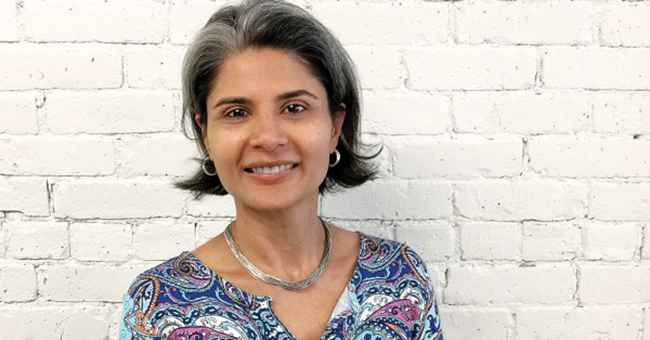
    This August, meet our editorial director, Gayatri Patnaik! 

    What drew you to publishing, Gayatri? How did you find your way to Beacon?

    I always thought I was going to be a Professor and had just finished my Masters in Cultural Anthropology from The New School for Social Research. My thesis was on the role of the Indian government in perpetuating the AIDS pandemic, and as passionate as I was about it, I wasn’t sure I wanted to make the PhD commitment. Around this time, I happened to spend time in India with my uncle, Sonny Mehta, a longtime publisher who tossed out, “Why not try an internship in publishing and see what happens?” I did, and it changed my life.

    Book publishing and anthropology are similar in that both are almost designed to get you out of your own skin . . . and both were/are for me fundamentally expansive. After trying different kinds of publishing, I realized that the best fit for me was to find a house with a social justice mission that was a hybrid of the academic and the trade, and so when I got a call many years ago from Helene Atwan, I knew I’d found my publishing home.   

    You’ve attended conferences related to your field. Tell us more about those experiences and how they add to your work.

    I love attending conferences, and one of my favorites is probably the Organization of American Historians (OAH) conference. I acquire quite a few of our history titles at Beacon and have great respect for the crucial “bottom-up” histories that our authors write. At the OAH, it’s incredibly fun to talk about our books, authors, and what makes us distinctive as a house. It sounds odd to say, but after being at Beacon all these years, it truly feels like I’m inviting guests into my home when they come into our booth!

    What upcoming projects are you excited about?

    In the next two months, we have three books coming out that I’m excited about: a luminous biography by Imani Perry called Looking for Lorraine: The Radiant and Radical Life of Lorraine Hansberry. There’s Unapologetic: A Black, Queer and Feminist Mandate for Radical Movements from the visionary Charlene A. Carruthers. And the incisive and sharp How to Be Less Stupid About Race from Crystal M. Fleming.

    What’s your advice to someone interested in entering the publishing field?

    That there are various ways of being in publishing, from being a literary agent to being a field representative, to working at a publishing house. If you decide to work at a publishing house, don’t limit yourself to editorial! Definitely find time to find out about publicity, marketing, and production as well.   

    What helps you focus when you’re at work?

    Not checking email helps, but since I usually can’t afford to do this, I’m mostly scattered during the day. But I do find time to focus at night.

    As a longtime member of the Beacon publishing team, what has changed and what has stayed the same?

    I’ve been at Beacon a shocking number of years—sixteen! One aspect that’s stayed the same is that the press attracts incredible people with a passion for social justice. One change in the last couple of years is that we’re having more conversations and more transparency about issues of race and inclusivity which, while rarely easy and sometimes awkward, is a very good thing. This is what progress looks and feels like.

    Favorite thing about Boston?

    The Minuteman Trail.

    Favorite food?

    Korean food, specifically Bi bim bop.

    Best vacation destination?

    Istanbul.

    What are you reading right now?

    There There by Tommy Orange and Circe by Madeline Miller.

    Name a couple of non-office items on your desk and their significance to you.

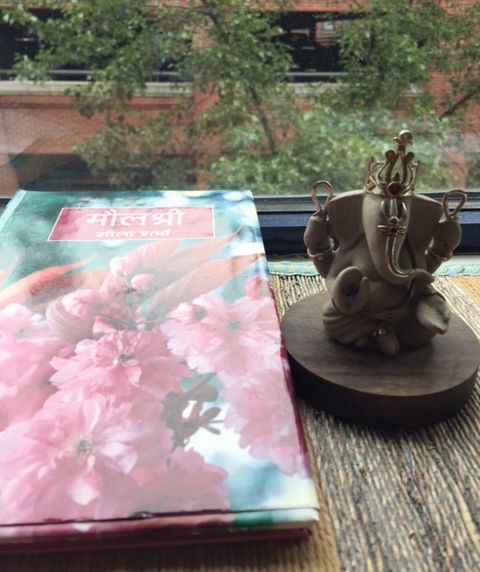
    A little statue of Ganesh that belonged to my maternal grandmother, Sheela Sharma. She was the author of over twenty books, and I have a couple of them on my bookshelf.

    Statue of Ganesh

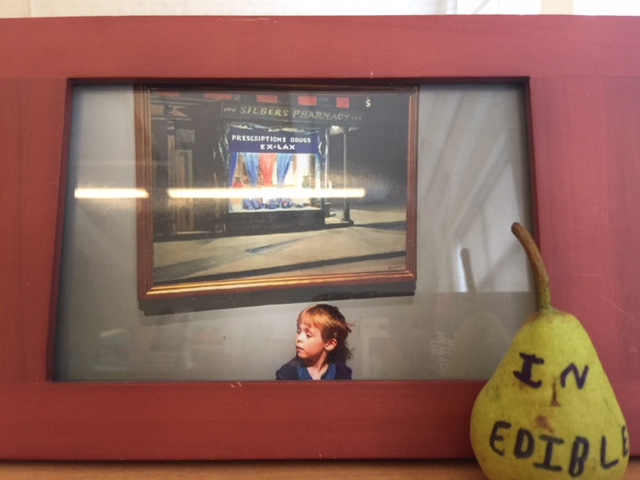
    I also have a photo of my son, Matthew, at the MFA, in front of the Hopper ‘pharmacy’ painting I’ve always loved. He recently slipped an unripe pear in my workbag on which he helpfully wrote ‘inedible’ using a permanent marker.

    Gayatri's son Matthew at the MFA

    What don’t people know about you?

    That I used to be a daredevil. Some would say reckless and they’d be right. I recently went bungee jumping and realized how much I loved it and am now looking into hang gliding. Anyone want to join me?

    Gayatri bungee jumping


    About Gayatri Patnaik 

    Previously an editor at both Palgrave Macmillan and Routledge, editorial director Gayatri Patnaik has been at Beacon Press for sixteen years and has published authors including Cornel West, Kate Bornstein, Marcus Rediker and Mary Frances Berry. She acquires in US History, with a focus on African American History and race/ethnicity/immigration, and began Beacon’s “ReVisioning American History” series. Gayatri occasionally signs memoir, began Beacon’s LGBTQ series, “Queer Action/Queer Ideas,” (edited with Michael Bronski) and developed books in “The King Legacy,” with Joanna Green, in a series about Dr. Martin Luther King, Jr. Follow her on Twitter at @gpatnaik1.

  • By Marcus Eriksen

    Plastic bottles

    Feeling confident that rolling your filled recyclables toter to the curb makes a difference? Curb your enthusiasm. It turns out that tons of the recyclables we think are getting processed into reusable materials are actually dumped in landfills, not recycling facilities. China’s ban on imported recyclable waste from our country and others only adds insult to injury. What do we do with all this waste? Especially when most of the plastics continue to pollute the oceans? In this excerpt from Marcus Eriksen’s Junk Raft: An Ocean Voyage and a Rising Tide of Activism to Fight Plastic Pollution, he shows how we need to completely rethink the way our goods are manufactured so that, in the long run, they’re made for a zero-waste economy.

    ***

    On the table were familiar objects from Kamilo Beach, Hawaii: degraded toys, bottles and caps, glow sticks, small net floats, and pieces of crates with Chinese characters on them, arranged in glass cases like museum artifacts. “Do you know this place?” Sophie asked.

    “Yeah, we’ve been there a few times,” I replied, taking a moment to look at the broken toys encrusted with byrozoans from months or years at sea. Sophie Thomas is a circular-economy design engineer and former director of the Great Recovery, based in the United Kingdom. She’s brought these plastics here to spark conversations about design.

    We were in Brussels at PolyTalk 2016, sponsored by Plastics Europe, the largest trade group of plastic producers in the European Union, akin to the American Chemistry Council in the United States. Surprisingly, the group invited its critics to the table to talk trash.

    Earlier that day, when I was on a panel, I had walked center stage and unveiled the forty-five-pound camel gastrolith from Dubai, announcing, “Here’s the result of poor design.” I heard gasps as I lifted it above my head. “And without good legislative policy to eliminate these design failures, we’re not giving smarter alternatives a level playing field to compete,” I added.

    Sophie was in the audience. Later, I asked, “So, how do you suppose you would solve this issue?”

    “Plastic pollution is really the result of an upstream design problem,” she replied. While managing the Great Recovery, she took students to London’s landfill and to old Cornish tin mines, and hosted “tear-down” events, deconstructing everyday items from washing machines to radios, bras, pens, and oil rigs to see how they’re made and how they could be made better. One shoe may include metal, wood, leather, cardboard, PVC, textile, and rubber, all fused with an indestructible glue; a laptop may have more than a hundred chemical components sourced from more than ten countries. “We’re not designing for material recovery after its second or third life,” she said.

    I think back to when I was in the Marines and we learned to disassemble an M16 in sixty seconds, an ability drilled into our heads with daily repetition. How long would it take to disassemble an iPhone?

    Sophie explained how her team of design students had salvaged from a landfill a perfectly good sofa that couldn’t be legally resold by charity organizations because the fire-safety tag had been ripped off. “That’s a design problem,” she said. “Just stamp it on the fabric.” They deconstructed that sofa in two hours, separating the poly-cotton cover from the foam stuffing, the plastic webbing from the felt padding, the polyester wadding from the cardboard support, the metal clips from the steel springs, and the burlap underlayer from the plywood frame and staples. “The labor alone cost more than the value of materials that could be salvaged,” she said, “so unwittingly, it’s designed for waste.”

    I looked down at her Kamilo Beach display. “So, you would design each of these differently?” I said. She’d set up her exhibit in the foyer outside the conference hall. She’s smartly dressed, wears her blond hair pulled back, and has blue eyes. I could imagine her scrambling across the beach collecting junk washed ashore, as Anna and I have done, or knee-deep in a landfill with her students, excavating appliances and pointing out design flaws.

    “Design for longevity and fixability, leasing over ownership, reuse before recycling, and make things easy to dismantle. That’s good design,” she replied. “We urgently need all designers to visit end-of-life facilities so they can see for themselves how their design choice is the difference between ‘waste’ or ‘material resource.’ You’ve got to plan for the endgame.”

    “But don’t those ideas fly in the face of planned obsolescence?” I asked.

    “The problem now is that you have other kinds of planned obsolescence: technological as new software and upgrades overwhelm old hardware, psychological obsolescence due to fashion (‘pink is the new blue’), and conventional design weakness, to perpetuate needing the newest, latest model,” she replied.

    Planned obsolescence drives cheap-as-possible chemistry and design, deflecting responsibility for material management and waste to the public sector. When waste-to-energy seems to be the collective corporate end-of-life plan, incentives to achieve a circular economy are undermined.

    Months after PolyTalk, I asked Rob Boogaard of Interface, Inc., about planned obsolescence. He explained that Interface’s carpet squares last fifteen years, after which the company takes them back, but it’s the fashion sense of architects that shortens their life considerably (same for clothing, as “transitional fashion” creates mountain of microfiber waste from synthetic textiles). “Our carpet square concept allows customers to replace the worn-out places, rather than tear up the whole room,” he said, suggesting that service can replace sales, lengthening the life and deferring the obsolescence of products.

    Boogaard went on to explain the importance of understanding the entire process, such as the methods of raw-material extraction, the environmental persistence and health effects of the chemistry used, the carbon footprint of transporting parts for assembly and sale, and the social justice implications along the way, such as providing workers fair wages and health care. To reduce these life-cycle impacts, Interface sources some nylon from recovered fishing nets and has a take-back program for its old carpet squares. One Interface factory in the Netherlands is operating with 100 percent renewable energy, uses virtually zero water in manufacturing processes, and has attained zero waste to landfill.

    Sophie noted, “I would pass one piece of legislation that would require all product-design plans to include a second- and third-life use. In the second-life plan, you’re asking yourself, ‘How can I make it last a long while and set up a system of reuse and recovery to get it back?’ In the third life you design for maximum material value, keeping it as high as possible because if you downgrade (like mixed or inseparable materials, or complicated disassembly) you make trash,” she said. “It’s not about being more sustainable, it’s about focusing on what the product does and how can this service be delivered more effectively.” Instead of focusing on selling light bulbs, cars, and mattresses, thinking must shift to how better to provide light, transportation, and comfortable sleep. The profit comes from meeting a customer’s need over time, instead of putting all of your effort and profit into the sale of stuff that’s designed for uselessness over time. In this way, the producer manages the material flow, planning for recovery, whether leasing cars or carpet tiles.


    About the Author 

    Marcus Eriksen is the cofounder and director of research for the 5 Gyres Institute, with firsthand experience from more than twenty ocean-crossing expeditions, and he has written and published research on the impact of plastic pollution in the world’s oceans. He is the author of My River Home: A Journey from the Gulf War to the Gulf of Mexico and Junk Raft: An Ocean Voyage and a Rising Tide of Activism to Fight Plastic Pollution. Visit his website.

  • Reading

    If you’re not diving into the ocean at the beach this season, crack open those books and dive into summer reading! Sometimes you just need a break  from the awfulness that’s inundated the news and our social feeds. So. Fiction? Nonfiction? What’s your pleasure? We asked our staff members what they’re reading and what they’d recommend. You’ll thank us later.

    ***

    Orange_El Akkad_Baker

    “I’m reading Tommy Orange’s There There, which is packed with memorable, 3D characters, covers a big swath of American history (1970s to present day), and makes me laugh and think. Deserves all the prizes and accolades. Also, a bit slow to catch up to this one, but just finished Omar El Akkad’s American War, which really took me by surprised. I don’t read science fiction as a rule, but this felt like reading a novel about the civil war and one about our current climate set in the near future. No flying cars, but malfunctioning drones. Can hardly recommend it heartily enough. Also, coming to this one very late, but Calvin Baker’s historical novel Dominion, which is a very powerful look at freed slaves in the eighteenth century leading up to the revolution. I guess I’m getting lessons in American history through different lenses. Which, of course, is what we do in nonfiction with our Revisioning American History series.”
    —Helene Atwan, Director

    Novels in Three Lines

    “I’ve read and reread Novels in Three Lines several times. Fénéon was a French anarchist and art critic and wrote anonymous filler and headlines for a French newspaper, and this book is a collection of them. Of course, now there’s a twitter feed for this content—these headlines were the original, proto-twitter micro novels.”
    —Carol Chu, Creative Director

    The Heads of Colored People“I recently finished The Heads of Colored People by Nafissa Thompson-Spires, and I absolutely loved it. Each story paints a complicated and enticing vignette of unique and often humorous characters that leave the reader surprised and anxious for more. The stories delve into contemporary everyday topics that on surface might feel minute, but our drawn out to create captivating portraits of people simply existing.”
    —Maya Fernandez, Editorial Assistant  

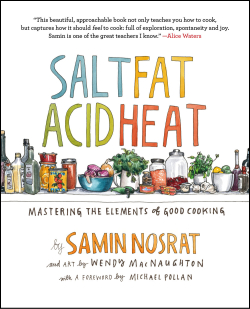
    Salt Fat Acid Heat“I’m currently obsessed with Salt, Fat, Acid, Heat: Mastering the Elements of Good Cooking by Samin Nosrat. I’m trying to become a better cook, and this is sort of the opposite of a traditional cookbook. Instead of just giving specific instructions with no explanation as to “why,” this book is all about figuring out how these four major elements of cooking work and how to use them in the smartest ways for all different types of food. Nosrat has insane cooking credentials, and her writing is super approachable and funny!”
    —Emily Powers, Associate Marketing Manager 

    Her Body and Other Parties_How to Write an Autobiographical Novel

    “Two books that blew me over this summer:

    • Her Body and Other Parties by Carmen Maria Machado: a debut collection of short stories. Some very spooky, some very sad. All very queer and excellent.
    • How to Write an Autobiographical Novel by Alexander Chee: A really lovely and thoughtful collection of essays reflecting on the little-scene emotional interior of becoming a writer, especially as a queer, biracial man during the AIDS crisis.”

    —Ayla Zuraw-Friedland, Assistant Editor

  • By Sharon Leslie Morgan

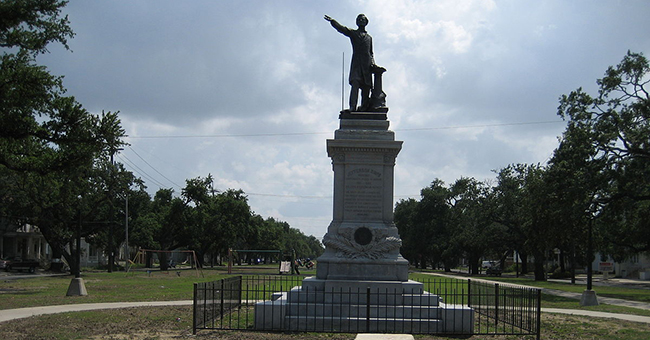
    Jefferson Davis monument

    Jefferson Davis monument. Photo credit: Infrogmation of New Orleans.

    Debates are erupting across America over statues, flags, markers, symbols, buildings, and street names that honor people, landscapes, and events of historic import. Often, the person or event being commemorated is offensive. Especially repugnant are those that celebrate “heroes” who committed extreme acts of inhumanity. Some demand that these icons be removed. Others demonstrate a willingness to fight for their retention. Which ones should stay? Which ones should go? Is there a middle ground? Who decides?

    As a genealogist, my encounters with such icons are inevitable. The southern landscapes I frequent are rife with painful reminders of enslaved ancestors who picked cotton while “Miss Anne” sipped tea on the verandah of a plantation great house. At almost every courthouse, there is a Confederate soldier standing on the front lawn, memorializing the dead in a war that never ended even after the Union triunphed. On the last Monday in April, public buildings are closed for Confederate Memorial Day, which is not a holiday I celebrate.

    When I see these icons, I cringe. I have no alternative but to shrug off my distaste and carry on. I am glad people are speaking out.

    It is welcome relief when I read of cities removing statues of men like Nathan Bedford Forrest (founder of the Ku Klux Klan), Jefferson Davis (president of the Confederacy), and J. Marion Sims (father of modern gynecology who practiced on enslaved black women). I cheered when Bree Newsome scaled a pole in 2015 to remove the Confederate flag flying over the South Carolina state house.

    In 2015, Dylann Roof massacred nine people in Charleston’s Emanuel AME church, reminding us in bloody terms that the “stars and bars” embody a symbol of intimidation and fear. In 2017 Charlottesville, a battle ensued between white nationalists and counter protestors over the removal of a statue of Robert E. Lee and the renaming of the space over which he presides as Emancipation Park. It ended with a young woman named Heather Heyer being murdered. General Lee still sits atop his horse “Traveller.”

    Juxtapose that giant rendition against the twelve-inch plaque embedded in the sidewalk of Court Square a few blocks away. It marks the auction block where human beings were bought and sold. If you’re not looking for it, it’s easy to miss beneath your feet. Signs along the trail to Richmond’s Shockoe Bottom slave market are scant and far between. The trail ends at a slavery reconciliation statue that sits under a highway bypass. To commemorate the civil rights movement, one must cross the Edmund Pettus Bridge in Selma, Alabama, named for a racist US senator who was a grand dragon of the Ku Klux Klan. And then, there is the Forks of the Road slave market in Natchez, Mississippi. Its placard at the crossroad of Liberty & Commerce fails to indicate the extreme irony of its location.

    “HIS-story” is the story of the victor. It recounts the conquests of a person who is generally white, male, heterosexual, and Christian. But what of the people who suffered and rebelled against his cruelty and oppression? Victors may be inclined to commemorate dominion, but victims surely don’t want to celebrate vanquishment.

    It is way past time for Americans to come to terms with whom and what we celebrate. You can’t just wipe out history, no matter how ugly it might be. To do so would engender a modern version of “whitewashing” that makes the egregious past easy to deny or forget. We need symbols to remind us not only from whence America came but also of what we as a collective aspire to become. Citizens must collaboratively decide what to do, and whatever happens at the grassroots level, the mission does not stop at removing flags and recalibrating statues. Books, lesson plans, and the educational system need to be redesigned so history is taught in a way that is accurate, honest, and balanced. That goes for other subjects as well.

    As Jewish people say of their holocaust: “Never forget.” That is good advice. We Americans—of  all colors and creeds—have a moral obligation to remember.


    About the Author 

    Sharon Leslie Morgan is co-author of Gather at the Table: The Healing Journey of a Daughter of Slavery and a Son of the Slave Trade (Beacon Press). She is the founder of OurBlackAncestry.com, a website devoted to African American family research.

  • Starbucks plastic cups

    Photo credit: Alvin Trusty

    In a world polluted by plastics that humankind just won’t quit, Starbucks plans on phasing out plastic straws in its 28,000 stores by 2020. Many applaud the company’s decision to do its part in reducing marine plastic pollution, even though the caffeine watering hole will be replacing the straws with sippy cup-like lids made from—you guessed it!—plastic. So how much of a dent will this make in the grand scheme of protecting our environment? We have less than two years to see the results. And what about those of the disability community who depend on straws? Did Starbucks think their decision through? We reached out to some of our authors to get a broader sense of the impact this will have on several fronts: environmental activism, consumer activism, and disability rights.

    ***

    Lennard Davis“The problem is that these decisions are made without the input of people with disabilities. When the discussion about the ecological problems of plastic straws comes up, this seems like an issue that all progressives would agree upon. But when you consider a straw a form of access or accommodation, then the problem changes. As long as we think in dubious terms of a template-like interchangeable human being who has a standardized body as the subject of laws or regulations, we will continue to have this problem. The Americans with Disabilities Act doesn’t postulate a single solution to all accommodations. It posits solutions to a variety of bodily and mental differences. If Starbucks had disability rights consultants, they would have gotten this right the first time around.”
    —Lennard Davis, Enabling Acts: The Hidden Story of How the Americans with Disabilities Act Gave the Largest US Minority Its Rights


    Marcus Eriksen“Starbucks kicking the straw habit, while only a drop in the plastic bucket, is an opportunity for engagement in the wider issue of plastic pollution impacts. Straws are one of the many ‘single-use throwaways,’ like plastic bags, Styrofoam, and microbeads, that top the list of harmful plastics. They are harmful because of their ubiquity as environmental waste and contributor to microplastic impacts, but of equal importance is the signal straws give to society that plastic used as a throwaway material is acceptable—but not anymore. While single-use throwaway plastics make up less than five percent of the world’s plastic consumption, they are the frontrunners in terms of products that pollute the environment and trash communities. To that end, Starbucks’ contribution is the tip of the iceberg.”
    —Marcus Eriksen, Junk Raft: An Ocean Voyage and a Rising Tide of Activism to Fight Plastic Pollution


    Fran Hawthorne“Sure, any effort to reduce the amount of plastic we use is helpful, overdue, and insufficient, so I’m happy to welcome Starbucks to this too-small club. Now here are some more, easy steps that Starbucks could take: Lobby every city in which it has outlets (that’s actually less than half the Earth) to ban these straws, as its hometown of Seattle has already done. Train its baristas to ask customers if they’ve brought their own thermos, or if they’re dining in and might prefer a porcelain mug, rather than assuming that all coffee-drinkers need a throwaway paper cup. And by the way, readers, this advice applies to us, too. At any restaurant we go to, our first words to our server—after ‘Hello’—could be something like: ‘No, thanks, I don’t need a straw’ or ‘Please give me a reusable mug.’”
    —Fran Hawthorne, Ethical Chic: The Inside Story of the Companies We Think We Love


    Ben Mattlin“When I first heard about the straw ban, I thought, ‘No big deal. I always carry my own bendy straws anyway.’ But then I heard a Seattle activist on the radio sarcastically say, It IS possible to drink without a straw—and I felt offended. It’s not possible for ME! Check your privilege! And I realized that these well-meaning environmentalists had completely left out the disability perspective. I’m sure no one would object to exceptions being made for those of us who ask for or need a plastic straw, but I don’t want it to become special treatment. That’s not equality. I don’t want my using a straw to become a big deal, something people gape at or ask about or frown upon. To me, if you want to ban a disposable plastic item that’s bad for sea life, why not outlaw six-pack holders?
    —Ben Mattlin, In Sickness and In Health: Love, Disability, and a Quest to Understand the Perils and Pleasures of Interabled Romance

  • By Dolly Withrow

    Valley

    “You gotta walk that lonesome valley/You gotta walk it by yourself.”
    —Woody Guthrie

    Long before time jerked me toward middle age with such haste it snatched my breath away, I looked forward to balmy evenings on our front porch. Sitting on weathered benches, my family and I faced the dirt road running past our house. Beyond the road where the heavens met a faraway hill, the setting sun fired the western sky with red and gold, intermingled with a veil of lavender-gray. We humans don’t get all bright days; we must take the gray, too, and we did.

    We gathered on that concrete porch where morning glories wound themselves around twine my grandfather had strung from the bottom banister to the upper porch. Light and shadow danced at our feet until the sun sank behind the hill and the morning glories went to sleep by closing their petals like pulling down a blind for the night. During that magical time between the last of daylight and the first of darkness, we often sang hymns, and sometimes the adults told stories. I listened and began to understand the art of narrative. Now, as a woman with a shorter future than past, I find the sight of a country road or morning glories climbing on a rusted fence can transport me back to childhood. The sounds of someone singing a hymn or telling a tall tale can once more place me on a weathered bench with the ghosts of loved ones who have been gone for a lifetime.  

    Despite my bruise-tender youth, one song affected me deeply. I still remember the words. I knew neither the songwriter nor the singer; it didn't matter. The lyrics had a message for all humans. We sang in unison, “You gotta walk that lonesome valley/You gotta walk it by yourself.” Little did I know then that when I would approach the end of my own journey, those words would echo once more in my writing.

    You see, we humans are a tough lot. We live with the knowledge that we were born to die. That’s a lot to have thrown at us, a lot to cope with, but we cope. We do it partly by avoiding the grim-gray subject of death. Instead of facing death in this country, we shove the subject back into a dim corner. After all, death is a heartbreaking, dreary business, and we don’t do it well. Subsequently, most people in their final hours bid the world goodbye in a cold hospital environment where they are hooked up to IVs. The last sounds they hear are the beeps of technology.

    On August 24, 2015, when I went to bed, I had a book and two dogs to keep me company. Lying in another bed in another place, Bill, my husband, was surrounded by kind hospice workers. In his room were Risa, our loving daughter, and her husband, Don, who, like Bill was a former Marine. As such, he remained by Bill’s side, because that’s what Marines do when one of their buddies is in trouble. Still, Bill was more alone than he had ever been. He was in a deep coma, a word from Greek, koma, meaning a deep sleep. What he still knew, if anything, no one could say. As he lay there, totally unresponsive, with his eyes open, he stared into a place that forever remains a mystery to the entire human race.

    When I turned out the bedside lamp on that Monday night, I was a married woman, and I offered up a silent prayer for my husband, as well as for our son and daughter. Being a weak, fumbling human, I asked for help, too. Dealing with death as a topic is one thing; dealing with death itself is quite another.

    The following morning, I saw Pam, our daughter-in-law, approach the kitchen door. I was ready to leave, for we were going to see Bill at Hospice Hubbard House. When she walked into the kitchen, she hugged me. I knew my husband was gone. A hospice worker had called and told her that if I wanted to see Bill before he was transported to Marshall Medical School she would be sure he was still there.          

    I said, “No, he has already left.” Woody Guthrie had it right. Bill had to walk that lonesome valley of death all alone.

    My husband had said, “I just want this to be over. I want it to end.” He was ready.

    Years earlier, a philosophy professor stood in front of the classroom where he displayed his narrow knowledge and hid his wide ignorance as all professors must do. He said something that has stuck in my mind like a thumbtack in cork. He said we don’t die until our mind tells us it’s time. I don’t know if he was right, but Bill knew it was time. I take some comfort in that.

    Remembering when I sang Guthrie’s song in the mellow light of evening and remembering when Bill began his lonesome walk, I think time is cyclical. Like reading some novels, we end at the beginning.


    About the Author 

    A retired English professor, Dolly Withrow is the author of four books, including The Confident Writer, a grammar-based college textbook. She was a professional columnist for three newspapers and read her essays on West Virginia Public Radio. She also taught for University of Iowa’s Summer Writing Festival and has won national and state writing awards.

  • A Q&A with Alan Michael Collinge

    Paid Off

    Paid Off

    TruTV premiered a new game show on July 17. On Paid Off, contestants answer trivia questions to win a prize that would be a dream come true for most of us who are dogged with higher education fees: their student loan debts are paid off! But is a game show really the best way to raise awareness about a financial crisis that continues to plague so many borrowers? Our blog editor Christian Coleman, who’s also addled with student loan debt, caught up with Alan Collinge, author of The Student Loan Scam: The Most Oppressive Debt in US History—and How We Can Fight Back, to find out.

    Christian Coleman: What do you think about this game show’s premise?

    Alan Michael Collinge: First: Let's look at the facts.

    TruTV rose to cable prominence airing shows including:

    • America’s Dumbest. This is a series which features videos of people doing very stupid things. This has expanded to include World’s Dumbest and also Dumbest Criminals. These shows all ridicule, humiliate, and degrade their subjects.
    • Storage Wars. This show celebrates auctioning off storage lockers, where the personal assets of unknown, misfortunate people are pilfered and examined for their value. The more valuable the items that were lost, the more exciting the show becomes.
    • South Beach Tow. This show puts the spotlight on people losing their vehicles and documents their reactions to this loss. Often, the towing company resorts to jacking the cars late at night and in other dramatic manners.
    • Las Vegas Jailhouse. This show documents all manner of arrestees at a Las Vegas jail. Like South Beach Tow, the show is from the perspective of the police/towing company, rather than the perspective of those losing their vehicles, or being arrested.

    This just scratches the surface of the shows on TruTV that degrade, humiliate, and exploit, all for the purpose of “entertainment.”

    The creator of this show promises the show will attempt to address the seriousness of the student debt problem at the end of the show by urging viewers to “call [their] representatives, because we need and deserve a better solution than this show.” The producer, however, explains it much differently: “We’re a comedy channel first and foremost,” said Lesley Goldman, senior vice president of development and original programming at TruTV, which often targets viewers under age thirty-five. “But we fell in love with this idea because of the unique hook of a game show taking the bite out of a student debt crisis. It seemed so incredibly innovative, relatable, and timely.” 

    Given their history of doing shows that humiliate, degrade, and demean people shamelessly, it is fair to guess that this show will be more along those lines. Any politically-correct, fifteen-second “wrapper” during the rolling credits of the show (or similar) will be greatly outweighed and overpowered by the disempowerment, discouragement, humiliation, and loss of hope that this show, by its very nature, will seed in the minds of the viewers for the other 29.75 minutes of the show. 

    Also, ingrained in the premise of the show is the notion that everyone has an obligation to repay their loans. This, frankly, is a very dubious premise at this time. In fact, I would say that if HR. 2366, at a minimum, is not passed this session, the most wise, patriotic, and sensible action anyone and indeed everyone should take is to cease paying their loans. Feeding this monster is the last thing that should happen, particularly now, as it has become so terribly threatening.

    This show reminds of a dystopian movie called The Running Man, with Arnold Schwarzenegger, where there was a game show that forced people with heart conditions to run on a treadmill. Stephen King wrote this novella in 1982. Interestingly, it took place in the future, estimated to be between 2018-2020!

    Those are my thoughts.

    CC: Natalia Abrams, founder and executive director of the nonprofit group Student Debt Crisis, gave this advice to the producers of the show: “Every step of the way, from signing up for college to paying back their loans, it’s been a confusing process. So make sure that there's some heart to this show.” Is there any advice you’d give to the producers?

    AMC: Beyond pulling themselves out of the gutter and not airing it? The show could dedicate at least five minutes in the heart of the show, not a forgettable wrapper at the end, explaining the uniquely predatory nature of these loans due to the unprecedented stripping of fundamental, even Constitutional borrowing rights, like statutes of limitations, and bankruptcy rights. The show could, on an ongoing basis, urge its viewers to push their members of Congress to, at a minimum, pass HR. 2366 and return constitutional bankruptcy rights to all student loans.

    CC: Your book The Student Loan Scam was published in 2009. What’s changed on front lines of student loan debt since then?

    AMC: The problem has grown far, far worse. When I wrote the book, we owed about $600 Billion, and the average undergraduate borrower was taking out about $15,000 in loans. Today, we owe well over $1.5 Trillion, and the average undergraduate is taking out about $39,000 in loans. The Department of Education currently profits well over $50 Billion per year from this predatory lending system, and even makes a profit on defaults.

    Just after I published The Student Loan Scam, President Obama essentially nationalized the program, to where the government (not the banks) now make interest on the loans. This (obviously) has been great for the government, but the banks are still servicing loans (i.e. collecting payments), and also still own most of the collection companies that collect on defaulted loans. This has given these entities an even stronger incentive to want loans to default, rather than remain in good stead, since they can make far more money collecting on defaulted loans (particularly through loan rehabilitation), than simply servicing healthy ones.

    Thanks to a recent Brookings study, we can now prove that the true default rate of 2004 undergrads is about 40%. Given that this class was only borrowing a third of what is being borrowed today, it is very reasonable to expect that well upwards of 50% of today’s students will wind up in default. Probably closer to 60%-70%. We also can now prove that the vast majority of people who are enrolled in income based repayment, and/or are trying for the Public Service Loan Forgiveness program will be disqualified for one reason or another. In the first round of forgiveness for PSLF, only about 7.5% of the people who thought they would get it actually will. Similarly, we now know that as of three years ago, a whopping 57% of the people in IBR had been disqualified. 

    The real devastation that this lending system has caused to people and families across the country has greatly increased since I wrote the book. Frankly, I never would have dreamed that it could have become so much worse in such a short period of time. 

    The one ray of hope that I can point to is a bipartisan bill in the House right now, HR. 2366. This bill would make student loans treated the same as all other loans in bankruptcy proceedings. Short of cancelling all student loans, this is the only legislative remedy I can identify that might solve the problem. Only with bankruptcy rights back in place can we expect the lending side to behave in good faith. While very few borrowers are likely to actually file for bankruptcy, having this right restored is absolutely critical to forcing the lending side to administer the lending program fairly. This includes the servicers, collection companies, and even the Department of Education, which frankly has become a captured agency, and a willing co-conspirator in the Student Loan Scam.

    We are pushing very hard for HR. 2366. If it is not passed this session, there is a high likelihood that we will initiate a full-on debt refusal movement. I hope that it does not come to that. 

    In the past five weeks, there have been three op-eds at three major media outlets including USA Today, the Chicago Sun Times, and Bloomberg News. All of these pieces have called unambiguously for the return of bankruptcy rights. So, the tide is turning, and people are waking up to this injustice. Even Fox News Radio did a five-part series on the bankruptcy issue, and incredibly, were surprisingly sympathetic to this argument. This is all very encouraging.

    CC: For those of us addled with student debt—and who have no intentions of competing on the show—what do you recommend that we do to alleviate this financial burden?

    AMC: I urge everyone with student loans, and anyone who pays for college out-of-pocket, to fight for HR. 2366. The Founders knew that bankruptcy rights are key to keeping a lending system fair, and prices rational. That is why they called for uniform bankruptcy laws ahead of the power to declare war and raise an army. While no one wants to file for bankruptcy, having this right back in place for the citizens is absolutely essential.  

    This is a tough battle, but everyone needs to understand that the “Golden Rule” actually works for us. We essentially “hold the gold.” Therefore, it is we who should be making the rules.


    About Alan Michael Collinge 

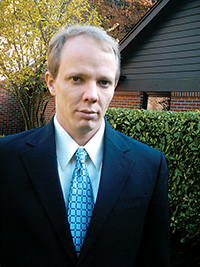
    Alan Michael CollingeAlan Michael Collinge is Founder of StudentLoanJustice.Org, a grassroots organization, and political action committee. He holds BS, MS, and Eng. Degrees in aerospace engineering from the University of Southern California. 

    Since Founding StudentLoanJustice.Org in March, 2005 as a result of his own personal experiences with college loans, Collinge has been featured on 60 Minutes, and also in print media including Fortune Magazine, the San Francisco Chronicle, The Boston Phoenix, The Village Voice, Inside Higher Ed, and others. He has published editorials in the Los Angeles Times, Baltimore Sun, Denver Post, and many other outlets. 

    Prior to founding StudentLoanJustice.Org, Collinge was Associate Scientist of Aeronautics at the California Institute of Technology, and also was regional project director for a government loan program administered by the U.S. Department of Transportation. Follow him on Twitter at @alanslj.