• By Richard Hoffman

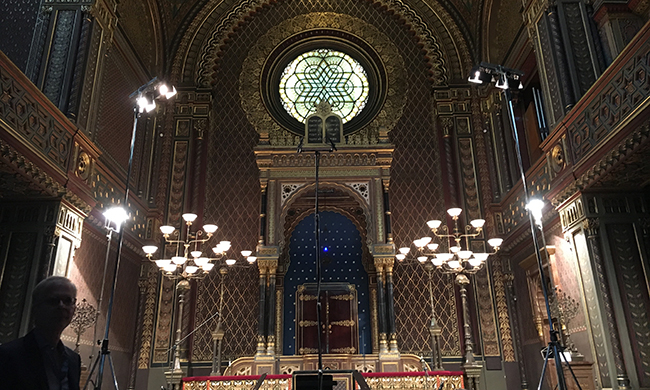
    Spanish Synagogue in Prague, Czech Republic

    Spanish Synagogue in Prague, Czech Republic. Photo credits: Richard Hoffman

    Friends ask me, “How was your trip to Prague?” and I tell them that Prague is as beautiful as everyone says. I’m thinking, as I say this, that sometimes, in a world with Instagram, Pinterest, Wikimedia, it becomes harder to experience a place, to have an unmediated encounter with it. I had been worried about that. In the weeks preceding the trip, I avoided the travel books my wife brought home from the library, resisted the temptation to let Rick Steves, via YouTube, walk me through the cobbled squares under towers and domes and historic statuary, and deliberately zoned out when friends who had been there enthused about it. I need not have worried. Prague “in person” is so richly layered and textured, no camera or travelogue could possibly have spoiled it for me.

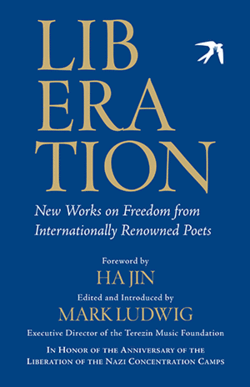
    I was there to attend the premier of a piece of music based on my poem, “Rune.” The poem is from my collection, Noon until Night, and first appeared in the anthology Liberation: New Works on Freedom from Internationally Renowned Poets, edited by Mark Ludwig and published by Beacon Press. Mark is Director of The Terezin Music Foundation, which commissioned Czech composer Jiří Gemrot to create the piece I had come to hear.

    Liberation

    I sat on a folding chair in perhaps the most beautiful space I have ever been inside. Reconstructed several times, the Spanish Synagogue occupies the foundation of the oldest synagogue in Prague. During WWII, the Nazis used it to store confiscated Jewish art and artifacts to be part of their planned “Museum of the Extinct People.” Later, under the Soviets, the building fell into ruin, and its present transcendent beauty is in fact a reconstruction begun after the Velvet Revolution of 1989.

    As the synagogue began filling with people, now and again, through the buzz of murmured conversation, I could hear the tuning of instruments somewhere in an anteroom. The concert was part of The Prague International Spring Music Festival, and I was there with the Terezin Music Foundation’s tour. I paged through the evening's program, where the poem appeared, with a Czech translation, “Runa,” beside it:

    RUNE

    A day nears, feast
    of a saint unborn,
    unlike our forebears’
    or any we have known.

    We know how dark
    are powers kept in darkness
    (a broken lock, a stopped clock,
    masks and lies.)

    When we wake
    that unexampled day
    will we believe ourselves
    free or broken?

    By the time the musicians, choir, and choirmaster had filed in, my anticipation was nearly unbearable.

    I have heard poems of mine set to music before, with mixed results. The verb “set” has always seemed to me inadequate, suggesting that the poem needed only to be lodged or placed on a stave, its words hung out like wash on the line. But I prefer to think of it as more of a translation, carrying the same opportunities and pitfalls. As with any translation, the balance is always between faithfulness to the original and the requirement to make something that works in the new language. As the poet providing the “text” for the work (the term makes me wince), I always hope the composer will work with the music that is already there.

    Although definitions of poetry are abundant and various (and limiting!), I think of a poem as a purposeful sonic structure made of words, and in that sense, it is already a song. It contains its own score, so to speak, in its rhythms, echoes, phrasings, pauses; i.e. it is written for the voice and the ear, a song sung within the parameters of the speaking voice. I always prefer, then, when a composer teases out the music he or she finds in the poem, enlarging it, making it more apparent. The ones I have liked seem to somehow illuminate the essence of the poem.

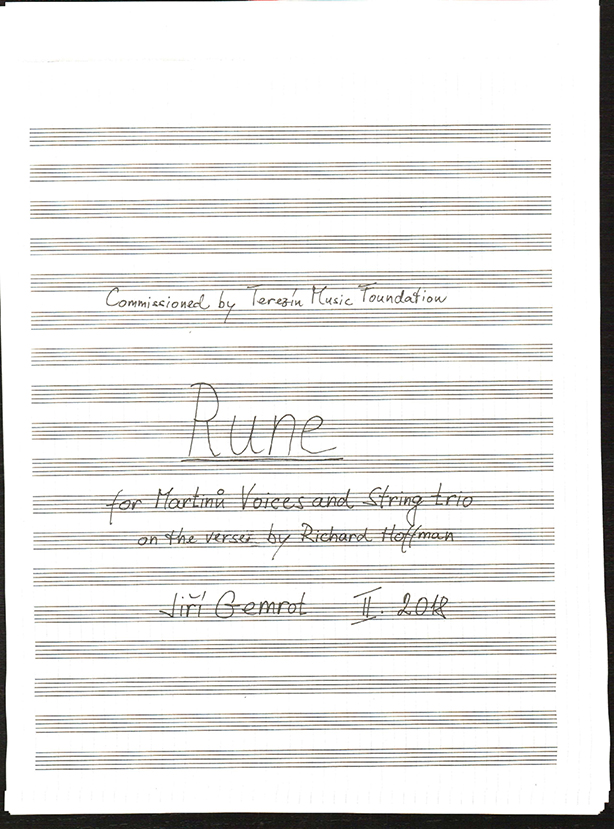
    Gemrot’s composition did exactly that—and more, much more. Beginning with a string trio, he intuited and recreated the anxiety from which the poem had arisen. From the first few phrases, I felt he had “got it.” When the voices entered, at first I heard only the vowels, but as the tenors repeated the lines sung by the sopranos, I was soon deeper in the poem even than I had been writing it, when I was struggling to understand what was emerging on the page.

    Cover page of Rune by Jiří Gemrot

    The poem is in a somewhat fatigued, plaintive voice verging, perhaps, on despair. The music captured that distress and found enough beauty there to almost but not quite resolve the poem’s question. I had conceived “Rune” as the utterance of a solitary I speaking on behalf of a we. Sung by a choir of some thirty voices, however, it became the voice of that we and affected me profoundly. I experienced a strange distortion of time, somewhat like déjà vu; something opened and then deepened in me as I listened there, in what is truly a sacred space, by which I mean one in which transformation seems possible, in which the world as it is ceases its tyranny, loses for a moment its intractability, and offers an opening, or at least a new vista. Not every instance of déjà vu is merely a hiccup in the hippocampus. In fact, the poem was transformed there in that space, in the voices of the Martinů Voices, via the genius of the composer. The poem now understood itself, and I, the poet, with it . . . 

    . . . so that the rest of that week in Prague, Gemrot’s grave music haunting me, I came to an ever deeper appreciation of the question the poem asks: crossing Charles Bridge, stopping to look at the statues of spiritual and political martyrs; walking in Wenceslas Square and thinking about how in 1968, in the space of months, the freedom of music and dancing became the brokenness of tanks and murder; touring the castle where powers were kept in darkness and St. Vitus Cathedral where the Bohemian Crown Jewels are protected by seven locks and seven keys; even noting that the Prague Orloj, the ancient astronomical clock atop the Old Town Hall, was broken. Most devastating, however, was the day we spent at Terezin, where the Nazis’ “masks and lies” concealed from the rest of the world the reality of the holocaust, dressing atrocity in art, including poetry and music. The poem belonged here. In Prague. I had written it, but it was no longer mine.

    All I wanted after the concert was to meet the composer. I saw him slip through a side door of the sanctuary with a few people, and when I caught up with him there, in a cramped little sacristy, he was with his daughter and two young grandsons, one wearing headphones to listen to a recording of the concert made by Czech Radio. I introduced myself and we embraced. I only meant to say, “Thank you,” but I kept shaking his hand, clasping it in both of mine, trying to say at least some of what I’ve been trying to articulate here.

    Poets often say that they don’t know where their poems come from, at least certain poems that seem to write themselves. “Rune” was one of those. But now, thanks to composer Jiří Gemrot, to the Martinů Voices, to choirmaster Lukáš Vasilek, and of course to Mark Ludwig, I know where it came from. It came from Prague. And that evening, in a beautiful building defiantly rebuilt, it was home.


    About the Author 

    Richard HoffmanRichard Hoffman is the author of Love & Fury: A Memoir, Half the House: A Memoir; the poetry collections Without Paradise, Emblem, Gold Star Road, winner of both the 2006 Barrow Street Press Poetry Prize and the 2008 Sheila Motton Award from the New England Poetry Club, and Noon Until Night; and the short story collection Interference and Other Stories. He is senior writer-in-residence at Emerson College and lives in Cambridge, Massachusetts. Follow him on Twitter at @rhoffman49 and visit his website.

  • By Steve Early

    Jovanka Beckles with campus workers at UC-Berkeley

    Jovanka Beckles with campus workers at UC-Berkeley. Photo credit: Steve Early

    Since the election of Donald Trump and inauguration day protests against him across the country in January, 2017, some women involved in that nationwide movement have decided to run for office themselves. At the local, state, and federal level, first-time female candidates are challenging both conservative Republicans and corporate-backed Democrats. One of the most widely-noted examples of this electoral wave was last month’s New York City primary contest between a long-time Congressional incumbent and twenty-eight-year old Alexandria Ocasio-Cortez.

    A young woman of color who went to Boston University and backed Bernie Sanders in 2016, Ocasio-Cortez lives in the apartment building she grew up in and, until recently, supported herself by tending bar in Manhattan. She waged a low-budget campaign, but one that resonated with poor and working-class people in her Bronx and Queens district. Her male opponent, leader of the powerful Queens Democratic Party machine, raked in money from Wall Street and spent heavily on glossy mailers.

    Ocasio-Cortez scored an upset victory, powered by grassroots canvassing by activists from the Democratic Socialists of America and other groups. Now she, rather than incumbent who saw himself as a future House speaker, will be on the November ballot against a token Republican. If voters back Ocasio-Cortez again, she’ll become the youngest woman ever to serve in Congress (not to mention its youngest socialist).

    Ocasio-Cortez’s inspiring breakthrough provides a timely reminder of what other younger women—and men—are up against, when they, as ordinary working people, seek elected office in places like New York or California. Most successful candidates, on either coast, tend to have professional backgrounds, plus personal wealth or ties to others with it. They leverage their law, business, consulting, or incumbent office-holder connections to build big campaign war chests, filled with contributions from industry associations, corporate political action committees, and wealthy individuals. With far greater ease than any blue-collar or service sector worker, they can take time off to campaign, particularly if they’re already on the public pay-roll.

    The current campaign experience of one of the heroines of Refinery Town: Big Oil, Big Money, and the Remaking of an American City, my Beacon Press book about Richmond, CA, illustrates this uneven playing field. Richmond city councilor Jovanka Beckles, a black latina lesbian born in Panama, is running for a seat in our state assembly. Her current elected position comes with no full-time salary, just an annual stipend. To support herself, Beckles does child protection work for Contra Costa County, now putting in four ten-hour shifts, every week. Since last summer, she has also been out campaigning many evenings and almost every weekend in Assembly District 15, which covers part of Oakland, all of Berkeley and Richmond, and several neighboring communities in the East Bay.

    As I reported in Refinery Town, Beckles is deeply committed to running “corporate free.” As a candidate backed by the Richmond Progressive Alliance (RPA) and Bernie Sanders himself, she has spurned all campaign donations from corporate PACs, while welcoming, as a union member herself, support from local labor organizations representing nurses, teachers, transit workers, and city employees.

    Four years ago, when Beckles was standing for re-election in Richmond, her advocacy of environmental justice, tax and campaign finance reform led our city’s largest employer, Chevron, to spend more than three million dollars trying to defeat her. Despite being deluged with negative ads and slanderous mailers, Richmond voters returned Beckles to office, along with two RPA running mates also credited with helping to revive the city. And, then in 2016, two younger progressives, supported by Beckles, won election to the council as well, after campaigning for new tenant protections. Despite strong opposition by landlords and local real estate interests, Richmond now has both rent control and a progressive “super-majority” of five out of seven city councilors.

    Moving up in politics—while sticking to the principle of running “corporate free”—is not easy, however. By June of this year, Beckles found herself in a “jungle primary” race with ten other Democratic or Republican candidates, five of whom were far better funded than her. (In California, the top two primary vote getters move on the general election, regardless of party affiliation.) The first-place finisher was Buffy Wicks, a well-connected former Obama Administration official who has never held elected office before and lived only briefly in the district.  

    Wicks became the beneficiary of more than $1.2 million in campaign funding from wealthy donors tied to Lyft, Uber, and Bay Area tech firms, charter school interests, major landlords, a health care industry PAC, and Govern for California, a business oriented Super-PAC created by the current board chair of Wal-Mart and a former top advisor to Republican Governor Arnold Schwarzenegger.

    This being California, the AD 15 candidate who out-spent Beckles by a ten-to-one margin is not a Republican herself, but rather a self-proclaimed fellow “progressive” Democrat (albeit one who does not favor rent control or moving too fast in the direction of single payer health care). The “corporate money free/people power” candidate from Richmond placed second on June 5, thanks to a largely volunteer-run campaign like Ocasio-Cortez’s and a Sanders-style small donor base. Beckles was backed by Our Revolution, the national network of local progressive groups, including the RPA, which grew out of Bernie Sanders’ presidential campaign. She also won endorsements from the SEIU, the Teamsters, ATU, CWA, and NUHW, all of which favor union members running for office themselves.

    Over the next four months in Assembly District 15, we’re likely to see much more of the record-breaking political spending that dominated the primary stage of the race. The role of Obama Administration alumni and deep-pocketed national Democratic Party donor networks, on Wicks behalf, has already drawn critical media attention. If the candidates were both men, their run-off might even be described as a contest between David and Goliath. Jovanka Beckles has no shortage of experience being out-spent by opponents with corporate patronage and, thus, far deeper pockets. “We don’t have a million dollars to send out a bunch of mailers,” she says. And that’s because “we’re not trying to elect another status-quo Democrat.”

    On November 6, we’ll find out whether “big money” can buy an election in the liberal East Bay—or whether, once again, a lot will be spent in vain, in the fashion of Chevron four years ago in Richmond.


    About the Author 

    Steve EarlySteve Early is a journalist, lawyer, and Richmond-based author of Refinery Town: Big Oil, Big Money, and the Remaking of an American City (Beacon Press, 2017). He can be reached at Lsupport@aol.com. Visit his website.

  • White Fragility on NYT Best Sellers List

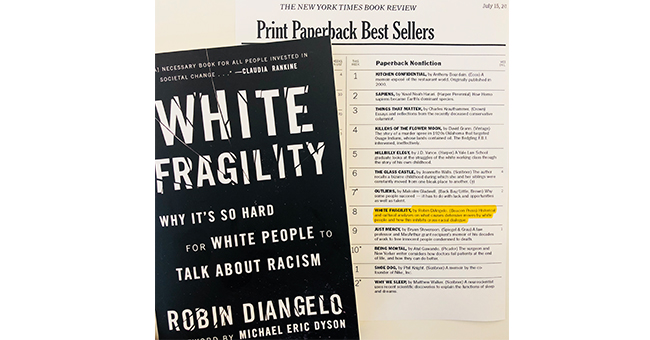
    We have a New York Times best seller! Hailed by Michael Eric Dyson as “a vital, necessary, and beautiful book,” Robin DiAngelo’s White Fragility: Why It’s So Hard for White People to Talk About Racism ranked number 8 on their list of bestselling Paperback Nonfiction within its first week of going on sale!

    “We’re so excited to be publishing it,” says our editor Rachael Marks, “and it’s been heartening to see how hungry people are for the book! In a time where more and more white people feel emboldened to act on their privilege to uphold systemic prejudice and inequality, her book couldn’t be more timely. Robin challenges readers, particularly those of us who identify as politically progressive and therefore immune to racism, to reflect on how we’ve been socialized to understand racism as something only ‘bad’ people intentionally participate in. The reality, however, is more complex, and Robin shows that racism is deeply embedded in society. The book helps white people confront the role they play in perpetuating racism (whether they’re aware of it or not), address their own white fragility, and engage more constructively in conversations about racism.”

    The buzz around DiAngelo’s groundbreaking book attests to the urgent need for dialogue on contemporary race issues. As Claudia Rankine says, “This is a necessary book for all people invested in societal change through productive social and intimate relationships.” Bitch listed it in their “30 Most Anticipated Nonfiction Books of 2018” roundup. They wrote that it “should be taught in courses about whiteness” and that it “offers a framework for understanding how privilege informs white people’s lack of engagement with race.” It’s on Mashable’s list of the best books that deconstruct racism in America. And on their list of “Must-Read Race and Culture Books of the Summer,” Colorlines wrote that White Fragility “introduces a constructive way for organizers to respond to White people whose discomfort prevents them from understanding and addressing racism.”

    So if you’re the type that “doesn’t see color” or simply isn’t racist, and certainly not part of White Supremacist culture, it’s time to check your white fragility at the door and pick up a copy of DiAngelo’s book. You can also catch up with Robin DiAngelo by checking out her USA Today Q&A about Starbucks’ implicit bias training. In her Seattle Times profile piece, she explains why it’s important for white people to see color: “If I have no idea how my race shapes me, I am probably not going to be open to any feedback about how your race shapes you. And so we [white people] end up minimizing and invalidating [people of color].” And if you weren’t able to attend her talk at the Seattle Public Library, you can watch it here.

    Congratulations to Robin DiAngelo! White Fragility will be an enduring resource in the ongoing mission to dismantle white supremacy.

    Think you don’t have white fragility? Take our white fragility quiz to find out!

    Bookstores interested in purchasing copies can contact Penguin Random House. Visit our website for more information.

  • Daniel Barks

    In these times when readers are responding to our books “more than ever,” when our authors—such as Cornel West, Anita Hill, and Christopher Emdin—are appearing in the media, their ideas going viral on social media, their voices being heard on so many platforms, we thought it might be good to take a break to focus on some of the staff who work hard to find, shape, edit, produce, and promote those works. Our blog series “Beacon Behind the Books” introduces to you a member of our staff and gives you a behind-the-scenes look, department by department, at what goes on at our office.

    This July, meet our print planning and digital production manager, Daniel Barks! 

    What drew you to publishing, Daniel? How did you find your way to Beacon?

    It begins the same way all these stories do: I’ve loved books all my life. I started working in a bookstore in college (shout out to Left Bank Books in St. Louis!), and there I realized that as long as I could make some kind of living working with books, that’s what I wanted to do. I wound up working there for almost seven years in all before moving to Boston. Once here, I very fortuitously got a job at Harvard Book Store, but was ready to shift to the other side of the bookish curtain when a sales position opened up at Beacon. The skills and knowledge I’d picked up through years of bookselling lined up with what I needed to know here, and it’ll be five years this summer since I started, though I’ve hopped over to our production team since then.

    What’s one book on our list that has influenced your thinking on a particular issue?

    Several of our books have made me consider issues in a new light, or engage with an issue in-depth for the first time. Somewhere in between these two is The Drone Eats with Me by Atef Abu Saif, in which the author recounts through diary entries his family’s experiences during the 2014 Gaza war. We’ve all encountered accounts of the horrors of war, but this was the first truly modern experience I’d read (and read again) and delved into. A beautifully written and truly devastating book.

    How much of what you learned in college and/or graduate school have you found vital to your work?

    *cries in German*

    What upcoming projects are you excited about?

    We currently have two books planned for January 2019 which will serve as the first entries in a new “Celebrating Black Women Writers” series: Corregidora by Gayl Jones and If I Can Cook/You Know God Can by Ntozake Shange. These are both books Beacon had published previously, and while neither has been “forgotten,” they both deserve more attention than they’ve received. I can’t wait for them to be re-introduced to people.

    What other departments does your department interact or collaborate with? And how?

    Production works very closely with Editorial on new books, as they end up handing over to us custody of the manuscripts they’ve been working on with the authors. We then keep in touch with the author and the editor as we shepherd the manuscript through copyediting, typesetting, proofreading, and—ultimately—printing. At that point, with finished books in hand, we start to work more closely with our sales and marketing folks, who become very invested in making sure we keep enough copies of each book on hand as they go on sale.

    Favorite thing about Boston?

    As a midwestern transplant who likes to travel, one of the best things about Boston is its coastal hub status. Over the past few years of vacations and holidays, I’ve gotten completely spoiled on direct flights. Getting to Europe or South America with no layover? Golden, I tell you!

    Favorite book ever?

    An impossible question! But some possibilities by category:

    • From which I have borrowed substantial tracts of thought: Labyrinths by Jorge Luis Borges
    • The most beautiful book-as-object I own: Incidents by Roland Barthes, with photographs by Bishan Samaddar (Seagull Books, 2010)
    • The recent titles I secretly want to buy again every time I try to find something new at a bookstore: A Little Life by Hanya Yanagihara and Station Eleven by Emily St. John Mandel

    Favorite podcasts?

     Several news and economics podcasts from Slate and NPR have helped me keep up-to-date with the world, but honestly, these days I look forward more and more to the “strictly entertainment” podcasts in my roster, like My Brother, My Brother and Me and My Favorite Murder, both of which came to me via recommendations from fellow Beacon folks.

    Name a couple non-office items on your desk and their significance to you.

    First, there’s my sentimental framed photo of my husband with our then four-month-old puppy, Kafka. That one’s a good reminder of everything right and good in the world.

      Daniel Barks' husband with puppy Kafka

    Otherwise, there’s my figurine of Link from The Legend of Zelda, a gift from a friend and former coworker; he’s like the guardian spirit of my desk, warding off any potential bad vibes.

      Figurine of Link from The Legend of Zelda


    About Daniel Barks 

    Daniel Barks joined Beacon in 2013 with extensive indie bookstore background having worked in management at both Left Bank Books in St. Louis and Harvard Book Store in Cambridge. He is a graduate of Washington University in St. Louis.

  • A Q&A with Margaret Regan
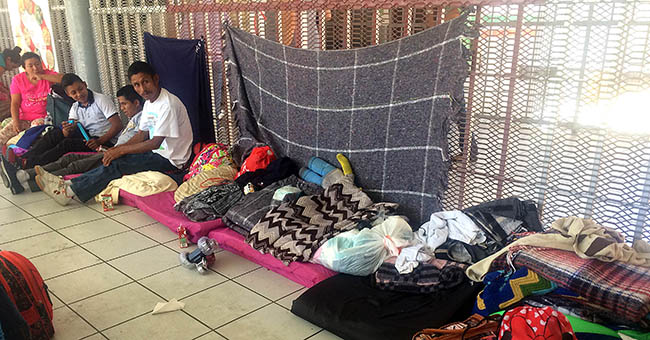
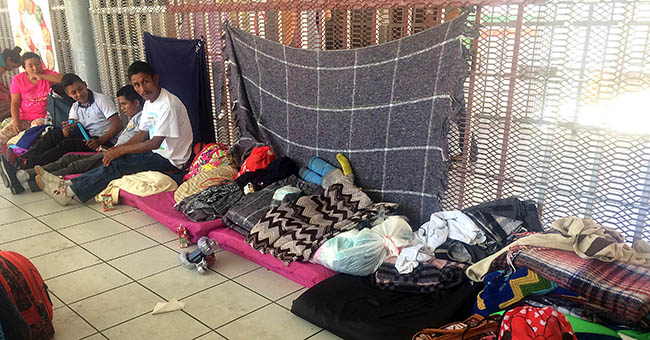
    Asylum seekers waiting in line  sitting on blankets donated by local people in Nogales  Sonora. They're waiting to make their case with a U.S. immigration agent.

    Asylum seekers waiting in line sitting on blankets donated by local people in Nogales Sonora. They're waiting to make their case with a U.S. immigration agent. Photo credits: Margaret Regan.

    Across the country, thousands took to the streets for the Keep Families Together march to protest the separation of immigrant families. But the fate of these families is still in jeopardy due to the spike in anti-immigrant policies enforced by the Trump administration. Margaret Regan, journalist and author of Detained and Deported: Stories of Immigrant Families Under Fire, has seen first-hand what migrant families are going through as they’re waiting to be processed by Customs and Border Enforcement. She reports from the front lines in this Q&A with our blog editor Christian Coleman.

    Christian Coleman: What developments have you seen first-hand of migrants who’ve been waiting to be processed by Customs and Border Enforcement?

    Margaret Regan: On a blazing 99-degree day, I visited the US Port of Entry at Nogales, the border town sixty miles south of my Tucson home. On the Mexican side, I saw something I’d never before seen on the border: a refugee camp. I counted forty-eight people living outdoors on a tile floor, mercifully protected from the sun by an overhanging roof. Half of these asylum seekers were mothers or fathers, the other half were kids: babies, young children, teenagers.  

    Four of the women had the swollen belly of pregnancy; one Guatemalan woman sat on the floor nursing her baby boy, her face tight with worry and fear.

    The weary travelers had set up donated blankets and water bottles and toys in their cramped living space. The parents mostly sat exhausted, leaning against the walls. But little kids were rocketing around; four boys were swinging around concrete poles. A toddler was sacked out on a blanket on the floor, her arms flung outward, deep in sleep.

    The locals have been kind to the wayfarers, bringing food, toys, and bedding, and offering shelter to some for the night. The Catholic Kino Border Initiative arrives with breakfast each morning, and provides beds and floor space in a shelter run by nuns. But many sleep outside at the port all night.

    Everyday tourists walk by in the lane next to this human drama, carrying their purchased trinkets, confidently flashing their US passports. The refugees don’t have that freedom of movement: some had already waited six days in the heat to tell a Customs and Border Patrol agent their harrowing stories of violence in their Central American homelands and in cartel-ridden Mexican states. CBP had slowed the process mightily—and kept people living on the streets—by speaking with only three or four families a day.

    I spoke to eight of the refugees, and heard accounts of kidnapping and murder, of extortion and threats against children, of domestic violence and rape of women.

    Kimberly, a twenty-three-year old single mother from Huehuetenango, in northwest Guatemala, had left her home with her four-year-old daughter to escape violence. She used all the money she had to ride by bus 20,064 miles from her highlands home to this hot camp on the edge of America.

    “My sister was kidnapped and wasn’t found for four days,” she said.

    The kidnappers wanted money the family didn’t have. Kimberly feared that she or her little girl would be next; she fled in hopes of a safer life with family members in Baltimore. I met Kimberly before Trump signed an order ending family separation, and she had heard that the American president was taking children away from their mothers. Asked if she was afraid that the agents would take her little girl, she nodded. “Mucho,” she said. 

    Rony, a thirty-year-old dad, was from San Marcos, a district in western Guatemala long in the grip of the drug trade. He was here in Nogales for one reason only.

    “My only goal is to protect my son,” he says. “I came to ask for political asylum.”

    Like Kimberly, Rony was escaping extortion by would-be kidnappers. A drug cartel had three times tried to abduct his ten-year-old son from school. On the first effort, a man came to the school pretending to be the dad. The boy refused to go with him. The second time, the teacher called Rony, telling him that someone had showed up, insisting he was the father. The third time, men followed his son as he walked home from school until he took refuge in a babysitter’s house.

    Rony went to the police, but they did nothing. Often accused of being in league with the drug dealers, the police sometimes tip off the gangsters that someone has reported them. Terrified of an attack, Rony took his son and fled.

    Mario, a twenty-seven-year-old from Honduras traveling alone, said that when he was seven, the Mafia murdered his father. Later a brother disappeared permanently. “They’re after the whole family,” Mario said. When his brother vanished, Mario “ran away.”

    All of the people I talked to intended to seek asylum on the grounds of drug cartel violence and kidnapping, police corruption, or domestic violence. But Attorney General Jeff Sessions, breaking with previous standards, recently ruled that crime and domestic violence will no longer be grounds for asylum. And though the family separation policy was supposed to apply only to those who crossed the border without papers (a misdemeanor), some asylum seekers who presented themselves lawfully at the port of entry had their children wrenched away.

    Central American migrants are far more common than Mexicans these days, but the overall number of migrants at the border is at low historical levels, despite President Trump’s talk of an “invasion.” The government’s own numbers prove it: This year in May, CBP arrested 51,912 migrants along the Southwest border. In May 2016, two years ago, they arrested more, 55,442. What the administration is relying on to inflate their claims is that apprehensions dropped significantly in May 2017, to 19,940. Apparently, potential asylum seekers were so terrorized by Trump’s threats in his first few months in office that they stayed home. But conditions are so bad that asylum seekers eventually returned in their usual numbers. As many researchers have pointed out, these numbers are far below the days of mass migration back at the turn of this century.

    And it is important to remember that the United States badly destabilized Guatemala, El Salvador, and Honduras during the Reagan-era wars, by contributing arms, money, and military “advisors” to murderous regimes. Mass genocide killed thousands in these countries; in Guatemala alone at least 200,000 indigenous people died. As Princeton prof Douglas Massey reported in High Country News, the destruction of local economies followed, leaving space for violent gangs like MS-13 (imported from Los Angeles) to terrorize people like Kimberly, Rony, and Mario. The disaster they’re fleeing is in large part of our own making.  

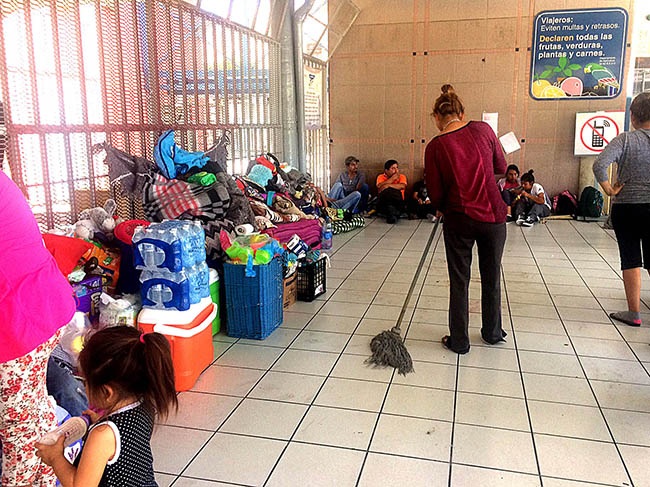
    At least once a day, the women in the camp tidy up the place  with brooms and mops.

    At least once a day, the women in the camp tidy up the place with brooms and mops.

    CC: What becomes of migrants and their children after they get through the Port of Entry?

    MR: Virtually all undocumented people who’ve been processed by CBP at the Arizona border are first taken to a Border Patrol holding tank. They can be locked up short-term in perreras, the now-notorious “dog kennel” cages seen in recent news photos. Many parents and children land in the Border Patrol station in Tucson, a prison-like facility with such poor conditions that a judge in an ACLU lawsuit found “persuasive evidence that the basic human needs of detainees are not being met.”

    The lockup has sleeping mats now, in response to the judge’s order, but it hasn’t met his other demands. The place is still a hielera, an icebox, and the food is scant and almost inedible. At Casa Alitas, a Catholic shelter in Tucson, I met Aldea Batal Cuilco, a pregnant Guatemalan traveling with a toddler. She’d spent one night in a cell there that was “mucho frío,” she said, very cold. And though she told an agent she was expecting, she didn’t get the extra food the rules required. She got the same poor offering that her fellow inmates did: highly processed frozen burritos.

    Asylum seekers without children would likely be sent to Arizona’s Eloy Detention Center and held indefinitely. But Aldea kept her child and was released to a shelter where she and her little girl got beds to sleep in and ate hearty home-cooked food for two days before departing on a three-day Greyhound-bus ride to Florida. She traveled legally with papers from ICE, with strict orders to report to a Florida immigration court under pain of arrest; she also had to give ICE the address where she’d be living. Unlike other adult travelers, as a pregnant woman she didn’t get the painful ankle bracelet that ICE locks onto other migrants to track their location.

    But many hoping for asylum are arrested crossing the border; when parent separation was in effect, they had their children ripped from their arms. From mid-May to mid-June, some fifty-six arrested parents going through the mass Streamline court hearing said they has been separated from a total of sixty children, according to the Arizona Daily Star.

    Mirroring the nationwide confusion about the whereabouts of the more than 2,300 children abducted by the feds, bereft parents repeatedly told the Streamline judges they had no idea where their kids were. One judge asked a federal attorney prosecuting the cases about their whereabouts. The attorney replied that he didn’t know, and it wasn’t his business to know, because he represented Homeland Security and the children were in the jurisdiction of the Dept. of Health and Human Services. The judge, exasperated, told him to find out.

    But the Streamline numbers don’t reflect all the kids taken in Arizona. Writing in June in The Guardian, Lauren Dasse, a lawyer who directs the Florence Refugee and Immigrant Rights Project, said her group documented 425 cases of family separation in the state since January, “with drastic increases in the last month.” There are at least fourteen shelters in the state holding migrant kids; one in Tucson is run by Southwest Key, the same non-profit chain that houses migrant boys in a former Walmart in Texas.

    And as in Texas and elsewhere, the children taken from parents in Arizona were of all ages, from tender-age—the federal-speak word for infants—all the way to teenagers. Dasse reported that “a five-month-old baby…was taken from his mother, and is held in immigration detention with three of his siblings. Their mother, escaping serious threats of violence, is held in a detention center several states away.”

    CC: What will happen in the wake of President Trump’s executive order ending family separation?

    MR: ICE and Border Patrol may have stopped tearing children away from their mothers and fathers, but Trump’s next strategy is hardly humane. He intends to put parents and children in indefinite family detention. To do that, he has to get around the 1997 Flores settlement that limits incarceration of immigrant children to no more than twenty days. And his lawyers must bring their case to Dolly Gee, the tough federal judge in Los Angeles who scuttled the Obama administration’s effort to keep children in family detention for far longer than that.

    If Flores were to be stricken down, everything would change. Coupled with the Supreme Court’s February ruling that immigrants can be held indefinitely, with no right to periodic hearings, the loss of Flores could mean years-long incarceration of families. Children could grow up behind bars.

    Homeland Security might turn its longtime collaborators, for-profit private prison companies, to build and operate new family detention centers. We have three now: one operated by Berks County in Pennsylvania; and two in Texas, one run by the for-profit CoreCivic (formerly Corrections Corporation of America), and the other by GEO Group—both opened under President Obama in 2015. These family lock-ups have a total of about 3,000 beds, not nearly enough for the thousands of moms, dads, and kids that the current administration proposes to lock up. Family detention has been extremely profitable to these prison corporations: family prisons charge the government about $300 a day per inmate, double what the for-profits earn per inmate in adult detention. As always, the more immigrants America locks up, the more money the for-profit prisons make.

    Asylum seekers. At right, a nursing mother walks with her son strapped to her back.

    Asylum seekers. At right, a nursing mother walks with her son strapped to her back.

    CC: How will the children currently detained be returned to their parents?

    MR: That’s the big question. Trump’s executive order outlined no plan to return the children to their families. In chaotic days after the announcement, federal departments offered contradictory statements, with one official asserting that none of the children recently detained would benefit from the new policy, another quickly rebutting that claim.

    Four days after the announcement, Homeland Security and Health and Human Services finally outlined a plan for reunification of nearly all the children separated from their parents. A press release said that 522 children out of the more than 2,300 in their custody had already been returned. (Those 522 kids were the ones still being held by Border Patrol near the border; the rest are in in facilities around the country.)

    “The United States government knows the location of all children in its custody,” the statement read, but it was a declaration that was hard to believe, given the weeks of confusion featuring hen children scattered all over the US, tiny kids wailing for absent parents, desperate parents unable to learn where their kids were, and some adults deported without getting their children back. Even highly trained social workers, lawyers, and reporters struggled to connect parents with children in the Kafkaesque detention system.

    The feds don’t have much time now to figure out how to get to these parents and kids back together. On Tuesday, June 26, another no-nonsense federal judge, Dana Sabraw of US district court in San Diego, ordered the government to reunite all the children with their parents within thirty days. Children younger than five must be returned to their parents within fourteen days.

    CC: Your book Detained and Deported was originally published in 2015. What changes have you seen since then for immigrant families during the Trump administration?

    MR: Detained and Deported ended with the 2014 “surge” of migrant families fleeing the horrors of violent Central American nations. Obama dealt with that by reintroducing family detention centers, opening the two permanent centers in Texas and a temporary one in New Mexico. Throughout his two terms, Obama detained thousands of immigrants and deported people at a record pace, though the deportations slowed in his final years.

    So Trump came to office with a border enforcement regime already in place: some 35,000 beds in detention centers; 650 miles of walls across the southwest border; and 60,000 employees at Customs and Border Patrol. But Trump immediately took harsh new actions. He abandoned the Obama directive for ICE to concentrate efforts on immigrants who had committed crimes, while using prosecutorial discretion with law-abiding immigrant families already living in the US Under Trump, all immigrants were to be subject to deportation, no exception.

    ICE arrests in the interior of the country, largely of immigrants who had lived here for a long time, soared. Trump reignited mass ICE raids on workplaces, making military-like assaults on a gardening enterprise in Ohio, a meat-packing plant in Tennessee, arresting parents, affecting children, and decimating communities. Trump tried to abolish DACA, the Obama program to permit law-abiding young adults who had been brought to the US without papers to remain and work here for renewable two-year periods. So far, Trump’s effort has been stymied by the courts. Finally, his administration unleashed the brand-new “zero tolerance” policy of charging every single crosser with a crime, and created the nightmare of deliberate family separation.


    About Margaret Regan 
    Margaret ReganMargaret Regan is the author of two award-winning books: Detained and Deported: Stories of Immigrant Families Under Fire, a 2015 Southwest Book of the Year; and  The Death of Josseline: Immigration Stories from the Arizona Borderlands, a 2010 Southwest Book of the Year and a Common Read for the Unitarian Universalist Association of Congregations. A longtime writer for the Tucson Weekly, Regan has won many regional and national awards for her immigration reporting, including the 2016 Matthew Freeman Social Justice Lectureship at Roosevelt University, Chicago. She lives in Tucson, Arizona.
  • By William Ayers

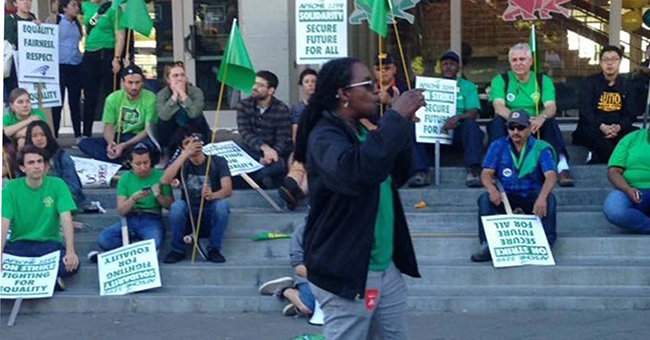
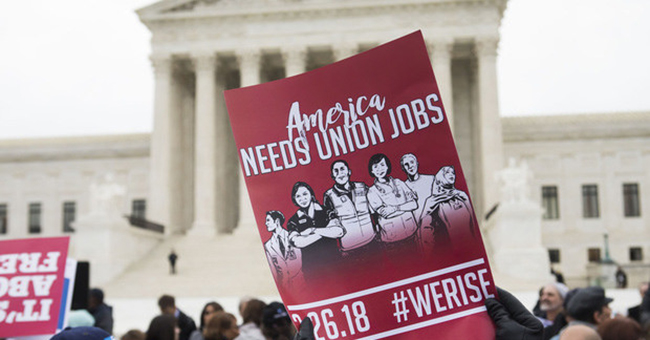
    Demonstrators outside the US Supreme Court during arguments in the union fees case Janus v. AFSCME, on February 26, 2018.

    Demonstrators outside the US Supreme Court during arguments in the union fees case Janus v. AFSCME, on February 26, 2018. Photo credit: WFSE/AFSCME C28.

    The US Supreme Court ruled earlier this week in Janus v. American Federation of State, County and Municipal Employees (AFSCME), and found in favor of Mark Janus, a child support specialist with the Illinois Department of Healthcare and Family Services, who chose not to join the union, but was required under Illinois law to pay what are called “fair share” fees to AFSCME as the collective bargaining agent for all state workers. Janus argued that even though he was covered by the collective bargaining agreement, it was a violation of his First Amendment rights to force him to support the union. AFSCME contended that requiring workers who choose not to join the union to pay a smaller portion, or a “fair share,” is reasonable since they, along with their dues-paying colleagues, benefit concretely from collective bargaining. Without agency fees, those who don’t pay anything at all are essentially “free riders”—or “takers” to borrow a term-of-art from the conservative playbook—benefiting from the work of others, but neither participating nor contributing.

    Janus followed Friedrichs v. California Teachers Association, a case organized and championed by powerful forces bent on destroying organized labor, specifically public-sector unions. Friedrichs challenged agency fees collected by the California Teachers Association, an affiliate of both the National Education Association and the American Federation of Teachers.

    When Justice Antonin Scalia died suddenly in early 2016, the Supreme Court deadlocked (4-4) on Friedrichs. In 2017, after Neil Gorsuch replaced Scalia and the Supreme Court returned to a full complement of nine Justices, the Court agreed to hear Janus, a substantially similar case. With the addition of Justice Gorsuch, the anti-labor forces won the day, and “right-to-work” became the law of the land.

    Public-employee unions were already barred from spending fair-share fees on electoral politics, but Janus asserted that any action by a government employee union, including collective bargaining, is inherently political, and that therefore spending money on anything constitutes forced political speech and violated his First Amendment rights. AFSCME and other public employee unions argued that since the law requires it to provide due representation to all members for an entire unit, including non-members like Janus, then depriving AFSCME of fair-share fees would make it possible for Janus and others to enjoy the benefits of collective bargaining without having to pay anything for those benefits. If a huge number of workers became free riders, the result would devastate AFSCME financially, and create divisions among the employees. Labor leaders have argued that the case had nothing to do with free speech, and union destruction was the real goal of the law suit all along.

    But there is so much more to the story: this all comes in the wake of teacher revolts that swept the country this past Spring. The day before West Virginia teachers walked out last February, sparking a rolling and accelerating rebellion, a teacher revolution was “impossible.” The day after they won their demands, the revolution became “inevitable.”

    That’s the rhythm of every revolution throughout history: impossible on to inevitable in the blink of an eye.

    I’ve never before heard of a state-wide teachers’ strike. This past Spring, the unheard of was breaking out all over.

    West Virginia, Oklahoma, Arizona, Kentucky, Colorado, and no one can say for sure where the rebellion might spark up when school opens in the Fall.

    But this much is clear: these initial hot spots were among the twenty-seven “right-to-work” states (or “right-to-work-for-less” states as labor refers to them) with severely limited bargaining rights and prohibitions against workers paying “agency fees” in exchange for representation.

    While destroying or weakening organized labor, specifically public-sector unions, has been a right-wing dream for decades, the anti-union forces may come to regret what they’d wished for just as they get the first sweet taste of the victory they’d sought. After all, unions and collective bargaining also have provided stability and labor peace—the opposite of what’s sweeping the country now—and this new reality will open up new strategies and new tactics, and a challenge to traditional forms of business unionism.

    The conservative assault on teachers’ unions and the attendant disregard for everyday school teachers by a range of political figures and power brokers is nothing new—teachers are routinely characterized as lazy, incompetent, unaccountable functionaries who work six hours a day, nine months a year, and still lay about their well-appointed teacher lounges whining while their special-interest unions protect them with unfair contracts that have been foisted on unsuspecting school boards.

    Or, so goes the familiar story.

    What’s new—and entirely encouraging for those of us who care about teaching and advocate for a strong public school system—is the spontaneous series of actions highlighting the desperation that has brought teachers to the breaking point: salaries that require full-time teachers to wait tables or drive Uber to make ends meet; furlough days for teachers and staff; catastrophic classroom overcrowding; inadequate and outdated classroom supplies; the wholesale destruction of arts programs, and more. None of this would be acceptable for the children of the privileged, and in a democracy, where all people are assumed to be of incalculable value, none of this should be acceptable for the children who come to school with less.

    These teacher actions—each one demanding adequate funding and authentic support for public education—also challenge the myths about teachers and public education that have dominated the national debates until now, myths like “you can’t fire the bad ones,” or “teachers unions negatively impact student test scores.” As one Arizona teacher said from the picket line, “I’m not striking against my students—I’m striking for my students.”

    “Pencils down” walk-outs should remind us that good working conditions are good teaching conditions, and that good teaching conditions create good learning conditions. Collective bargaining and union membership not only result in higher wages and benefits for teachers and more stability in the teaching profession. When teachers ask for smaller classes, full arts programs, and well-paid support staff including counselors, social workers, and nurses, it’s ridiculous to cast those demands as narrow or self-interested. Yes, those things are good for teachers—and they are essential for a decent learning environment. The voice of teachers in these and other matters represents what’s good for students and their families as well.

    The broader conflict is about the future of organizing in general and asks us to rethink strategies for labor organizing in particular. The Koch brothers and other wealthy and powerful right-wing forces are mobilized—under the banner of “ensuring worker freedom”—to challenge worker protections and to destroy any remnants of organized labor as we’ve known it for most of a century. Their grand design includes accumulating a string of state-level victories while building momentum toward undoing all federal labor laws that offer workers’ protections. They also support a proposed pro-employer Employee Rights Act, a vast overhaul of federal laws governing union organizing, and they have a powerful ally in the Trump administration, which has already changed the previous administration’s overtime rule and joint employment standard.

    Anticipating an unfavorable ruling in Janus, Illinois Local 150 of the Operating Engineers filed a suit challenging the state of Illinois’ requirement that they represent non-dues-paying members. They argued that if they can’t collect fair-share fees then they should not be obliged to represent non-members. It’s then a small step to establishing that unions should be permitted to organize and represent individuals within a workplace or bargaining unit without winning a majority vote in an election.

    But we are not at the end of the story, and no one should expect the rolling teacher revolt to end soon. Teachers in West Virginia offer a glimpse of what’s ahead—a nationwide rising and resistance to the destruction of public education.


    About the Author 

    William AyersWilliam Ayers was Distinguished Professor of Education and Senior University Scholar at the University of Illinois at Chicago. He is the founder of the Small Schools Workshop and the Center for Youth and Society, and the author of many books including Teaching Toward Freedom, A Kind and Just Parent, Fugitive Days, and Public Enemy, and co-author of “You Can’t Fire the Bad Ones!” Follow him on Twitter at @WilliamAyers.

  • By Linda K. Wertheimer

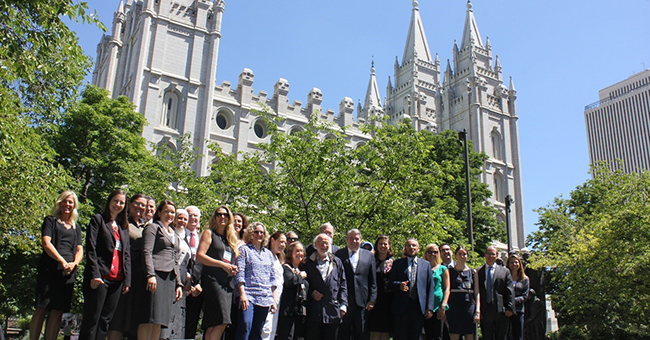
    Presenters, including author Linda K. Wertheimer, from the Brigham Young University’s Religious Freedom Annual Review conference and hosts from the Mormon church stand in front of the Salt Lake Temple.

    Presenters, including author Linda K. Wertheimer, from the Brigham Young University’s Religious Freedom Annual Review conference and hosts from the Mormon church stand in front of the Salt Lake Temple.

    How can we agree to disagree? How can we get Americans of different views, religions, races, and backgrounds in the same room and debate the issues of our times? Right now, accomplishing such a lofty goal seems elusive. Still, at a recent conference, there were glimmers of hope.

    On June 20-21, Brigham Young University’s International Center for Law and Religion Studies held its fifth Religious Freedom Annual Review, bringing in speakers of different faiths and races to talk about religious freedom and related topics. More than 500 people attended. While most were Mormon and white, the attendees included Jews, Muslims, and Christians of various branches and races. I gave talks related to my book, Faith Ed, Teaching About Religion In An Age Of Intolerance. As I have done in other parts of the country, I asked attendees to consider a scenario involving a guest speaker on Islam in public schools as part of instruction on world religions.

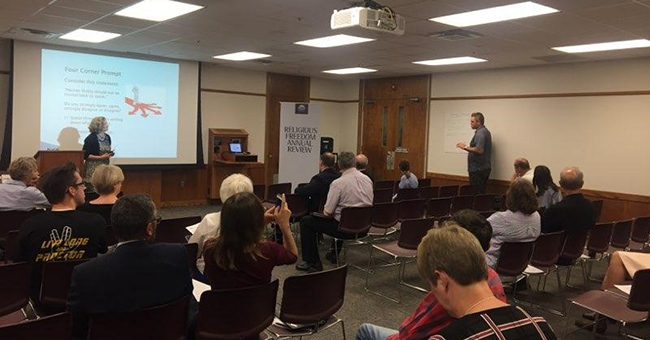
    Author Linda K. Wertheimer asks attendees of a conference in Provo, Utah, to share their group’s conclusions on whether a guest speaker on Islam should be invited back to speak.

    Author Linda K. Wertheimer asks attendees of a conference in Provo, Utah, to share their group’s conclusions on whether a guest speaker on Islam should be invited back to speak.

    What gave me glimmers of hope? There were people on all ends of the political spectrum delivering presentations, and the audience was respectful and engaged. Just the agenda topics showed a willingness to consider other points of view, to hear about the experiences of non- Christians in America, and to recognize the changes within Mormonism, too. The sessions included one called, “Religious freedom issues facing American Muslims,” and “Finding common ground and the common good on religious liberty and LGBTQ Rights.” There was also a session on fostering community at BYU with LGBTQ students and a talk about how religion can contribute to the common good.

    In Faith Ed, Utah received a brief mention for its history of hosting religious education classes on Christianity during the school day in buildings next to its public schools. The Mormon church created those buildings, known as seminaries. These classes clearly are about preaching one faith, not teaching about world religions as a part of social studies or geography. But they are legal because they are taught outside of the regular public school building.

    During my talk, I mentioned my own experiences as a captive audience of such classes held illegally in my rural Ohio school in the 1970s. I talked about the ostracism and isolation I felt every time the religious ed teacher walked in, and I walked out, feeling the eyes of my classmates following me. While Utah’s approach was legal, I said, I noted that audience members might want to think about the experience it creates for the students who do not go. They may end up feeling like the ‘other’ in a predominantly Mormon school and region, as I did in my predominantly evangelical Christian school and town. In fact, Ohio friends of mine who later moved to Utah said they left the state partly because of those religious classes. They did not want their child to feel peer pressure to attend. They were Christians, but not Mormons.

    I saw some heads nodding in agreement as I spoke. But I saw others who sat there silently. One woman raised her hand at the end of my talk and asked why these classes would ever be an issue. She said they were an elective, like theater or music, and students had a choice. I noted that theater or music were a part of a well-rounded education in a public school, while a class intent on preaching the tenets of a faith was not.

    My talk ended, and the woman stayed behind as others left, wanting to push the issue more. I stayed calm, and so did she as we debated. She said she had had non-Mormon friends, and they never seemed bothered. “But how did you know? How can you really know?” I asked. During my reporting for Faith Ed, I interviewed numerous youths who were religious minorities, including Jews, Hindus, Muslims, Sikhs, and a Jehovah’s Witness. Most said they rarely talked about how their status as religious minorities affected them. Muslim kids told me about peers asking them if they had a bomb in their locker or comparing them to terrorists in their other way. Ultimately, we agreed to disagree.

    My last day in Utah, members of the Mormon church took on the main role as speakers and tour guides. We toured a center for Mormon charity operations and saw a multi-silo building that held wheat, a storehouse of food produced entirely by Mormon volunteers, a bakery, and a thrift store. We also received a guided tour of parts of the Mormon history museum in Salt Lake, and heard a talk from a historian of the church’s fights for religious liberty.

    The museum highlighted persecution Mormons experienced as they tried to create their Zion, a utopian community, in Missouri and in other places. Our guide did not hide an unflattering part of that nineteenth-century history; Mormon settlers, after being attacked by one village, attacked another one that had had nothing to do with that initial battle.

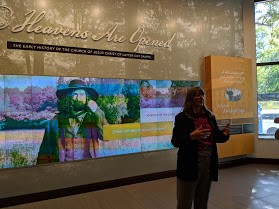
    A guide from the Mormon history museum begins a tour for Wertheimer and other presenters at a religious freedom conference.

    A guide from the Mormon history museum begins a tour for Wertheimer and other presenters at a religious freedom conference.

    At a closing session of the conference, Kristen Looney, the director of the Religious Freedom Center of the Newseum, had given a talk on civil dialogue, a concept debated rancorously in America at the moment. She gave her talk before the owner of the Red Hen restaurant in Lexington, VA, made national news for asking White House press secretary Sarah Huckabee Sanders to leave. The restaurant owner, along with many on her staff, felt Sanders was supporting inhumane policies.

    Looney did not weigh in on the Red Hen incident. It hadn’t happened yet. But she shared wisdom that could apply to all of America. “Dialogue does not mean you have to give up your deepest beliefs. Dialogue is thinking together and understanding,” she said.

    For those of us at that conference in Utah, our time together was all about civil dialogue. May it make a difference.


    About the Author 

    Linda K. WertheimerLinda K. Wertheimer, a former Boston Globe education editor, is the award-winning author of Faith Ed: Teaching About Religion In An Age of Intolerance. During her nearly thirty-year journalism career, she was a reporter at The Dallas Morning News and The Orlando Sentinel as well as for other publications. Her work has appeared in the Washington Post, the New York Times, the Boston Globe Magazine, USA Today, Time, and many other publications. Faith Ed in 2016 won a national book award—second place in the Religion News Association nonfiction religion book contest. She has also won awards for her writing from the Education Writers Association and other organizations. She was a 2014 finalist in the Massachusetts Cultural Council artist fellowship awards. A graduate of Northwestern University’s Medill School of Journalism, she lives in the Boston area with her husband and son. Follow her on Twitter at @Lindakwert and visit her website.


  • A Q&A with Crystal Marie Fleming

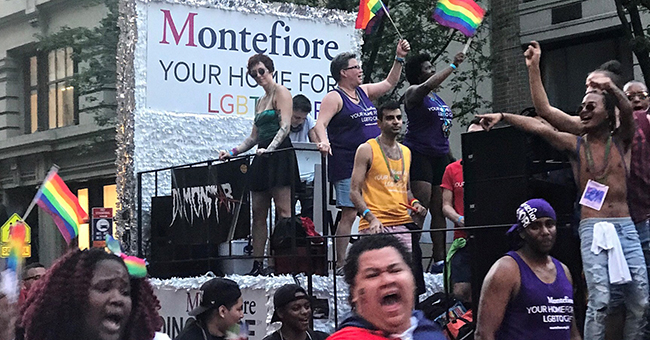
    New York City Pride, 2018

    New York City Pride, 2018. Photo credits: Crystal Fleming

    We hope you had a fabulously affirming Pride Month! Our bleak political climate needs to be shaken up by all the loud, proud, and resilient celebrations queerness we can throw at it. For our upcoming author, Crystal Marie Fleming, whose new book How to Be Less Stupid About Race: On Racism, White Supremacy, and the Racial Divide will be out in September 2018, it was a joyous occasion. Our blog editor Christian Coleman caught up with her to ask her how she celebrated Pride in New York City and what being proudly Black and queer means to her during our current administration.

    Christian Coleman: How did you celebrate Pride this year, Crystal?

    Crystal Marie Fleming: Usually my girlfriend and I celebrate Pride together, but she happened to be out of town. So, this year I celebrated pride by attending the march in New York City with a group of girlfriends and going out for dinner afterwards. We had a wonderful time. I came home to a gorgeous bouquet of flowers sent from my lady, so in that way, she was still part of my celebration.

    CC: You tweeted that you were celebrating bi-visibility at Pride. Tell us a little about why this is important to you.

    CMF: I identify as queer and bisexual. Bi-invisbility is a challenge that many bisexual people face—our sexuality is often unrecognized by others, even if we are “out” about our identity. People often presume your sexuality from the gender(s) of your partner(s). When I’ve been in relationships with men, I was often assumed to be heterosexual. Conversely, when I’m out with my girlfriend, people often assume that I’m a lesbian because we’re both women. While I don’t mind being occasionally mistaken for lesbian or straight, I prefer to be recognized for who I am.

    It took me many years—well into my late twenties—for me to fully embrace my sexuality. In addition to homophobia, bisexual people also have to deal with biphobia from straight people as well as others within the LGBTQIA* community. Most of my past partners were men. Some of them were ambivalent about my sexuality and even expressed homophobic and biphobic attitudes. Looking back, I stayed in those relationships, in part, because I was also ambivalent about my identity and still had a long way to go in deepening my self-love. At a certain point, I made a conscious decision for my own wellbeing to be very, very out about being bi. This intentional hypervisibility allowed me to connect with bi-inclusive people and weed out biphobic folks. This was especially important to me when I finally got serious about dating women. I started blogging and writing publicly about my sexuality many years ago in order to come all the way out and celebrate my journey toward self-acceptance and personal liberation. I was apprehensive about meeting biphobic lesbians and queer women, so I proactively made my bisexual pride very clear both online and offline. I met my current partner almost five years ago, and one of the many things I loved about her was how open and affirming she was about my identity. Some people feel threatened or insecure about dating a bisexual person, but this has never been a problem in our relationship.

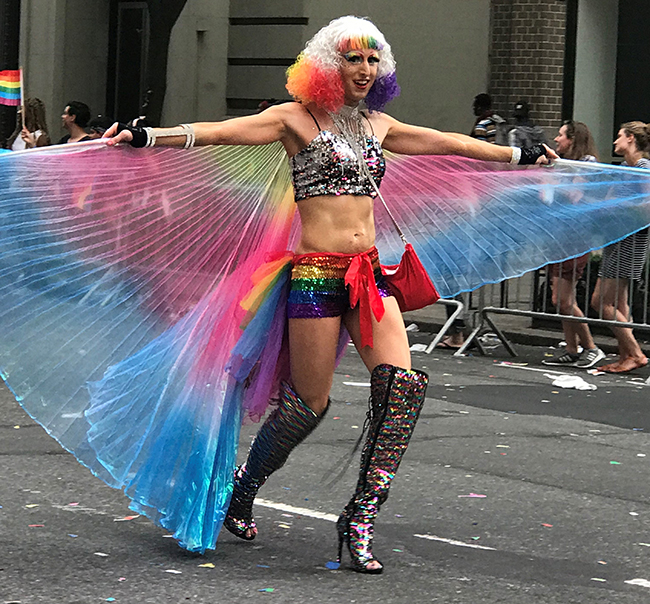
    New York City Pride, 2018

    New York City Pride, 2018

    CC: What were some of your favorite parts about this year’s Pride?

    CMF: Pride is just such an inspiring and beautiful display of affirmation, solidarity, and protest. What’s interesting for me—and I think most LGBTQIA* folks would agree—is that my relationship to Pride has changed dramatically over the years as I became more comfortable and even flamboyant with my identity. I vividly remember, back when I was still halfway in the closet, being afraid to attend a Pride parade or march. One year, when I was living in France during graduate school, I realized that the Paris Pride procession went right past my apartment in Montparnasse—but still, I was too nervous to go downstairs and join in the festivities. Pride took on a new dimension for me when I met my partner and started attending with her. It’s certainly true, I think, that many bisexual people feel more included and recognized in queer spaces when we’re in a same-sex relationship. Sometimes, bisexual people partnered with someone of the opposite sex are questioned and made to feel unwelcome in queer spaces. I also started to really enjoy Pride once I learned more about Stonewall and the role of African American and Latinx trans women in essentially starting the modern LGBTQIA* movement.

    This year, I really loved seeing all the Black folks and people of color showing up and showing out. There were Black queer families with their kids and Black and Brown trans women and lesbians and gay men and drag queens. I loved the wide spectrum of gender presentations beyond the binary and sexual identities that are rarely recognized and celebrated.  It’s such a beautiful thing to express solidarity with people who exist, survive and thrive at the margins. There was a group in the march representing asexual people, and when I saw them pass by, I started cheering and screaming for them, because we never acknowledge asexual people as much as we ought to. And when I was cheering for them, some folks in the group came over to where I was standing and I could just tell how happy they were to be seen and valued. We high-fived and wished each other a happy Pride. Scenes like this played out again and again during the march. I feel like having this joyous day every year to exchange good energy and affirmation is really touching and healing for our community.

    CC: You write about race, sexuality, and politics, teach sociology and Africana studies at Stony Brook University, and research racism in the US and Europe. With this in mind, are there any particular issues you’d like to see Pride parades address?

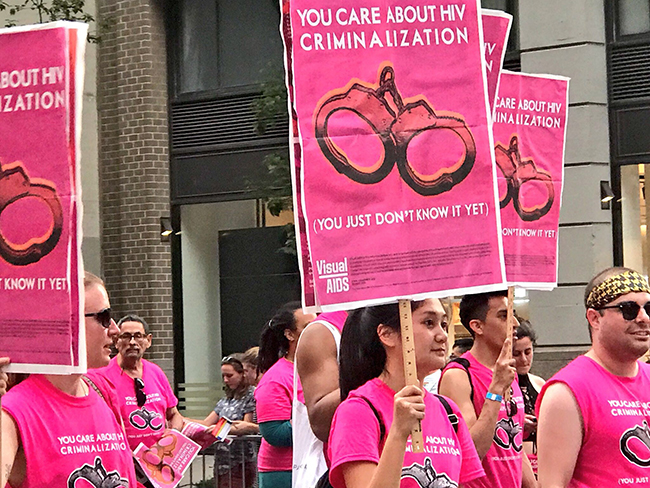
    CMF: Beyond celebrating identity, I really appreciated the protest signs and resistance around issues like HIV criminalization, civil liberties, immigration, family separation, and reproductive rights. I feel like resistance is the true spirit of Pride. When my friends and I noticed that the NYPD and the FBI were participating in the march, we started chanting “BLACK LIVES MATTER!” As many others say—it’s not just a parade, it’s a march. It’s about affirming who we are, yes, but also affirming the kind of world we wish to live in and challenging the oppression and inequalities that persist today.

    New York City Pride, 2018

    New York City Pride, 2018

    CC: What does being Black and queer mean to you during our current administration?

    CMF: Gosh. Where to begin? Years ago, I naively thought that I was living in the best time in modern history to be an openly queer black woman. And in some respects, this might be true. But there are so many severe civil and human rights challenges that LGBTQIA* people still face. Whether we’re talking about the epidemic of violence targeting trans women broadly and trans women of color specifically, or the mental and physical health disparities experienced by queer, gay, lesbian and bisexual people, we are dealing with serious problems that undermine our wellbeing. Trans people are still fighting for legal protections and basic dignities, like being able to use the bathroom in peace. Discrimination, homophobia, biphobia and transphobia remain rampant. Recently, my girlfriend and I were holding hands in New York City and an older white woman expressed her dismay by screaming and verbally attacking us.

    With Justice Kennedy retiring and the Supreme Court sure to veer toward the extreme right, it’s clear that many of the rights that those who came before us fought for are in jeopardy. For me, being Black and queer in 2018 means being aware of the specific vulnerabilities of living at the intersection of multiple axes of domination. But it also means being joyful, bold, and brave as I live in my truth and surround myself with loving people and chosen family. It means drawing on my spiritual practice, the power of meditation, and my intimate relationship with God to keep me grounded and in touch with the beauty and magic of Life, even in the midst of human suffering. We are living in challenging times, but then, these have always been challenging times. If my ancestors could live through the Middle Passage and survive the most oppressive apparatus of state violence ever conceived, then I am determined to allow their resilience, hope, and persistence to shine on through me. Next year, I'd like to throw a Pride-themed Juneteenth party or a Juneteenth-themed Pride celebration. We have to keep nurturing our joy, optimism, and capacity for expansive love, no matter what’s going on with our politics.


    About Crystal Marie Fleming 

    Crystal Marie Fleming, PhD, is a writer and sociologist who researches racism in the United States and abroad. She earned degrees from Wellesley College and Harvard University and is associate professor of sociology and Africana studies at Stony Brook University. Fleming writes about race, sexuality, and politics for publications including The Root, Black Agenda Report, Vox, and Everyday Feminism, and she has tens of thousands of followers on social media. She is the author of Resurrecting Slavery: Racial Legacies and White Supremacy in France. Her new book, How to Be Less Stupid About Race: On Racism, White Supremacy, and the Racial Divide, comes out in September 2018. Follow her on Twitter at @alwaystheself and visit her website.

  • A Q&A with Charlene Carruthers

    BYP100

    Photo credit: BYP100/YouTube

    “We are fighting for our lives—and the lives of our people against formidable opponents/enemies. We are optimistic and steadfast in the idea that we can learn to treat each other better. We are participants and practitioners in various projects of abolition. We are practicing and theorizing as we go. We are seeking to eradicate systems in the world while being in, of and outside of the world. And it is worth it.”

    This mission statement comes from Charlene Carruthers’s forthcoming Unapologetic: A Black, Queer, and Feminist Mandate for Radical Movements. It’s also the mission of BYP100 (Black Youth Project 100), a Black youth organization founded in 2013 to empower the next generation of Black activism. Carruthers, a Black, queer, feminist community organizer, is the founding national director of BYP100. As Pride Month draws to a close, we caught up with her to ask about the work BYP100 is doing for the LGBTQ movement, police presence at Pride parades, and why it’s important to organize through a Black, queer, feminist lens.

    Beacon Press: How involved is BYP100 in today’s LGBTQ movement and what are some of your plans going forward?

    Charlene Carruthers: Our national and local work focuses on various issues that impact Black LGBTQ people. For example, our Washington, DC chapter is leading a campaign, within a coalition, to end the criminalization of sex work. This issue disproportionately impacts Black trans women (whether they engage in sex work or not), queer people, and gender-nonconforming people. We have always done our work in the tradition of radical Black feminist and LGBTQ movements.

    BP: BYP100’s mission is to help advocate and organize through a Black, queer, feminist lens. Why would you say this is an important lens for young people to operate through when it comes to activism?

    CC: The Black, queer, feminist lens allows people to view the world in a way that accounts for multiple modes of resistance and multiple experiences of oppression. Organizing is not inherently radical. It's important for young people to take up clear political commitments that are based in the basic notion that none of us will be free until all of us are free.

    BP: Is there one specific instance that really pushed you to be a voice for your community and your cause as a whole?

    CC: No, there’s not one specific instance. Traveling to South Africa when I was eighteen years old changed my life and made me more curious about the conditions in Black communities across the diaspora. However, I've always been the type of person who took action when someone I cared about was harmed our hurt. It may be because I’m the oldest of three siblings.

    BP: There is contention involving police presence at Pride events. What is your stance on this? Do you think they should be involved, or do you think, regardless of intention—safety and enjoyment for LGBTQ law enforcers—there shouldn’t be a police presence?

    CC: Pride began because of a riot against the police. Marsha P. Johnson and Sylvia Rivera didn’t resist so that the police could continue to harass our communities. I am an abolitionist, and I don’t believe that the police keep our people safe. This year at pride in Chicago, people were beaten and harassed by cops. It happens every single year. We should build our own safety teams to serve at Pride events. I know it’s possible.

    BP: One final question: What is something most people don’t know about you?

    CC: Most people don’t know that I’m an introvert who goes to the grocery store for fun. I believe that food is the best way to connect with other people. It’s also how I connect with myself. 


    About Charlene Carruthers 

    One of America’s most influential activists, Charlene A. Carruthers has spent over a decade developing leaders as an effective strategist, community organizer, and educator. She is a Black lesbian feminist and founding national director of the BYP100 (Black Youth Project 100), a leading organization of young activists in the movement for Black liberation. Her work has been featured in outlets including the Nation, NBC News, BBC News, Huffington Post, the New Yorker, Al Jazeera, Ebony, USA Today, and the Washington Post. Carruthers was born, raised, and still resides on the South Side of Chicago. Follow her on Twitter at @CharleneCac and visit her website.

  • By Karl Giberson

    Jeff Sessions

    Photo credit: Gage Skidmore

    The emergence of “Trump Evangelicals” is baffling and confusing. The latest puzzle in what has become a political sideshow is Jeff Sessions’ ill-considered appeal to St. Paul—the primary source for Christian theology—in a futile attempt to mute the national outcry about the Trump administration’s decision to abuse immigrant children as a strategy to discourage immigrants from seeking to enter the United States illegally.

    Sessions’ appeal to the “clear and wise command” of Paul was a mixture of naivete, cynicism, manipulation, and pseudo-Christian nonsense. The passage Sessions invoked comes from a letter that Paul wrote to a small congregation of Christians in Rome in the first century. He told his readers that they should all be “subject to the governing authorities, for there is no authority except that which God has established.” Paul describes the governing authorities as “God’s servants” and commands submission to them as a “matter of conscience.”

    This passage has been a cornucopia of confusion for centuries and, taken out of context, has been used by Christians to rationalize an astonishing range of offensive things, from the violent suppression of peasant revolts in sixteenth-century Germany to slavery in the American South. Now we find the attorney-general appealing to Trump’s white evangelical base to accept the abuse of children on our southern border on the grounds that God-ordained authorities are simply carrying out the law.

    Evangelicals are far from monolithic theologically but, as a group, they have traditionally downplayed the importance of scholarship in understanding their faith, believing that God intended the Bible—which they view as inerrant—to be understood by a simple reading without the need for complex considerations of original languages, audience, and cultural context. This view of Scripture promotes “proof-texting”—the practice of lifting a short passage, often a single verse, from its context and using it to address an issue that would utterly baffle the original writer. 

    An astonishing 81% of white evangelicals voted for Trump, and continue in their loyalty, despite Trump being the most overtly unchristian president in modern US history. They are the single largest religious group in America, at 17% of the population in 2016, down from 23% in 2006. Non-white evangelicals make up another 8% or so—a percentage that is increasing. Most of them voted against Trump.

    Sessions was speaking language all too familiar to evangelicals in his simplistic decontextualized invocation of Paul’s admonition to obey authority.

    The apostle Paul—one of the most brilliant and well-educated writers of his time and the author of much of the New Testament—cannot possibly have been suggesting that “all governing authorities, in all times, regardless of their policies, are ordained of God and should be obeyed.” No serious biblical scholar believes this, and a careful reading of  Paul in context rules out Sessions’ interpretation, which is far from new. And, to my knowledge, no Christian in history has ever promoted this interpretation of Paul in the abstract, as a general principle. What has happened in practice, however, is that Christians appeal to this isolated verse when they need to defend an unjust law or questionable practice from attacks by progressive Christians who are arguing from a more holistic and informed perspective.

    Martin Luther, to take one famous example, invoked Paul to justify the violent suppression of rebellious peasants who were pushing back against exploitive leaders in the sixteenth century; John Calvin, in remarkable contrast, highlighted an adjacent passage making the opposite point, where Paul states that legitimate authorities “hold no terror for those who do right.” Calvin argued that authoritarian rulers who terrorized their subjects—like the German leaders abusing Luther’s peasants— were thus illegitimate and justly opposed. Eighteenth century British loyalists quoted Paul to discourage the colonial rebellion against King George—after all, he was the king by divine decree! Rebels quoted Paul in their counterargument that British rule was illegitimate. Slaveholders and abolitionists both used these passages to make their diametrically opposed cases.

    So what point was Paul making? Nobody knows. He may have been addressing an issue specific to his audience in Rome, suggesting restraint on the part of some unruly Christians—in which case the passage may have no meaning beyond that context. A great many things in the Bible are so contextual that they are simply not relevant today. There are prohibitions against eating shellfish, women speaking in church or going without head-coverings. The Israelites were forbidden to wear cloth sewn from more than one type of fabric, eat pork, or get tattoos. Some scholars think Paul suspected that Roman authorities would read his letter en route to delivery and the passage was for their eyes, to assuage concerns that the emerging Christian religion might pose a threat to the state. Some scholars believe that Paul did not even write this passage, and it was inserted later.

    What we do know is that the controversial passage cannot possibly mean what Sessions presumably wanted it to mean—that Christians should tolerate widespread abuse of children simply because the abuse was at the hands of a duly elected government. Assuming Sessions believed his own argument—and I wonder about that—he was simply engaging in the common practice of reading personal values and beliefs into holy books, rather than being guided by the values and beliefs that come out of the book. 

    America’s holy book, the Bible, is an interpretive nightmare, which is why the denominations that try to follow it most closely—like Baptists—are constantly splintering over disagreements about what it means (there are hundreds of Baptist denominations). The Bible is a compilation of dozens of books, written in several languages, over many centuries, by very different people, writing to very different audiences, reflecting a great diversity of worldviews, and making a great many different points. A startling variety of things can be—and have been—defended by invoking the Bible. And often both sides of a dispute are quoting the Bible.

    Sessions has been excoriated for his opportunistic appeal to Paul. His appeal, curiously, even runs counter to the beliefs of his own denomination, the United Methodists, where he is an active member. In fact the United Methodists are presently dealing with formal “church charges” that hundreds of Methodist leaders and laity have made against Sessions. He is accused of “child abuse, immorality, racial discrimination.” His interpretation of Paul is “contrary to the established standards of doctrines” of the United Methodist Church. The original letter that launched the investigation says “we deeply hope for a reconciling process that will help this long-time member of our connection step back from his harmful actions and work to repair the damage he is currently causing to immigrants, particularly children and families.” Sessions may be ejected from his denomination, unless he breaks rank with Trump over the treatment of immigrants.

    This sordid episode highlights America’s schizophrenic religious personality and explains why Trump’s evangelical base remains faithful to him, despite his unchristian treatment of immigrants. The Trump evangelicals belong to a largely fundamentalist movement that emerged a century ago when traditional protestant Christians became alarmed about religious modernity, which was creeping into the established “mainline” denominations—the Methodists, the Episcopalians, the Anglicans. Religious modernity, to oversimplify, championed the social gospel of “loving one’s neighbor” and reaching out to “the least of these,” rather than traditional doctrines and beliefs like the Trinity, the Virgin Birth, and miracles—beliefs that science and biblical scholarship were calling into question.

    Defining itself over and against religious modernity, fundamentalism all but abandoned the social gospel as a watered down pseudo-Christianity. In time, the social gospel and even the phrase “social justice” came to be viewed with suspicion and hostility. Glenn Beck told his listeners that if they found the words “social justice” or “economic justice” on their church Web site, they should leave their church “as fast as you can.”

    We are now at a point where America’s white evangelicals—as a group, with noted exceptions like Jim Wallis—simply have no idea how to relate their faith to issues of social justice. Most of them think social justice reeks of “leftism,” and cheer every time Trump ridicules it. Evangelicals would be baffled by a question about the moral and theological status of the people seeking entry to the US on our southern border. There exists no body of knowledge one could label “evangelical social teaching,” in contrast to the well-developed “Catholic social teaching,” that is quite clear on how we should respond to the desperate souls on our border.

    Jeff Sessions stands astride this uniquely American theological divide. As Trump’s attorney general, he must pander to white evangelicals, emphasizing  “law-and-order politics” over social justice, abusing brown children in the service of an agenda far removed from traditional Christianity. As a leader in the United Methodist Church, however, he must surely know better—and he may be forced to choose between his denomination or the policies of Donald Trump. His time of tribulation—a favored evangelical phrase—is just beginning.


    About the Author 

    Karl GibersonKarl Giberson is Professor of Science & Religion at Stonehill College and author of Saving the Original Sinner: How Christians Have Used the Bible’s First Man to Oppress, Inspire, and Make Sense of the World. Follow him on Twitter at @gibersok and visit his website.