• By Robin DiAngelo

    Robin DiAngelo

    Robin DiAngelo

    The United States was founded on the principle that all people are created equal. Yet the nation began with the attempted genocide of Indigenous people and the theft of their land. American wealth was built on the labor of kidnapped and enslaved Africans and their descendants. Women were denied the right to vote until 1920, and black women were denied access to that right until 1964. The term identity politics refers to the focus on the barriers specific groups face in their struggle for equality. We have yet to achieve our founding principle, but any gains we have made thus far have come through identity politics.

    The identities of those sitting at the tables of power in this country have remained remarkably similar: white, male, middle- and upper-class, able-bodied. Acknowledging this fact may be dismissed as political correctness, but it is still a fact. The decisions made at those tables affect the lives of those not at the tables. Exclusion by those at the table doesn’t depend on willful intent; we don’t have to intend to exclude for the results of our actions to be exclusion. While implicit bias is always at play because all humans have bias, inequity can occur simply through homogeneity; if I am not aware of the barriers you face, then I won’t see them, much less be motivated to remove them. Nor will I be motivated to remove the barriers if they provide an advantage to which I feel entitled.

    All progress we have made in the realm of civil rights has been accomplished through identity politics: women’s suffrage, the American with Disabilities Act, Title 9, federal recognition of same-sex marriage. A key issue in the 2016 presidential election was the white working class. These are all manifestations of identity politics.

    Take women’s suffrage. If being a woman denies you the right to vote, you ipso facto cannot grant it to yourself. And you certainly cannot vote for your right to vote. If men control all the mechanisms that exclude women from voting as well as the mechanisms that can reverse that exclusion, women must call on men for justice. You could not have had a conversation about women’s right to vote and men’s need to grant it without naming women and men. Not naming the groups that face barriers only serves those who already have access; the assumption is that the access enjoyed by the controlling group is universal. For example, although we are taught that women were granted suffrage in 1920, we ignore the fact that it was white women who received full access or that it was white men who granted it. Not until the 1960s, through the Voting Rights Act, were all women—regardless of race—granted full access to suffrage. Naming who has access and who doesn’t guides our efforts in challenging injustice.

    ~~~

    My book, White Fragility: Why It’s So Hard for White People to Talk about Racism, is unapologetically rooted in identity politics. I am white and am addressing a common white dynamic. I am mainly writing to a white audience; when I use the terms us and we, I am referring to the white collective. This usage may be jarring to white readers because we are so rarely asked to think about ourselves or fellow whites in racial terms. But rather than retreat in the face of that discomfort, we can practice building our stamina for the critical examination of white identity—a necessary antidote to white fragility. This raises another issue rooted in identity politics: in speaking as a white person to a primarily white audience, I am yet again centering white people and the white voice. I have not found a way around this dilemma, for as an insider I can speak to the white experience in ways that may be harder to deny. So, though I am centering the white voice, I am also using my insider status to challenge racism. To not use my position this way is to uphold racism, and that is unacceptable; it is a “both/and” that I must live with. I would never suggest that mine is the only voice that should be heard, only that it is one of the many pieces needed to solve the overall puzzle.

    People who do not identify as white may also find this book helpful for understanding why it is so often difficult to talk to white people about racism. People of color cannot avoid understanding white consciousness to some degree if they are to be successful in this society, yet nothing in dominant culture affirms their understanding or validates their frustrations when they interact with white people. I hope that this exploration affirms the cross-racial experiences of people of color and provides some useful insight.

    White Fragility looks at the United States and the general context of the West (United States, Canada, and Europe). It does not address nuances and variations within other sociopolitical settings. However, these patterns have also been observed in white people in other white settler societies such as Australia, New Zealand, and South Africa.

    Throughout White Fragility, I argue that racism is deeply complex and nuanced, and given this, we can never consider our learning to be complete or finished. One example of this complexity is in the very use of the racial categories “white” and “people of color.” I use the terms white and people of color to indicate the two macro-level, socially recognized divisions of the racial hierarchy. Yet in using these terms, I am collapsing a great deal of variation. And though I believe that temporarily suspending individuality to focus on group identity is healthy for white people, doing so has very different impacts on people of color. For multiracial people in particular, these binary categories leave them in a frustrating “middle.”

    Multiracial people, because they challenge racial constructs and boundaries, face unique challenges in a society in which racial categories have profound meaning. The dominant society will assign them the racial identity they most physically resemble, but their own internal racial identity may not align with the assigned identity. For example, though the musician Bob Marley was multiracial, society perceived him as black and thus responded to him as if he were black. When multiracial people’s racial identity is ambiguous, they will face constant pressure to explain themselves and “choose a side.” Racial identity for multiracial people is further complicated by the racial identity of their parents and the racial demographics of the community in which they are raised. For example, though a child may look black and be treated as black, she may be raised primarily by a white parent and thus identify more strongly as white.

    The dynamics of what is termed “passing”—being perceived as white—will also shape a multiracial person’s identity, as passing will grant him or her society’s rewards of whiteness. However, people of mixed racial heritage who pass as white may also experience resentment and isolation from people of color who cannot pass. Multiracial people may not be seen as “real” people of color or “real” whites. (It is worth noting that though the term “passing” refers to the ability to blend in as a white person, there is no corresponding term for the ability to pass as a person of color. This highlights the fact that, in a racist society, the desired direction is always toward whiteness and away from being perceived as a person of color.)

    I will not be able to do justice to the complexity of multiracial identity. But for the purposes of grappling with white fragility, I offer multiracial people the concept of saliency. We all occupy multiple and intersecting social positionalities. I am white, but I am also a cisgender woman, able-bodied, and middle-aged. These identities don’t cancel out one another; each is more or less salient in different contexts. For example, in a group in which I am the only woman, gender will likely be very salient for me. When I am in a group that is all white except for one person of color, race will likely be my most salient identity. As you read my book, it will be for you to decide what speaks to your experience and what doesn’t, and in what contexts. My hope is that you may gain insight into why people who identify as white are so difficult in conversations regarding race and/or gain insight into your own racial responses as you navigate the roiling racial waters of daily life.


    About the Author 

    Robin DiAngelo is an academic, lecturer, and author and has been a consultant and trainer on issues of racial and social justice for more than twenty years. She formerly served as a tenured professor of multicultural education at Westfield State University.

  • By Helene Atwan

    Donald Hall

    Donald Hall

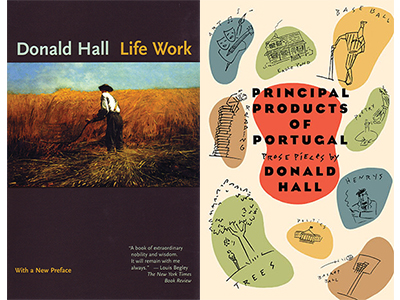
    Like most Americans who care about poetry and literature, I was saddened to learn that Donald Hall died this weekend. We were privileged to publish two of his books of prose: Life Work and Principle Products of Portugal.
    Life Work and Principal Products of Portugal

    When I first took over as director of the press in 1995, a poster for Life Work was proudly displayed in our offices, and it made me even happier to be a part of the press. Later, I was fortunate to meet Don and to chat with him about projects, on and off, though never quite lucky enough to publish any new work. His work is a gift to us all. I think often about one line of his, often quoted by a mutual friend, that resonates especially now: Work, love, build a house, and die. But build a house. The house that Donald Hall built is a mansion with room to embrace all readers. He will be missed.

    Here’s how others are remembering Donald Hall:

    “Mr. Hall was one of the leading poets of his generation, frequently mentioned in the company of Robert Bly, James Wright and Galway Kinnell. In evoking a bucolic New England past and expressing a deep veneration of nature, he used simple and direct language, though often to surreal effect.”
    —David Kirby, The New York Times

    “Hall said he saw no reason to spend life writing poems ‘unless your goal is to write great poems.’”
    —Jennifer Hijazi, PBS NewsHour

    “Some poets come to their art in youth, but few as early as Donald Hall. He made up his mind to be a poet when he was 14, began to write poems several hours a day, and never wavered from his calling in a long, prolific life.”
    —David Mehegan and Joseph P. Kahn, The Boston Globe


    About the Author 

    Helene AtwanHelene Atwan has been director of Beacon Press since 1995. She has been reading poetry all her life. Follow her on Twitter at @hatwan.

  • By Daina Berry

    Husbands, wives, and families sold indiscriminately to different purchasers, are violently separated ; probably never to meet again, 1853

    Source: New York Public Library

    We’ve watched the devastating news footage of immigrant children being separated from their families at the US-Mexico border and held in fenced cages as part of the Trump administration’s “zero tolerance” immigration policy. Twitter has been bristling with outrage. Hillary Clinton tweeted that “there’s nothing American about tearing families apart.” But separating families, especially families of color, has historical precedence. It’s an established American tradition. Going as far back as the slave trade, we learn that enslaved Black children experienced the same trauma on the auction block as today’s immigrant children. Just take a look at this passage from Daina Berry’s The Price for Their Pound of Flesh. Before writing off draconian policies issued from the White House as un-American, check your history.

    ***

    Many enslaved children have vivid memories of the sale experience. Marlida Pethy of Missouri recalled that when she was “nine or ten years old,” she was “put up on de block to be sold.” Of the stand, she recalled, “It was just a piece cut out of a log and [it] stood on [one] end.” Her recollection about her price is even more telling: “Dey was offered $600 but my mistress cried so much dat master did not sell me.” The mistress’s attachment to her human property was so great in this case that the family decided not to sell Marlida. Such interventions were not always successful or helpful. Several enslaved people reported that their mistresses were as violent and sadistic as their husbands. In this case, we do not know if Marlida preferred to remain with her mistress. All we know is that Marlida was not sold and that, decades later, she remembered the monetary value she carried at auction. It made a deep impression on her young mind.

    The sounds, sights, and smells of slave auctions contributed to the horror of enslaved children’s lives. Loud, rhythmic bid calls echoing from the mouths of auctioneers competed with chatter from potential buyers, the rattling of chains, and the everyday noises of a town center. Joining these audible oddities was another unpleasant sound that could be heard above all others at the end of a sale: the cries of wailing mothers, overcome with grief after being separated from their children.

    At that moment, all children understood their status and experienced, for the first time and likely not the last, the overwhelming heaviness of loss. Some parents had protected their children from the realities of enslavement, allowing them the innocence of childhood. However, at auction, the point of separation, children witnessed the full intensity of their parents’ distress. The breaking up of families was devastating for the enslaved and also for some others who witnessed it. For many abolitionists, particularly visitors to the Deep South, the sound of shrieking mothers and crying babies and the sight of confused and frightened children were too much to bear. During one Louisiana auction where 149 enslaved people were sold at once, a Northern abolitionist said that none of the enslaved people would “raise his or her head and eyes” to gaze out at the potential buyers in the audience. “Some poor girls,” overcome with emotion, were “weeping audibly and are all looking sad—sad—sad!”

    Many enslaved adults recalled horrific experiences on the auction block. Charles Ball was four years old when separated from his mother. On the day of his sale, he “was naked” and never owned any clothes. His new owner dressed him, but Ball vividly recalled that his “poor mother,” who knew it might be the last time she saw her son, “ran after” him. She took him “down from the horse” and held him tight, then “wept loudly and bitterly” over him. When it was time for him to leave, she “walked along the road beside the horse,” pleading with the owner not to take her son. After being physically separated, his mother was whipped, and Ball remembered “the cries of my poor parent” as they became less audible the further he traveled. Despite the fading sounds of her cries, and as “young as I was,” Ball explained, “the horrors of that day sank deeply into my heart, and even at this time though half a century has elapsed, the terrors of the scene return with painful vividness.”

    In countless descriptions of auction scenes, auctioneers cannot be heard over the cries of enslaved parents. W. L. Bost of North Carolina vividly remembered that, when he “was a little boy, ’bout ten years” old, a coffle of enslaved people stayed on his “place” on their way to a market. He saw that they “nearly froze to death” because they came in December before sales on the “first day of January.” The coffle included “four or five of them chained together.” It was so cold that he saw “ice balls hangin’ on to the bottom” of the women’s dresses. “All through the night,” Bost explained, “I could hear them mournin’ and prayin.’” He remembered hearing the auctioneer “cry ’em off” as they stood on the block and saw weeping mothers calling for their children and husbands.

    Witnessing these scenes as a boy had a profound impact on Bost’s young mind. He was thankful that his enslaver did not sell any of his human property. Seeing the yearly coffles was evidence that his family was fortunate. His memory of trading season included a critical analysis of the way enslaved people were treated like hogs and sheep. They were driven “jes like sheep in a pasture.” The speculators “rode on horses,” and when the enslaved were cold, “they make ’em run ’til they are warm again.” All of those for sale were kept “in the quarters jes like droves of hogs,” and during the night he heard them crying.

    Enslaved children learned to fear auctions, even if they were not initially separated from their parents. Anna Kentuck and her little boy, Armstead, three years old, were sold together for $1,950; however, the sale was later canceled, and the two approached the block a second time. One witness described “Armstead, the poor little boy” as “living proof” that “even little children can feel the atrocity of being thus sold.” As the second sale commenced, Armstead began to cry “most pitifully” and hid his face “under the white apron of his weeping mother.” The two cried together because they knew that ultimately they could be separated.

    Martha King also remembered being sold at five years old. She was placed on the auction block with her grandmother, mother, aunts, and uncles. “I can remember it well,” she told interviewers in the 1930s. “A white man ‘cried’ me off just like I was an animal or varmint or something.” King even recalled her monetary value: “Old man Davis give him $300.00 for me.” Their mothers’ reactions intensified enslaved children’s understanding of separation. They witnessed their mothers’ devastation and helplessness. Fathers, if they were recognized and present, desperately tried to make deals for their families to stay together. These efforts were difficult, because, although many sales began with instructions that families would not be separated, market needs trumped conditions of sale and families were often separated.

    As for W. L. Bost, we know that he was not sold, but he witnessed auctions and could recite bid calls decades later. “I remember when they put ’em on the block to sell ’em,” he noted. “The ones ’tween 18 and 30,” people considered prime, “always bring the most money.” The auctioneer, who stood away from the human chattel, “cry ’em off as they stand on the block.” Perhaps haunted by this scene, Bost said he could hear the auctioneer’s voice “as long as I live.”


    About the Author 

    Daina Berry is an associate professor of history and African and African diaspora studies, and the Oliver H. Radkey Regents Fellow in History, at the University of Texas at Austin. An award-winning historian, she is also a Distinguished Lecturer for the Organization of American Historians. She lives in Austin, Texas. Follow her on Twitter at @DainaRameyBerry and visit her website. 

  • By Clayborne Carson

    Dorothy Cotton

    Photo credit: File photo

    This was posted originally on the Stanford University King Institute website. 

    Dorothy Foreman Cotton, a prominent veteran leader in the human rights movement and a frequent visitor to the King Institute, passed away on June 10, 2018 in her home at Ithaca, New York. Throughout the 1960s, Cotton was the highest-ranking female member in the Southern Christian Leadership Conference (SCLC), directing the group’s Citizenship Education Program (CEP) at the peak of the Southern civil rights struggle. She held a position in Martin Luther King, Jr.’s inner circle of executive staff. In December of 1964, Cotton was part of the entourage that traveled to Oslo, Norway to celebrate King’s acceptance of the Nobel Peace Prize. 

    Cotton was an avid advocate of the notion that movements are built not by leaders but by those at the bottom, at the grassroots level. As she wrote in her 2012 memoir, If Your Back’s Not Bent: The Role of the Citizenship Education Program in the Civil Rights Movement, King emerged out of a movement beyond the control of any one leader: 

    . . . his voice was heard explaining, challenging, teaching, justifying protest actions—but he did not start the actions. The people were energized; the people acted. He did not tell Rosa Parks to keep her seat; he did not tell the four students in Greensboro, North Carolina, to take seats at the Woolworth’s lunch counter where Black people were not allowed to sit (though we could shop at every other counter in the store). He did not tell Fannie Lou Hamer and Annie Devine to demand the right to vote in the Mississippi Delta. He did not tell the Reverend Fred Shuttlesworth to take his bold action in Birmingham, Alabama, which was the catalyst for a hotbed of protest action and is still talked about around the world. 

    Born Dorothy Lee Foreman in 1930, Cotton spent her childhood in Goldsboro, North Carolina, where she and her three sisters were raised by their father, a tobacco factory worker, after the death of their mother in 1934. Upon graduating from high school, Cotton left for Shaw University in Raleigh, North Carolina, where she paid for her tuition by working as university president Robert Prentiss Daniel’s housekeeper. When he accepted a position as president of Virginia State College in Petersburg, Virginia, Cotton transferred there to complete her undergraduate degree in English and library science. She married George J. Cotton shortly after graduation before going on to complete her master’s degree in speech therapy at Boston University.

    In 1960, when King invited Walker to come to Atlanta to serve as SCLC’s executive director, Cotton joined the organization as Walker’s administrative assistant. Her work became more focused the following year, when she became SCLC’s educational consultant. Later, she was promoted to be the education director of the CEP in 1963. Cotton described her responsibility as helping “people realize that they have within themselves the stuff it takes to bring about a new order.” Actively teaching literacy, citizenship, and nonviolent protest tactics, Cotton motivated others to become registered voters and active political participants. She spent much of her time with the CEP, traveling throughout the South and conducting educational programs with Andrew Young and Septima Clark.

    As one of SCLC’s most important leaders, Cotton established a close relationship with King. In a telegram acknowledging his nomination for the Nobel Peace Prize, she expressed her admiration for “the seriousness and devotion with which you hold your noble charge.” Her relationship with King was not limited to SCLC work, as she pointed out that those working for the organization “were all friends as well as staff.” This friendship showed her a side of him that “was fun to be with . . . he was the life of the party.”

    As the sole female SCLC administrator, Dorothy Cotton often spoke candidly about the difficulties she faced dealing with the strong egos of the male ministers who dominated the organization. Ultimately, she gained their admiration and respect through her success in training local movement leaders, who were themselves often female. As her SCLC colleague Andrew Young recalled:

    Dorothy assumed a very natural role as everybody’s sister. The men began to relate to one another through her. The precise enunciation and elocution of her speech demanded that her opinions earn respect. Her charm and effusive personality inspired admiration and also kept potential male admirers at bay; her quick wit crushed many egos.

    Cotton retired from SCLC in 1972. Following her departure, she held jobs relating to public service and social action, including director of the federal Child Development/Head Start program of the Jefferson County Committee for Economic Opportunity in Birmingham, Alabama, and vice president for field operations at the King Center in Atlanta. In 1982, she accepted a position with Cornell University as the director of student activities. In the early 1990s, Cotton returned to her civil rights background and began leading seminars and workshops on leadership development and social change. She later became a founding member of the National Citizenship School, devoted to teaching the skills of creating publicly accountable institutions reflecting democratic ideals. During the 1990s, her many admirers established the Dorothy Cotton Institute in Ithaca, New York, to promote the cause for human rights. Most recently in 2012, Cotton published a memoir, If Your Back's Not Bent: The Role of the Citizenship Education Program in the Civil Rights Movement, in which she documented the cruciality of finding power at the grassroots level. She captured the power of extraordinary teachers who reminded ordinary people that they could and should take action in the struggle against racial oppression. 


    About the Author 

    Clayborne CarsonClayborne Carson is professor of history at Stanford University, the founding director of the Martin Luther King, Jr., Research and Education Institute, and director of the King Papers Project. The author and editor of numerous books, he is general editorial advisor to The King Legacy and lives in Palo Alto, California. Follow him Twitter at @ClayborneCarson and visit his website.

  • A Q&A with Mary Frances Berry and Adam Eichen

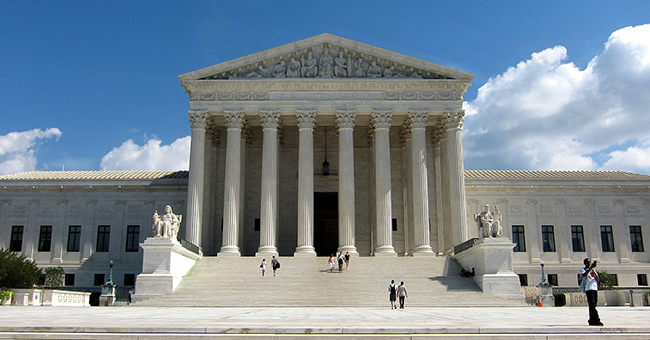
    US Supreme Court Building

    Photo credit: AgnosticPreachersKid

    “Just won big Supreme Court decision on Voting! Great News!” That’s what Donald Trump tweeted from Singapore when the Supreme Court ruled, on June 11, that Ohio could purge voting rolls of people who hadn’t cast ballots in a while. This means that someone would have to register once again to vote. And the Supreme Court’s ruling concluded that Ohio’s voter purge system does not violate federal laws. Other states plan to follow Ohio’s example. What are the implications of this, especially for midterm election season? Our blog editor Christian Coleman asked Mary Frances Berry, author of Five Dollars and a Pork Chop Sandwich, and Adam Eichen, co-author of Daring Democracy, to find out. 

    Christian Coleman: So why did the Supreme Court vote in favor of allowing voter purges in Ohio? 

    Mary Frances Berry: The Court Republican majority simply joined the effort to remove people who would likely vote for Democrats from the rolls. However, even if registered voters don’t vote, there is no compelling reason to remove them from the rolls.

    Adam Eichen: I won’t speculate on the Court’s ulterior motivations in Husted v. A. Philip Randolph Institute, but this case certainly appeared to use statutory interpretation to green light discriminatory voting policy.

    Some context about the case: In Ohio, when someone does not vote in a federal election, that person is sent a notice in the mail to confirm that they still reside at the same address. If the individual fails to return the mailer and does not vote in subsequent two federal elections, he or she will be removed from the voter rolls.

    Very few people respond to these mailers. According to Justice Breyer, who dissented, only 235,000 out of 1.5 million postcards were returned in 2012. Ohio’s Republican Secretary of State, Jon Husted (after whom this case is named) admitted that over 2 million voters were removed from the rolls from 2011 to 2016. (Ohio is one of six states that uses failure to vote as a means of starting the purge process—the only one that does it after missing only one federal election cycle.)

    The Supreme Court had to decide whether this purging process violated the National Voter Registration Act (and the subsequent Help America Votes Act), which explicitly says “no registrant may be removed solely by reason of a failure to vote.”

    The Court ultimately ruled that Ohio’s voter purge system “treats the failure to return a notice and the failure to vote as evidence that a registrant has moved, not as a ground for removal.” In other words, since the purges don’t take place solely on the basis of non-voting, it’s acceptable. As Demos’ Chiraag Bains retorts, “This logic ignores Congress’s own statement when passing the NVRA that people should not be removed ‘due to their failure to respond to a mailing.’”

    So what does this decision mean? To put it bluntly: vulnerable communities will be purged from voter rolls at disproportionately high rates. Justice Sotomayor aptly put it in her dissent that the Court’s ruling “entirely ignores the history of voter suppression against which the NVRA was enacted and upholds a program that appears to further the very disenfranchisement of minority and low-income voters that Congress set out to eradicate.”

    CC: Is the voter purge another form of voter suppression, and if so, are there other examples of this happening in recent history? 

    MFB: Shades of Bush v Gore when the Supreme Court handed the 2000 election to George W. Bush by permitting widespread voter suppression, including purges in Florida. Justice Scalia explained that the court majority refused a recount just to end the dispute. He repeatedly expressed the view that people should just “get over it.” But there were numerous denials of the right to vote that went unremedied. The United Civil Rights Commission’s 2001 report showed the right to vote was violated not just by what ballots were not counted but also that likely Democratic voters who were registered were told they were not and prevented from voting, disabled people in wheelchairs were assigned to inaccessible polling places (one had a big ditch outside).

    In recent years, we have examples of states enforcing strict ID laws; closing polling places on Sunday, which had been prime voting day for some black church goers; understaffing, leading to long lines that discouraged voters; moving polling places at the last minute; closing down some registrar offices all to suppress the vote, mainly of Blacks and Latinos.

    AE: Liberals and conservatives alike should agree: Verifying and updating voter rolls is a necessary part of our elections system. And our voter rolls are often out-of-date—after all, people move or pass away every day.

    But ordinary list maintenance is different than aggressive voter purging, especially one, like Ohio’s, that is premised on “use it or lose it.” This kind of “list maintenance” is nothing more than voter suppression of vulnerable groups.

    There are many ways to assure well-maintained lists, such as implementing automatic voter registration—which updates a citizen’s registration with every eligible governmental interaction. There is no need for aggressive and wanton purging to clean up our voter rolls.

    Purging, though, is just one sliver of American voter suppression tactics. Since the Supreme Court gutted the Voting Rights Act in 2013, states are increasingly passing discriminatory election laws such as voter ID requirements, reduction of polling places, and burdensome voter registration restrictions. To put it bluntly, voter suppression is ubiquitous.

    CC: Republicans are arguing that they’re trying to promote ballot integrity and prevent voter fraud. Is voter fraud the real issue here? 

    MFB: No. Voter fraud is rare, but the fraud that exists consists mainly of buying votes in exchange for favors, not ID fraud or any of the other false claims Republicans make. Vote-buying is done by campaigns in both parties, because the real voting problem is voter turnout, which remains abysmal. People who are registered and are in places where violence or economic pressure doesn’t prevent them from voting don’t vote because they aren’t interested in the candidates they are offered and think voting doesn’t help them or their communities. An elderly Black woman I describe in my book, Five Dollars and a Pork Chop Sandwich, whose vote politicians routinely bought, described the process to her state voter fraud investigator. Politicians promise to do something, and they never do what they say, but she voted because at least she could count on being given a small amount of money and a sandwich and cold drink after she voted.

    AE: Of course not. There is no evidence of widespread voter fraud. Period. Study after study proves as much. Again, updated voter rolls are integral, but not at the expense of purging voters. This is about increasing the odds—even if only slightly—to win elections.

    CC: Since midterm season is here, what can voters do to make sure they get their voices heard? 

    MFB: Register if they haven’t already and help other people to register who need help with ID or travelling to the registrar’s office. Vote in state and local elections where the rules that lead to disfranchisement are made. Pick candidates who at least promise to do what they think is important, vote, and then remember who is elected and hold them accountable. Even if your candidate loses, hold the winner accountable. They still have a responsibility to implement the duties of the office. It’s not unusual for people not to even know who their elected office-holders are. Vote based on policy, not personalities.

    AE: Register everyone you know to vote and then vote. Elections, for better or worse, are a moment to reshape the political landscape—to remake what is politically possible.

    But voting is not enough. Even if we were to elect an entirely new Congress, the same institutional pressures—the need to raise money to run for office, lobbyists flooding politicians with corporate-sponsored white papers, a voting system that produces an unrepresentative electorate—will remain. The America that we collectively want will remain unattainable because our broken democratic system will continue to distort popular opinion.

    So, I urge everyone to join organizations that fight for meaningful democracy reforms (The Field Guide to Democracy Movement offers a list of relevant groups). Every state needs to do better—even the Democratic ones. We must all demand—and I truly mean demand—pro-democracy policies, such as automatic voter registration, same-day registration, pre-registration for sixteen year olds, public financing of elections, independent redistricting commissions, and ranked choice voting.

    For these midterms, there will also be pro-democracy initiatives on the ballot in states across the country. If there is one in your state, ensure its passage. If there isn’t, develop creative ways to make democracy reform central in every local, state, and federal election.

    A better democracy is possible if enough people demand it.


    About Mary Frances Berry and Adam Eichen 

    Mary Frances BerryMary Frances Berry is the Geraldine R. Segal Professor of American Social Thought and professor of History and Africana Studies at the University of Pennsylvania. She is the former chairwoman of the US Commission on Civil Rights, a Distinguished Fellow of the American Society for Legal History, the author of twelve books, and the recipient of thirty-five honorary degrees. Dr. Berry has appeared on Real Time with Bill Maher, The Daily Show, Tavis Smiley, PBS NewsHour, CBS Evening News, Al Jazeera America News, and various MSNBC and CNN shows. She is the author of History Teaches Us to Resist: How Progressive Movements Have Succeeded in Challenging Times. Follow her on Twitter at @DrMFBerry and visit her website.


    Adam EichenAdam Eichen is the Communications Strategist at Equal Citizens and a Democracy Fellow at the Small Planet Institute, cofounded by Frances Moore Lappé. He is the co-author of Daring Democracy: Igniting Power, Meaning, and Connection for the America We Want. Follow him on Twitter at @AdamEichen.

  • By Carlos A. Ball

    Masterpiece Cakeshop

    Masterpiece Cakeshop. Photo credit: Jeffrey Beall

    The Supreme Court’s recent ruling involving the Colorado baker who refused to make a wedding cake for a same-sex couple reminds me of its decision almost fifty years ago to reverse Muhammad Ali’s conviction for refusing to be inducted into the Army. In 1967, when Ali was the professional heavyweight boxing champion of the world, he refused to join the Army on the ground that he was a conscientious objector. At the time, federal prosecutors claimed he was not entitled to the exemption from military service because his objections to fighting in the Vietnam War were not sincere. By the time the case reached the Supreme Court four years later, the government had changed its legal position, and was now arguing that although Ali’s religious objections to serving in the military were held in good faith, he was not entitled to the exemption because he had not proven that he objected to participating in any war, as opposed to only those armed conflicts that he deemed unjust.

    The Supreme Court, after accepting the boxer’s appeal, had a dilemma on its hands: reversing Ali’s conviction might make it possible for thousands of other men to also claim conscientious objector status as a way of refusing to serve in a controversial and unpopular war. In the end, a unanimous Court overturned Ali’s conviction. But it did so in such an exceptionally narrow way that it made it extremely unlikely that other exemption claimants would be able to use Ali’s victory as a legal precedent.

    The justices based their reversal on the procedural ground that the federal government had taken inconsistent positions in the case, first claiming that Ali’s religious objections to war were not sincere, but then conceding that the boxer was acting in good faith. The government’s change in position, the Court concluded, was enough to vacate Ali’s criminal conviction because it rendered unclear the government’s reasons for denying him the exemption.

    Similarly, when the Supreme Court in Masterpiece Cakeshop v. Colorado Civil Rights Commission recently sided with the baker who refused to make a wedding cake for a gay couple, it did so in an extremely narrow way. The couple had sued under a Colorado law that prohibits places of public accommodation, including most businesses, from discriminating on the basis of sexual orientation. In defending himself from the lawsuit, the baker claimed that the First Amendment’s protections of free speech and the free exercise of religion granted him a constitutional right to continue baking wedding cakes for heterosexual couples, but to refuse to do so for same-sex ones. The baker argued that being required to bake a cake for gay couples forced him to publicly support same-sex marriages in contravention of his religious views.

    As I explain in my book The First Amendment and LGBT Equality, the Supreme Court has never recognized the notion that the owners of for-profit businesses have a constitutional right to discriminate. As Justice Sandra Day O’Connor put it in a case involving gender discrimination, “the Constitution does not guarantee a right to choose employees, customers, suppliers, or those with whom one engages in simple commercial transactions, without restraint from the State. [For example], a shopkeeper has no constitutional right to deal only with persons of one sex.” Had the Supreme Court accepted the baker’s constitutional argument in Masterpiece Cakeshop, it would have made it possible for a large number of religious business owners to refuse to abide by the same antidiscrimination laws that apply to everyone else.

    It is worth noting that the baker’s legal argument was not intended to protect (1) only certain religious objections to serving (2) only some classes of individuals. Instead, recognizing the baker’s constitutional claim would have laid the foundation for making it possible for any defendant in any discrimination case—whether involving a claim of racial, sex, religious, disability, sexual orientation, or gender identity discrimination—to use religious views as a shield against the enforcement of laws applicable to everyone else.

    Rather than holding that the Constitution granted the baker a right to refuse serving certain segments of the population because of his religious views, the Supreme Court instead ruled on his behalf in an extremely narrow way. In doing so, the Court reasoned that statements made by two members of the seven-member Colorado Civil Rights Commission could be understood to reflect prejudice on the basis of religion, therefore depriving the baker of a fair opportunity to have his legal case adjudicated by an impartial governmental body.

    As other commentators have pointed out, it is not at all clear that the two statements in question constitute evidence of religious prejudice. Among other things, they pale in comparison to statements made by Donald Trump about the need to ban Muslim immigrants from entering the United States. But be that as it may, it is difficult to imagine how the Court could have sided with the baker in a narrower way. As with the Muhammad Ali case from the early 1970s, the Court in Masterpiece Cakeshop sided with the religious litigant against the government based solely on the procedural history of the case. This makes it impossible for social and religious conservatives to claim, as a substantive matter, that the ruling shields other religious employers, landlords, or business owners from having to abide by antidiscrimination obligations.

    At the same time, the Court, speaking through Justice Anthony Kennedy, recognized two principles that are crucial to protecting LGBT people from discrimination going forward. First, the Court reaffirmed the general rule that religious objections “do not allow business owners and other actors in the economy and in society to deny protected persons equal access to goods and services under a neutral and generally applicable public accommodations law.” Second, the Court recognized that religious exemptions allowing business owners to deny LGBT people goods and services stigmatizes and harms sexual minorities. As Kennedy explained, if such exemptions are “not confined, then a long list of persons who provide goods and services for marriages and weddings might refuse to do so for gay persons, thus resulting in a community-wide stigma inconsistent with the history and dynamics of civil rights laws that ensure equal access to goods, services, and public accommodations.”

    In short, while the baker in Masterpiece Cakeshop may have won his particular battle, the social and religious conservatives who supported his cause may have lost the war. The Supreme Court chose to decide the dispute as narrowly as possible, as it did in the case of the world’s most famous boxer almost fifty years ago, while reaffirming basic principles about the need to limit religious exemptions when applying antidiscrimination laws.

    Few people today remember Muhammad Ali’s case before the Supreme Court (including apparently President Trump, who recently suggested that Ali should be pardoned despite the fact that, after the Court’s ruling in the early 1970s, there is nothing to pardon.) Similarly, it is entirely possible that fifty years from now few people will remember that the Colorado business owner who refused to bake a wedding cake for a same-sex couple also won his case before the Supreme Court.


    About the Author 

    image from www.beaconbroadside.comCarlos A. Ball is Distinguished Professor of Law at Rutgers University. His most recent book is The First Amendment and LGBT Equality. He is also the author of From the Closet to the Courtroom. His next book, The Queering of Corporate America, will be published next year by Beacon Press.

  • Invisible No More - Say Her Name Week of Action

    Sandra Bland. Rekia Boyd. Decynthia Clements. Chikesia Clemons. Mya Hall. These Black women’s lives and others have been tragically cut short because of police brutality and the criminal justice system. This level of violence hasn’t stopped. It’s high time to take a stance. During this year’s #SayHerName National Week of Action to End Violence Against All Black Women and Girls (June 11 through 17), Beacon Press is pleased to announce that all profits from this week’s sales of Andrea Ritchie’s groundbreaking Invisible No More: Police Violence Against Black Women and Women of Color will be donated to Black Youth Project 100.  

    As a mission-driven publisher that seeks to promote justice, equity, and compassion in human relations through the books it produces, we find it more important than ever to highlight Ritchie’s book and the important work she’s doing to raise awareness around radically rethinking our visions of safety—and the means we devote to achieving it. Her work has uncovered sobering statistics, as seen during her Twitter town hall conversation on June 12:

    INMB - Twitter Town Hall 1

    INMB - Twitter Town Hall 2

    Follow Ritchie and Invisible No More on Twitter to stay up-to-date on this weeks’ events and to find out what you can do to support the movement to end violence against all Black women—cis-, transgender, and gender nonconforming—and girls. Visit the book’s website for resources and information on how to take action. And if you haven’t done so already, buy a copy of Invisible No More!

    Beacon Press is an independent publisher of serious non-fiction. Our books often change the way readers think about fundamental issues; they promote such values as freedom of speech and thought; diversity, religious pluralism, and anti-racism; and respect for diversity in all areas of life.

  • By Richard Blanco

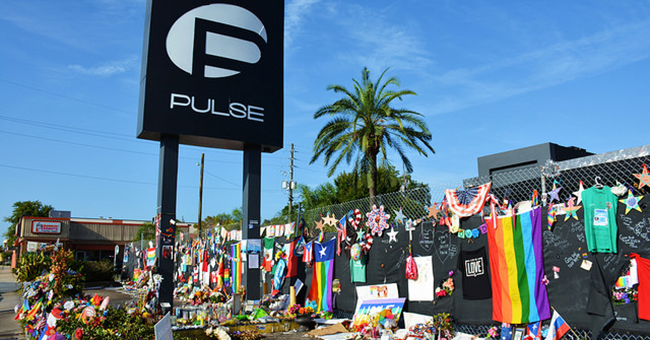
    Memorials left at the Pulse nightclub in Orlando, Florida

    Memorials left at the Pulse nightclub in Orlando, Florida. Photo credit: WalterPro

    Two years ago, the mass shooting at the gay nightclub Pulse in Orlando, Florida, took the lives of forty-nine people and left fifty-three others wounded. Pulse was hosting a “Latin Night,” and most of the victims were Latinx. In response to the tragedy, 2013 inaugural poet Richard Blanco wrote “One Pulse—One Poem.” His poem was collected in the poetry anthology Bullets into Bells: Poets & Citizens Respond to Gun Violence, a moving testament to the urgent need for gun control. Today, we share with you the full text of his tribute to Orlando.

    ***

    To honor the lives and memory of the victims
    of the Pulse tragedy, and to help us all heal.


    Here, sit at my kitchen table, we need to write this
    together. Take a sip of café con leche, breathe in
    the steam and our courage to face this page, bare
    as our pain. Curl your fingers around mine, curled
    around my pen, hold it like a talisman in our hands
    shaking, eyes swollen. But let’s not start with tears,
    or the flashing lights, the sirens, nor the faint voice
    over the cell phone when you heard “I love you . . .”
    for the very last time. No, let’s ease our way into this,
    let our first lines praise the plenitude of morning,
    the sun exhaling light into the clouds. Let’s imagine
    songbirds flocked at my window, hear them chirping
    a blessing in Spanish: bendición-bendición-bendición

    Begin the next stanza with a constant wind trembling
    every palm tree, yet steadying our minds just enough
    to write out: bullets, bodies, death—the vocabulary
    of violence raging in our minds, but still mute, choked
    in our throats. Leave some white space for a moment
    of silence, then fill it with lines repeating the rhythms
    pulsing through Pulse that night—salsa, deep house,
    electro, merengue, and techno heartbeats mixed with
    gunshots. Stop the echoes of that merciless music
    with a tender simile to honor the blood of our blood,
    without writing blood. Use warm words to describe
    the cold bodies of our husbands, lovers, and wives,
    our sisters, brothers, and friends. Draw a metaphor
    so we can picture the choir of their invisible spirits
    rising with the smoke toward disco lights, imagine
    ourselves dancing with them until the very end.

    Write one more stanza—now. Set the page ablaze
    with the anger in the hollow ache of our bones—
    anger for the new hate, same as the old kind of hate
    for the wrong skin color, for the accent in a voice,
    for the love of those we’re not supposed to love.
    Anger for the voice of politics armed with lies, fear
    that holds democracy at gunpoint. But let’s not
    end here. Turn the poem, find details for the love
    of the lives lost, still alive in photos—spread them
    on the table, give us their wish-filled eyes glowing
    over birthday candles, their unfinished sand castles,
    their training-wheels, Mickey Mouse ears, tiaras.
    Show their blemished yearbook faces, silver-teeth
    smiles and stiff prom poses, their tasseled caps
    and gowns, their first true loves. And then share
    their very last selfies. Let’s place each memory
    like a star, the light of their past reaching us now,
    and always, reminding us to keep writing until
    we never need to write a poem like this again.

    ***

    Look for “One Pulse—One Poem” in Blanco’s upcoming poetry collection How to Love a Country in March 2019!


    About the Author 

    Selected by President Obama to be the fifth inaugural poet in history, Richard Blanco joined the ranks of such luminary poets as Robert Frost, Maya Angelou, Miller Williams, and Elizabeth Alexander. Standing as the youngest, first Latino, first immigrant, and first openly gay person to serve in such a role, he read his inaugural poem, “One Today,” as an honorary participant in the official ceremony on January 21, 2013. Blanco was made in Cuba, assembled in Spain, and imported to the United States, meaning that his mother, seven months pregnant, and the rest of the family arrived as exiles from Cuba to Madrid, where he was born. Only forty-five days later the family emigrated once more and settled in Miami, where Blanco was raised and educated. The negotiation of cultural identity and universal themes of place and belonging characterize his three collections of poetry, which include City of a Hundred Fires (awarded the Agnes Starrett Poetry Prize from the University of Pittsburgh Press), Directions to the Beach of the Dead (recipient of the Beyond Margins Award from the PEN American Center), and Looking for The Gulf Motel (winner of the Patterson Poetry Prize, a Maine Literary Poetry Award, and the Thom Gunn Award). His poems have also appeared in the Best American Poetry, and Great American Prose Poems series, and he has been featured on CBS Sunday Morning, and National Public Radio’s All Things Considered and Fresh Air, as well as major US and international media, including CNN, Telemundo, AC360, the BBC, Univision, and PBS. Blanco is a fellow of the Bread Loaf Writers Conference, recipient of two Florida Artist Fellowships, and a Woodrow Wilson Visiting Fellow. A builder of cities as well as poems, he is also a professional civil engineer currently living in Bethel, Maine. Follow him on Twitter at @rblancopoet and visit his website. 

  • By Ben Mattlin

    WheelchairWhy should the idea of an interabled couple be considered either noble or tragic? It shouldn’t. Born with spinal muscular atrophy and married to an able-bodied wife, Ben Mattlin sets out to show us in In Sickness and In Health that interabled couples are not as unusual as onlookers seem to think. While these couples have to untangle issues of dependency and need, patience and generosity, commitment and autonomy, and other hard-to-define dynamics, they have an intimacy all their own and love as anyone else. This is especially true of lesbian couple Christina and Janet, who are profiled in his book. This Pride month, we’re sharing selections of Mattlin’s interview of them in which he asks them about the challenges and joys of their long-term relationship.

    ***

    Here’s what I know going in: Christina, sixty-two at the time we speak, is a professor of English and feminist, gender, and sexuality studies at Wesleyan University, in Middletown, Connecticut, and author of the memoir A Body, Undone: Living On After Great Pain. In October 2003, she suffered a severe bicycling accident—a twig got caught in one of her spokes, sending her flying. Yes, a twig. “My chin took the full force of the blow, which smashed my face and broke the fifth and sixth cervical vertebrae in my neck,” she writes. “The broken bone scraped my spinal cord.” The hyperextension of her neck caused an “incomplete” (meaning her spinal cord was scraped, not severed) injury at the C5–C6 level. Today, she has severe paralysis in her trunk and legs, with just enough function in her arms and hands to drive an adapted minivan. She uses a standard wheelchair, speaks clearly, although her breathing is sometimes strained, and has zero bladder or bowel control. She also copes with ongoing physical pain throughout her body.

    At the time of the accident, she and Janet had already been living together for six years. Janet, seven years Christina’s junior, is a professor of women’s, gender, and sexuality studies at Columbia University’s Barnard College, in New York City. So when we first speak, they’ve been an item for more than nineteen years. Neither is interested in getting legally married, however, given the connubial history of paternalism, as Christina explains in her book—the “contracting” of a wife as a man’s personal property. Furthermore, they say, they’re not keen on turning a private, voluntary commitment into a government-validated obligation.

    I understand, but it makes me smile. After so many have fought so hard and so long for marriage equality, which this couple supports, the institution itself still isn’t to everyone’s taste. The right to marriage isn’t an obligation to marry, after all. Still, it’s only fair to have the option. Equal access, freedom of choice—the principles go hand-in-hand.

    ~~~

    How do they handle the frustrations? What keeps them from bickering with each other over these and other shared aggravations? Their answers are complex and surprising. “One of the traits that helps is generosity,” says Janet. “And of the two of us, Christina is the more generous, since she has to be patient pretty much all the time.”

    I work this idea through my brain. Does it count as generosity if she really has no choice?

    Janet goes on: “She has to decide whether to tell me about her needs. She has to be patient if I’m not able to help right away or if I don’t understand. That takes generosity, and there are all kinds of things she has to be generous about as we go through the day and I try to assist her.”

    ~~~

    To understand better how they balance Christina’s requests and Janet’s constraints of time and patience, I bring up the example of the crooked window shades from Christina’s book. Christina says the way they’ve negotiated through such “rough spots” is by implementing what she dubs the feminist notion of process. “It’s important to go over what happened,” she explains, “to ask, What just happened? And try to figure it out and not just brush it away or get over it or try not to have it happen again. To look at it and understand the process. That way, every fight becomes a learning experience, and conflicts can actually bring us closer.”

    They learned to do this—separately, pre-relationship, and together—by working with feminist organizations that were “run by consensus,” Christina says. For instance, as a graduate student she worked with a group that ran a shelter for battered women. “A collective,” she corrects herself, “that had our meetings by consensus.”

    Into my speakerphone, I read aloud a passage from Christina’s book: “It’s a testament to the sheer durability of our feelings for each other that the love that was so vital and alive before the accident survived without a scratch.” Then I say, “A lot of couples feel deep love but can’t stay together after a traumatic event like yours. So does love alone explain your longevity as a couple?”

    “Well, there are other qualities that shore us up. Financial resources, for one,” answers Christina. “We have money to pay for help, which many others don’t.”

    Christina is able to manage on her own through most of the day, but her aide, Donna, comes every morning for about four hours to help her get showered and dressed. Donna also administers her twice-weekly bowel program—manually flushing out shit—and changes her suprapubic catheter every two weeks, which is the external cath for voiding the bladder. Donna helps with occasional “stander” therapy too, getting Christina into and out of a device that locks her into a vertical position for a time, to improve her circulation and bone density, among other purported benefits. “But once I get to my computer, Donna can leave [and] I go to work,” says Christina. Some days Christina has to leave the house to teach a class or attend a faculty meeting. “When I come home, there’s nobody there. I get my own food and put myself to bed.”

    Donna has been helping Christina since she got out of the hospital twelve years ago. I’ve never had a personal-care assistant last anywhere near that long. They clearly have a good relationship. But when Christina is in New York, or when Christina and Janet travel, Janet does all the personal care. So I ask if they ever wish they had more hired help—or less, for that matter, for more privacy. “Always the trade-off,” Christina muses, without really answering.

    “We’re truly fortunate,” says Janet then. “The balance between getting help and maintaining privacy is probably the best it can be, given Christina’s needs.”

    ~~~

    Christina and Janet own up to having other advantages as well. “The material structure of our lives is extremely helpful,” says Janet. “We both have flexible jobs, so I can shift my teaching schedule to afternoons and do care for her in the mornings. That kind of thing.”

    They also credit ongoing support from family and friends. Yet surely not everybody has been supportive, I say, having heard about and experienced enough awful behavior to know what I’m talking about. But Christina insists no one who knows them has expressed surprise over their staying together post-injury. “What about strangers?” I query, undeterred.

    “It’s true, our union isn’t always immediately legible,” Christina allows. “One of the things I hate most is when we’re not taken as a sexual couple.” This was often the case even before her injury. Perhaps they don’t fulfill enough lesbian stereotypes for some observers to see them as sexual partners. (In her book, Christina jokingly refers to herself as “butch-femme” and Janet as “femme-butch,” a distinction without much difference and utterly lost on the general public.) What’s different now is some strangers make too much fuss. “The inspirational stuff is just ghastly,” is how Christina puts it.

    When strangers misjudge their relationship, neither Christina nor Janet makes much of it, typically. But there are exceptions. “It depends how much energy we feel like exerting,” says Janet. “I couldn’t even tell you what the triggers are for me.” But she has reacted when people park in accessible spaces without a placard. “That’s not just a personal affront—it’s making life harder for everybody with a disability,” she explains.

    ~~~

    Later, Janet lets me know that there may have been some who doubted the strength of their union. She doesn’t say so directly, but I infer it from the way she harps on the point that certain aspects of their lives—of their personalities—are immutable and nonnegotiable. “You can’t say, ‘Now that Christina’s disabled, you’ll find some other lover,’” she says, quoting what somebody must’ve said to her at some point. “Well, no. That doesn’t change. I love Christina. Christina is my lover.”

    As she talks, I’m reminded of when my mother told me as a child about the painter Christy Brown, made famous in the Oscar-winning movie My Left Foot. “He couldn’t hold a paintbrush with his hand, but that didn’t stop him from painting,” Mom said. “He painted with the only limb he could control: his left foot.” The moral: disability doesn’t change who you are, or whom you love.

    ~~~

    Perhaps nothing else matters more than the commitment to making it work. It seems I keep coming to this conclusion: people stay together because they wish and resolve to stay together. 

    In the days that follow, as I review my recordings and notes, my assessment shifts somewhat. Perhaps a loving commitment can conquer all, but clearly it helps if it’s armed with communication, patience, generosity, and financial resources. The lesson I glean from Christina and Janet comes in two parts: use the tools you’ve got, and value the process.


    About the Author 

    Ben Mattlin is the author of Miracle Boy Grows Up and In Sickness and In Health: Love, Disability, and a Quest to Understand the Perils and Pleasures of Interabled Romance, and a frequent contributor to Financial Advisor magazine. His work has appeared in the New York Times, Los Angeles Times, Washington Post, Chicago Tribune, USA Today, and Vox, and on NPR. He lives in Los Angeles, California. Follow him on Twitter at @benmattlin and visit his website.

  • By Fred Pearce

    Grapevines growing in La Geria, Lanzarote, Spain

    Grapevines growing in La Geria, Lanzarote, Spain

    The rivers of lava flowed with no apparent end. And then came the earthquakes. Hawai’i’s Kilauea Volcano had been erupting since mid-May. It’s entered a quiet phase now, but what happens next remains uncertain. What’s certain is the damage left in its wake. Similarly, the Canary Island of Lanzarote experienced violent volcanic eruptions nearly nonstop for five consecutive years. This happened three centuries ago. But instead of causing massive destruction, Lanzarote’s eruptions laid the foundation of a rejuvenated agriculture. The following passage from the upcoming revised edition of Fred Pearce’s When the Rivers Run Dry: Water—The Defining Crisis of the Twenty-First Century describes the marvelous benefits the black volcanic stones of the eruptions brought to the island.

    ***

    Lanzarote, an island off the west coast of Africa, was a tranquil place in the eighteenth century, ruled by Spanish priests and visited occasionally by ships making the transatlantic crossing. Farming was rudimentary and the living poor. The island had less rain than much of the Sahara desert. Then came a series of massive volcanic eruptions that shook the island almost without a break from 1730 to 1735. A priest described how, at the height of the eruptions, “the earth suddenly opened… a gigantic mountain rose and sank back into its crater on the same day, covering the island with stones and ashes”.

    It could have been the end for the island’s inhabitants. Yet, far from obliterating its life, the eruptions provided the key to the island’s future prosperity. The black volcanic stones noted by the priest launched a bizarre agricultural revolution. As the farmers returned to their fields, and contemplated the task of removed the stones, they noticed something odd. In the areas covered by stones, their crops were bursting forth, whereas elsewhere they were not. It didn’t take the farmers long to discover why. The black pumice-like stones had shaded the soil from the glare of the sun, reducing evaporation and keeping the soils damp. They were also porous and trapped moisture by capturing night-time dew. We now know the stones—which the local people called picon—cut water loss from the often-parched fields by around seventy-five percent. New crops would grow in the soil, including fruit and vegetables, provided there was a layer of picon at the surface. 

    Soon the farmers were importing camels from Mauritania to haul stones to fields that had not benefited from the eruptions. Formerly useless hillsides were cleared of brush, cut into terraces, covered in picon and planted with vegetables. By 1776, an anonymous chronicler was recording a “prodigious mutation” of farming on the island. “Marvels abound, with the land being more fertile, becoming fruitful and bearing fruit two or three times a year. Like sponges, the picon soaks up the water, and the crops receive a delicate, gentle watering,” he wrote. “Before the eruptions in 1730, the most the island produced was bread and beef; now on the strength of the picon, it produces grapevines, vegetables, maize, potatoes, pumpkins and other produce.”

    Exports of surplus produce began. Grapes did particularly well. The farmers grew prickly pears for the cochineal insects that infested them. The insects are deep crimson inside, and the islanders scraped up the insects with a spoon, dried and ground them, before selling the vivid crimson remains as a dye. Cochineal harvesting was big business in Lanzarote in the nineteenth century, before the advent of synthetic dyes.

    The stones revolutionized agriculture. Their water catching abilities remain vital on an island with no permanent rivers, few underground water reserves and rainfall averaging just thirty-seven inches a year. Nowadays, most of Lanzarote’s population make their living from the two million tourists who visit each year. But the black fields produce nearly half a million gallons of wine a year. Lanzarote cochineal is still used in everything from lipstick to strawberry milkshake and Campari. 

    Farmers reckon fields need to be replenished every thirty to fifty years, as the stones become mixed into the soil. But there are still plenty to go round. “Virtually all cultivated fields in Lanzarote still have a layer of picon today,” says David Riebold, a British forestry scientist on the island, who showed me round. “Without picon, you couldn’t grow crops in most places.”

    The technology has some precedents. It seems the prehistoric inhabitants of Easter Island in the Pacific used mulches of volcanic stones to trap moisture, especially after they had destroyed their forests. Some farmers in arid western China cover their fields with gravel from river beds to cut down evaporation. But, like the dew ponds on England, picon remains a remarkably local hydrological phenomenon that goes largely unnoticed both by the world’s agriculturalists and by the millions of tourists taking the sun on this very unusual desert island.

    ***

    Look for Fred Pearce’s When the Rivers Run Dry: Water—The Defining Crisis of the Twenty-First Century this August!


    About the Author 

    Fred PearceFred Pearce has reported on environmental, science, and development issues from eighty-five countries over the past twenty years. Environment consultant at New Scientist from 1992 to 2018, he also writes regularly for the Guardian newspaper and Yale University’s prestigious e360 website. His many books include The New Wild, When the Rivers Run Dry, With Speed and Violence, Confessions of an Eco-Sinner, The Coming Population Crash, and The Land Grabbers.