• By Rebecca Todd Peters

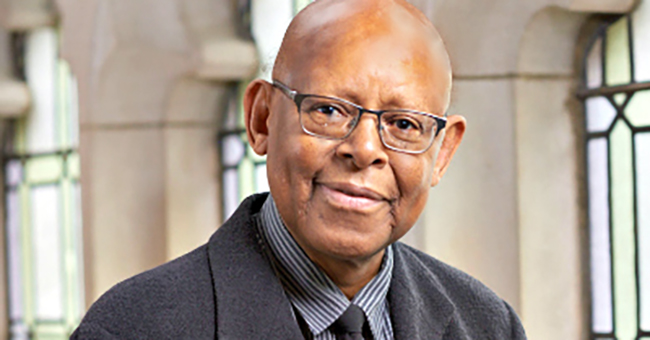
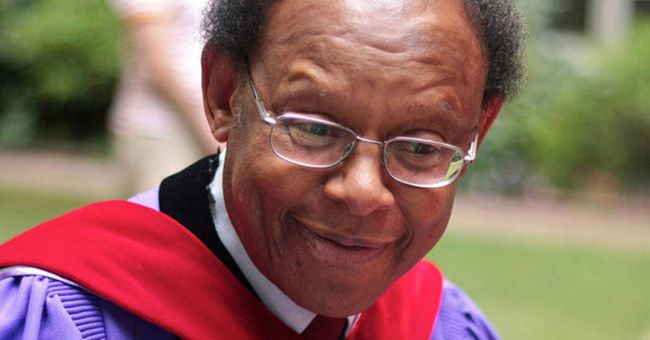
    James H. Cone

    James H. Cone. Photo credit: Union Theological Seminary, NYC

    On Saturday, like many people across the country, I heard the news that James Cone had passed. Serving on the Union Theological Seminary faculty for almost fifty years means that Dr. Cone literally taught generations of seminarians, and I was fortunate to be one of those folks.

    I still remember the first day of his systematic theology class, in the first semester of my first year of seminary. Sitting in that lecture hall in 1992, with nearly 100 students and watching him take the podium and explain to us that he was a the-o-lo-gian (in his classic, high-pitched, Southern drawl), and what that meant for him as a scholar and a black man from Arkansas, was highlight of my seminary career.

    He taught the contemporary “half” of the systematic theology course which focused largely on the twentieth century, but he came alive when lecturing about liberation theology! As the father of black liberation theology and one of the leading liberation theologians since the publication of his 1969 book Black Theology and Black Power, Cone had a front-row seat for the development of liberation theologies across the globe from the 1960s through the 1990s when I had him as a professor.

    He could be an electric lecturer, and more than once, his weekly lectures ended in standing ovations. It was inspirational to learn about the liberation theology from a man who knew personally most of the people whose work he taught. He told personal stories about their lives and their work and made the social contexts out of which their positions developed come alive.

    Cone’s own development of black theology was a response to the notion that Christianity was “the white man’s religion.” He responded with an adamant, “No! The Christian gospel is not the white man’s religion. It is a religion of liberation, a religion that says God created all people to be free.”

    This message, which is at the heart of all liberation theologies—that Christianity is a religion of liberation—is what drew me to Union Theological Seminary to study with the giants of the field at the time, including Beverly Wildung Harrison, James Cone, Delores Williams, and Larry Rasmussen.

    While giants in the field, they were also folks, and folks are flawed—all of us. Cone was criticized throughout his career for his failure to adequately address his own sexism (though he had been persuaded to use inclusive language by the time I had him in class). Likewise, my mentor, Beverly Harrison, struggled with her own internalized racism throughout her career as well. I learned from these theological giants both the importance and necessity of liberation theologies that transform our faith, our life, and our world as well as the reality that we all fall short in this lifetime. In watching these mentors, I learned the necessity of always being on the lookout for my own demons and shortcomings.

    The liberation insights I learned from Cone and others are foundational to my own feminist liberation ethics and particularly informed the argument in my new book, Trust Women: A Progressive Christian Argument for Reproductive Justice. Like Cone, I refuse to cede Christianity to those who seek to own and define it in ways that reject liberation and freedom. In my case, I refuse to cede Christianity to the pro-life voices who insist that Christianity is against abortion.

    The theological giants who trained me taught me to seek the truth of liberation in the gospel and to preach it loud and clear. In the increasingly regressive and xenophobic world that we live in today, speaking the truth that abortion is a normal part of women’s lives and always has been is a fundamental witness to my faith and to the God I know who desires that women and their partners are able to have healthy, happy, and whole lives, and that this sometimes means saying “no” to a particular pregnancy.

    Because the task of liberation theology is to upset the status quo and to call Christians to be our better selves, it will always be controversial and confrontational. Theologians like Jim Cone taught Christians not to accept the received tradition unquestioningly but to question the received tradition and to always, always, always look for God’s promise of liberation and transformation of the oppressed and marginalized.


    About the Author 
    Rebecca Todd PetersRebecca Todd Peters is Professor of Religious Studies at Elon University. Her work as a feminist social ethicist is focused on globalization, economic, environmental, and reproductive justice. Her books include Trust Women: A Progressive Christian Argument for Reproductive Justice, In Search of the Good Life, and Solidarity Ethics. Ordained in the Presbyterian Church (USA), she has been active denominationally and ecumenically for more than twenty-five years and currently represents the PC (USA) as a member of the Faith and Order Standing Commission of the World Council of Churches. Follow her on Twitter at @toddiepeters and visit her website.
  • By Rita Nakashima Brock

    James H. Cone

    James H. Cone. Photo credit: Coolhappysteve

    I first met James Cone in the back seat of a car. I was teaching at a Black college in rural east Texas in 1981, and he had been invited to lecture on campus. I was invited along when Jim had to be driven to the airport, and we were introduced as he got into car.

    While in college and seminary in California, I had been introduced to the struggles for justice of the Black Panther Party, the United Farm Workers, and the feminist women’s self-help health movement. The early works of Cone, Mary Daly, Marianne Katopo, Nelle Morton, Paolo Friere, and Rubem Alves had shaped my orientation to theology, and I had been teaching Cone, Friere-style, in a class at the college.

    Several things about Jim that would characterize our collegial relationship came through in that first conversation. He was warm, laughed easily, and was passionately committed to the liberation theology project. He remained an engaging dialogue partner and a generous friend.

    One of his advisees at Union once said to me that when she was struggling about what to do for her dissertation, he told her to write about what hurt her the most. This advice also grounded the power of Jim’s work; it made him a formative, powerful, and staunch Black Liberation theologian.

    Moral injury grounds liberation theology. Every major theologian of the second half of the twentieth-century wrote in the wake of World War II—and in the US in the face of the Vietnam War—and the subsequent eruption of justice movements all over the world brought into sharp focus the betrayals of traditional Christian theology. Every theologian, in heeding the massive suffering of marginalized people, had to reconstruct theological meaning because of the harm inflicted by hetero-white-patriarchal-capitalist theological systems.

    When liberation theologians from Asia, Africa, and Latin America—all men—founded the Ecumenical Association of Third World Theologians (EATWOT) in 1976, Jim insisted that they must include US minorities. He argued that the US might be an affluent, “first-world” country, but people of color in the US were struggling for economic and socio-political justice in the face of white supremacy. He asserted that we needed to be in the liberation conversations. Though we never had equal status to other delegations in EATWOT, US minorities were later included.  As were women, when Mercy Oduyoye insisted we were the “eruption within the eruption” of liberation theology.

    While Jim and I shared a commitment to liberation theology, our sharpest disagreements were about atonement theology and the dangers of sanctifying suffering. I rejected atonement for an incarnational theology of erotic power, grounded in mutual love and presence. I believed atonement theology focused too exclusively on oppression of a particular group, such as “the poor” or people of color, and the sanctification of suffering and self-sacrificing love in oppressed communities masked the ways women and LGBT people are also oppressed within those communities and ignores questions of intersectionality. He was not unsympathetic to layers of oppression, but the work of womanist theologians and their critiques of atonement, which took place at Union, never really informed his work. His staunch commitment to the God of the oppressed could make him sharp and fierce against his critics, but I was spared what some experienced as a wall of fury when he was crossed. I’ve expressed outrage myself on occasion, and I know outrage is one aspect of moral injury that I continue to struggle with personally.

    In my disputes with him, however, he listened carefully, argued fiercely, and shook his head with a wry smile when we agreed to disagree. Whatever our theological differences, I found him a kindred spirit and always enjoyed our intensely animated conversations.

    It was sometimes years between our conversations, and I feel a great loss now that there will never be another—at least in this life. James Cone is one of the most crucial, creative, and influential American theologians of the second half of the twentieth century, a fierce advocate for racial justice, and a beloved colleague whose passing is mourned by many. I, too, will miss him.


    About the Author 

    Rita Nakashima BrockRita Nakashima Brock is Senior Vice President of Moral Injury Programs at Volunteers of America in Alexandria, VA. She is the author, with Gabriella Lettini, of Soul Repair: Recovering from Moral Injury After War, and with Rebecca Ann Parker, of Proverbs of Ashes and Saving Paradise. She lives in Oakland, California. 

  • By Bill Ayers

    National Memorial for Peace and Justice

    National Memorial for Peace and Justice. Photo credit: junaidrao

    This post appeared originally on Bill Ayers’ blog.

    On April 26 and 27, we joined thousands of people from around the country and around the world at the Peace and Justice Opening in Montgomery, Alabama. Days were filled with formal and informal gatherings, reunions and new connections, the Peace and Justice Summit featuring many powerful thinkers including Elizabeth Alexander, Jelani Cobb, Ava DuVernay, and Michelle Alexander, and on the last night, the Concert for Peace and Justice. The focus of the gathering was the unveiling of two breathtaking new sites: the National Memorial for Peace and Justice, and the Legacy Museum, both projects of the Equal Justice Initiative (EJI). 

    Under the leadership of Bryan Stevenson, a civil rights lawyer who has for decades championed the most vulnerable people caught in the criminal justice system, EJI’s mission has been to advance an honest reckoning with the legacy of slavery, lynching, and segregation, and with building a process of truth-telling and racial reconciliation. These sites are stunning illustrations of that larger project.

    The National Memorial for Peace and Justice records and memorializes the over 4000 people murdered in the terror campaigns that followed the abolition of slavery and the defeat of Black Reconstruction in the South. The Memorial sits on a grassy hill overlooking the state capitol, which was also the heart and headquarters of the Confederate traitors who, in 1860, were willing to blow up the entire country in defense of a single freedom: their assumed right to own other human beings. It is unlike any other memorial in the world. 

    Up a gently rising path, you encounter several human figures, naked and in chains, each with a different posture and facial expression: fear, fury, resignation, pain, defiance. Continue up the path and enter the memorial square, face to face with row after row of tall metal rectangles, weathered and standing close together like grave stones. Each rectangle has etched on its face the name of a county where a documented lynching took place, followed by the names of the victims of the terror—one after another—and the date of each specific atrocity. Say their names.

    The Memorial does the hard work of documenting and representing thousands of lynchings over many decades—it names the victims, person by person—and illustrates that the terror was systematic and pervasive. The Memorial tells the truth—hard, unblinking, trembling, and real. By now you are engulfed in rectangles, disoriented and surrounded, and soon the names twist and surge toward you. The massive scale of the murders becomes palpable—the rectangles stretch into the far distance—and yet each name is distinct, each the one of one.

    Continue walking, and the metal monuments seem to rise in front of you, higher and higher, as the floor gradually descends. Now they are swinging above, like bodies from a tree branch. The effect is devastating. 

    We seek out the Lowndes County, Alabama monument, looking for the name of Jim Press Meriweather, and there he is, killed on 08-22-1935 for the “crime” of attempting to organize a Sharecropper’s Union. The Legacy Museum has been collecting earth from each lynching site, and months earlier, our family had made a pilgrimage to the place of Meriweather’s murder in order to gather soil to add to this sacred display. We pause in silence before seeking out four counties from our home state of Illinois—one is St. Claire County where at least twenty-nine souls were slaughtered in a frenzied white race riot in July, 1917. 

    There’s a clear recognition here that there can be no racial reconciliation without a serious reckoning with the truth, and that the truth of history can never be unmade. Facing history can be agonizing, painful, sometimes horrifying—the Memorial is an unambiguous statement of that fact. But the cost of not remembering is excruciating as well, and willful ignorance and collective silence assure that the racial wounds will never heal, the horror will continue in evolving forms. The tragedy, shame, and pain of this country—kidnapping, slavery, rape, murder, genocide, torture, terrorism, predation, exploitation and oppression, degradation and humiliation—are both foundational and linked. Slavery begets lynching begets Jim Crow and segregation and voter suppression and mass incarceration. Lynching’s fingerprints are all over the killings of Trayvon Martin, Troy Davis, Mike Brown, Laquan McDonald, Rekia Boyd, and thousands of other Black people whose lives were taken at the hands of police and America’s legal lynching apparatus, capital punishment, and white supremacist violence.

    Lynching was ritual, and the ceremony required witnesses and a code of silence to protect the guilty as well as to commune with them. In this way, the entire community teamed up and shared the experience. And this, too, is heritage: in the face of police violence and mass incarceration, to stay quiet is to collaborate.

    In spite of everything and against expectation, a sense of hopefulness pervades the Memorial and the Museum, a hope that a new world might be created from the wreckage of this inheritance, a more loving and just and peaceful world. But only if we pay full attention to the crimes of history. The dialectic of horror and light, anger and love, is conspicuous in every corner. Once you see it, you can’t un-see it, true, but once you see it, you might be inspired to remove the stain, to get busy in a movement of repair—you can choose to become resident of a country that does not yet exist but is clearly in-the-making. And don’t call us the “resistance;” we’re the creators, the inventors, the visionaries; Trump is the resistance. Activists must always ask, “Where is the love?” And in this space, the love is peeking from behind every stone.

    The experience of the Memorial is staggering, awe-inspiring, illuminating, breathtaking—beyond moving, it feels life-altering. Plan a visit and take the children.


    About the Author 

    Bill AyersWilliam Ayers was Distinguished Professor of Education and Senior University Scholar at the University of Illinois at Chicago. He is the founder of the Small Schools Workshop and the Center for Youth and Society, and the author of many books including Teaching Toward Freedom, A Kind and Just Parent, Fugitive Days, and Public Enemy, and co-author of “You Can’t Fire the Bad Ones!” Follow him on Twitter at @WilliamAyers.

  • By Paul Ortiz

    A Day without Immigrants, Los Angeles, CA, May 1, 2006

    A Day without Immigrants, Los Angeles, CA, May 1, 2006. Photo credit: Chris Lewis

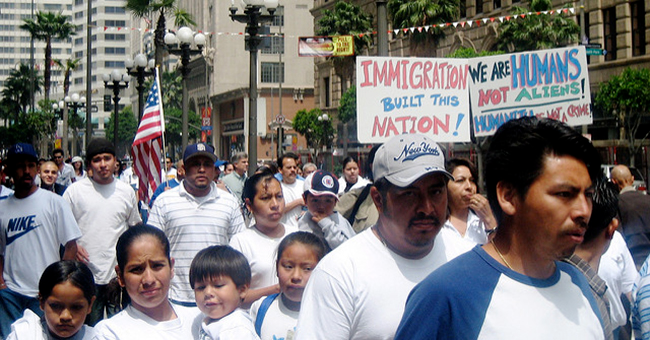
    International Workers’ Day, also known as May Day, celebrates laborers and the working class around the globe. It’s the same day that migrant workers—Chicanos/as, Afro-Cubanos, and immigrants from nearly every continent on earth—united in the first “Day Without Immigrants,” in 2006, to prove the value of their labor. In the following excerpt from An African American and Latinx History of the United States, historian Paul Ortiz shows us a glimpse of that day. In the US, these workers would endorse and vote for Barack Obama a year later, as he embodied what their movement was fighting for.

    ***

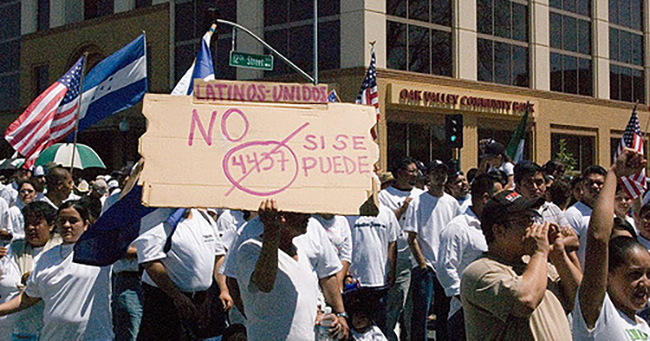
    When migrant laborers, Nuyoricans, Chicana/os, Afro-Cubanos, Guatemaltecos, and immigrants from every part of earth united on May Day in 2006, they protested immigration restriction measures that threatened their families, their livelihoods, and their dignity. The testimonials featured on picket signs, in interviews, and on the Internet and other venues opened a window into the resurgence of working-class political culture. The demonstrators vigorously expressed their opposition to US House Resolution 4437.52. Latinx workers restored the age-old faith that racial capitalism had tried to drown out, that labor was the true source of the nation’s wealth. Yolanda Lopez, a custodian and union organizer in California, stated, “We consider that as workers without faces, we are the ghosts who clean but never have any type of recognition. So I think that this is a very good fight we have now, which is to try to gain equality and respect.” Lopez and her compañeras were fighting for better wages and working conditions, but they were also looking for recognition of their humanity as women and as immigrant workers: “With equality we will get a more just salary. And with respect we feel more honored as a human being. We are here. I have a face, I have a name, and I am here.”

    Millions marched down main streets across the country shouting “¡Sí, se puede!”—Yes, we can!—and carried signs proclaiming, “You Might Hate Us/But You Need Us,” “Primo de Mayo, a Day Without a Mexican,” and “This Land Is Your Land, This Land Is Our Land.” In New York City, Latinx workers were joined by thousands of African Americans as well as Jamaican, Irish, and Chinese immigrants who added their voices to the protests. Reflecting on her experience marching in Los Angeles, Sonja Marie Diaz reflected, “To me, May Day is an extension of transnational social movements; something that transcends borders and embodies the experience of people of color everywhere.” Diaz, the daughter of United Farm Worker parents who had been activists in the 1960s, stressed the continuity of struggle that May Day represented for her: “Growing up in Los Angeles as a third-generation Chicana, protesting was part of my history. From the displacement of my grandparents due to unfair land laws and zoning, to discrimination in schools, and illegal labor treatment in the fields, my family was on the front lines advocating for their survival and justice for all.” Maria Padilla, a university dining hall employee and union organizer at the University of California, Santa Cruz, talked about the importance of students and workers coming together in an internationalist endeavor:

    I think the most positive thing today, for me, was to see the unity between workers and students. To see that united we have the strength and will be heard. . . . And I am not only here fighting for the workers who are here in this country. I think of those who are [in Mexico] who are in the maquiladoras, in the fields, and in the factories. Where they are mistreated and only get paid twenty-five cents an hour, and they are forced to work for long hours. I am also fighting for them here.

    The Great American Strike shut down meat packing, garment manufacturing, port transportation, trucking, and food service in many parts of the country. Several days in advance of the gigantic protest, dubbed by some organizers as “A Day Without Immigrants,” the companies Cargill, Tyson Foods, and the Seaboard Corporation announced that they would be closing their operations due to a lack of personnel. Customers of fast-food franchises in California were turned away by apologetic managers who explained that “Mexican truckers” had refused to deliver bread. The May Day protests followed an earlier wave of walkouts that occurred in March and April. These incipient strikes were led in many cases by agricultural and construction workers seeking to boost their wages and to escape poverty conditions. “In South Florida and Immokalee, [harvesting] pretty much ground to a halt,” said G. Ellis Hunt Jr., president of Hunt Bros., a Florida grower and packinghouse owner with more than five thousand grove acres split equally between Polk and Immokalee counties.

    In the weeks leading up to International Workers’ Day, the union organizer Jorge Rodriguez vowed, “There will be 2 to 3 million people hitting the streets in Los Angeles [on May 1] alone. We’re going to close down Los Angeles, Chicago, New York, Tucson, Phoenix, Fresno. . . . We want full amnesty, full legalization for anybody who is here. That is the message that is going to be played out across the country on May 1.” Latinx workers organized the demonstrations through the social institutions that had helped sustain their communities, including comités cívicos from their home countries, workers’ centers, labor unions, Catholic Church social justice committees, sports clubs, and civil rights organizations. Many of the regions that witnessed high turnouts of Latinx workers in the May Day protests had long histories of Latinx economic and social justice organizing.

    One of the most popular picket signs on May Day vowed “Hoy Marchamos, Mañana Votamos”—“Today We March, Tomorrow We Vote.” The historian Ruth Milkman notes, “Soon after the marches, the We Are America Alliance and many other organizations launched naturalization and voter registration drives. These efforts had already begun to yield fruit by the November 2006 [midterm] elections.” As Milkman observed, the general strike prepared the way for new kinds of political movements rooted in the everyday concerns of the working classes. María Elena Durazo used the momentum generated by the Great American Strike to call for a new living-wage movement. Durazo was the daughter of migrant farmworkers, and she herself picked fruits and vegetables as a young girl in the 1960s. Like so many young Latinas of her generation she was inspired by the United Farm Workers to become a labor activist; she eventually rose to become the executive secretary–treasurer of the Los Angeles County Federation of Labor.

    Magnifying the lessons of May Day, 2006, Durazo said, “We must build a movement with thousands of leaders and millions of supporters that can pressure elected officials and corporations to do the right thing. When we build a movement of the working poor, we will have the power to end poverty.” Subsequently Durazo was one of the first major Latina leaders in the United States to endorse Barack Obama during the Democratic primaries in 2008. Explaining her endorsement, Durazo said, “On a personal level [Obama] embodies the slogan we use a lot, Cesar Chavez’s ‘Sí, se puede.’ He has proved it by the way he inspires voters.” The Illinois senator had actually learned his signature slogan from the farmworker movement, which the UFW cofounder Dolores Huerta pointedly reminded him of in 2008.

    A Day without Immigrants, Modesto, CA, 2006

    A Day without Immigrants, Modesto, CA, 2006. Photo credit: Open Sky Media

    International Workers’ Day organizers began weaving together new alliances for social justice. “The diversity of organizations proved that May Day and fighting for immigrant rights was bigger than a ‘Latino’ fight,” Danae Tapia, one of the student organizers of the strike movement in Central California, wrote. “We all tied the injustices that we faced with immigration, borders, war and an unfair education system. For example, Palestine and Mexico; undocumented students and undocumented workers; unequal access to education & unfair wages; war in the Middle East & wars around the world that force people to migrate, etc.” Tapia’s coalition that prepared for May Day mobilizations included white unionists, longtime Chicano movimiento people, undocumented college students, socialists, and many more. This was an alliance that was sustained in subsequent union and immigration rights drives due to its breadth and depth. “Because of the diversity of organizations,” Tapia observed, “our action was so much stronger and that’s how we continued our marches and actions the years that followed because the injustices that we all faced were intertwined with each other. Our local fight is a global fight.” The Latinx-led labor insurrections of 2006 provided the first hints of the beginning of a sea change in American politics.

    In the wake of the Great American Strike, the percentage of workers joining unions increased for the first time in a generation. The Labor Council for Latin American Advancement reported, “Close to 30 percent of the growth is attributed to Latinos who added 120,000 members to the labor movement.” At the gigantic Smithfield Foods plant in Tarheel, North Carolina, Latinx workers walked off of the job with their African American and white counterparts on Martin Luther King Jr. Day in 2007. The union organizer Eduardo Peña told the media, “We’ve got Latino workers here ready to walk out for the holiday. I hear them saying things like, ‘People assume that we don’t know who King was—his struggle was the same struggle we’re going through now.’” Subsequently, the United Food and Commercial Workers won a union representation election at the four-thousand-worker plant after sixteen years of trying. These gains built on the increase in Latinx workers who had organized and joined unions in the preceding decade.

    Insurgency and organization were the new watchwords of the working class. Less than a month after Obama’s election, workers at the Bank of America–controlled Republic Windows and Doors in Chicago seized control of their factory after managers announced that they were unilaterally closing the plant. Even though Bank of America had recently received a $25 billion taxpayer bailout from the public, Republic employees were informed that they would receive no severance pay. What the bank did not count on, however, was the resolve of its 240 employees: “A mostly African-American and immigrant Latino workforce,” Jerry Mead-Lucero noted, “they organized into [United Electrical Workers] Local 1110 four years ago after dumping a company union that had agreed to a wage freeze and had allowed dozens of workers to be fired with no protest.” After shutting out the bosses, Republic Windows employees called on the community for support, and soon the plant was surrounded by hundreds of supporters for nearly a week. Faith-based organizations provided strike assistance. Jerry Mead-Lucero described how “supporters appeared at the factory’s entrance bearing gifts of food, coffee, blankets, and sleeping bags. They signed posters that workers taped to the factory walls, with messages like ‘Thanks for showing us all how to fight back’ and ‘You are an inspiration to us all.’” The first sit-down strike waged by American workers in years earned the work force a severance package and public support from Barack Obama and served as an inspiration to others that organizing is worth it.


    About the Author 

    Paul Ortiz is an associate professor of history and the director of the Samuel Proctor Oral History Program at the University of Florida. He is the author of An African American and Latinx History of the United States, Emancipation Betrayed: The Hidden History of Black Organizing and White Violence from Reconstruction to the Bloody Election of 1920, and coeditor of the oral history Remembering Jim Crow: African Americans Tell About Life in the Segregated South. He lives in Gainesville, Florida.

  • By Eugene Grant

    Benjamin Lay, portrait painted by William Williams in 1790

    Benjamin Lay, portrait painted by William Williams in 1790

    I didn’t learn of Benjamin Lay until I was thirty-one years old. This is important, because I myself have dwarfism. There is a shameful absence of books documenting the lives of important historical figures with dwarfism. Just as Game of Thrones and Tyrion Lannister alone cannot compensate—as many average height people seem to think he does—for centuries of ridicule and abuse, so Marcus Rediker and The Fearless Benjamin Lay cannot make up for this dearth of representation, but the book is a significant step forwards.

    Who was Benjamin Lay? Born in England 1682, Lay was one of the first white radical abolitionists. An autodidact, he was a sailor, glove-maker, book-seller, and author. He wrote one of the world’s first abolitionist texts, All Slave-Keepers That Keep the Innocent in Bondage, Apostates. A devout Quaker, Lay loudly called for the church to cast out slave-owners. He boycotted slave-produced commodities.  

    His time at sea, and particularly his experiences in Barbados, fuelled his hatred of slavery and he later became notorious for theatrical protests at Quaker meetings. In one spectacular demonstration, in 1738 at the Philadelphia Yearly Meeting, he hid a bladder, filled with red juice, inside a book, before running his sword through the text and spattering ‘blood’ on the stunned slave-keepers present.

    At the time, many Quakers resisted Lay’s abolitionist views. Just as Lay had called for slave-keepers to be cast out of the church, they cast him out of his. They disowned him. They denounced his book. They stopped him speaking at meetings—often physically removing him from the premises. They even withheld his marriage certificate to his wife, Sarah.

    While talking and tweeting about Lay’s life, I encountered those who—in good will, I’m sure—thought it best to celebrate Lay’s achievements without mentioning his dwarfism. Such views take shape in a world where so many are taught that dwarfism is, at best, undesirable, and, at worst, to be feared or loathed. To erase Lay’s dwarfism would be, some might think, to “make him normal”.  

    But life in a dwarf body shaped Lay’s beliefs. At times he struggled to be considered equal—a battle many dwarf people still face today. In one incident, Rediker records how an average height man tried to humiliate Lay by approaching him and announcing: “I am your servant”. With razor-sharp repartee, Lay stuck out his foot and replied, “Then clean my shoe”, embarrassing the bully. To erase his dwarfism would limit our view of his life. It would sever a connection between Lay and his wife, Sarah, herself a dwarf person. And it was life in a dwarf body that led to some historians, Rediker notes, to dismiss Lay as “a little hunchback”, sustaining his obscurity.

    There is another vital reason why we must keep Lay’s dwarfism at the heart of discussions about him: because pernicious stereotypes dominate representations of dwarf people. A film about Lay’s life is yet to be made, but movies like Austin Powers and Wolf of Wall Street—which sustain the spectacle of dwarf bodies and condone violence towards them (violence then re-enacted in real life)—gross hundreds of millions of dollars. Growing up as a dwarf person myself, by ten I had heard of the Seven Dwarfs; by thirteen the vile Mini-Me character hit our screens, and three decades went by before I learned of Benjamin Lay.

    One of the defining features of Rediker’s book is how he addresses Lay’s dwarfism. Other authors of historical biographies of defiant, gentle, and inspiring dwarf people have claimed to celebrate their subjects’ lives while simultaneously insulting their bodies and diminishing their extraordinary struggles—without reviewers noticing or caring. Rediker does no such thing, seeking advice from the excellent Little People of America organisation and explicitly acknowledging the “discrimination based on size and an often tyrannical normative image of the human body” our community experiences on a daily basis. As a proud and conscious dwarf person, as I finished reading that passage, it felt like a corset had been removed and oxygen filled my lungs.

    Lay is not just a role model; he is a dwarf role model. When I have children—who are likely to have dwarfism too—I will tell them bedtime stories of Lay’s life and deeds. And, on our bookshelves, a copy of Rediker’s book, The Fearless Benjamin Lay, a celebratory and evidenced record of this great man, will await them.


    About the Author 

    Eugene Grant is a writer and activist in the UK dwarfism community. He tweets @MrEugeneGrant.

  • By Mary Collins

    Donald Collins with Moose the Therapy Dog at the American College Counselors Association conference in Charlotte, NC

    Donald Collins with Moose the Therapy Dog at the American College Counselors Association conference in Charlotte, NC

    I never expected my trans son, Donald, whom I battled with over his medical decisions during his transition in high school and college, would ever agree to pen a collection of essays with me that explored our painful emotional journey—nearly failed journey—as a family.

    I never expected that after traveling to Yale Medical School, elite private colleges, professional conferences and conventions, that our best Q&A about At the Broken Places: A Mother and Trans Son Pick Up the Pieces would be with a group of freshmen at a small regional public university. The honors students had all read the book, processed the tense emotional landscape it explored, and accepted the ambiguity of it all.

    They accepted not taking sides.

    I never expected parents of transgender children who attended our events to have such an intense emotional response to my candor and expressions of grief over the “loss” of the daughter I thought I had. They often hang on my arm, weep, and literally shake as they let go, one by one, each of the feelings they’ve been hiding.

    They come out of their emotional closet.

    I never expected to receive so many heart-felt messages from people all over the country. Even one man in Canada, who opened his Facebook message with, “I am a normal person, not some creep…” went on to share that he loves his only boy, now a transgender girl, more than anything, but “absolutely hates the fact that I have this overwhelming feeling that here, in 2017, I’m supposed to be able to flick a switch, accept all of this and move on.” He confessed to “feeling bad for feeling this way.”

    I never expected to be so completely awed by Donald’s emerging sense of self as an adult, as a trans man, as an author and public spokesperson. In less than a year, I feel that being on the road together has shown me so many layers of his complex personality, especially his fair-mindedness with questioning parents and audience participants who ask inappropriate questions, and his incredible sense of humor. Before our biggest audience for an event—several hundred college counselors from across the US—Donald broke the tension by singing the praises of Moose the Therapy Dog, who was on hand in the audience care of a counselor from VA Tech.

    Who knew that somehow a golden lab named Moose could be part of our road show?!

    I always knew that books and art have so much power to transform, but I never expected our book to transform so much about us as a family emerging from a tough emotional transition.

    As mom and son, we have shared awesome fried chicken in North Carolina; constantly revisited and learned something new from our own book each time we prepared for a new audience; shared jokes, discussed books and the news, sought out good coffee shops, and admired the design of public spaces in ways few people I know even bother to notice.

    I never expected the book would help us reconnect, to regain empathy for each other, to retouch love.


    About the Author 

    Mary CollinsMary Collins worked for twenty years as a freelance writer and editor for a range of clients, including the National Geographic Society and Smithsonian Institution. She is currently a professor of nonfiction at Central Connecticut State University. She is the co-author of At the Broken Places: A Mother and Trans Son Pick Up the Pieces.

  • A Q&A with Aviva Chomsky

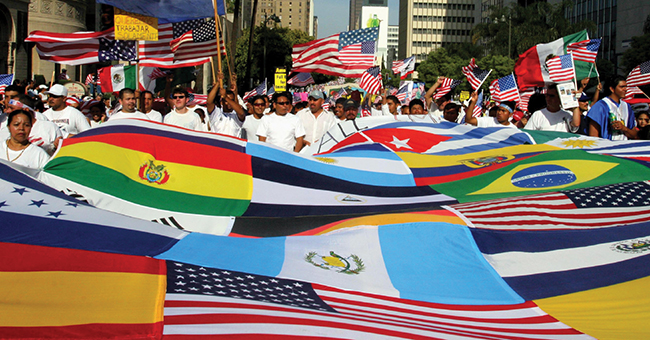
    Los Angeles May Day March

    Los Angeles May Day March. Photo credit: David Bacon

    Little more than a year into his administration, the egregious myths and misinformed claims Donald Trump has voiced about immigrants and immigration persist and promote aggressive anti-immigrant policies. This calls for Aviva Chomsky’s revised and updated myth-busting book “They Take Our Jobs!”: And 20 Other Myths About Immigration. Crucial for our politically fraught times, this expanded edition contains fresh material addressing what’s been happening in immigration policy for the last ten years. It also helps us understand the underlying assumptions behind the myths. Beacon Broadside editor Christian Coleman caught up with Chomsky to chat with her about it.

    Christian Coleman: Why did you feel it was important to do a revised edition of “They Take Our Jobs!”?

    Aviva Chomsky: It’s been over ten years since the first edition came out. Of course, many new things have happened over the course of those ten years, but at the same time, I feel like the debate is in some ways still stuck in some of the same misunderstandings and myths. Sometimes I hear people repeating the myths I wrote about: Immigrants take American jobs! Immigrants don’t pay taxes! They should come here the right way! And I think, Wow, why didn’t they read my book?

    In addition to the fact that so many of the same myths are still circulating, I’d say that the tenor of the immigration debate has, if anything, gotten worse in the past decade. I think President Trump has pushed the boundaries of the kinds of aggressive and racist speech that can be considered mainstream or acceptable. I mean, if the President says that immigrants are criminals, he brings that language or those ideas into the mainstream. Trump also pushes some of the myths himself, either explicitly or implicitly. Even if he is sometimes vague about the details, he certainly suggests that immigrants are a drain on the economy, and that they take Americans’ jobs.

    So I wanted to bring the book up to date both by filling in some of the changing trends, policies, and activism over the past ten years, and also addressing the ways that the myths have been mobilized in the current political context.

    CC: What are some changes (or a big change) in immigration policy that have taken place since the initial publication of the book?

    AC: During the Obama presidency, we saw two apparently contradictory trends. On one hand, immigration enforcement went way up. Obama was termed the “deporter-in-chief” because he raised deportations to levels never seen before. On the other hand, Obama made some important concessions to certain categories of immigrants. His implementation of “prosecutorial discretion” during his second term allowed many immigrants with long-term ties to the country to avoid deportation. ICE agents carried out this discretion at an individual level, and then Obama made it official with DACA, Deferred Action for Childhood Arrivals, in 2012. DACA granted a temporary legal status to hundreds of thousands of youth who met its parameters: between the ages of fifteen and thirty, brought to the US by their parents before the age of fifteen, high school graduates, in school, or serving in the military. Although apparently contradictory, these two sets of policies were actually two sides of the same coin. Obama tried to neatly divide immigrants into what he termed “felons” versus “families.” He promoted the supposed “innocence” of some immigrants by emphasizing the criminality of others. This criminalization of immigrants is built on a long history and especially on the ways the Clinton administration changed laws to turn a lot more immigrants into “felons.” It also continued to build the foundation for what we’re seeing now under Trump.

    As we know, criminalization, and the carceral state, are deeply racialized in the United States. I’d say Trump has taken long-standing beliefs and policies and mobilized racism in two somewhat new directions. First, he is more blunt about ideas that Democrats tried to be more polite about. The Clintons and Barack Obama never used language like “shithole countries”—but their policies towards, say, Haiti and Honduras were just as malicious. Second, Trump is more resolutely anti-immigrant in all respects than any recent president. In general, US leaders have tried to manage immigration to fill labor needs, and have celebrated the country’s immigrant heritage. Even as they criminalized and deported many immigrants, they lauded immigrants whom they defined as deserving. Trump, in contrast, just doesn’t like immigrants at all (except maybe if they are from Norway). He is working to shift millions of immigrants who currently hold legal status (like DACA and TPS) into illegal status and deportation, and seeks to dramatically reduce legal immigration. Trump is simply taking the coercive stance that his predecessors applied to those they defined as “criminal immigrants” and expanding to cover almost all immigrants.

    CC: Is there one myth or perhaps a few that you see more prevalent now than before?

    AC: I’d say there are two: one, that immigrants are criminals, and two, that immigrants come here to take advantage of the United States. In a way, these are connected—by turning immigrants into “bad hombres,” Trump helps to erase history and the disasters that US policy has helped to create in the countries that immigrants are currently fleeing, especially in Central America.

    CC: What would you like readers to take away from the book during our current administration?

    AC: So many people have said to me, “How do I convince people who think immigrants take jobs/are dangerous threats/are ruining the economy/etc.?” In the book, I try to address the most common anti-immigrant arguments in concise and fact-based ways. The book also asks readers to read and think critically about how we come to take certain ideas for granted. The most pernicious myths are those that we don’t even recognize as controversial—they are imbedded in our worldview. I think my book asks readers to challenge not just specific claims about immigrants, but deeper ideas about society, economy, and this country.


    About Aviva Chomsky 

    Aviva Chomsky is a professor of history and the coordinator of Latin American Studies at Salem State University. The author of several books, Chomsky has been active in Latin American solidarity and immigrants’ rights movements for over thirty years. She lives in Salem, Massachusetts.

  • A Q&A with David Stovall

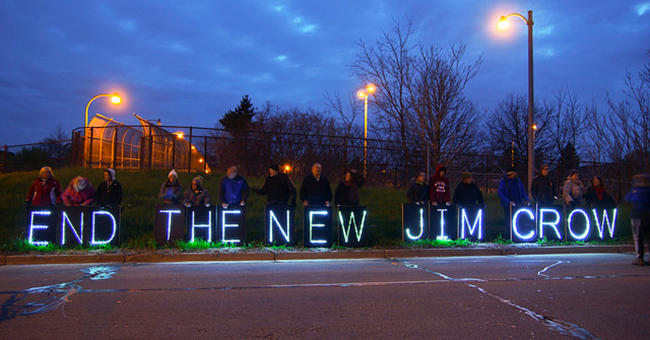
    The Overpass Light Brigade in Milwaukee, WI, protesting against voucher programs and charter schools

    The Overpass Light Brigade in Milwaukee, WI, protesting against voucher programs and charter schools. Photo credit: Joe Brusky

    Charter schools promised to provide high-quality education for students whose needs were not met in district-run schools. But as prominent educators Raynard Sanders, David Stovall, and Terrenda White show in their book Twenty-First-Century Jim Crow Schools: The Impact of Charters on Public Education, that promise is a ruse. Market-driven education reforms have boldly reestablished a tiered public-school system that segregates students by race and class. And with current Secretary of Education Betsy DeVos advocating for charters and vouchers, the fight for publicly-funded public education continues to be an uphill struggle. This is especially true for poor, working-class, and Black and Latinx families. Beacon Broadside editor Christian Coleman caught up with David Stovall to ask him about their book and the truth about charters.

    Christian Coleman: What was the inspiration for writing this book?  

    David Stovall: When Raynard contacted us as potential authors, I agreed with him that we needed to be explicit around the severity of the situation with charter schools across the country.

    CC: Tell us about your background and how it shaped your stance on the impact of charters on public education. 

    DS: I’m born and raised in Chicago, and have witnessed the charter phenomenon emerge from a community-based approach to a corporate conglomerate model that is grounded in theories of deficit surrounding Black and Latino youth. From discipline policies to curriculum, it sickens me to see schools that think Black and Latino youth are to be “fixed” by aspiring to what is perceived as White, middle-class values.

    CC: Secretary of Education Betsy DeVos promotes charter schools and vouchers because they offer a “better” education. But parents have had to face misleading data and advertising about these schools. What are some examples? 

    DS: Some charters raffle off iPads, televisions, and other trinkets to attract families to apply, while the data demonstrates consistently that charters don’t do better than neighborhood public schools.

    CC: You write that many charter schools are intent with replacing community culture with “grit.” Tell us a little about what’s wrong with the idea of “grit,” especially when it comes to Black and Latinx communities. 

    DS: Grit becomes a pathology. If students don’t demonstrate whatever it is construed to mean, then they are considered weak, or in the worst cases, permanently deviant. Ignored in this is support for students instead of expecting them to “tough it out.” This is never asked of White students in affluent suburban schools.

    CC: Why do we need to be vigilant of charter schools during the current administration? 

    DS: We are witnessing a moment where the current administration is arguing for the end of public education as we know it. Critical in this juncture is the idea that charters represent a “choice” when we find in many cases that it’s nothing more than a choice to decide on how you will be dehumanized and belittled.

    CC: What are some ways that parents, teachers, and community members are fighting back against charter schools? 

    DS: In some cities, we find parents pushing for moratoria on charters and developing critical questions for families when approached by charters.

    CC: In the foreword, President of Chicago Teachers Union Karen Lewis writes, “After reading this book, I hope that real conversations start happening not only in New Orleans, Chicago, and New York, but across the entire country.” What would you like readers to take away from your book? 

    DS: That the current charter phenomenon is complex, layered, and deserves explicit attention.


    About David Stovall 

    David StovallDavid Stovall is Professor of Educational Policy Studies and African-American Studies at the University of Illinois at Chicago.

  • By Helene Atwan

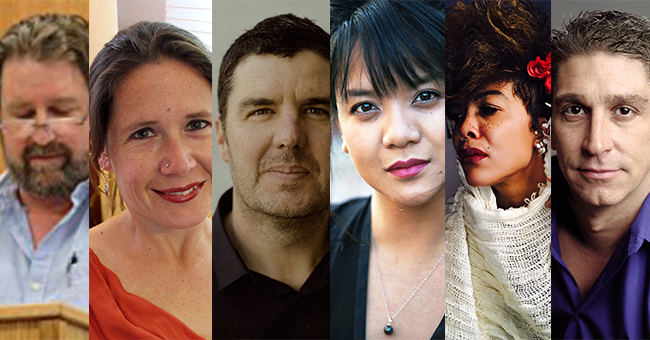
    Beacon Press Poets from left to right: Brian Clements, Alexandra Teague, Dean Rader, Sasha Pimentel, Dominique Christina, Richard Blanco

    Beacon Press Poets from left to right: Brian Clements, Alexandra Teague, Dean Rader, Sasha Pimentel, Dominique Christina, Richard Blanco

    Is it only in April that we’re supposed to appreciate poetry? After all, as this April in New England is proving beyond a doubt, it is the cruelest month. But maybe that’s why we need poetry . . . Now, more than ever, we’ve discovered that we need poetry not just to delight and uplift us, but to teach us, to show us. Probably that’s always been true, but in 2018, we’ve witnessed the power of poetry to bring crystalline focus to the gun debate with an anthology that has been read at countless public gatherings and from the floor of Congress: Bullets into Bells: Poets & Citizens Respond to Gun Violence, brilliantly edited by Brian Clements, Alexandra Teague, and Dean Rader. We’ve also felt the power of poetry to explore the pain of women living on the borders—physical and psychological—through the passionate work of Sasha Pimentel in her award-winning For Want of Water. And we’ve just sent to production the latest book in our National Poetry Series collection, Anarcha Speaks: A History in Poems, by the remarkable artist Dominique Christina, selected by Pulitzer Prize–winner Tyehimba Jess, for publication in October. These books convince me that poetry packs a punch, well above its weight in the publishing scene.

    Bullets into Bells, For Want of Water, Anarcha Speaks

    I look back at our poetic legacy, including more than a dozen works by Mary Oliver and half a dozen by Sonia Sanchez, as well as James Baldwin’s only collection, and I feel proud of what they have achieved through their brilliant poems. I’m especially proud to announce that we will be publishing Richard Blanco’s new volume, in 2019, How to Be An American, a book that digs deep into the issues he has encountered in his life as a gay man, an immigrant, and a keen observer of life in the Trump years.

    Just after 9/11, we published an invaluable collection edited by poet Joan Murray called Poems to Live By in Uncertain Times, which was followed five years later by Poems to Live By in Troubling Times. The volumes we look to publish now might help us live through these outrageous times.

    So, as we continue to aspire to “ignite hearts and minds,” we will continue to publish poetry that ignites, enflames, sometimes even consumes us.


    About the Author 

    HeleneAtwanHelene Atwan has been director of Beacon Press since 1995. She has been reading poetry all her life. Follow her on Twitter at @hatwan.

  • A Q&A with Ryan Lugalia-Hollon and Daniel Cooper

    The War on NeighborhoodsWhat happens when the main investment in a community is policing and mass incarceration rather than human and community development? The result is what scholars Ryan Lugalia-Hollon and Daniel Cooper call a “war on neighborhoods,” which furthers poverty and disadvantage. The neighborhood of Austin, a majority-Black community in Chicago’s West Side, is representative of such neighborhoods where residents have endured decades of the highest rates of arrest, imprisonment, and crime. Lugalia-Hollon and Cooper tell the story of Austin in their book The War on Neighborhoods: Police, Prison, and Punishment in a Divided City. In it, they also call for a profound transformation of our flawed approach to public safety. Beacon Broadside editor Christian Coleman caught up with them to chat about their book.

    Christian Coleman: What was the inspiration for writing the book?

    Ryan Lugalia-Hollon & Daniel Cooper: Both of us worked on Chicago’s West side for years, focusing on several different issues. But all roads eventually led us to mass incarceration. Whether we were working on housing, workforce development or youth development, we began to see how the justice system impacted all these issues. They were inextricably connected.

    In the time we spent working on the West Side, we saw just how profoundly mass incarceration affects communities. We saw neighborhood resources disappearing—from grocery stores, to non-profits, to schools—while investment in removing poor people and sending them to prison continued unabated.

    While these were not new insights to people living on the West Side, that reality is totally foreign to most Americans living outside of such impacted places. We thought it was urgent that more people were aware.

    CC: Tell us a little bit about your backgrounds and how crucial they were to your approach in writing the book.

    RLH & DC: We wrote this book as witnesses; as white men who have been immune to the racism of the criminal justice system. We grew up without knowing many people who had been incarcerated. But the more we got to know the city of Chicago, and the more we got involved, the harder it was to ignore the painful reality of one of the greatest injustices of our lifetime—mass incarceration. By writing about the difficult truths we found in Chicago’s Austin neighborhood, we hope more people will be informed when they talk about policing and incarceration in our country.

    We also approached the book as urban planners. We both have a planning background, which is really important to us. We believe that with the right investments and local decision-making power, neighborhoods can always be strengthened and transformed for the people who live there. That’s what we want to see happen in the Austin neighborhood.

    CC: One term you use in the book is “concentrated punishment.” Why is this term important for us to understand the effects of mass incarceration in places like Austin?

    RLH & DC: Many people understand that incarceration disproportionately affects people of color, and black people in particluar. But the disproportionality is much more striking when considering the geography at play.

    The scale of punishment in Austin, and other West Side neighborhoods, is shocking when compared to white neighborhoods and cities. At any given time, Chicago’s Austin area has more people behind bars than several small countries combined. Incarceration rates on Chicago’s West Side are ten times that of Russia (442 per 100,000), which is among the other top imprisoners on earth. Meanwhile, the incarceration rates of even the most impacted white areas are nothing extraordinary. The rate of Chicago’s most affected white neighborhood is roughly the same as South Korea’s (104 per 100,000), which is very close to the global average (100 per 100,000). 

    Because our urban areas are so segregated, many people have managed to avoid the realities of areas like Austin. Our book attempts to put those realities front and center so they can’t be avoided.

    CC: Why is it commonly believed that increased aggressive policing and imprisonment in neighborhoods will curb crimes when studies show they actually lead to increased disadvantage?

    RLH & DC: Many people still believe that more punishment leads to more safety, which is one of the greatest myths of the last forty years. This wasn’t always the case. At one time, we saw poverty as the root cause of crime and public safety challenges.

    Starting with Nixon, there was a concerted effort to flip this order, for largely political purposes. When society labels crime as the root cause of poverty, then we can justify locking up people at alarming rates, and we don’t have to invest in alleviating poverty. Successive adminstrations campained on law enforcement solutions, which play to people’s fear of “the other.”  

    The reality is that the benefits of punishment weaken over time and even start to reverse, especially in places where punishment is concentrated. In just one five-year period, there were 6,700 residents incarcerated from a West Side Chicago zip code. That’s thousands of parents and neighbors taken away. Now, what are the cumulative effects of those removals?

    Those absences affect the next generation of residents. They impact everything from parenting, to school performance, to household stability. As a society, we frequently talk about how important families are to the lives of both young people and neighborhoods. Yet we destroy families when we remove a parent frome the household, and then we wonder why youth are disconnected and community violence is high. If we keep seeing law enforcement solutions as answers to this problem, we will never solve the deeply rooted issues of poverty and youth violence.  

    CC: In what ways are urban and rural communities linked by mass incarceration?

    RLH & DC: Across the United States, prison construction in rural places has served as an economic development strategy, with prisoners as the commodity that provides corrections jobs as well as some related service jobs in rural areas—everything from hotels for visiting families, to health and legal services.

    As it turns out, this is largely a false promise of economic development. Prisons are not actually a strong foundation for new rural economies. The boost to employment is minimal, though in some places that minimal boost may be the only existing economic stimulus.

    This has pitted rural communities against urban communities of color in a perverse, zero-sum competition for increasingly scarce resources. Rural communities are more and more dependent on Chicago’s West Side being treated as prisoners to keep their jobs secure. A reduction in prison sentences is a real threat to job security.

    Both places have been similarly abandoned by outside capital. State investments into human, community, and economic development could potentially help both disadvantaged urban and rural areas. That would be a much better model.

    CC: What would you like readers to take away from your book, especially in light of the fiftieth anniversary of Martin Luther King, Jr.’s death and where civil rights stands today for urban communities like Austin?

    RLH & DC: Dr. King knew that you have to address root causes to change the conditions for communities. And he knew that racism stood in that way of doing that. Today, when we condemn people for their poverty, their race, their homelessness, and their mental illness, and their home address, we are ensuring continued suffering.

    To fix our flawed approach to public safety, we have to do more than just change broken laws. We have to reinvest in the communities that have been most affected. We have to address the problems that people in those communities are facing; from unemployment, to mental illness, to housing instability.

    Thus, our book calls for shifting resources away from prisons and investing in the human, community, and economic development potential of our most marginalized urban communities. This is congruent with what Dr. King was fighting for in the final months of his life—an economic justice agenda for communities like Chicago’s West Side. It is also aligned with key aspects of the Vision for Black Lives.


    The War on NeighborhoodsLearn more about The War on Neighborhoods, a narrative-driven exploration of policing and the punishment of disadvantage in Chicago, and a new vision for repairing urban neighborhoods.


    About Ryan Lugalia-Hollon and Daniel Cooper


    Ryan Lugalia-Hollon
     has worked in youth development for over twenty years, including restorative justice, violence prevention, and trauma-informed care efforts in Chicago. He holds a PhD and Masters in Urban Planning and Policy from the University of Illinois at Chicago. He currently leads an education network in San Antonio, Texas. Follow him on Twitter at @DrLullon. 

    Daniel Cooper works with organizations in Chicago on issues such as violence prevention, justice system reform, community development, and health equity. He holds a PhD in Community Research and Action from Vanderbilt University and a Masters in Urban Planning and Policy from the University of Illinois at Chicago. He is the founding executive director of the Center for Equitable Cities at Adler University in Chicago.